
THE SOLAR SYSTEM By Edward Walker Introduction In
THE SOLAR SYSTEM By Edward Walker
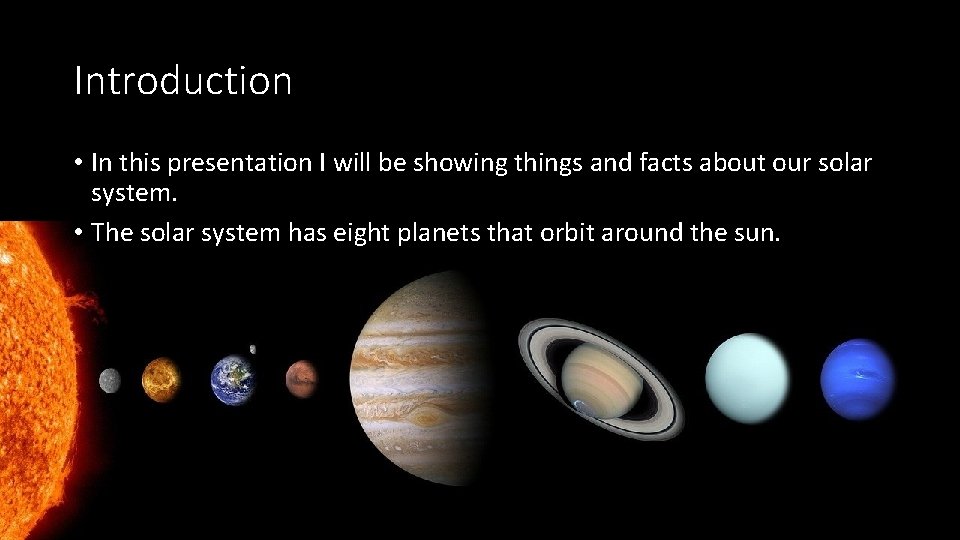
Introduction • In this presentation I will be showing things and facts about our solar system. • The solar system has eight planets that orbit around the sun.
Contents • • • The Sun Mercury Venus Earth and Moon Mars Jupiter Saturn Uranus Neptune Voyager Credits Glossary
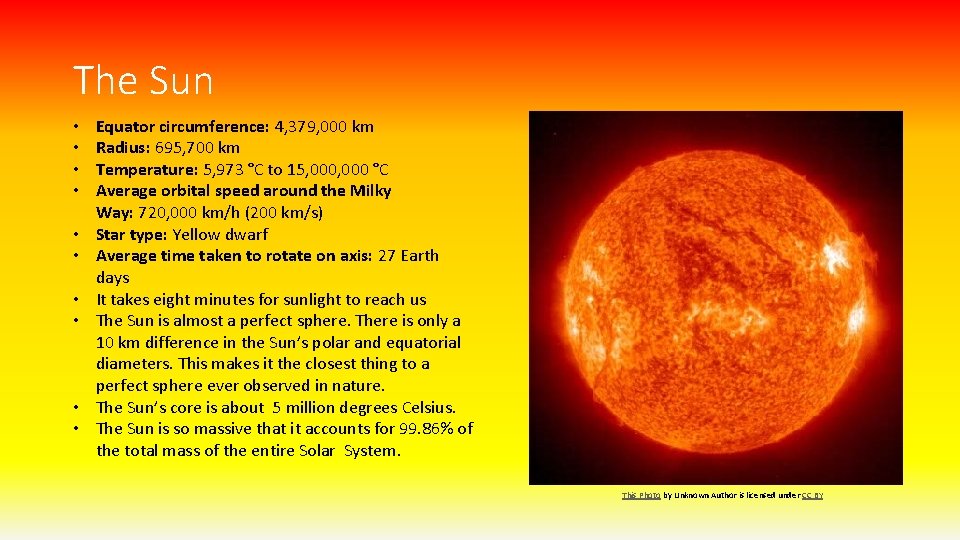
The Sun • • • Equator circumference: 4, 379, 000 km Radius: 695, 700 km Temperature: 5, 973 °C to 15, 000 °C Average orbital speed around the Milky Way: 720, 000 km/h (200 km/s) Star type: Yellow dwarf Average time taken to rotate on axis: 27 Earth days It takes eight minutes for sunlight to reach us The Sun is almost a perfect sphere. There is only a 10 km difference in the Sun’s polar and equatorial diameters. This makes it the closest thing to a perfect sphere ever observed in nature. The Sun’s core is about 5 million degrees Celsius. The Sun is so massive that it accounts for 99. 86% of the total mass of the entire Solar System. This Photo by Unknown Author is licensed under CC BY
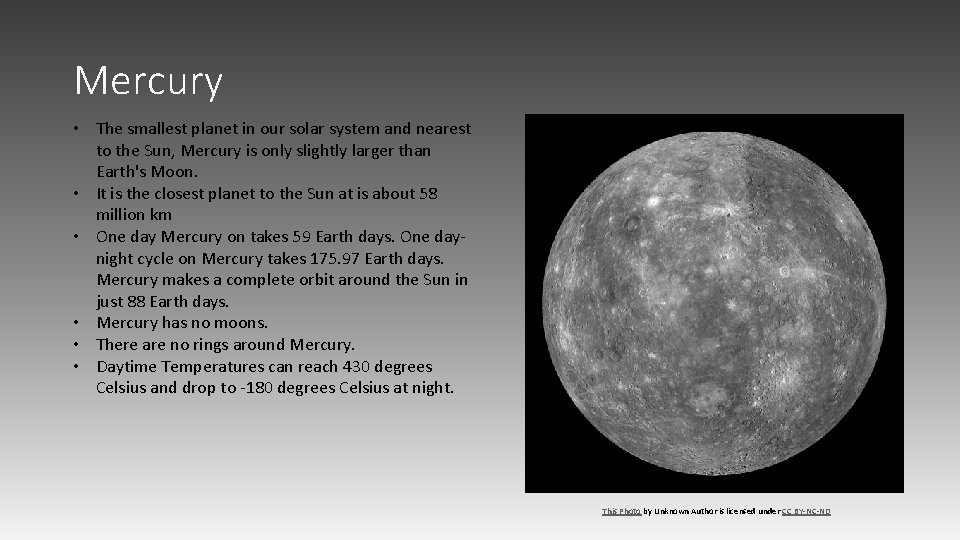
Mercury • The smallest planet in our solar system and nearest to the Sun, Mercury is only slightly larger than Earth's Moon. • It is the closest planet to the Sun at is about 58 million km • One day Mercury on takes 59 Earth days. One daynight cycle on Mercury takes 175. 97 Earth days. Mercury makes a complete orbit around the Sun in just 88 Earth days. • Mercury has no moons. • There are no rings around Mercury. • Daytime Temperatures can reach 430 degrees Celsius and drop to -180 degrees Celsius at night. This Photo by Unknown Author is licensed under CC BY-NC-ND
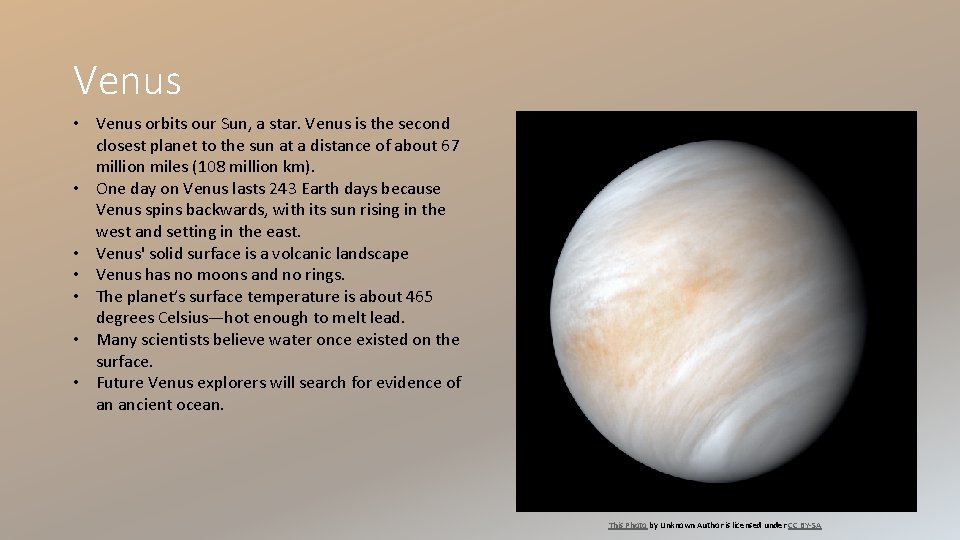
Venus • Venus orbits our Sun, a star. Venus is the second closest planet to the sun at a distance of about 67 million miles (108 million km). • One day on Venus lasts 243 Earth days because Venus spins backwards, with its sun rising in the west and setting in the east. • Venus' solid surface is a volcanic landscape • Venus has no moons and no rings. • The planet’s surface temperature is about 465 degrees Celsius—hot enough to melt lead. • Many scientists believe water once existed on the surface. • Future Venus explorers will search for evidence of an ancient ocean. This Photo by Unknown Author is licensed under CC BY-SA
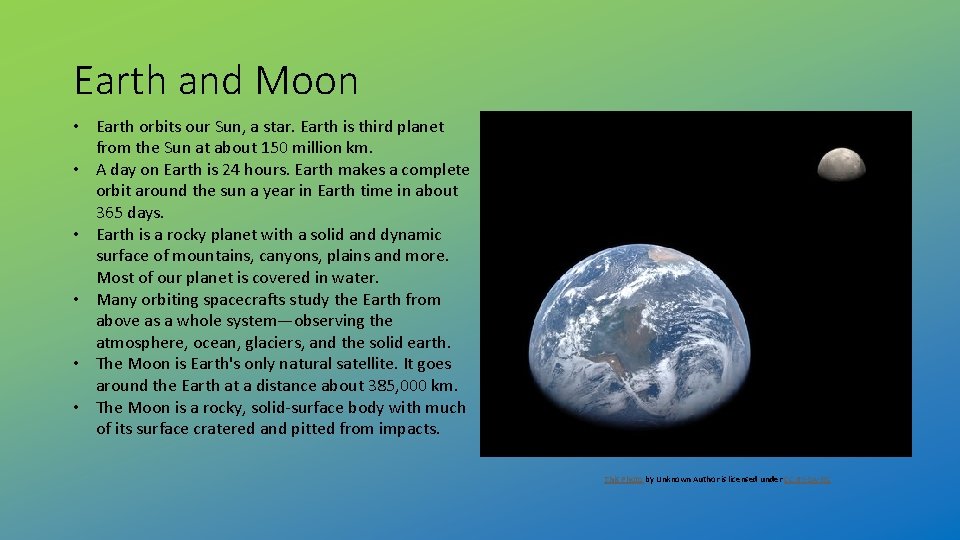
Earth and Moon • Earth orbits our Sun, a star. Earth is third planet from the Sun at about 150 million km. • A day on Earth is 24 hours. Earth makes a complete orbit around the sun a year in Earth time in about 365 days. • Earth is a rocky planet with a solid and dynamic surface of mountains, canyons, plains and more. Most of our planet is covered in water. • Many orbiting spacecrafts study the Earth from above as a whole system—observing the atmosphere, ocean, glaciers, and the solid earth. • The Moon is Earth's only natural satellite. It goes around the Earth at a distance about 385, 000 km. • The Moon is a rocky, solid-surface body with much of its surface cratered and pitted from impacts. This Photo by Unknown Author is licensed under CC BY-SA-NC
Mars • Mars orbits our Sun, a star. Mars is the fourth planet from the Sun at an average distance of about 228 million km. • One day on Mars takes a little over 24 hours. Mars makes a complete orbit around the Sun a year in Martian time in 687 Earth days. • Mars is a rocky planet. Its solid surface has been altered by volcanoes, impacts, winds, crustal movement and chemical reactions. • Mars has a thin atmosphere made up mostly of carbon dioxide, argon, nitrogen, and a small amount of oxygen and water vapor. • Several missions have visited this planet, from flybys and orbiters to rovers on the surface. The first true Mars mission success was the Mariner 4 flyby in 1965. • At this time, Mars' surface cannot support life as we know it. Current missions are determining Mars' past and future potential for life. This Photo by Unknown Author is licensed under CC BY-SA-NC
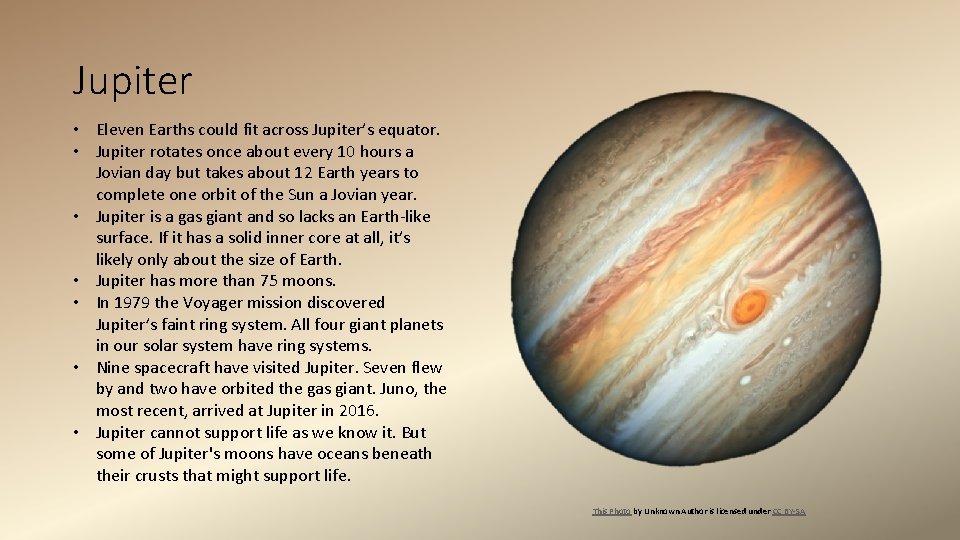
Jupiter • Eleven Earths could fit across Jupiter’s equator. • Jupiter rotates once about every 10 hours a Jovian day but takes about 12 Earth years to complete one orbit of the Sun a Jovian year. • Jupiter is a gas giant and so lacks an Earth-like surface. If it has a solid inner core at all, it’s likely only about the size of Earth. • Jupiter has more than 75 moons. • In 1979 the Voyager mission discovered Jupiter’s faint ring system. All four giant planets in our solar system have ring systems. • Nine spacecraft have visited Jupiter. Seven flew by and two have orbited the gas giant. Juno, the most recent, arrived at Jupiter in 2016. • Jupiter cannot support life as we know it. But some of Jupiter's moons have oceans beneath their crusts that might support life. This Photo by Unknown Author is licensed under CC BY-SA
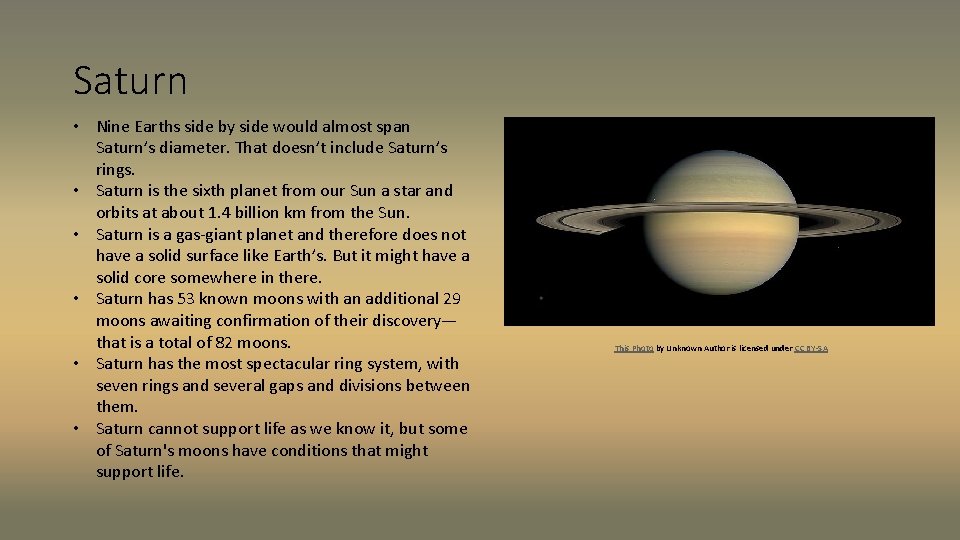
Saturn • Nine Earths side by side would almost span Saturn’s diameter. That doesn’t include Saturn’s rings. • Saturn is the sixth planet from our Sun a star and orbits at about 1. 4 billion km from the Sun. • Saturn is a gas-giant planet and therefore does not have a solid surface like Earth’s. But it might have a solid core somewhere in there. • Saturn has 53 known moons with an additional 29 moons awaiting confirmation of their discovery— that is a total of 82 moons. • Saturn has the most spectacular ring system, with seven rings and several gaps and divisions between them. • Saturn cannot support life as we know it, but some of Saturn's moons have conditions that might support life. This Photo by Unknown Author is licensed under CC BY-SA
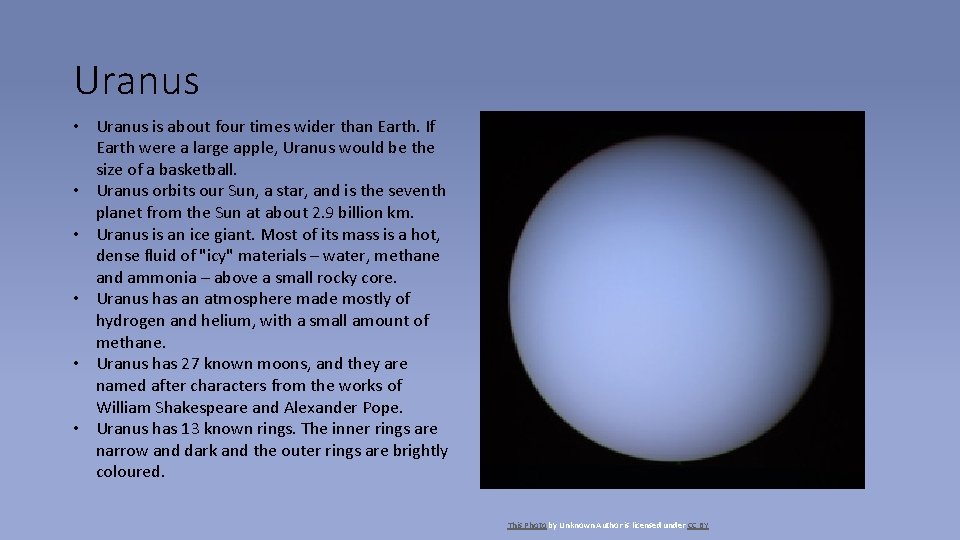
Uranus • Uranus is about four times wider than Earth. If Earth were a large apple, Uranus would be the size of a basketball. • Uranus orbits our Sun, a star, and is the seventh planet from the Sun at about 2. 9 billion km. • Uranus is an ice giant. Most of its mass is a hot, dense fluid of "icy" materials – water, methane and ammonia – above a small rocky core. • Uranus has an atmosphere made mostly of hydrogen and helium, with a small amount of methane. • Uranus has 27 known moons, and they are named after characters from the works of William Shakespeare and Alexander Pope. • Uranus has 13 known rings. The inner rings are narrow and dark and the outer rings are brightly coloured. This Photo by Unknown Author is licensed under CC BY
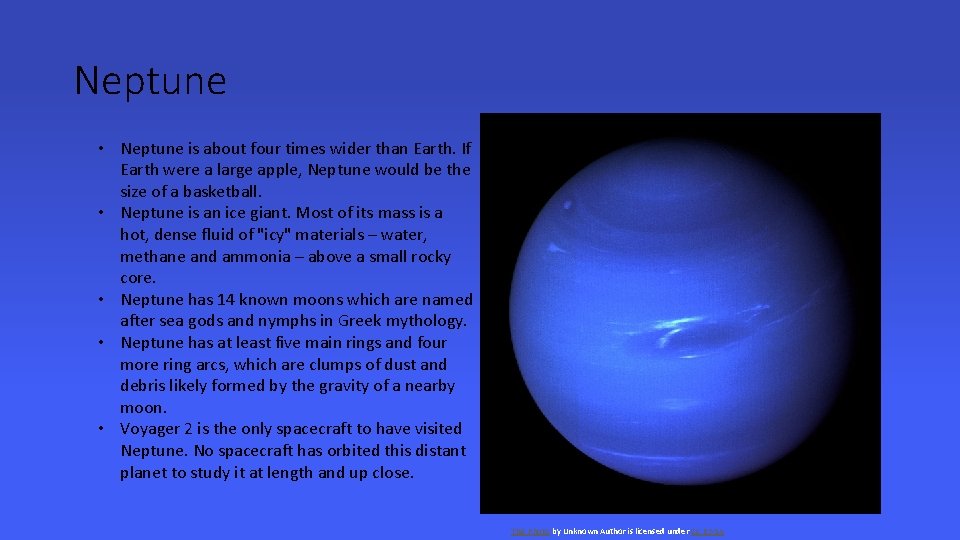
Neptune • Neptune is about four times wider than Earth. If Earth were a large apple, Neptune would be the size of a basketball. • Neptune is an ice giant. Most of its mass is a hot, dense fluid of "icy" materials – water, methane and ammonia – above a small rocky core. • Neptune has 14 known moons which are named after sea gods and nymphs in Greek mythology. • Neptune has at least five main rings and four more ring arcs, which are clumps of dust and debris likely formed by the gravity of a nearby moon. • Voyager 2 is the only spacecraft to have visited Neptune. No spacecraft has orbited this distant planet to study it at length and up close. This Photo by Unknown Author is licensed under CC BY-SA
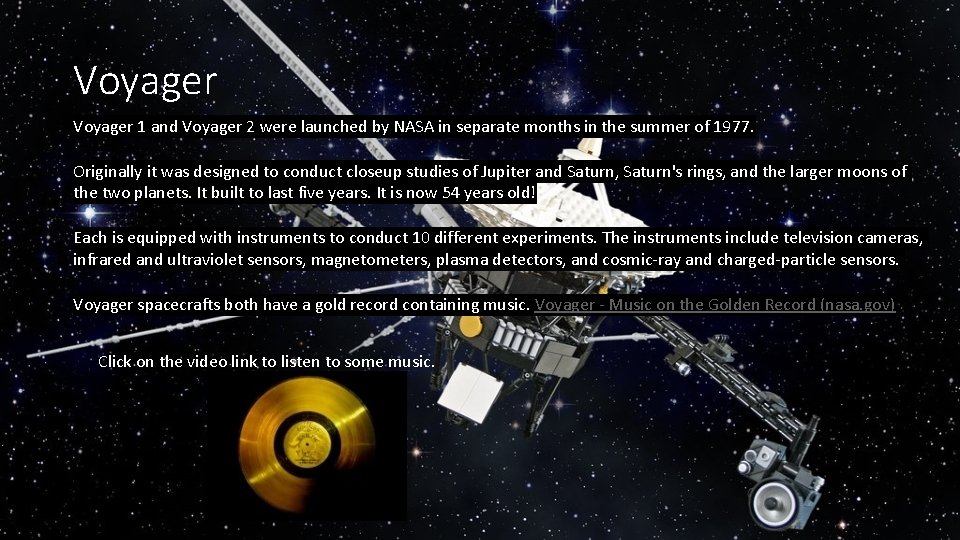
Voyager 1 and Voyager 2 were launched by NASA in separate months in the summer of 1977. Originally it was designed to conduct closeup studies of Jupiter and Saturn, Saturn's rings, and the larger moons of the two planets. It built to last five years. It is now 54 years old! Each is equipped with instruments to conduct 10 different experiments. The instruments include television cameras, infrared and ultraviolet sensors, magnetometers, plasma detectors, and cosmic-ray and charged-particle sensors. Voyager spacecrafts both have a gold record containing music. Voyager - Music on the Golden Record (nasa. gov) Click on the video link to listen to some music.
Credits All my information for this presentation came from NASA. Overview | Sun – NASA Solar System Exploration Overview | Mercury – NASA Solar System Exploration Overview | Venus – NASA Solar System Exploration Overview | Earth – NASA Solar System Exploration Overview | Mars – NASA Solar System Exploration Overview | Jupiter – NASA Solar System Exploration Overview | Saturn – NASA Solar System Exploration Overview | Uranus – NASA Solar System Exploration Overview | Neptune – NASA Solar System Exploration This Photo by Unknown Author is licensed under CC BY-SA
Glossary Circumference The outer boundary, especially of a circular area; perimeter. Equator the great circle of the earth that is equidistant from the North Pole and South Pole. Atmosphere the gaseous envelope surrounding the earth; the air. Mythology a body of myths, as that of a particular people or that relating to a particular person Greek mythology. Voyager one of a series of U. S. space probes that obtained scientific information while flying by the planets Jupiter, Saturn, and Uranus. Helium is an inert, gaseous element present in the sun's atmosphere and in natural gas.
- Slides: 15