
THE SOCIOLOGICAL IMAGINATION What is Sociology What is
- Slides: 13
THE SOCIOLOGICAL IMAGINATION What is Sociology?
What is sociology? • Sociology is a study of the ways that people are affected by, and affect society • Sociologists are interested in looking at the processes that are associated with groups, societies and institutions. • Every day the social structures that we are part of – family, school, social media the economic system, create opportunities and constraints that characterise our lives and make us into the people that we are.
Common Sense Vs Sociology is generally about trying to find insights into the world that an ordinary person would not see. Lots of people are interested in social life, in fact, probably everyone is interested in social life. We are all interacting and seeking to understand meaning constantly. However, what separates sociology from this “person in the street” (PITS) view, is that generally PITS are basing opinions on “common sense” and personal experience. Sociologists reject these as they are inadequate ways of explaining society.
• Common sense and personal experience are usually based on our own limited and biased opinions – our gut instinct, which overrides our objectivity. Instead sociologists claim that the best way to study society is to conduct research which uncovers patterns that would normally remain hidden. This research should be based on facts rather than opinions
Theories • But the research isn’t enough, you can’t just stop at making tables of data. It is a sociologist’s role to interpret the data – to draw conclusions (like you did in Modern Studies). They are looking for patterns, and seeking relationships between phenomena. The process of conducting explanations for the social patterns is known as “theorising”.
What are Theories? • A theory is a way of understanding things about the world in which we live. Theories stem from ideas that have been or could be tested through research. In social sciences theories are only seen as having significance if they are backed by objective research. In sociology there were two broad categories of types of theories, structural theories and social action theories
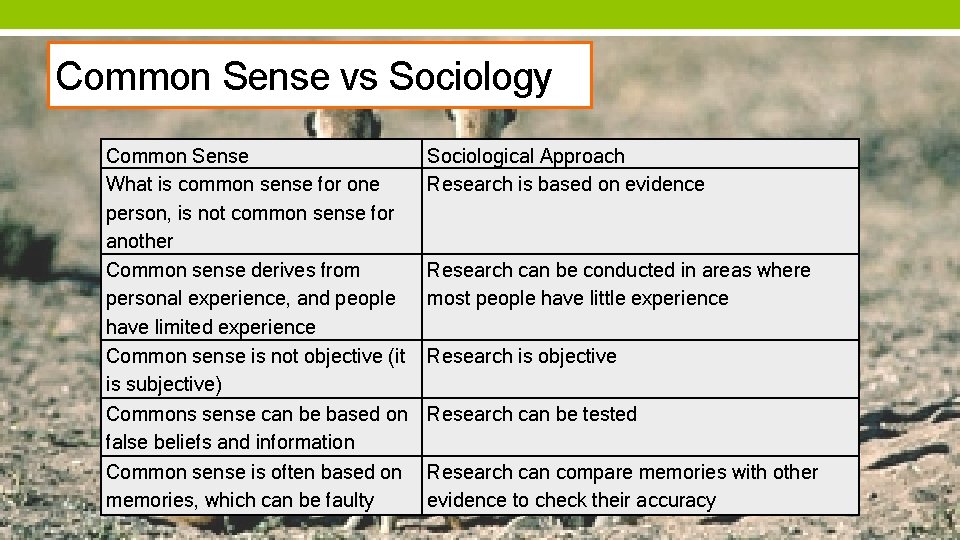
Common Sense vs Sociology Common Sense What is common sense for one person, is not common sense for another Common sense derives from personal experience, and people have limited experience Common sense is not objective (it is subjective) Commons sense can be based on false beliefs and information Common sense is often based on memories, which can be faulty Sociological Approach Research is based on evidence Research can be conducted in areas where most people have little experience Research is objective Research can be tested Research can compare memories with other evidence to check their accuracy
The “Sociological Imagination” • The American Sociologist C Wright Mills believed that if we are to truly understand the world around us we have to adopt what he called the “sociological imagination”, which is a different way of looking at society. Making the familiar strange – like putting on a new pair of glasses and seeing things completely differently. We take daily activities – things we do all the time and take for granted, and really think about them from a different perspective – so we remove the common sense view of things. For example – eating food. We often think about the biological imperative to eat food, but food is much more than that. Food is often a way of bringing people together, a way of teaching children about the world, a way of having power over someone else. Food can also affect health and the environment.
Personal troubles/ Public Issues • Another aspect of the sociological imagination is recognising that although we may experience issues as individuals – “personal troubles”, all of these issues are placed in a public context. So, an individual might face money troubles which can affect their life in a particular way, but that individual is actually experiencing a social issue – inequality, poverty – something which is a part of social life, a problem for the whole of society. We don’t just look at the individual, we look for a trend or a pattern.
You have already been doing this… • When we have studied social issues in Modern Studies, or terrorism, we have been using the sociological imagination to look at the issues broadly and look at causes and effects on the whole of society. We learn about all the relationships- the links between, we don’t just look at it from an emotional perspective. We attempt to remove the common sense viewpoint and apply scientific thinking and methodology.
Thinking outside our own experiences • The sociological imagination is the concept of being able to “think ourselves away” from the familiar routines of our daily lives in order to look at them anew. Mills defined sociological imagination as “the vivid awareness of the relationship between experience and the wider society" it is the ability to see things socially and how they interact and influence each other. To have a sociological imagination, a person must be able to pull away from the situation and think from an alternative point of view. This ability is central to one's development of a sociological perspective on the world.
Drinking a cup of coffee 1. Social aspect – bringing people together 2. Daily ritual which helps to maintain bonds 3. 4. 5. 6. in family and friendship or workplace Drug addiction – caffeine – why is caffeine not considered an illegal drug? Global trade – social and economic relations – linking different parts of the world, power relationships Coffee snobbery - status History and cultural change – why has Britain moved from tea to coffee?
The purpose of sociology… • Sociology not only helps us analyse current and existing patterns of social life, but it also helps us to see some of the possible futures open to us. Through the sociological imagination, we can see not only what is real, but also what could become real should we desire to make it that way. Sociology should lead the public to become more engaged as citizens. Sociology isn’t just about describing the world – it is about changing it. The more we understand how power operates in the system, the more able we will be to free ourselves from the machine by acting collectively