
The social area Levine et al 2001 Crosscultural

- Slides: 33
The social area Levine et al. (2001) Cross-cultural differences in helping strangers OCR Psychology for A level Year 1 2015 © Hodder & Stoughton Limited
The social area Task Imagine you are alone in a city. You require help (you could be lost, you might need money, etc. ). • Which city would you most like to be in? Where do you think you would be most likely to get help? • Where would you least like to be? Where do you think you would get the least help? OCR Psychology for A level Year 1 2015 © Hodder & Stoughton Limited
The social area Links between your answers • Are there any links between the cities that were chosen? • Are the cities all in similar countries? • Are they culturally similar? OCR Psychology for A level Year 1 2015 © Hodder & Stoughton Limited
The social area Previous research • Differences in helping behaviour have been noted around the world – although there is very little scientific evidence. • Previous research often tests the popular hypothesis that the tendency to help strangers declines as the size of a city increases. OCR Psychology for A level Year 1 2015 © Hodder & Stoughton Limited
The social area Levine’s general idea • Levine wanted to conduct a cross-cultural study (a study that is done in multiple cultures) to look at levels of spontaneous help. • Levine wanted to scientifically test cross-cultural differences. OCR Psychology for A level Year 1 2015 © Hodder & Stoughton Limited
The social area Three aims The study had three main goals: 1. To see if the tendency of people within a city to offer non-emergency help to strangers was stable across different situations in which people needed help. 2. To see if helping of strangers varies across cultures. 3. To identify the characteristics of those communities in which strangers are more (or less) likely to be helped. OCR Psychology for A level Year 1 2015 © Hodder & Stoughton Limited
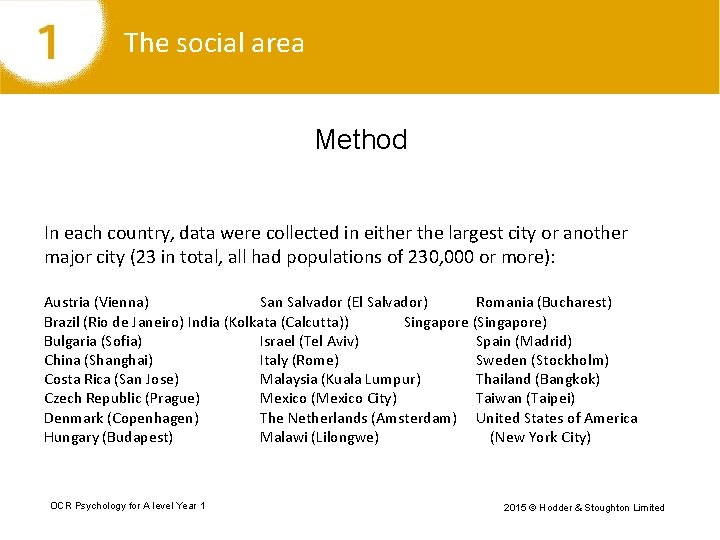
The social area Method In each country, data were collected in either the largest city or another major city (23 in total, all had populations of 230, 000 or more): Austria (Vienna) San Salvador (El Salvador) Romania (Bucharest) Brazil (Rio de Janeiro) India (Kolkata (Calcutta)) Singapore (Singapore) Bulgaria (Sofia) Israel (Tel Aviv) Spain (Madrid) China (Shanghai) Italy (Rome) Sweden (Stockholm) Costa Rica (San Jose) Malaysia (Kuala Lumpur) Thailand (Bangkok) Czech Republic (Prague) Mexico (Mexico City) Taiwan (Taipei) Denmark (Copenhagen) The Netherlands (Amsterdam) United States of America Hungary (Budapest) Malawi (Lilongwe) (New York City) OCR Psychology for A level Year 1 2015 © Hodder & Stoughton Limited
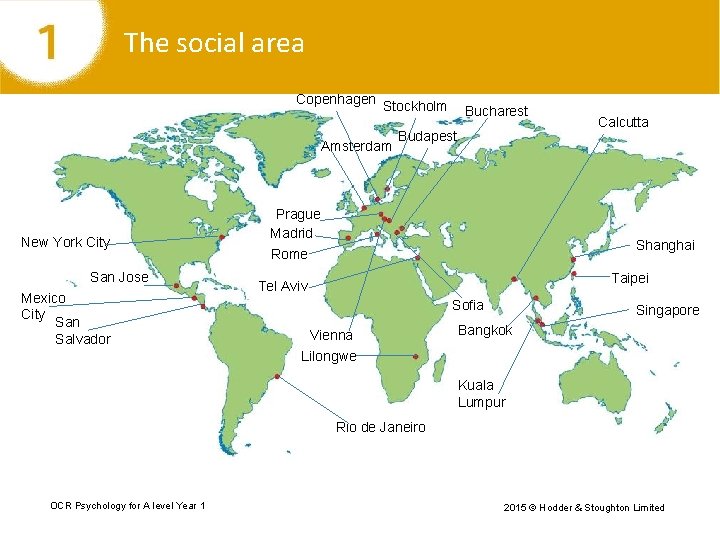
The social area Activity 1 • Have a go at labelling the cities on a world map (Activity 1). • Check your answers on the next slide. OCR Psychology for A level Year 1 2015 © Hodder & Stoughton Limited
The social area Copenhagen Stockholm Amsterdam New York City San Jose Mexico City San Salvador Bucharest Budapest Prague Madrid Calcutta Shanghai Rome Taipei Tel Aviv Sofia Vienna Lilongwe Singapore Bangkok Kuala Lumpur Rio de Janeiro OCR Psychology for A level Year 1 2015 © Hodder & Stoughton Limited
The social area Data collection Collection at the various international sites was conducted by students who were either travelling to foreign countries or returning to their home countries for the summer, or by cross-cultural psychologists and their students in other countries who volunteered to assist the authors. • Are there any issues with this method? • Researcher bias? Issue with the researchers being students? OCR Psychology for A level Year 1 2015 © Hodder & Stoughton Limited
The social area Helping behaviours Originally there were five separate helping behaviours: Dropped pen; Hurt leg; Helping blind person across the street; Asking for change; Mislaid letters. Two were removed (Asking for change and Mislaid letters) due to issues. Why do you think this was? • • Asking for change – The concept of money was too different across cultures, with some countries lacking small change. Mislaid letters – In some places people didn’t want to touch envelopes in case they contained explosive, and some areas didn’t have postboxes so it required a lot of effort. Also, in some countries letters are not very common due to illiteracy. This leaves three different non-emergency helping behaviours. OCR Psychology for A level Year 1 2015 © Hodder & Stoughton Limited
The social area Dropped pen Walking at a carefully practised, moderate pace (15 paces/10 seconds), experimenters walked towards a lone pedestrian passing in the opposite direction. When 10 to 15 feet from the subject, the experimenter reached into his pocket and accidentally, without appearing to notice, dropped his pen behind him, in full view of the subject, and continued walking past the subject. A total of 214 men and 210 women were approached. Participants were scored as having helped if they called back to the experimenter that he had dropped the pen and/or picked up the pen and brought it to the experimenter. OCR Psychology for A level Year 1 2015 © Hodder & Stoughton Limited
The social area Hurt leg Walking with a heavy limp and wearing a large and clearly visible leg brace, experimenters ‘accidentally’ dropped and unsuccessfully struggled to reach down for a pile of magazines as they came within 20 feet of a passing pedestrian. A total of 253 men and 240 women were approached. Helping was defined as offering to help and/or beginning to help without offering. OCR Psychology for A level Year 1 2015 © Hodder & Stoughton Limited
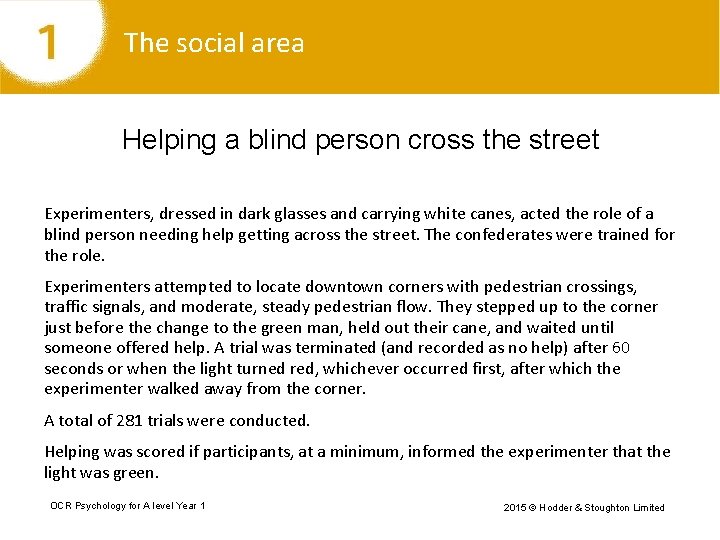
The social area Helping a blind person cross the street Experimenters, dressed in dark glasses and carrying white canes, acted the role of a blind person needing help getting across the street. The confederates were trained for the role. Experimenters attempted to locate downtown corners with pedestrian crossings, traffic signals, and moderate, steady pedestrian flow. They stepped up to the corner just before the change to the green man, held out their cane, and waited until someone offered help. A trial was terminated (and recorded as no help) after 60 seconds or when the light turned red, whichever occurred first, after which the experimenter walked away from the corner. A total of 281 trials were conducted. Helping was scored if participants, at a minimum, informed the experimenter that the light was green. OCR Psychology for A level Year 1 2015 © Hodder & Stoughton Limited
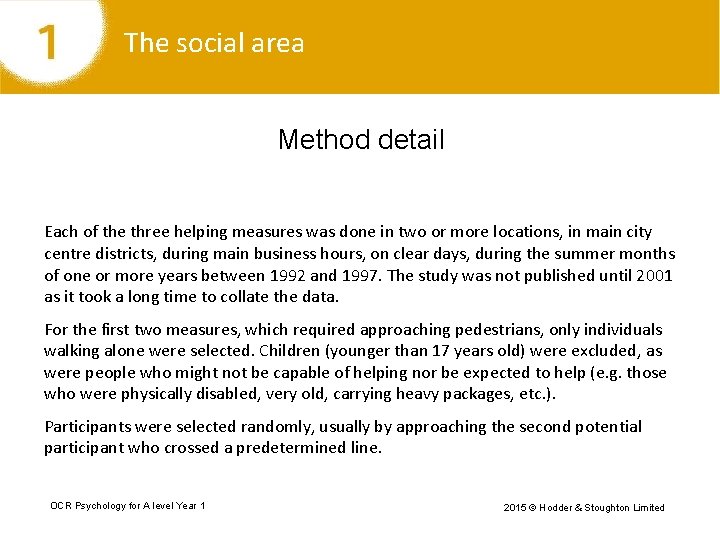
The social area Method detail Each of the three helping measures was done in two or more locations, in main city centre districts, during main business hours, on clear days, during the summer months of one or more years between 1992 and 1997. The study was not published until 2001 as it took a long time to collate the data. For the first two measures, which required approaching pedestrians, only individuals walking alone were selected. Children (younger than 17 years old) were excluded, as were people who might not be capable of helping nor be expected to help (e. g. those who were physically disabled, very old, carrying heavy packages, etc. ). Participants were selected randomly, usually by approaching the second potential participant who crossed a predetermined line. OCR Psychology for A level Year 1 2015 © Hodder & Stoughton Limited
The social area Standardised procedure All experimenters were male and of college age (US university students). They were all trained for their roles (they practised their roles together to ensure consistency) and had detailed instructions on how to act and how to score participants. OCR Psychology for A level Year 1 2015 © Hodder & Stoughton Limited
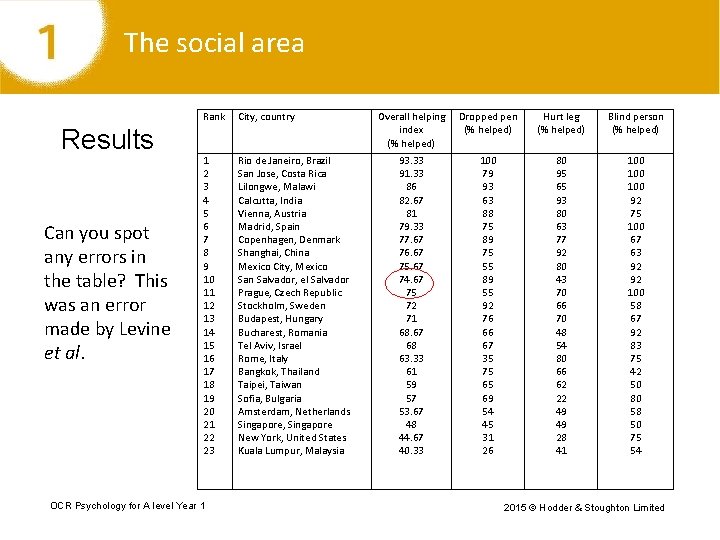
The social area Results Can you spot any errors in the table? This was an error made by Levine et al. Rank City, country 1 2 3 4 5 6 7 8 9 10 11 12 13 14 15 16 17 18 19 20 21 22 23 Rio de Janeiro, Brazil San Jose, Costa Rica Lilongwe, Malawi Calcutta, India Vienna, Austria Madrid, Spain Copenhagen, Denmark Shanghai, China Mexico City, Mexico San Salvador, el Salvador Prague, Czech Republic Stockholm, Sweden Budapest, Hungary Bucharest, Romania Tel Aviv, Israel Rome, Italy Bangkok, Thailand Taipei, Taiwan Sofia, Bulgaria Amsterdam, Netherlands Singapore, Singapore New York, United States Kuala Lumpur, Malaysia OCR Psychology for A level Year 1 Overall helping index (% helped) Dropped pen (% helped) Hurt leg (% helped) Blind person (% helped) 93. 33 91. 33 86 82. 67 81 79. 33 77. 67 76. 67 75. 67 74. 67 75 72 71 68. 67 68 63. 33 61 59 57 53. 67 48 44. 67 40. 33 100 79 93 63 88 75 89 75 55 89 55 92 76 66 67 35 75 65 69 54 45 31 26 80 95 65 93 80 63 77 92 80 43 70 66 70 48 54 80 66 62 22 49 49 28 41 100 100 92 75 100 67 63 92 92 100 58 67 92 83 75 42 50 80 58 50 75 54 2015 © Hodder & Stoughton Limited
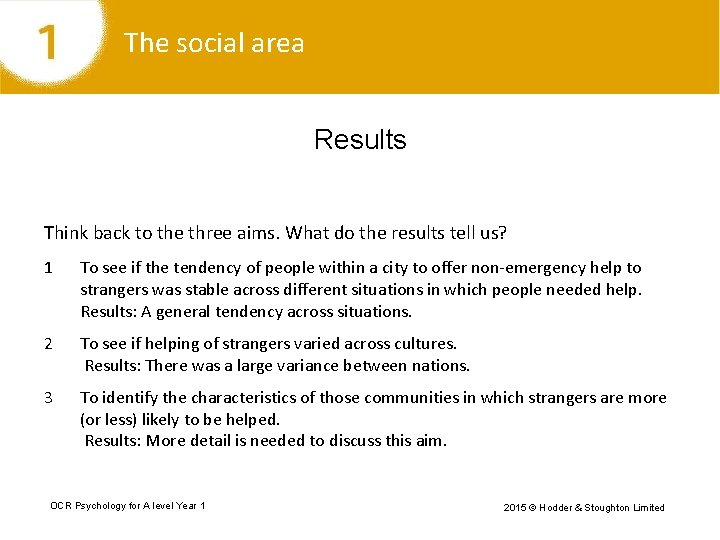
The social area Results Think back to the three aims. What do the results tell us? 1 To see if the tendency of people within a city to offer non-emergency help to strangers was stable across different situations in which people needed help. Results: A general tendency across situations. 2 To see if helping of strangers varied across cultures. Results: There was a large variance between nations. 3 To identify the characteristics of those communities in which strangers are more (or less) likely to be helped. Results: More detail is needed to discuss this aim. OCR Psychology for A level Year 1 2015 © Hodder & Stoughton Limited
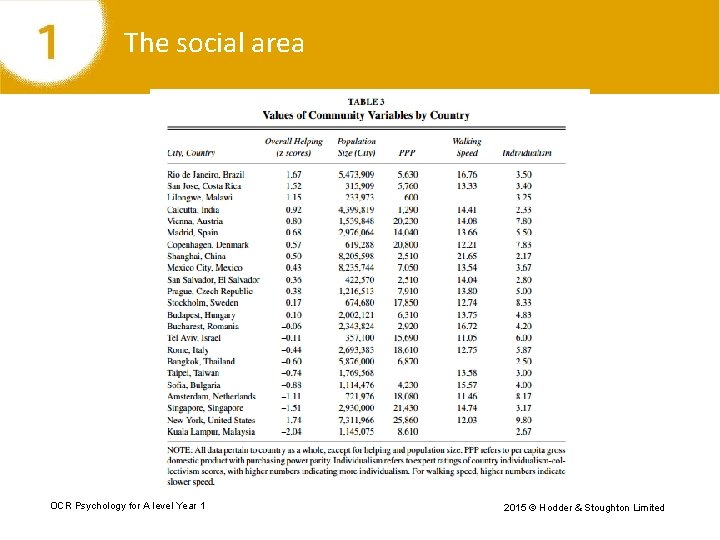
The social area Community variables These four factors were also recorded and a correlational analysis between each factor and helping behaviours was conducted. • • Population size Economic indicator Cultural values Walking speed OCR Psychology for A level Year 1 2015 © Hodder & Stoughton Limited
The social area Population size While all cities had populations of more than 230, 000, there were still differences in population size. Population size for each metropolitan area was taken from the most current United Nations Demographic Yearbook. OCR Psychology for A level Year 1 2015 © Hodder & Stoughton Limited
The social area Economic indicator (PPP) • PPP is an indicator of economic well-being that measures how much the average income in a country is capable of purchasing. • For example, the US has a PPP of 25, 860, whereas Malawi has a PPP of 600. Think of PPP as an indicator of how rich a country is. OCR Psychology for A level Year 1 2015 © Hodder & Stoughton Limited
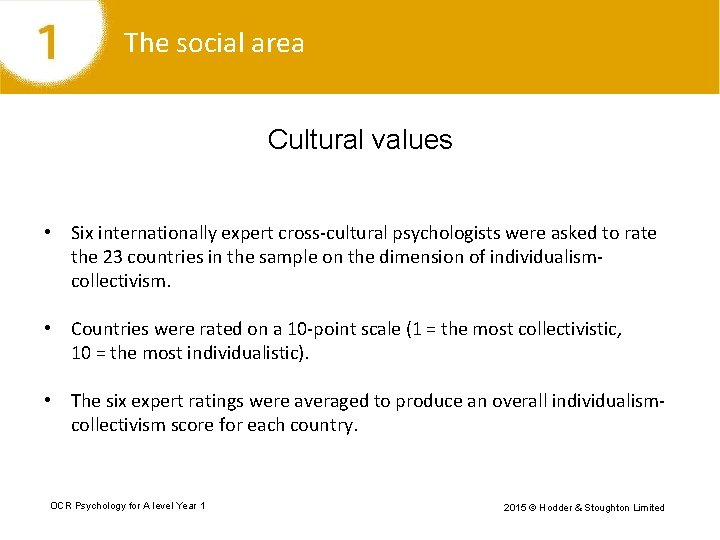
The social area Cultural values • Six internationally expert cross-cultural psychologists were asked to rate the 23 countries in the sample on the dimension of individualismcollectivism. • Countries were rated on a 10 -point scale (1 = the most collectivistic, 10 = the most individualistic). • The six expert ratings were averaged to produce an overall individualismcollectivism score for each country. OCR Psychology for A level Year 1 2015 © Hodder & Stoughton Limited
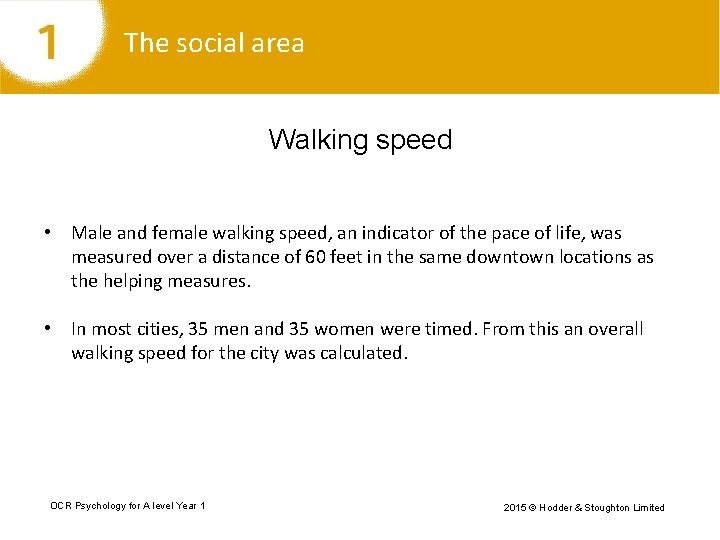
The social area Walking speed • Male and female walking speed, an indicator of the pace of life, was measured over a distance of 60 feet in the same downtown locations as the helping measures. • In most cities, 35 men and 35 women were timed. From this an overall walking speed for the city was calculated. OCR Psychology for A level Year 1 2015 © Hodder & Stoughton Limited
The social area OCR Psychology for A level Year 1 2015 © Hodder & Stoughton Limited
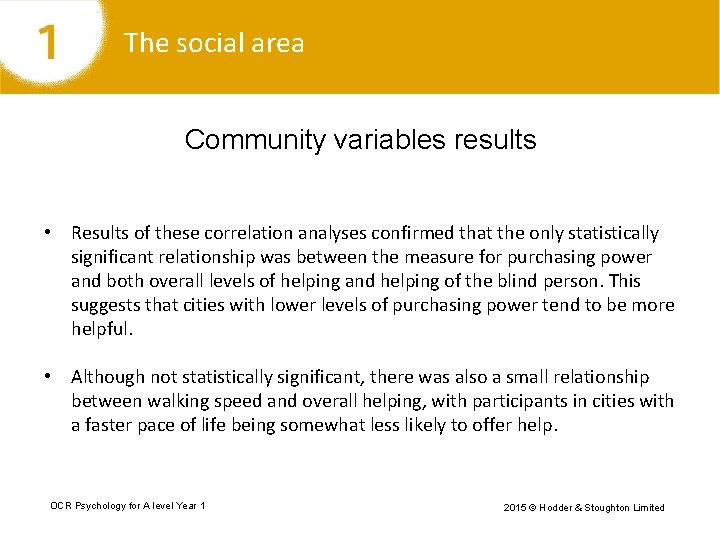
The social area Community variables results • Results of these correlation analyses confirmed that the only statistically significant relationship was between the measure for purchasing power and both overall levels of helping and helping of the blind person. This suggests that cities with lower levels of purchasing power tend to be more helpful. • Although not statistically significant, there was also a small relationship between walking speed and overall helping, with participants in cities with a faster pace of life being somewhat less likely to offer help. OCR Psychology for A level Year 1 2015 © Hodder & Stoughton Limited
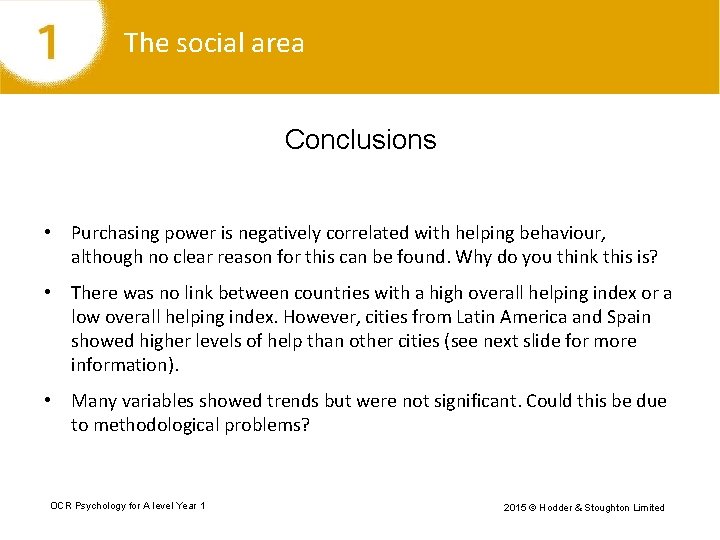
The social area Conclusions • Purchasing power is negatively correlated with helping behaviour, although no clear reason for this can be found. Why do you think this is? • There was no link between countries with a high overall helping index or a low overall helping index. However, cities from Latin America and Spain showed higher levels of help than other cities (see next slide for more information). • Many variables showed trends but were not significant. Could this be due to methodological problems? OCR Psychology for A level Year 1 2015 © Hodder & Stoughton Limited
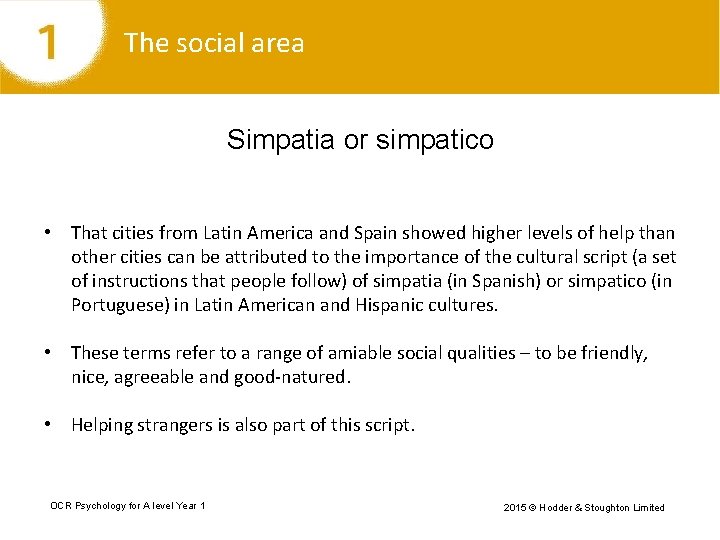
The social area Simpatia or simpatico • That cities from Latin America and Spain showed higher levels of help than other cities can be attributed to the importance of the cultural script (a set of instructions that people follow) of simpatia (in Spanish) or simpatico (in Portuguese) in Latin American and Hispanic cultures. • These terms refer to a range of amiable social qualities – to be friendly, nice, agreeable and good-natured. • Helping strangers is also part of this script. OCR Psychology for A level Year 1 2015 © Hodder & Stoughton Limited
The social area Activity 2 Complete the cartoon strip activity to summarise the study (see Activity 2). OCR Psychology for A level Year 1 2015 © Hodder & Stoughton Limited
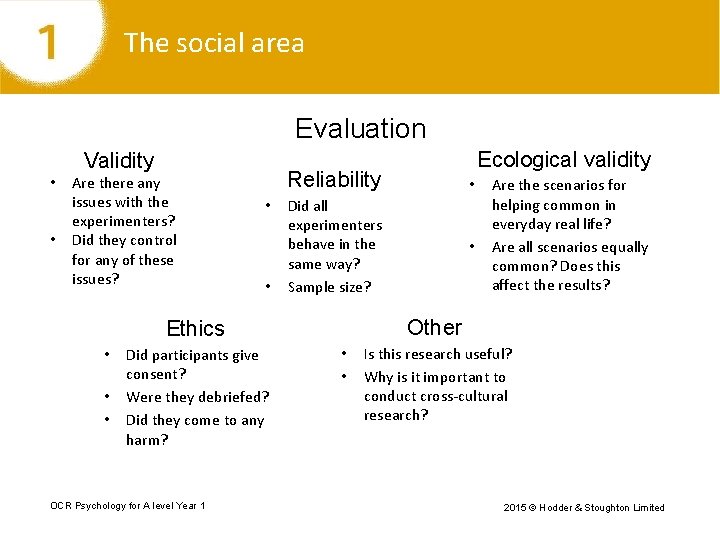
The social area Evaluation Validity • • Are there any issues with the experimenters? Did they control for any of these issues? • • Reliability • Did all experimenters behave in the same way? Sample size? • • • Did participants give consent? Were they debriefed? Did they come to any harm? OCR Psychology for A level Year 1 Are the scenarios for helping common in everyday real life? Are all scenarios equally common? Does this affect the results? Other Ethics • Ecological validity • • Is this research useful? Why is it important to conduct cross-cultural research? 2015 © Hodder & Stoughton Limited
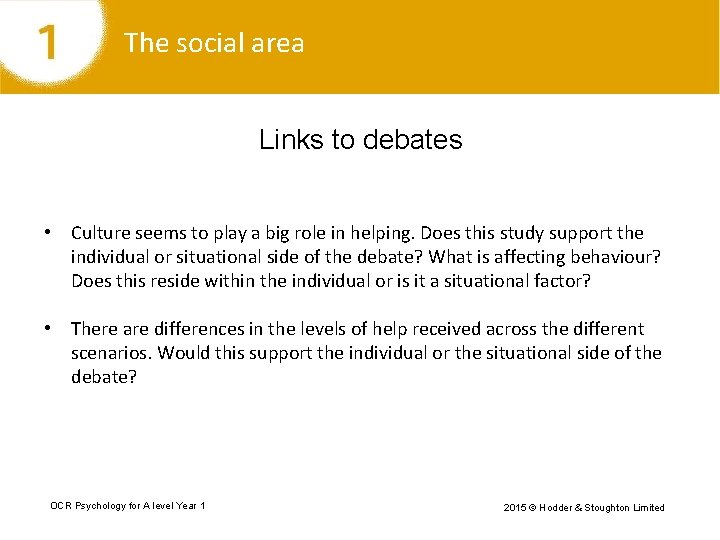
The social area Links to debates • Culture seems to play a big role in helping. Does this study support the individual or situational side of the debate? What is affecting behaviour? Does this reside within the individual or is it a situational factor? • There are differences in the levels of help received across the different scenarios. Would this support the individual or the situational side of the debate? OCR Psychology for A level Year 1 2015 © Hodder & Stoughton Limited
The social area Links to areas/perspectives • Levine et al. ’s study falls under the social area because the study looks at how social variables (such as a city’s population and how well off the people in a city are) impact behaviour. OCR Psychology for A level Year 1 2015 © Hodder & Stoughton Limited
The social area Links to key themes • This study suggests that responses to people in need vary across the world. Therefore culture has a big impact on the responses given. • When compared to the classic study of Piliavin, this study is useful as it suggests that the findings from Piliavin may be due to culture. New York finished 22 nd out of 23 in overall help, which may have influenced Piliavin’s results. • Individual, social and cultural diversity – Levine’s study clearly shows how culture plays a role in helping behaviour. It also sheds light on the results of Piliavin and helps us see these results in a new way (taking into account the role of culture). OCR Psychology for A level Year 1 2015 © Hodder & Stoughton Limited
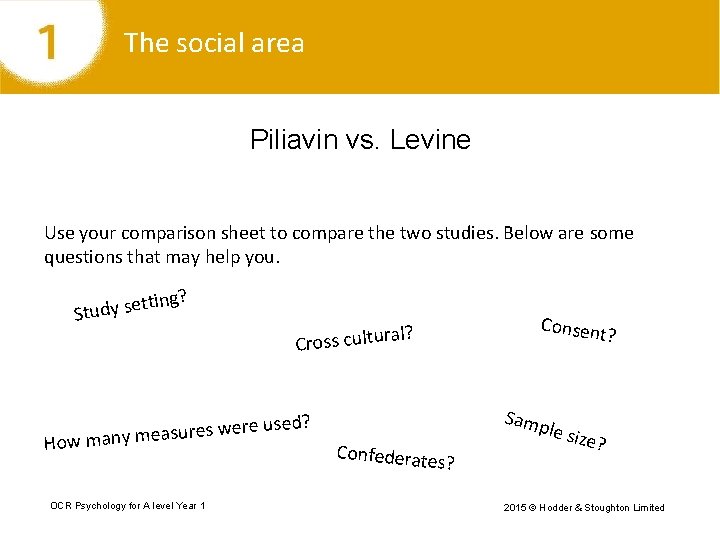
The social area Piliavin vs. Levine Use your comparison sheet to compare the two studies. Below are some questions that may help you. ? tting e s y d u t S l? Cross cultura sed? u e r e w s e r u s a w many me Ho OCR Psychology for A level Year 1 Consent ? Samp Confederate s? le siz e? 2015 © Hodder & Stoughton Limited