
The Social and Economic Costs of Alcohol Use
- Slides: 30
The Social and Economic Costs of Alcohol Use in Wisconsin D. Paul Moberg University of Wisconsin Population Health Institute dpmoberg@wisc. edu Revision: January 12, 2009
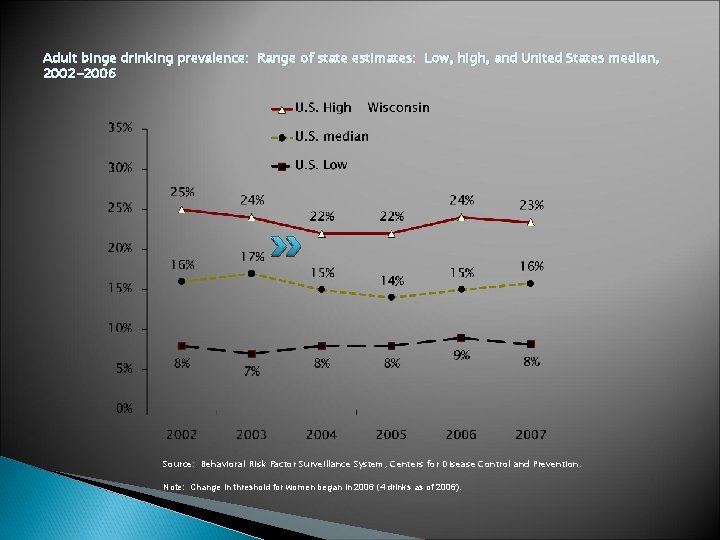
Adult binge drinking prevalence: Range of state estimates: Low, high, and United States median, 2002 -2006 Source: Behavioral Risk Factor Surveillance System, Centers for Disease Control and Prevention. Note: Change in threshold for women began in 2006 (4 drinks as of 2006).
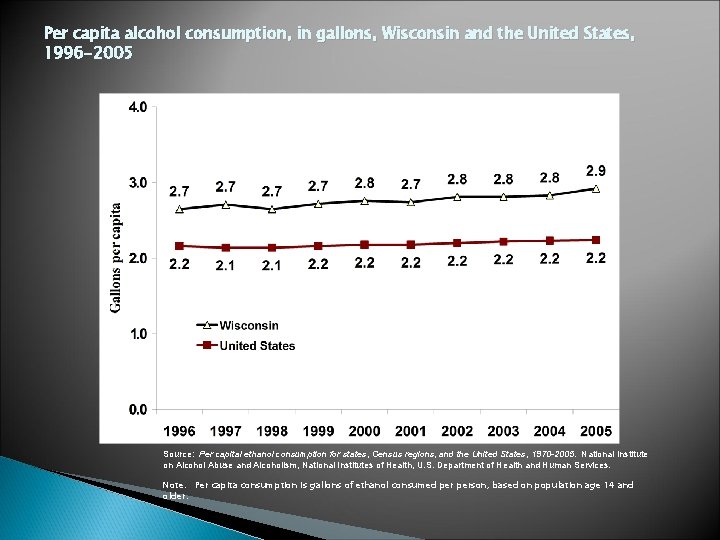
Per capita alcohol consumption, in gallons, Wisconsin and the United States, 1996 -2005 In WI this translates to 996 drinks per drinker per year or 2. 7 drinks/day Source: Per capital ethanol consumption for states, Census regions, and the United States, 1970 -2005. National Institute on Alcohol Abuse and Alcoholism, National Institutes of Health, U. S. Department of Health and Human Services. Note. Per capita consumption is gallons of ethanol consumed person, based on population age 14 and older.
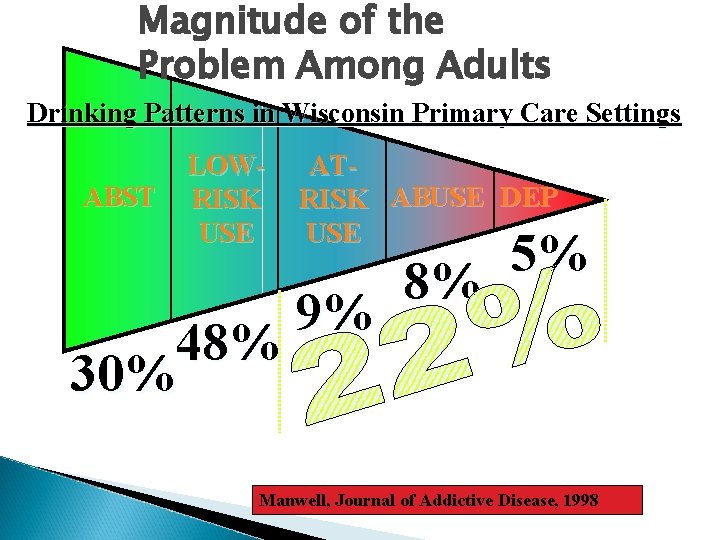
Magnitude of the Problem Among Adults Drinking Patterns in Wisconsin Primary Care Settings ABST LOWRISK USE 48% 30% ATRISK ABUSE DEP USE 9% 5% 8% Manwell, Journal of Addictive Disease, 1998
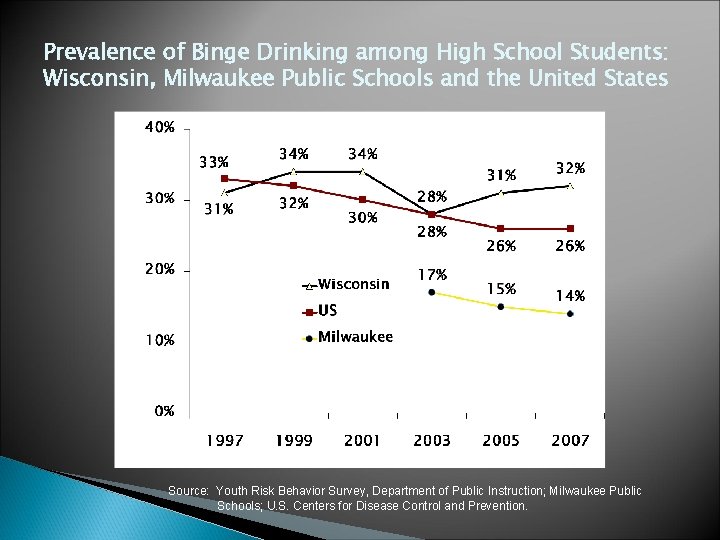
Prevalence of Binge Drinking among High School Students: Wisconsin, Milwaukee Public Schools and the United States Source: Youth Risk Behavior Survey, Department of Public Instruction; Milwaukee Public Schools; U. S. Centers for Disease Control and Prevention.
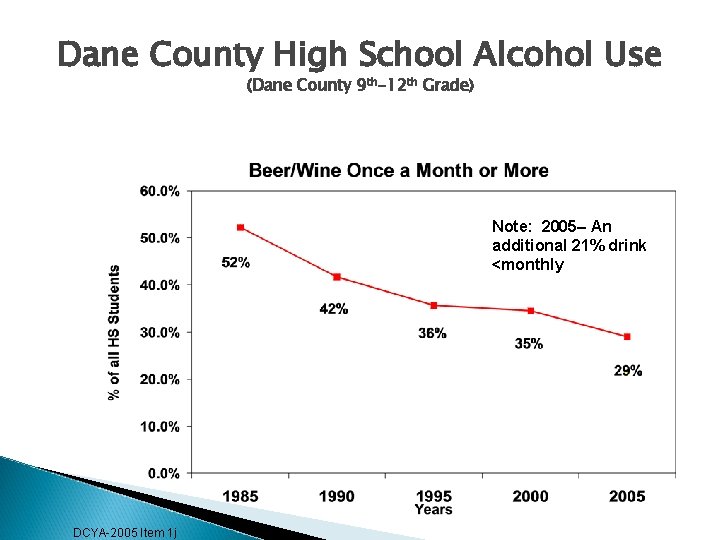
Dane County High School Alcohol Use (Dane County 9 th-12 th Grade) Note: 2005– An additional 21% drink <monthly DCYA-2005 Item 1 j
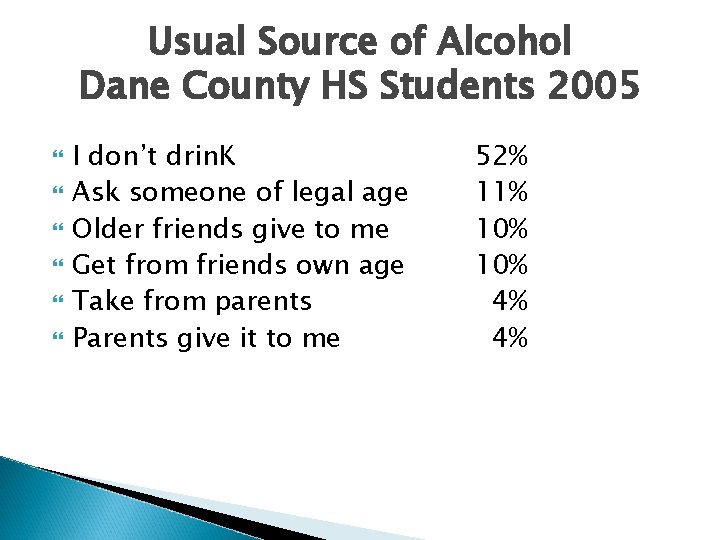
Usual Source of Alcohol Dane County HS Students 2005 I don’t drin. K Ask someone of legal age Older friends give to me Get from friends own age Take from parents Parents give it to me 52% 11% 10% 4% 4%
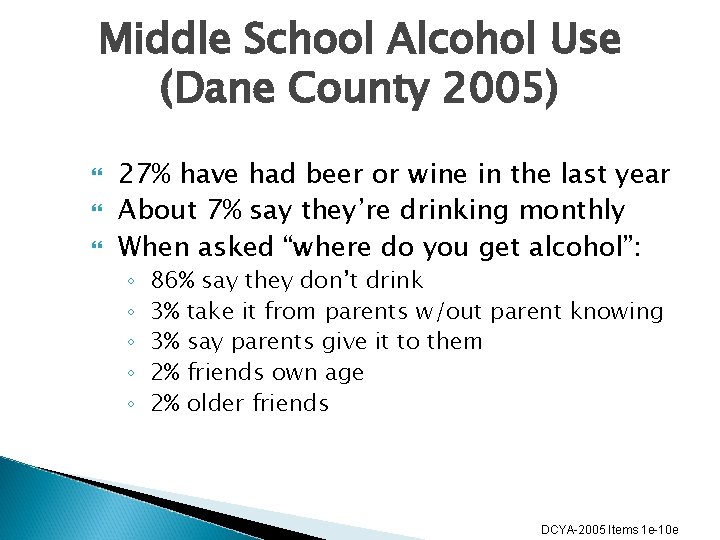
Middle School Alcohol Use (Dane County 2005) 27% have had beer or wine in the last year About 7% say they’re drinking monthly When asked “where do you get alcohol”: ◦ ◦ ◦ 86% say they don’t drink 3% take it from parents w/out parent knowing 3% say parents give it to them 2% friends own age 2% older friends DCYA-2005 Items 1 e-10 e
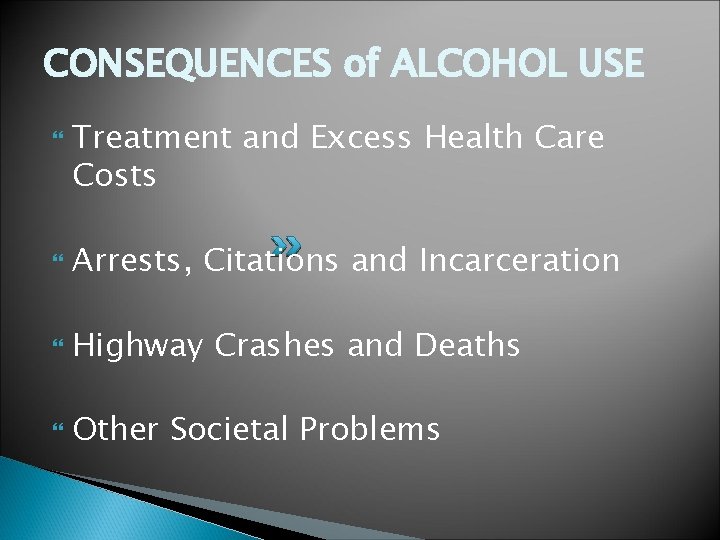
CONSEQUENCES of ALCOHOL USE Treatment and Excess Health Care Costs Arrests, Citations and Incarceration Highway Crashes and Deaths Other Societal Problems
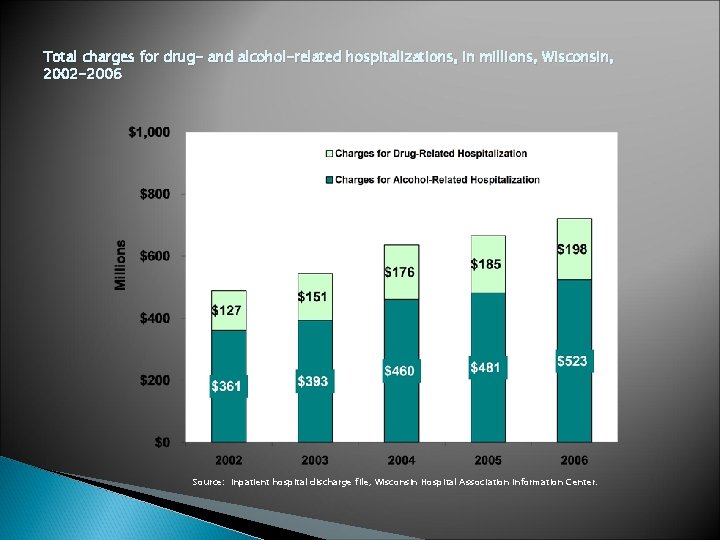
Total charges for drug- and alcohol-related hospitalizations, in millions, Wisconsin, 2002 -2006 Source: Inpatient hospital discharge file, Wisconsin Hospital Association Information Center.
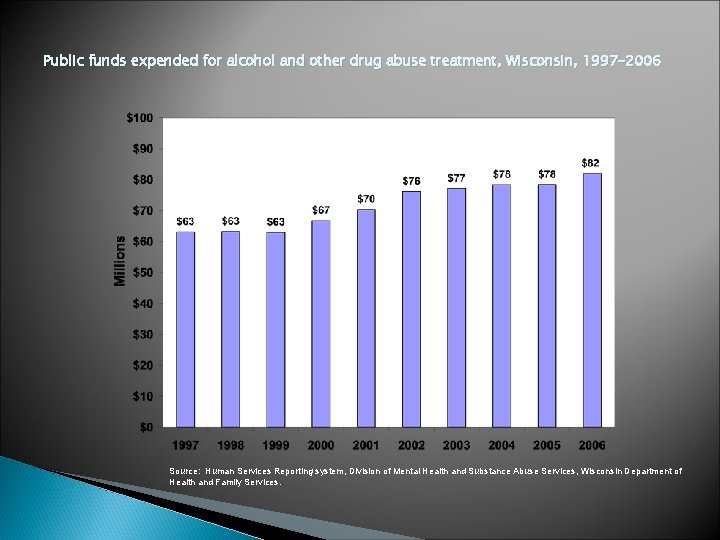
Public funds expended for alcohol and other drug abuse treatment, Wisconsin, 1997 -2006 Source: Human Services Reporting system, Division of Mental Health and Substance Abuse Services, Wisconsin Department of Health and Family Services.
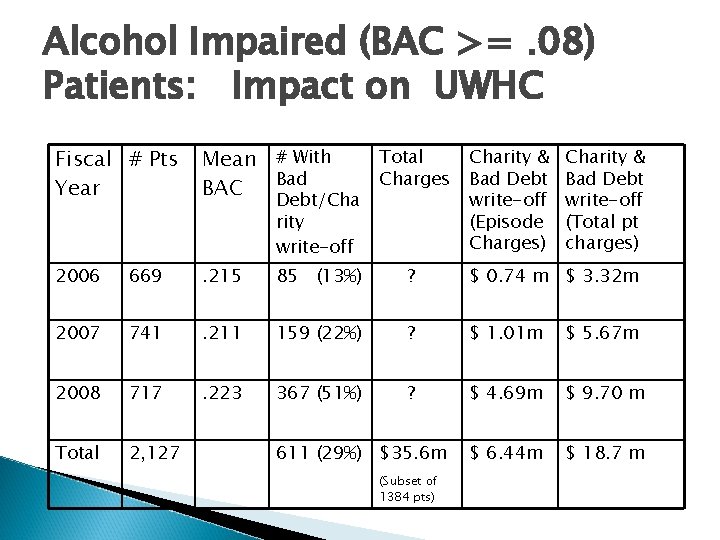
Alcohol Impaired (BAC >=. 08) Patients: Impact on UWHC Fiscal # Pts Year Mean # With Bad BAC 2006 669 . 215 85 (13%) ? $ 0. 74 m $ 3. 32 m 2007 741 . 211 159 (22%) ? $ 1. 01 m $ 5. 67 m 2008 717 . 223 367 (51%) ? $ 4. 69 m $ 9. 70 m Total 2, 127 $ 6. 44 m $ 18. 7 m Debt/Cha rity write-off Total Charges 611 (29%) $35. 6 m (Subset of 1384 pts) Charity & Bad Debt write-off (Episode Charges) Charity & Bad Debt write-off (Total pt charges)
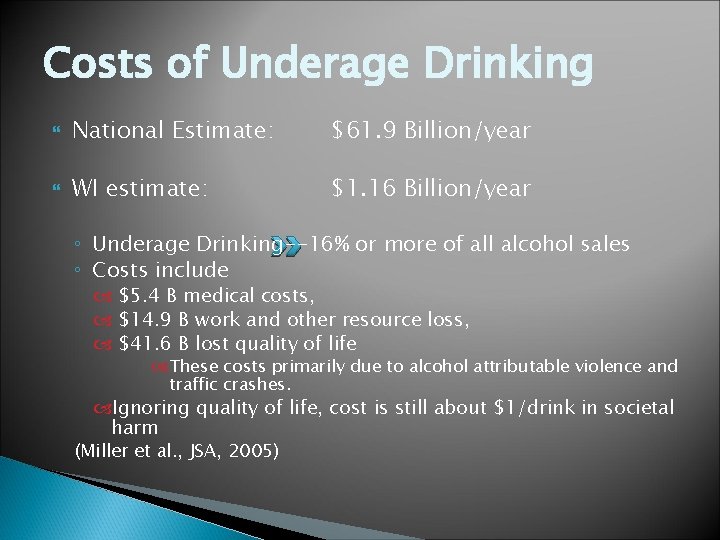
Costs of Underage Drinking National Estimate: $61. 9 Billion/year WI estimate: $1. 16 Billion/year ◦ Underage Drinking--16% or more of all alcohol sales ◦ Costs include $5. 4 B medical costs, $14. 9 B work and other resource loss, $41. 6 B lost quality of life These costs primarily due to alcohol attributable violence and traffic crashes. Ignoring quality of life, cost is still about $1/drink in societal harm (Miller et al. , JSA, 2005)
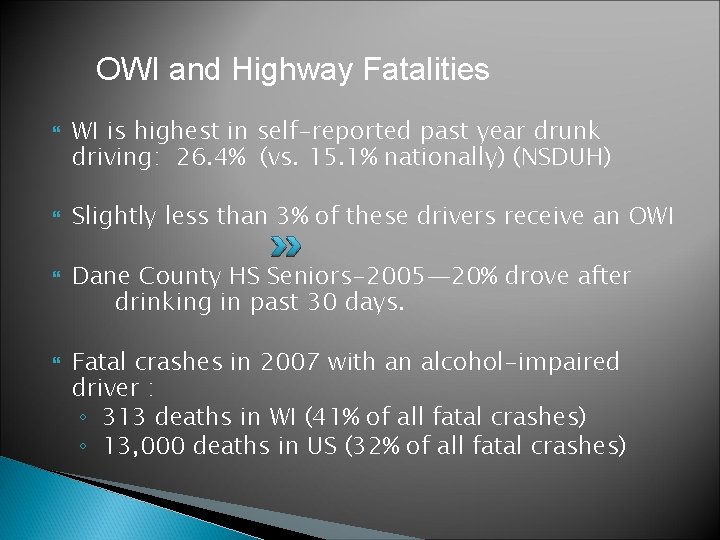
OWI and Highway Fatalities WI is highest in self-reported past year drunk driving: 26. 4% (vs. 15. 1% nationally) (NSDUH) Slightly less than 3% of these drivers receive an OWI Dane County HS Seniors-2005— 20% drove after drinking in past 30 days. Fatal crashes in 2007 with an alcohol-impaired driver : ◦ 313 deaths in WI (41% of all fatal crashes) ◦ 13, 000 deaths in US (32% of all fatal crashes)
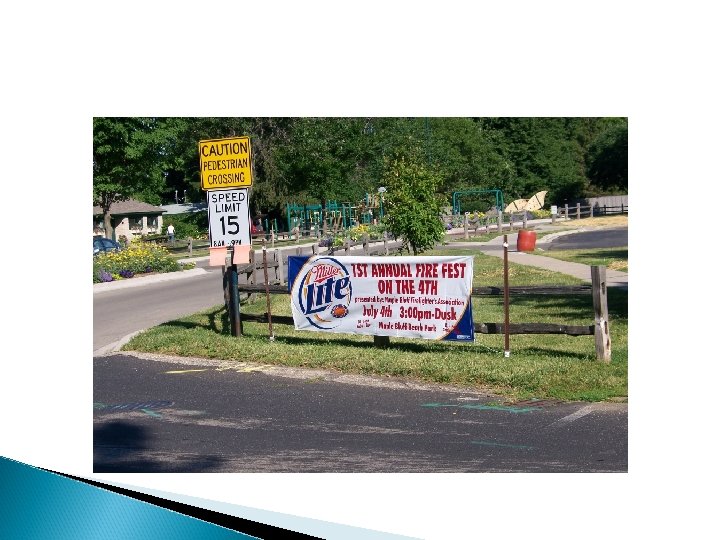
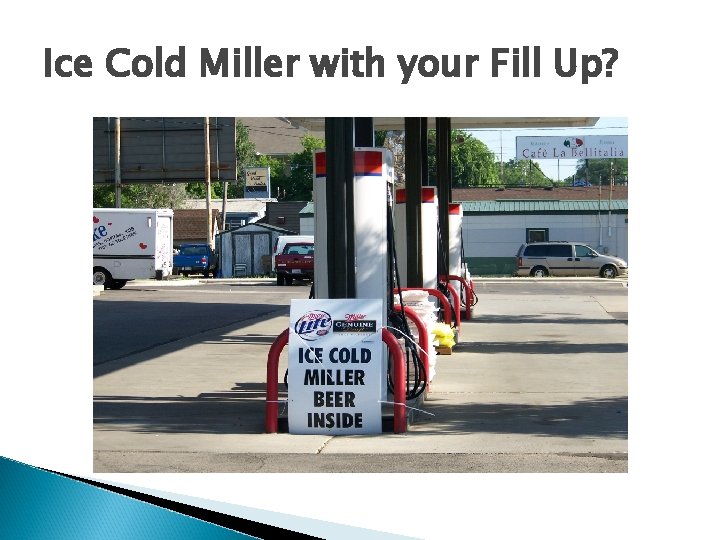
Ice Cold Miller with your Fill Up?
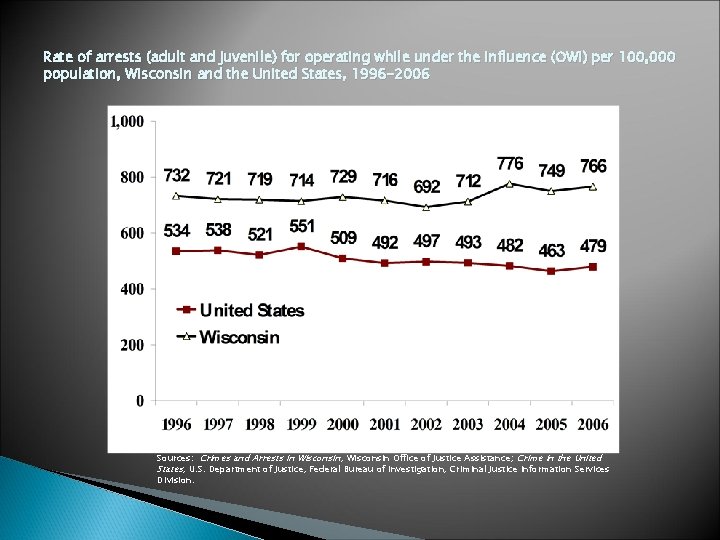
Rate of arrests (adult and juvenile) for operating while under the influence (OWI) per 100, 000 population, Wisconsin and the United States, 1996 -2006 Sources: Crimes and Arrests in Wisconsin , Wisconsin Office of Justice Assistance; Crime in the United States, U. S. Department of Justice, Federal Bureau of Investigation, Criminal Justice Information Services Division.
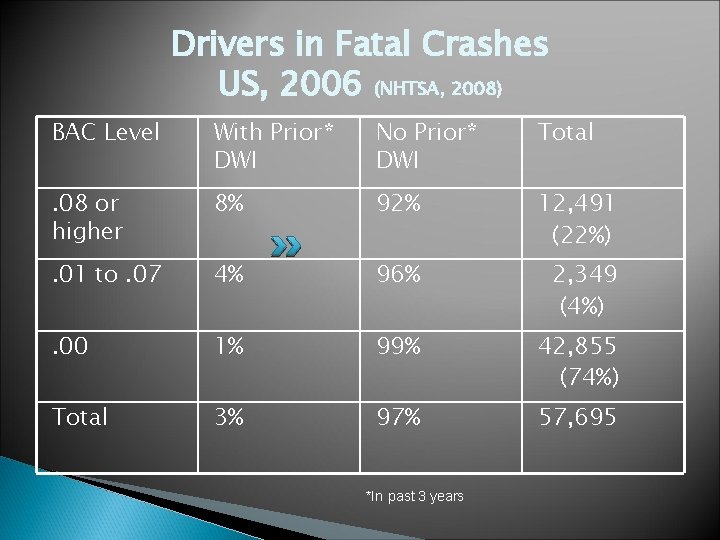
Drivers in Fatal Crashes US, 2006 (NHTSA, 2008) BAC Level With Prior* DWI No Prior* DWI Total . 08 or higher 8% 92% 12, 491 (22%) . 01 to. 07 4% 96% 2, 349 (4%) . 00 1% 99% 42, 855 (74%) Total 3% 97% 57, 695 *In past 3 years
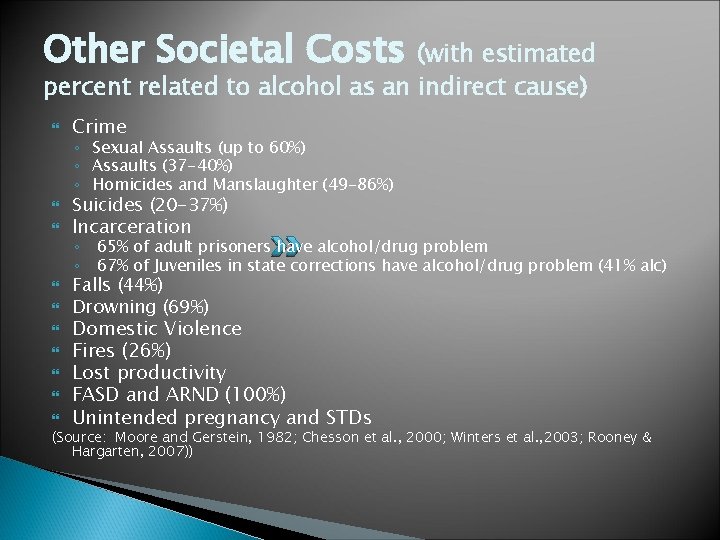
Other Societal Costs (with estimated percent related to alcohol as an indirect cause) Crime Suicides (20 -37%) ◦ Sexual Assaults (up to 60%) ◦ Assaults (37 -40%) ◦ Homicides and Manslaughter (49 -86%) Incarceration ◦ ◦ 65% of adult prisoners have alcohol/drug problem 67% of Juveniles in state corrections have alcohol/drug problem (41% alc) Falls (44%) Drowning (69%) Domestic Violence Fires (26%) Lost productivity FASD and ARND (100%) Unintended pregnancy and STDs (Source: Moore and Gerstein, 1982; Chesson et al. , 2000; Winters et al. , 2003; Rooney & Hargarten, 2007))
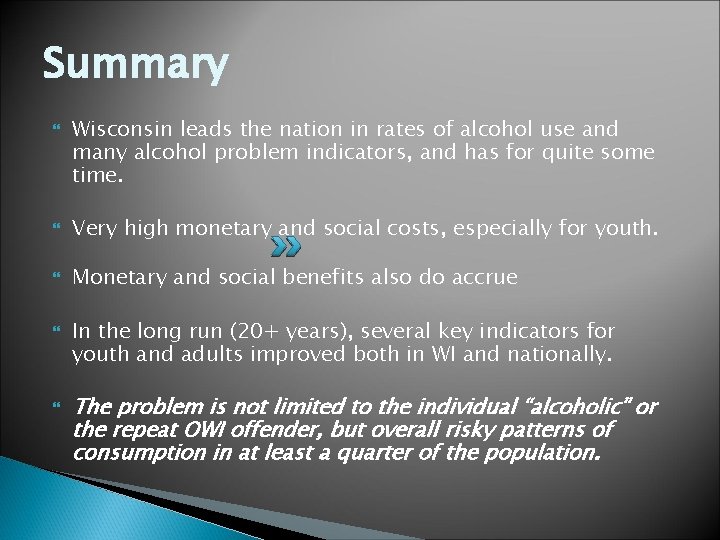
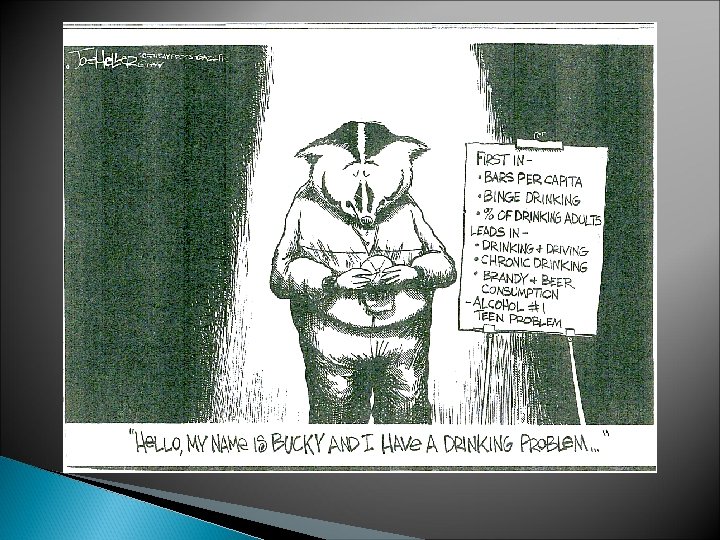
Summary Wisconsin leads the nation in rates of alcohol use and many alcohol problem indicators, and has for quite some time. Very high monetary and social costs, especially for youth. Monetary and social benefits also do accrue In the long run (20+ years), several key indicators for youth and adults improved both in WI and nationally. The problem is not limited to the individual “alcoholic” or the repeat OWI offender, but overall risky patterns of consumption in at least a quarter of the population.
Solutions: Five A’s of Alcohol Control* ◦ Access to/availability of alcohol ◦ Affordability of alcohol ◦ Attractiveness of alcohol use ◦ Acceptability of risky and underage alcohol use ◦ And…safety is also important *Thanks to Julia Sherman
Evidence-Based Program and Policy Solutions Environmental Approaches to Prevention ◦ Cost of alcohol Alcohol taxes Drink specials ◦ Access/availability # retail outlets, hours, density Social availability ◦ Advertising and promotion restrictions ◦ Transportation and OWI Policy Increase perceived risk of OWI arrest Graduated licensing ◦ Promoting safety (server training, ride programs, dose-effects education) ◦ SPF-SIG
Evidence-Based Program and Policy Solutions (continued) Educational Interventions ◦ Increase perceived harm Education and media approaches Press coverage of alc-involved incidents? ◦ Social/Peer/Community Norm Change ◦ Life Skills approaches ◦ Family strengthening and parent skills training programs
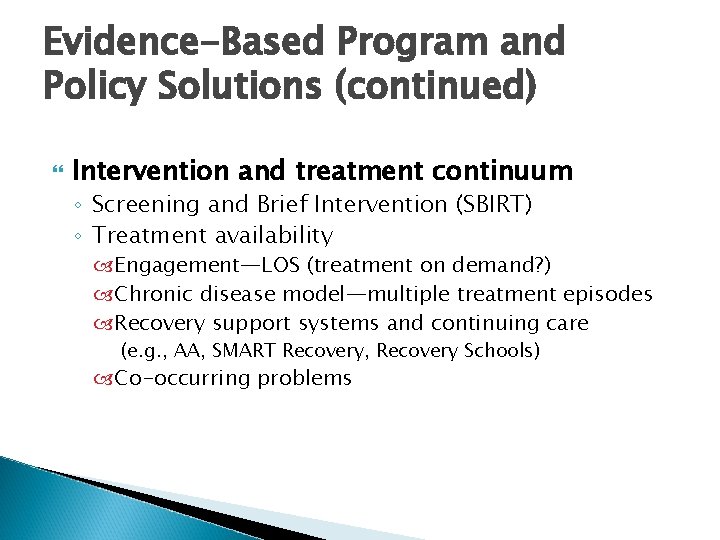
Evidence-Based Program and Policy Solutions (continued) Intervention and treatment continuum ◦ Screening and Brief Intervention (SBIRT) ◦ Treatment availability Engagement—LOS (treatment on demand? ) Chronic disease model—multiple treatment episodes Recovery support systems and continuing care (e. g. , AA, SMART Recovery, Recovery Schools) Co-occurring problems