
The SNAP Integral Field Spectrograph Specifications and Requirements

![Optimisation [0. 35 -1. 7] m l/dl =100, constant 2 bras 1 pixel/elt resolution](https://slidetodoc.com/presentation_image_h2/0fbb1dbf284f7de5687df0d7c522f465/image-10.jpg "Optimisation [0. 35 -1. 7] m l/dl =100, constant 2 bras 1 pixel/elt resolution")



![Absolute redshift error Requirement A. Kim note Use the emission line for [OII]3727 as](https://slidetodoc.com/presentation_image_h2/0fbb1dbf284f7de5687df0d7c522f465/image-29.jpg "Absolute redshift error Requirement A. Kim note Use the emission line for [OII]3727 as")

- Slides: 31
The SNAP Integral Field Spectrograph Specifications and Requirements Anne EALET Project scientist CPPM, CNRS (IN 2 P 3) FRANCE November 15 & 16, 2005 Anne EALET
Overview — Mission requirements —The SNAP Spectrograph specifications —Optimization of the performances —The calibrations requirements —Technical requirements —Summary November 15 & 16, 2005 Anne EALET 2
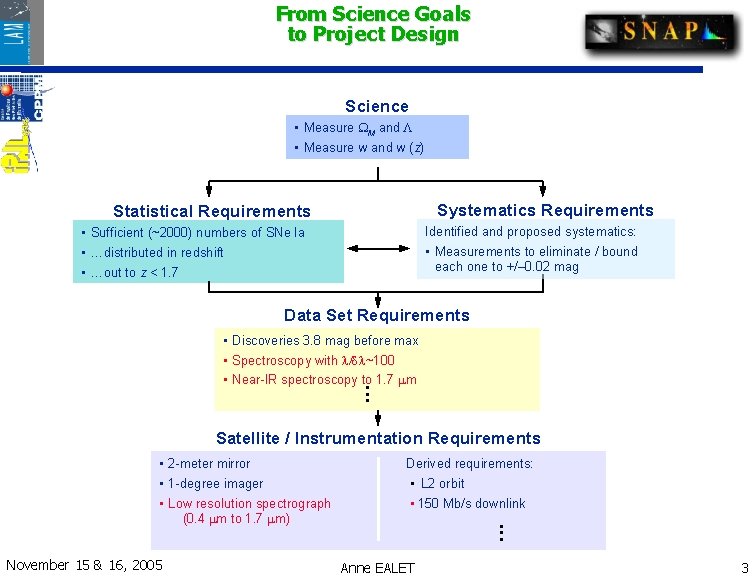
From Science Goals to Project Design Science • Measure M and • Measure w and w (z) Systematics Requirements Statistical Requirements Identified and proposed systematics: • Sufficient (~2000) numbers of SNe Ia • …distributed in redshift • …out to z < 1. 7 • Measurements to eliminate / bound each one to +/– 0. 02 mag Data Set Requirements • Discoveries 3. 8 mag before max • Spectroscopy with l/dl~100 • Near-IR spectroscopy to 1. 7 m • • • Satellite / Instrumentation Requirements • 2 -meter mirror • 1 -degree imager • Low resolution spectrograph (0. 4 m to 1. 7 m) November 15 & 16, 2005 Derived requirements: • L 2 orbit • 150 Mb/s downlink • • • Anne EALET 3
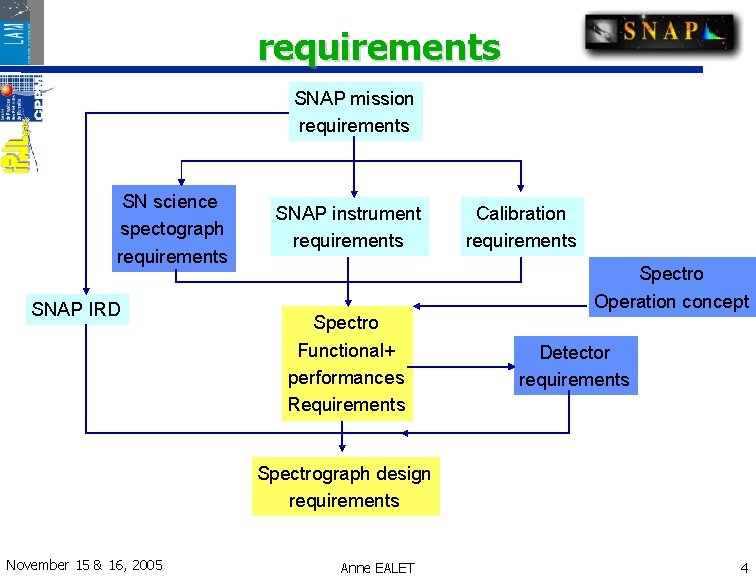
requirements SNAP mission requirements SN science spectograph requirements SNAP IRD SNAP instrument requirements Calibration requirements Spectro Operation concept Spectro Functional+ performances Requirements Detector requirements Spectrograph design requirements November 15 & 16, 2005 Anne EALET 4
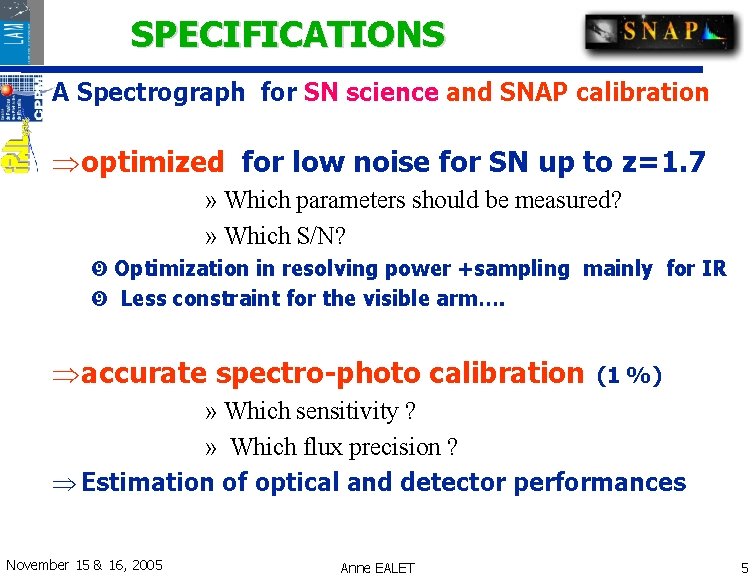
SPECIFICATIONS A Spectrograph for SN science and SNAP calibration Þoptimized for low noise for SN up to z=1. 7 » Which parameters should be measured? » Which S/N? Optimization in resolving power +sampling mainly for IR Less constraint for the visible arm…. Þaccurate spectro-photo calibration (1 %) » Which sensitivity ? » Which flux precision ? Þ Estimation of optical and detector performances November 15 & 16, 2005 Anne EALET 5
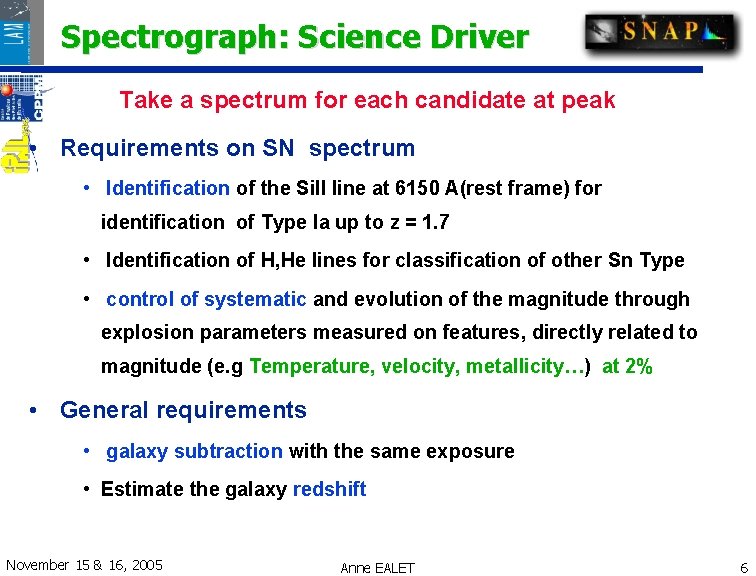
Spectrograph: Science Driver Take a spectrum for each candidate at peak • Requirements on SN spectrum • Identification of the Si. II line at 6150 A(rest frame) for identification of Type Ia up to z = 1. 7 • Identification of H, He lines for classification of other Sn Type • control of systematic and evolution of the magnitude through explosion parameters measured on features, directly related to magnitude (e. g Temperature, velocity, metallicity…) at 2% • General requirements • galaxy subtraction with the same exposure • Estimate the galaxy redshift November 15 & 16, 2005 Anne EALET 6
SN science requirements (or why we need a spectrograph) November 15 & 16, 2005 Anne EALET 7
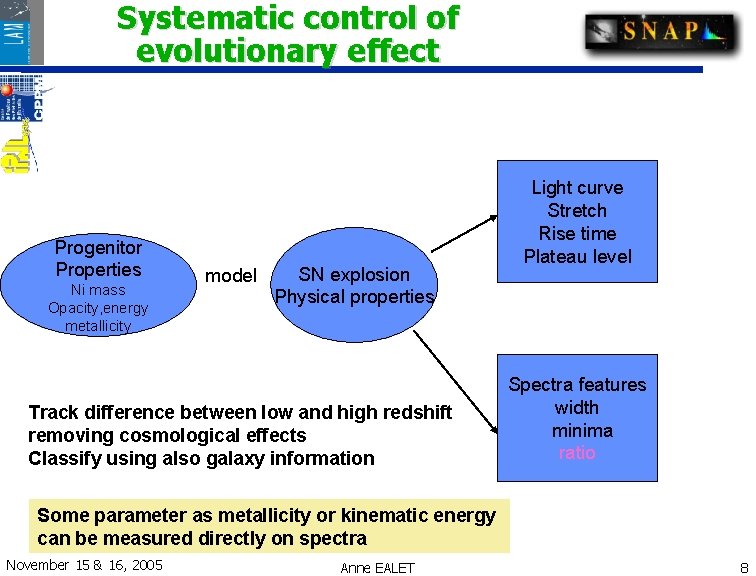
Systematic control of evolutionary effect Progenitor Properties Ni mass Opacity, energy metallicity model SN explosion Physical properties Track difference between low and high redshift removing cosmological effects Classify using also galaxy information Light curve Stretch Rise time Plateau level Spectra features width minima ratio Some parameter as metallicity or kinematic energy can be measured directly on spectra November 15 & 16, 2005 Anne EALET 8
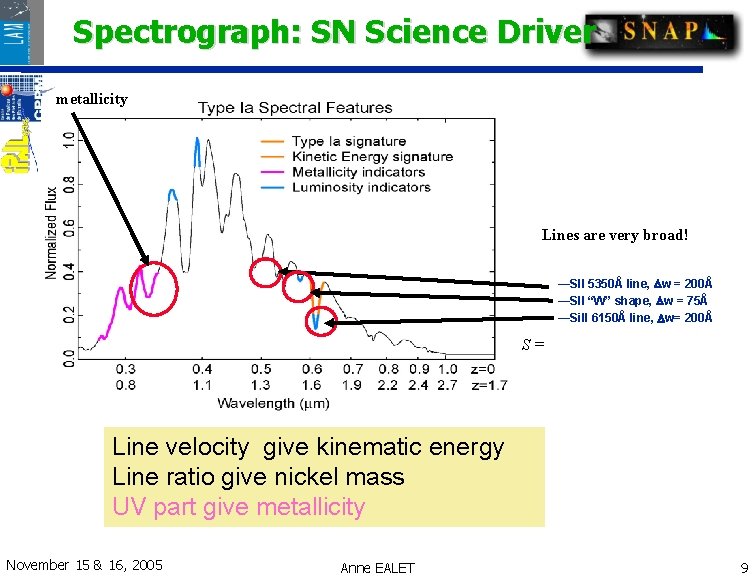
Spectrograph: SN Science Driver metallicity Lines are very broad! —SII 5350Å line, Dw = 200Å —SII “W” shape, Dw = 75Å —Si. II 6150Å line, Dw= 200Å S= Line velocity give kinematic energy Line ratio give nickel mass UV part give metallicity November 15 & 16, 2005 Anne EALET 9
Optimisation [0. 35 -1. 7] m l/dl =100, constant 2 bras 1 pixel/elt resolution Dithering Pixel size: 0. 15” Sn model: Hoeflich/Nugent -temperature T -velocity V -progenitor metallicity Z Z V T spectrum Derivatives on parameters T, V, Z Caveats: ETC calculator Instrument properties, dl… S/N = f(dl) only igeneral form of spectra (no ratio) s. M • 2 Use = dm/dx sij 2 dm/dx j dm/dx are s • i. Slopes =fi(dl, S/N, z), i=x only knownsfrom<model 2% M Þ minimisation is ok j ÞExposure time can be over/under estimate s. Mmin November 15 & 16, 2005 Exposure time Anne EALET dl, pixel size, pixel/PSF 10
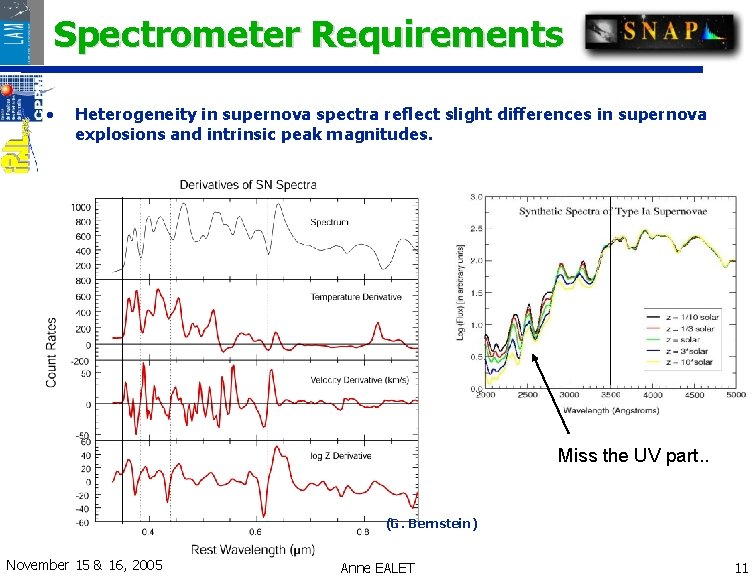
Spectrometer Requirements • Heterogeneity in supernova spectra reflect slight differences in supernova explosions and intrinsic peak magnitudes. Miss the UV part. . (G. Bernstein) November 15 & 16, 2005 Anne EALET 11
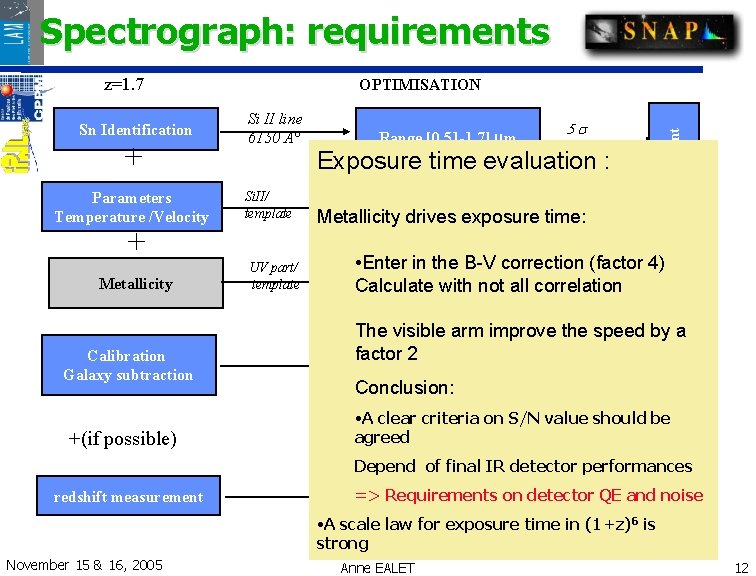
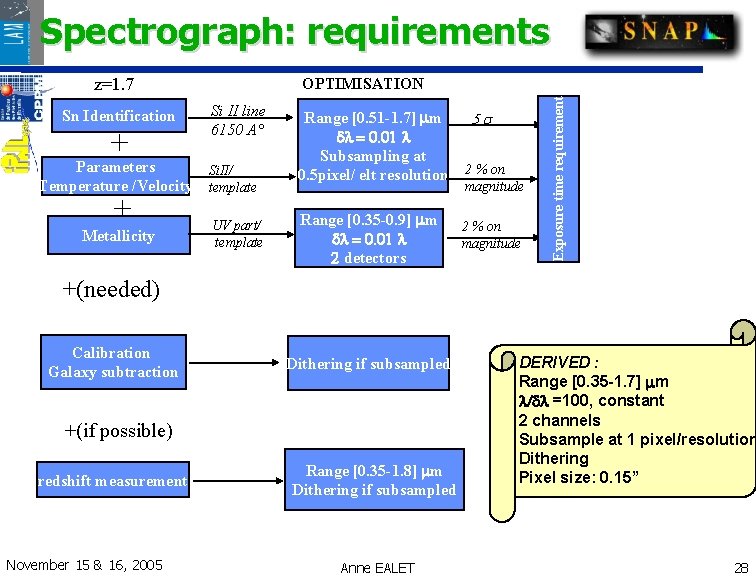
Spectrograph: requirements z=1. 7 + Parameters Temperature /Velocity Si II line 6150 A° Si. II/ template + Metallicity +(needed) Calibration Galaxy subtraction +(if possible) redshift measurement UV part/ template Range [0. 51 -1. 7] m 5 s dl = 0. 01 levaluation : Exposure time Subsampling at 0. 5 pixel/ elt resolution Metallicity drives exposure 2 % on magnitude time: • Enter in the B-V correction 2 % on(factor 4) Range [0. 3 -0. 9] m extinction Calculate with not all correlation 2 detectors Exposure time requirement Sn Identification OPTIMISATION The visible arm improve the speed by a factor 2 Dithering if subsampled Conclusion: • A clear criteria on S/N value should be agreed Depend of final IR detector performances Range [0. 35 -1] m => Requirements dl = 0. 01 l on detector QE and noise • A scale law for exposure time in (1+z)6 is strong November 15 & 16, 2005 Anne EALET 12
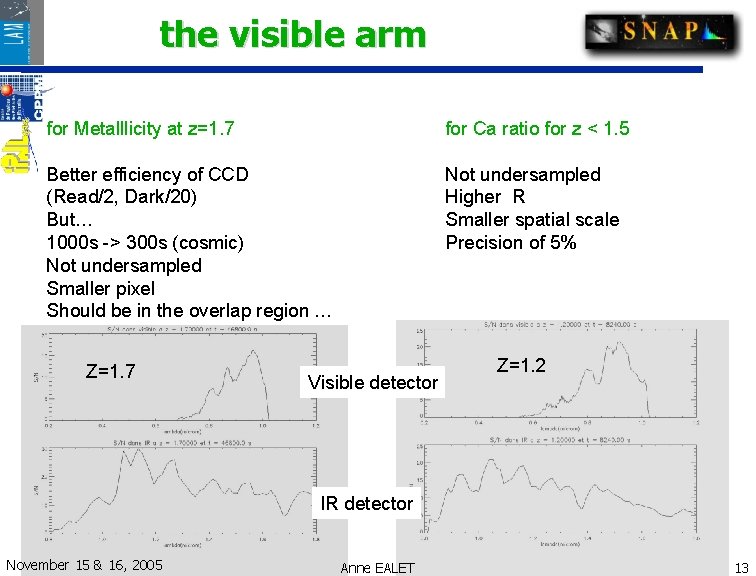
the visible arm for Metalllicity at z=1. 7 for Ca ratio for z < 1. 5 Better efficiency of CCD (Read/2, Dark/20) But… 1000 s -> 300 s (cosmic) Not undersampled Smaller pixel Should be in the overlap region … Not undersampled Higher R Smaller spatial scale Precision of 5% Z=1. 7 Visible detector Z=1. 2 IR detector November 15 & 16, 2005 Anne EALET 13
SOME SIMULATED LOW RESOLUTION SPECTRUM AFTER CALIBRATION BEFORE CALIBRATION Z=1. 7 November 15 & 16, 2005 Anne EALET 14
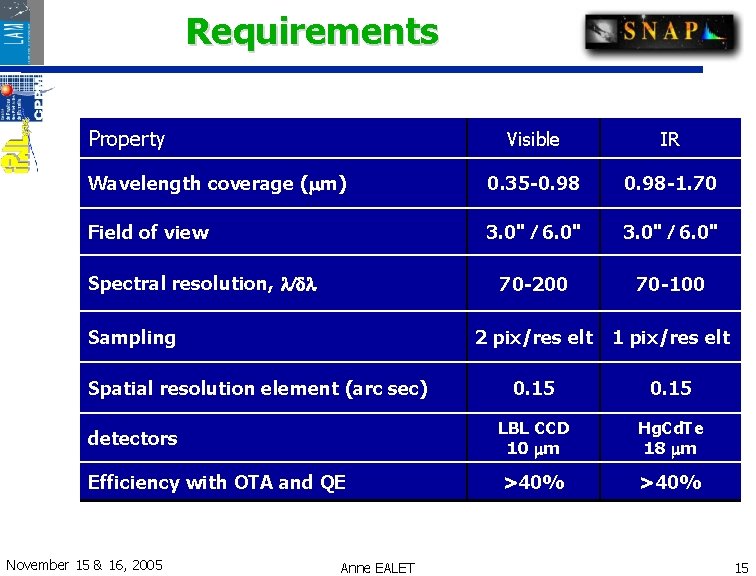
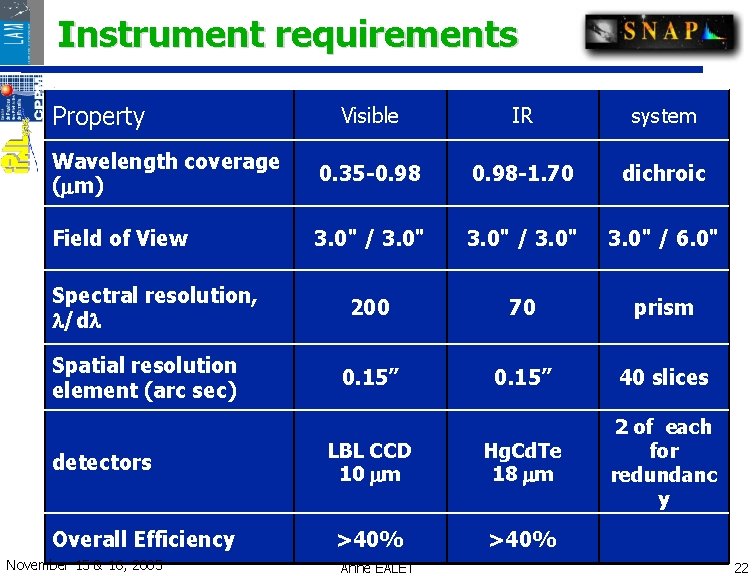
Requirements Property Visible IR Wavelength coverage ( m) 0. 35 -0. 98 -1. 70 Field of view 3. 0" / 6. 0" 70 -200 70 -100 2 pix/res elt 1 pix/res elt 0. 15 detectors LBL CCD 10 m Hg. Cd. Te 18 m Efficiency with OTA and QE >40% Spectral resolution, l/dl Sampling Spatial resolution element (arc sec) November 15 & 16, 2005 Anne EALET 15
SN calibration requirements November 15 & 16, 2005 Anne EALET 16
Spectro-photometry requirement From the SNAP calibration requirements: Spectrograph help to limit the error transfer from primary (standard) stars to secondary stars • • Register very bright stars up to V=0 take bright spectrum at 1% accuracy increase the dynamical range to register faint SN up to mab=26 and to register very bright stars to mv=0 with a 1% accuracy November 15 & 16, 2005 Anne EALET 17
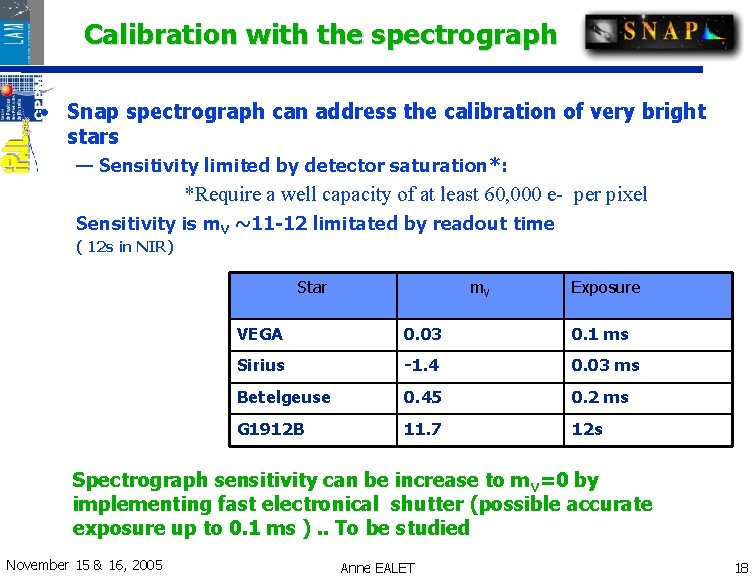
Calibration with the spectrograph • Snap spectrograph can address the calibration of very bright stars — Sensitivity limited by detector saturation*: *Require a well capacity of at least 60, 000 e- per pixel Sensitivity is m. V ~11 -12 limitated by readout time ( 12 s in NIR) Star m. V Exposure VEGA 0. 03 0. 1 ms Sirius -1. 4 0. 03 ms Betelgeuse 0. 45 0. 2 ms G 1912 B 11. 7 12 s Spectrograph sensitivity can be increase to m. V=0 by implementing fast electronical shutter (possible accurate exposure up to 0. 1 ms ). . To be studied November 15 & 16, 2005 Anne EALET 18
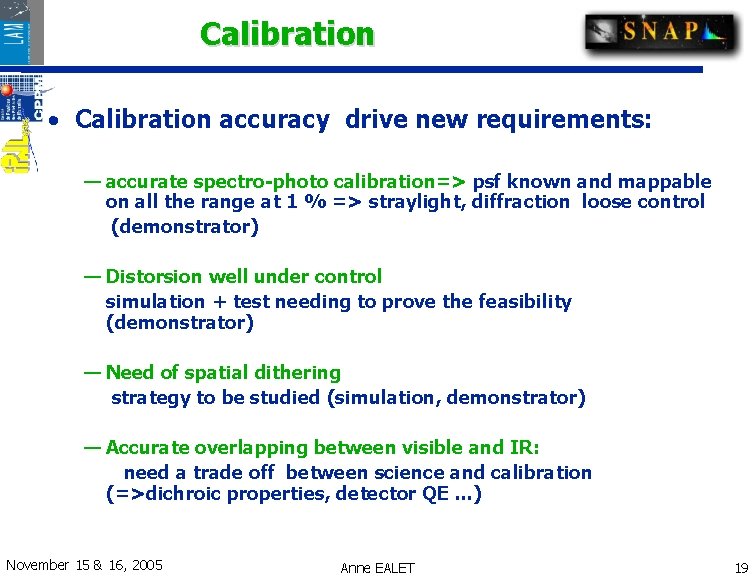
Calibration • Calibration accuracy drive new requirements: — accurate spectro-photo calibration=> psf known and mappable on all the range at 1 % => straylight, diffraction loose control (demonstrator) — Distorsion well under control simulation + test needing to prove the feasibility (demonstrator) — Need of spatial dithering strategy to be studied (simulation, demonstrator) — Accurate overlapping between visible and IR: need a trade off between science and calibration (=>dichroic properties, detector QE …) November 15 & 16, 2005 Anne EALET 19
To functional requirements —trade off on technologies — space constraints —Mechanism: shutter, dithering — Optical performance — Detector performance —Calibration unit —Operation mode November 15 & 16, 2005 Anne EALET 20
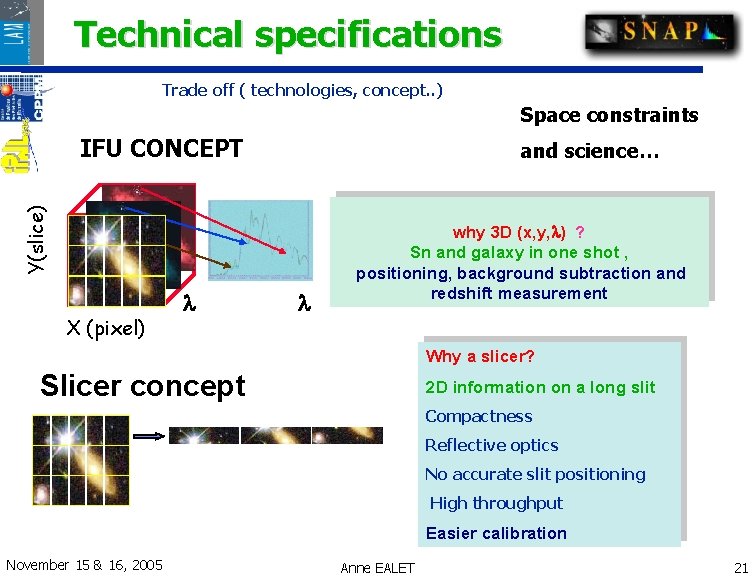
Technical specifications Trade off ( technologies, concept. . ) Space constraints IFU CONCEPT Y(slice) and science… X (pixel) l l why 3 D (x, y, l) ? Sn and galaxy in one shot , positioning, background subtraction and redshift measurement Why a slicer? Slicer concept 2 D information on a long slit Compactness Reflective optics No accurate slit positioning High throughput Easier calibration November 15 & 16, 2005 Anne EALET 21
Instrument requirements Property Visible IR system Wavelength coverage ( m) 0. 35 -0. 98 -1. 70 dichroic Field of View 3. 0" / 3. 0" / 6. 0" 200 70 prism 0. 15” 40 slices LBL CCD 10 m Hg. Cd. Te 18 m 2 of each for redundanc y >40% Spectral resolution, l/dl Spatial resolution element (arc sec) detectors Overall Efficiency November 15 & 16, 2005 Anne EALET 22
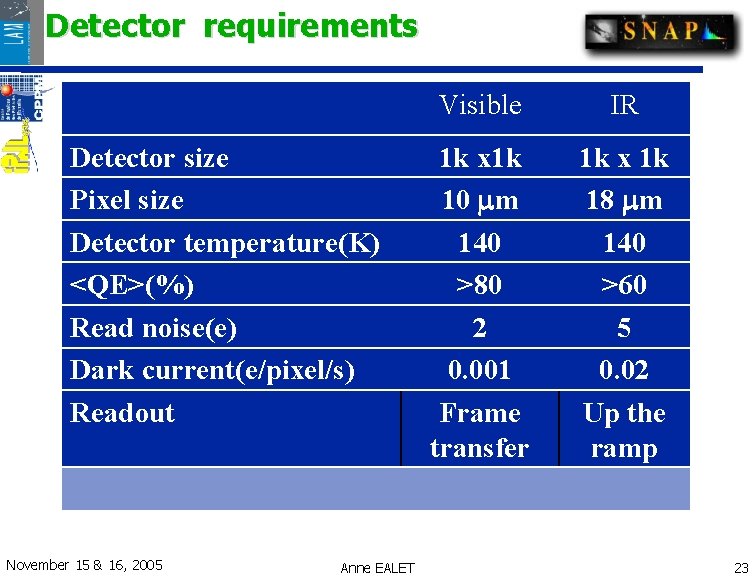
Detector requirements Detector size Pixel size Detector temperature(K) <QE>(%) Read noise(e) Dark current(e/pixel/s) Readout November 15 & 16, 2005 Anne EALET Visible IR 1 k x 1 k 10 m 140 >80 2 0. 001 Frame transfer 1 k x 1 k 18 m 140 >60 5 0. 02 Up the ramp 23
Summary November 15 & 16, 2005 Anne EALET 24
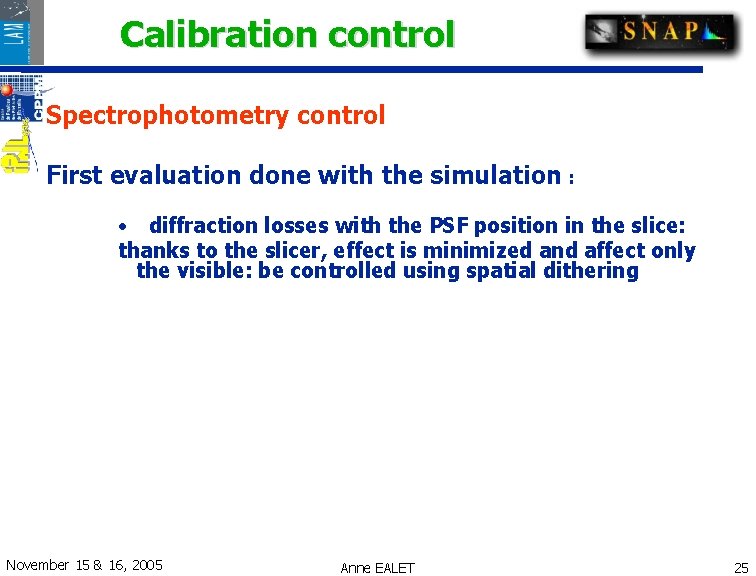
Calibration control Spectrophotometry control First evaluation done with the simulation : • diffraction losses with the PSF position in the slice: thanks to the slicer, effect is minimized and affect only the visible: be controlled using spatial dithering November 15 & 16, 2005 Anne EALET 25
SPARE November 15 & 16, 2005 Anne EALET 26
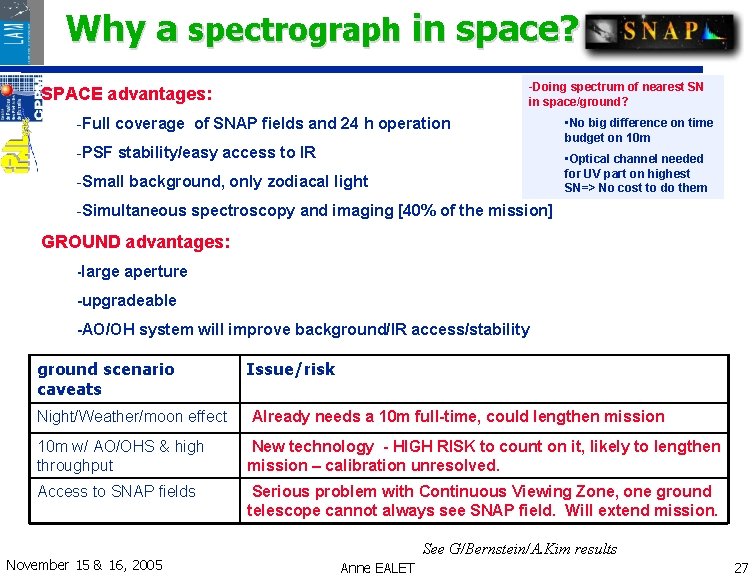
Why a spectrograph in space? -Doing spectrum of nearest SN in space/ground? SPACE advantages: -Full coverage of SNAP fields and 24 h operation -PSF stability/easy access to IR • No big difference on time budget on 10 m • Optical channel needed for UV part on highest SN=> No cost to do them -Small background, only zodiacal light -Simultaneous spectroscopy and imaging [40% of the mission] GROUND advantages: -large aperture -upgradeable -AO/OH system will improve background/IR access/stability ground scenario caveats Issue/risk Night/Weather/moon effect Already needs a 10 m full-time, could lengthen mission 10 m w/ AO/OHS & high throughput New technology - HIGH RISK to count on it, likely to lengthen mission – calibration unresolved. Access to SNAP fields Serious problem with Continuous Viewing Zone, one ground telescope cannot always see SNAP field. Will extend mission. November 15 & 16, 2005 See G/Bernstein/A. Kim results Anne EALET 27
Spectrograph: requirements z=1. 7 + Si II line 6150 A° Parameters Si. II/ Temperature /Velocity template + Metallicity UV part/ template Range [0. 51 -1. 7] m dl = 0. 01 l Subsampling at 0. 5 pixel/ elt resolution Range [0. 35 -0. 9] m dl = 0. 01 l 2 detectors 5 s 2 % on magnitude Exposure time requirement Sn Identification OPTIMISATION +(needed) Calibration Galaxy subtraction Dithering if subsampled +(if possible) redshift measurement November 15 & 16, 2005 Range [0. 35 -1. 8] m Dithering if subsampled Anne EALET DERIVED : Range [0. 35 -1. 7] m l/dl =100, constant 2 channels Subsample at 1 pixel/resolution Dithering Pixel size: 0. 15” 28
Absolute redshift error Requirement A. Kim note Use the emission line for [OII]3727 as estimator No dithering Dithering will improve with a factor 2 in the IR November 15 & 16, 2005 dz = (1+z) * dl /dx * pix-size / l / pix_factor Anne EALET 29
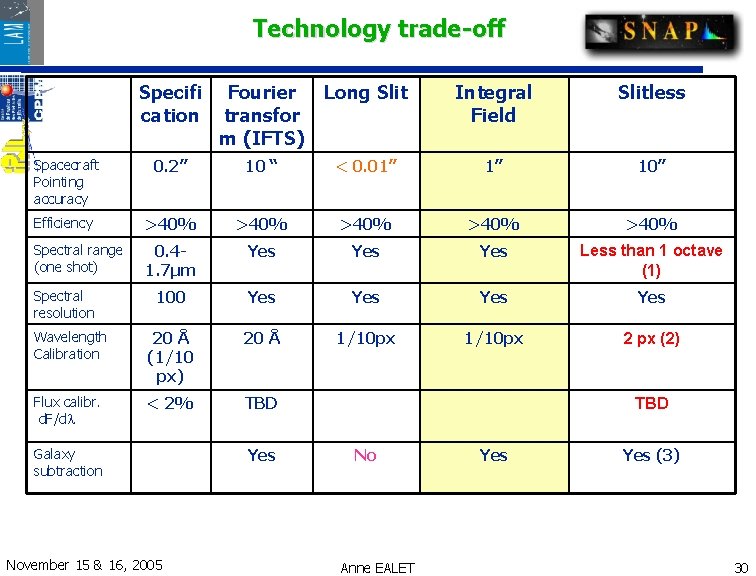
Technology trade-off Specifi cation Fourier transfor m (IFTS) Long Slit Integral Field Slitless Spacecraft Pointing accuracy 0. 2” 10 “ < 0. 01” 1” 10” Efficiency >40% >40% Spectral range (one shot) 0. 41. 7µm Yes Yes Less than 1 octave (1) 100 Yes Yes Wavelength Calibration 20 Å (1/10 px) 20 Å 1/10 px 2 px (2) Flux calibr. d. F/dl < 2% TBD Spectral resolution Galaxy subtraction November 15 & 16, 2005 Yes TBD No Anne EALET Yes (3) 30
Technology trade-off IFU type Throughput Spectral domain Filling factor Sensitivity Risk cooling November 15 & 16, 2005 Lenslets+fibre Image slicer 80% 50 -80% >90% Limitated Full Coverage 75 -85% 75 -95% >4 px/ spatial elmt ( noise) 1 px/ Spatial elmt Diffuse light Diffraction Fiber/Lenset Glue Diffraction Mirror alignment Diffraction yes difficult yes Anne EALET 31