
The SNAMP Project Learning how to apply adaptive




- Slides: 48
The SNAMP Project: Learning how to apply adaptive management in the Sierra Nevada Forest Plan Amendment • Second Quarterly Meeting • November 29 th 2007 • Auburn CA
Outline for Public Meeting • 1. Review our Guiding Principles and Key Agreements • 2. Project Timeline & Team Updates • 3. Discussion • Public Meeting Format • Data Sharing • Celebration and Where Do We Go From Here? Sierra Nevada Adaptive Management Project http: //snamp. cnr. berkeley. edu/
Review our guiding principles and key agreements • Ground Rules • Roles and Relationships for this Meeting: • Facilitator: Kim Rodrigues • Recorder: Susan Clark • Roles and Relationships for the Project: • Lead PI: John Battles • New Project Coordinator: Ann Huber Sierra Nevada Adaptive Management Project http: //snamp. cnr. berkeley. edu/
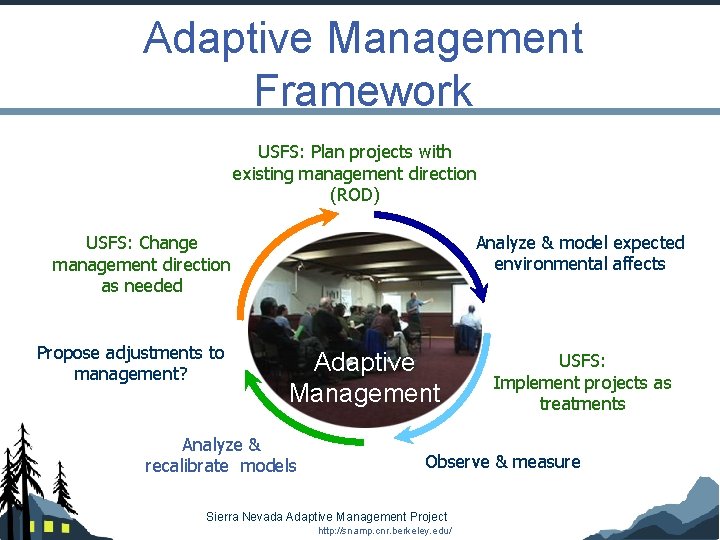
Adaptive Management Framework USFS: Plan projects with existing management direction (ROD) Analyze & model expected environmental affects USFS: Change management direction as needed Propose adjustments to management? Adaptive Management Analyze & recalibrate models USFS: Implement projects as treatments Observe & measure Sierra Nevada Adaptive Management Project http: //snamp. cnr. berkeley. edu/
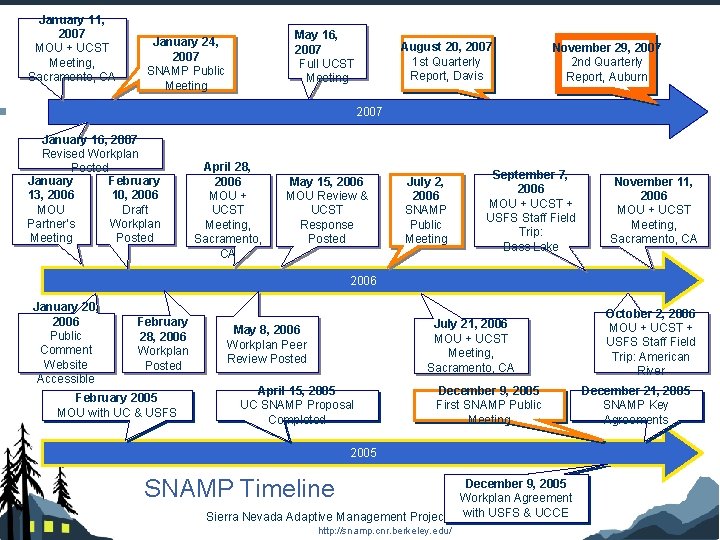
January 11, 2007 MOU + UCST Meeting, Sacramento, CA May 16, 2007 Full UCST Meeting January 24, 2007 SNAMP Public Meeting August 20, 2007 1 st Quarterly Report, Davis November 29, 2007 2 nd Quarterly Report, Auburn 2007 January 16, 2007 Revised Workplan Posted January February 13, 2006 10, 2006 MOU Draft Partner’s Workplan Meeting Posted April 28, 2006 MOU + UCST Meeting, Sacramento, CA May 15, 2006 MOU Review & UCST Response Posted July 2, 2006 SNAMP Public Meeting September 7, 2006 MOU + UCST + USFS Staff Field Trip: Bass Lake November 11, 2006 MOU + UCST Meeting, Sacramento, CA 2006 January 20, 2006 Public Comment Website Accessible February 28, 2006 Workplan Posted February 2005 MOU with UC & USFS July 21, 2006 MOU + UCST Meeting, Sacramento, CA May 8, 2006 Workplan Peer Review Posted April 15, 2005 UC SNAMP Proposal Completed December 9, 2005 First SNAMP Public Meeting 2005 SNAMP Timeline Sierra Nevada Adaptive Management Project http: //snamp. cnr. berkeley. edu/ December 9, 2005 Workplan Agreement with USFS & UCCE October 2, 2006 MOU + UCST + USFS Staff Field Trip: American River December 21, 2005 SNAMP Key Agreements
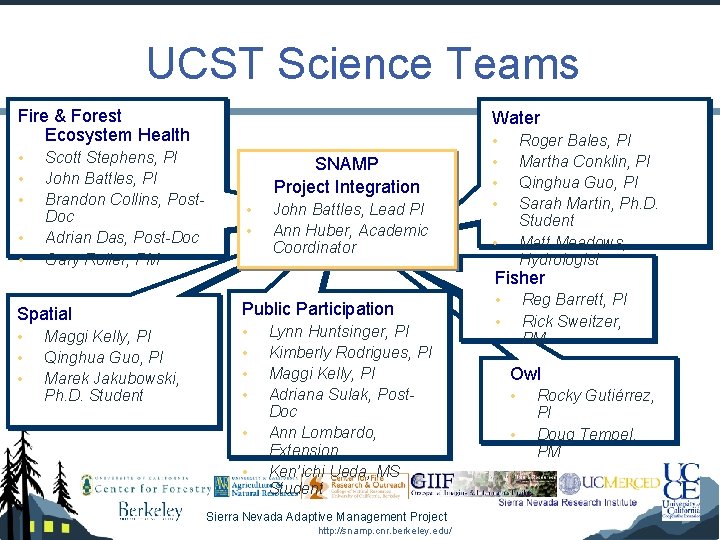
UCST Science Teams Fire & Forest Ecosystem Health • • • Scott Stephens, PI John Battles, PI Brandon Collins, Post. Doc Adrian Das, Post-Doc Gary Roller, PM Spatial • • • Maggi Kelly, PI Qinghua Guo, PI Marek Jakubowski, Ph. D. Student Water SNAMP Project Integration • • John Battles, Lead PI Ann Huber, Academic Coordinator • • Roger Bales, PI Martha Conklin, PI Qinghua Guo, PI Sarah Martin, Ph. D. Student Matt Meadows, Hydrologist • Fisher Public Participation • • • Lynn Huntsinger, PI Kimberly Rodrigues, PI Maggi Kelly, PI Adriana Sulak, Post. Doc Ann Lombardo, Extension Ken’ichi Ueda, MS Student Sierra Nevada Adaptive Management Project http: //snamp. cnr. berkeley. edu/ • • Reg Barrett, PI Rick Sweitzer, PM Owl • • Rocky Gutiérrez, PI Doug Tempel, PM
The SNAMP Study Sites Placeholder for site maps Sierra Nevada Adaptive Management Project http: //snamp. cnr. berkeley. edu/
The SNAMP Study Sites Placeholder for site photos Sierra Nevada Adaptive Management Project http: //snamp. cnr. berkeley. edu/
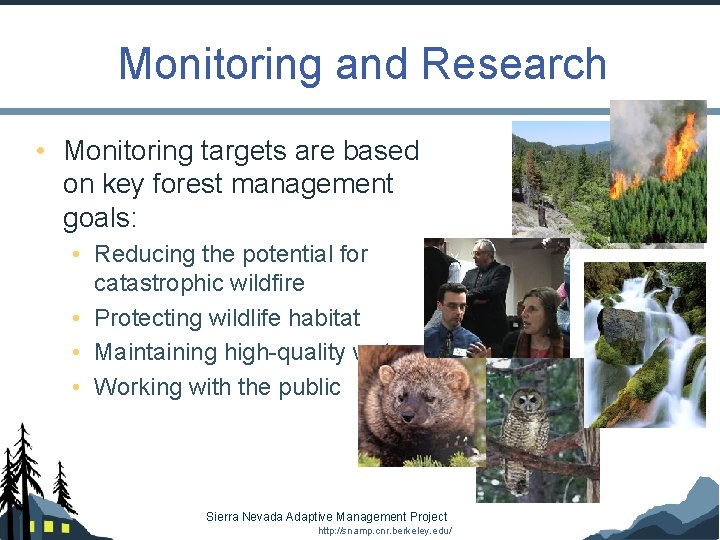
Monitoring and Research • Monitoring targets are based on key forest management goals: • Reducing the potential for catastrophic wildfire • Protecting wildlife habitat • Maintaining high-quality water • Working with the public Sierra Nevada Adaptive Management Project http: //snamp. cnr. berkeley. edu/
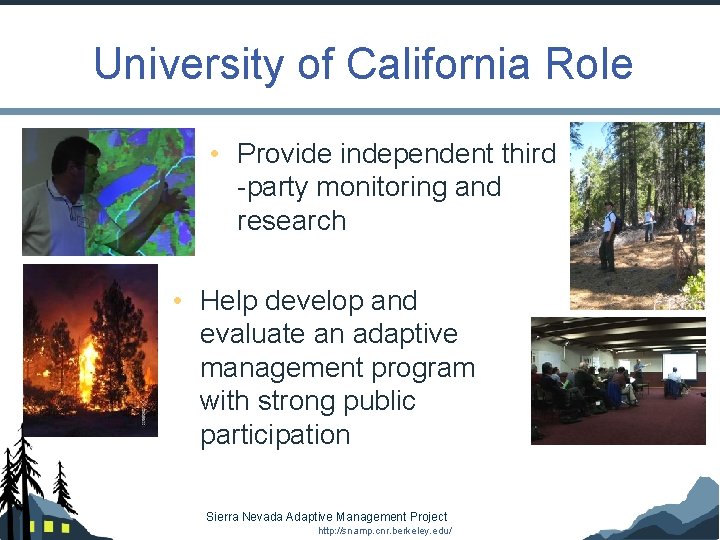
University of California Role • Provide independent third -party monitoring and research • Help develop and evaluate an adaptive management program with strong public participation Sierra Nevada Adaptive Management Project http: //snamp. cnr. berkeley. edu/
Science Team: Our Commitment • Monitoring • We will monitor and analyze impacts of management treatments (and USFS public participation processes) as a third party • Open and Transparent Process • We commit to an open and transparent process, with public participation and full reporting to USFS and public from the beginning • Information Tracking • We will follow how information is gathered and used as it is fed back into the adaptive management process; report on use of information to public, Science Team, and USFS • Public Participation • We will engage the public, as stakeholders, in monitoring and research, to develop a “community of stakeholders” at Sierra Nevada Adaptive Management Project local and regional scales http: //snamp. cnr. berkeley. edu/
Project Integration Group (John) • Accomplishments since Q 1 • Formalized internal UCST communication • Bimonthly UCST conference calls • Weekly communication with each science team regarding their progress • Weekly update email posted to UCST • Coordinated: • Getting science team workplans posted to SNAMP website • Q 2 meeting and logistics planning with PPT • UCST review of data sharing and publications guidelines agreement with PPT • Owl revised proposal discussion and presentation Sierra Nevada Adaptive Management Project http: //snamp. cnr. berkeley. edu/
Project Integration Group (John) • Accomplishments since Q 1 (continued) • Obtained UCST consensus on • Process for proposing new / altered research plans • Revised Neutrality Statement • Communication with MOU Partners • Worked with USFS and Spatial Team to coordinate development of updated, detailed SNAMP project map • Coordination of housing logistics for science teams for next summer • Communication with FS personnel regarding plans for treatment implementation • Served as central information hub for communications between MOU partners and science team members • Developed UCST org chart • Clarified purchasing procedures for UC Berkeley teams Sierra Nevada Adaptive Management Project http: //snamp. cnr. berkeley. edu/
SNAMP Project Challenges (John) • Uneven funding • Implications of one-year delay • Scale Issues Sierra Nevada Adaptive Management Project http: //snamp. cnr. berkeley. edu/
Project Integration Group (John) • Next steps • Progress on data sharing and integration between teams with data • Begin integrating complementary research studies in the Sierra Nevada (meta-replication) • More frequent, improved communication with MOUP Sierra Nevada Adaptive Management Project http: //snamp. cnr. berkeley. edu/
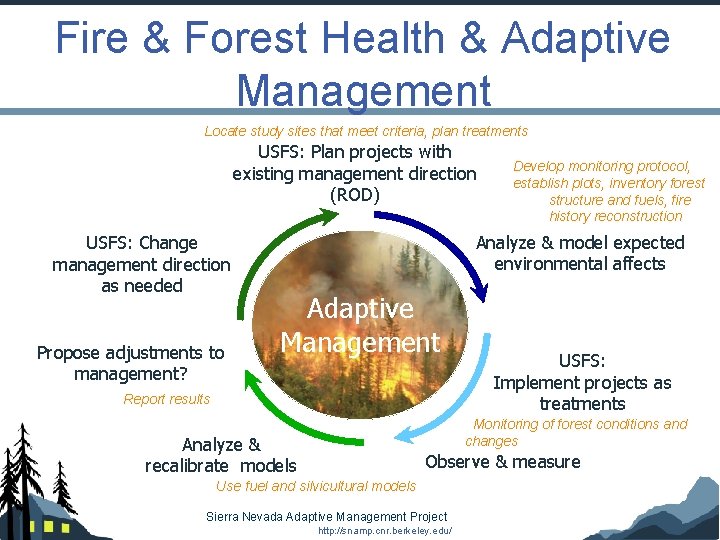
Fire & Forest Health & Adaptive Management Locate study sites that meet criteria, plan treatments USFS: Plan projects with existing management direction (ROD) USFS: Change management direction as needed Propose adjustments to management? Report results Develop monitoring protocol, establish plots, inventory forest structure and fuels, fire history reconstruction Analyze & model expected environmental affects Adaptive Management USFS: Implement projects as treatments Monitoring of forest conditions and changes Analyze & recalibrate models Observe & measure Use fuel and silvicultural models Sierra Nevada Adaptive Management Project http: //snamp. cnr. berkeley. edu/
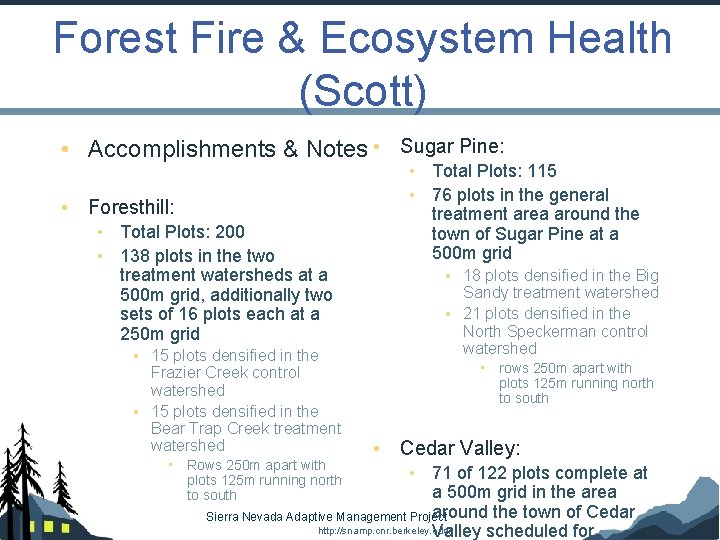
Forest Fire & Ecosystem Health (Scott) • Accomplishments & Notes • Sugar Pine: • Foresthill: • Total Plots: 200 • 138 plots in the two treatment watersheds at a 500 m grid, additionally two sets of 16 plots each at a 250 m grid • 15 plots densified in the Frazier Creek control watershed • 15 plots densified in the Bear Trap Creek treatment watershed • Rows 250 m apart with plots 125 m running north to south • Total Plots: 115 • 76 plots in the general treatment area around the town of Sugar Pine at a 500 m grid • 18 plots densified in the Big Sandy treatment watershed • 21 plots densified in the North Speckerman control watershed • rows 250 m apart with plots 125 m running north to south • Cedar Valley: • 71 of 122 plots complete at a 500 m grid in the area around the town of Cedar Sierra Nevada Adaptive Management Project http: //snamp. cnr. berkeley. edu/ Valley scheduled for
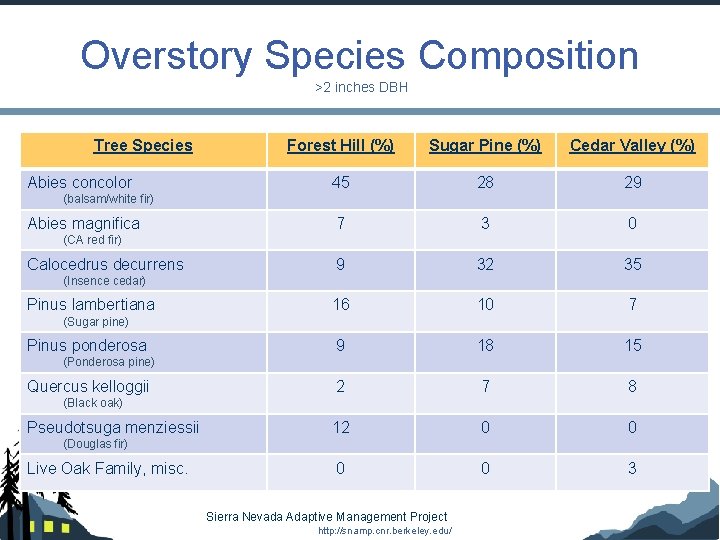
Overstory Species Composition >2 inches DBH Tree Species Abies concolor Forest Hill (%) Sugar Pine (%) Cedar Valley (%) 45 28 29 7 3 0 9 32 35 16 10 7 9 18 15 2 7 8 12 0 0 3 (balsam/white fir) Abies magnifica (CA red fir) Calocedrus decurrens (Insence cedar) Pinus lambertiana (Sugar pine) Pinus ponderosa (Ponderosa pine) Quercus kelloggii (Black oak) Pseudotsuga menziessii (Douglas fir) Live Oak Family, misc. Sierra Nevada Adaptive Management Project http: //snamp. cnr. berkeley. edu/
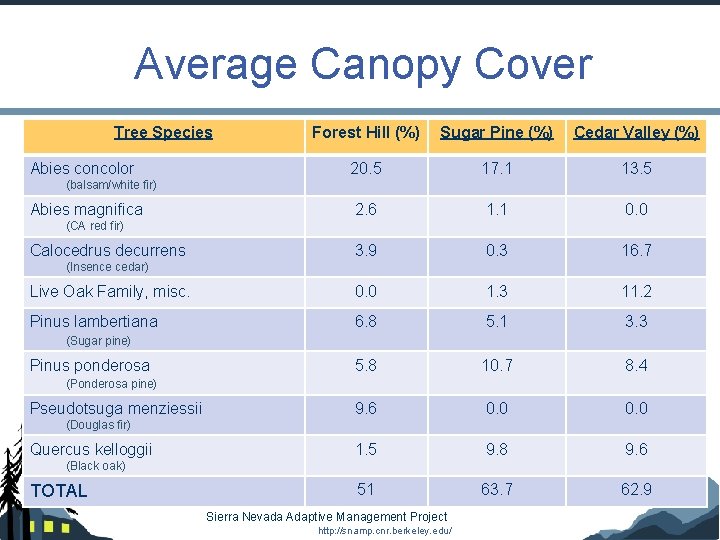
Average Canopy Cover Tree Species Forest Hill (%) Sugar Pine (%) Cedar Valley (%) 20. 5 17. 1 13. 5 2. 6 1. 1 0. 0 3. 9 0. 3 16. 7 Live Oak Family, misc. 0. 0 1. 3 11. 2 Pinus lambertiana 6. 8 5. 1 3. 3 5. 8 10. 7 8. 4 9. 6 0. 0 1. 5 9. 8 9. 6 51 63. 7 62. 9 Abies concolor (balsam/white fir) Abies magnifica (CA red fir) Calocedrus decurrens (Insence cedar) (Sugar pine) Pinus ponderosa (Ponderosa pine) Pseudotsuga menziessii (Douglas fir) Quercus kelloggii (Black oak) TOTAL Sierra Nevada Adaptive Management Project http: //snamp. cnr. berkeley. edu/
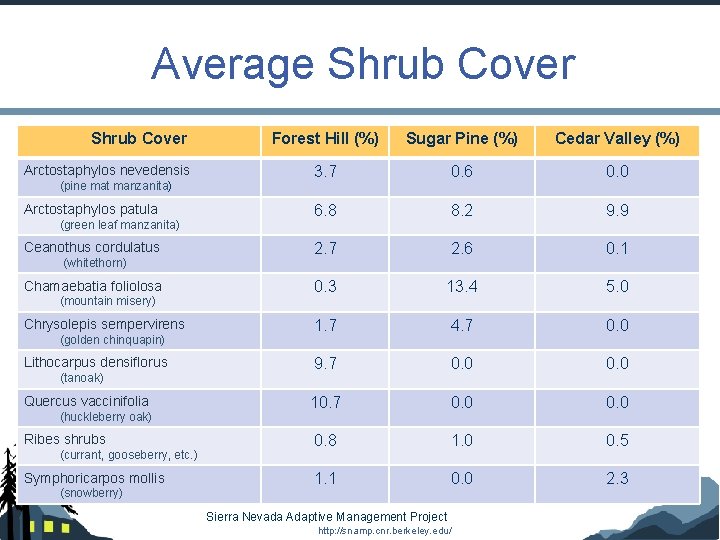
Average Shrub Cover Arctostaphylos nevedensis (pine mat manzanita) Arctostaphylos patula (green leaf manzanita) Ceanothus cordulatus (whitethorn) Chamaebatia foliolosa (mountain misery) Chrysolepis sempervirens (golden chinquapin) Lithocarpus densiflorus (tanoak) Quercus vaccinifolia (huckleberry oak) Ribes shrubs (currant, gooseberry, etc. ) Symphoricarpos mollis (snowberry) Forest Hill (%) Sugar Pine (%) Cedar Valley (%) 3. 7 0. 6 0. 0 6. 8 8. 2 9. 9 2. 7 2. 6 0. 1 0. 3 13. 4 5. 0 1. 7 4. 7 0. 0 9. 7 0. 0 10. 7 0. 0 0. 8 1. 0 0. 5 1. 1 0. 0 2. 3 Sierra Nevada Adaptive Management Project http: //snamp. cnr. berkeley. edu/
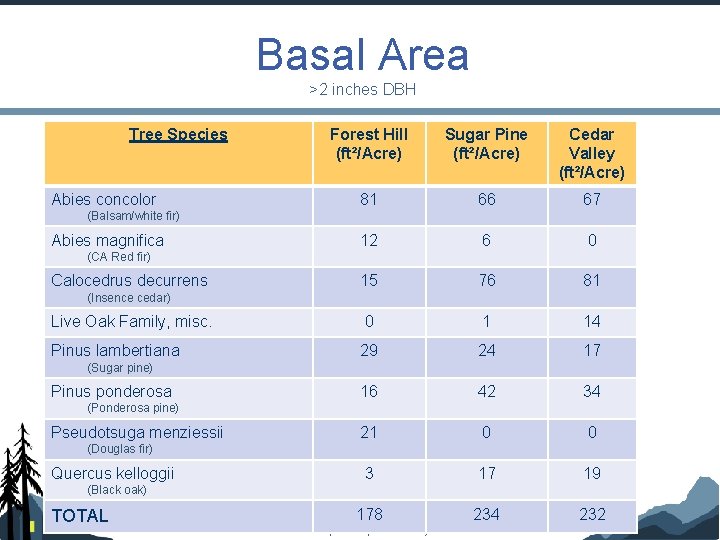
Basal Area >2 inches DBH Tree Species Forest Hill (ft²/Acre) Sugar Pine (ft²/Acre) Cedar Valley (ft²/Acre) 81 66 67 12 6 0 15 76 81 Live Oak Family, misc. 0 1 14 Pinus lambertiana 29 24 17 16 42 34 21 0 0 3 17 19 234 232 Abies concolor (Balsam/white fir) Abies magnifica (CA Red fir) Calocedrus decurrens (Insence cedar) (Sugar pine) Pinus ponderosa (Ponderosa pine) Pseudotsuga menziessii (Douglas fir) Quercus kelloggii (Black oak) TOTAL 178 Sierra Nevada Adaptive Management Project http: //snamp. cnr. berkeley. edu/
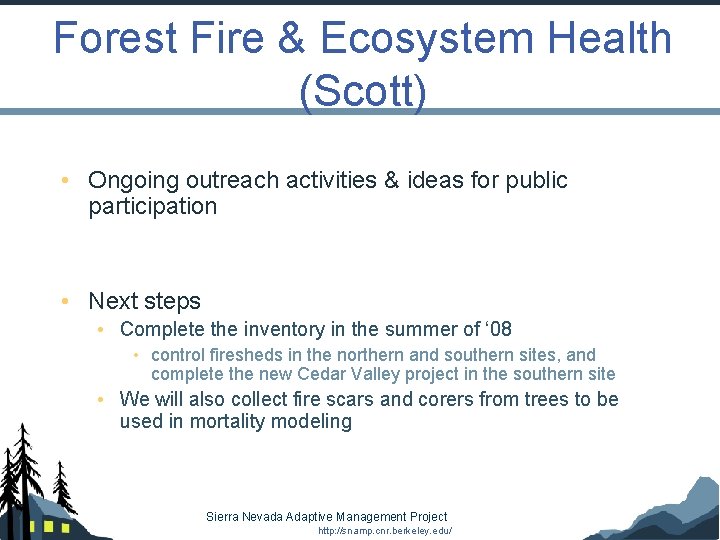
Forest Fire & Ecosystem Health (Scott) • Ongoing outreach activities & ideas for public participation • Next steps • Complete the inventory in the summer of ‘ 08 • control firesheds in the northern and southern sites, and complete the new Cedar Valley project in the southern site • We will also collect fire scars and corers from trees to be used in mortality modeling Sierra Nevada Adaptive Management Project http: //snamp. cnr. berkeley. edu/
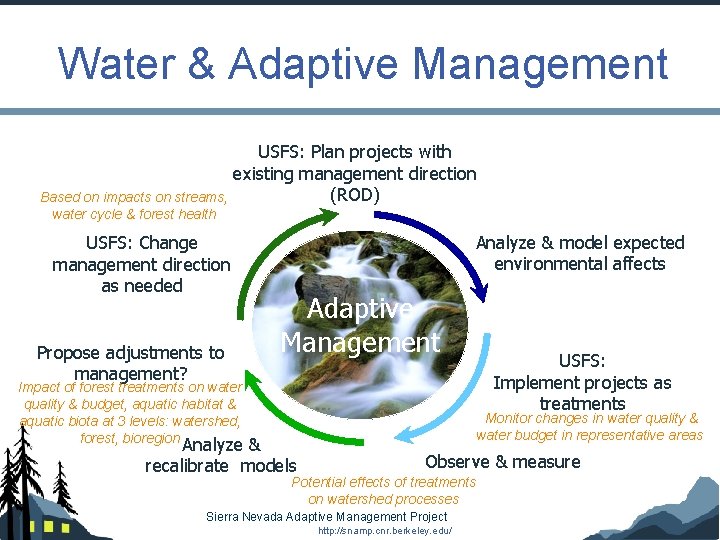
Water & Adaptive Management USFS: Plan projects with existing management direction (ROD) Based on impacts on streams, water cycle & forest health USFS: Change management direction as needed Propose adjustments to management? Impact of forest treatments on water quality & budget, aquatic habitat & aquatic biota at 3 levels: watershed, forest, bioregion Analyze & model expected environmental affects Adaptive Management Analyze & recalibrate models USFS: Implement projects as treatments Monitor changes in water quality & water budget in representative areas Observe & measure Potential effects of treatments on watershed processes Sierra Nevada Adaptive Management Project http: //snamp. cnr. berkeley. edu/
Water (Roger & Martha) • Accomplishments & Notes • 4 meteorological stations completed • Additional instrument sites selected • Ongoing outreach activities & ideas for public participation • Yosemite H. S. , Oakhurst, CA • Next steps • • Sediment basin permitting construction Procure & install instrument clusters Set up modeling framework Await funding & purchases from DWR Sierra Nevada Adaptive Management Project http: //snamp. cnr. berkeley. edu/
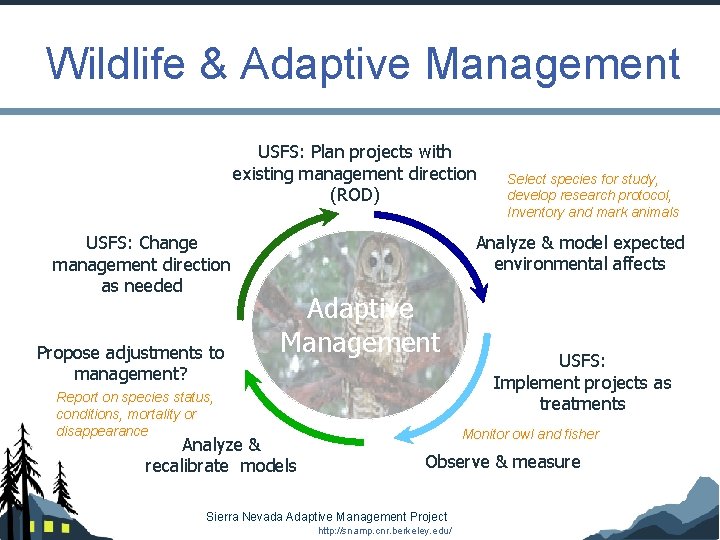
Wildlife & Adaptive Management USFS: Plan projects with existing management direction (ROD) USFS: Change management direction as needed Propose adjustments to management? Report on species status, conditions, mortality or disappearance Select species for study, develop research protocol, Inventory and mark animals Analyze & model expected environmental affects Adaptive Management Analyze & recalibrate models USFS: Implement projects as treatments Monitor owl and fisher Observe & measure Sierra Nevada Adaptive Management Project http: //snamp. cnr. berkeley. edu/
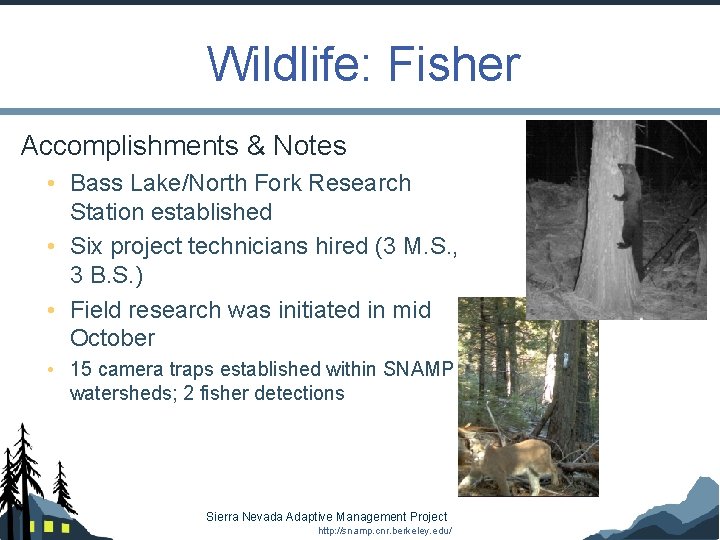
Wildlife: Fisher Accomplishments & Notes • Bass Lake/North Fork Research Station established • Six project technicians hired (3 M. S. , 3 B. S. ) • Field research was initiated in mid October • 15 camera traps established within SNAMP watersheds; 2 fisher detections Sierra Nevada Adaptive Management Project http: //snamp. cnr. berkeley. edu/
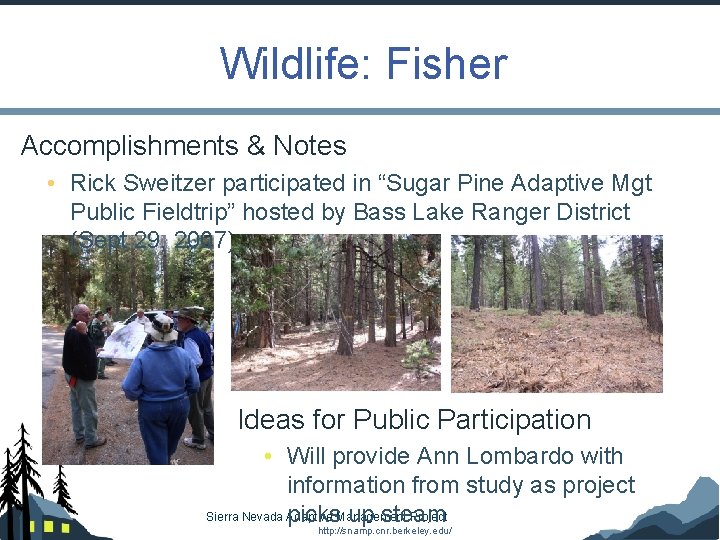
Wildlife: Fisher Accomplishments & Notes • Rick Sweitzer participated in “Sugar Pine Adaptive Mgt Public Fieldtrip” hosted by Bass Lake Ranger District (Sept 29, 2007) Ideas for Public Participation • Will provide Ann Lombardo with information from study as project Sierra Nevada Adaptive Project picks. Management up steam http: //snamp. cnr. berkeley. edu/
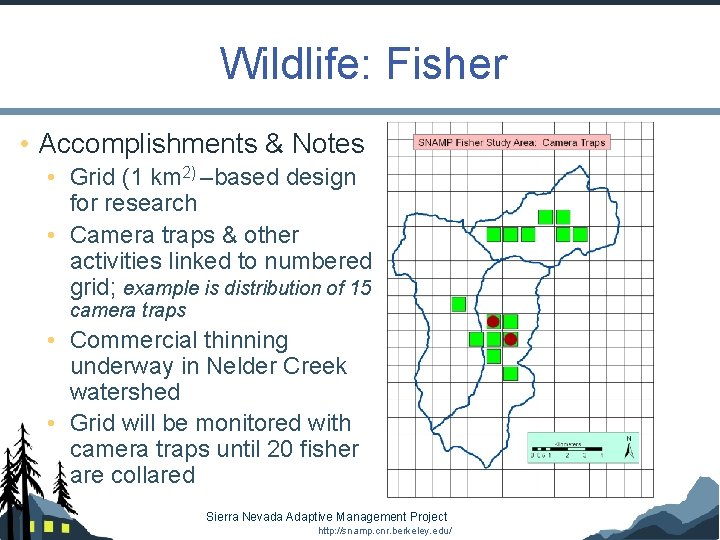
Wildlife: Fisher • Accomplishments & Notes • Grid (1 km 2) –based design for research • Camera traps & other activities linked to numbered grid; example is distribution of 15 camera traps • Commercial thinning underway in Nelder Creek watershed • Grid will be monitored with camera traps until 20 fisher are collared Sierra Nevada Adaptive Management Project http: //snamp. cnr. berkeley. edu/
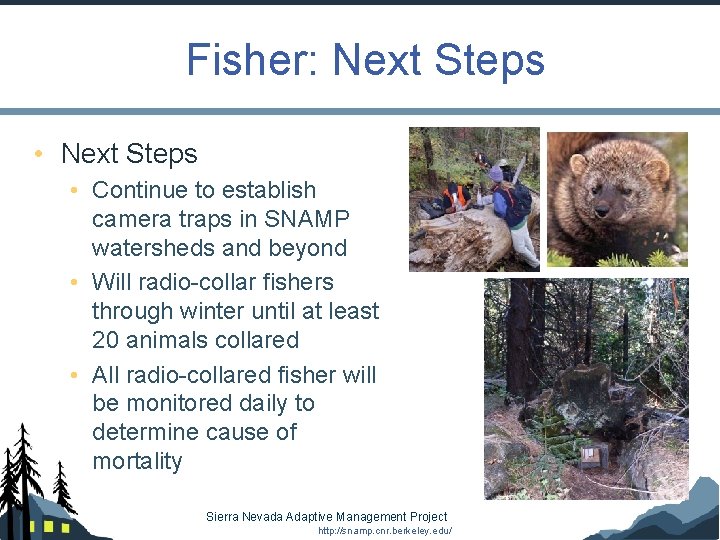
Fisher: Next Steps • Continue to establish camera traps in SNAMP watersheds and beyond • Will radio-collar fishers through winter until at least 20 animals collared • All radio-collared fisher will be monitored daily to determine cause of mortality Sierra Nevada Adaptive Management Project http: //snamp. cnr. berkeley. edu/
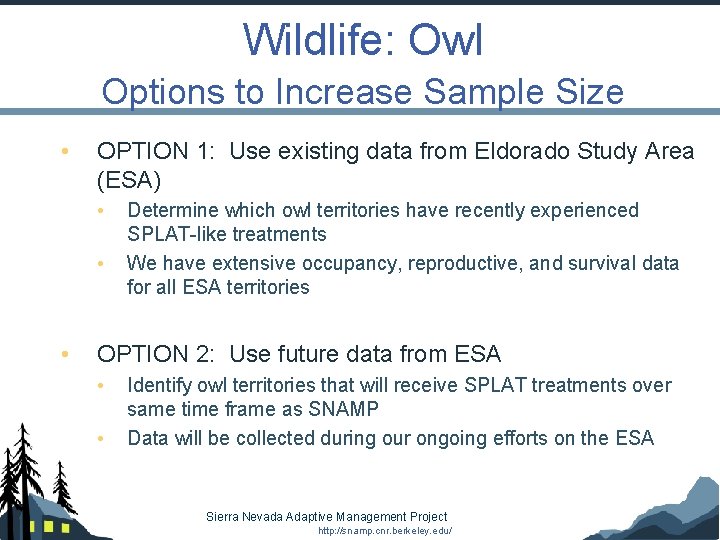
Wildlife: Owl Options to Increase Sample Size • OPTION 1: Use existing data from Eldorado Study Area (ESA) • • • Determine which owl territories have recently experienced SPLAT-like treatments We have extensive occupancy, reproductive, and survival data for all ESA territories OPTION 2: Use future data from ESA • • Identify owl territories that will receive SPLAT treatments over same time frame as SNAMP Data will be collected during our ongoing efforts on the ESA Sierra Nevada Adaptive Management Project http: //snamp. cnr. berkeley. edu/
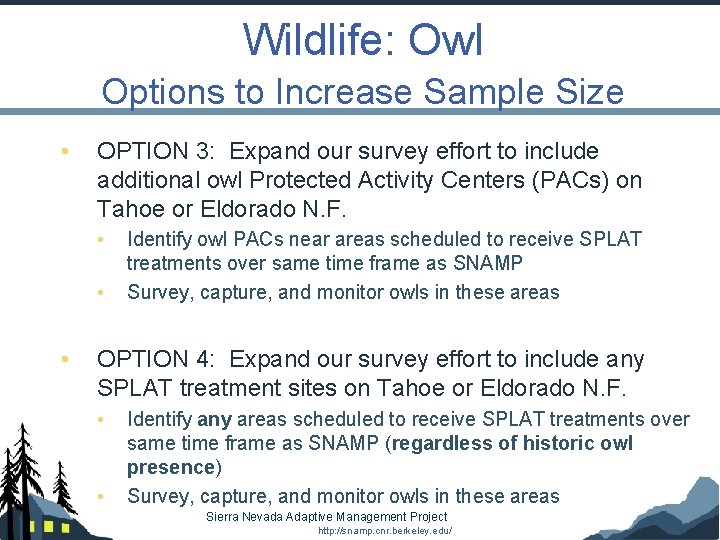
Wildlife: Owl Options to Increase Sample Size • OPTION 3: Expand our survey effort to include additional owl Protected Activity Centers (PACs) on Tahoe or Eldorado N. F. • • • Identify owl PACs near areas scheduled to receive SPLAT treatments over same time frame as SNAMP Survey, capture, and monitor owls in these areas OPTION 4: Expand our survey effort to include any SPLAT treatment sites on Tahoe or Eldorado N. F. • • Identify any areas scheduled to receive SPLAT treatments over same time frame as SNAMP (regardless of historic owl presence) Survey, capture, and monitor owls in these areas Sierra Nevada Adaptive Management Project http: //snamp. cnr. berkeley. edu/
Wildlife: Owl Implications of Revised Study Design • Increased cooperation between UCST and U. S. Forest Service • • • Financial cost • • • Required for all options but particularly critical for Options 3 -4 With assistance from U. S. F. S. , assess the potential increase in sample size from Options 1 -2 before the 2008 field season Options 1 -2 incur no additional costs for SNAMP Options 3 -4 incur additional (but unknown) costs for SNAMP Scale of Study Area • • Expanded scale of owl sampling increases the generality of owl results Strengthens the study (rather than weakens it) Sierra Nevada Adaptive Management Project http: //snamp. cnr. berkeley. edu/
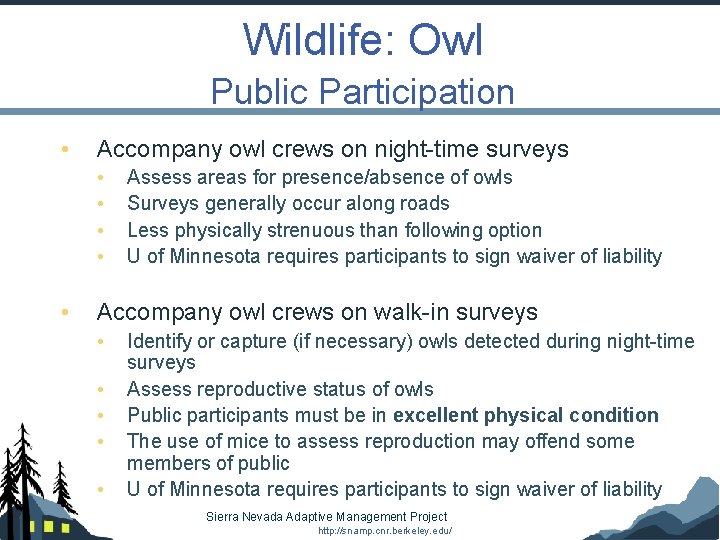
Wildlife: Owl Public Participation • Accompany owl crews on night-time surveys • • • Assess areas for presence/absence of owls Surveys generally occur along roads Less physically strenuous than following option U of Minnesota requires participants to sign waiver of liability Accompany owl crews on walk-in surveys • • • Identify or capture (if necessary) owls detected during night-time surveys Assess reproductive status of owls Public participants must be in excellent physical condition The use of mice to assess reproduction may offend some members of public U of Minnesota requires participants to sign waiver of liability Sierra Nevada Adaptive Management Project http: //snamp. cnr. berkeley. edu/
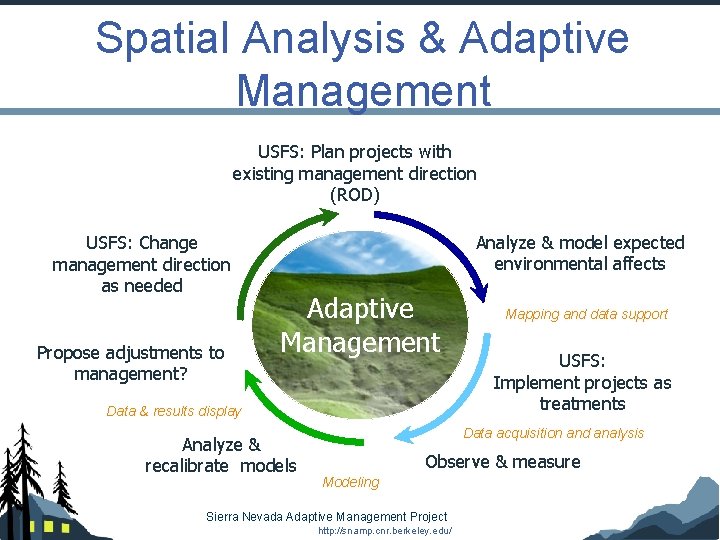
Spatial Analysis & Adaptive Management USFS: Plan projects with existing management direction (ROD) USFS: Change management direction as needed Propose adjustments to management? Data & results display Analyze & model expected environmental affects Adaptive Management Analyze & recalibrate models Mapping and data support USFS: Implement projects as treatments Data acquisition and analysis Observe & measure Modeling Sierra Nevada Adaptive Management Project http: //snamp. cnr. berkeley. edu/
Spatial Team: UCB and UCM (Maggi) • Accomplishments & Notes • • • Lidar data for the Southern site have been acquired Study Site maps have been created and posted GIS data are continually maintained Facilitated GIS software licensing for other teams Evaluation of large-scale forest structure data for wildlife team use • Coordinate Data Sharing Draft Protocol for: • Within-team sharing • Data sharing with the public Sierra Nevada Adaptive Management Project http: //snamp. cnr. berkeley. edu/
Spatial Team: Next Steps • Data Acquisition • Acquiring high spatial resolution images for the study areas • Plan Lidar data acquisition and other spatial data for the Northern site • Updating spatial data, current vegetation maps and high resolution DEM for larger study areas • Data Processing • Processing Southern Site Lidar data to extract DEM and vegetation structure • Process remote sensing data and other spatial data • Data Sharing • Coordinate gathering and sharing of data collected by UCST • Setting up the data sever for users to upload data with security login in and distribute spatial data via web GIS technique Work to link the remote sensing derived products to other team field measurements, and start upscalling Sierra Nevada Adaptive Management Project http: //snamp. cnr. berkeley. edu/
Spatial Team • Ongoing Outreach Activities & Ideas for Public Participation • • Study site maps available on SNAMP site Data Sharing discussion begun Web. GIS site in development Encourage discussion through Discussion Board Sierra Nevada Adaptive Management Project http: //snamp. cnr. berkeley. edu/
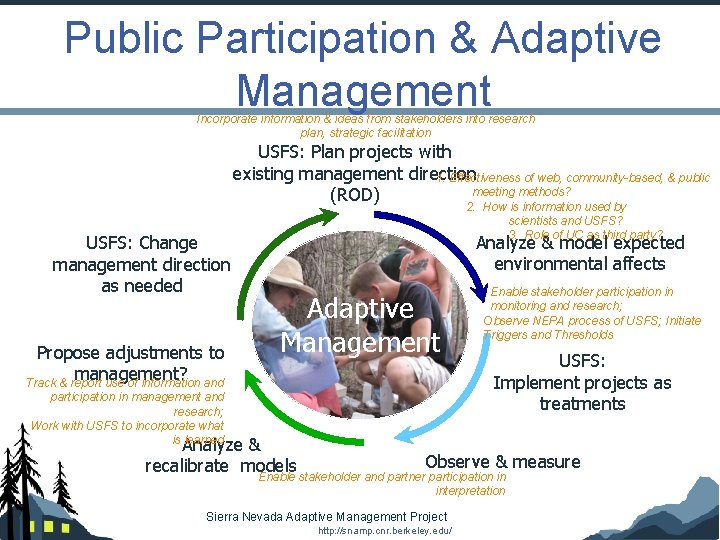
Public Participation & Adaptive Management Incorporate information & ideas from stakeholders into research plan, strategic facilitation USFS: Plan projects with existing management direction 1. Effectiveness of web, community-based, & public meeting methods? (ROD) USFS: Change management direction as needed Propose adjustments to management? Track & report use of information and participation in management and research; Work with USFS to incorporate what is learned 2. How is information used by scientists and USFS? 3. Role of UC as third party? Analyze & model expected environmental affects Adaptive Management Enable stakeholder participation in monitoring and research; Observe NEPA process of USFS; Initiate Triggers and Thresholds USFS: Implement projects as treatments Analyze & Observe & measure recalibrate models Enable stakeholder and partner participation in interpretation Sierra Nevada Adaptive Management Project http: //snamp. cnr. berkeley. edu/
Public Participation (Lynn) • Accomplishments & Notes • Introducing Anne Lombardo -- local outreach • Introducing Adrianna Sulak -- project analysis • Strategic facilitation continuing including facilitating Triggers and Threshold process • Continued website development with systematic user input • Developed a range of outreach materials: SNAMP handout, maps, newsletter • Participation in, and evaluation of Forest Service and other outreach meetings and activities • Project archival and historical information Sierra Nevada Adaptive Management Project http: //snamp. cnr. berkeley. edu/
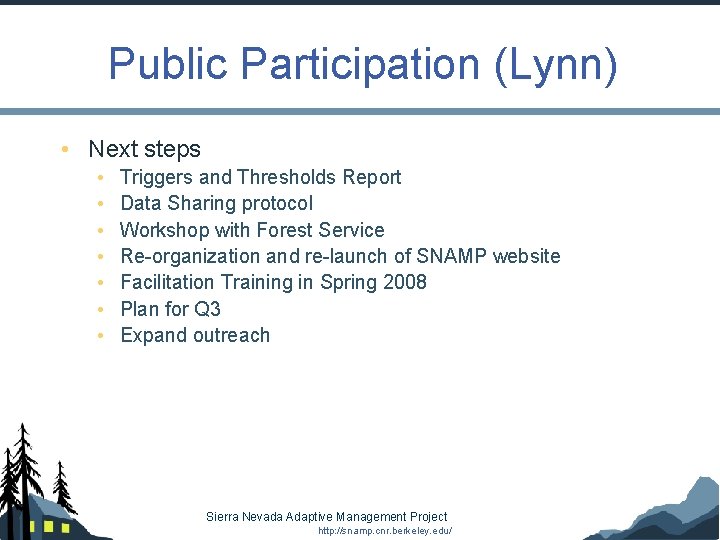
Public Participation (Lynn) • Next steps • • Triggers and Thresholds Report Data Sharing protocol Workshop with Forest Service Re-organization and re-launch of SNAMP website Facilitation Training in Spring 2008 Plan for Q 3 Expand outreach Sierra Nevada Adaptive Management Project http: //snamp. cnr. berkeley. edu/
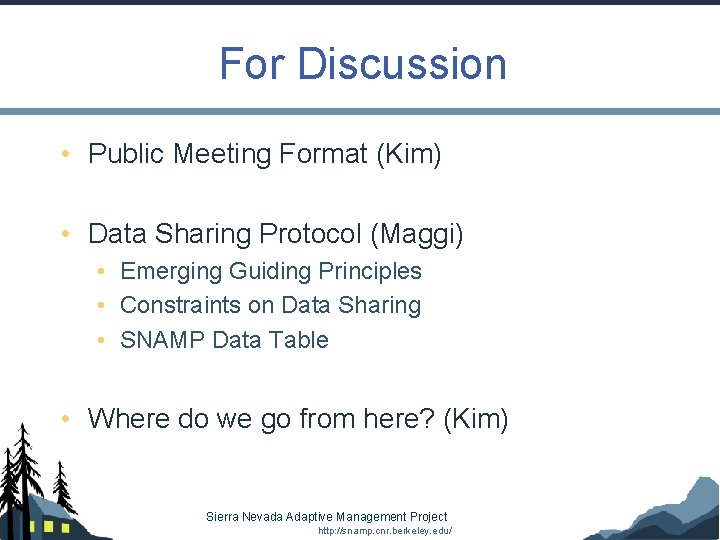
For Discussion • Public Meeting Format (Kim) • Data Sharing Protocol (Maggi) • Emerging Guiding Principles • Constraints on Data Sharing • SNAMP Data Table • Where do we go from here? (Kim) Sierra Nevada Adaptive Management Project http: //snamp. cnr. berkeley. edu/
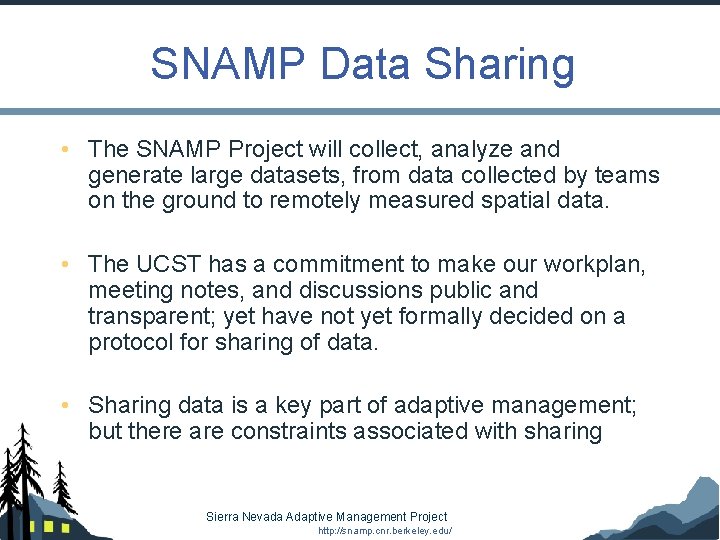
SNAMP Data Sharing • The SNAMP Project will collect, analyze and generate large datasets, from data collected by teams on the ground to remotely measured spatial data. • The UCST has a commitment to make our workplan, meeting notes, and discussions public and transparent; yet have not yet formally decided on a protocol for sharing of data. • Sharing data is a key part of adaptive management; but there are constraints associated with sharing Sierra Nevada Adaptive Management Project http: //snamp. cnr. berkeley. edu/
Data Sharing Guidelines • Data propriety begins with the lead PI of the research teams that have collected the data, and each PI will have the ability to decide which of their team’s data can be shared, either internally (within UCST) or externally (outside of UCST); • There is a limited time period that the lead research team PI have propriety of their data (6 -12 months); • All data requests must be approved in writing by the science team lead PI that has overseen the study in question; Nevada Adaptive Management Project • All science Sierra team PIs must archive their data at least http: //snamp. cnr. berkeley. edu/
Data Sharing Constraints • The UCST will make efforts to make spatial and non-spatial data public whenever possible and/or appropriate. • There are compelling reasons why a scientist might not want to distribute data, for example: • disclosure of location of people or rare and endangered species might put them at risk; • data might not be complete; • data might have proprietary restrictions originating outside of the UCST. • For spatial data that is common across all teams, the spatial team will review and make recommendations on the appropriate format for data sharing. We are concerned about distributing overly large file sizes. Sierra Nevada Adaptive Management Project http: //snamp. cnr. berkeley. edu/
Data from SNAMP * shown in public meeting presentation, which is published on the web. ** There was a public request for these data. Sierra Nevada Adaptive Management Project http: //snamp. cnr. berkeley. edu/
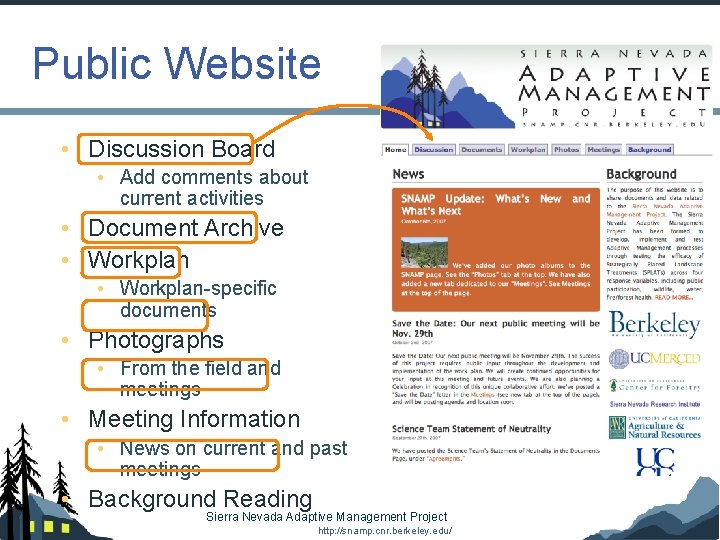
Public Website • Discussion Board • Add comments about current activities • Document Archive • Workplan-specific documents • Photographs • From the field and meetings • Meeting Information • News on current and past meetings • Background Reading Sierra Nevada Adaptive Management Project http: //snamp. cnr. berkeley. edu/
Time to Celebrate • Eat • Talk • Be Merry • Please talk to each other and share ideas about how to work together. Sierra Nevada Adaptive Management Project http: //snamp. cnr. berkeley. edu/