
The SLAC ATLAS Program Challenges and Opportunities David
- Slides: 55
The SLAC ATLAS Program: Challenges and Opportunities David Mac. Farlane and Su Dong For the SLAC ATLAS group The SLAC ATLAS Program: Challenges and Opportunities Page 1
Outline • Introduction and overall strategic direction – Overview of challenges, opportunities and goals • Survey of current ATLAS activities – Activities on pixel and tracking systems, DAQ and high-level trigger (HLT) systems, and simulations • Planned growth and future direction for ATLAS program – Moving from R&D to major roles for upgraded pixel and TDAQ systems – Expanded computing role and plans for west coast center • Conclusions The SLAC ATLAS Program: Challenges and Opportunities Page 2
Why was it crucial for SLAC to join ATLAS? • The most compelling questions in particle physics can only be addressed at the energy frontier • The best way of sustaining a vibrant energy frontier community for a future linear collider is to be engaged now • The energy frontier is the highest priority program for the national user community & our traditional user base • ATLAS is the future for our accelerator-based program, and therefore the glue tying together the HEP program at SLAC Led to SLAC to become a member of ATLAS in July 2006 The SLAC ATLAS Program: Challenges and Opportunities Page 3
Initial challenges and opportunities • Late entry into a major worldwide collaboration with established players and institutional responsibilities – Major impact still achieved by operating in a service mode to resolve many real issues arising during commissioning over the last 3 years • Core capabilities and unique expertise from constructing & operating BABAR are now being applied to ATLAS • Gaining agreement from OHEP for substantial growth has been difficult with OHEP reorganization along program lines • Our goal is to significantly strengthen the US ATLAS effort by the infusion of a large and experienced SLAC team The SLAC ATLAS Program: Challenges and Opportunities Page 4
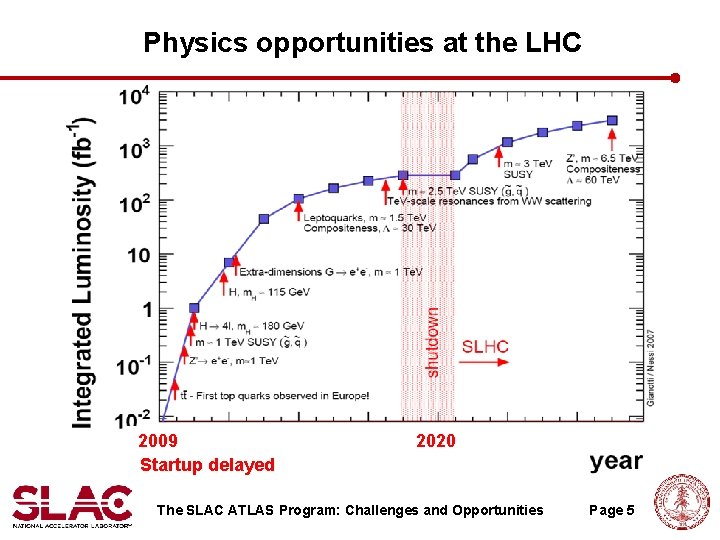
Physics opportunities at the LHC 2009 Startup delayed 2020 The SLAC ATLAS Program: Challenges and Opportunities Page 5
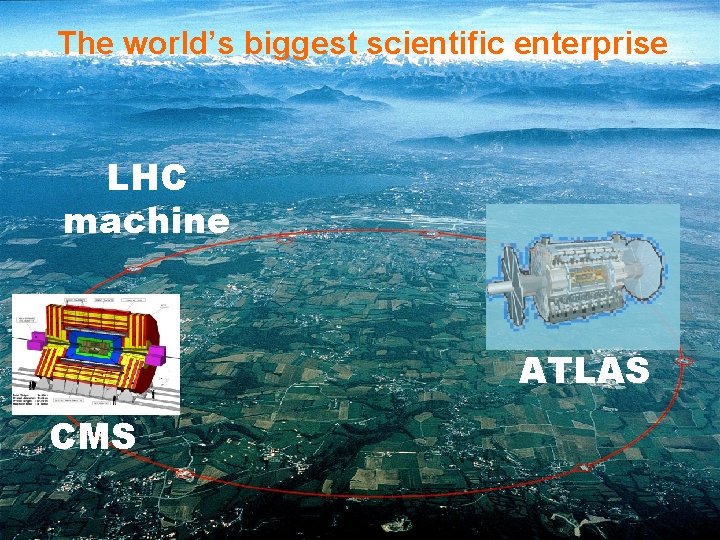
The world’s biggest scientific enterprise LHC machine ATLAS CMS The SLAC ATLAS Program: Challenges and Opportunities Page 6
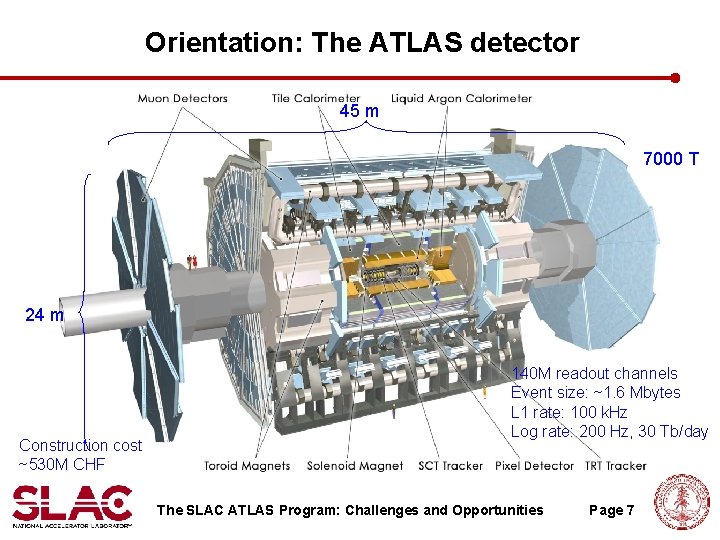
Orientation: The ATLAS detector 45 m 7000 T 24 m Construction cost ~530 M CHF 140 M readout channels Event size: ~1. 6 Mbytes L 1 rate: 100 k. Hz Log rate: 200 Hz, 30 Tb/day The SLAC ATLAS Program: Challenges and Opportunities Page 7
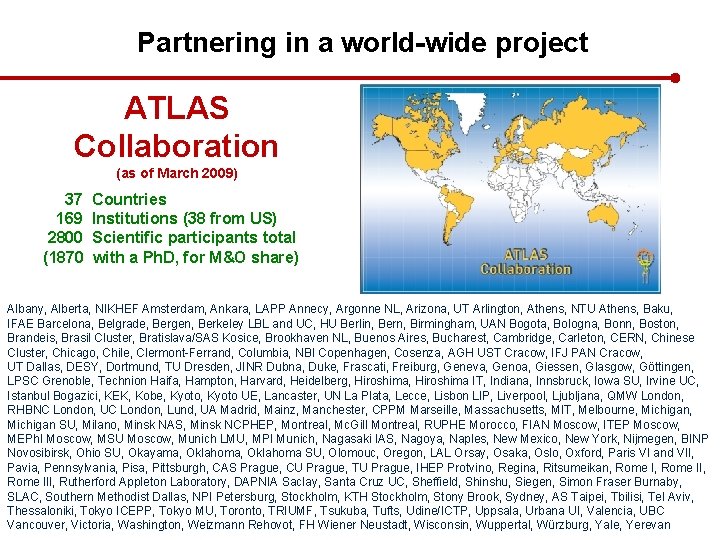
Partnering in a world-wide project ATLAS Collaboration (as of March 2009) 37 169 2800 (1870 Countries Institutions (38 from US) Scientific participants total with a Ph. D, for M&O share) Albany, Alberta, NIKHEF Amsterdam, Ankara, LAPP Annecy, Argonne NL, Arizona, UT Arlington, Athens, NTU Athens, Baku, IFAE Barcelona, Belgrade, Bergen, Berkeley LBL and UC, HU Berlin, Bern, Birmingham, UAN Bogota, Bologna, Bonn, Boston, Brandeis, Brasil Cluster, Bratislava/SAS Kosice, Brookhaven NL, Buenos Aires, Bucharest, Cambridge, Carleton, CERN, Chinese Cluster, Chicago, Chile, Clermont-Ferrand, Columbia, NBI Copenhagen, Cosenza, AGH UST Cracow, IFJ PAN Cracow, UT Dallas, DESY, Dortmund, TU Dresden, JINR Dubna, Duke, Frascati, Freiburg, Geneva, Genoa, Giessen, Glasgow, Göttingen, LPSC Grenoble, Technion Haifa, Hampton, Harvard, Heidelberg, Hiroshima IT, Indiana, Innsbruck, Iowa SU, Irvine UC, Istanbul Bogazici, KEK, Kobe, Kyoto UE, Lancaster, UN La Plata, Lecce, Lisbon LIP, Liverpool, Ljubljana, QMW London, RHBNC London, UC London, Lund, UA Madrid, Mainz, Manchester, CPPM Marseille, Massachusetts, MIT, Melbourne, Michigan SU, Milano, Minsk NAS, Minsk NCPHEP, Montreal, Mc. Gill Montreal, RUPHE Morocco, FIAN Moscow, ITEP Moscow, MEPh. I Moscow, MSU Moscow, Munich LMU, MPI Munich, Nagasaki IAS, Nagoya, Naples, New Mexico, New York, Nijmegen, BINP Novosibirsk, Ohio SU, Okayama, Oklahoma SU, Olomouc, Oregon, LAL Orsay, Osaka, Oslo, Oxford, Paris VI and VII, Pavia, Pennsylvania, Pisa, Pittsburgh, CAS Prague, CU Prague, TU Prague, IHEP Protvino, Regina, Ritsumeikan, Rome II, Rome III, Rutherford Appleton Laboratory, DAPNIA Saclay, Santa Cruz UC, Sheffield, Shinshu, Siegen, Simon Fraser Burnaby, SLAC, Southern Methodist Dallas, NPI Petersburg, Stockholm, KTH Stockholm, Stony Brook, Sydney, AS Taipei, Tbilisi, Tel Aviv, Thessaloniki, Tokyo ICEPP, The Tokyo. SLAC MU, Toronto, Tsukuba, Tufts, Udine/ICTP, Uppsala, Urbana UI, Valencia, ATLASTRIUMF, Program: Challenges and Opportunities Page 8 UBC Vancouver, Victoria, Washington, Weizmann Rehovot, FH Wiener Neustadt, Wisconsin, Wuppertal, Würzburg, Yale, Yerevan
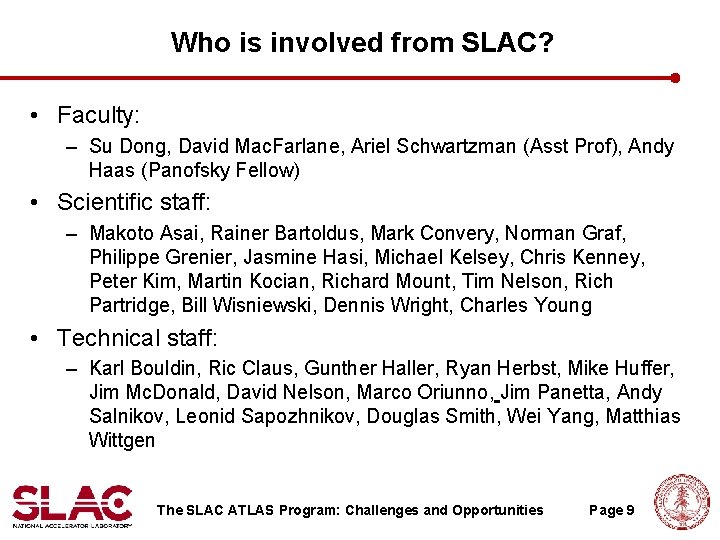
Who is involved from SLAC? • Faculty: – Su Dong, David Mac. Farlane, Ariel Schwartzman (Asst Prof), Andy Haas (Panofsky Fellow) • Scientific staff: – Makoto Asai, Rainer Bartoldus, Mark Convery, Norman Graf, Philippe Grenier, Jasmine Hasi, Michael Kelsey, Chris Kenney, Peter Kim, Martin Kocian, Richard Mount, Tim Nelson, Rich Partridge, Bill Wisniewski, Dennis Wright, Charles Young • Technical staff: – Karl Bouldin, Ric Claus, Gunther Haller, Ryan Herbst, Mike Huffer, Jim Mc. Donald, David Nelson, Marco Oriunno, Jim Panetta, Andy Salnikov, Leonid Sapozhnikov, Douglas Smith, Wei Yang, Matthias Wittgen The SLAC ATLAS Program: Challenges and Opportunities Page 9
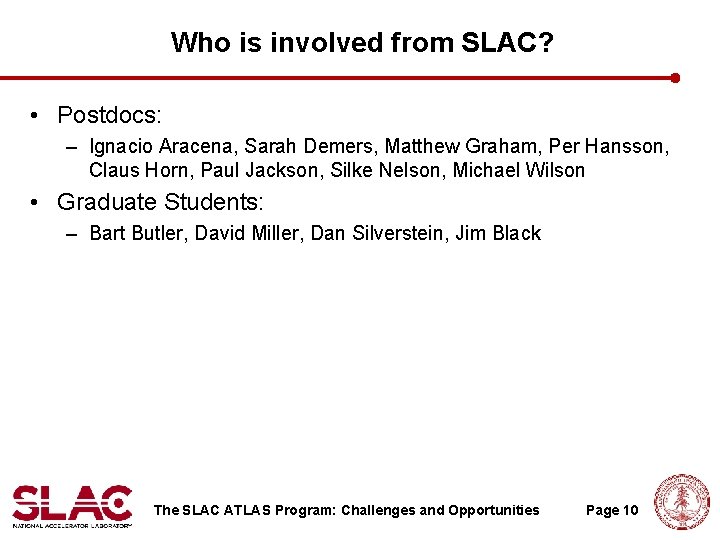
Who is involved from SLAC? • Postdocs: – Ignacio Aracena, Sarah Demers, Matthew Graham, Per Hansson, Claus Horn, Paul Jackson, Silke Nelson, Michael Wilson • Graduate Students: – Bart Butler, David Miller, Dan Silverstein, Jim Black The SLAC ATLAS Program: Challenges and Opportunities Page 10
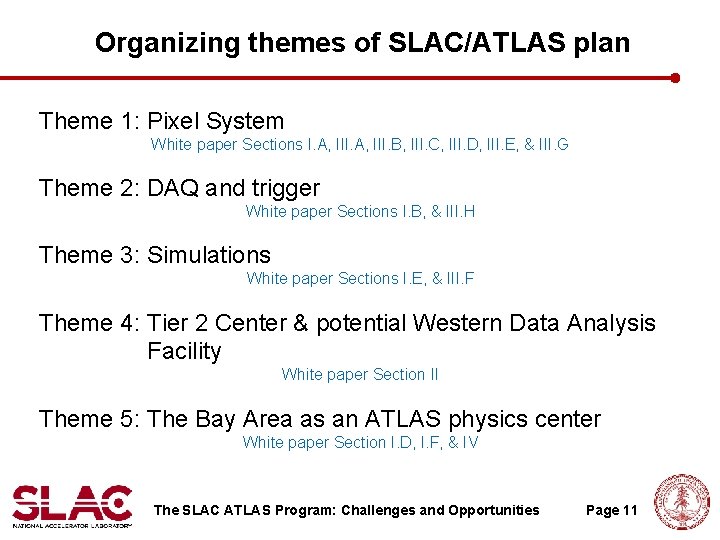
Organizing themes of SLAC/ATLAS plan Theme 1: Pixel System White paper Sections I. A, III. B, III. C, III. D, III. E, & III. G Theme 2: DAQ and trigger White paper Sections I. B, & III. H Theme 3: Simulations White paper Sections I. E, & III. F Theme 4: Tier 2 Center & potential Western Data Analysis Facility White paper Section II Theme 5: The Bay Area as an ATLAS physics center White paper Section I. D, I. F, & IV The SLAC ATLAS Program: Challenges and Opportunities Page 11
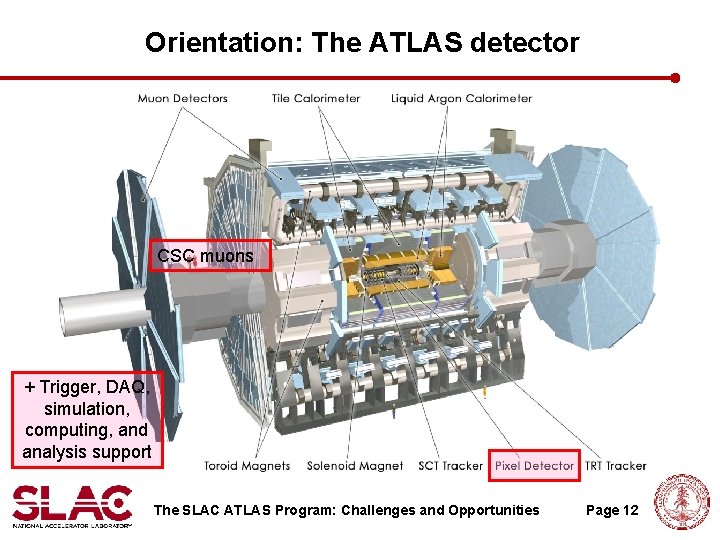
Orientation: The ATLAS detector CSC muons + Trigger, DAQ, simulation, computing, and analysis support The SLAC ATLAS Program: Challenges and Opportunities Page 12
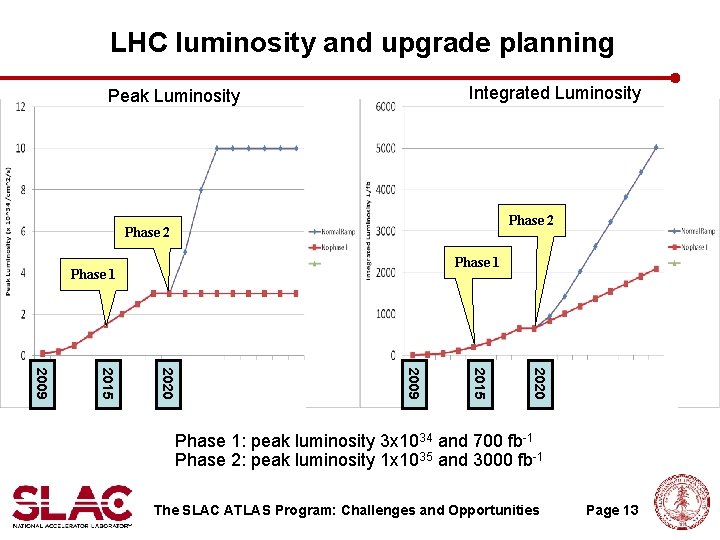
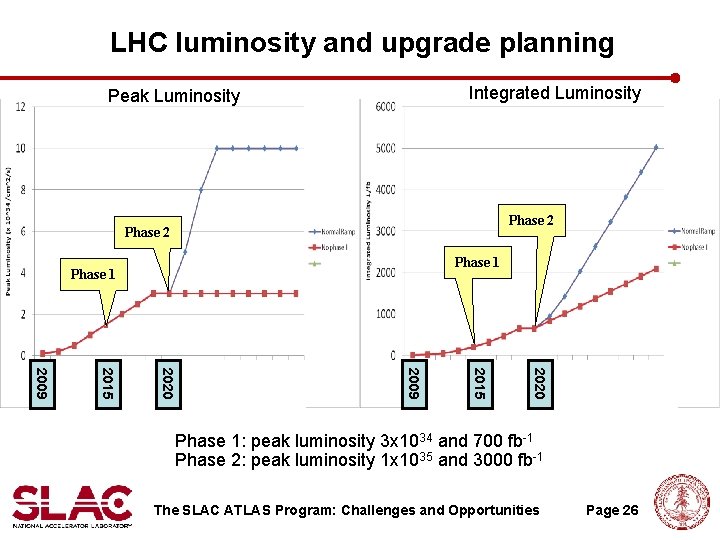
LHC luminosity and upgrade planning Integrated Luminosity Peak Luminosity Phase 2 Phase 1 2020 2015 2009 Phase 1: peak luminosity 3 x 1034 and 700 fb-1 Phase 2: peak luminosity 1 x 1035 and 3000 fb-1 The SLAC ATLAS Program: Challenges and Opportunities Page 13
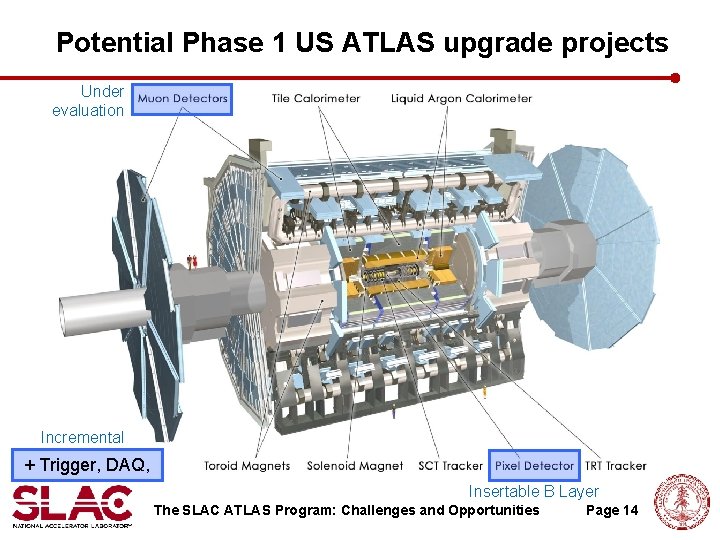
Potential Phase 1 US ATLAS upgrade projects Under evaluation Incremental + Trigger, DAQ, Insertable B Layer The SLAC ATLAS Program: Challenges and Opportunities Page 14
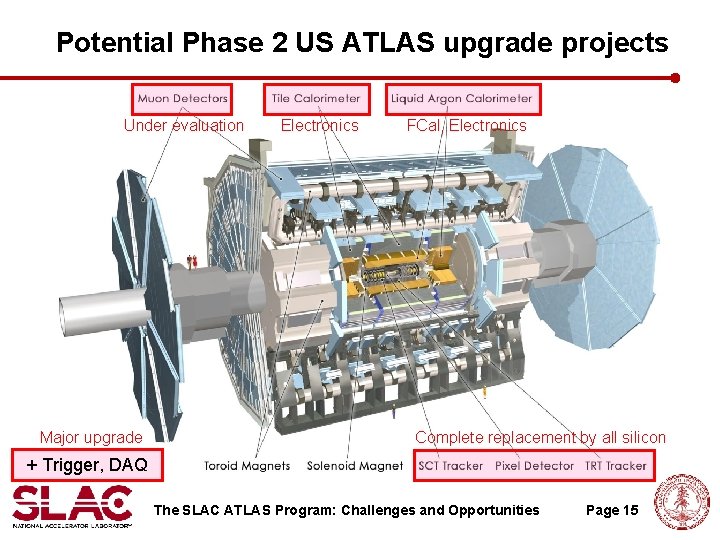
Potential Phase 2 US ATLAS upgrade projects Under evaluation Major upgrade Electronics FCal, Electronics Complete replacement by all silicon + Trigger, DAQ The SLAC ATLAS Program: Challenges and Opportunities Page 15
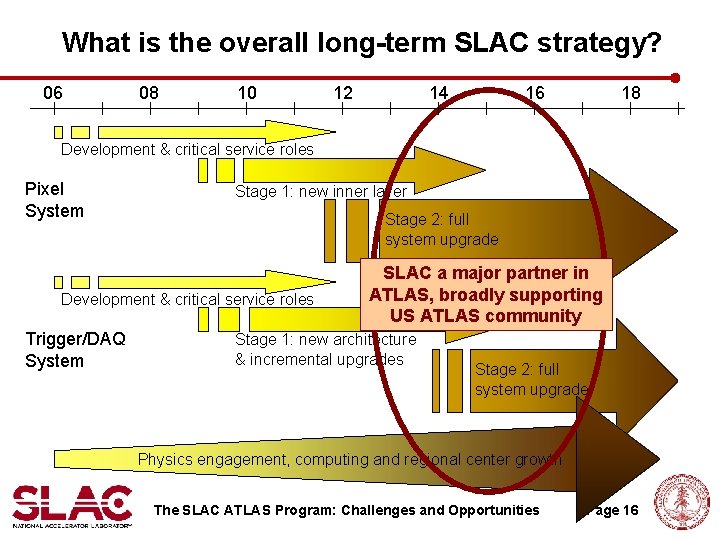
What is the overall long-term SLAC strategy? 06 08 10 12 14 16 18 Development & critical service roles Pixel System Stage 1: new inner layer Stage 2: full system upgrade Development & critical service roles Trigger/DAQ System SLAC a major partner in ATLAS, broadly supporting US ATLAS community Stage 1: new architecture & incremental upgrades Stage 2: full system upgrade Physics engagement, computing and regional center growth The SLAC ATLAS Program: Challenges and Opportunities Page 16
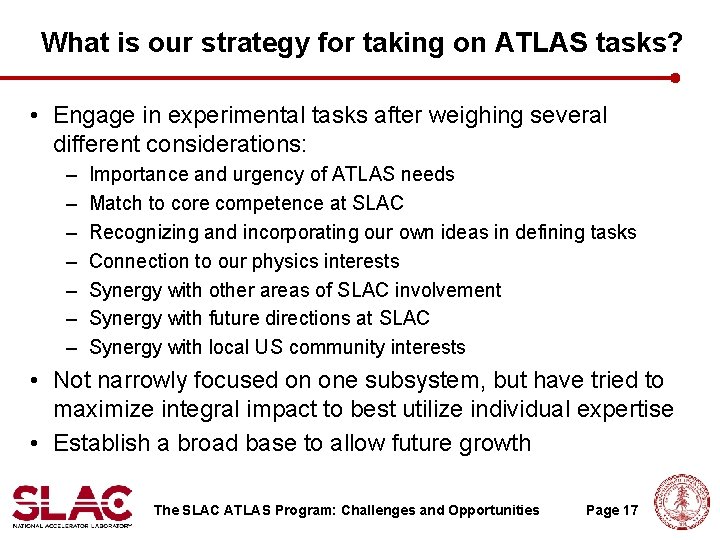
What is our strategy for taking on ATLAS tasks? • Engage in experimental tasks after weighing several different considerations: – – – – Importance and urgency of ATLAS needs Match to core competence at SLAC Recognizing and incorporating our own ideas in defining tasks Connection to our physics interests Synergy with other areas of SLAC involvement Synergy with future directions at SLAC Synergy with local US community interests • Not narrowly focused on one subsystem, but have tried to maximize integral impact to best utilize individual expertise • Establish a broad base to allow future growth The SLAC ATLAS Program: Challenges and Opportunities Page 17
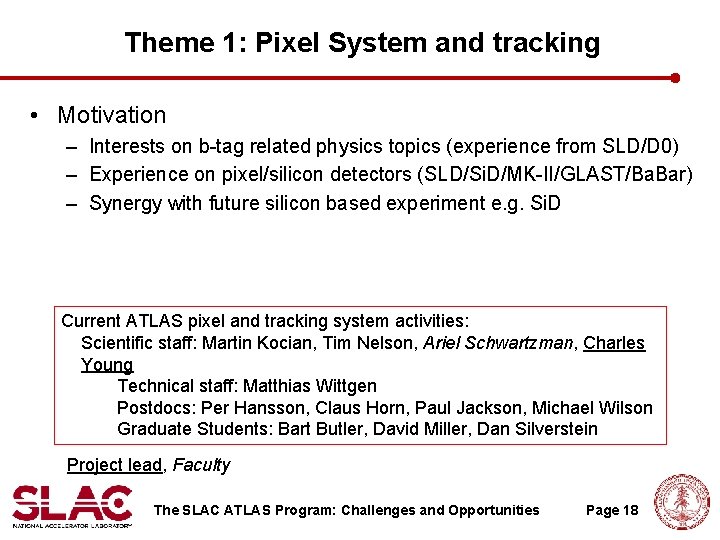
Theme 1: Pixel System and tracking • Motivation – Interests on b-tag related physics topics (experience from SLD/D 0) – Experience on pixel/silicon detectors (SLD/Si. D/MK-II/GLAST/Ba. Bar) – Synergy with future silicon based experiment e. g. Si. D Current ATLAS pixel and tracking system activities: Scientific staff: Martin Kocian, Tim Nelson, Ariel Schwartzman, Charles Young Technical staff: Matthias Wittgen Postdocs: Per Hansson, Claus Horn, Paul Jackson, Michael Wilson Graduate Students: Bart Butler, David Miller, Dan Silverstein Project lead, Faculty The SLAC ATLAS Program: Challenges and Opportunities Page 18
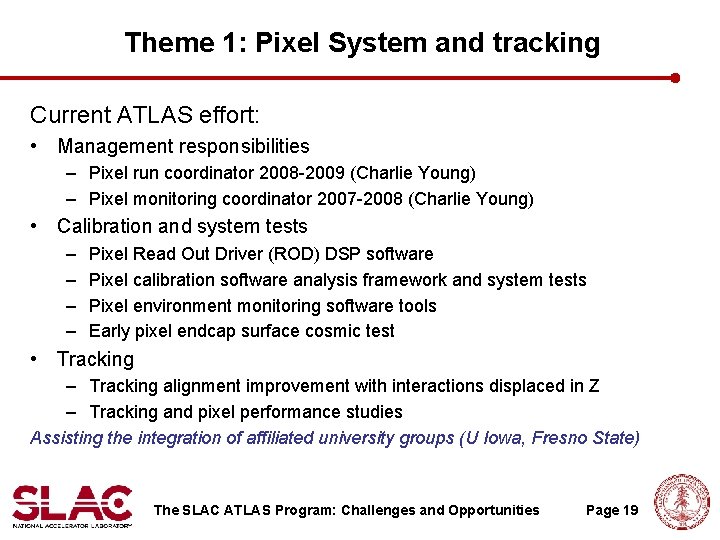
Theme 1: Pixel System and tracking Current ATLAS effort: • Management responsibilities – Pixel run coordinator 2008 -2009 (Charlie Young) – Pixel monitoring coordinator 2007 -2008 (Charlie Young) • Calibration and system tests – – Pixel Read Out Driver (ROD) DSP software Pixel calibration software analysis framework and system tests Pixel environment monitoring software tools Early pixel endcap surface cosmic test • Tracking – Tracking alignment improvement with interactions displaced in Z – Tracking and pixel performance studies Assisting the integration of affiliated university groups (U Iowa, Fresno State) The SLAC ATLAS Program: Challenges and Opportunities Page 19
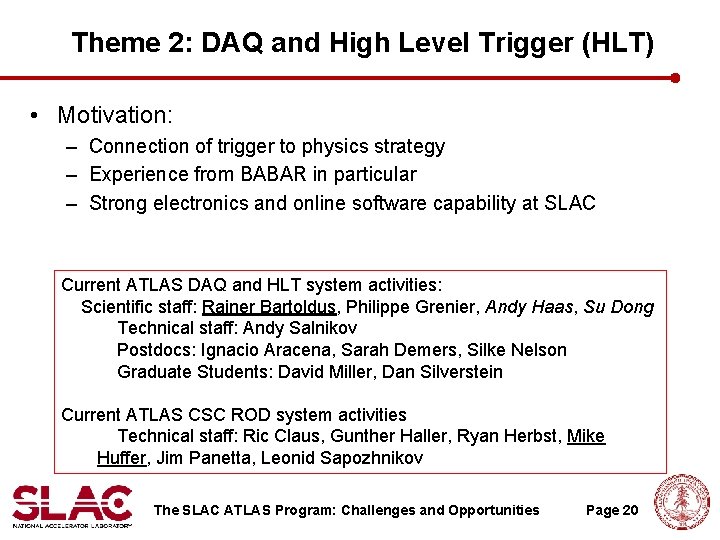
Theme 2: DAQ and High Level Trigger (HLT) • Motivation: – Connection of trigger to physics strategy – Experience from BABAR in particular – Strong electronics and online software capability at SLAC Current ATLAS DAQ and HLT system activities: Scientific staff: Rainer Bartoldus, Philippe Grenier, Andy Haas, Su Dong Technical staff: Andy Salnikov Postdocs: Ignacio Aracena, Sarah Demers, Silke Nelson Graduate Students: David Miller, Dan Silverstein Current ATLAS CSC ROD system activities Technical staff: Ric Claus, Gunther Haller, Ryan Herbst, Mike Huffer, Jim Panetta, Leonid Sapozhnikov The SLAC ATLAS Program: Challenges and Opportunities Page 20
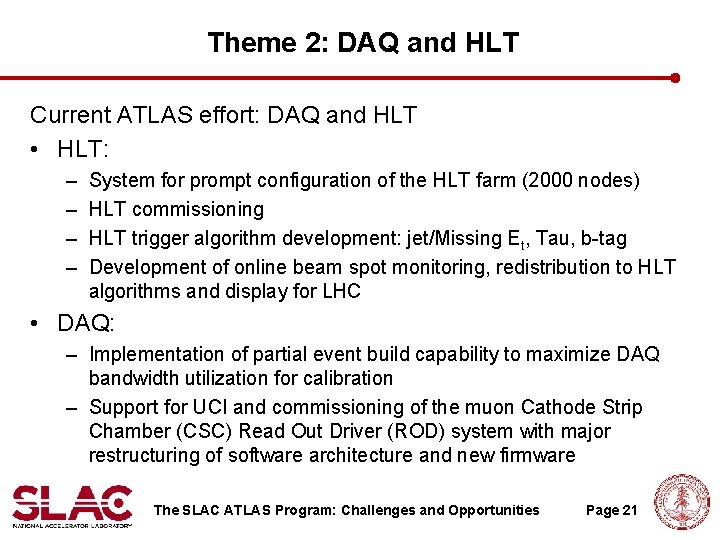
Theme 2: DAQ and HLT Current ATLAS effort: DAQ and HLT • HLT: – – System for prompt configuration of the HLT farm (2000 nodes) HLT commissioning HLT trigger algorithm development: jet/Missing Et, Tau, b-tag Development of online beam spot monitoring, redistribution to HLT algorithms and display for LHC • DAQ: – Implementation of partial event build capability to maximize DAQ bandwidth utilization for calibration – Support for UCI and commissioning of the muon Cathode Strip Chamber (CSC) Read Out Driver (ROD) system with major restructuring of software architecture and new firmware The SLAC ATLAS Program: Challenges and Opportunities Page 21
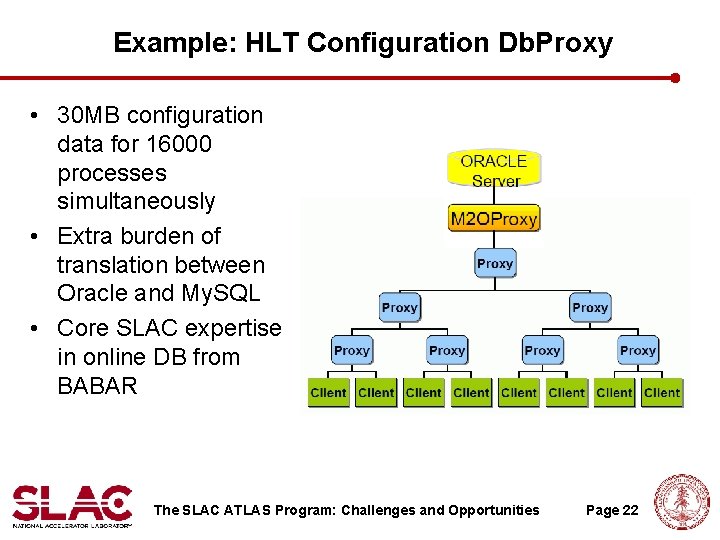
Example: HLT Configuration Db. Proxy • 30 MB configuration data for 16000 processes simultaneously • Extra burden of translation between Oracle and My. SQL • Core SLAC expertise in online DB from BABAR The SLAC ATLAS Program: Challenges and Opportunities Page 22
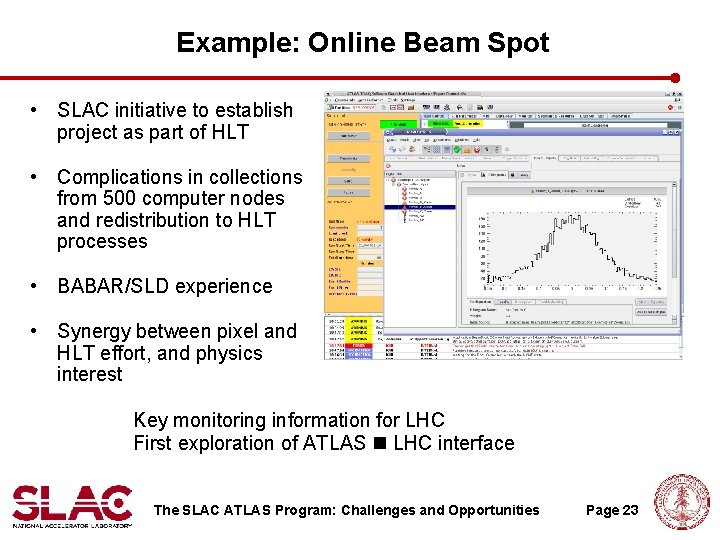
Example: Online Beam Spot • SLAC initiative to establish project as part of HLT • Complications in collections from 500 computer nodes and redistribution to HLT processes • BABAR/SLD experience • Synergy between pixel and HLT effort, and physics interest Key monitoring information for LHC First exploration of ATLAS n LHC interface The SLAC ATLAS Program: Challenges and Opportunities Page 23
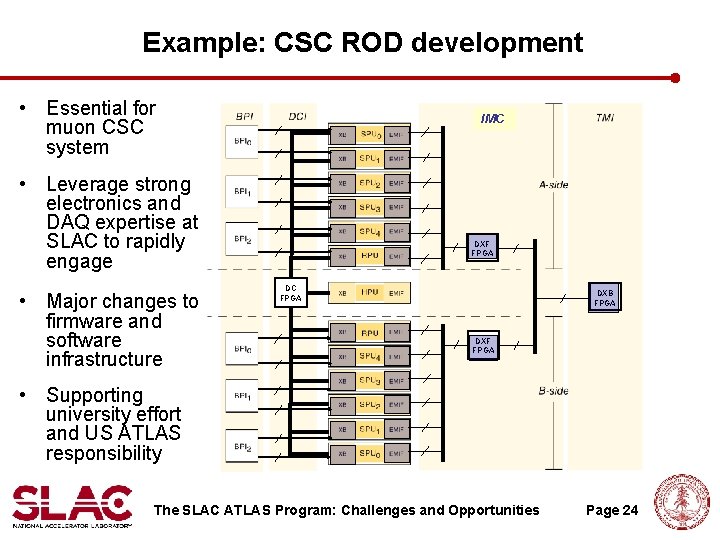
Example: CSC ROD development • Essential for muon CSC system IMC • Leverage strong electronics and DAQ expertise at SLAC to rapidly engage • Major changes to firmware and software infrastructure DXF FPGA DC FPGA DXB FPGA DXF FPGA • Supporting university effort and US ATLAS responsibility The SLAC ATLAS Program: Challenges and Opportunities Page 24
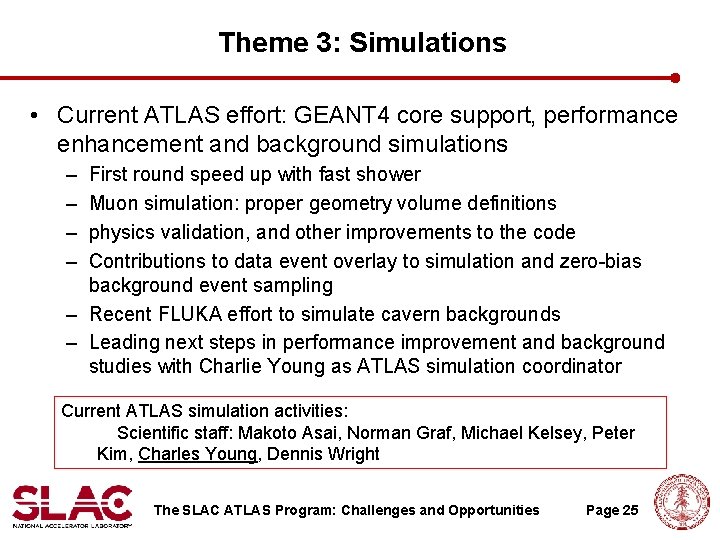
Theme 3: Simulations • Current ATLAS effort: GEANT 4 core support, performance enhancement and background simulations – – First round speed up with fast shower Muon simulation: proper geometry volume definitions physics validation, and other improvements to the code Contributions to data event overlay to simulation and zero-bias background event sampling – Recent FLUKA effort to simulate cavern backgrounds – Leading next steps in performance improvement and background studies with Charlie Young as ATLAS simulation coordinator Current ATLAS simulation activities: Scientific staff: Makoto Asai, Norman Graf, Michael Kelsey, Peter Kim, Charles Young, Dennis Wright The SLAC ATLAS Program: Challenges and Opportunities Page 25
LHC luminosity and upgrade planning Integrated Luminosity Peak Luminosity Phase 2 Phase 1 2020 2015 2009 Phase 1: peak luminosity 3 x 1034 and 700 fb-1 Phase 2: peak luminosity 1 x 1035 and 3000 fb-1 The SLAC ATLAS Program: Challenges and Opportunities Page 26
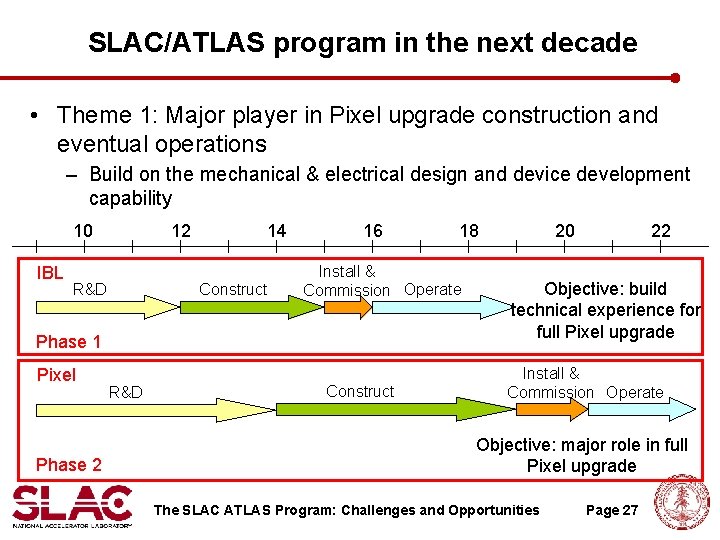
SLAC/ATLAS program in the next decade • Theme 1: Major player in Pixel upgrade construction and eventual operations – Build on the mechanical & electrical design and device development capability 10 IBL 12 R&D 14 Construct 16 Install & Commission Operate Phase 1 Pixel Phase 2 R&D 18 Construct 20 22 Objective: build technical experience for full Pixel upgrade Install & Commission Operate Objective: major role in full Pixel upgrade The SLAC ATLAS Program: Challenges and Opportunities Page 27
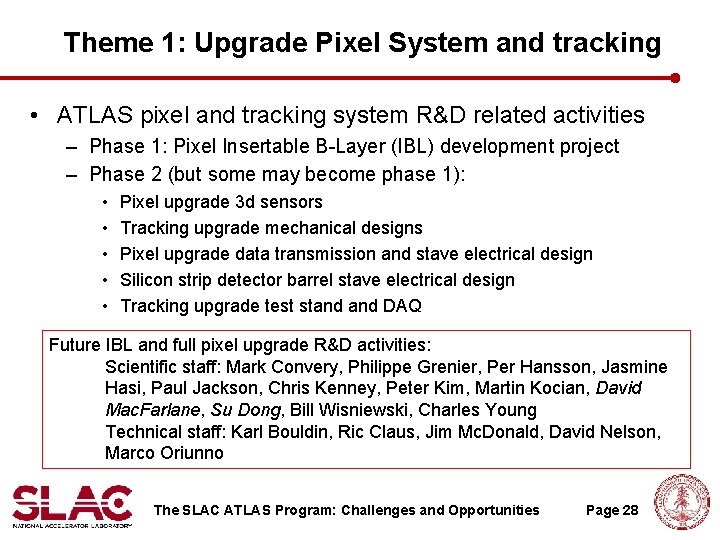
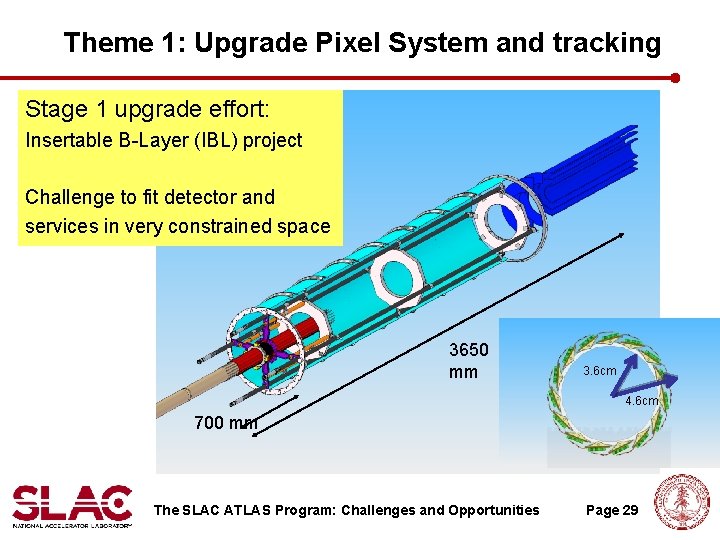
Theme 1: Upgrade Pixel System and tracking • ATLAS pixel and tracking system R&D related activities – Phase 1: Pixel Insertable B-Layer (IBL) development project – Phase 2 (but some may become phase 1): • • • Pixel upgrade 3 d sensors Tracking upgrade mechanical designs Pixel upgrade data transmission and stave electrical design Silicon strip detector barrel stave electrical design Tracking upgrade test stand DAQ Future IBL and full pixel upgrade R&D activities: Scientific staff: Mark Convery, Philippe Grenier, Per Hansson, Jasmine Hasi, Paul Jackson, Chris Kenney, Peter Kim, Martin Kocian, David Mac. Farlane, Su Dong, Bill Wisniewski, Charles Young Technical staff: Karl Bouldin, Ric Claus, Jim Mc. Donald, David Nelson, Marco Oriunno The SLAC ATLAS Program: Challenges and Opportunities Page 28
Theme 1: Upgrade Pixel System and tracking Stage 1 upgrade effort: Insertable B-Layer (IBL) project Challenge to fit detector and services in very constrained space 3650 mm 3. 6 cm 4. 6 cm 700 mm The SLAC ATLAS Program: Challenges and Opportunities Page 29
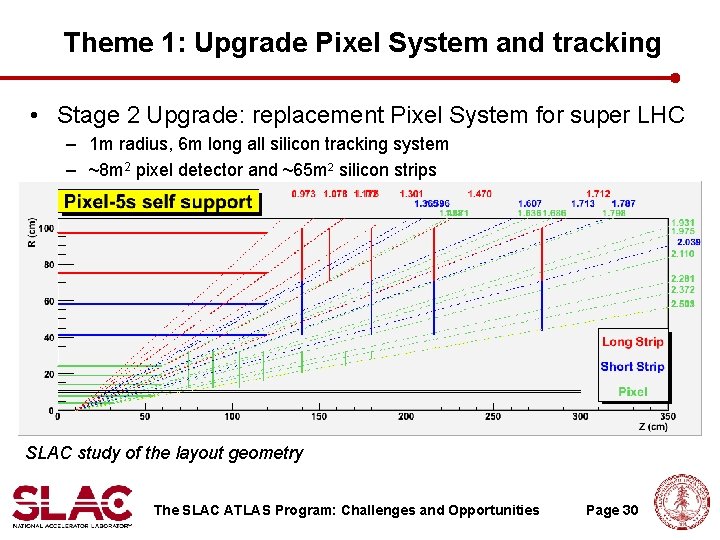
Theme 1: Upgrade Pixel System and tracking • Stage 2 Upgrade: replacement Pixel System for super LHC – 1 m radius, 6 m long all silicon tracking system – ~8 m 2 pixel detector and ~65 m 2 silicon strips SLAC study of the layout geometry The SLAC ATLAS Program: Challenges and Opportunities Page 30
Theme 3: Upgrade Simulations • Pixel and Tracking Systems layout studies – Basic upgrade layout design decisions for the future Pixel and Silicon Tracker Systems need simulation support. – We propose to use existing ATLAS simulation tool kit in conjunction with the linear collider framework Lcsim (more flexible geometry variations), to provide physics and performance guidance to these design decisions Future ATLAS tracking system simulation activities: Scientific staff: Rich Partridge, Charles Young Postdocs: Matthew Graham, Michael Wilson The SLAC ATLAS Program: Challenges and Opportunities Page 31
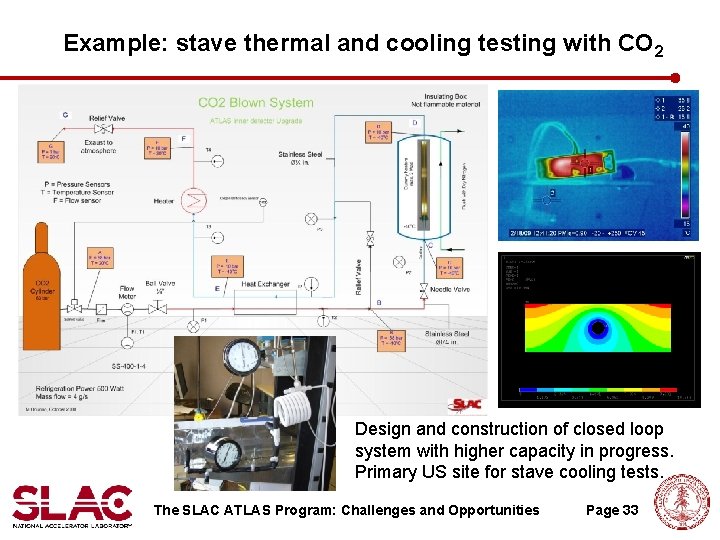
Theme 1: Upgrade Pixel System and tracking • Upgrade Pixel System for super LHC – We are working closely with LBNL/UCSC, and ATLAS as a whole, on various R&D issues towards a super LHC pixel detector: • 3 d pixel sensors • Multi Gbit/s electrical data transmission • Electrical stave design • CO 2 cooling test facility and thermal tests • Mechanical designs • New test stand DAQ – Preparing infrastructure as a possible site for assembly and testing. The SLAC ATLAS Program: Challenges and Opportunities Page 32
Example: stave thermal and cooling testing with CO 2 Design and construction of closed loop system with higher capacity in progress. Primary US site for stave cooling tests. The SLAC ATLAS Program: Challenges and Opportunities Page 33
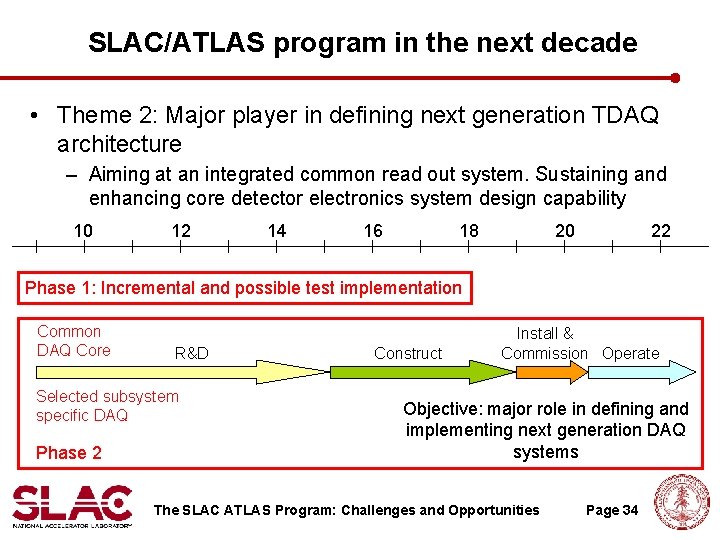
SLAC/ATLAS program in the next decade • Theme 2: Major player in defining next generation TDAQ architecture – Aiming at an integrated common read out system. Sustaining and enhancing core detector electronics system design capability 10 12 14 16 18 20 22 Phase 1: Incremental and possible test implementation Common DAQ Core R&D Selected subsystem specific DAQ Phase 2 Construct Install & Commission Operate Objective: major role in defining and implementing next generation DAQ systems The SLAC ATLAS Program: Challenges and Opportunities Page 34
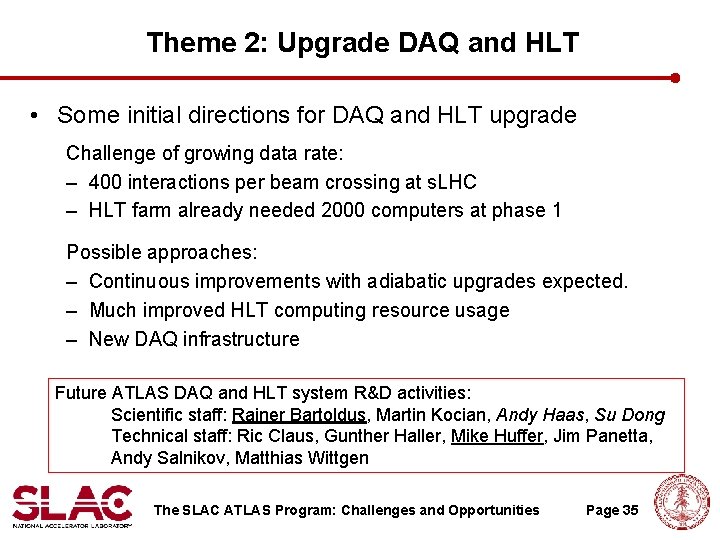
Theme 2: Upgrade DAQ and HLT • Some initial directions for DAQ and HLT upgrade Challenge of growing data rate: – 400 interactions per beam crossing at s. LHC – HLT farm already needed 2000 computers at phase 1 Possible approaches: – Continuous improvements with adiabatic upgrades expected. – Much improved HLT computing resource usage – New DAQ infrastructure Future ATLAS DAQ and HLT system R&D activities: Scientific staff: Rainer Bartoldus, Martin Kocian, Andy Haas, Su Dong Technical staff: Ric Claus, Gunther Haller, Mike Huffer, Jim Panetta, Andy Salnikov, Matthias Wittgen The SLAC ATLAS Program: Challenges and Opportunities Page 35
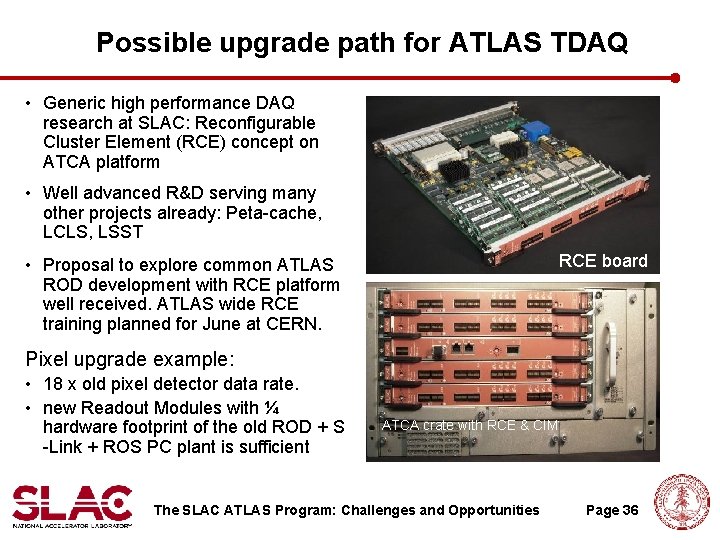
Possible upgrade path for ATLAS TDAQ • Generic high performance DAQ research at SLAC: Reconfigurable Cluster Element (RCE) concept on ATCA platform • Well advanced R&D serving many other projects already: Peta-cache, LCLS, LSST RCE board • Proposal to explore common ATLAS ROD development with RCE platform well received. ATLAS wide RCE training planned for June at CERN. Pixel upgrade example: • 18 x old pixel detector data rate. • new Readout Modules with ¼ hardware footprint of the old ROD + S -Link + ROS PC plant is sufficient ATCA crate with RCE & CIM The SLAC ATLAS Program: Challenges and Opportunities Page 36
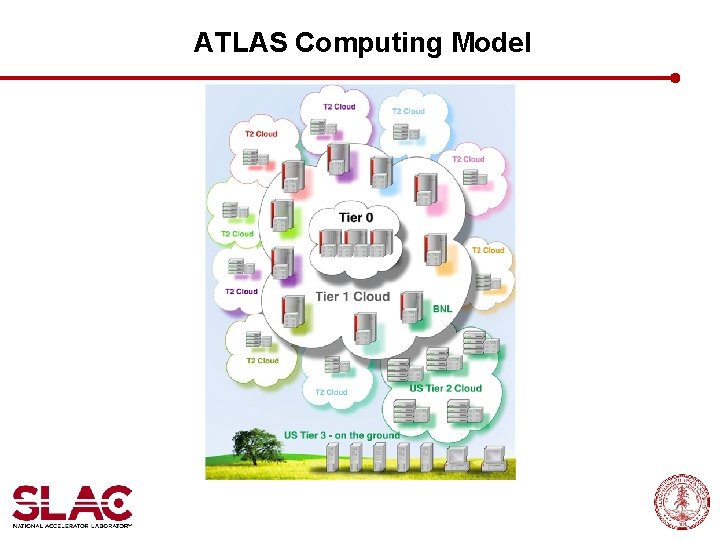
Theme 4: Tier 2 and Analysis Facility • Planning for ATLAS computing and analysis well advanced – Based on a 3 -tiered & distributed model similar to BABAR • ATLAS Tier 2 center at SLAC represents about 20% of the installed BABAR computing hardware – ATLAS now has access to a much larger pool of available CPU cycles through general queue access to BABAR hardware • Future ATLAS computing needs may require major additional resources – Physics tools and algorithm development with multiple reprocessing of significant fractions of events – Alignment calibration & development with calibration data streams – Development and validation of high-level trigger algorithms The SLAC ATLAS Program: Challenges and Opportunities Page 37
Theme 4: Tier 2 and Analysis Facility • Future direction for ATLAS Tier 2 & 3 implementation also needs clarification – Hosting Tier 3 centers at SLAC may be an attractive option, both in terms of maintaining efficient operation and sharing CPU resources – Present model for limited Tier 2 analysis role may evolve anyway based on real experience with data and analysis • Working to develop a model for a Western Data Analysis Facility at SLAC – Migrate from BABAR dominated to ATLAS dominated computing hardware operation, within site power and cooling capabilities – Understand economies of sharing support personnel, CPU and disk hardware across Tier 2 and Tier 3 needs – Integrate into US ATLAS and ATLAS planning for Tier 2 & 3 planning and initial experience with data The SLAC ATLAS Program: Challenges and Opportunities Page 38
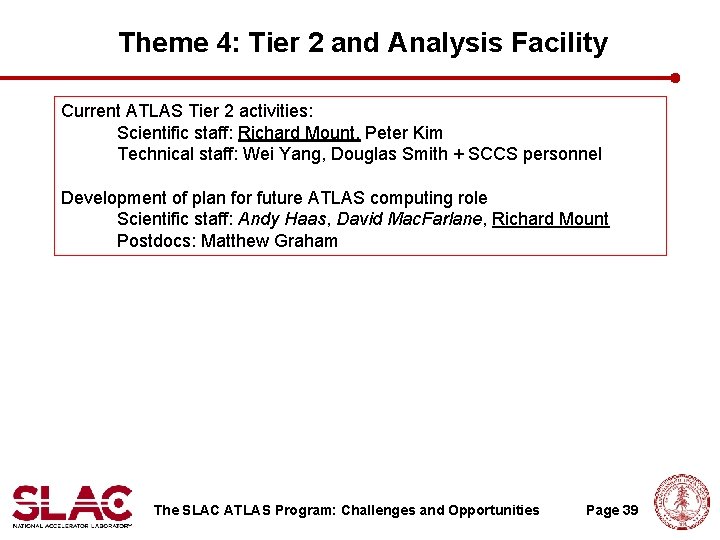
Theme 4: Tier 2 and Analysis Facility Current ATLAS Tier 2 activities: Scientific staff: Richard Mount, Peter Kim Technical staff: Wei Yang, Douglas Smith + SCCS personnel Development of plan for future ATLAS computing role Scientific staff: Andy Haas, David Mac. Farlane, Richard Mount Postdocs: Matthew Graham The SLAC ATLAS Program: Challenges and Opportunities Page 39
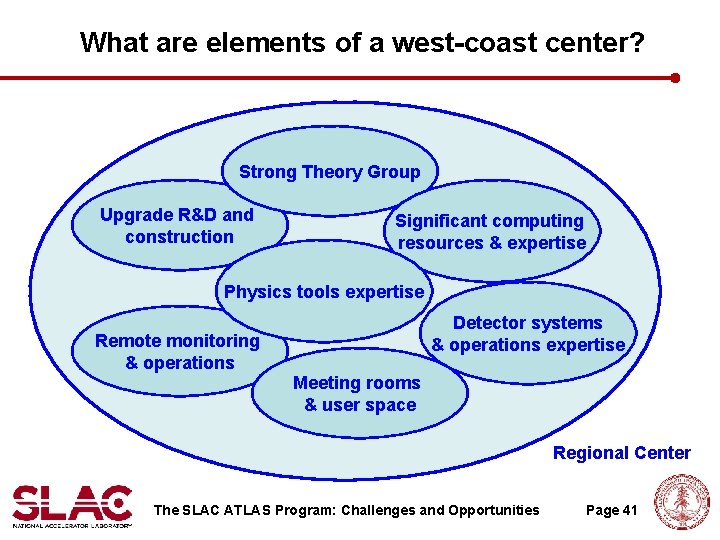
Theme 5: The bay area as a west-coast ATLAS center • CERN cannot host major portions of the LHC collaborations long term • The Bay Area could play a leading role in supporting LHC physics – Concentration of expertise on computing, analysis and detector systems – Proximity of physics analysis support centers, capability for hosting workshops, tutorials and seminars – Attractive training centers due to a combination of tutorials, available expertise, & participation in upgrade activities – Strength of Theory Groups & their strong interest in LHC physics • Working to create a consensus in the US ATLAS community for a viable regional center role The SLAC ATLAS Program: Challenges and Opportunities Page 40
What are elements of a west-coast center? Strong Theory Group Upgrade R&D and construction Significant computing resources & expertise Physics tools expertise Detector systems & operations expertise Remote monitoring & operations Meeting rooms & user space Regional Center The SLAC ATLAS Program: Challenges and Opportunities Page 41
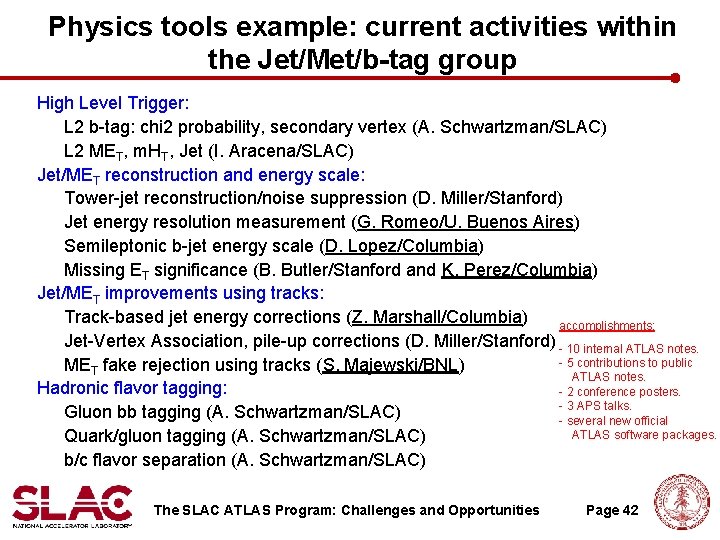
Physics tools example: current activities within the Jet/Met/b-tag group High Level Trigger: L 2 b-tag: chi 2 probability, secondary vertex (A. Schwartzman/SLAC) L 2 MET, m. HT, Jet (I. Aracena/SLAC) Jet/MET reconstruction and energy scale: Tower-jet reconstruction/noise suppression (D. Miller/Stanford) Jet energy resolution measurement (G. Romeo/U. Buenos Aires) Semileptonic b-jet energy scale (D. Lopez/Columbia) Missing ET significance (B. Butler/Stanford and K. Perez/Columbia) Jet/MET improvements using tracks: Track-based jet energy corrections (Z. Marshall/Columbia) accomplishments: Jet-Vertex Association, pile-up corrections (D. Miller/Stanford) - 10 internal ATLAS notes. - 5 contributions to public MET fake rejection using tracks (S. Majewski/BNL) ATLAS notes. Hadronic flavor tagging: - 2 conference posters. - 3 APS talks. Gluon bb tagging (A. Schwartzman/SLAC) - several new official ATLAS software packages. Quark/gluon tagging (A. Schwartzman/SLAC) b/c flavor separation (A. Schwartzman/SLAC) The SLAC ATLAS Program: Challenges and Opportunities Page 42
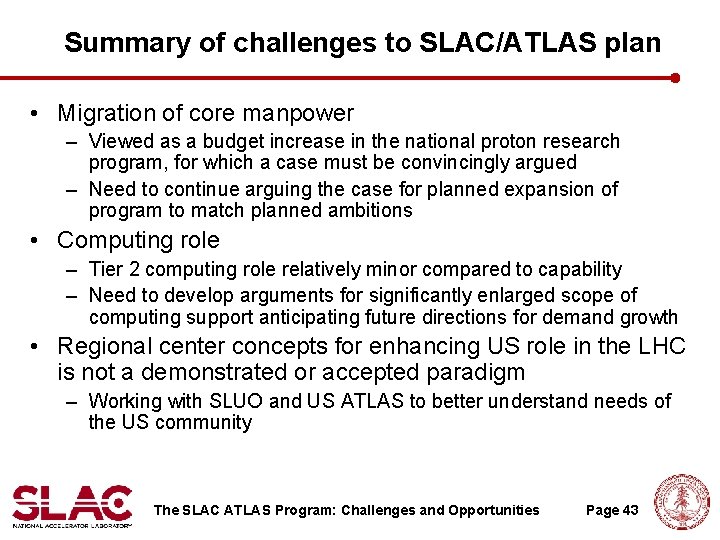
Summary of challenges to SLAC/ATLAS plan • Migration of core manpower – Viewed as a budget increase in the national proton research program, for which a case must be convincingly argued – Need to continue arguing the case for planned expansion of program to match planned ambitions • Computing role – Tier 2 computing role relatively minor compared to capability – Need to develop arguments for significantly enlarged scope of computing support anticipating future directions for demand growth • Regional center concepts for enhancing US role in the LHC is not a demonstrated or accepted paradigm – Working with SLUO and US ATLAS to better understand needs of the US community The SLAC ATLAS Program: Challenges and Opportunities Page 43
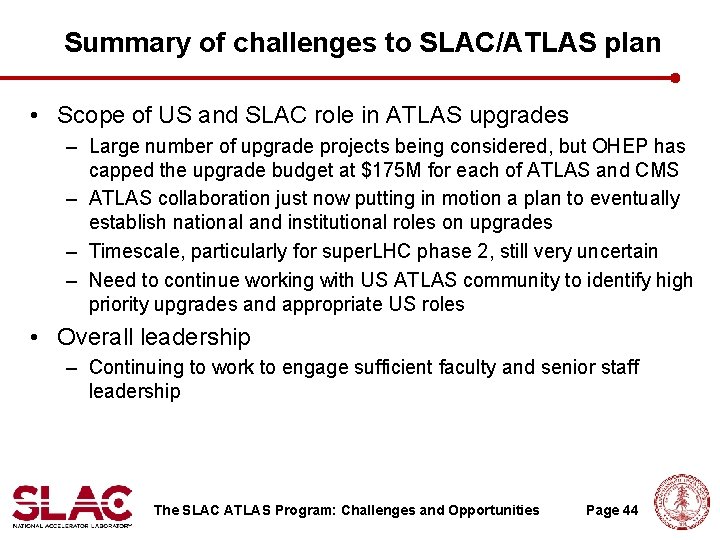
Summary of challenges to SLAC/ATLAS plan • Scope of US and SLAC role in ATLAS upgrades – Large number of upgrade projects being considered, but OHEP has capped the upgrade budget at $175 M for each of ATLAS and CMS – ATLAS collaboration just now putting in motion a plan to eventually establish national and institutional roles on upgrades – Timescale, particularly for super. LHC phase 2, still very uncertain – Need to continue working with US ATLAS community to identify high priority upgrades and appropriate US roles • Overall leadership – Continuing to work to engage sufficient faculty and senior staff leadership The SLAC ATLAS Program: Challenges and Opportunities Page 44
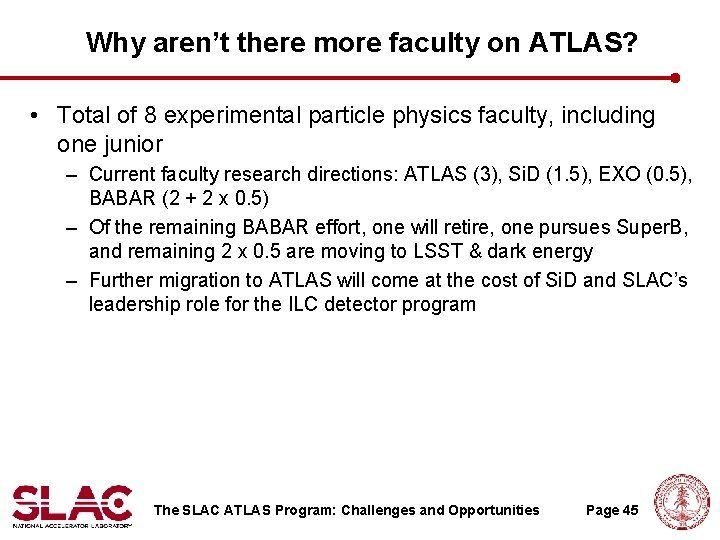
Why aren’t there more faculty on ATLAS? • Total of 8 experimental particle physics faculty, including one junior – Current faculty research directions: ATLAS (3), Si. D (1. 5), EXO (0. 5), BABAR (2 + 2 x 0. 5) – Of the remaining BABAR effort, one will retire, one pursues Super. B, and remaining 2 x 0. 5 are moving to LSST & dark energy – Further migration to ATLAS will come at the cost of Si. D and SLAC’s leadership role for the ILC detector program The SLAC ATLAS Program: Challenges and Opportunities Page 45
Overall summary and outlook • SLAC is moving to significantly expand our role on ATLAS – Motivated by sustaining an energy frontier physics program at the LHC in the mid-term and eventually the ILC in the future – Matching core capabilities and operational expertise in areas that are unique and/or appropriate for a national lab program – A cornerstone of the future accelerator-based HEP program • Moving forward with indentifying crucial upgrade roles – Plan supports some of the crucial system upgrades that are anticipated to be major future responsibilities for the US community • Taking on appropriate roles for national lab in support the highest priority LHC program – Significantly enlarged ATLAS program will provide a strong anchor on the west coast for maximizing return on US investment in ATLAS The SLAC ATLAS Program: Challenges and Opportunities Page 46
Backup material The SLAC ATLAS Program: Challenges and Opportunities Page 47
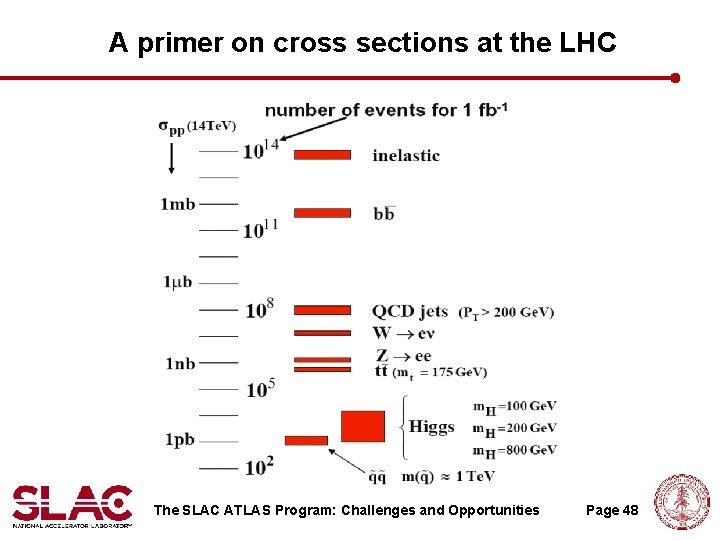
A primer on cross sections at the LHC The SLAC ATLAS Program: Challenges and Opportunities Page 48
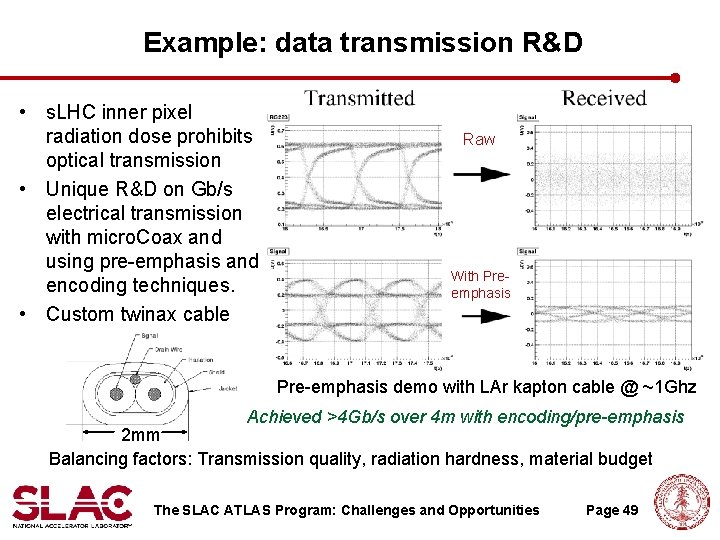
Example: data transmission R&D • s. LHC inner pixel radiation dose prohibits optical transmission • Unique R&D on Gb/s electrical transmission with micro. Coax and using pre-emphasis and encoding techniques. • Custom twinax cable Raw With Preemphasis Pre-emphasis demo with LAr kapton cable @ ~1 Ghz Achieved >4 Gb/s over 4 m with encoding/pre-emphasis 2 mm Balancing factors: Transmission quality, radiation hardness, material budget The SLAC ATLAS Program: Challenges and Opportunities Page 49
ATLAS Computing Model
Physics Preparation Activities • Emphasis on building expertise on physics signature reconstruction and trigger: – Grass root Jet/Missing. Et/b-tag analysis group – ATLAS jet energy calibration task force coordination (Ariel Schwartzman) – Trigger algorithm (jet/MET/tau/b-jet) and menu development – Tracking and alignment – Pileup study / simulation • Main physics interests in new physics searches, in conjunction with initial SM measurements to assist development and validation of the physics tools. The SLAC ATLAS Program: Challenges and Opportunities Page 51
Current physics analysis topics • • Measurement of t g t + x t`t cross section with b-jet + MET (t. W)(`t. W) same sign dilepton search R-Parity Violating SUSY search with displaced vertices Stopped gluino search New physics search with b-jet + MET SUSY Higgs from bb. H/A production (trigger study) The SLAC ATLAS Program: Challenges and Opportunities Page 52
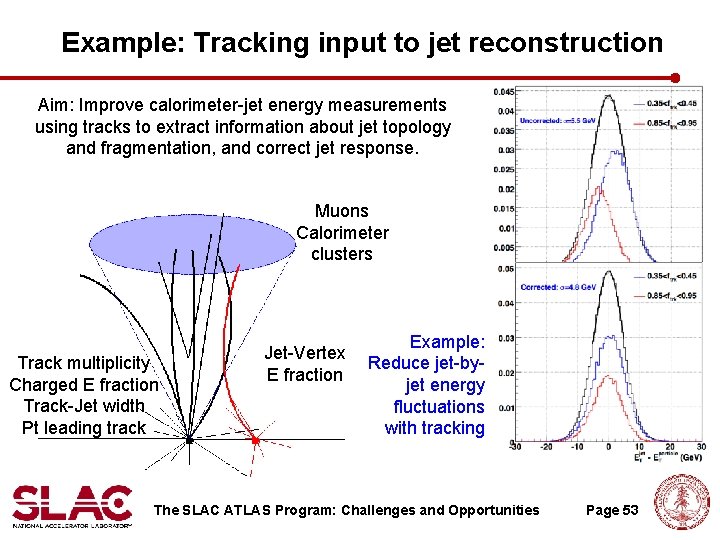
Example: Tracking input to jet reconstruction Aim: Improve calorimeter-jet energy measurements using tracks to extract information about jet topology and fragmentation, and correct jet response. Muons Calorimeter clusters Track multiplicity Charged E fraction Track-Jet width Pt leading track Jet-Vertex E fraction Example: Reduce jet-byjet energy fluctuations with tracking The SLAC ATLAS Program: Challenges and Opportunities Page 53
Reflections on Experimental Involvement • The experimental and upgrade projects where we succeeded well through creativity and expertise has shown to be primarily leveraging experience from recent HEP experiment, in particular BABAR. • Heading into the future, the ATLAS experience can also be expected to be the primary base for sustained competence for ambitions in future energy frontier endeavor. The SLAC ATLAS Program: Challenges and Opportunities Page 54
super. LHC: an inevitable path for HEP ? • Early discoveries at LHC would imply the effective extra energy reach (~30 -40%) at high lumi could uncover additional new particles. That extra reach is likely to have complementary physics to Linear Collider. • If early phase of LHC not revealing new physics, it would be hard to argue for other new facilities. s. LHC will be taking on an even central focus of hope for new physics through its effective additional energy reach. The SLAC ATLAS Program: Challenges and Opportunities Page 55