
The Skeletal System The head bones connected to
The Skeletal System The head bone’s connected to the neck bone…
Function n Movement – muscle attachment n Protection n Structure/Framework n Produce red blood cells 206 bones in the body!
Joints A Functional Junction

Joint Function n Bind parts of skeletal system n Make possible bone growth n Permit bones to change shape during child birth n Enable body to move in response to skeletal muscle contraction

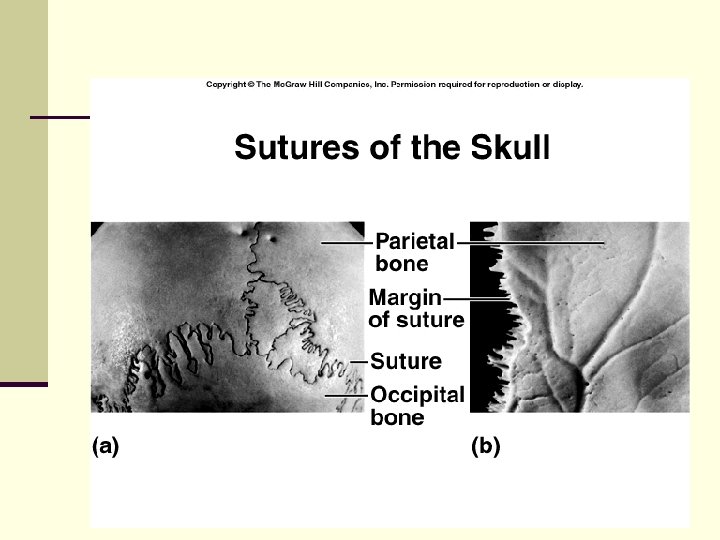
Fibrous Joints n Lie between bones that closely contact one another n Formed with a thin layer of dense CT n NO appreciable movement n Limited movement at distal end of tibia/fibula n Ex. Sutures between flat bones of skull
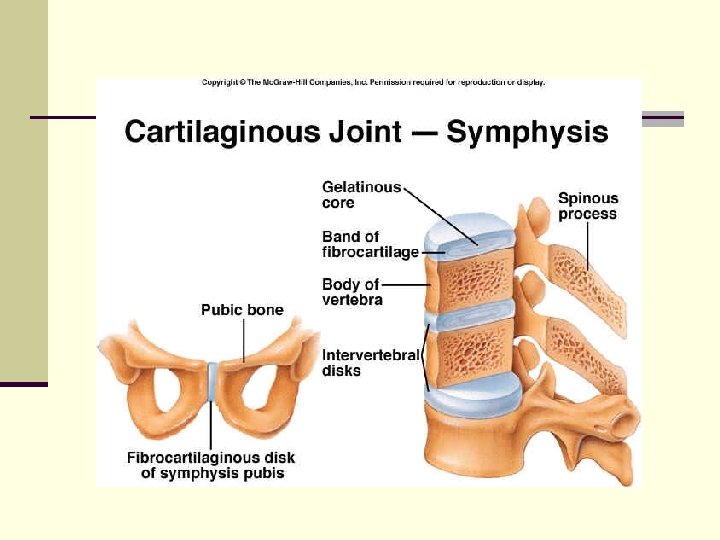
Cartilaginous Joints n Formed by fibrocartilage n Intervertebral discs of V. C. separate vertebrae, absorb shock, and equalize pressure between adjacent vertebrae when the body moves n Allow limited movement n Ex. Symphysis pubis; first rib with sternum
Synovial Joints n Most joints of the skeletal system allow free movement n Articular ends of bones in this type of joint are covered in hyaline cartilage (articular cart) n Joint Capsule – tubular capsule of dense CT holds the bones together n Outer layer of ligaments; inner lining of synovial membrane (secretes synovial fluid…lubrication)

Synovial Joints cont. n Some have menisci – shock absorbing pads of fibrocartilage between articulating surfaces n Also may have bursae – fluid filled sac usually located between skin and underlying bony prominences n Aids in movement of tendons
Classification of Synovial Joints 1. Ball and socket joint – bone with a ball shaped head that articulates with a cup shaped cavity of another bone l l Allows widest range of motion, including rotational Ex. Shoulder and hip joints 2. Condyloid joint – oval shaped condyle of a bone fits into an elliptical cavity of another l l Allows variety of movements, however not rotational Ex. Between metacarpals and proximal phalanges
Classification cont. 3. Gliding joint – nearly flat/slightly curved l Allow sliding and twisting movements l Ex. Wrists and ankles 4. Hinge joint – convex surface of one bone fits into concave surface of another l l Allows movement in only one plane (hinge of door) flexion/extension Ex. Elbow and phalanges
Classification cont. 5. Pivot joint – cylindrical surface of one bone rotates within a ring formed of bone and ligament l l Allows rotation around a central axis Ex. Proximal ends of radius and ulna 6. Saddle joint – between bones whose articulating surfaces have both convex and concave regions l l Allows variety of movements Trapezium (carpal) and metacarpal of thumb
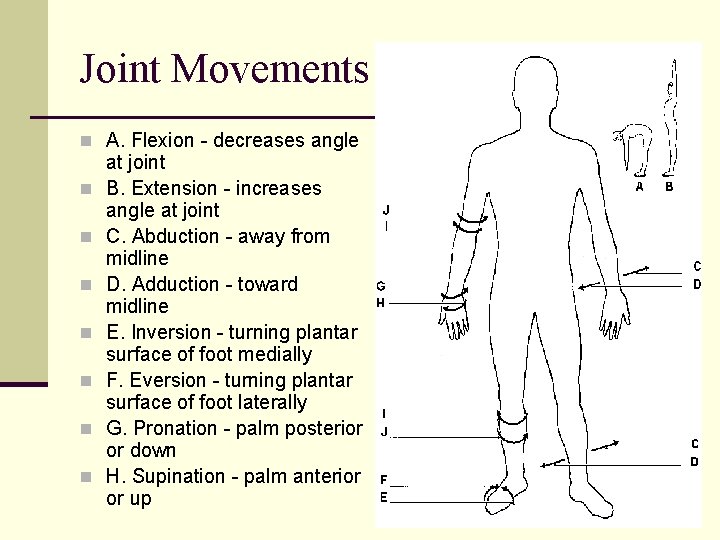
Joint Movements n A. Flexion - decreases angle n n n n at joint B. Extension - increases angle at joint C. Abduction - away from midline D. Adduction - toward midline E. Inversion - turning plantar surface of foot medially F. Eversion - turning plantar surface of foot laterally G. Pronation - palm posterior or down H. Supination - palm anterior or up
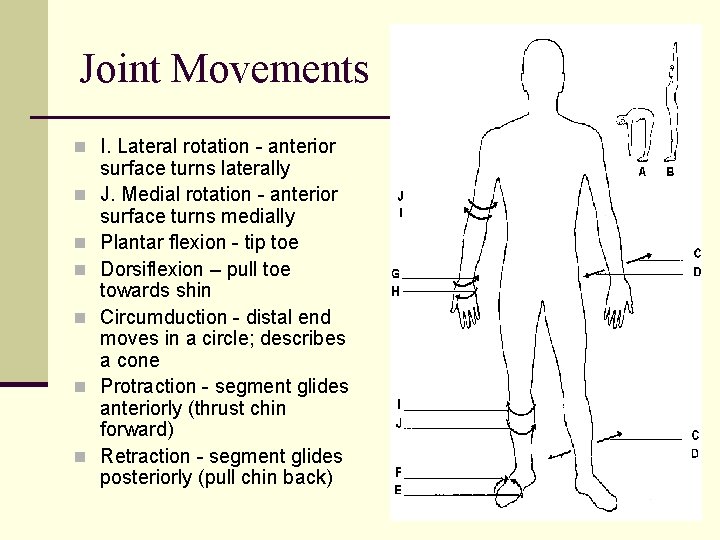
Joint Movements n I. Lateral rotation - anterior n n n surface turns laterally J. Medial rotation - anterior surface turns medially Plantar flexion - tip toe Dorsiflexion – pull toe towards shin Circumduction - distal end moves in a circle; describes a cone Protraction - segment glides anteriorly (thrust chin forward) Retraction - segment glides posteriorly (pull chin back)
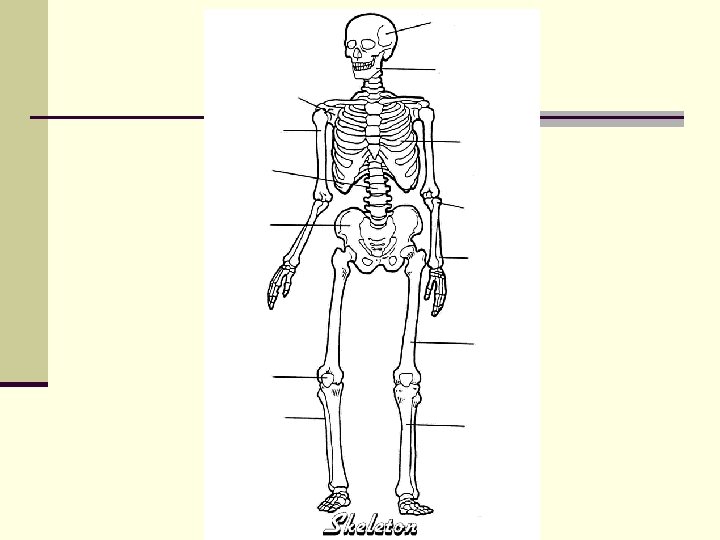
Skeletal System Review n Diagrams n LM pages: 90, 91, 96, 108, 110, 118, 127, 131 (top), text p. 155 (top) n Short Answer/Fill in the blank n Functions of skeletal system n Examples of 3 processes, 2 foramens, 1 condyle AND the bone they are associated with n 3 parts of the pelvis n Where the ribs attach n Bone that supports the tongue n Bones that make up the orbit of the eye
Review cont. n Multiple choice n Identifying bones in either appendicular or axial skeleton n Match parts of bone with definition n Joint type with description and example n Define: sinus, synovial fluid, and ligament
- Slides: 19