
The Skeletal System Structure Function Is this the
- Slides: 45
The Skeletal System: Structure, Function
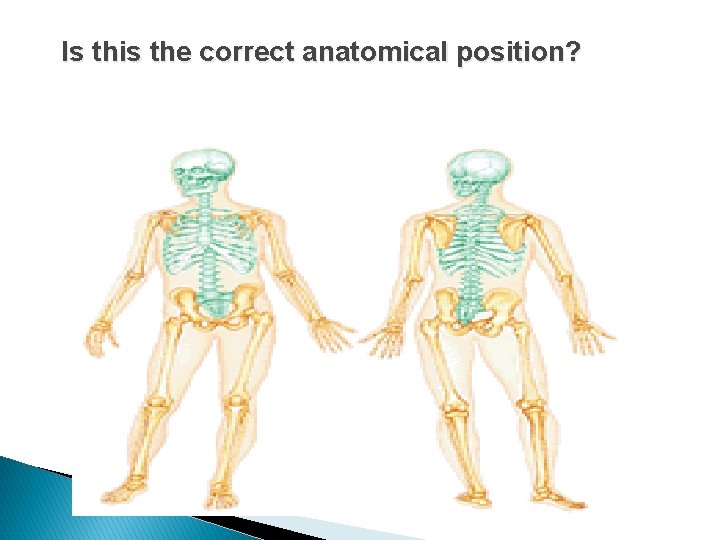
Is this the correct anatomical position?
The Skeletal System · Parts of the skeletal system · Bones (skeleton) · Joints · Cartilages · Ligaments (bone to bone)(tendon=bone to muscle) · Divided into two divisions · Axial skeleton- skull, spinal column · Appendicular skeleton – limbs and girdle Copyright © 2003 Pearson Education, Inc. publishing as Benjamin Cummings
Functions of Bones · Support of the body · Protection of soft organs · Movement due to attached skeletal muscles · Storage of minerals and fats · Blood cell formation Copyright © 2003 Pearson Education, Inc. publishing as Benjamin Cummings
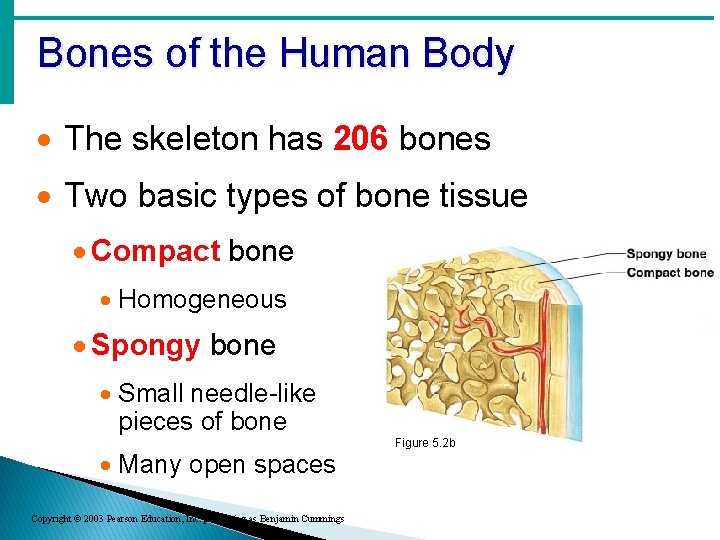
Bones of the Human Body · The skeleton has 206 bones · Two basic types of bone tissue · Compact bone · Homogeneous · Spongy bone · Small needle-like pieces of bone · Many open spaces Copyright © 2003 Pearson Education, Inc. publishing as Benjamin Cummings Figure 5. 2 b
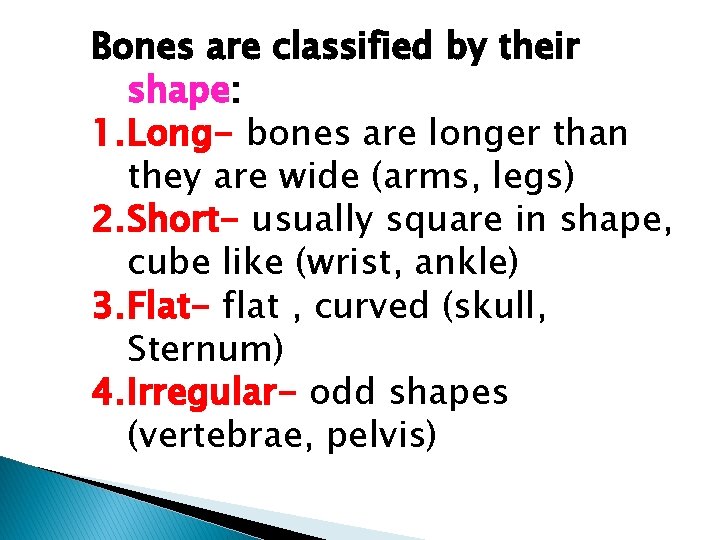
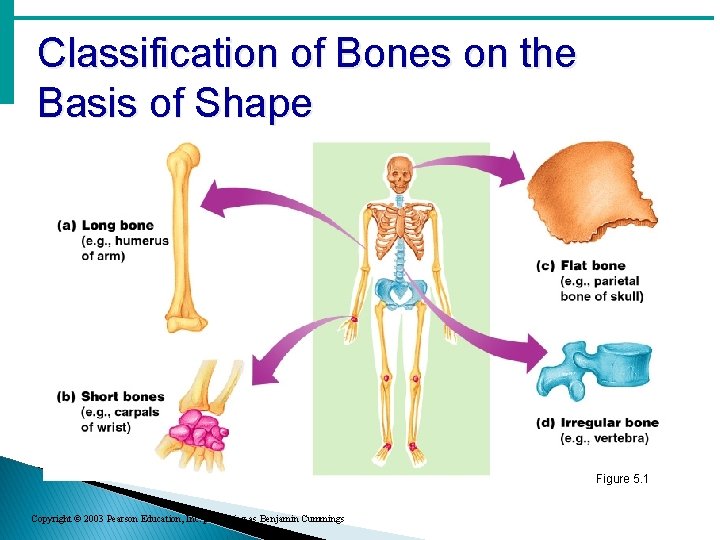
Bones are classified by their shape: 1. Long- bones are longer than they are wide (arms, legs) 2. Short- usually square in shape, cube like (wrist, ankle) 3. Flat- flat , curved (skull, Sternum) 4. Irregular- odd shapes (vertebrae, pelvis)
Classification of Bones on the Basis of Shape Figure 5. 1 Copyright © 2003 Pearson Education, Inc. publishing as Benjamin Cummings
Types of Bone Cells · Osteocytes · Mature bone cells · Osteoblasts · Bone-forming cells · Osteoclasts · Bone-destroying cells · Break down bone matrix for remodeling and release of calcium · Bone remodeling is a process by both osteoblasts and osteoclasts Copyright © 2003 Pearson Education, Inc. publishing as Benjamin Cummings
Changes in the Human Skeleton · In embryos, the skeleton is primarily hyaline cartilage · During development, much of this cartilage is replaced by bone · Cartilage remains in isolated areas · Bridge of the nose · Parts of ribs · Joints Copyright © 2003 Pearson Education, Inc. publishing as Benjamin Cummings
Red and Yellow Bone Marrow � The formation of blood cells, (hematopoiesis), takes place mainly in the red marrow of the bones. � In infants, red marrow is found in the bone cavities. With age, it is largely replaced by yellow marrow for fat storage. � In adults, red marrow is limited to the spongy bone in the skull, ribs, sternum, clavicles, vertebrae and pelvis. Red marrow functions in the formation of red blood cells, white blood cells and blood platelets.
The Axial Skeleton · Forms the longitudinal part of the body · Divided into three parts · Skull · Vertebral Column · Rib Cage Copyright © 2003 Pearson Education, Inc. publishing as Benjamin Cummings Slide
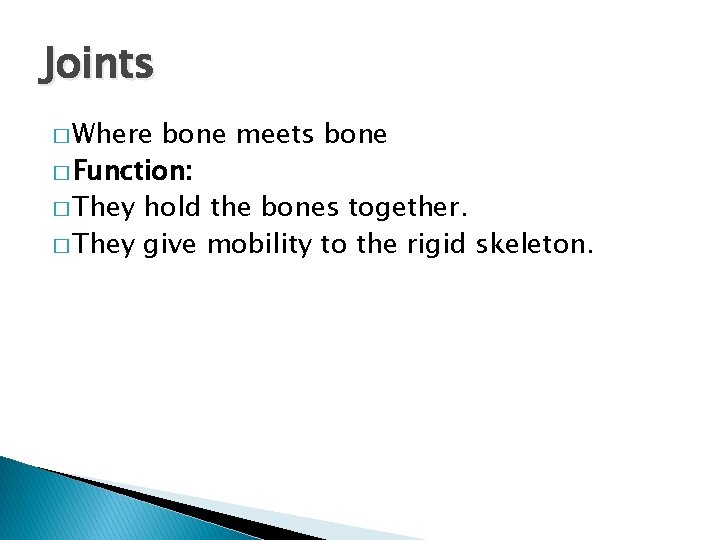
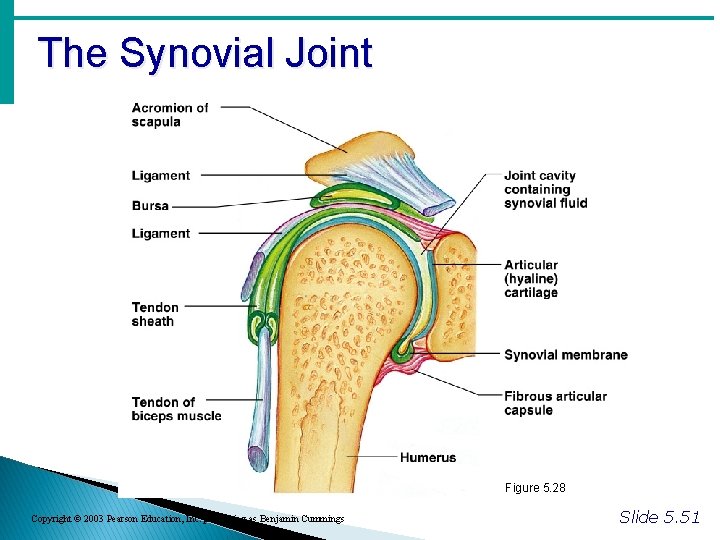
Joints A joint, or articulation, is the place where two bones come together. � Fibrous- Immovable: connect bones, no movement. (skull and pelvis). � Cartilaginous- slightly movable, bones are attached by cartilage, a little movement (spine or ribs). � Synovial- freely movable, much more movement than cartilaginous joints. Cavities between bones are filled with synovial fluid. This fluid helps lubricate and protect the bones.
Joints � Where bone meets bone � Function: � They hold the bones together. � They give mobility to the rigid skeleton.
The Synovial Joint Figure 5. 28 Copyright © 2003 Pearson Education, Inc. publishing as Benjamin Cummings Slide 5. 51
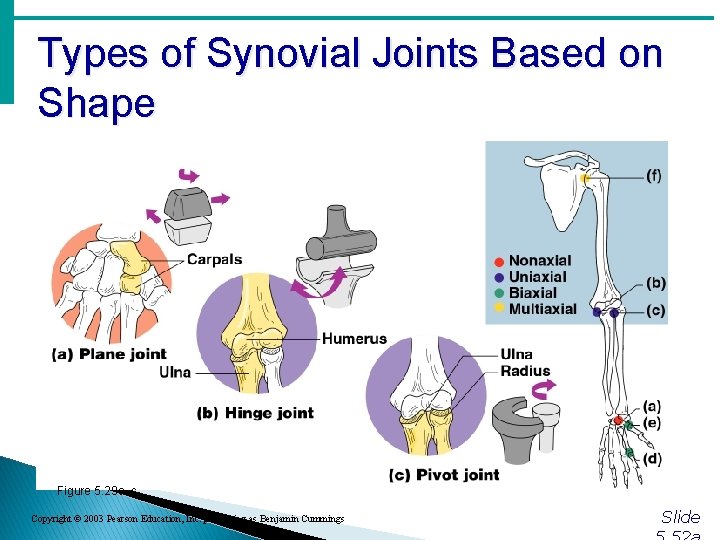
Types of Synovial Joints Based on Shape Figure 5. 29 a–c Copyright © 2003 Pearson Education, Inc. publishing as Benjamin Cummings Slide
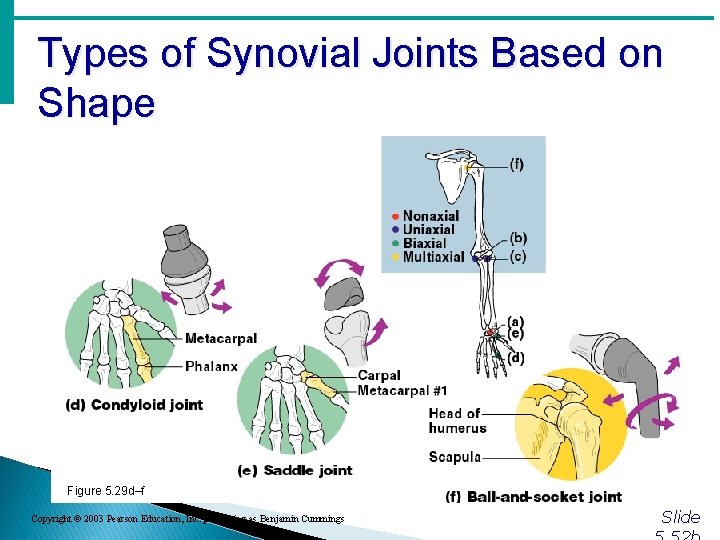
Types of Synovial Joints Based on Shape Figure 5. 29 d–f Copyright © 2003 Pearson Education, Inc. publishing as Benjamin Cummings Slide
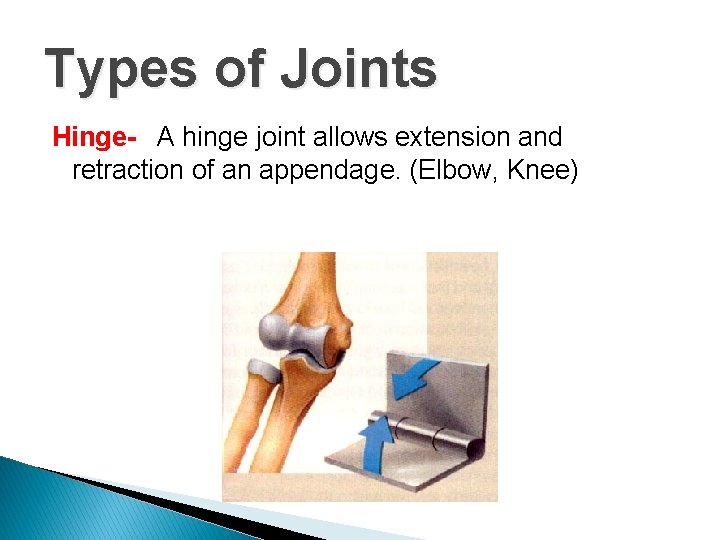
Types of Joints Hinge- A hinge joint allows extension and retraction of an appendage. (Elbow, Knee)
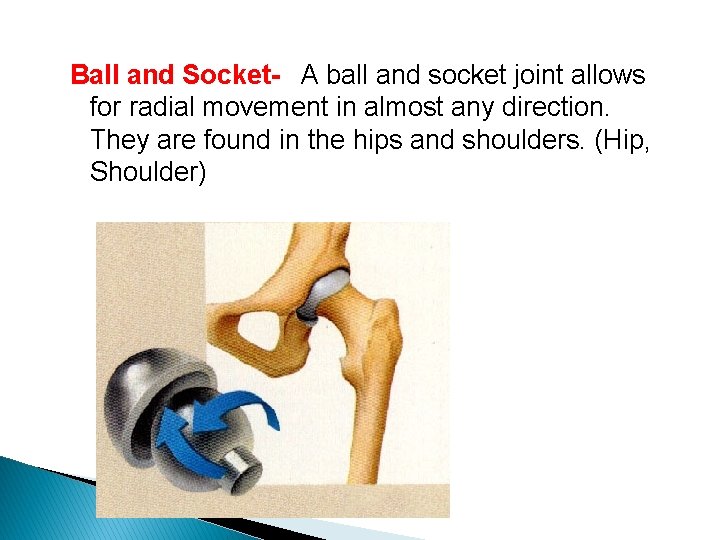
Ball and Socket- A ball and socket joint allows for radial movement in almost any direction. They are found in the hips and shoulders. (Hip, Shoulder)
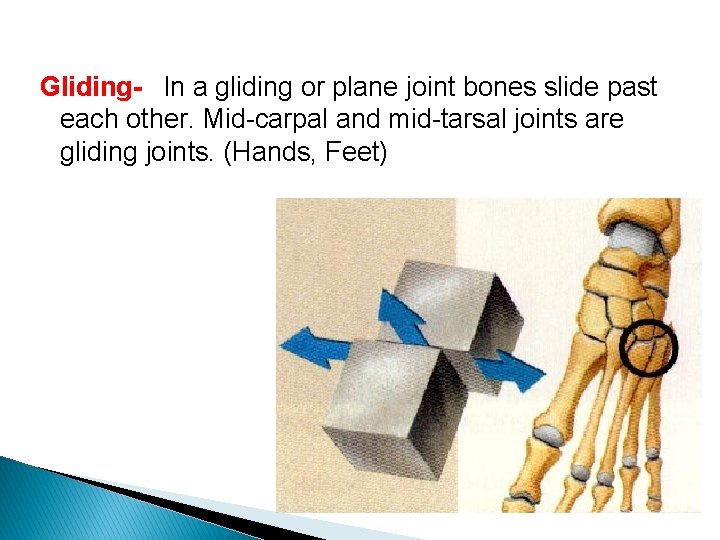
Gliding- In a gliding or plane joint bones slide past each other. Mid-carpal and mid-tarsal joints are gliding joints. (Hands, Feet)
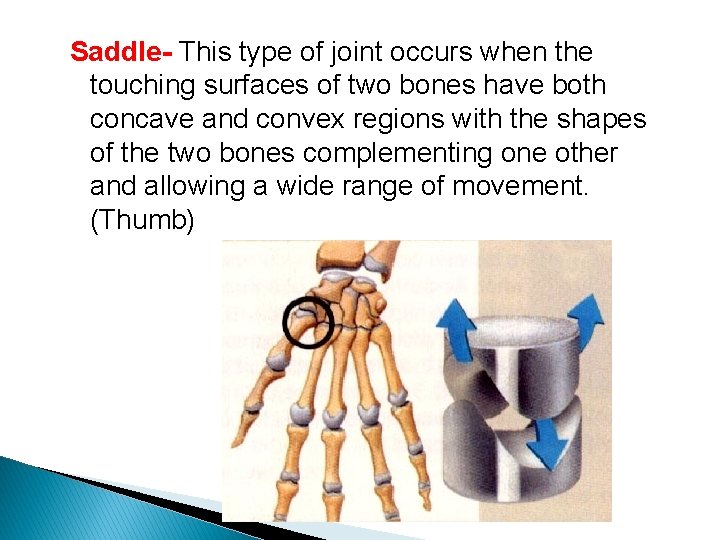
Saddle- This type of joint occurs when the touching surfaces of two bones have both concave and convex regions with the shapes of the two bones complementing one other and allowing a wide range of movement. (Thumb)
Ligaments strong cords of fibrous tissue connect bones
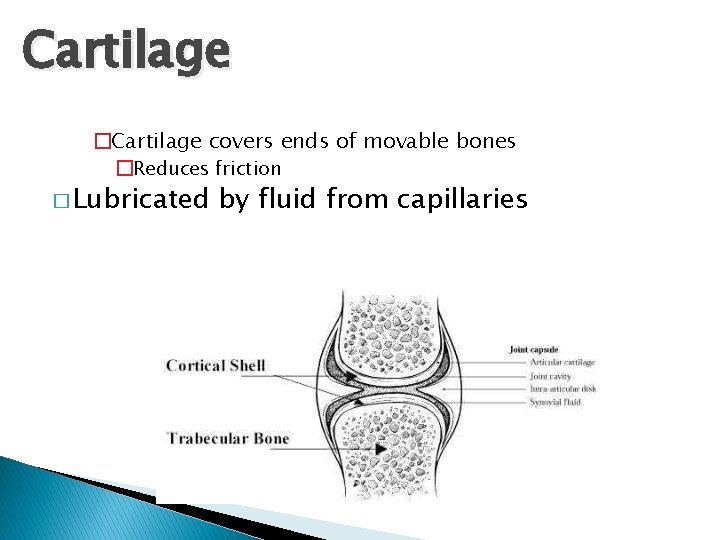
Cartilage �Cartilage covers ends of movable bones �Reduces friction � Lubricated by fluid from capillaries
Muscular System Functions � Body movement (Locomotion) � Maintenance of posture � Respiration ◦ Diaphragm and intercostal contractions � Communication (Verbal and Facial) � Constriction of organs and vessels ◦ Peristalsis of intestinal tract ◦ Vasoconstriction of b. v. and other structures (pupils) � Heart beat � Production of body heat (Thermogenesis)
CHARACTERISTICS OF MUSCLES � Made up of bundles of muscle fibers � Provide the force to move bones � Assist in maintaining posture � Assist with heat production
Muscular System � Organs of Muscular System ◦ Muscles
Properties of Muscle � Excitability: capacity of muscle to respond to a stimulus � Contractility: ability of a muscle to shorten and generate pulling force � Extensibility: muscle can be stretched back to its original length � Elasticity: ability of muscle to recoil to original resting length after stretched
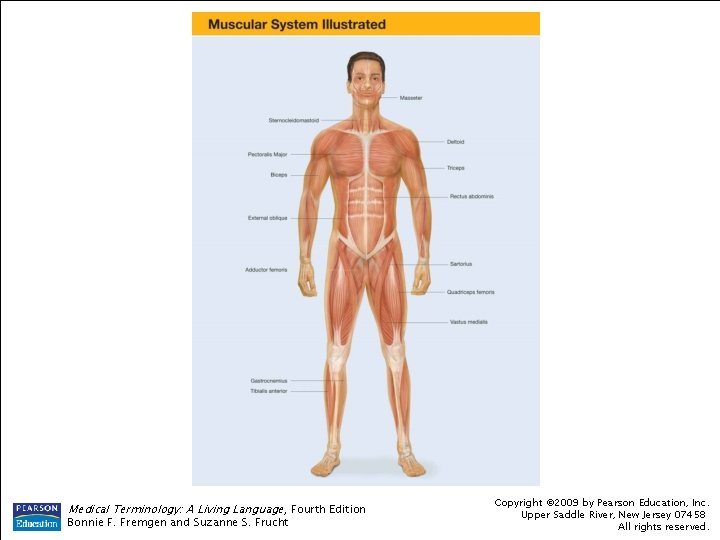
Medical Terminology: A Living Language , Fourth Edition Bonnie F. Fremgen and Suzanne S. Frucht Copyright © 2009 by Pearson Education, Inc. Upper Saddle River, New Jersey 07458 All rights reserved.
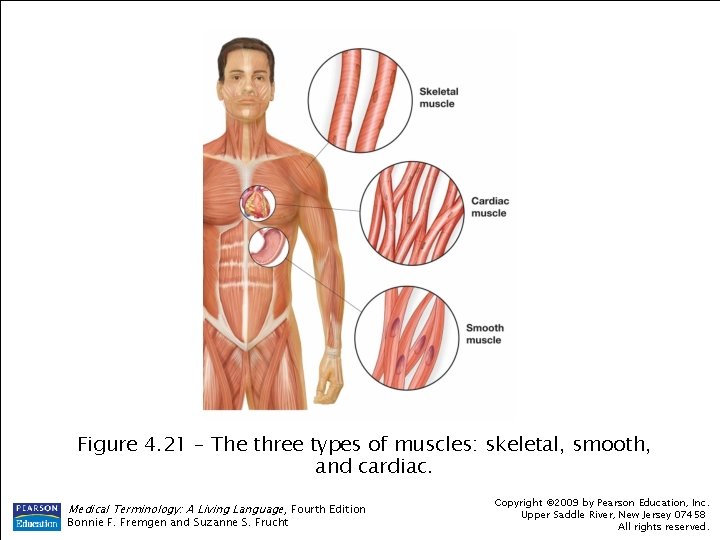
Types of Muscle � Skeletal � Smooth � Cardiac ◦ Attached to bones ◦ Makes up 40% of body weight ◦ Responsible for locomotion, facial expressions, posture, respiratory movements, other types of body movement ◦ Voluntary in action; controlled by somatic motor neurons ◦ In the walls of hollow organs, blood vessels, eye, glands, uterus, skin ◦ Some functions: propel urine, mix food in digestive tract, dilating/constricting pupils, regulating blood flow, ◦ In some locations, autorhythmic ◦ Controlled involuntarily by endocrine and autonomic nervous systems ◦ Heart: major source of movement of blood ◦ Autorhythmic ◦ Controlled involuntarily by endocrine and autonomic nervous systems
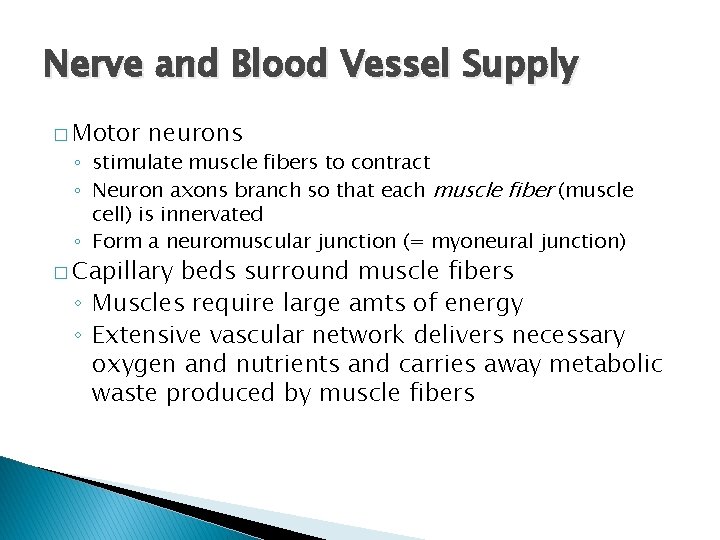
Nerve and Blood Vessel Supply � Motor neurons ◦ stimulate muscle fibers to contract ◦ Neuron axons branch so that each muscle fiber (muscle cell) is innervated ◦ Form a neuromuscular junction (= myoneural junction) � Capillary beds surround muscle fibers ◦ Muscles require large amts of energy ◦ Extensive vascular network delivers necessary oxygen and nutrients and carries away metabolic waste produced by muscle fibers
Figure 4. 21 – The three types of muscles: skeletal, smooth, and cardiac. Medical Terminology: A Living Language , Fourth Edition Bonnie F. Fremgen and Suzanne S. Frucht Copyright © 2009 by Pearson Education, Inc. Upper Saddle River, New Jersey 07458 All rights reserved.
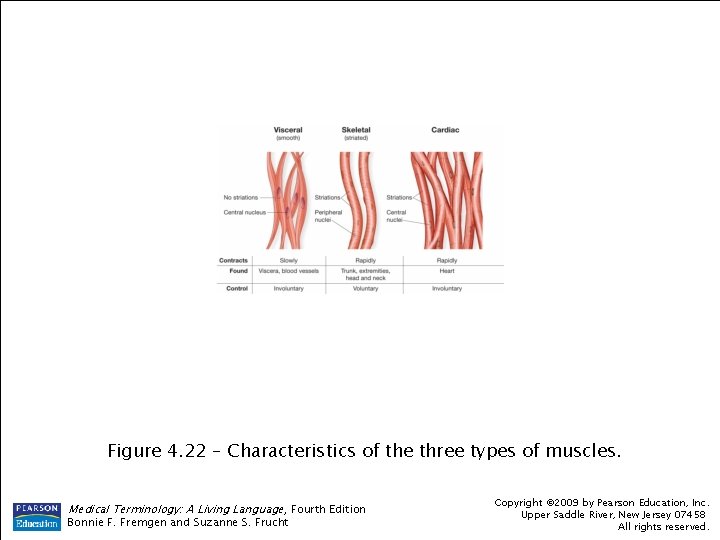
Skeletal Muscles � Attached to bones � Produce voluntary movement of skeleton � Also referred to as striated muscle ◦ Looks striped under microscope
Skeletal Muscles � Muscle tissue is wrapped in layers of connective ◦ Called fascia ◦ Tapers at the end to form tendon ◦ Inserts into periosteum to attach muscle to bone � Are stimulated by motor neurons ◦ Point of contact with muscle fiber is called myoneural junction
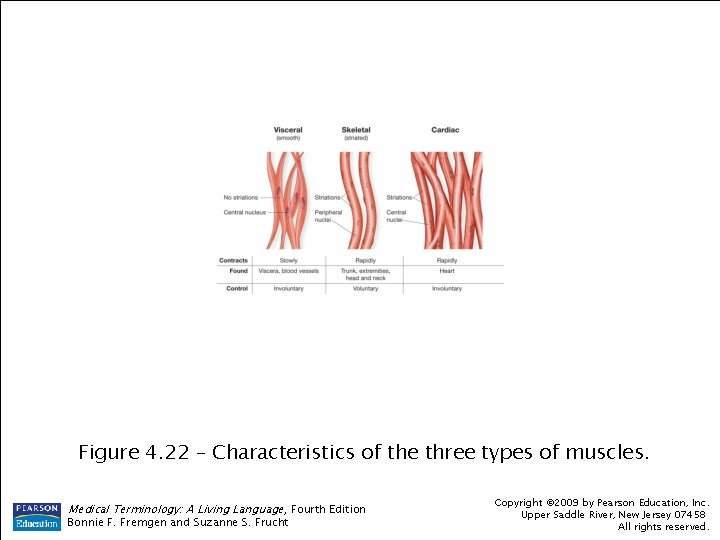
Figure 4. 22 – Characteristics of the three types of muscles. Medical Terminology: A Living Language , Fourth Edition Bonnie F. Fremgen and Suzanne S. Frucht Copyright © 2009 by Pearson Education, Inc. Upper Saddle River, New Jersey 07458 All rights reserved.
Smooth Muscles � Associated ◦ ◦ with internal organs Also called visceral muscle Stomach Respiratory airways Blood vessels � Called smooth because has no microscopic stripes � Produces involuntary movement of these organs
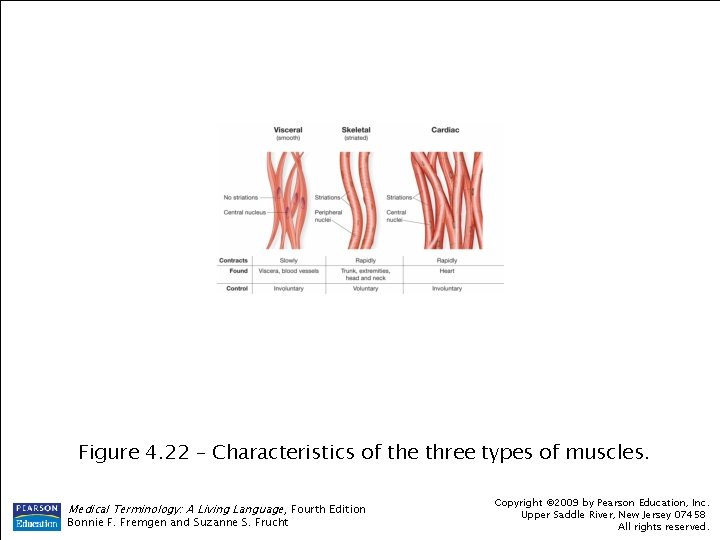
Figure 4. 22 – Characteristics of the three types of muscles. Medical Terminology: A Living Language , Fourth Edition Bonnie F. Fremgen and Suzanne S. Frucht Copyright © 2009 by Pearson Education, Inc. Upper Saddle River, New Jersey 07458 All rights reserved.
Cardiac Muscle � Also called myocardium � Makes up walls of heart � Involuntary contraction of heart to pump blood
Figure 4. 22 – Characteristics of the three types of muscles. Medical Terminology: A Living Language , Fourth Edition Bonnie F. Fremgen and Suzanne S. Frucht Copyright © 2009 by Pearson Education, Inc. Upper Saddle River, New Jersey 07458 All rights reserved.
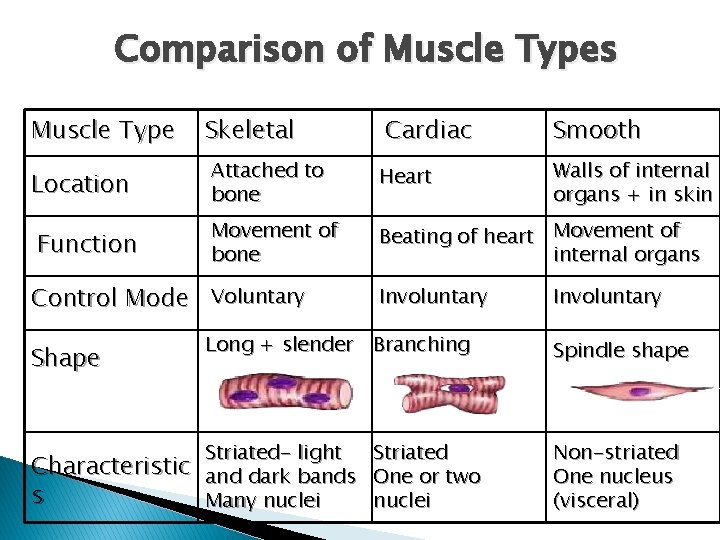
Comparison of Muscle Types Muscle Type Skeletal Cardiac Smooth Location Attached to bone Heart Walls of internal organs + in skin Movement of bone Beating of heart Movement of internal organs Function Control Mode Voluntary Shape Characteristic s Involuntary Long + slender Branching Spindle shape Striated- light Striated and dark bands One or two Many nuclei Non-striated One nucleus (visceral)
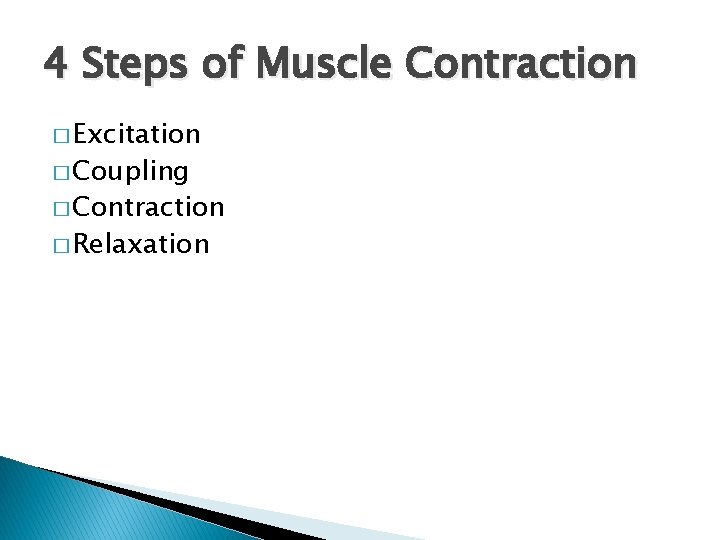
4 Steps of Muscle Contraction � Excitation � Coupling � Contraction � Relaxation
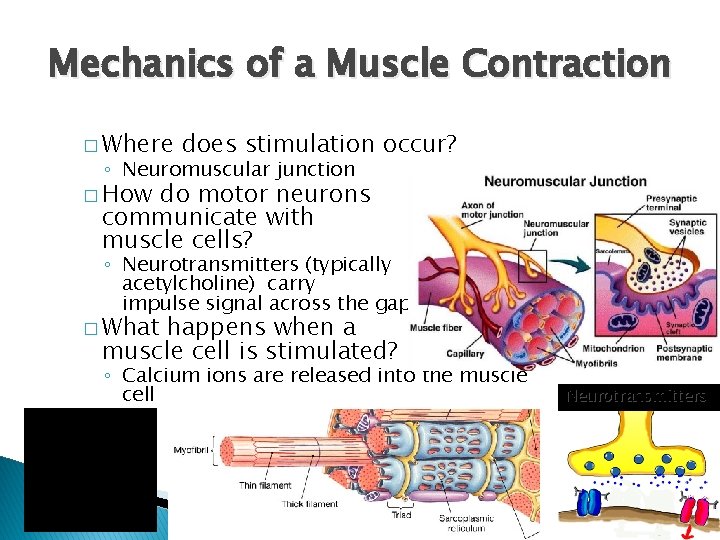
Mechanics of a Muscle Contraction � Where does stimulation occur? ◦ Neuromuscular junction � How do motor neurons communicate with muscle cells? ◦ Neurotransmitters (typically acetylcholine) carry impulse signal across the gap � What happens when a muscle cell is stimulated? ◦ Calcium ions are released into the muscle cell Myofibrils are surrounded by calciumcontaining sarcoplasmic reticulum. Neurotransmitters
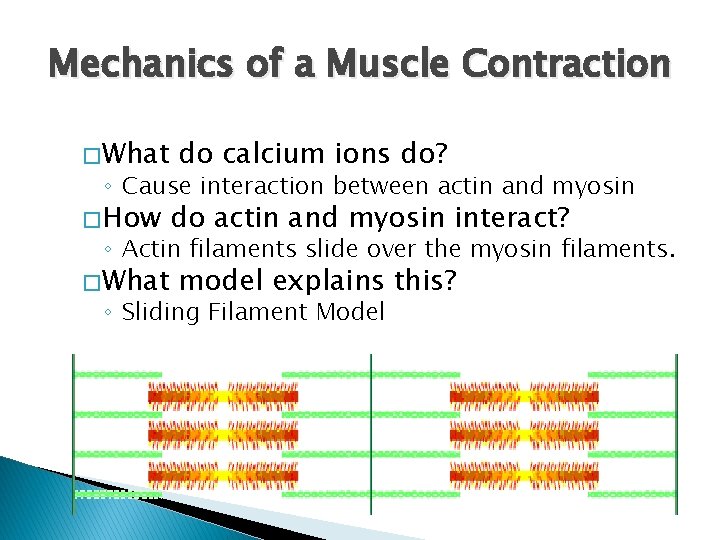
Mechanics of a Muscle Contraction � What do calcium ions do? ◦ Cause interaction between actin and myosin � How do actin and myosin interact? ◦ Actin filaments slide over the myosin filaments. � What model explains this? ◦ Sliding Filament Model
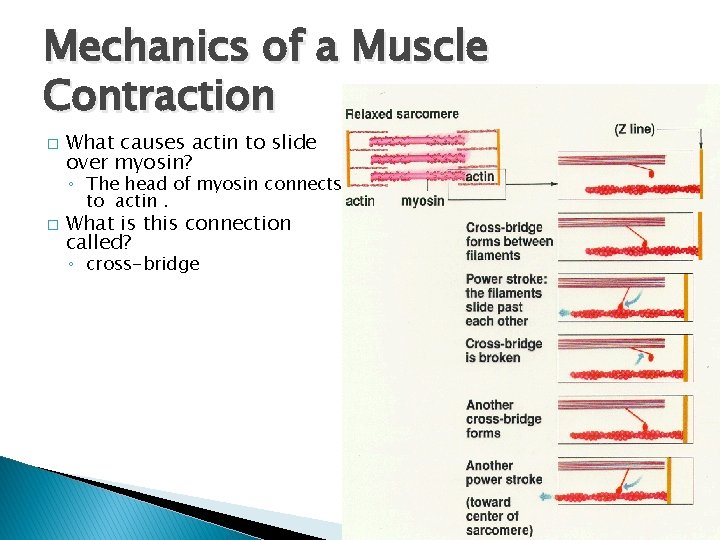
Mechanics of a Muscle Contraction � What causes actin to slide over myosin? ◦ The head of myosin connects to actin. � What is this connection called? ◦ cross-bridge
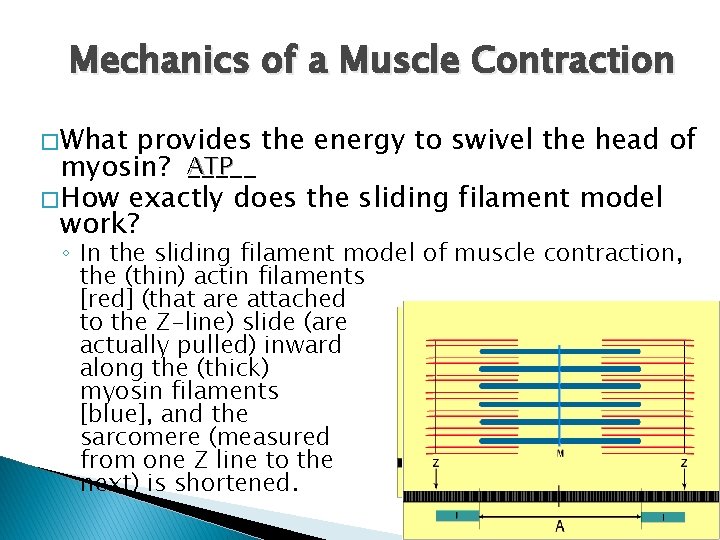
Mechanics of a Muscle Contraction � What provides the energy to swivel the head of ATP myosin? _____ � How exactly does the sliding filament model work? ◦ In the sliding filament model of muscle contraction, the (thin) actin filaments [red] (that are attached to the Z-line) slide (are actually pulled) inward along the (thick) myosin filaments [blue], and the sarcomere (measured from one Z line to the next) is shortened.
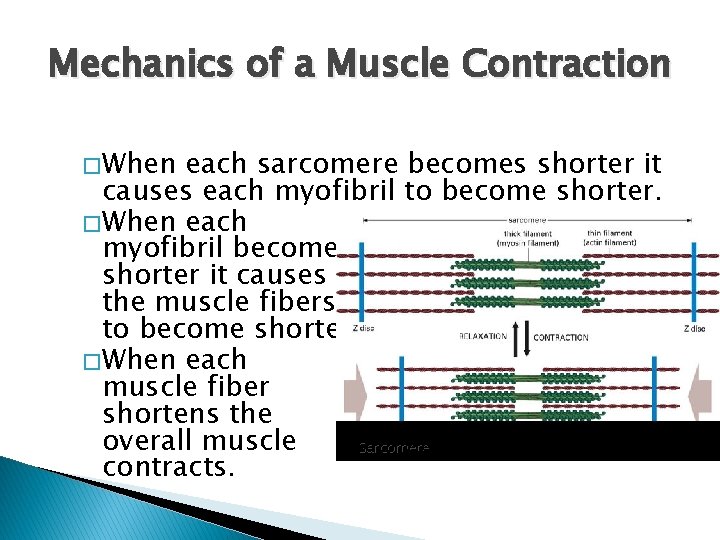
Mechanics of a Muscle Contraction � When each sarcomere becomes shorter it causes each myofibril to become shorter. � When each myofibril becomes shorter it causes the muscle fibers to become shorter � When each muscle fiber shortens the overall muscle Sarcomere contracts.
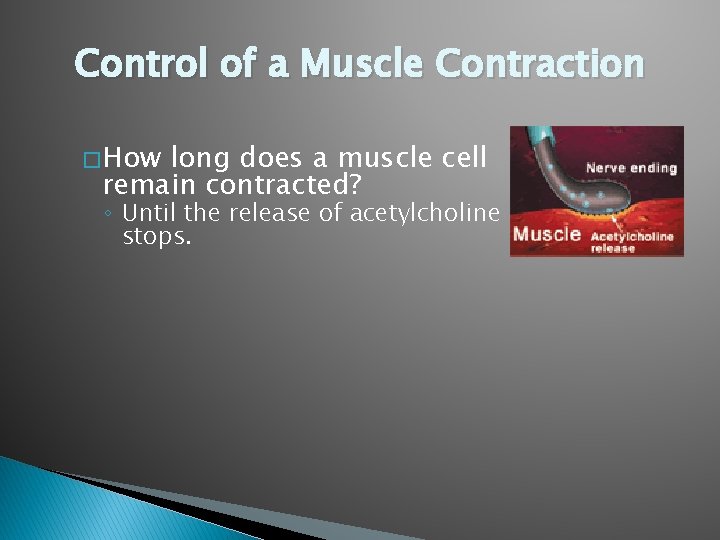
Control of a Muscle Contraction � How long does a muscle cell remain contracted? ◦ Until the release of acetylcholine stops.