
The Skeletal System Intro and Axial Structure Function
- Slides: 34
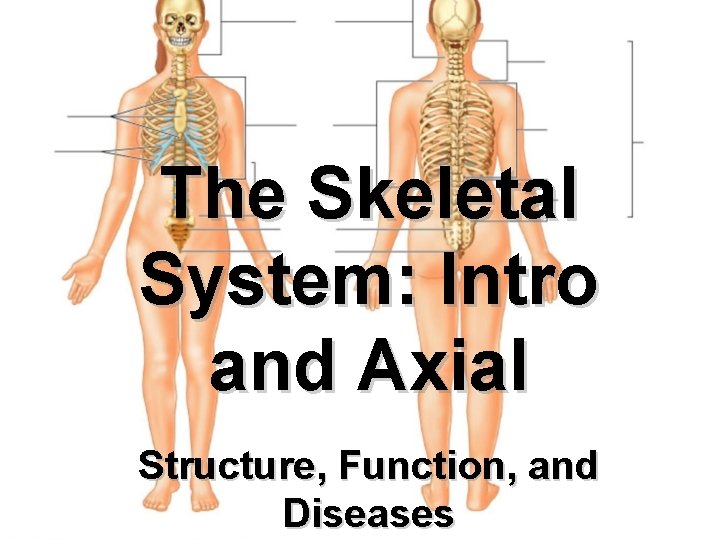
The Skeletal System: Intro and Axial Structure, Function, and Diseases
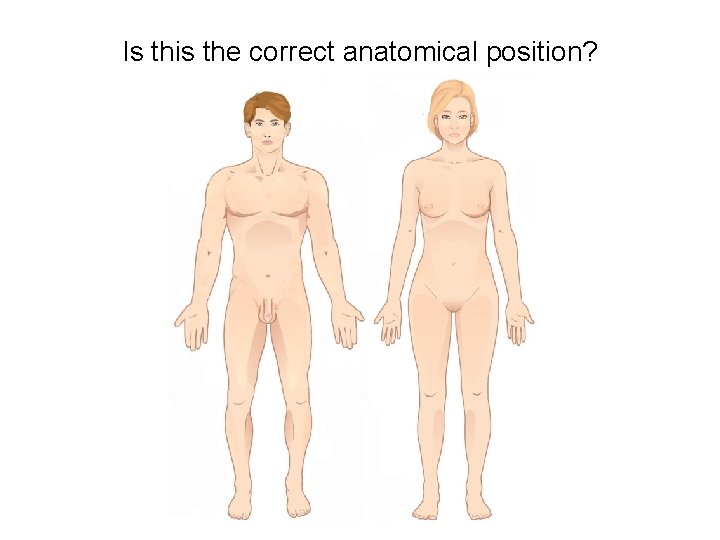
Is this the correct anatomical position?
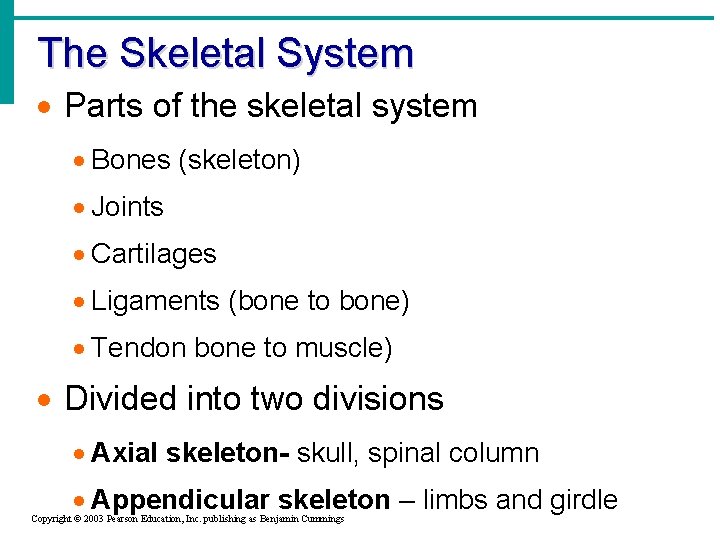
The Skeletal System · Parts of the skeletal system · Bones (skeleton) · Joints · Cartilages · Ligaments (bone to bone) · Tendon bone to muscle) · Divided into two divisions · Axial skeleton- skull, spinal column · Appendicular skeleton – limbs and girdle Copyright © 2003 Pearson Education, Inc. publishing as Benjamin Cummings
Functions of Bones · Support of the body · Protection of soft organs · Movement due to attached skeletal muscles · Storage of minerals and fats · Blood cell formation Copyright © 2003 Pearson Education, Inc. publishing as Benjamin Cummings
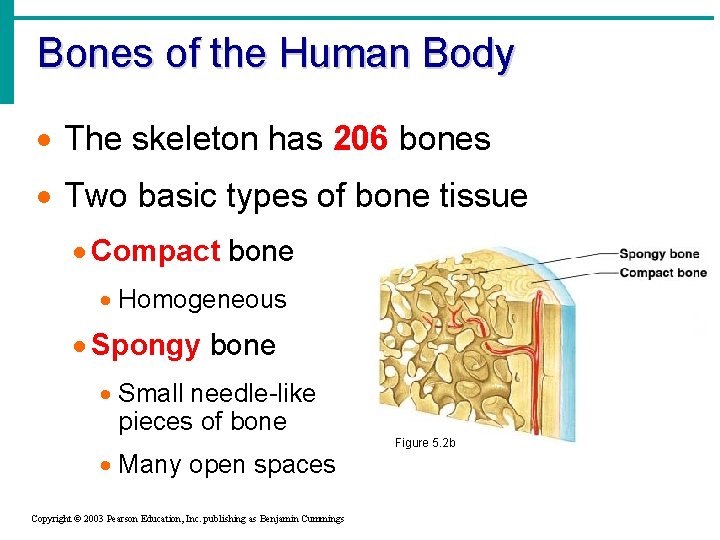
Bones of the Human Body · The skeleton has 206 bones · Two basic types of bone tissue · Compact bone · Homogeneous · Spongy bone · Small needle-like pieces of bone · Many open spaces Copyright © 2003 Pearson Education, Inc. publishing as Benjamin Cummings Figure 5. 2 b
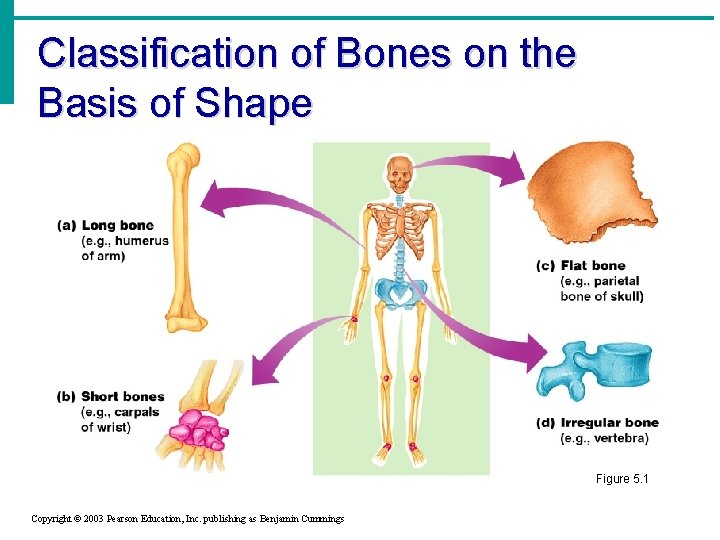
Bones are classified by their shape: 1. Long- bones are longer than they are wide (arms, legs) 2. Short- usually square in shape, cube like (wrist, ankle) 3. Flat- flat , curved (skull, Sternum) 4. Irregular- odd shapes (vertebrae, pelvis)
Classification of Bones on the Basis of Shape Figure 5. 1 Copyright © 2003 Pearson Education, Inc. publishing as Benjamin Cummings
Types of Bone Cells · Osteocytes · Mature bone cells · Osteoblasts · Bone-forming cells · Osteoclasts · Bone-destroying cells · Break down bone matrix for remodeling and release of calcium · Bone remodeling is a process by both osteoblasts and osteoclasts Copyright © 2003 Pearson Education, Inc. publishing as Benjamin Cummings
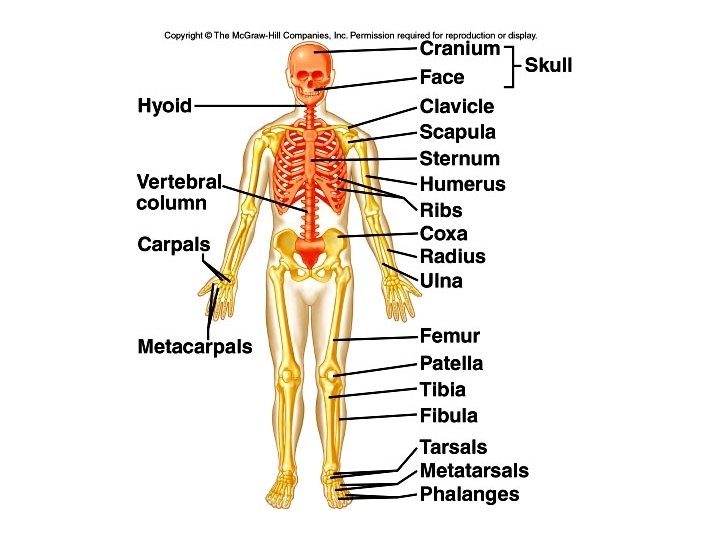
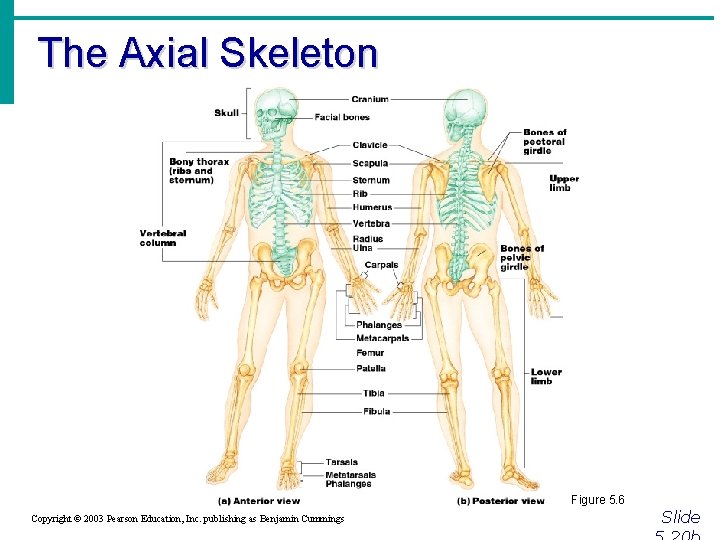
Axial skeleton supports and protects organs of head, neck and trunk Axial skeleton: • skull - cranium and facial bones) • hyoid bone - anchors tongue and muscles. – associated with swallowing • vertebral column - vertebrae and disks • bony thorax - ribs and sternum
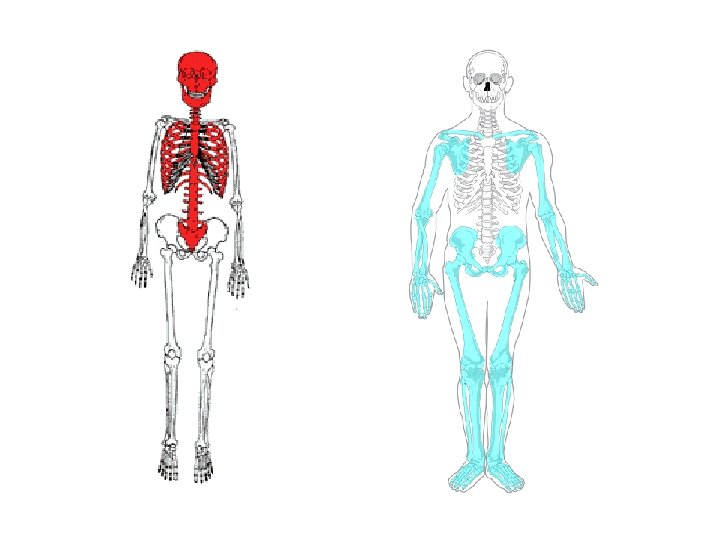
The Axial Skeleton · Forms the longitudinal part of the body · Divided into three parts · Skull · Vertebral Column · Rib Cage Copyright © 2003 Pearson Education, Inc. publishing as Benjamin Cummings Slide
The Axial Skeleton Figure 5. 6 Copyright © 2003 Pearson Education, Inc. publishing as Benjamin Cummings Slide
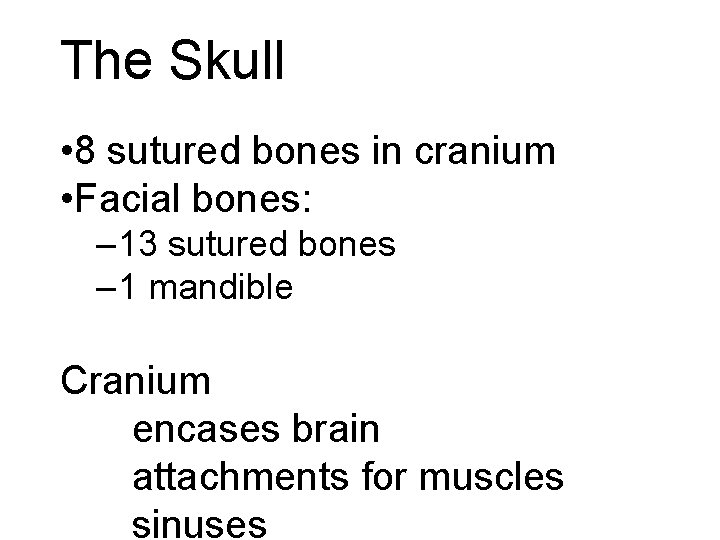
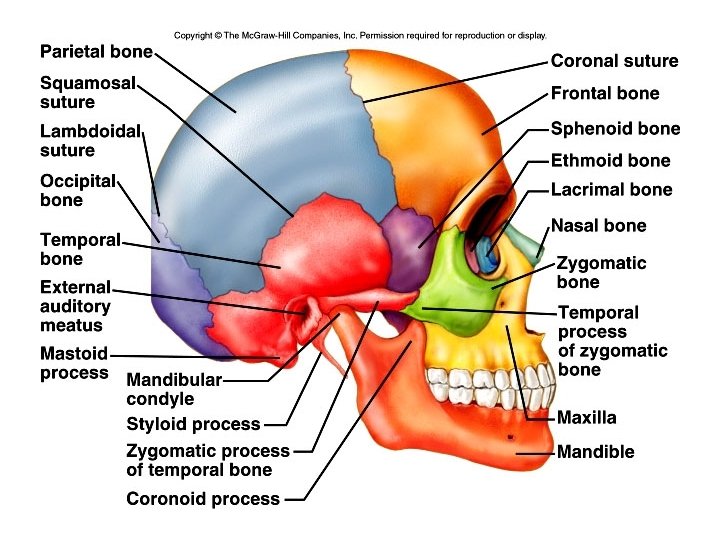
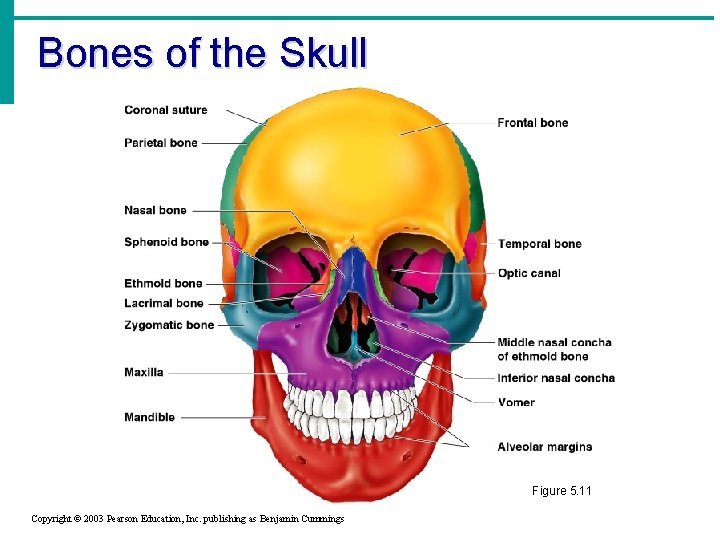
The Skull • 8 sutured bones in cranium • Facial bones: – 13 sutured bones – 1 mandible Cranium encases brain attachments for muscles sinuses
Bones of the Skull Figure 5. 11 Copyright © 2003 Pearson Education, Inc. publishing as Benjamin Cummings
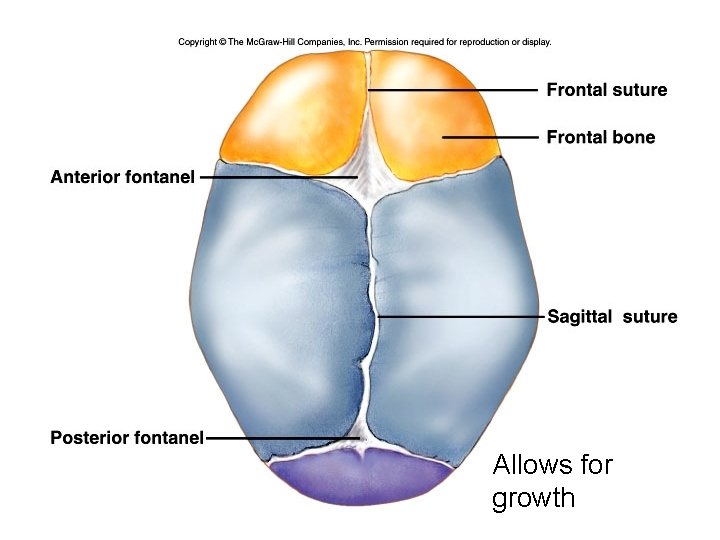
Allows for growth
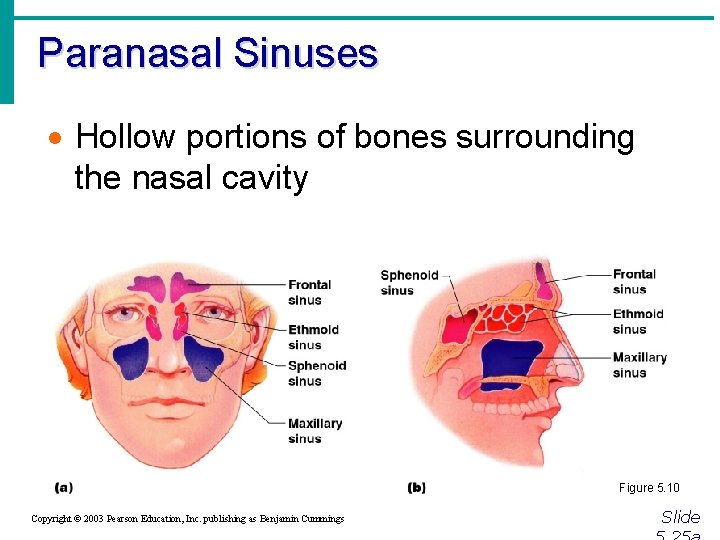
Paranasal Sinuses · Hollow portions of bones surrounding the nasal cavity Figure 5. 10 Copyright © 2003 Pearson Education, Inc. publishing as Benjamin Cummings Slide
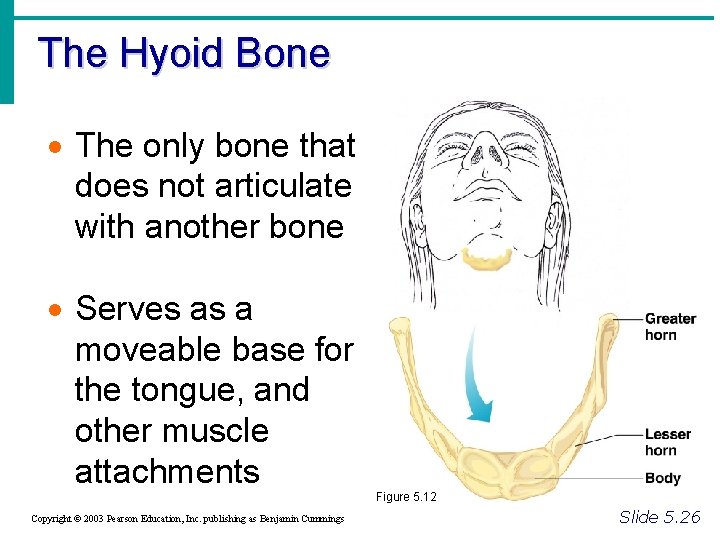
The Hyoid Bone · The only bone that does not articulate with another bone · Serves as a moveable base for the tongue, and other muscle attachments Figure 5. 12 Copyright © 2003 Pearson Education, Inc. publishing as Benjamin Cummings Slide 5. 26
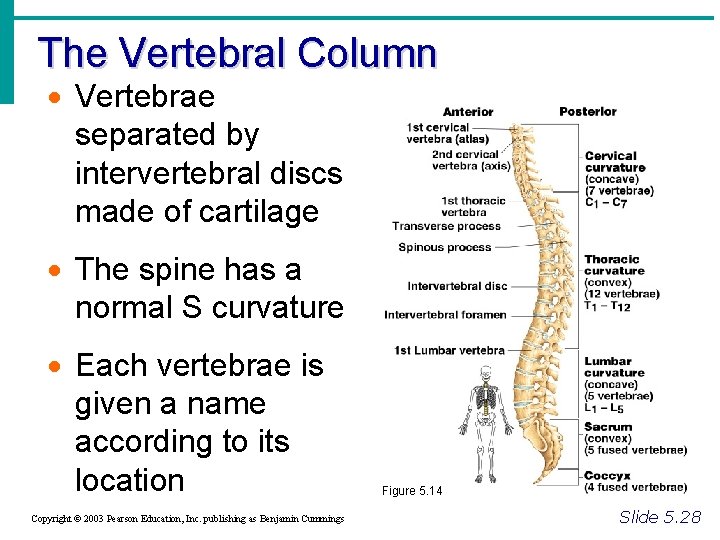
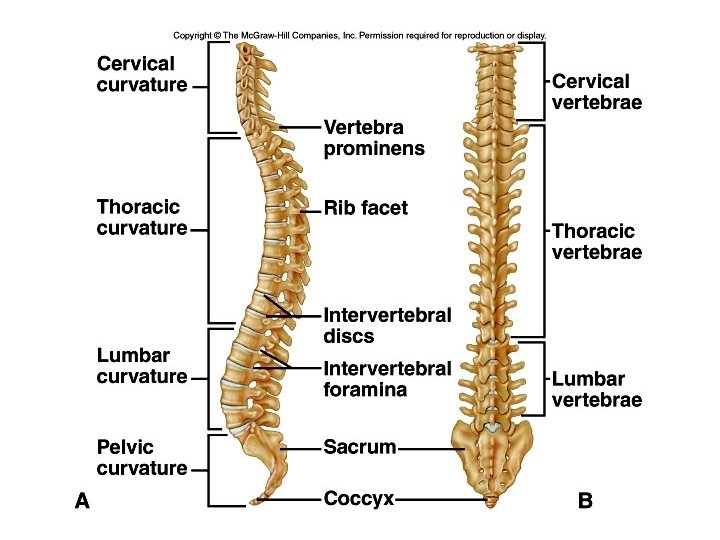
The Vertebral Column · Vertebrae separated by intervertebral discs made of cartilage · The spine has a normal S curvature · Each vertebrae is given a name according to its location Copyright © 2003 Pearson Education, Inc. publishing as Benjamin Cummings Figure 5. 14 Slide 5. 28
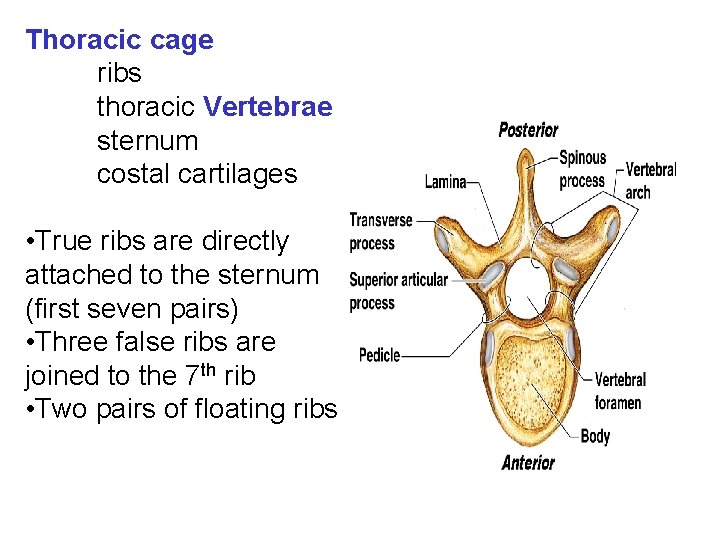
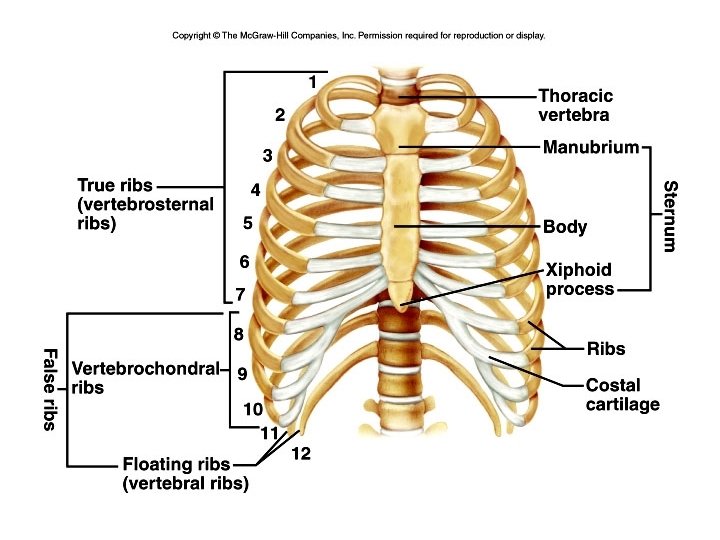
Thoracic cage ribs thoracic Vertebrae sternum costal cartilages • True ribs are directly attached to the sternum (first seven pairs) • Three false ribs are joined to the 7 th rib • Two pairs of floating ribs
Changes in the Human Skeleton · In embryos, the skeleton is primarily hyaline cartilage · During development, much of this cartilage is replaced by bone · Cartilage remains in isolated areas · Bridge of the nose · Parts of ribs · Joints Copyright © 2003 Pearson Education, Inc. publishing as Benjamin Cummings
Bone Fractures · A break in a bone · Types of bone fractures · Closed (simple) fracture – break that does not penetrate the skin · Open (compound) fracture – broken bone penetrates through the skin · Greenstick- frays, hard to repair, breaks like a green twig · Bone fractures are treated by reduction and immobilization · Realignment of the bone Copyright © 2003 Pearson Education, Inc. publishing as Benjamin Cummings
Appendicular skeleton includes bones of limbs and bones that anchor them to the axial skeleton Appendicular skeleton: pectoral girdle (clavicle, scapula) upper limbs (arms) pelvic girdle (sacrum, coccyx) lower limbs (legs) Articulation- where joints meet, connect, and are formed.
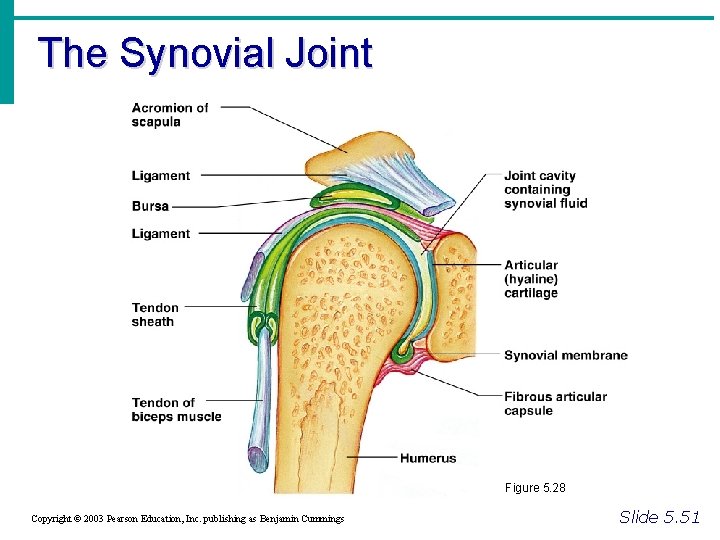
Joints A joint, or articulation, is the place where two bones come together. • Fibrous- Immovable: connect bones, no movement. (skull and pelvis). • Cartilaginous- slightly movable, bones are attached by cartilage, a little movement (spine or ribs). • Synovial- freely movable, much more movement than cartilaginous joints. Cavities between bones are filled with synovial fluid. This fluid helps lubricate and protect the bones.
The Synovial Joint Figure 5. 28 Copyright © 2003 Pearson Education, Inc. publishing as Benjamin Cummings Slide 5. 51
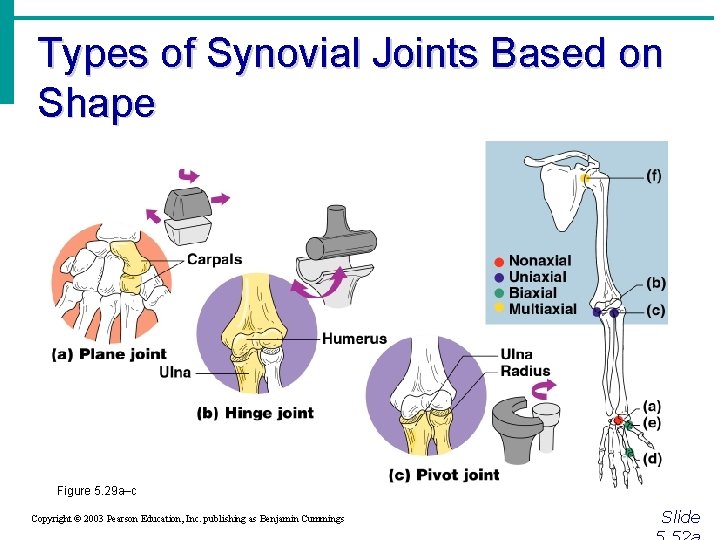
Types of Synovial Joints Based on Shape Figure 5. 29 a–c Copyright © 2003 Pearson Education, Inc. publishing as Benjamin Cummings Slide
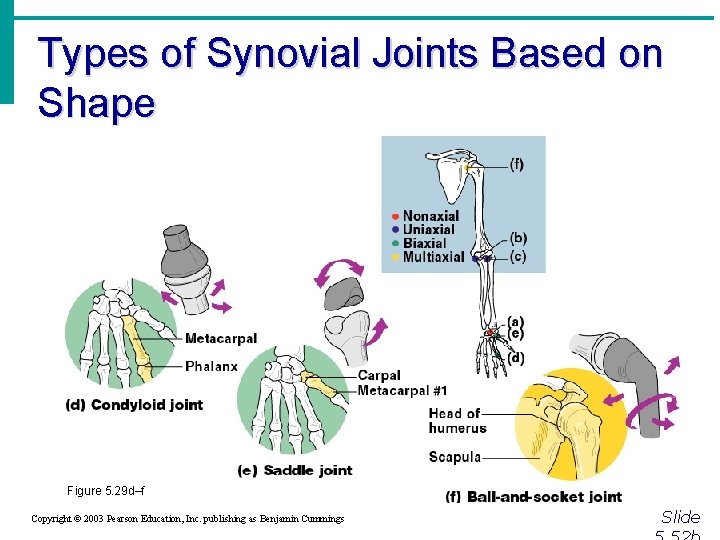
Types of Synovial Joints Based on Shape Figure 5. 29 d–f Copyright © 2003 Pearson Education, Inc. publishing as Benjamin Cummings Slide
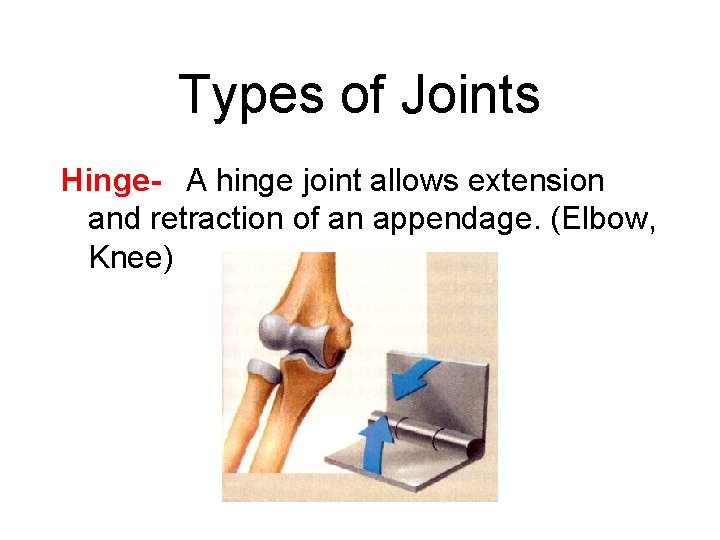
Types of Joints Hinge- A hinge joint allows extension and retraction of an appendage. (Elbow, Knee)
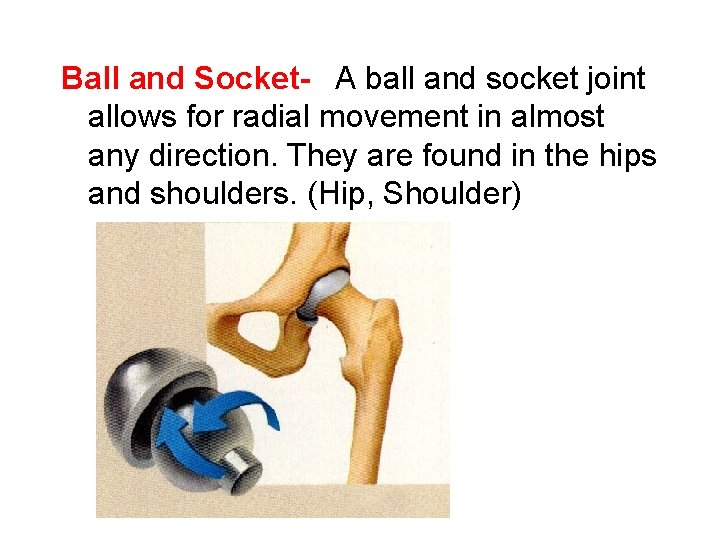
Ball and Socket- A ball and socket joint allows for radial movement in almost any direction. They are found in the hips and shoulders. (Hip, Shoulder)
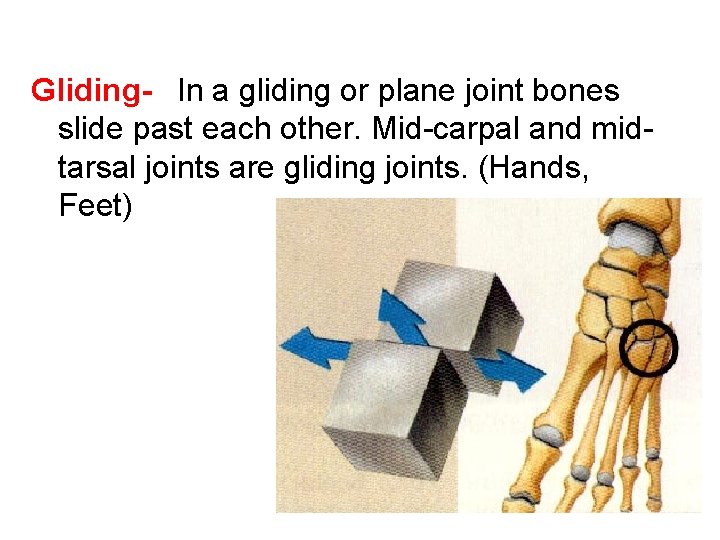
Gliding- In a gliding or plane joint bones slide past each other. Mid-carpal and midtarsal joints are gliding joints. (Hands, Feet)
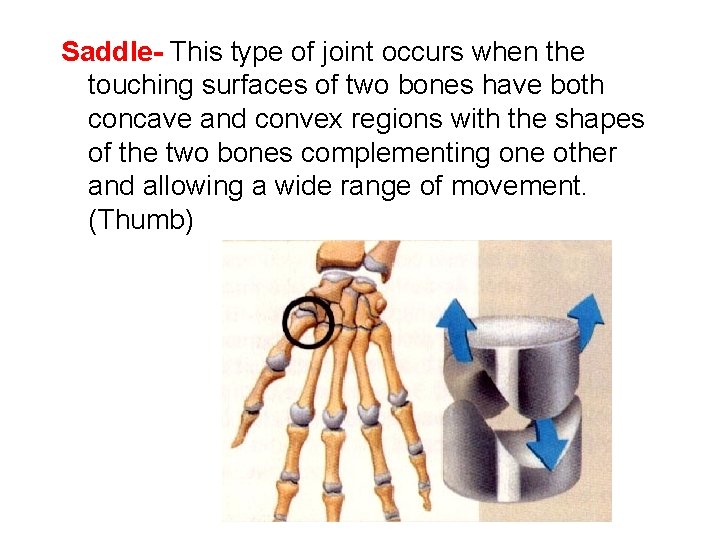
Saddle- This type of joint occurs when the touching surfaces of two bones have both concave and convex regions with the shapes of the two bones complementing one other and allowing a wide range of movement. (Thumb)