
The Skeletal System Bones An Overview Chapter 5
The Skeletal System: Bones, An Overview Chapter 5 a **People who missed test need to make it up at lunch today. Get food and come in if you need**
Warm-Up • 1. Name as many parts of the skeleton as you can think of. • 2. Have you broken a bone or know someone who has? If so which one/s - any gnarly bone breaks you had or know of?
The Skeletal System · Parts of the skeletal system · Bones (skeleton) · Joints · Cartilages · Ligaments · Divided into two divisions · Axial skeleton · Appendicular skeleton Copyright © 2003 Pearson Education, Inc. publishing as Benjamin Cummings Slide 5. 1
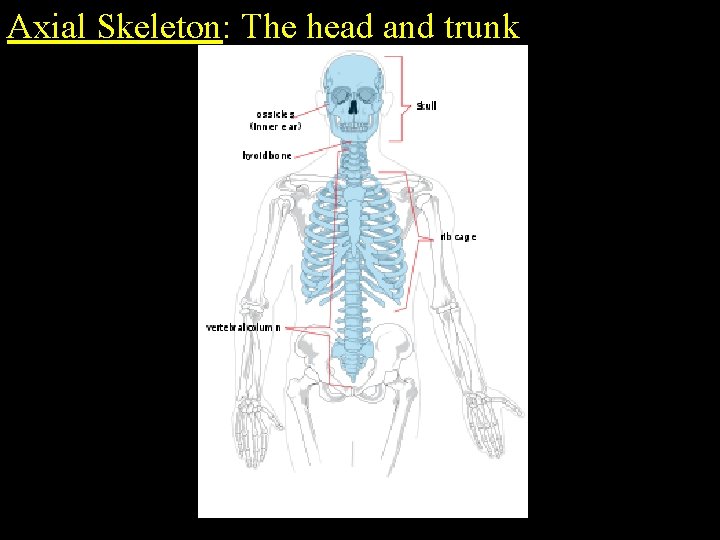
Axial Skeleton: The head and trunk
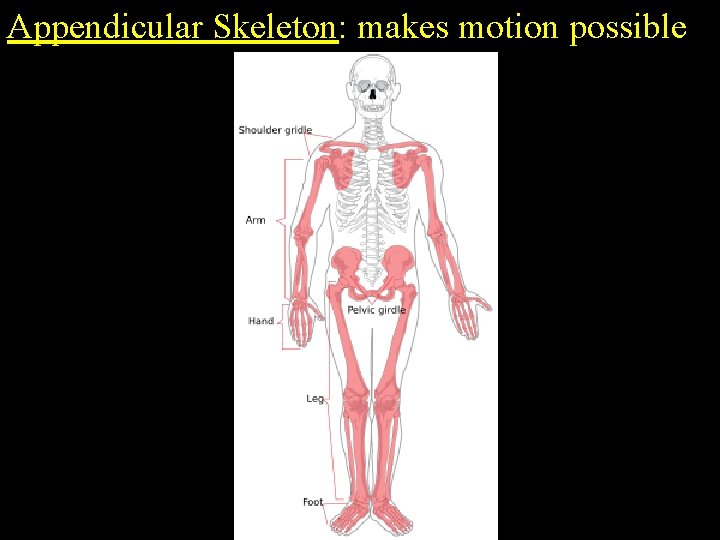
Appendicular Skeleton: makes motion possible
Quick Quiz 1 of 3 1. Where is the Axial Skeleton Located? 2. What is the function of the Appendicular Skeleton? 3. Name the 4 parts of the skeleton
Functions of Bones · Support of the body · Protection of soft organs · Movement due to attached skeletal muscles · Storage of minerals and fats · Blood cell formation Copyright © 2003 Pearson Education, Inc. publishing as Benjamin Cummings Slide 5. 2
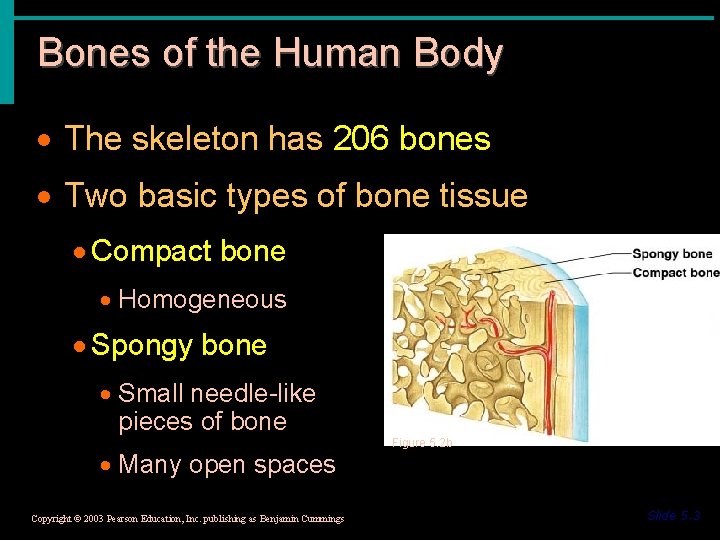
Bones of the Human Body · The skeleton has 206 bones · Two basic types of bone tissue · Compact bone · Homogeneous · Spongy bone · Small needle-like pieces of bone · Many open spaces Copyright © 2003 Pearson Education, Inc. publishing as Benjamin Cummings Figure 5. 2 b Slide 5. 3
Person with the best grades - tell your table 2 functions of the skeletal system
Classification of Bones · Long bones · Typically longer than wide · Have a shaft with heads at both ends · Contain mostly compact bone • Ex: Femur, humerus Copyright © 2003 Pearson Education, Inc. publishing as Benjamin Cummings Slide 5. 4 a

Classification of Bones · Short bones · Generally cube-shape · Contain mostly spongy bone · Ex: Carpals, tarsals Copyright © 2003 Pearson Education, Inc. publishing as Benjamin Cummings Slide 5. 4 b
Classification of Bones · Flat bones · Thin and flattened · Usually curved · Thin layers of compact bone around a layer of spongy bone · Ex: Skull, ribs, sternum Copyright © 2003 Pearson Education, Inc. publishing as Benjamin Cummings Slide 5. 5 a
Classification of Bones · Irregular bones · Irregular shape · Do not fit into other bone classification categories · Ex: Vertebrae and hip Copyright © 2003 Pearson Education, Inc. publishing as Benjamin Cummings Slide 5. 5 b
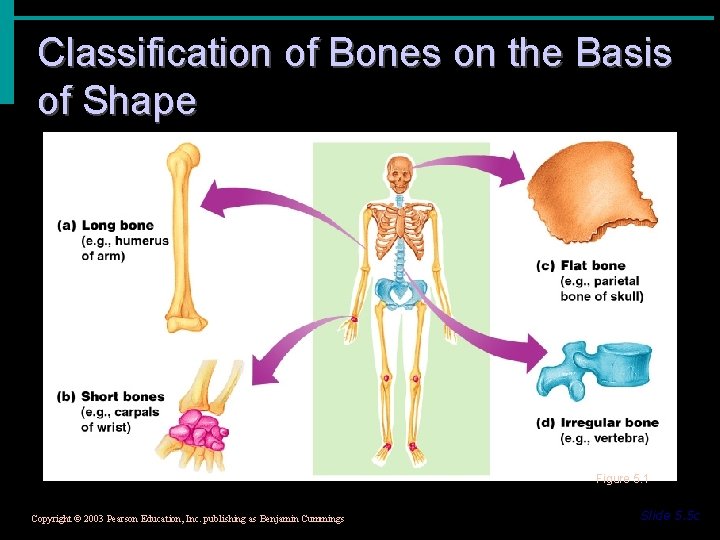
Classification of Bones on the Basis of Shape Figure 5. 1 Copyright © 2003 Pearson Education, Inc. publishing as Benjamin Cummings Slide 5. 5 c
Quick Quiz 2 of 3 1. What kind of bone can be found in the skull? 2. Name a long bone.
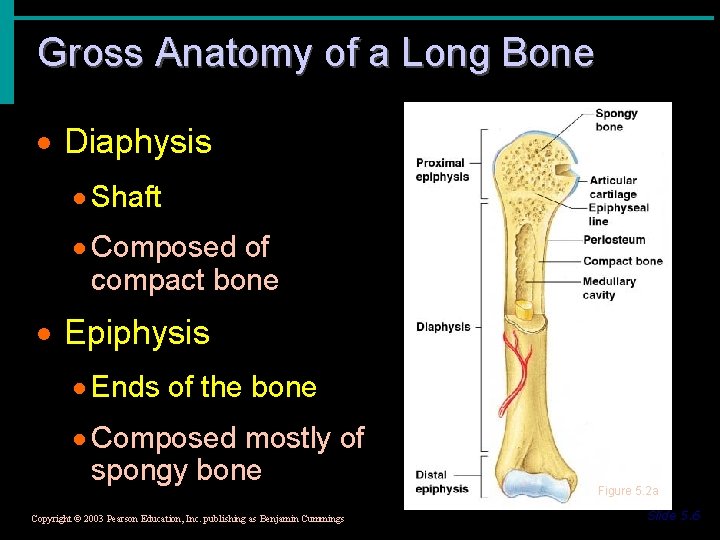
Gross Anatomy of a Long Bone · Diaphysis · Shaft · Composed of compact bone · Epiphysis · Ends of the bone · Composed mostly of spongy bone Copyright © 2003 Pearson Education, Inc. publishing as Benjamin Cummings Figure 5. 2 a Slide 5. 6
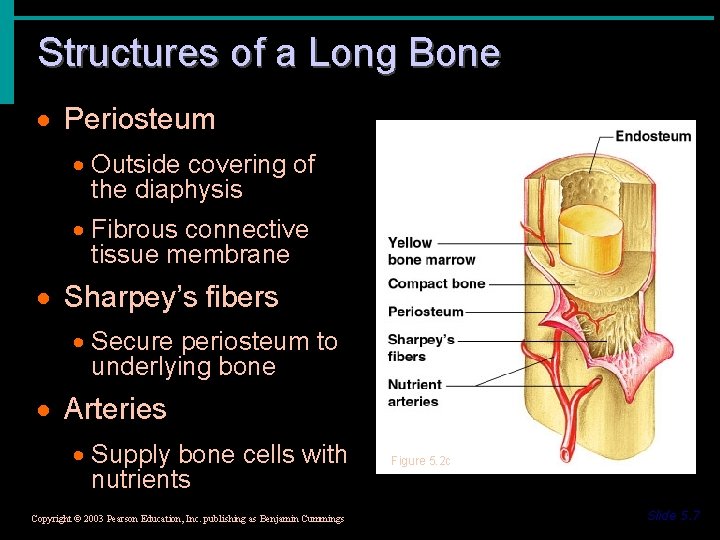
Structures of a Long Bone · Periosteum · Outside covering of the diaphysis · Fibrous connective tissue membrane · Sharpey’s fibers · Secure periosteum to underlying bone · Arteries · Supply bone cells with nutrients Copyright © 2003 Pearson Education, Inc. publishing as Benjamin Cummings Figure 5. 2 c Slide 5. 7
Challenge Problem • 1. Identify 2 long bones • 2. Identify 3 bones in the appendicular skeleton • 3. Describe where the axial skeleton is. • 4. Identify 3 flat bones • 5. What type of bone is the pelvis?
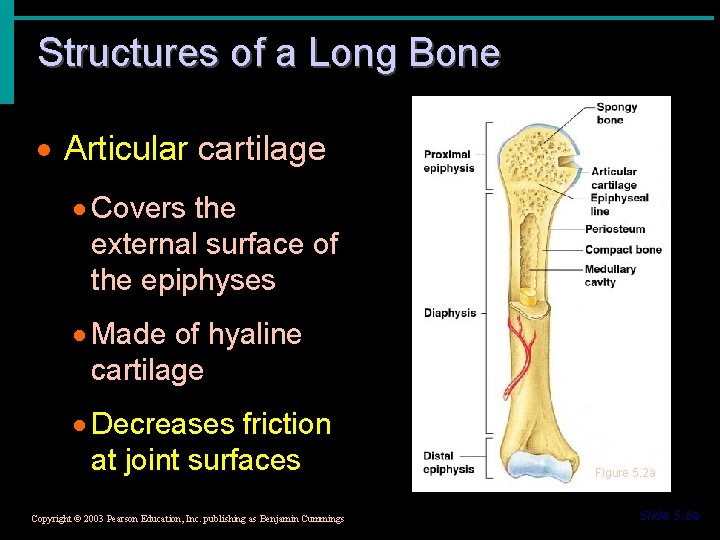
Structures of a Long Bone · Articular cartilage · Covers the external surface of the epiphyses · Made of hyaline cartilage · Decreases friction at joint surfaces Copyright © 2003 Pearson Education, Inc. publishing as Benjamin Cummings Figure 5. 2 a Slide 5. 8 a
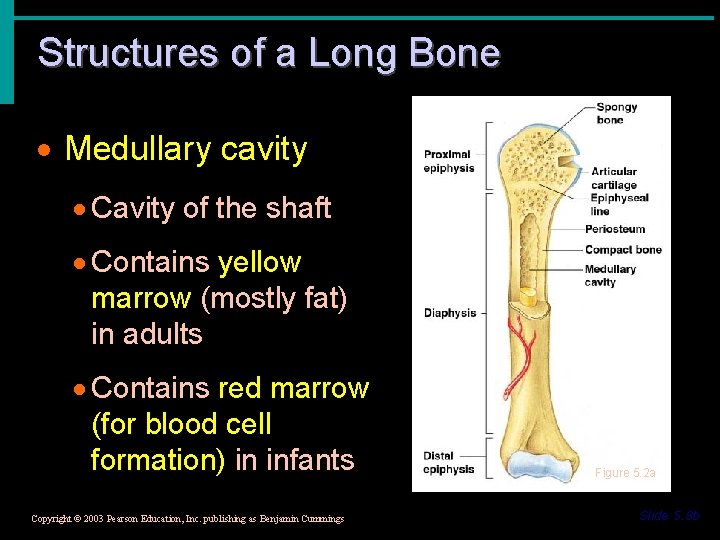
Structures of a Long Bone · Medullary cavity · Cavity of the shaft · Contains yellow marrow (mostly fat) in adults · Contains red marrow (for blood cell formation) in infants Copyright © 2003 Pearson Education, Inc. publishing as Benjamin Cummings Figure 5. 2 a Slide 5. 8 b
People closest to the windows tell your table what we call the ends and shaft of long bones.

Turn in the worksheet from yesterday 1. In the medullary cavity, yellow marrow is mostly __ 2. If a person did not have red marrow, what would result? 3. Identify 3 bones in the appendicular skeleton 4. T/F- bones have arteries and veins inside them. 5. Check this out!
Bone Markings · Surface features of bones · Sites of attachments for muscles, tendons, and ligaments · Passages for nerves and blood vessels · Categories of bone markings · Projections and processes – grow out from the bone surface · Depressions or cavities – indentations Copyright © 2003 Pearson Education, Inc. publishing as Benjamin Cummings Slide 5. 9
Microscopic Anatomy of Bone · Osteon (Haversian System) · A unit of bone · Central (Haversian) canal · Opening in the center of an osteon · Carries blood vessels and nerves · Perforating (Volkman’s) canal · Canal perpendicular to the central canal · Carries blood vessels and nerves Copyright © 2003 Pearson Education, Inc. publishing as Benjamin Cummings Slide 5. 10 a
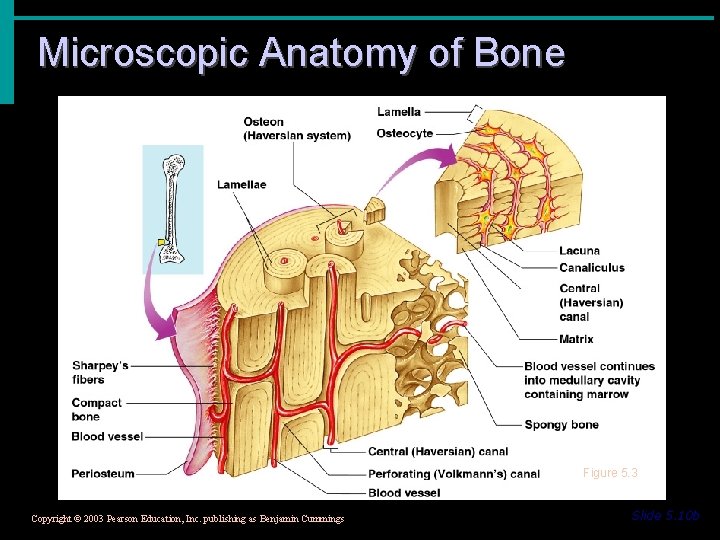
Microscopic Anatomy of Bone Figure 5. 3 Copyright © 2003 Pearson Education, Inc. publishing as Benjamin Cummings Slide 5. 10 b
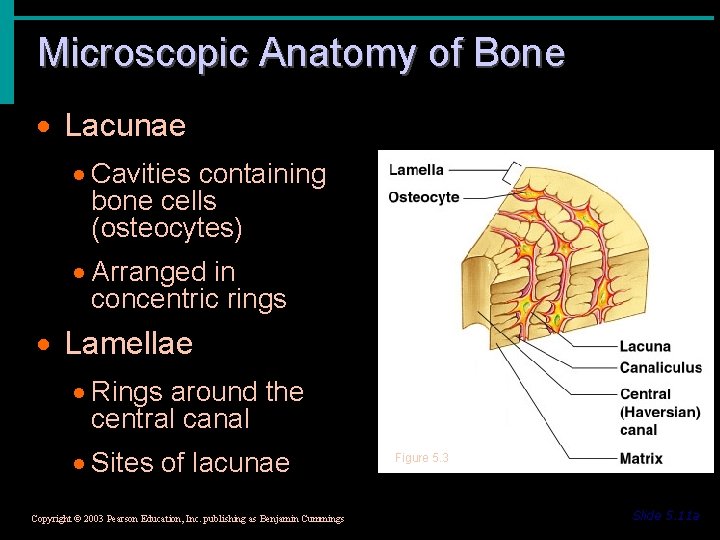
Microscopic Anatomy of Bone · Lacunae · Cavities containing bone cells (osteocytes) · Arranged in concentric rings · Lamellae · Rings around the central canal · Sites of lacunae Copyright © 2003 Pearson Education, Inc. publishing as Benjamin Cummings Figure 5. 3 Slide 5. 11 a
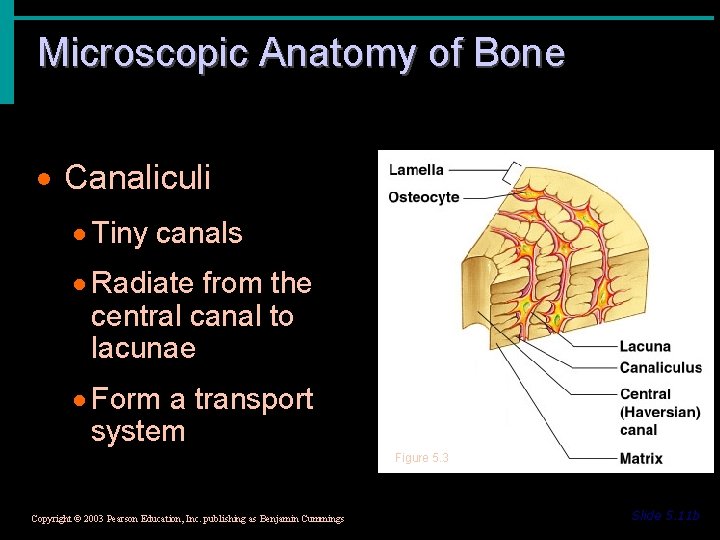
Microscopic Anatomy of Bone · Canaliculi · Tiny canals · Radiate from the central canal to lacunae · Form a transport system Figure 5. 3 Copyright © 2003 Pearson Education, Inc. publishing as Benjamin Cummings Slide 5. 11 b
Person wearing school colors • Tell your group members what happens when someone breaks a bone. Be as specific as possible. • Pretend you are a doctor.
Changes in the Human Skeleton · In embryos, the skeleton is primarily hyaline cartilage · During development, much of this cartilage is replaced by bone · Cartilage remains in isolated areas · Bridge of the nose · Parts of ribs · Joints Copyright © 2003 Pearson Education, Inc. publishing as Benjamin Cummings Slide 5. 12
Bone Growth · Bones are remodeled and lengthened until growth stops · Bones change shape somewhat · Bones grow in width Copyright © 2003 Pearson Education, Inc. publishing as Benjamin Cummings Slide 5. 13 b
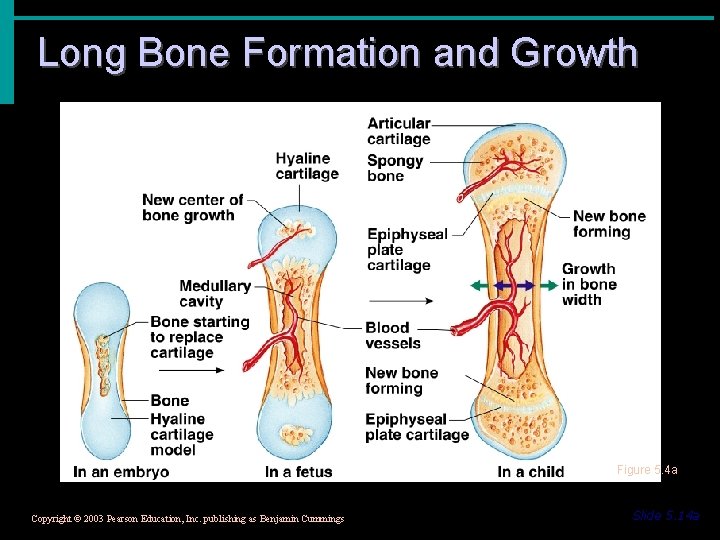
Long Bone Formation and Growth Figure 5. 4 a Copyright © 2003 Pearson Education, Inc. publishing as Benjamin Cummings Slide 5. 14 a
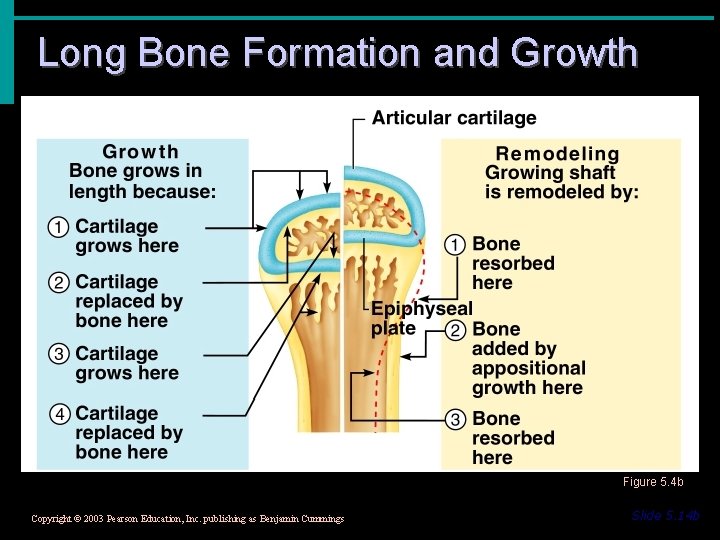
Long Bone Formation and Growth Figure 5. 4 b Copyright © 2003 Pearson Education, Inc. publishing as Benjamin Cummings Slide 5. 14 b
Types of Bone Cells · Osteocytes · Mature bone cells · Osteoblasts · Bone-forming cells · Osteoclasts · Bone-destroying cells · Break down bone matrix for remodeling and release of calcium · Bone remodeling is a process by both osteoblasts and osteoclasts Copyright © 2003 Pearson Education, Inc. publishing as Benjamin Cummings Slide 5. 15
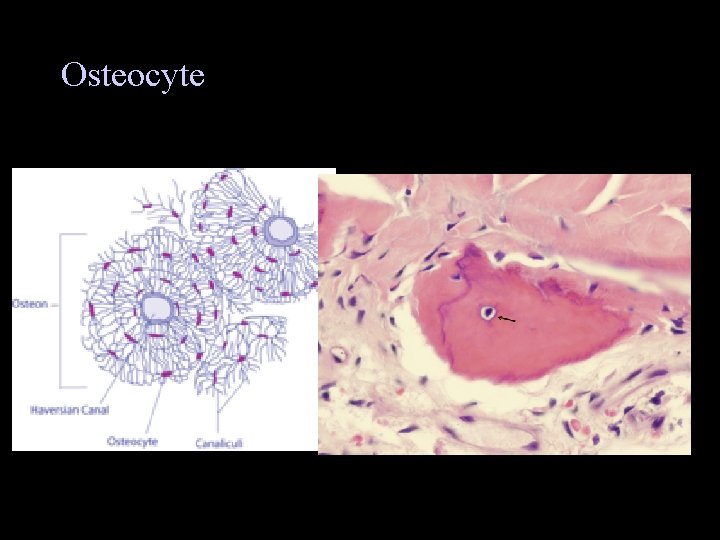
Osteocyte
Quick Quiz 3 of 3 • What is an Osteocyte? • What two types of bone cells are responsible for re-forming and growth?
Challenge Problem • 1. The vertebrae are part of which division of the skeleton? • 2. ______ break down too much bone in old people. • 3. If someone went to the hospital and severe arm pain, what might the problem be? Be specific • 4. If a basketball player smashed her patella, where is her injury? Specifically?
Questions for Verbal Skeleton Quiz • You will need to be able to identify… • Names of bones • Divisions of the skeletal system • Types of bones • Example question: • Point to and identify an irregular bone
- Slides: 39