
The Skeletal System Anatomy Skeleton gives us our
- Slides: 68
The Skeletal System: Anatomy • Skeleton gives us our recognizable human form, protects vital internal organs − − Bones Tendons: connect muscles to bones Ligaments: connect bone to bone Cartilage: cushions between bones • Lubricated by synovial fluid
Overview of Bones • Long bones − − − Femur Tibia Fibula Ulna Radius Humerus • Short bones − Bones of wrist − Bones of ankle • Flat bones − Some skull bones − Ribs − Sternum
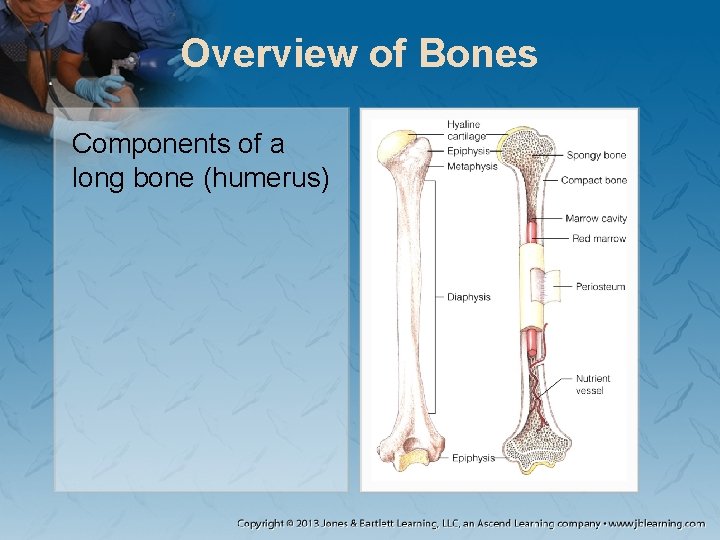
Overview of Bones Components of a long bone (humerus)
Types of Bone • Compact bone (solid) − Mostly solid, with few spaces − Contains a central space called marrow cavity • Cancellous bone (spongy) − Consists of lacy network of trabeculae
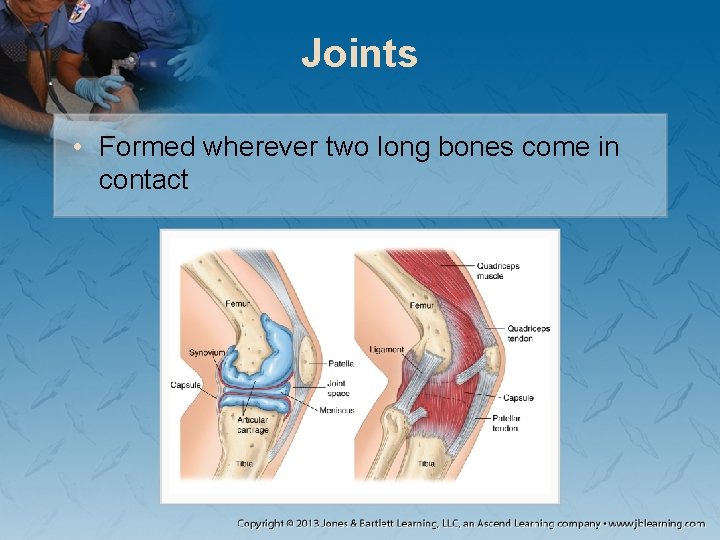
Joints • Formed wherever two long bones come in contact
Joints • Consist of: − Ends of bones − Surrounding connecting and supporting tissue • Classified as: − Amphiarthrotic(permits slight mobility) − Diarthrotic(freely movable) − Synarthrotic( permits little or no mobility)
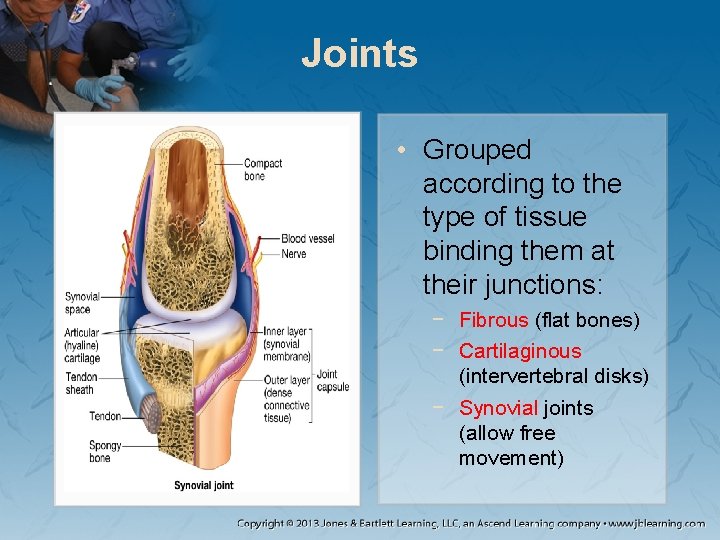
Joints • Grouped according to the type of tissue binding them at their junctions: − Fibrous (flat bones) − Cartilaginous (intervertebral disks) − Synovial joints (allow free movement)
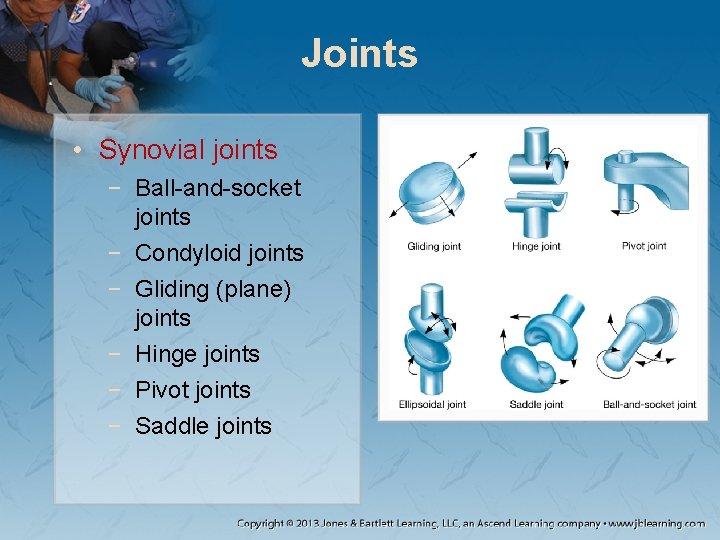
Joints • Synovial joints − Ball-and-socket joints − Condyloid joints − Gliding (plane) joints − Hinge joints − Pivot joints − Saddle joints
Joints • Joint capsule − Fibrous sac that holds the bone ends of a joint together • Synovial membrane − Inner lining of joint capsule that makes synovial fluid
Growth and Development of Bones • Begin to form in utero − Osteoblasts develop to osteocytes. − Bones develop from hyaline cartilage. • Growth continues through adolescence. • Osteogenesis: formation of bone
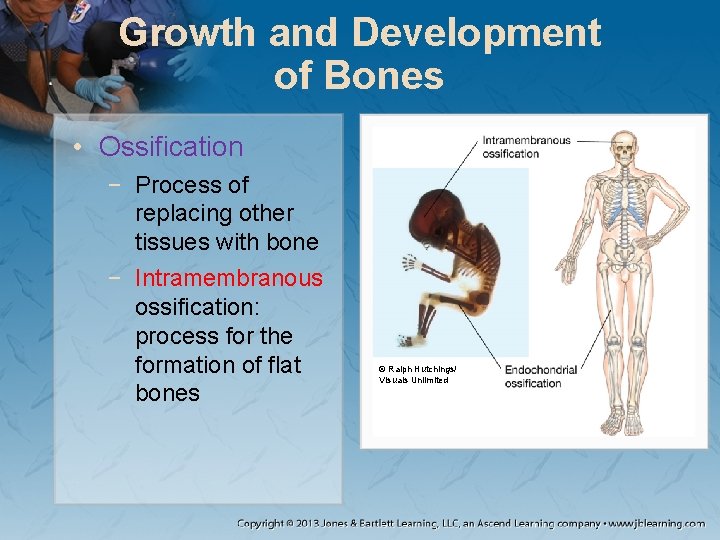
Growth and Development of Bones • Ossification − Process of replacing other tissues with bone − Intramembranous ossification: process for the formation of flat bones © Ralph Hutchings/ Visuals Unlimited
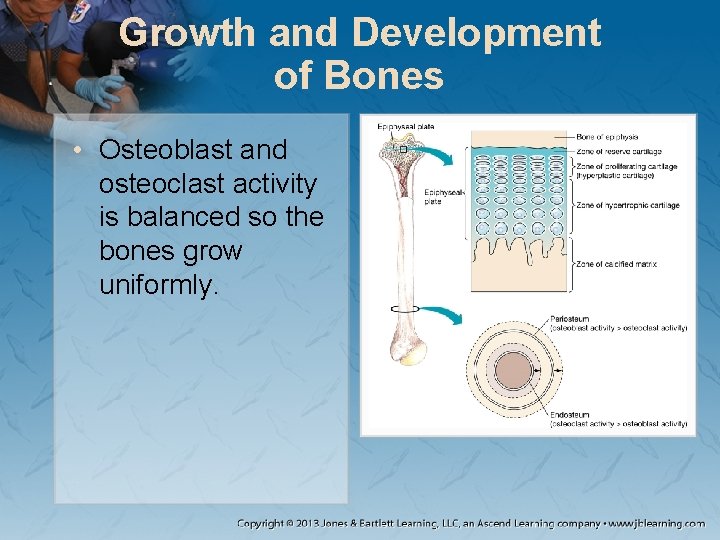
Growth and Development of Bones • Flat bones develop from connective tissue membrane to form spongy bone and then compact bone. − When bones are growing, the diaphyses meet the epiphyses at the epiphyseal plate.
Growth and Development of Bones • Osteoblast and osteoclast activity is balanced so the bones grow uniformly.
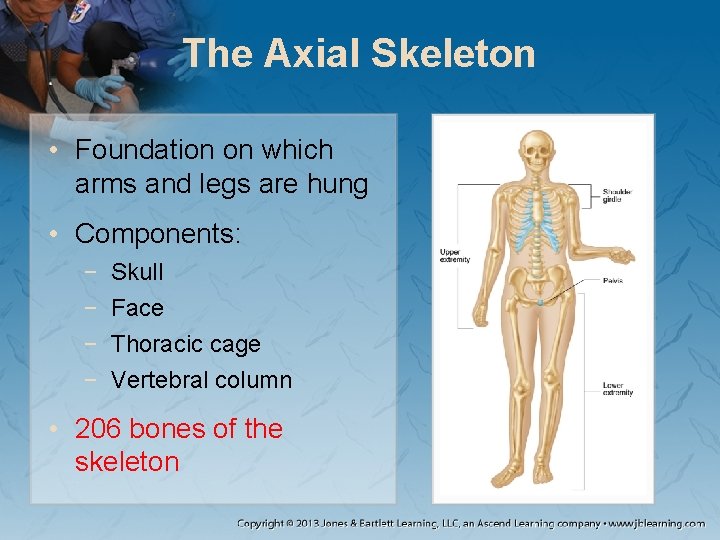
The Axial Skeleton • Foundation on which arms and legs are hung • Components: − − Skull Face Thoracic cage Vertebral column • 206 bones of the skeleton
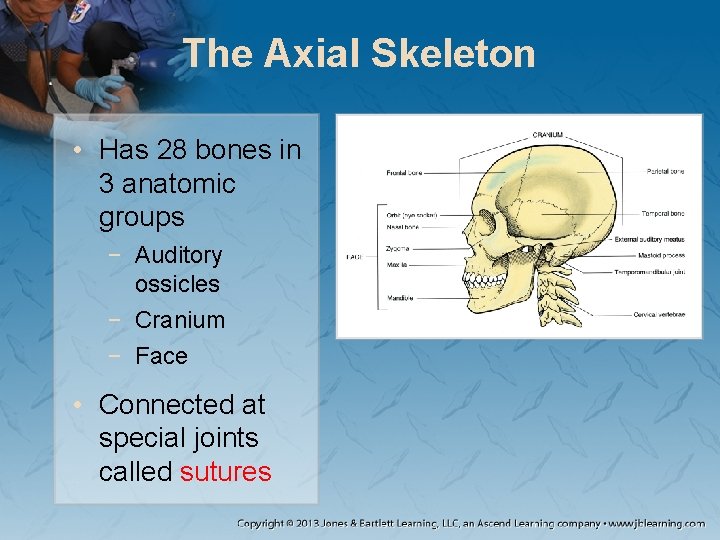
The Axial Skeleton • Has 28 bones in 3 anatomic groups − Auditory ossicles − Cranium − Face • Connected at special joints called sutures
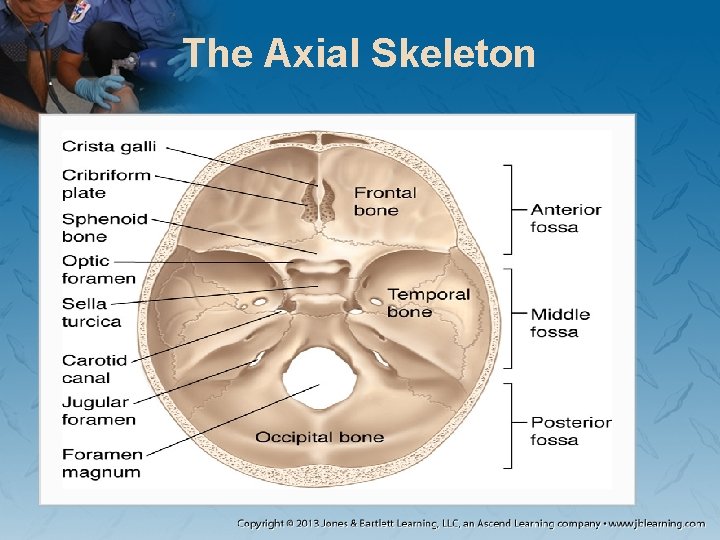
The Axial Skeleton
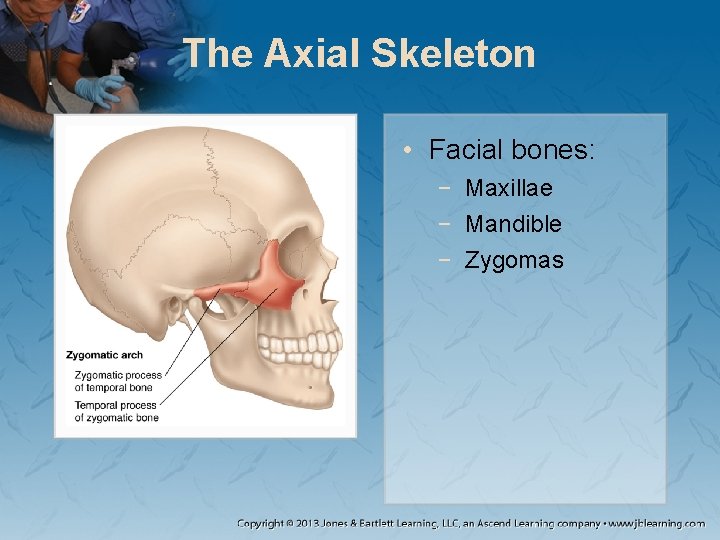
The Axial Skeleton • Facial bones: − Maxillae − Mandible − Zygomas
The Axial Skeleton • The orbit encloses and protects the eye. • Contains eyeball, muscles, blood vessels, nerves, fat • Blowout fracture: − A blow to the eye may result in fracture of the floor of the orbit. − Blood and fat leak into sinus.
The Axial Skeleton • Nasal septum separates nostrils. • Paranasal sinus contents drain into nasal cavity. • Sinusitis − Inflammation of the paranasal sinuses
The Axial Skeleton • Ossicles − Contained within the middle ear − Three tiny auditory bones • These bones are known for their shapes: − Hammer (malleus) − Anvil (incus) − Stirrup (stapes)
The Axial Skeleton • Mandible is made of lower jaw and teeth • Temporomandibular joint − Allows movement of mandible • Hyoid bone − Floats in the superior aspect of the neck, just below the mandible
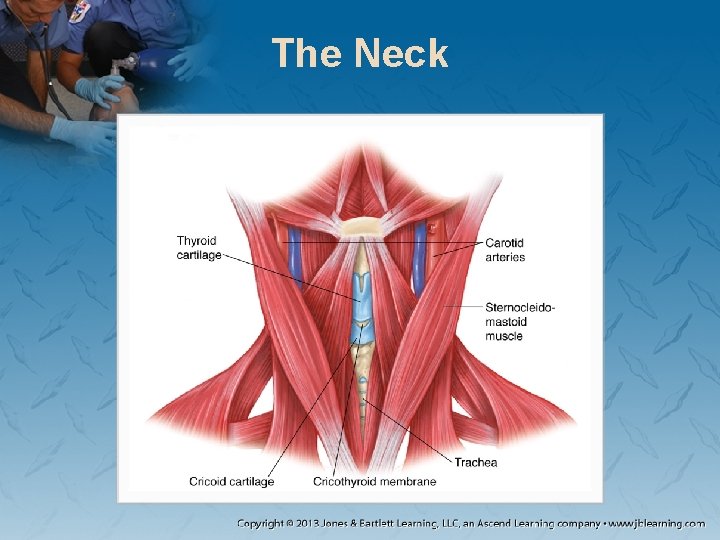
The Neck • Supported by cervical spine − First seven vertebrae of spinal column • Esophagus and trachea (windpipe) lie in midline of neck. • On either side of trachea: − Carotid arteries − Jugular veins − Nerves
The Neck
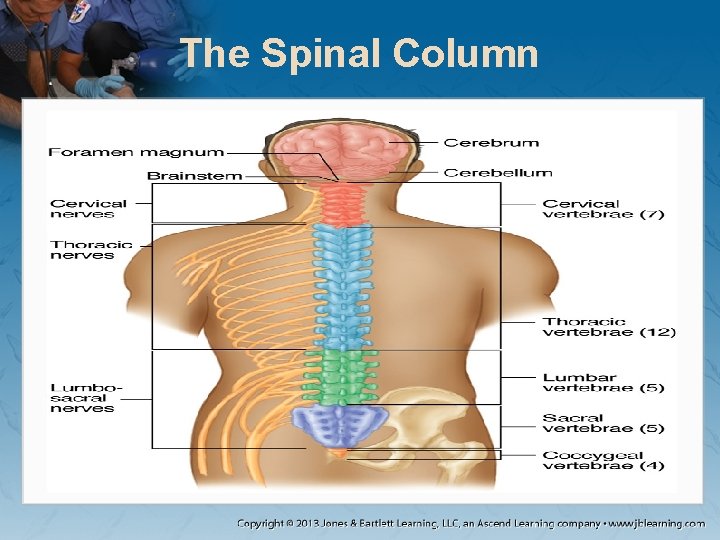
The Spinal Column
The Spinal Column • The first cervical vertebra (C 1) − Called the atlas − Located directly beneath the skull − Provides support for the head • Atlanto-occipital joint − Where C 1 articulates with the occipital condyles at base of the skull − Flexion, extension, and lateral bending are the only motions.
The Spinal Column • The second cervical vertebra (C 2) − Known as the axis − Located at the point at which the head rotates left and right. − The dens is an offshoot of C 2. − Atlas rotates around the axis at the dens
The Spinal Column • Vertebrae C 3 through C 6 form the cervical curve. • C 7 is called the vertebra prominens. − Has a large spinous process that may be seen and felt at the base of the neck
The Spinal Column • Anterior part of each vertebra consists of a round, solid block of bone called the body. − Posterior part of each vertebra forms a bony arch • Vertebrae are connected by ligaments and separated by an intervertebral disk.
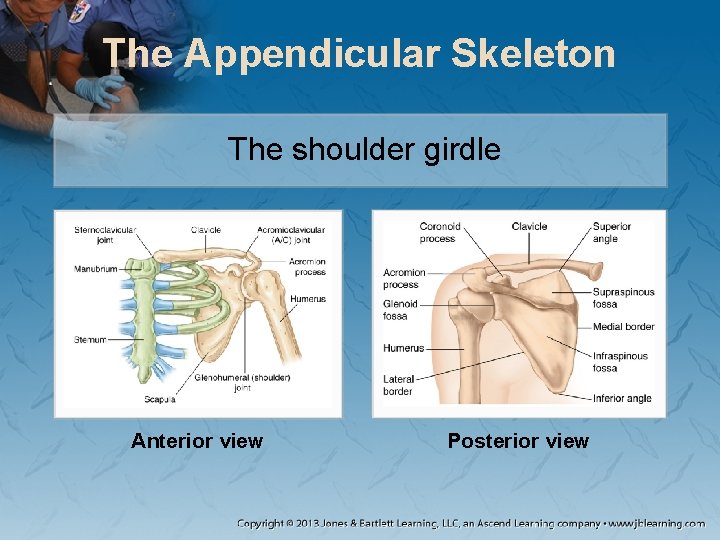
The Appendicular Skeleton • Shoulder girdle attaches upper extremity to body − Made up of the scapula (shoulder blade) and clavicle (collarbone) • Acromion process protects shoulder joint
The Appendicular Skeleton The shoulder girdle Anterior view Posterior view
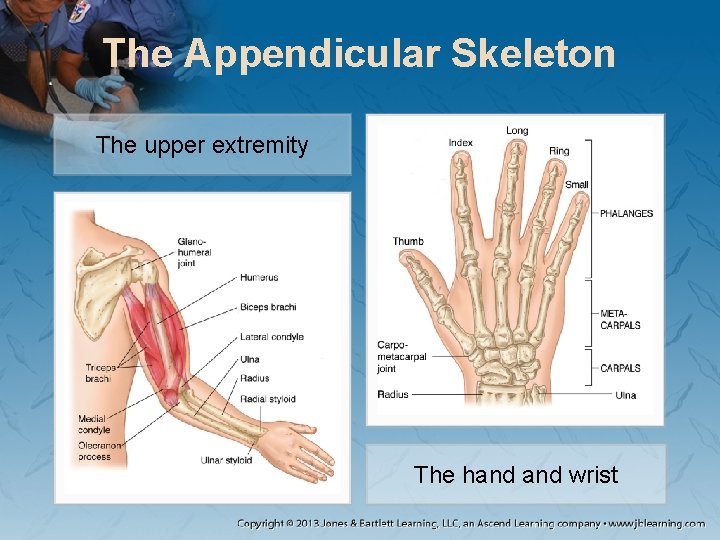
The Appendicular Skeleton The upper extremity The hand wrist
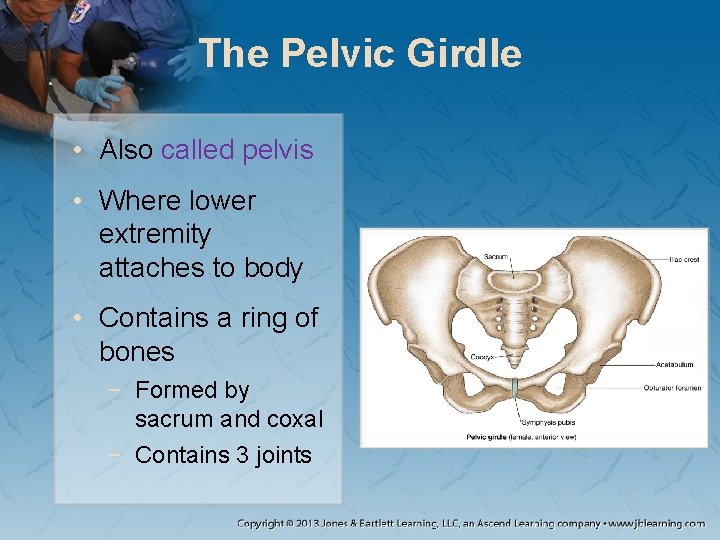
The Pelvic Girdle • Also called pelvis • Where lower extremity attaches to body • Contains a ring of bones − Formed by sacrum and coxal − Contains 3 joints
The Pelvic Girdle • Iliac crest: superior portion of the ilium • Obturator foramen − Opening between the ischium and pubis − Contains several important nerves and muscles • Pelvis supports the body’s weight and protects internal organs
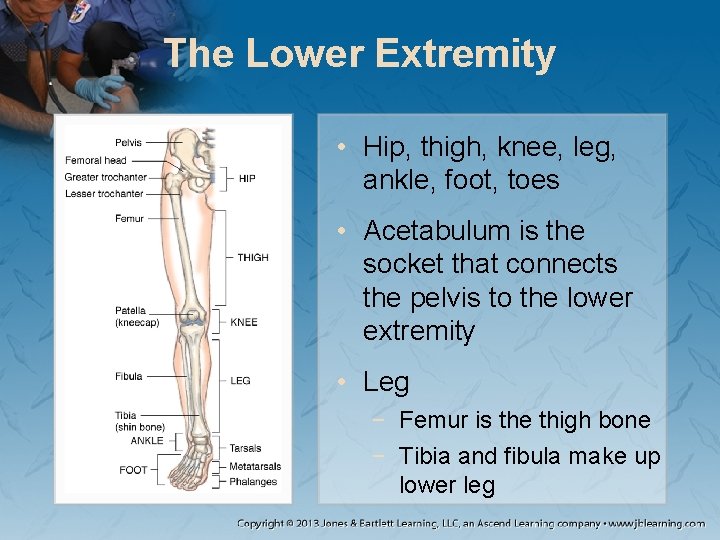
The Lower Extremity • Hip, thigh, knee, leg, ankle, foot, toes • Acetabulum is the socket that connects the pelvis to the lower extremity • Leg − Femur is the thigh bone − Tibia and fibula make up lower leg
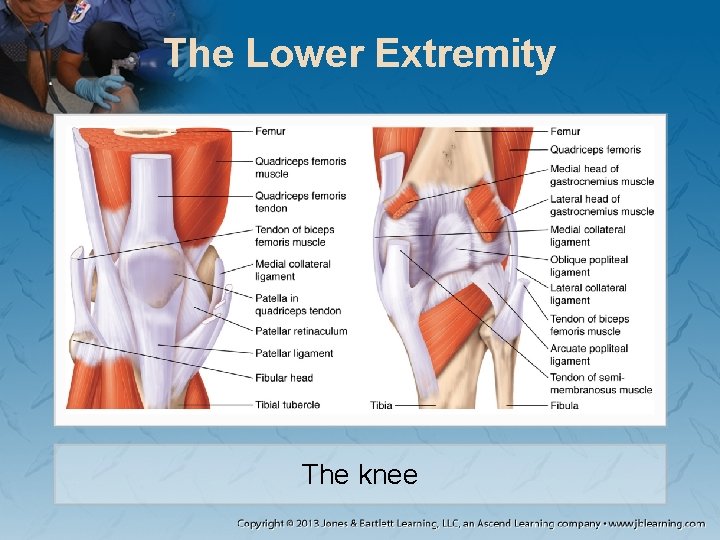
The Lower Extremity The knee
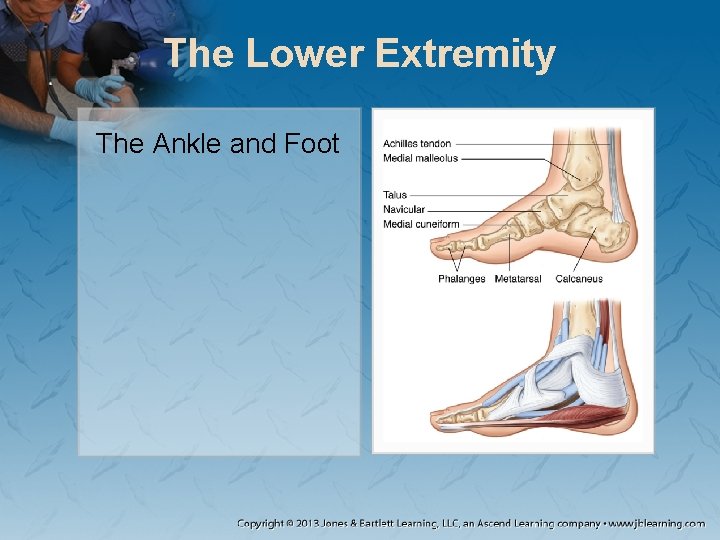
The Ankle and Foot • Talus articulates with the tibia and fibula to form the ankle − Ankle made up of seven bones called tarsals • A fibrous capsule surrounds the ankle joint.
The Ankle and Foot • Movements include dorsiflexion, plantar flexion, and limited inversion and eversion. − Metatarsals and phalanges are similar to hand bones. • Ball of the foot is junction between metatarsals and phalanges
The Lower Extremity The Ankle and Foot
The Skeletal System: Physiology • Bones protect internal organs. • With muscles, bones enable movement. • Bone stores minerals. − Particularly calcium • Plays role in forming blood cells, platelets
The Skeletal System: Physiology • Bones consist of − Collagen − Hydroxyapatite (mineral that contains calcium, phosphate) • Mineral components provide strength to bear weight.
The Skeletal System: Physiology • In the marrow of certain bones, cells can produce red cells, white cells, and platelets. • Bones are a living tissue requiring a blood supply. − During a person’s lifetime, bones are constantly remodeled to meet the stresses placed on them.
The Musculoskeletal System: Anatomy • Musculoskeletal system − Provides body’s form, upright posture, movement − Musculoskeletal refers to bones and voluntary muscles of the body. − Protects vital internal organs
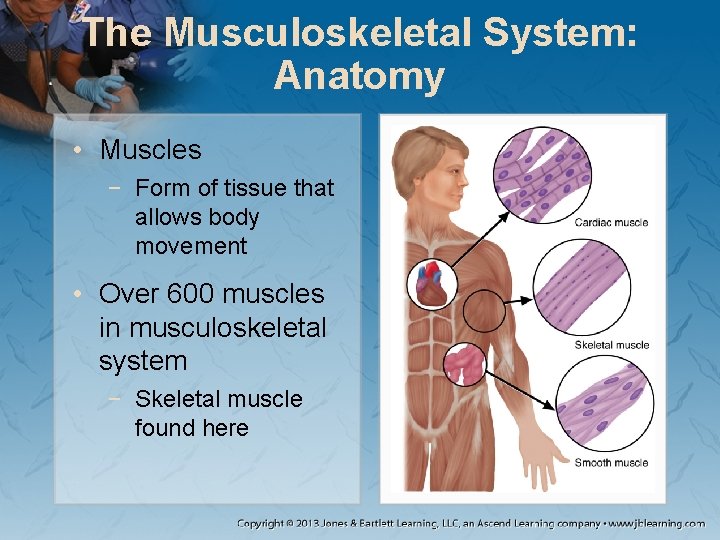
The Musculoskeletal System: Anatomy • Muscles − Form of tissue that allows body movement • Over 600 muscles in musculoskeletal system − Skeletal muscle found here
Skeletal Muscle • Attaches bones to the skeleton • Forms major muscle mass of body • Called voluntary muscle − Movement results from contraction or relaxation • Fascia − Separates skeletal muscles from other muscles − Holds skeletal muscles in place
Coverings of Connective Tissue • Fascia surrounds every muscle. − May form tendons beyond each muscle’s end • Tendon fibers may intertwine with bone fibers to attach muscle to bones. − Aponeuroses may attach to bones or coverings of other muscles.
Coverings of Connective Tissue • Epimysium closely surrounds skeletal muscles − Separated into small compartments by perimysium • The many layers of connective tissue allow a great deal of independent movement.
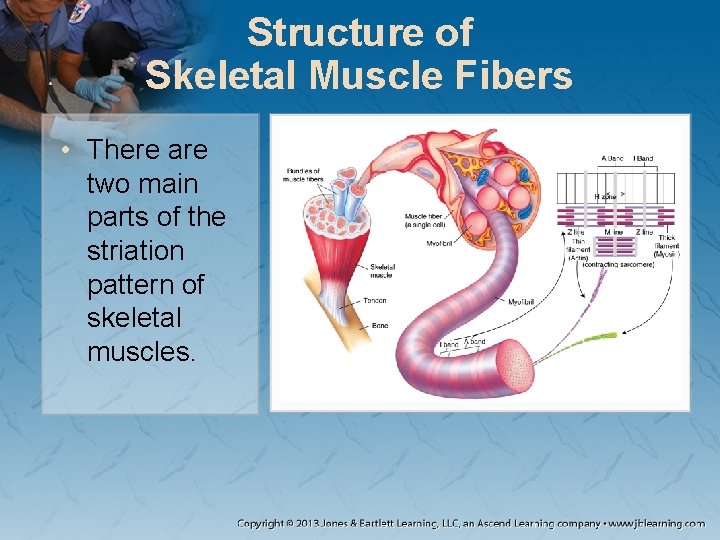
Structure of Skeletal Muscle Fibers • Skeletal muscle fiber − Single cell that contracts in response to stimulation − Thin, elongated cylinders with rounded ends • Sarcolemma lies above the sarcoplasm
Structure of Skeletal Muscle Fibers • Sarcoplasm is made up of threadlike myofibrils arranged parallel to each other. • Sarcomeres − Repeating patterns of striation units along each muscle fiber − Muscles considered to be collections of sarcomeres
Structure of Skeletal Muscle Fibers • There are two main parts of the striation pattern of skeletal muscles.
Structure of Skeletal Muscle Fibers • Sarcoplasmic reticulum − Network of channels that surrounds each myofibril inside the sarcoplasm of a muscle fiber • T-tubules − Other membranous channels extending inward and passing through the fiber
Motor Units • Each of the muscle fibers that make up a piece of muscle tissue have a single motor end plate. − When an impulse is transmitted, they all contract at the same time.
Contraction of Skeletal Muscles • Skeletal muscles contract when organelles and molecules bind myosin to actin. − Myofibrils move as the actin and myosin filaments slide.
Required Chemicals • Actin filaments include the proteins troponin and tropomyosin. − Strands of tropomyosin prevent actin–myosin interaction. • The sarcomere is the functional unit of skeletal muscle.
Required Chemicals • Sliding filament model − So named because of the way sarcomeres shorten from both ends • Myosin filaments contain the enzyme ATPase.
Contraction Stimulus • Nerve impulses transmit the impulses that causes contraction of skeletal muscle. − Also known as action potentials • Depolarization is the process by which cells activate in response to the action potential.
Contraction Stimulus • Acetylcholine is the neurotransmitter that stimulates skeletal muscle to contract. − Charged particles stimulate a muscle impulse. • Muscle relaxation is caused by the decomposition of acetylcholine via acetyl cholinesterase.
Energy Sources • Muscle fibers have just enough ATP for short-term contraction. − ATP is regenerated from ADP and phosphate. − Creatine phosphate accomplishes this with highenergy phosphate bonds. • Muscles use cellular respiration of glucose as energy to synthesize ATP.
Oxygen Use and Debt • Oxygen is required for glucose breakdown in mitochondria. − Red blood cells carry oxygen bound to hemoglobin molecules. − Myoglobin is synthesized in the muscles.
Oxygen Use and Debt • When skeletal muscles are used for a minute or more, anaerobic respiration is required. − When a person is exercising strenuously, oxygen is used mostly to synthesize ATP. − As lactic acid increases, an oxygen debt develops. • It may take several hours to convert lactic acid back into glucose.
Muscle Fatigue • Prolonged exercise may cause a muscle to become unable to contract. − Usually caused by lactic acid accumulation • Muscle cramps appear to be caused by changes in extracellular fluid.
Production of Heat • Most energy released in cellular respiration becomes heat. − Muscle tissue generates significant heat. • Blood transporting heat generated by muscle to other tissues helps maintain body temperature.
Muscle Responses • Muscle fiber will remain unresponsive until the threshold stimulus is applied. − Twitch: contractile response of a fiber to impulse − Two types of twitches: • Fatigue-resistant slow • Fatigable fast
Actions of Skeletal Muscles • Skeletal muscles cause unique movements based on: − The type of joint they attach to − Where the attachment points are • When a muscle appears to be at rest, its fibers still undergo muscle tone.
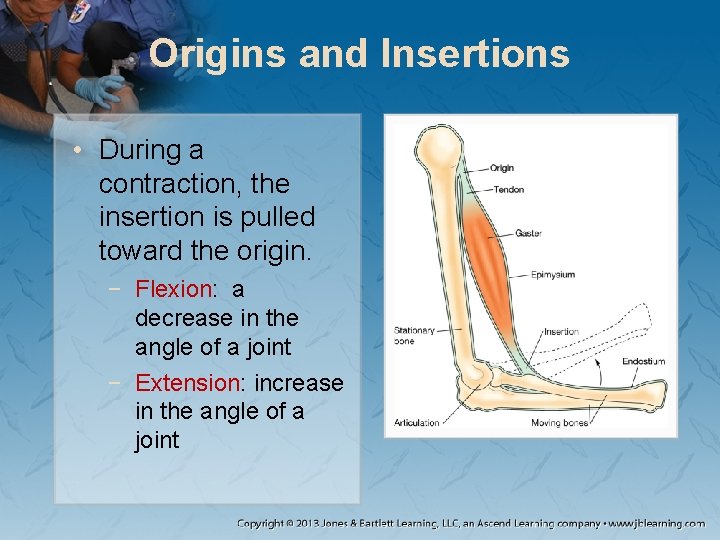
Origins and Insertions • Skeletal muscle usually fastens to an origin at a moveable joint. − The other end connects to an insertion on the other side of the joint. • There may be more than one origin or insertion.
Origins and Insertions • During a contraction, the insertion is pulled toward the origin. − Flexion: a decrease in the angle of a joint − Extension: increase in the angle of a joint
Skeletal Muscle Interactions • Skeletal muscles usually function in groups. − Prime movers contract to provide most of the desired movement. − Synergists work with a prime mover to make its action more effective. − Other muscles act as antagonists to prime movers.
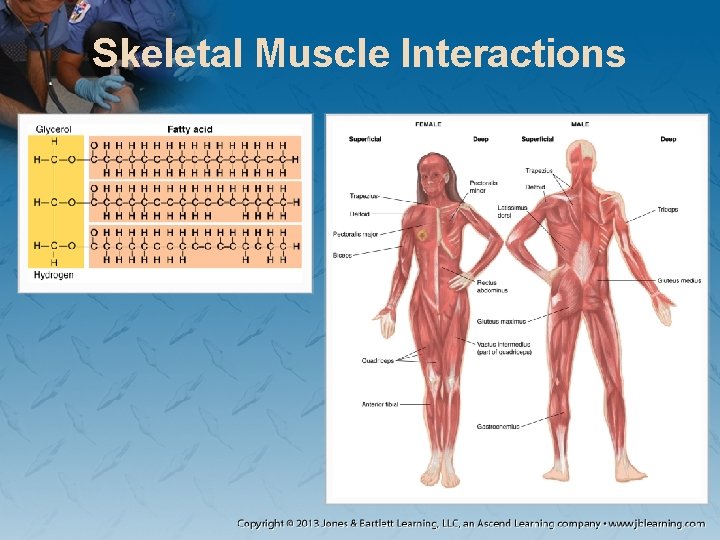
Skeletal Muscle Interactions
The Musculoskeletal System: Physiology • Functions of the musculoskeletal system: − Movement and manipulation of the environment • Heat is a by-product. – Shivering − Protect structures under them