
The Skeletal System All parts are connective tissue
- Slides: 28
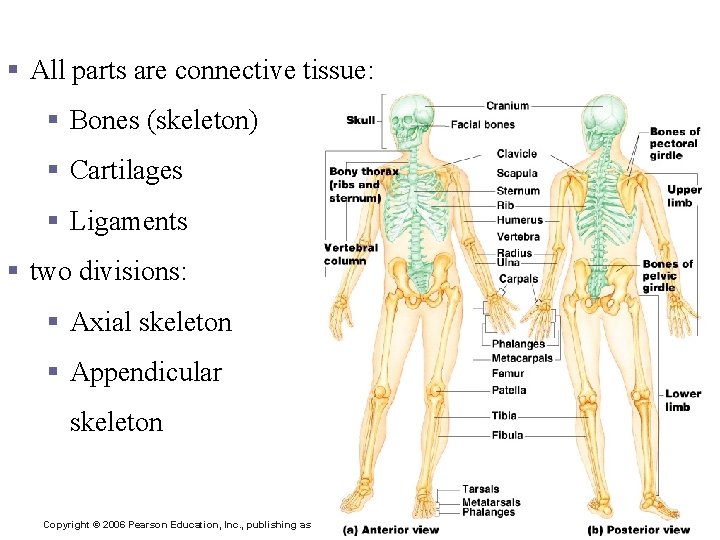
The Skeletal System § All parts are connective tissue: § Bones (skeleton) § Cartilages § Ligaments § two divisions: § Axial skeleton § Appendicular skeleton Copyright © 2006 Pearson Education, Inc. , publishing as Benjamin Cummings
Functions of Skeleton and Bones § Support of the body § Protection of soft organs § Movement due to attached skeletal muscles § Storage of minerals and fats § Blood cell formation Copyright © 2006 Pearson Education, Inc. , publishing as Benjamin Cummings
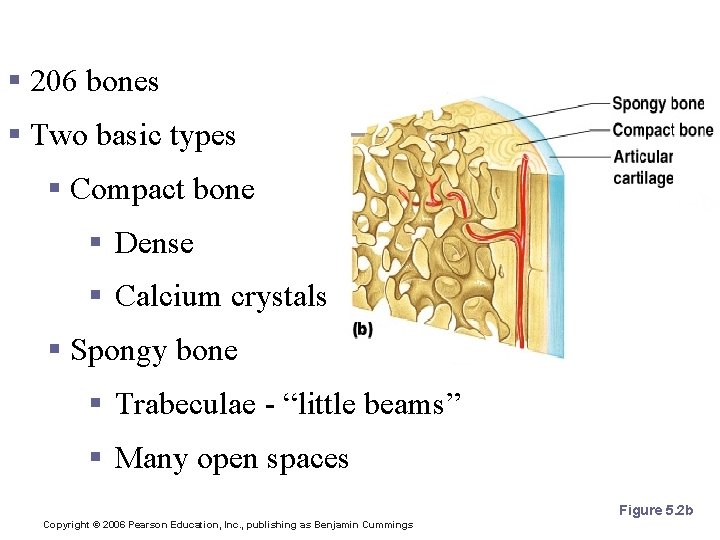
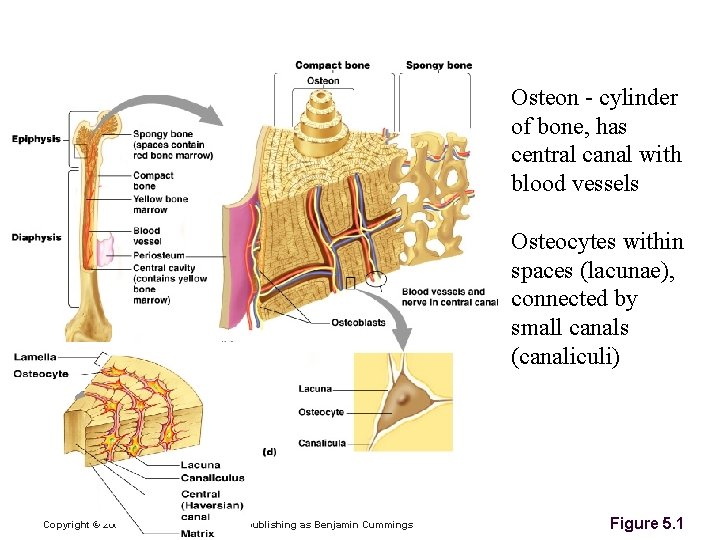
Bones of the Human Body § 206 bones § Two basic types § Compact bone § Dense § Calcium crystals § Spongy bone § Trabeculae - “little beams” § Many open spaces Figure 5. 2 b Copyright © 2006 Pearson Education, Inc. , publishing as Benjamin Cummings
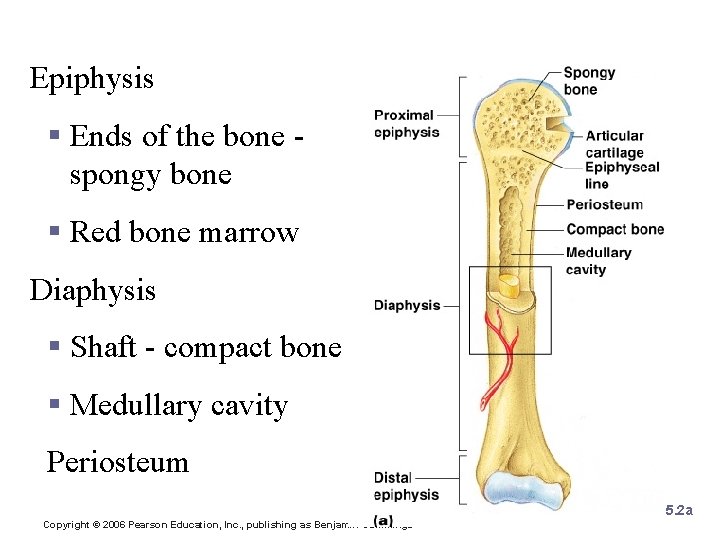
Gross Anatomy of a Long Bone Epiphysis § Ends of the bone spongy bone § Red bone marrow Diaphysis § Shaft - compact bone § Medullary cavity Periosteum Figure 5. 2 a Copyright © 2006 Pearson Education, Inc. , publishing as Benjamin Cummings
Structure of Bone Osteon - cylinder of bone, has central canal with blood vessels Osteocytes within spaces (lacunae), connected by small canals (canaliculi) Copyright © 2006 Pearson Education, Inc. , publishing as Benjamin Cummings Figure 5. 1
Cartilage and Ligaments § Ligaments - dense fibrous connective tissue § Collagen fibers, fibroblasts § Cartilage - collagen and elastin fibers in base of water. Smooth and flexible substance § used to reduce friction, provide support under pressure at joints Copyright © 2006 Pearson Education, Inc. , publishing as Benjamin Cummings
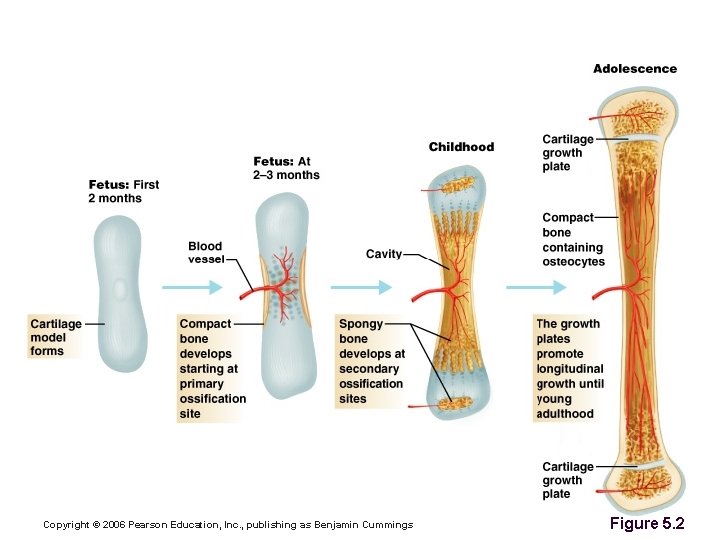
Changes in the Human Skeleton § Embryos - hyaline cartilage § Cartilage replaced by bone = ossification § done by osteoblasts - bone building cells § Secrete osteoid (proteins, fibers, enzymes) § Osteoid replaced by calcium phosphate salts § Cartilage remains in nose, ribs, joints, and epiphyseal plates, ends of bones Copyright © 2006 Pearson Education, Inc. , publishing as Benjamin Cummings
Bone Development (cont. ) Copyright © 2006 Pearson Education, Inc. , publishing as Benjamin Cummings Figure 5. 2
Types of Bone Cells § Chondrocytes § Cartilage-forming cells § Osteocytes § Mature bone cells § Osteoblasts § Bone-forming cells § Osteoclasts § Bone-destroying cells § Break down bone matrix for remodeling and release of calcium Copyright © 2006 Pearson Education, Inc. , publishing as Benjamin Cummings
Mature Bone Remodeling and Repair § Changes in shape, size, strength § Dependent on diet, exercise, age § Bone cells regulated by hormones § Parathyroid hormone (PTH): removes calcium from bone § Calcitonin: adds calcium to bone Copyright © 2006 Pearson Education, Inc. , publishing as Benjamin Cummings
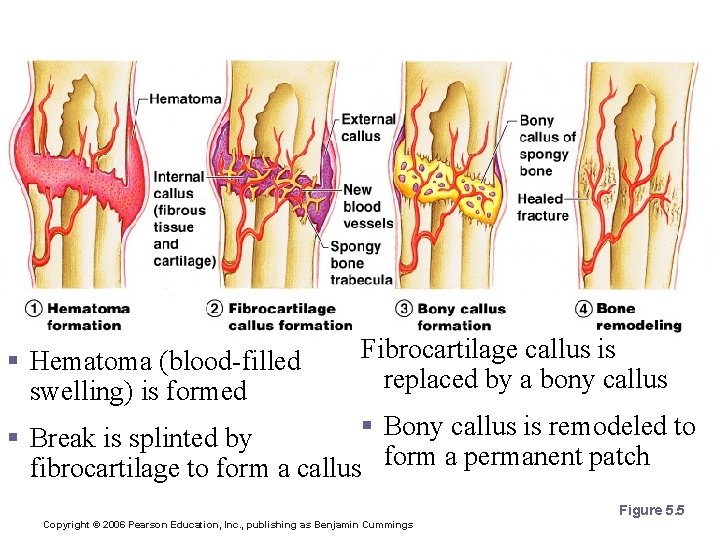
Stages in the Healing of a Bone Fracture § Hematoma (blood-filled swelling) is formed Fibrocartilage callus is replaced by a bony callus § Bony callus is remodeled to § Break is splinted by fibrocartilage to form a callus form a permanent patch Figure 5. 5 Copyright © 2006 Pearson Education, Inc. , publishing as Benjamin Cummings
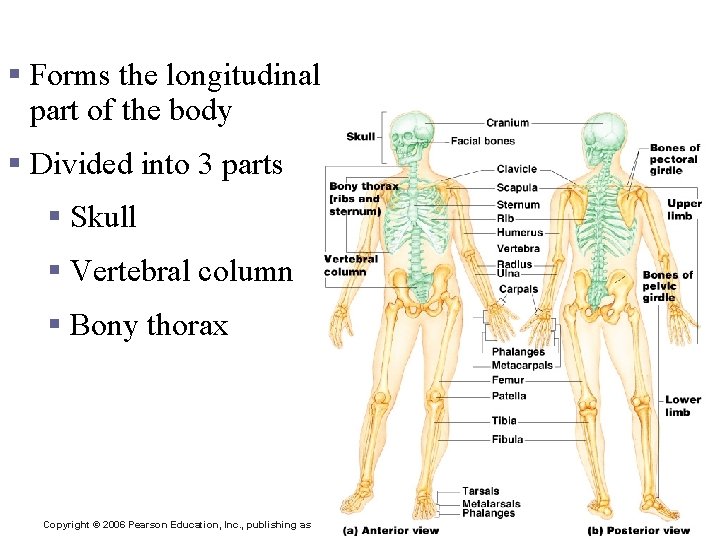
The Axial Skeleton § Forms the longitudinal part of the body § Divided into 3 parts § Skull § Vertebral column § Bony thorax Copyright © 2006 Pearson Education, Inc. , publishing as Benjamin Cummings
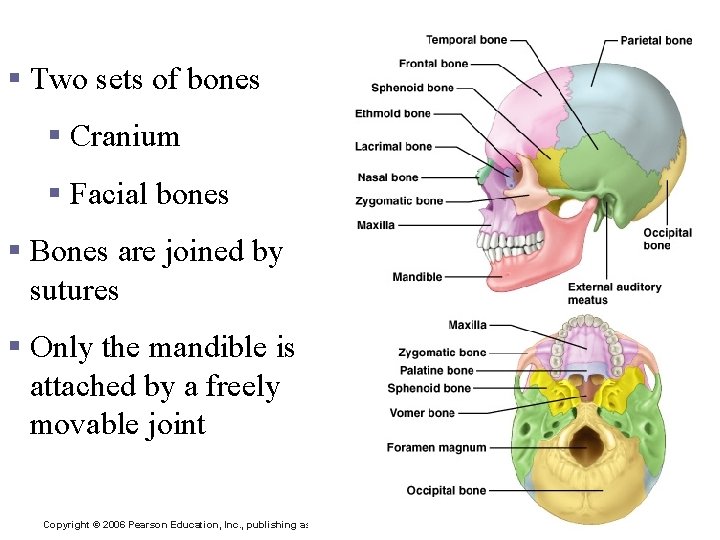
The Skull § Two sets of bones § Cranium § Facial bones § Bones are joined by sutures § Only the mandible is attached by a freely movable joint Copyright © 2006 Pearson Education, Inc. , publishing as Benjamin Cummings
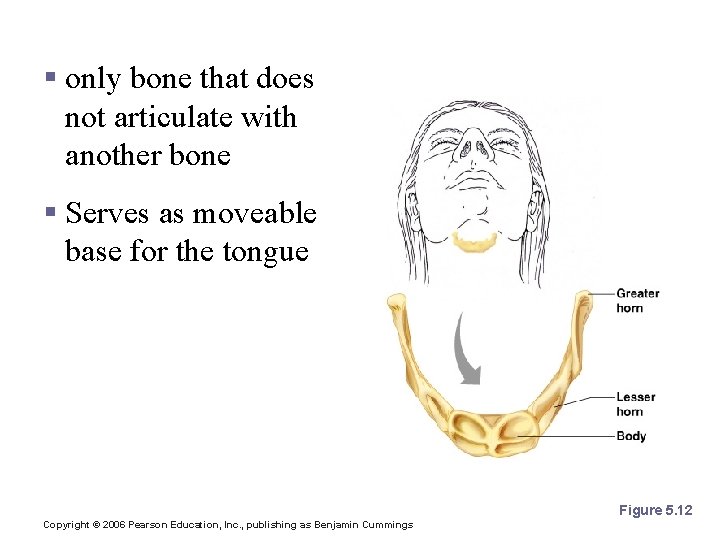
The Hyoid Bone § only bone that does not articulate with another bone § Serves as moveable base for the tongue Figure 5. 12 Copyright © 2006 Pearson Education, Inc. , publishing as Benjamin Cummings
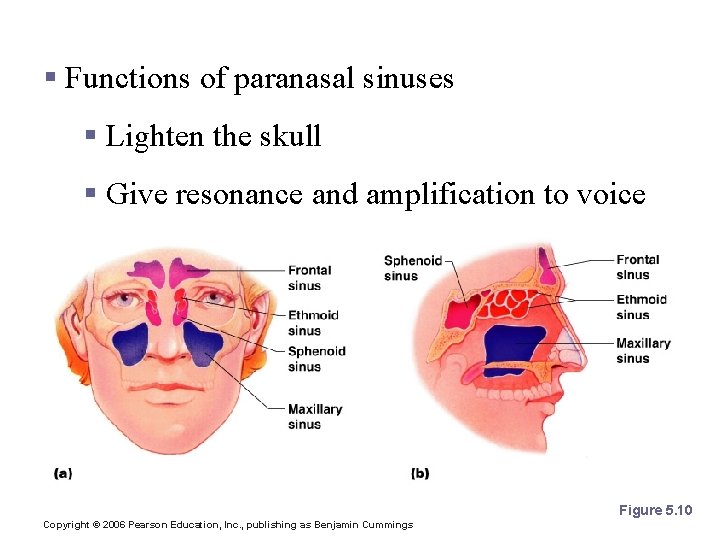
Paranasal Sinuses § Functions of paranasal sinuses § Lighten the skull § Give resonance and amplification to voice Figure 5. 10 Copyright © 2006 Pearson Education, Inc. , publishing as Benjamin Cummings
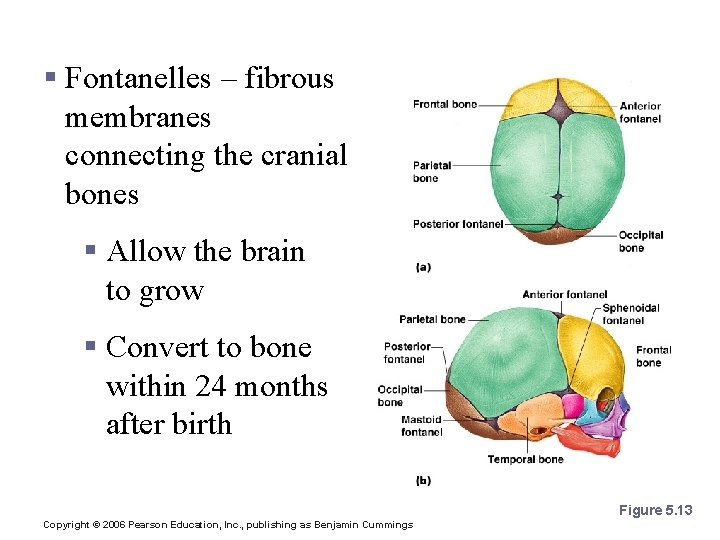
The Fetal Skull § Fontanelles – fibrous membranes connecting the cranial bones § Allow the brain to grow § Convert to bone within 24 months after birth Figure 5. 13 Copyright © 2006 Pearson Education, Inc. , publishing as Benjamin Cummings
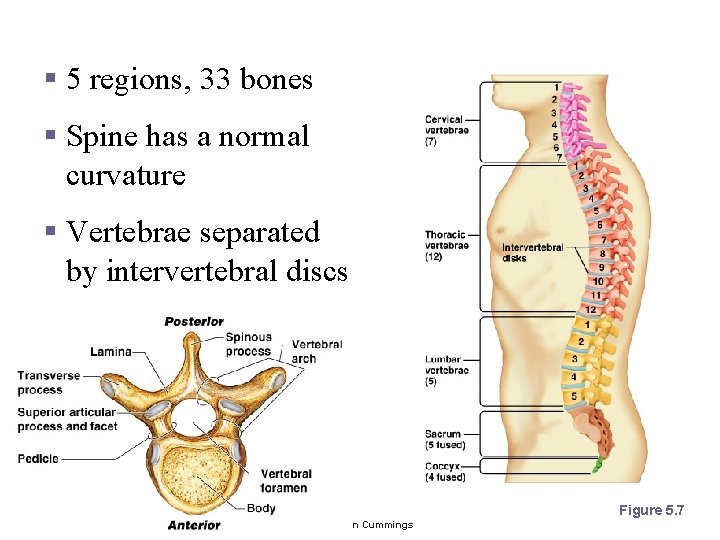
The Vertebral Column § 5 regions, 33 bones § Spine has a normal curvature § Vertebrae separated by intervertebral discs Figure 5. 7 Copyright © 2006 Pearson Education, Inc. , publishing as Benjamin Cummings
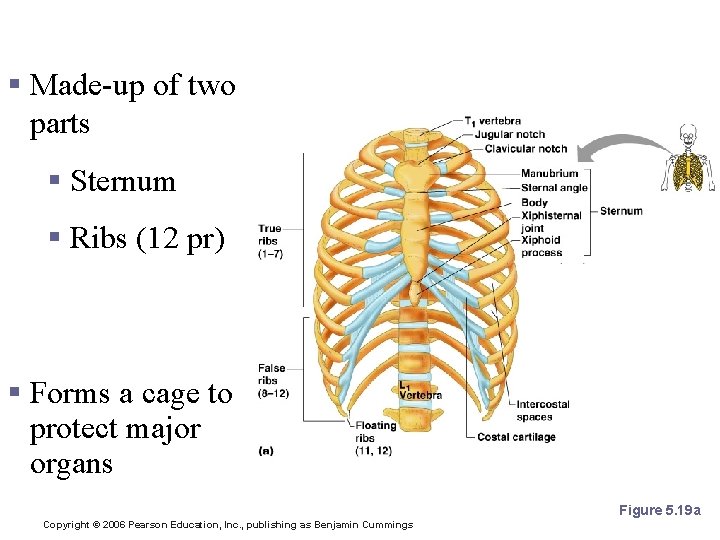
The Bony Thorax § Made-up of two parts § Sternum § Ribs (12 pr) § Forms a cage to protect major organs Figure 5. 19 a Copyright © 2006 Pearson Education, Inc. , publishing as Benjamin Cummings
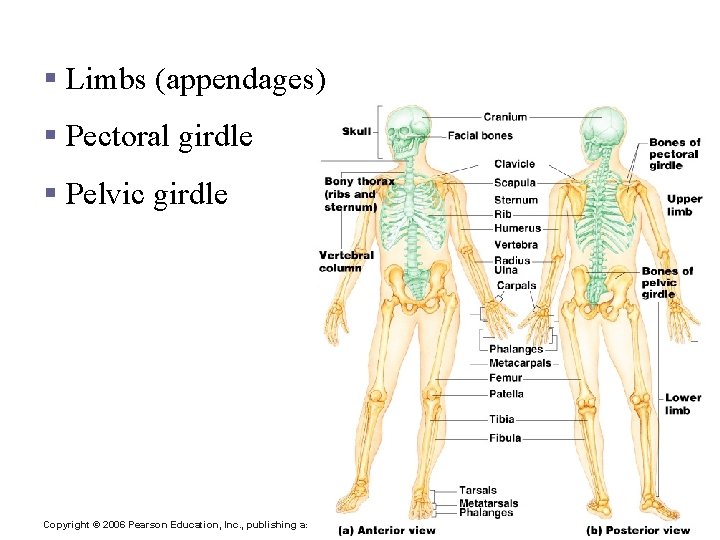
The Appendicular Skeleton § Limbs (appendages) § Pectoral girdle § Pelvic girdle Copyright © 2006 Pearson Education, Inc. , publishing as Benjamin Cummings
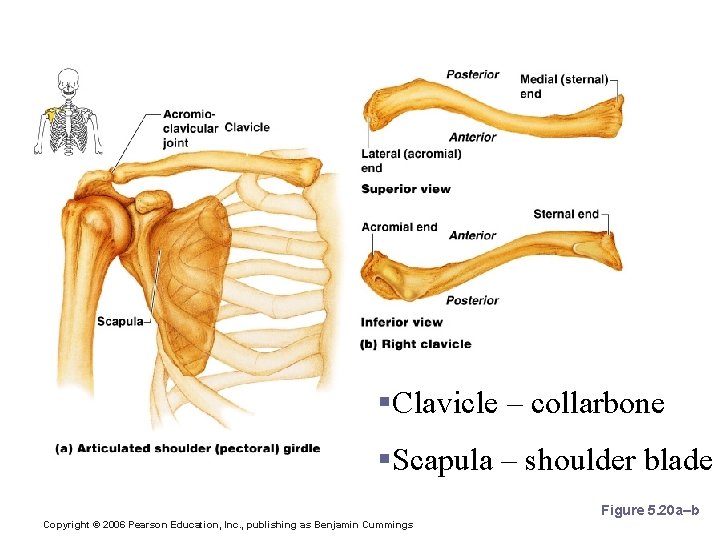
Bones of the Pectoral Girdle §Clavicle – collarbone §Scapula – shoulder blade Figure 5. 20 a–b Copyright © 2006 Pearson Education, Inc. , publishing as Benjamin Cummings
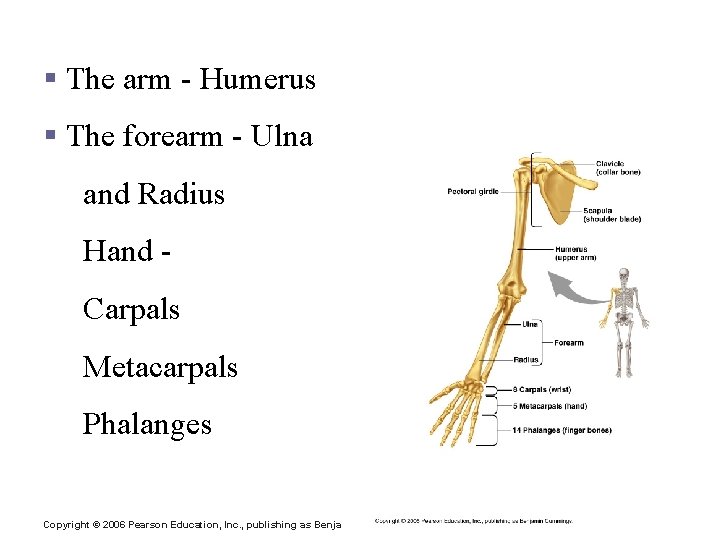
Bones of the Upper Limb § The arm - Humerus § The forearm - Ulna and Radius Hand Carpals Metacarpals Phalanges Figure 5. 21 a–b Copyright © 2006 Pearson Education, Inc. , publishing as Benjamin Cummings
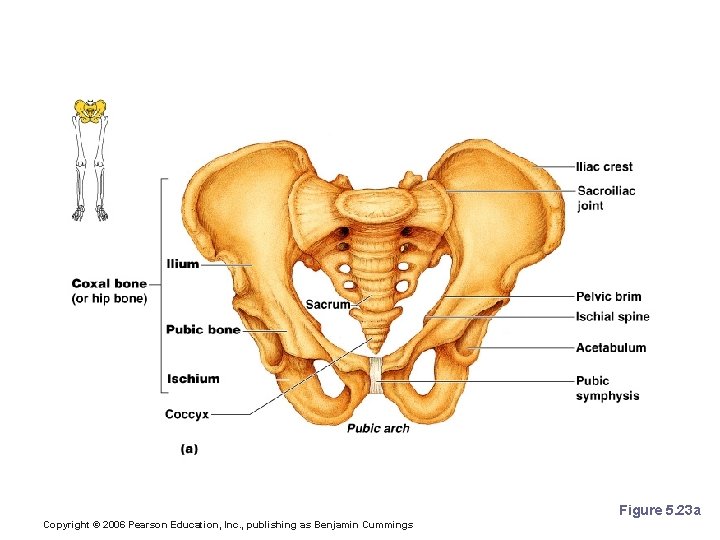
The Pelvis Figure 5. 23 a Copyright © 2006 Pearson Education, Inc. , publishing as Benjamin Cummings
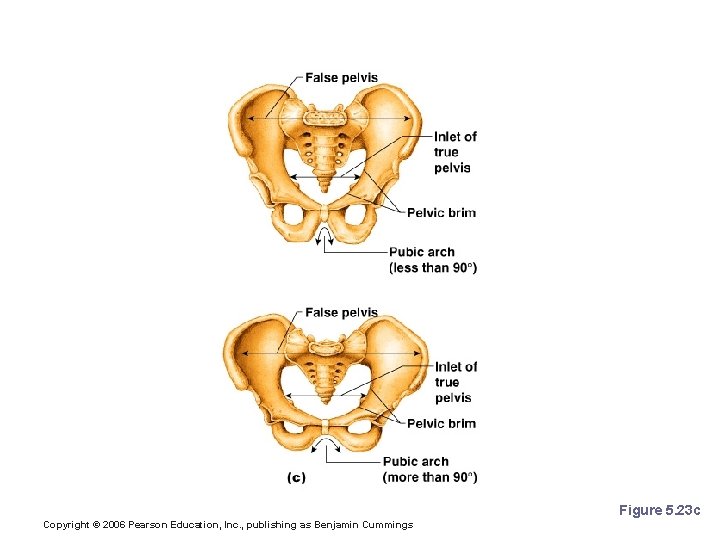
Gender Differences of the Pelvis Figure 5. 23 c Copyright © 2006 Pearson Education, Inc. , publishing as Benjamin Cummings
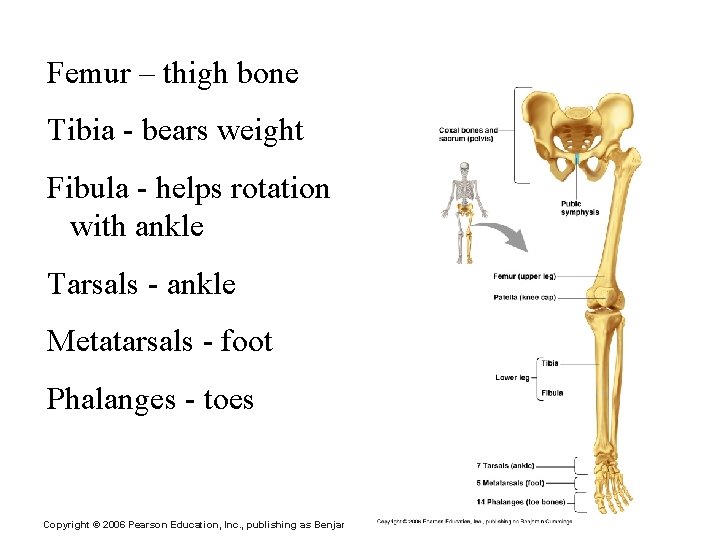
Bones of the Lower Limbs Femur – thigh bone Tibia - bears weight Fibula - helps rotation with ankle Tarsals - ankle Metatarsals - foot Phalanges - toes Figure 5. 24 a–b Copyright © 2006 Pearson Education, Inc. , publishing as Benjamin Cummings
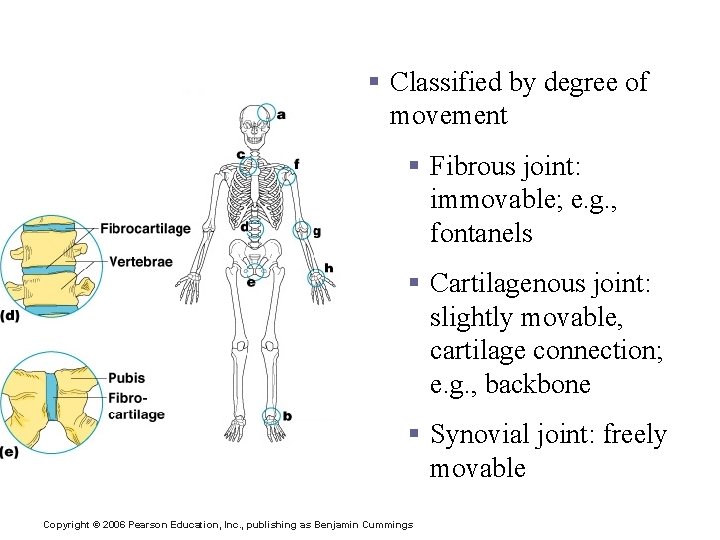
Joints (Articulations) § Classified by degree of movement § Fibrous joint: immovable; e. g. , fontanels § Cartilagenous joint: slightly movable, cartilage connection; e. g. , backbone § Synovial joint: freely movable Copyright © 2006 Pearson Education, Inc. , publishing as Benjamin Cummings
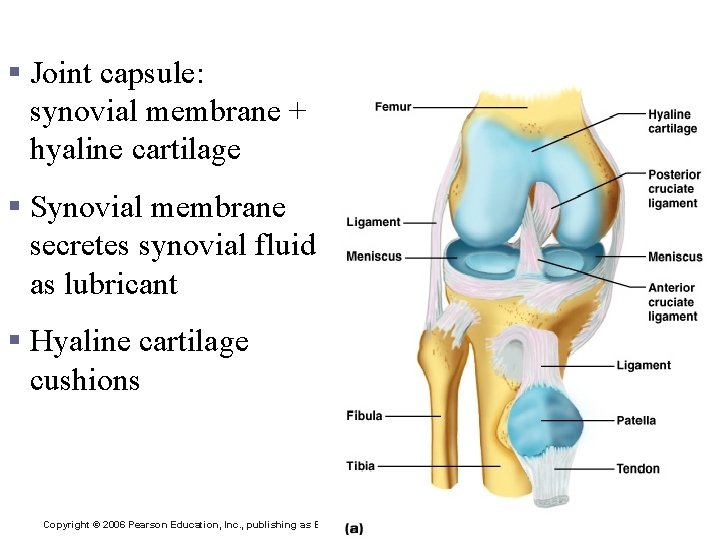
Synovial Joints - movable; all limbs § Joint capsule: synovial membrane + hyaline cartilage § Synovial membrane secretes synovial fluid as lubricant § Hyaline cartilage cushions Copyright © 2006 Pearson Education, Inc. , publishing as Benjamin Cummings
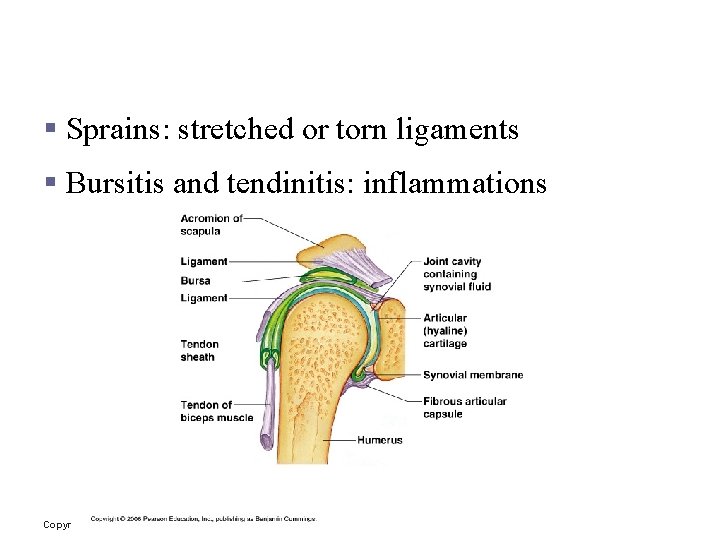
Disorders, Inflammatory Conditions Associated with Joints § Sprains: stretched or torn ligaments § Bursitis and tendinitis: inflammations Copyright © 2006 Pearson Education, Inc. , publishing as Benjamin Cummings
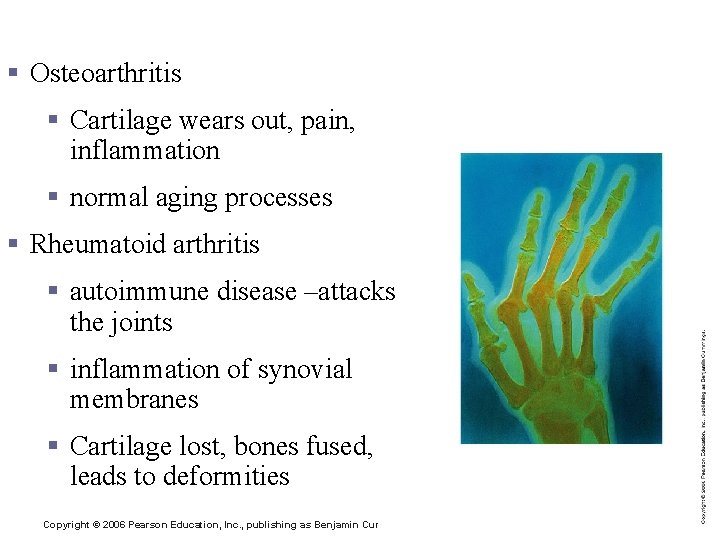
Clinical Forms of Arthritis § Osteoarthritis § Cartilage wears out, pain, inflammation § normal aging processes § Rheumatoid arthritis § autoimmune disease –attacks the joints § inflammation of synovial membranes § Cartilage lost, bones fused, leads to deformities Copyright © 2006 Pearson Education, Inc. , publishing as Benjamin Cummings