
The Six Basic Principles Section 1 Preamble Articles

The Six Basic Principles Section 1
Preamble & Articles Preamble - Introduction - States the purpose of the constitution Article I - Congress Article II - Presidency Article III - Judicial Branch Article IV - Relations among States Article V - Amending the Constitution Article VI - National Debts, Supremacy of National law, Oaths of Office Article VII - Ratifying the Constitution
Popular Sovereignty Government can only govern with the consent of the people. The U. S. Government draws all of its power from the people. The people are the only source of power
Limited Government may do only those things that the people have given it the power to do. Constitutionalism - Govt must be conducted according to constitutional principles. Govt and its officers are subject to the rule of law and not above it.
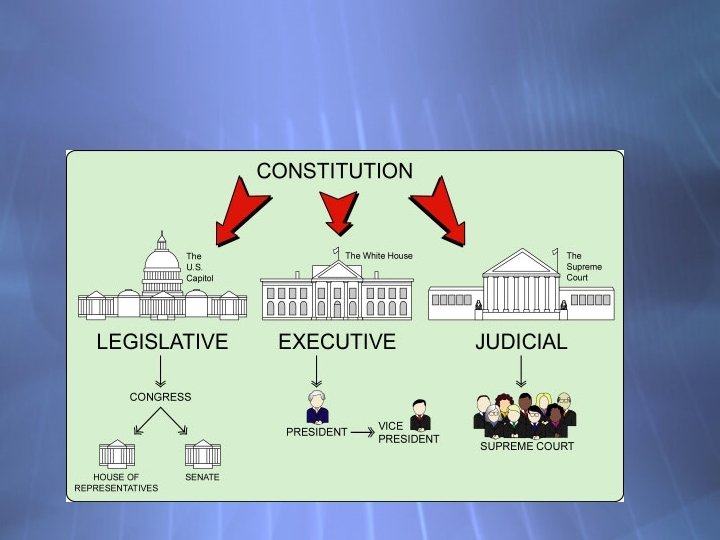
Separation of Powers Article I – Congress is the law making branch Article II – President executes, enforces and administers law Article III – The Supreme court interprets and applies the laws of the United States A stronger National Government with limits on its powers.
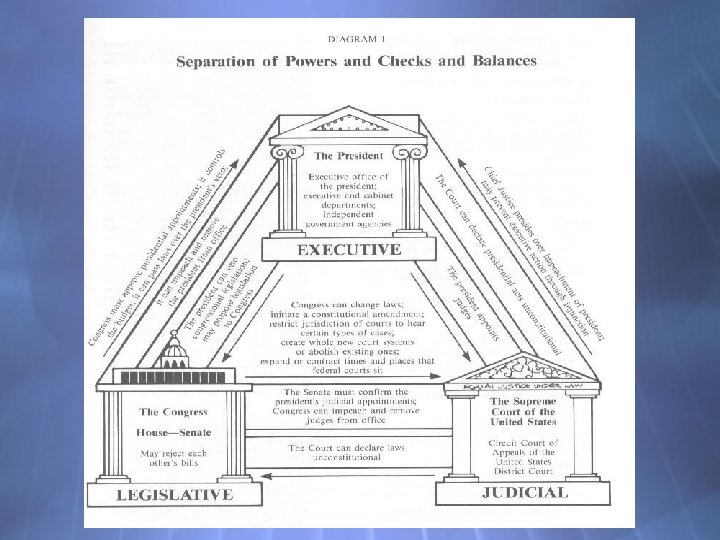
Checks and Balances Constitutional Checks/Restraints - Hold branches accountable to each other for actions Examples of checks: Veto, Appointments, Court Cases 1) Checks makes compromise necessary 2) Keeps the government running 3) It prevents an unjust combination of the majority. 4) Creates a working relationship between Congress & President Runs smoother when same political party is in control.
Judicial Review In judicial review, the court determines constitutionality of government actions. The power to declare acts unconstitutional. The Supreme Court answers the question: Does government act in accordance with the Constitution? Independent judges are essential - Protect against being swayed by society Power was established in the case of Marbury v. Madison Most cases govt is acting constitutionally
Federalism is the separation of power among central government & several regional governments. - Example: Washington DC and States The federal arrangement is a division of powers.
Formal Amendment Section 2
4 Methods of Formal Amendment 1. 2/3 vote in each house and ¾ of State legislatures (38) 2. Proposed by Congress and ratified at conventions in ¾ of the States 3. Proposed by an national convention requested by 2/3 of the States and ratified by ¾. 4. Proposed by a national convention, and ratified by conventions in ¾ of States.
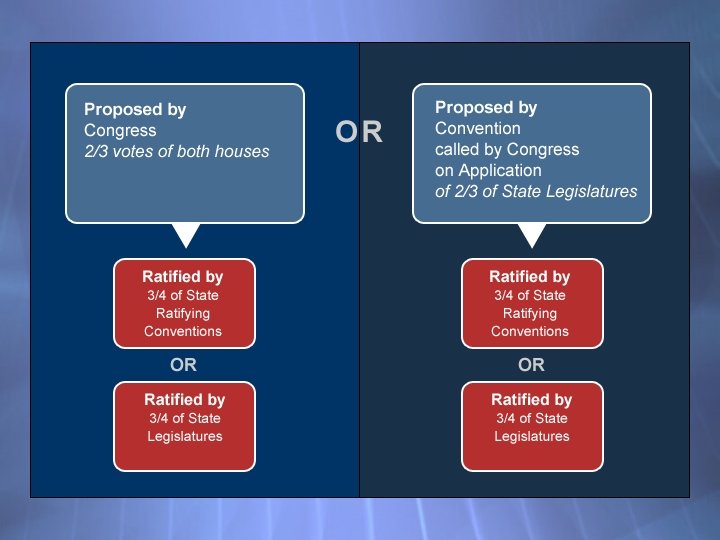
Federalism & Popular Sovereignty Amending embodies federalism - Proposed nationally, Ratified by States Amendments represent the sovereign will of the people Other details regarding amending: States can’t amend proposals by approved vote of the people. Article V - No State is deprived equal suffrage in the Senate.
The 27 Amendments Since 1789 10, 000 proposals made Bill of Rights (1 st 10 Amendments to Constitution) proposed 1789, ratified 1791 33 have been sent to the States 27 have been ratified There are time limit set for ratifying - 27 th Amendment ratified after 202 years but most were between 1 and 3 years. - Supreme Court case (Dillon v. Gloss) (1921) said Congress can set reasonable time limits
The 27 Amendments 1 st Amendment - Freedom of Religion, Speech, Press, Assembly & Petition 2 nd Amendment - Right to Bear Arms 3 rd Amendment - Quartering of Troops 4 th Amendment - Search & Seizures (warrant or Prob Cause)
es 5 th Amendment - No Double Jeopardy, No Self-Incrimination, Confront Witness, Eminent Domain 6 th Amendment - Fair, Speedy Trial, Informed of Charges 7 th Amendment - Civil Cases in Federal Court, Right to a Jury 8 th Amendment - Cruel & Unusual Punishment, Excessive Bail 9 th Amendment - Enumerated Rights (Bill of Rights are not your only rights)
l 10 th Amendment - Powers to the State(Those not to the Fed) 11 th Amendment - Suits against States(Can’t sue in Fed court) 12 th Amendment - election of president and vice (separate ballots) 13 th Amendment - slavery and involuntary servitude (abolished slavery) 14 th Amendment - rights of citizens- citizenship at birth
15 th Amendment (Civil War Amend) - right to vote- race, color, servitude 16 th Amendment - income tax- Congress power to tax income 17 th Amendment - election of senators - popular vote 18 th Amendment - prohibition of alcohol 19 th Amendment - equal suffrage - women 20 th Amendment (Lame Duck Amendment) - commencement of terms- January 20 th,
21 st Amendment - repeal of the 18 th 22 nd Amendment - presidential tenure- 2 terms 10 yrs. 23 rd Amendment - electors of D. C. - (3) 24 th Amendment - eliminated any poll tax 25 th Amendment - presidential succession 26 th Amendment - right to vote 18 yrs. 27 th Amendment - congressional pay - next term
Constitutional Changes by Other Means Section 3
5 Means of Change 1. Basic Legislation - Congress passes laws - How is uses its powers 2. Executive Action - In dealing with foreign affairs – President can make executive agreements with other foreign leaders - Military actions – can use the armed forces without declaring war under power as Commander in Chief 3. Court Decisions – case decisions make changes
4. Party Practices - political parties participate in process of choosing President - presidential appointments made considering the political parties 5. Custom – Unwritten rules that have become part of the procedures of government. For example, -Cabinet made of 15 departments - Vice President takes office in Death of the President(not formal until the 25 th amendment).

- Slides: 24