
The Six articles of faith in Sunni Islam
- Slides: 22
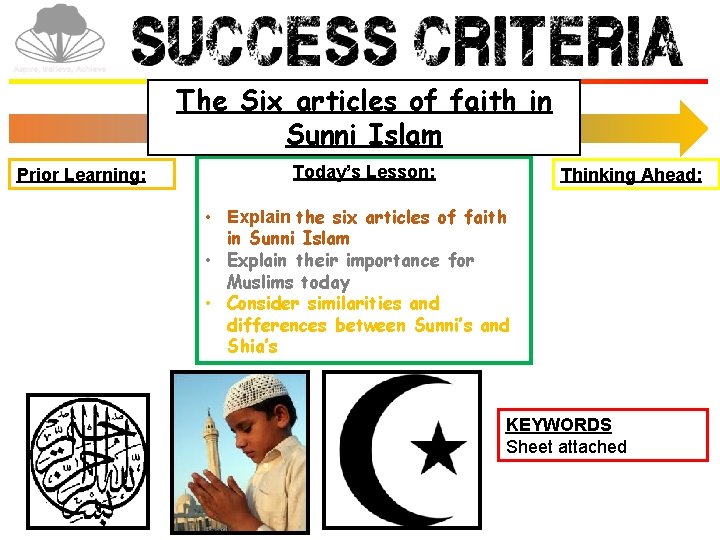
The Six articles of faith in Sunni Islam Prior Learning: Today’s Lesson: Thinking Ahead: • Explain the six articles of faith in Sunni Islam • Explain their importance for Muslims today • Consider similarities and differences between Sunni’s and Shia’s KEYWORDS Sheet attached
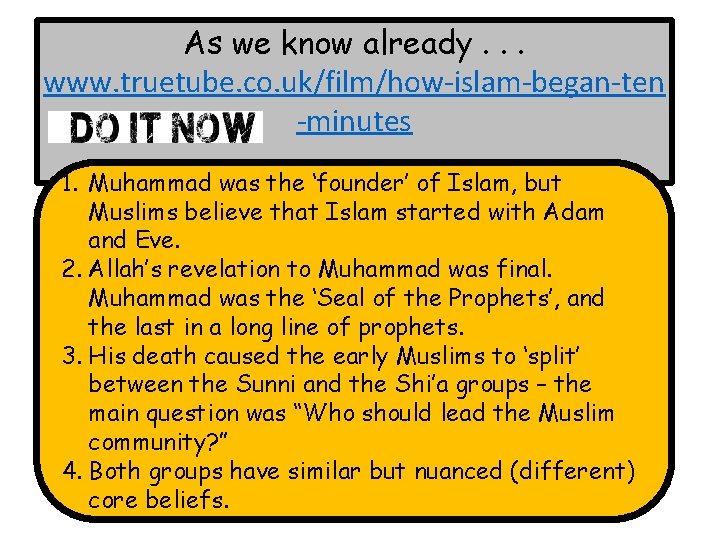
As we know already. . . www. truetube. co. uk/film/how-islam-began-ten -minutes 1. Muhammad was the ‘founder’ of Islam, but Muslims believe that Islam started with Adam and Eve. 2. Allah’s revelation to Muhammad was final. Muhammad was the ‘Seal of the Prophets’, and the last in a long line of prophets. 3. His death caused the early Muslims to ‘split’ between the Sunni and the Shi’a groups – the main question was “Who should lead the Muslim community? ” 4. Both groups have similar but nuanced (different) core beliefs.
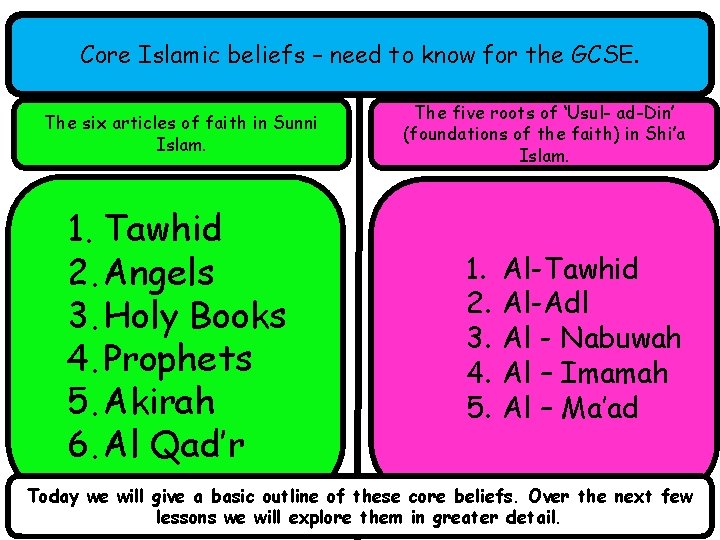
Core Islamic beliefs – need to know for the GCSE. The six articles of faith in Sunni Islam. 1. Tawhid 2. Angels 3. Holy Books 4. Prophets 5. Akirah 6. Al Qad’r The five roots of ‘Usul- ad-Din’ (foundations of the faith) in Shi’a Islam. 1. 2. 3. 4. 5. Al-Tawhid Al-Adl Al - Nabuwah Al – Imamah Al – Ma’ad Today we will give a basic outline of these core beliefs. Over the next few lessons we will explore them in greater detail.
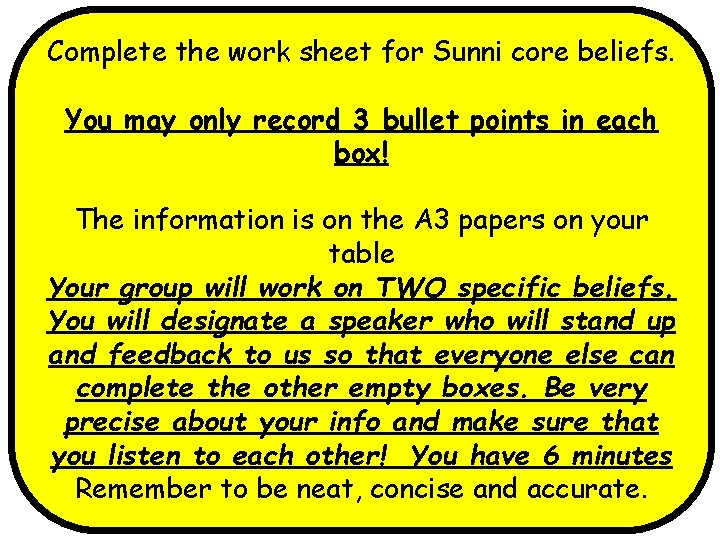
Complete the work sheet for Sunni core beliefs. You may only record 3 bullet points in each box! The information is on the A 3 papers on your table Your group will work on TWO specific beliefs. You will designate a speaker who will stand up and feedback to us so that everyone else can complete the other empty boxes. Be very precise about your info and make sure that you listen to each other! You have 6 minutes Remember to be neat, concise and accurate.
1. Tawhid 4. Prophets 2. Angels Sunni Islam – 6 articles of faith. 5. Akirah 3. Holy Books 6. Al Qad’r
To finish. . . How are these beliefs expressed in the Muslim community today? Pick 3 beliefs and explain how they are expressed by Muslims today. Example: Belief in Allah: encourages Muslims to be grateful to Allah. They express this gratitude through prayer and worship Challenge: ‘Belief in the day of Judgement is the most important belief in Islam’. Do you agree with this statement? Explain your views.
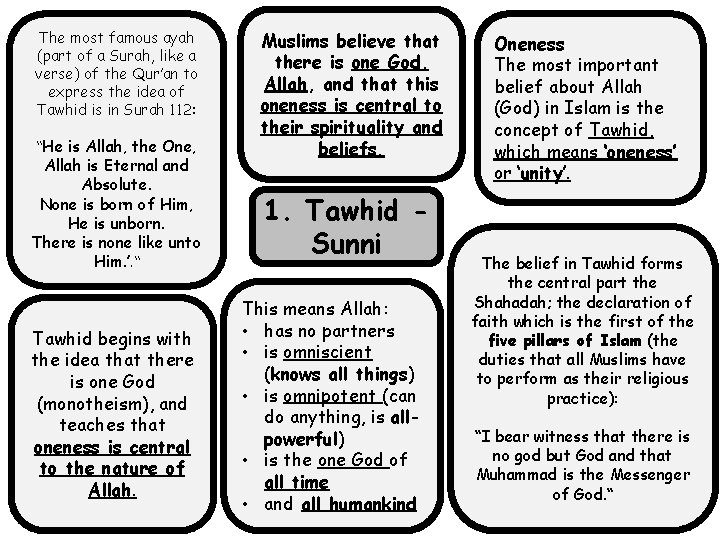
The most famous ayah (part of a Surah, like a verse) of the Qur’an to express the idea of Tawhid is in Surah 112: “He is Allah, the One, Allah is Eternal and Absolute. None is born of Him, He is unborn. There is none like unto Him. ’. “ Tawhid begins with the idea that there is one God (monotheism), and teaches that oneness is central to the nature of Allah. Muslims believe that there is one God, Allah, and that this oneness is central to their spirituality and beliefs. 1. Tawhid Sunni This means Allah: • has no partners • is omniscient (knows all things) • is omnipotent (can do anything, is allpowerful) • is the one God of all time • and all humankind Oneness The most important belief about Allah (God) in Islam is the concept of Tawhid, which means ‘oneness’ or ‘unity’. The belief in Tawhid forms the central part the Shahadah; the declaration of faith which is the first of the five pillars of Islam (the duties that all Muslims have to perform as their religious practice): “I bear witness that there is no god but God and that Muhammad is the Messenger of God. “
1. Al- Tawhid 3. Al-Nubuwah 2. Al-Adl Shi’a Islam – 5 roots of ‘Usul – ad-Din’. 4. Al- Imamah 5. Al – Ma’ad
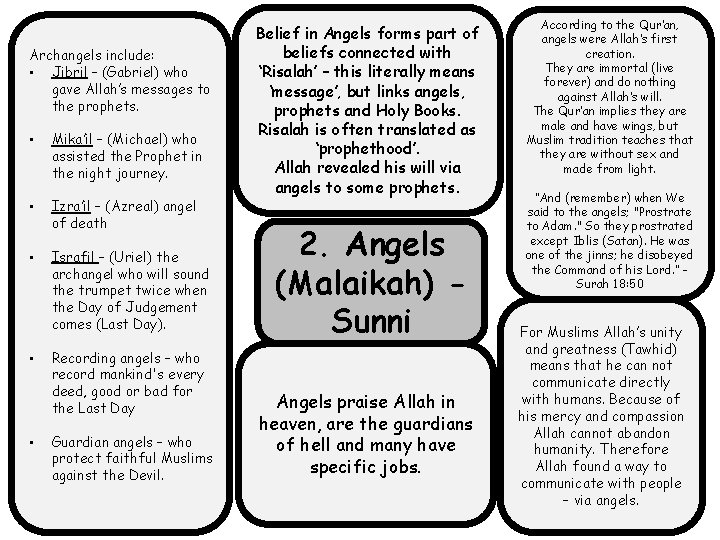
Archangels include: • Jibril – (Gabriel) who gave Allah’s messages to the prophets. • Mika’il – (Michael) who assisted the Prophet in the night journey. • Izra’il – (Azreal) angel of death • Israfil – (Uriel) the archangel who will sound the trumpet twice when the Day of Judgement comes (Last Day). • • Recording angels – who record mankind's every deed, good or bad for the Last Day Guardian angels – who protect faithful Muslims against the Devil. Belief in Angels forms part of beliefs connected with ‘Risalah’ – this literally means ‘message’, but links angels, prophets and Holy Books. Risalah is often translated as ‘prophethood’. Allah revealed his will via angels to some prophets. 2. Angels (Malaikah) Sunni Angels praise Allah in heaven, are the guardians of hell and many have specific jobs. According to the Qur’an, angels were Allah’s first creation. They are immortal (live forever) and do nothing against Allah’s will. The Qur’an implies they are male and have wings, but Muslim tradition teaches that they are without sex and made from light. “And (remember) when We said to the angels; "Prostrate to Adam. " So they prostrated except Iblis (Satan). He was one of the jinns; he disobeyed the Command of his Lord. ” Surah 18: 50 For Muslims Allah’s unity and greatness (Tawhid) means that he can not communicate directly with humans. Because of his mercy and compassion Allah cannot abandon humanity. Therefore Allah found a way to communicate with people – via angels.
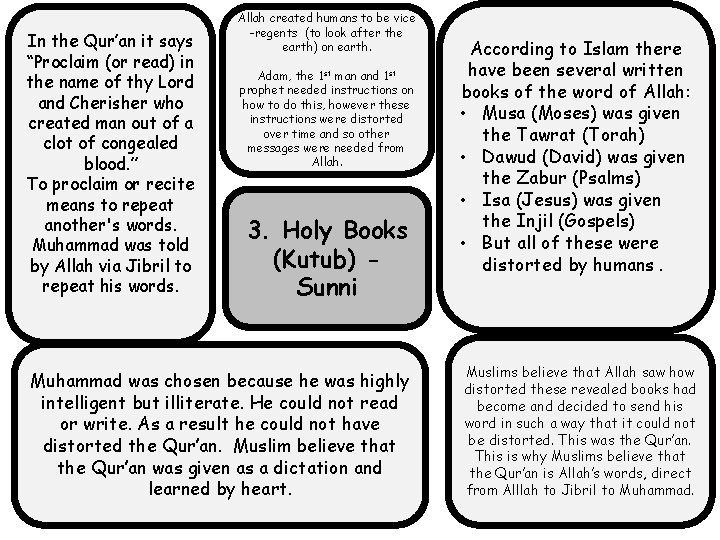
In the Qur’an it says “Proclaim (or read) in the name of thy Lord and Cherisher who created man out of a clot of congealed blood. ” To proclaim or recite means to repeat another's words. Muhammad was told by Allah via Jibril to repeat his words. Allah created humans to be vice -regents (to look after the earth) on earth. Adam, the 1 st man and 1 st prophet needed instructions on how to do this, however these instructions were distorted over time and so other messages were needed from Allah. 3. Holy Books (Kutub) Sunni Muhammad was chosen because he was highly intelligent but illiterate. He could not read or write. As a result he could not have distorted the Qur’an. Muslim believe that the Qur’an was given as a dictation and learned by heart. According to Islam there have been several written books of the word of Allah: • Musa (Moses) was given the Tawrat (Torah) • Dawud (David) was given the Zabur (Psalms) • Isa (Jesus) was given the Injil (Gospels) • But all of these were distorted by humans. Muslims believe that Allah saw how distorted these revealed books had become and decided to send his word in such a way that it could not be distorted. This was the Qur’an. This is why Muslims believe that the Qur’an is Allah’s words, direct from Alllah to Jibril to Muhammad.
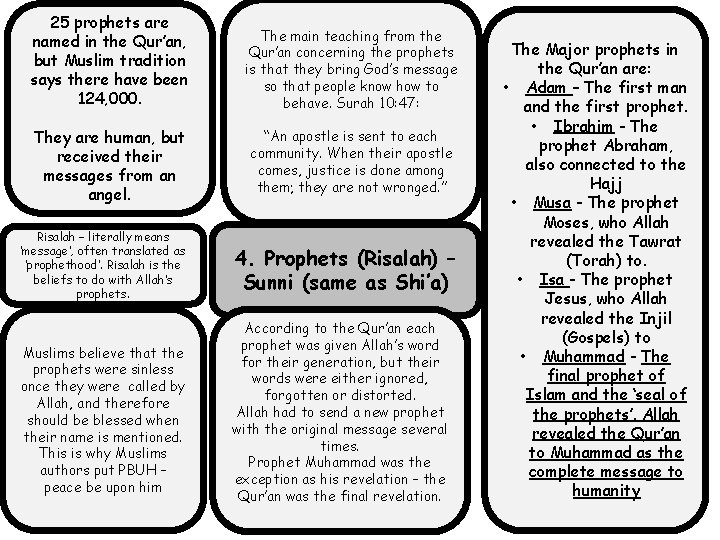
25 prophets are named in the Qur’an, but Muslim tradition says there have been 124, 000. They are human, but received their messages from an angel. Risalah – literally means ‘message’, often translated as ‘prophethood’. Risalah is the beliefs to do with Allah’s prophets. Muslims believe that the prophets were sinless once they were called by Allah, and therefore should be blessed when their name is mentioned. This is why Muslims authors put PBUH – peace be upon him The main teaching from the Qur’an concerning the prophets is that they bring God’s message so that people know how to behave. Surah 10: 47: “An apostle is sent to each community. When their apostle comes, justice is done among them; they are not wronged. ” 4. Prophets (Risalah) – Sunni (same as Shi’a) According to the Qur’an each prophet was given Allah’s word for their generation, but their words were either ignored, forgotten or distorted. Allah had to send a new prophet with the original message several times. Prophet Muhammad was the exception as his revelation – the Qur’an was the final revelation. The Major prophets in the Qur’an are: • Adam – The first man and the first prophet. • Ibrahim - The prophet Abraham, also connected to the Hajj • Musa - The prophet Moses, who Allah revealed the Tawrat (Torah) to. • Isa - The prophet Jesus, who Allah revealed the Injil (Gospels) to • Muhammad - The final prophet of Islam and the ‘seal of the prophets’. Allah revealed the Qur’an to Muhammad as the complete message to humanity
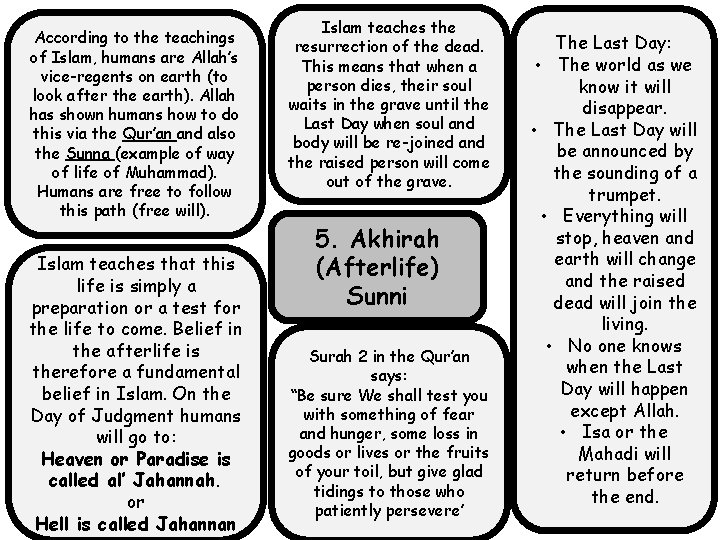
According to the teachings of Islam, humans are Allah’s vice-regents on earth (to look after the earth). Allah has shown humans how to do this via the Qur’an and also the Sunna (example of way of life of Muhammad). Humans are free to follow this path (free will). Islam teaches that this life is simply a preparation or a test for the life to come. Belief in the afterlife is therefore a fundamental belief in Islam. On the Day of Judgment humans will go to: Heaven or Paradise is called al’ Jahannah. or Hell is called Jahannan Islam teaches the resurrection of the dead. This means that when a person dies, their soul waits in the grave until the Last Day when soul and body will be re-joined and the raised person will come out of the grave. 5. Akhirah (Afterlife) Sunni Surah 2 in the Qur’an says: “Be sure We shall test you with something of fear and hunger, some loss in goods or lives or the fruits of your toil, but give glad tidings to those who patiently persevere’ The Last Day: • The world as we know it will disappear. • The Last Day will be announced by the sounding of a trumpet. • Everything will stop, heaven and earth will change and the raised dead will join the living. • No one knows when the Last Day will happen except Allah. • Isa or the Mahadi will return before the end.
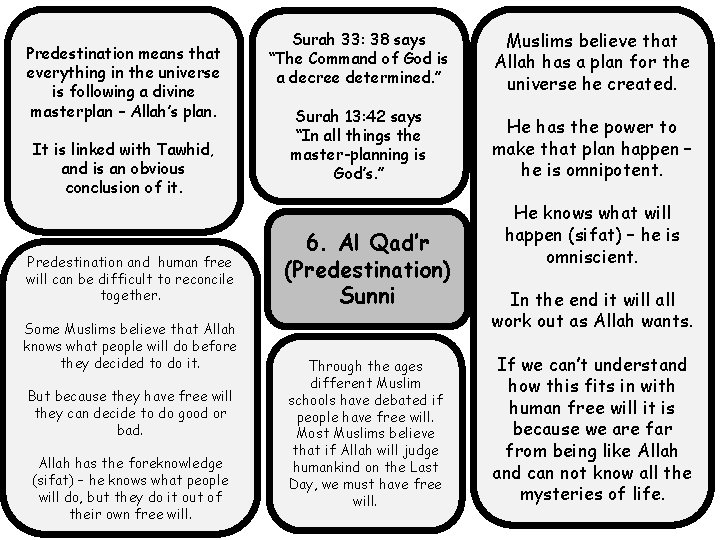
Predestination means that everything in the universe is following a divine masterplan – Allah’s plan. It is linked with Tawhid, and is an obvious conclusion of it. Predestination and human free will can be difficult to reconcile together. Some Muslims believe that Allah knows what people will do before they decided to do it. But because they have free will they can decide to do good or bad. Allah has the foreknowledge (sifat) – he knows what people will do, but they do it out of their own free will. Surah 33: 38 says “The Command of God is a decree determined. ” Muslims believe that Allah has a plan for the universe he created. Surah 13: 42 says “In all things the master-planning is God’s. ” He has the power to make that plan happen – he is omnipotent. 6. Al Qad’r (Predestination) Sunni Through the ages different Muslim schools have debated if people have free will. Most Muslims believe that if Allah will judge humankind on the Last Day, we must have free will. He knows what will happen (sifat) – he is omniscient. In the end it will all work out as Allah wants. If we can’t understand how this fits in with human free will it is because we are far from being like Allah and can not know all the mysteries of life.
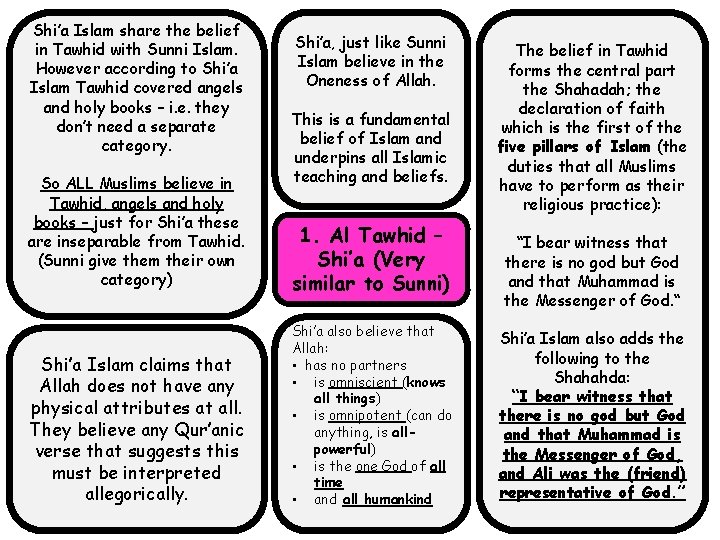
Shi’a Islam share the belief in Tawhid with Sunni Islam. However according to Shi’a Islam Tawhid covered angels and holy books – i. e. they don’t need a separate category. So ALL Muslims believe in Tawhid, angels and holy books – just for Shi’a these are inseparable from Tawhid. (Sunni give them their own category) Shi’a Islam claims that Allah does not have any physical attributes at all. They believe any Qur’anic verse that suggests this must be interpreted allegorically. Shi’a, just like Sunni Islam believe in the Oneness of Allah. This is a fundamental belief of Islam and underpins all Islamic teaching and beliefs. 1. Al Tawhid – Shi’a (Very similar to Sunni) Shi’a also believe that Allah: • has no partners • is omniscient (knows all things) • is omnipotent (can do anything, is allpowerful) • is the one God of all time • and all humankind The belief in Tawhid forms the central part the Shahadah; the declaration of faith which is the first of the five pillars of Islam (the duties that all Muslims have to perform as their religious practice): “I bear witness that there is no god but God and that Muhammad is the Messenger of God. “ Shi’a Islam also adds the following to the Shahahda: “I bear witness that there is no god but God and that Muhammad is the Messenger of God, and Ali was the (friend) representative of God. ”
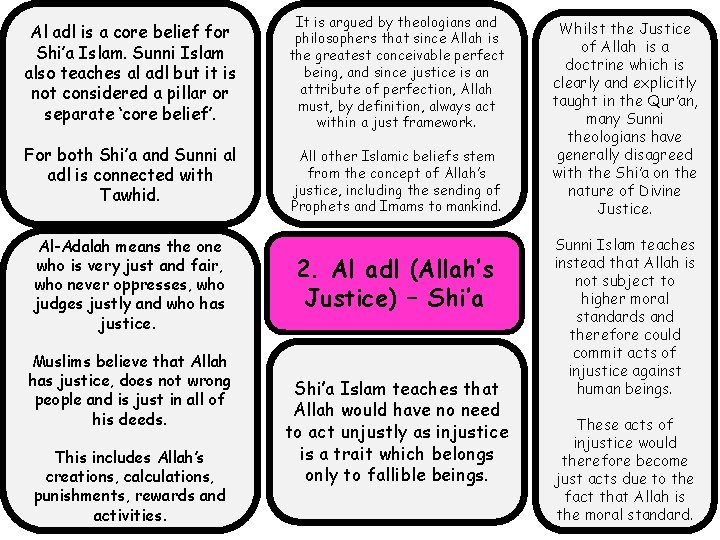
Al adl is a core belief for Shi’a Islam. Sunni Islam also teaches al adl but it is not considered a pillar or separate ‘core belief’. It is argued by theologians and philosophers that since Allah is the greatest conceivable perfect being, and since justice is an attribute of perfection, Allah must, by definition, always act within a just framework. For both Shi’a and Sunni al adl is connected with Tawhid. All other Islamic beliefs stem from the concept of Allah’s justice, including the sending of Prophets and Imams to mankind. Al-Adalah means the one who is very just and fair, who never oppresses, who judges justly and who has justice. Muslims believe that Allah has justice, does not wrong people and is just in all of his deeds. This includes Allah’s creations, calculations, punishments, rewards and activities. 2. Al adl (Allah’s Justice) – Shi’a Islam teaches that Allah would have no need to act unjustly as injustice is a trait which belongs only to fallible beings. Whilst the Justice of Allah is a doctrine which is clearly and explicitly taught in the Qur’an, many Sunni theologians have generally disagreed with the Shi’a on the nature of Divine Justice. Sunni Islam teaches instead that Allah is not subject to higher moral standards and therefore could commit acts of injustice against human beings. These acts of injustice would therefore become just acts due to the fact that Allah is the moral standard.
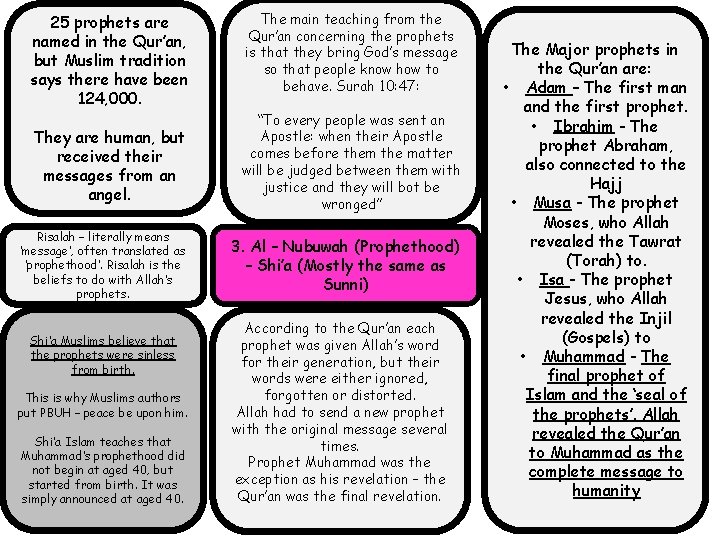
25 prophets are named in the Qur’an, but Muslim tradition says there have been 124, 000. The main teaching from the Qur’an concerning the prophets is that they bring God’s message so that people know how to behave. Surah 10: 47: They are human, but received their messages from an angel. “To every people was sent an Apostle: when their Apostle comes before them the matter will be judged between them with justice and they will bot be wronged” Risalah – literally means ‘message’, often translated as ‘prophethood’. Risalah is the beliefs to do with Allah’s prophets. 3. Al – Nubuwah (Prophethood) – Shi’a (Mostly the same as Sunni) Shi’a Muslims believe that the prophets were sinless from birth. This is why Muslims authors put PBUH – peace be upon him. Shi’a Islam teaches that Muhammad’s prophethood did not begin at aged 40, but started from birth. It was simply announced at aged 40. According to the Qur’an each prophet was given Allah’s word for their generation, but their words were either ignored, forgotten or distorted. Allah had to send a new prophet with the original message several times. Prophet Muhammad was the exception as his revelation – the Qur’an was the final revelation. The Major prophets in the Qur’an are: • Adam – The first man and the first prophet. • Ibrahim - The prophet Abraham, also connected to the Hajj • Musa - The prophet Moses, who Allah revealed the Tawrat (Torah) to. • Isa - The prophet Jesus, who Allah revealed the Injil (Gospels) to • Muhammad - The final prophet of Islam and the ‘seal of the prophets’. Allah revealed the Qur’an to Muhammad as the complete message to humanity
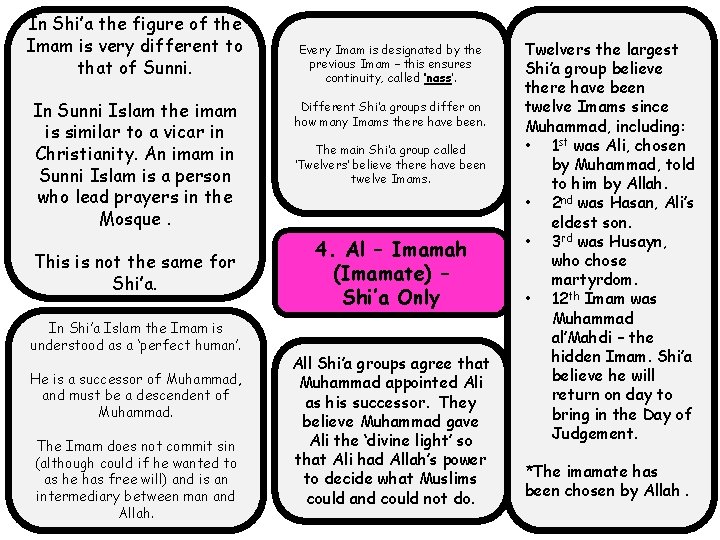
In Shi’a the figure of the Imam is very different to that of Sunni. Every Imam is designated by the previous Imam – this ensures continuity, called ‘nass’. In Sunni Islam the imam is similar to a vicar in Christianity. An imam in Sunni Islam is a person who lead prayers in the Mosque. The main Shi’a group called ‘Twelvers’ believe there have been twelve Imams. This is not the same for Shi’a. 4. Al – Imamah (Imamate) – Shi’a Only In Shi’a Islam the Imam is understood as a ‘perfect human’. He is a successor of Muhammad, and must be a descendent of Muhammad. The Imam does not commit sin (although could if he wanted to as he has free will) and is an intermediary between man and Allah. Different Shi’a groups differ on how many Imams there have been. All Shi’a groups agree that Muhammad appointed Ali as his successor. They believe Muhammad gave Ali the ‘divine light’ so that Ali had Allah’s power to decide what Muslims could and could not do. Twelvers the largest Shi’a group believe there have been twelve Imams since Muhammad, including: • 1 st was Ali, chosen by Muhammad, told to him by Allah. • 2 nd was Hasan, Ali’s eldest son. • 3 rd was Husayn, who chose martyrdom. • 12 th Imam was Muhammad al’Mahdi – the hidden Imam. Shi’a believe he will return on day to bring in the Day of Judgement. *The imamate has been chosen by Allah.
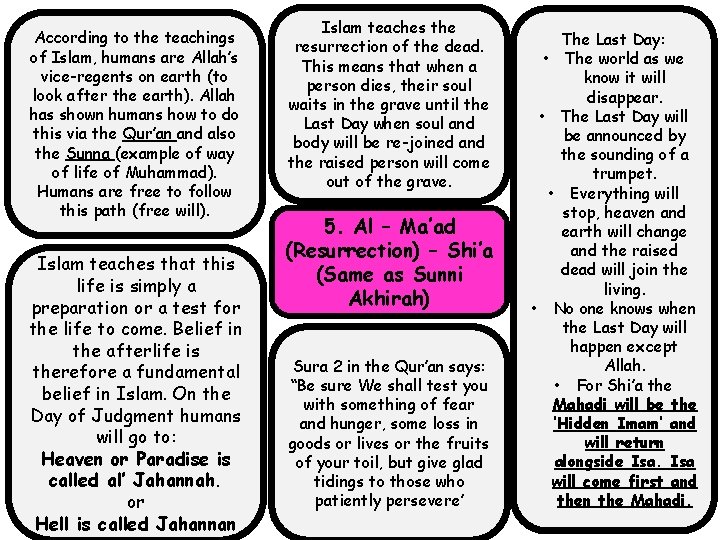
According to the teachings of Islam, humans are Allah’s vice-regents on earth (to look after the earth). Allah has shown humans how to do this via the Qur’an and also the Sunna (example of way of life of Muhammad). Humans are free to follow this path (free will). Islam teaches that this life is simply a preparation or a test for the life to come. Belief in the afterlife is therefore a fundamental belief in Islam. On the Day of Judgment humans will go to: Heaven or Paradise is called al’ Jahannah. or Hell is called Jahannan Islam teaches the resurrection of the dead. This means that when a person dies, their soul waits in the grave until the Last Day when soul and body will be re-joined and the raised person will come out of the grave. 5. Al – Ma’ad (Resurrection) – Shi’a (Same as Sunni Akhirah) Sura 2 in the Qur’an says: “Be sure We shall test you with something of fear and hunger, some loss in goods or lives or the fruits of your toil, but give glad tidings to those who patiently persevere’ The Last Day: • The world as we know it will disappear. • The Last Day will be announced by the sounding of a trumpet. • Everything will stop, heaven and earth will change and the raised dead will join the living. • No one knows when the Last Day will happen except Allah. • For Shi’a the Mahadi will be the ‘Hidden Imam’ and will return alongside Isa will come first and then the Mahadi.
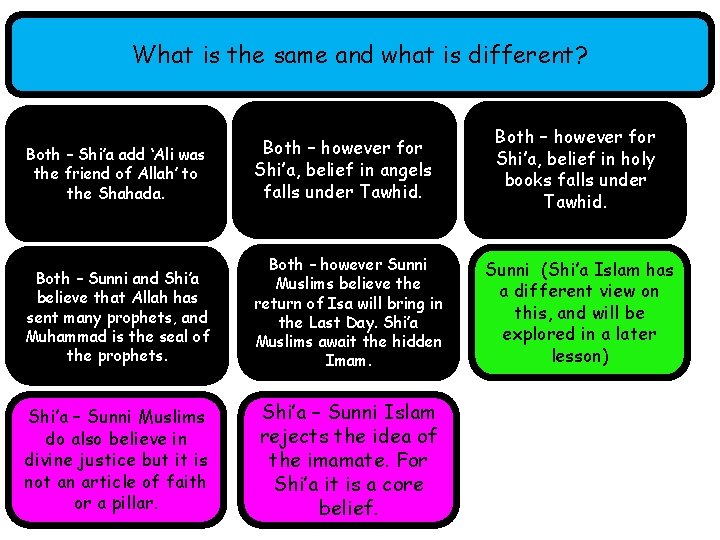
What is the same and what is different? Both – however for Shi’a, belief in holy books falls under Tawhid. Both – Shi’a add ‘Ali was the friend of Allah’ to the Shahada. Both – however for Shi’a, belief in angels falls under Tawhid. Angels Holy Books Both – Sunni and Shi’a believe that Allah has sent many prophets, and Muhammad is the seal of the prophets. Prophethood Both – however Sunni Muslims believe the return of Isa will bring in the Last Day. Shi’a Muslims await the hidden Imam. Sunni (Shi’a Islam has a different view on this, and will be Predestination explored in a later lesson) Shi’a – Sunni Muslims do also believe in divine justice but it is not an article of faith or a pillar. Shi’a – Sunni Islam rejects the idea of the imamate. For Shi’a it is a core belief. Tawhid Divine Justice Afterlife Imamate
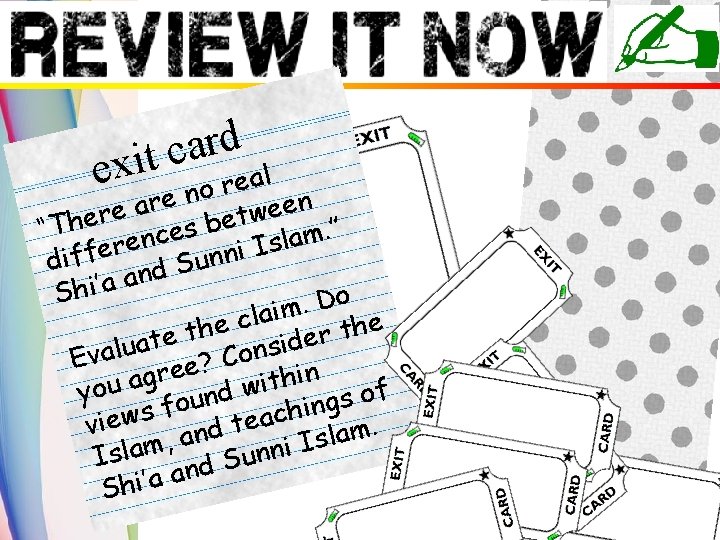
d r a c exit l a e r no e n r e a e e w r “The ences bet lam. ” s r I e i f n i u d S d an a ’ i h S o D. m ai l c e e h h t t r e e t d a i s u l n a o C Ev ? e n re i g h a t i u w f yo d o n s u g o n f i h s c w a e e i t v. d m n a l a s , I m i a n l n s u I S d an a ’ i h S
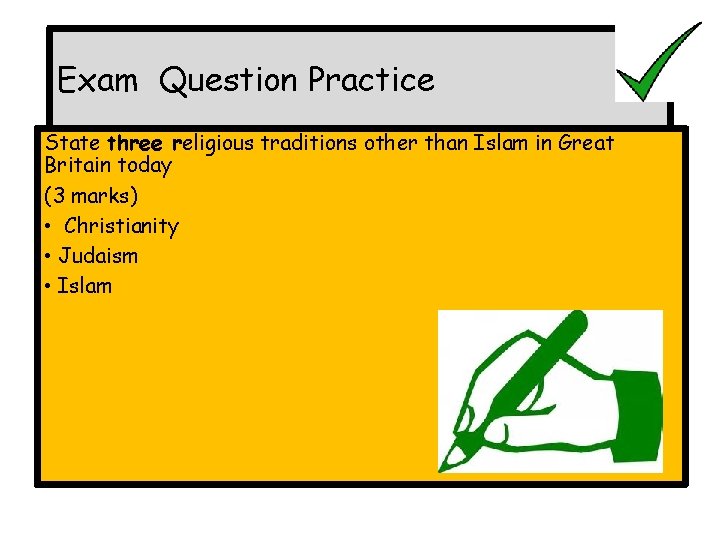
Exam Question Practice State three religious traditions other than Islam in Great Britain today (3 marks) • Christianity • Judaism • Islam
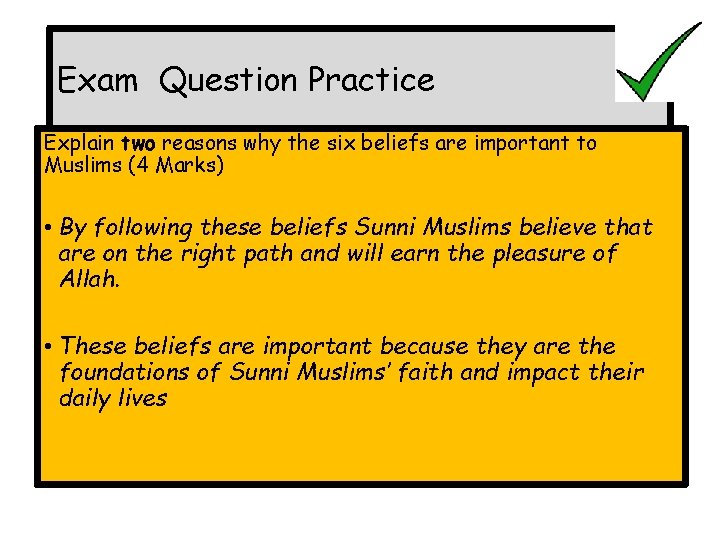
Exam Question Practice Explain two reasons why the six beliefs are important to Muslims (4 Marks) • By following these beliefs Sunni Muslims believe that are on the right path and will earn the pleasure of Allah. • These beliefs are important because they are the foundations of Sunni Muslims’ faith and impact their daily lives