
The Sirens Siren Boeotian blackfigure dish ca 570
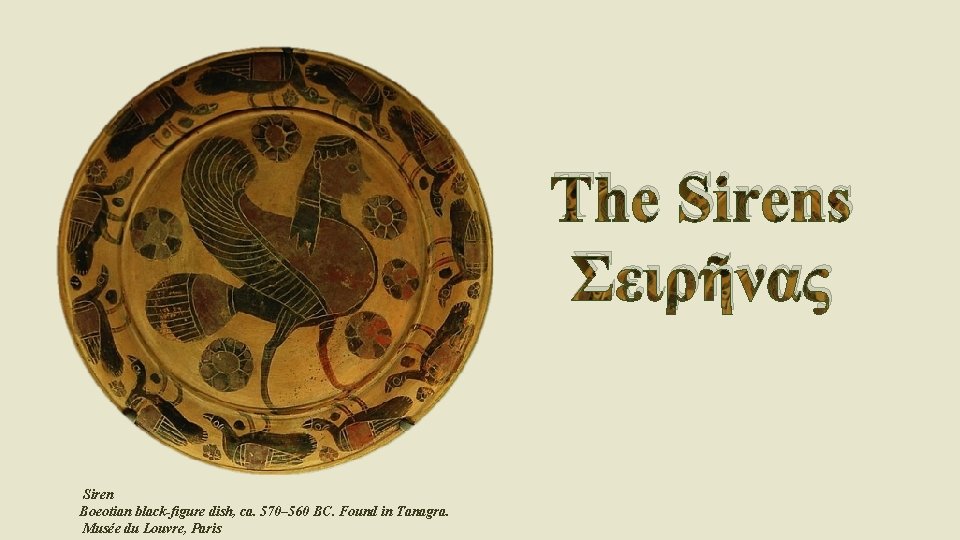
The Sirens Σειρῆνας Siren Boeotian black-figure dish, ca. 570– 560 BC. Found in Tanagra. Musée du Louvre, Paris
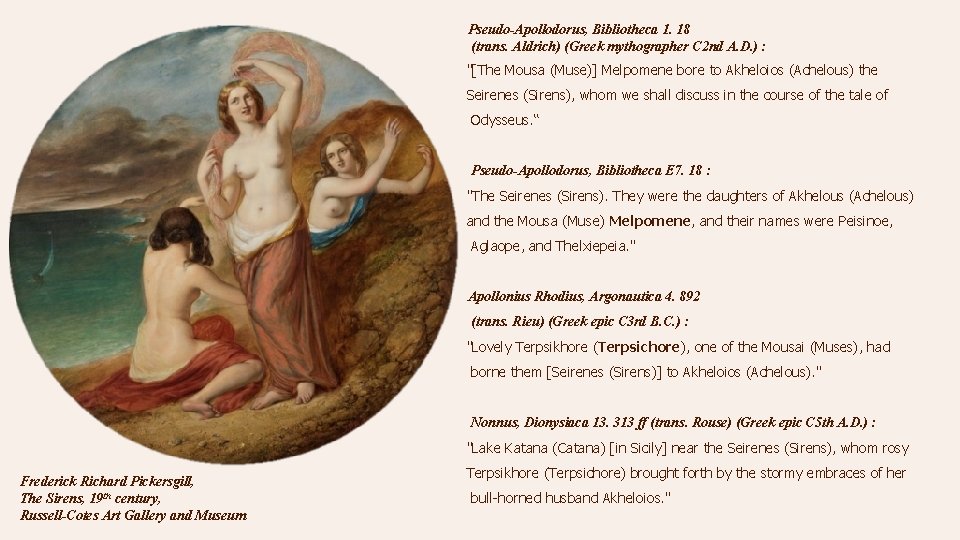
Pseudo-Apollodorus, Bibliotheca 1. 18 (trans. Aldrich) (Greek mythographer C 2 nd A. D. ) : "[The Mousa (Muse)] Melpomene bore to Akheloios (Achelous) the Seirenes (Sirens), whom we shall discuss in the course of the tale of Odysseus. “ Pseudo-Apollodorus, Bibliotheca E 7. 18 : "The Seirenes (Sirens). They were the daughters of Akhelous (Achelous) and the Mousa (Muse) Melpomene, and their names were Peisinoe, Aglaope, and Thelxiepeia. " Apollonius Rhodius, Argonautica 4. 892 (trans. Rieu) (Greek epic C 3 rd B. C. ) : "Lovely Terpsikhore (Terpsichore), one of the Mousai (Muses), had borne them [Seirenes (Sirens)] to Akheloios (Achelous). " Nonnus, Dionysiaca 13. 313 ff (trans. Rouse) (Greek epic C 5 th A. D. ) : "Lake Katana (Catana) [in Sicily] near the Seirenes (Sirens), whom rosy Frederick Richard Pickersgill, The Sirens, 19 th century, Russell-Cotes Art Gallery and Museum Terpsikhore (Terpsichore) brought forth by the stormy embraces of her bull-horned husband Akheloios. "
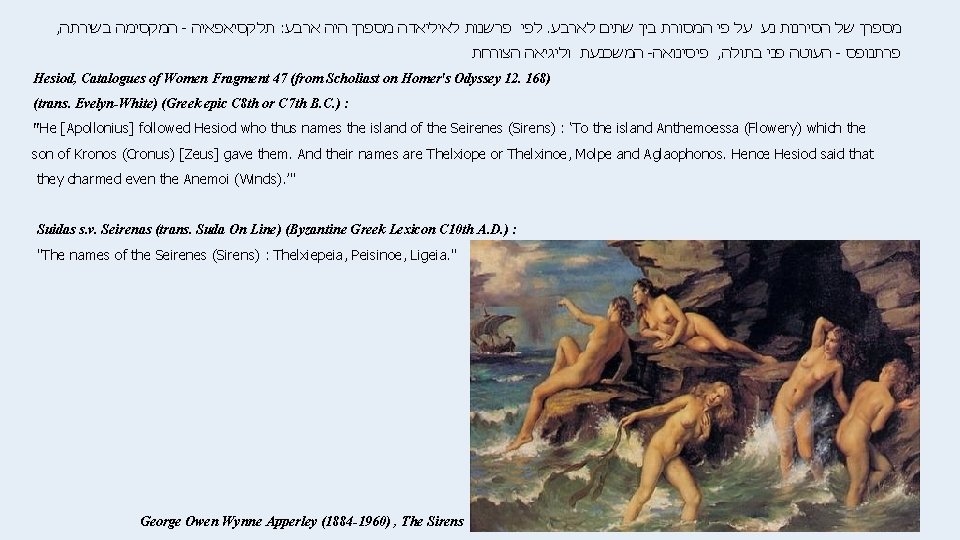
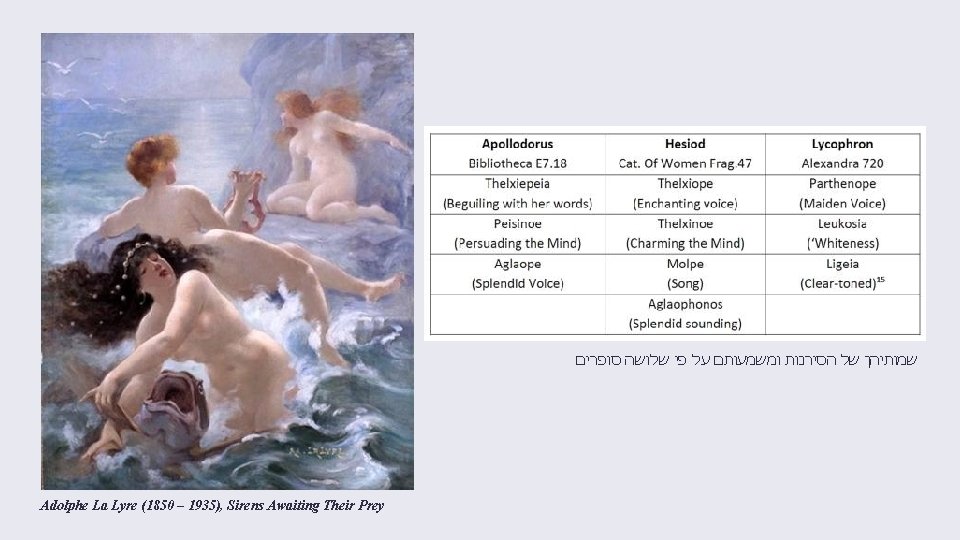
, המקסימה בשירתה - תלקסיאפאיה : לפי פרשנות לאיליאדה מספרן היה ארבע. מספרן של הסירנות נע על פי המסורת בין שתים לארבע המשכנעת וליגיאה הצורחת - פיסינואה , העוטה פני בתולה - פרתנופס Hesiod, Catalogues of Women Fragment 47 (from Scholiast on Homer's Odyssey 12. 168) (trans. Evelyn-White) (Greek epic C 8 th or C 7 th B. C. ) : "He [Apollonius] followed Hesiod who thus names the island of the Seirenes (Sirens) : ‘To the island Anthemoessa (Flowery) which the son of Kronos (Cronus) [Zeus] gave them. And their names are Thelxiope or Thelxinoe, Molpe and Aglaophonos. Hence Hesiod said that they charmed even the Anemoi (Winds). ’" Suidas s. v. Seirenas (trans. Suda On Line) (Byzantine Greek Lexicon C 10 th A. D. ) : "The names of the Seirenes (Sirens) : Thelxiepeia, Peisinoe, Ligeia. " George Owen Wynne Apperley (1884 -1960) , The Sirens
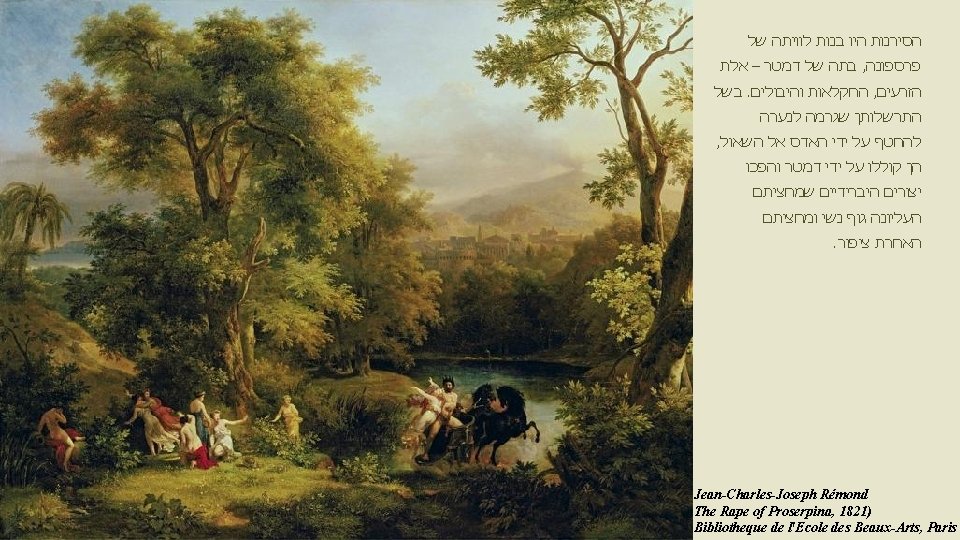
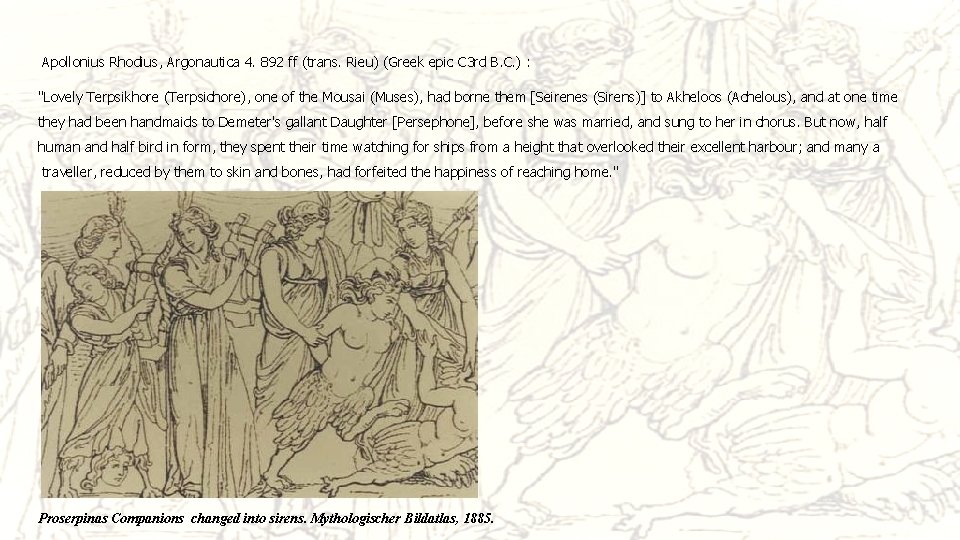
Apollonius Rhodius, Argonautica 4. 892 ff (trans. Rieu) (Greek epic C 3 rd B. C. ) : "Lovely Terpsikhore (Terpsichore), one of the Mousai (Muses), had borne them [Seirenes (Sirens)] to Akheloos (Achelous), and at one time they had been handmaids to Demeter's gallant Daughter [Persephone], before she was married, and sung to her in chorus. But now, half human and half bird in form, they spent their time watching for ships from a height that overlooked their excellent harbour; and many a traveller, reduced by them to skin and bones, had forfeited the happiness of reaching home. " Proserpinas Companions changed into sirens. Mythologischer Bildatlas, 1885.
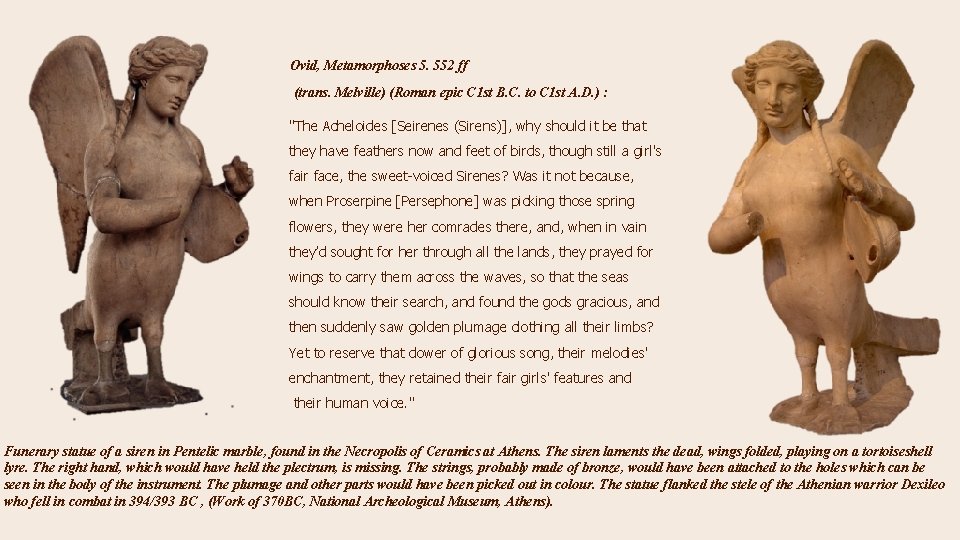
Ovid, Metamorphoses 5. 552 ff (trans. Melville) (Roman epic C 1 st B. C. to C 1 st A. D. ) : "The Acheloides [Seirenes (Sirens)], why should it be that they have feathers now and feet of birds, though still a girl's fair face, the sweet-voiced Sirenes? Was it not because, when Proserpine [Persephone] was picking those spring flowers, they were her comrades there, and, when in vain they’d sought for her through all the lands, they prayed for wings to carry them across the waves, so that the seas should know their search, and found the gods gracious, and then suddenly saw golden plumage clothing all their limbs? Yet to reserve that dower of glorious song, their melodies' enchantment, they retained their fair girls' features and their human voice. " Funerary statue of a siren in Pentelic marble, found in the Necropolis of Ceramics at Athens. The siren laments the dead, wings folded, playing on a tortoiseshell lyre. The right hand, which would have held the plectrum, is missing. The strings, probably made of bronze, would have been attached to the holes which can be seen in the body of the instrument. The plumage and other parts would have been picked out in colour. The statue flanked the stele of the Athenian warrior Dexileo who fell in combat in 394/393 BC , (Work of 370 BC, National Archeological Museum, Athens).
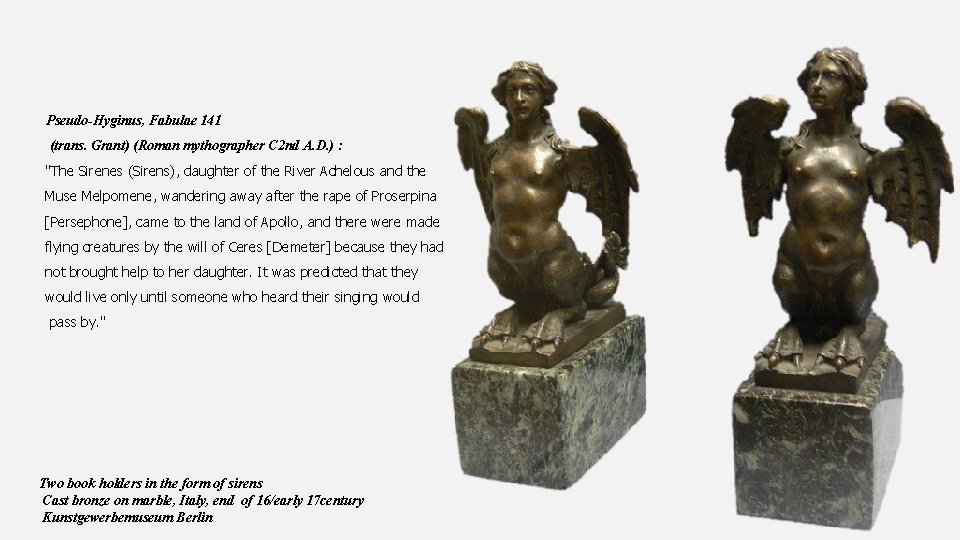
Pseudo-Hyginus, Fabulae 141 (trans. Grant) (Roman mythographer C 2 nd A. D. ) : "The Sirenes (Sirens), daughter of the River Achelous and the Muse Melpomene, wandering away after the rape of Proserpina [Persephone], came to the land of Apollo, and there were made flying creatures by the will of Ceres [Demeter] because they had not brought help to her daughter. It was predicted that they would live only until someone who heard their singing would pass by. " Two book holders in the form of sirens Cast bronze on marble, Italy, end of 16/early 17 century Kunstgewerbemuseum Berlin
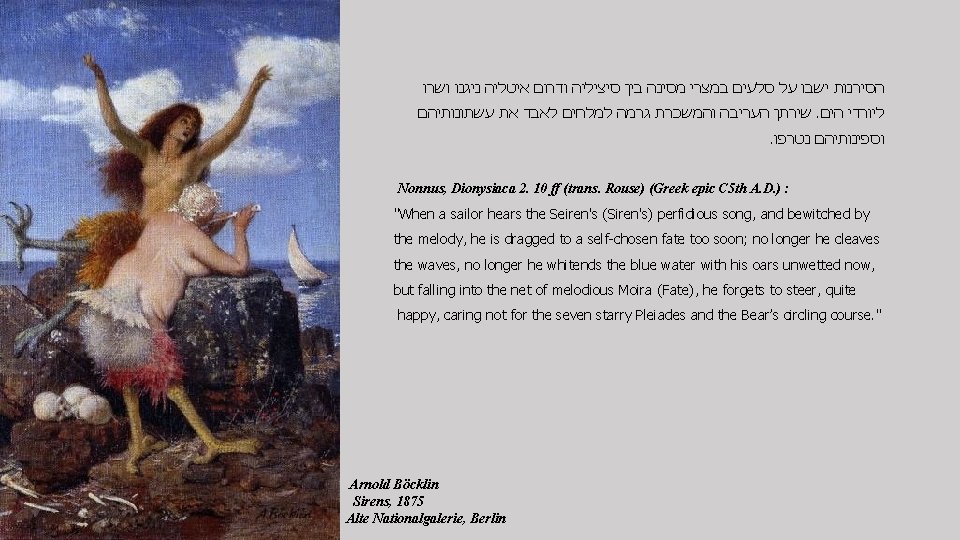
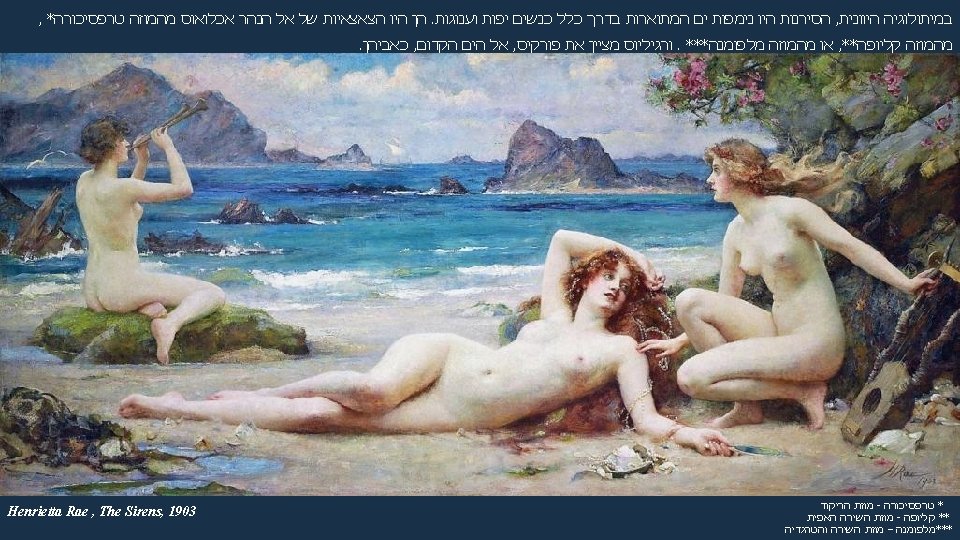
הסירנות ישבו על סלעים במצרי מסינה בין סיציליה ודרום איטליה ניגנו ושרו שירתן העריבה והמשכרת גרמה למלחים לאבד את עשתונותיהם. ליורדי הים . וספינותיהם נטרפו Nonnus, Dionysiaca 2. 10 ff (trans. Rouse) (Greek epic C 5 th A. D. ) : "When a sailor hears the Seiren's (Siren's) perfidious song, and bewitched by the melody, he is dragged to a self-chosen fate too soon; no longer he cleaves the waves, no longer he whitends the blue water with his oars unwetted now, but falling into the net of melodious Moira (Fate), he forgets to steer, quite happy, caring not for the seven starry Pleiades and the Bear’s circling course. " Arnold Böcklin Sirens, 1875 Alte Nationalgalerie, Berlin
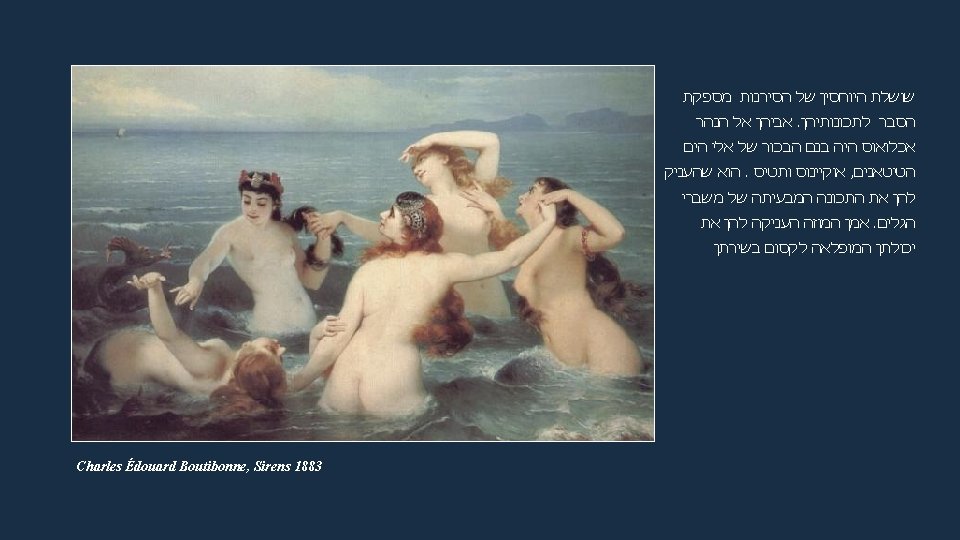
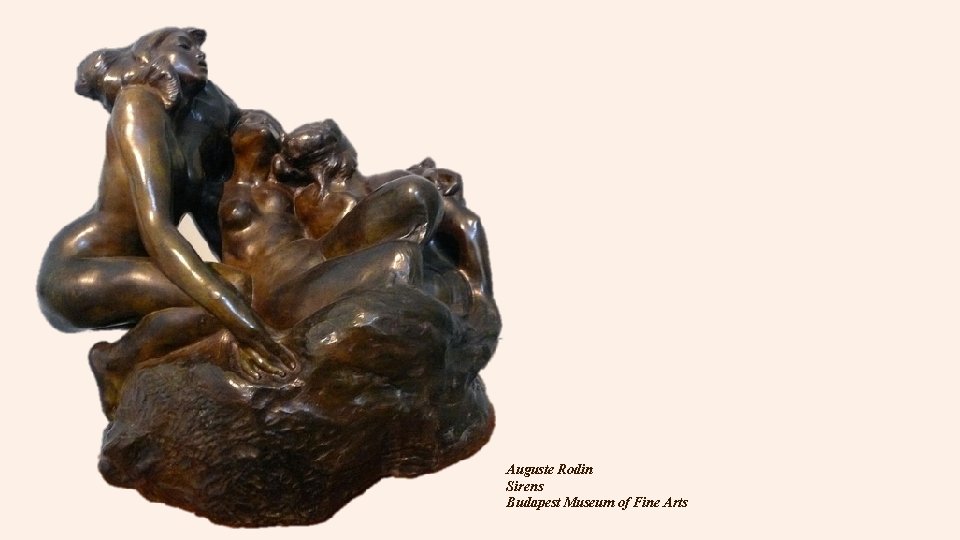
Auguste Rodin Sirens Budapest Museum of Fine Arts
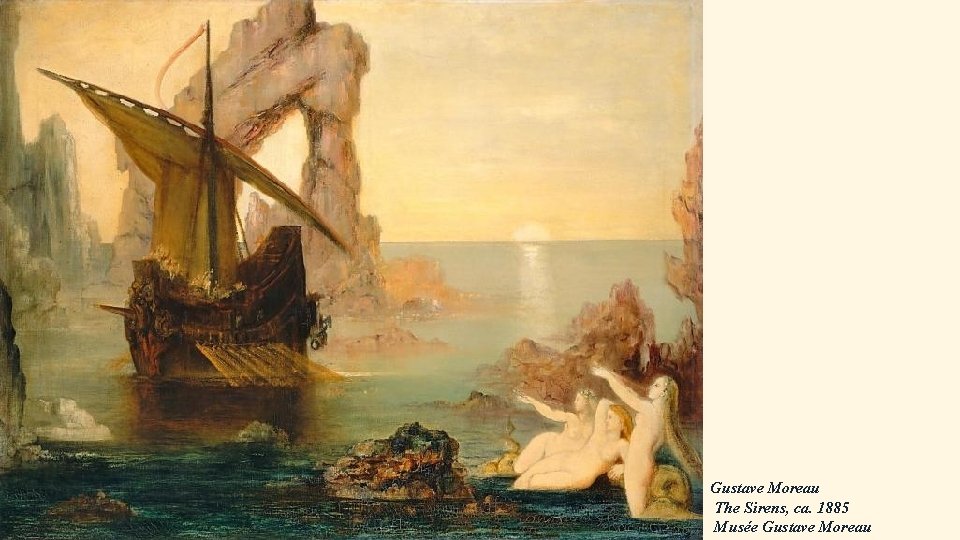
Gustave Moreau The Sirens, ca. 1885 Musée Gustave Moreau
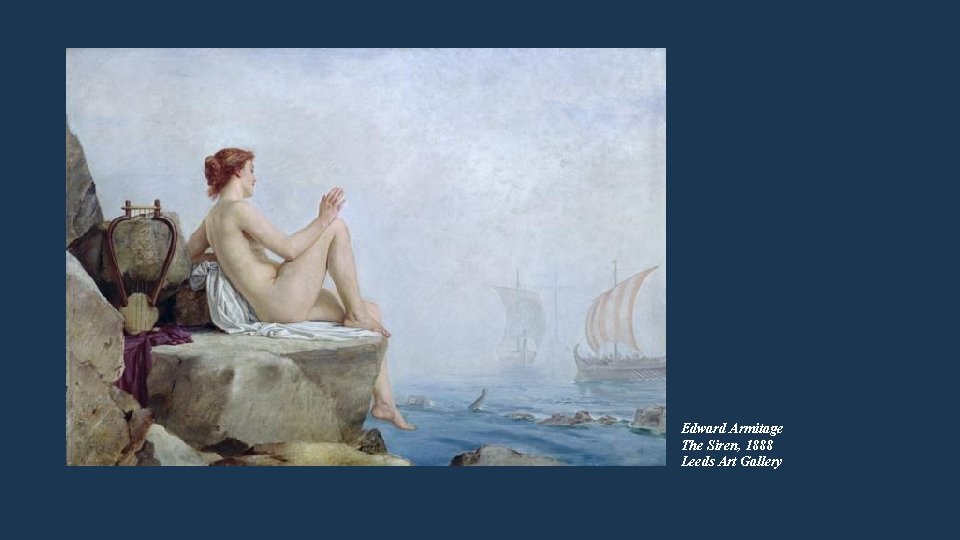
Edward Armitage The Siren, 1888 Leeds Art Gallery
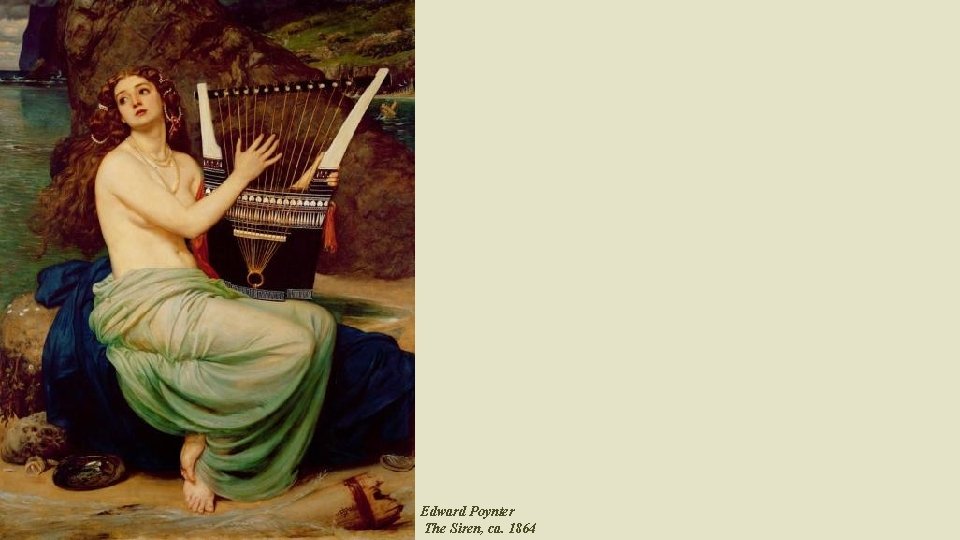
Edward Poynter The Siren, ca. 1864
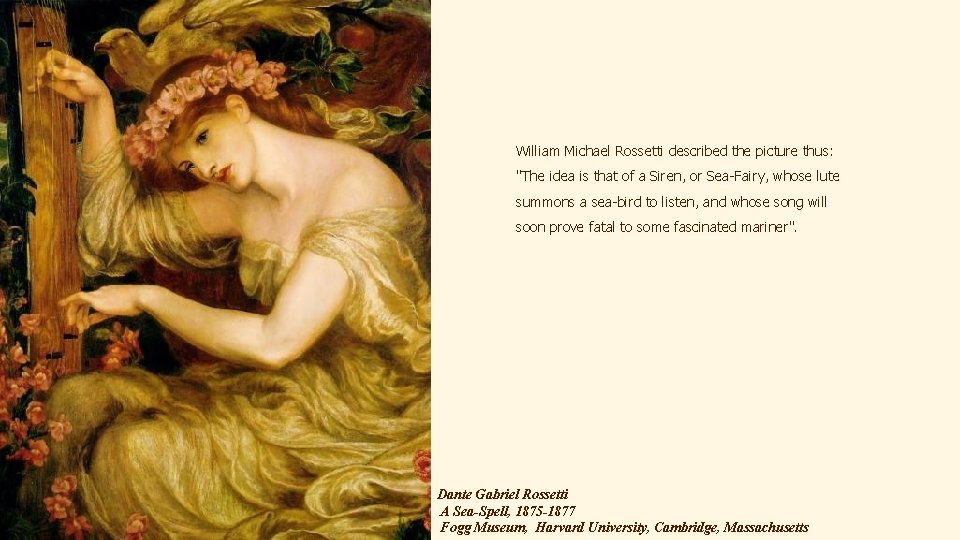
William Michael Rossetti described the picture thus: "The idea is that of a Siren, or Sea-Fairy, whose lute summons a sea-bird to listen, and whose song will soon prove fatal to some fascinated mariner". Dante Gabriel Rossetti A Sea-Spell, 1875 -1877 Fogg Museum, Harvard University, Cambridge, Massachusetts
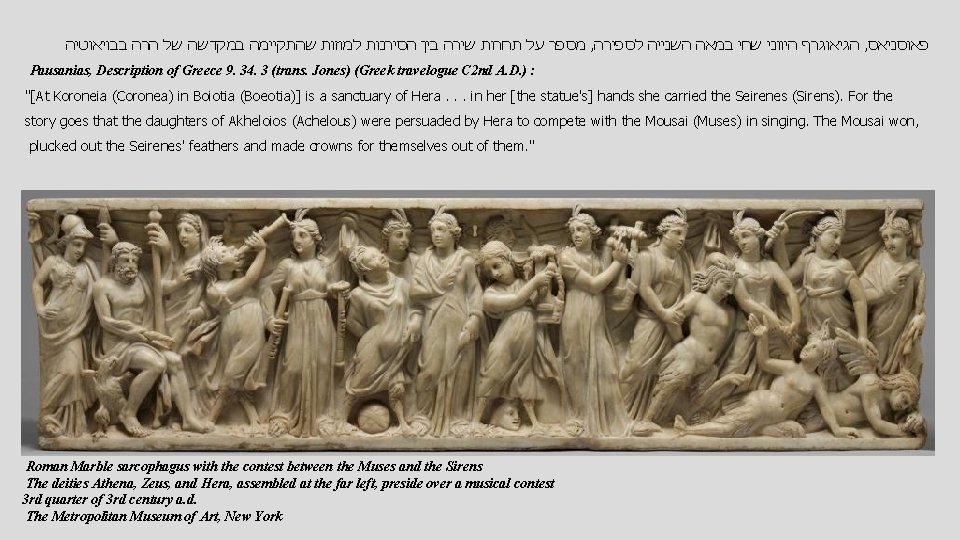
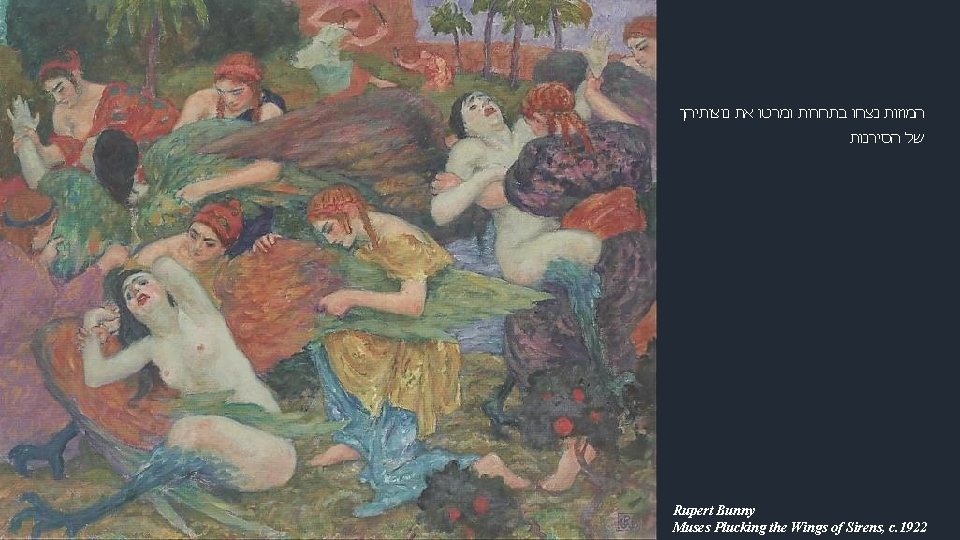
מספר על תחרות שירה בין הסירנות למוזות שהתקיימה במקדשה של הרה בבויאוטיה , הגיאוגרף היווני שחי במאה השנייה לספירה , פאוסניאס Pausanias, Description of Greece 9. 34. 3 (trans. Jones) (Greek travelogue C 2 nd A. D. ) : "[At Koroneia (Coronea) in Boiotia (Boeotia)] is a sanctuary of Hera. . . in her [the statue's] hands she carried the Seirenes (Sirens). For the story goes that the daughters of Akheloios (Achelous) were persuaded by Hera to compete with the Mousai (Muses) in singing. The Mousai won, plucked out the Seirenes' feathers and made crowns for themselves out of them. " Roman Marble sarcophagus with the contest between the Muses and the Sirens The deities Athena, Zeus, and Hera, assembled at the far left, preside over a musical contest 3 rd quarter of 3 rd century a. d. The Metropolitan Museum of Art, New York
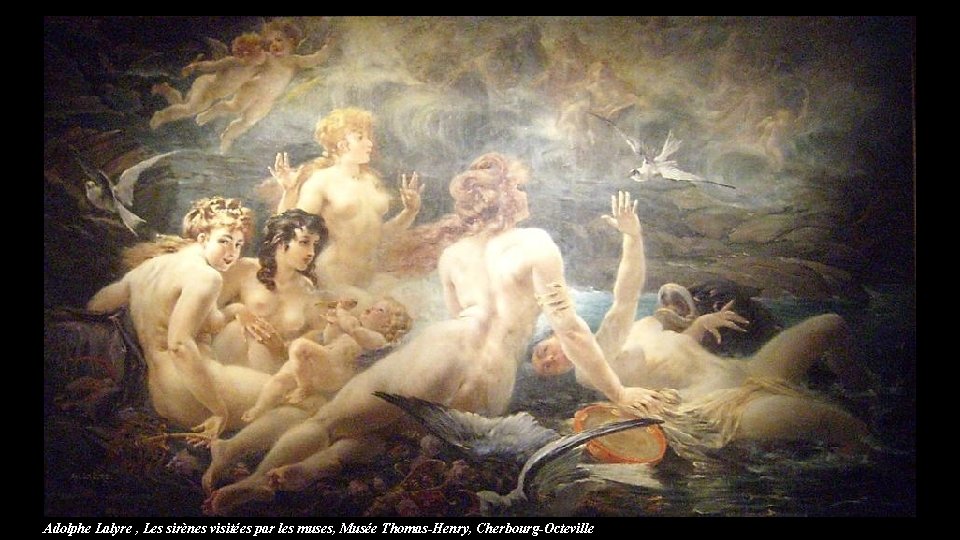
Adolphe Lalyre , Les sirènes visitées par les muses, Musée Thomas-Henry, Cherbourg-Octeville
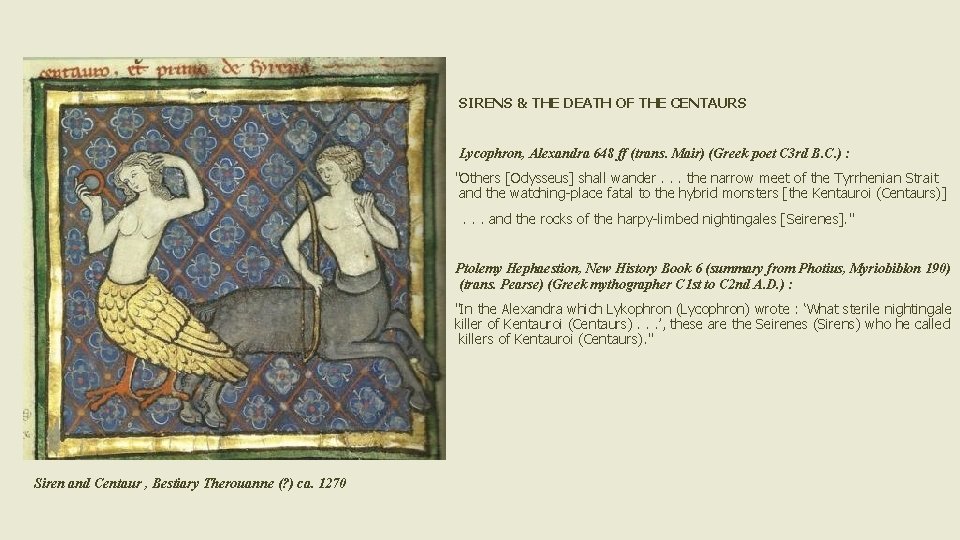
SIRENS & THE DEATH OF THE CENTAURS Lycophron, Alexandra 648 ff (trans. Mair) (Greek poet C 3 rd B. C. ) : "Others [Odysseus] shall wander. . . the narrow meet of the Tyrrhenian Strait and the watching-place fatal to the hybrid monsters [the Kentauroi (Centaurs)]. . . and the rocks of the harpy-limbed nightingales [Seirenes]. " Ptolemy Hephaestion, New History Book 6 (summary from Photius, Myriobiblon 190) (trans. Pearse) (Greek mythographer C 1 st to C 2 nd A. D. ) : "In the Alexandra which Lykophron (Lycophron) wrote : ‘What sterile nightingale killer of Kentauroi (Centaurs). . . ’, these are the Seirenes (Sirens) who he called killers of Kentauroi (Centaurs). " Siren and Centaur , Bestiary Therouanne (? ) ca. 1270
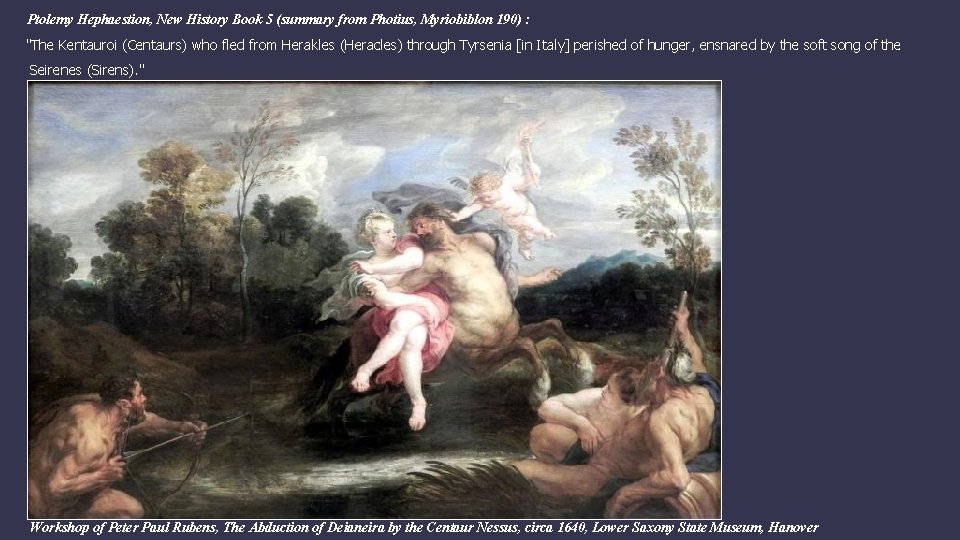
Ptolemy Hephaestion, New History Book 5 (summary from Photius, Myriobiblon 190) : "The Kentauroi (Centaurs) who fled from Herakles (Heracles) through Tyrsenia [in Italy] perished of hunger, ensnared by the soft song of the Seirenes (Sirens). " Workshop of Peter Paul Rubens, The Abduction of Deianeira by the Centaur Nessus, circa 1640, Lower Saxony State Museum, Hanover
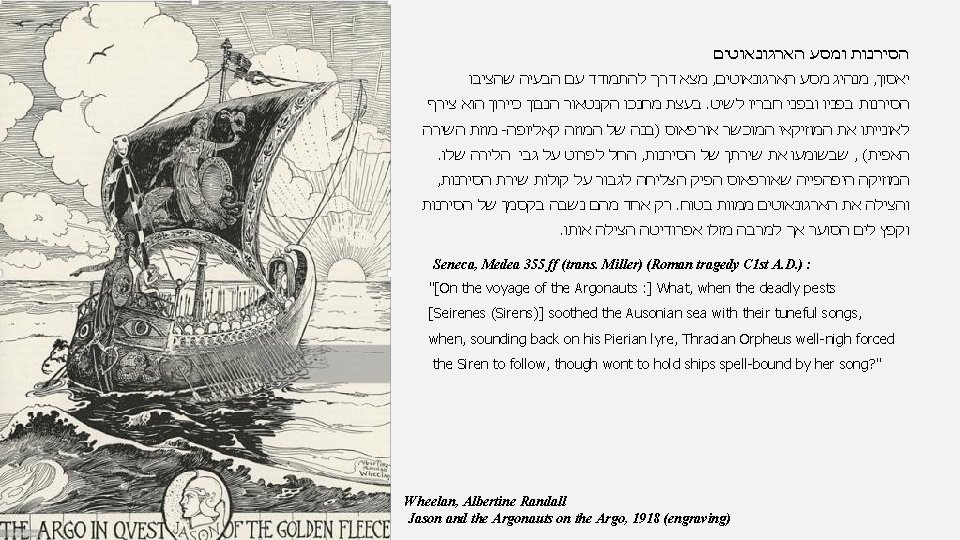
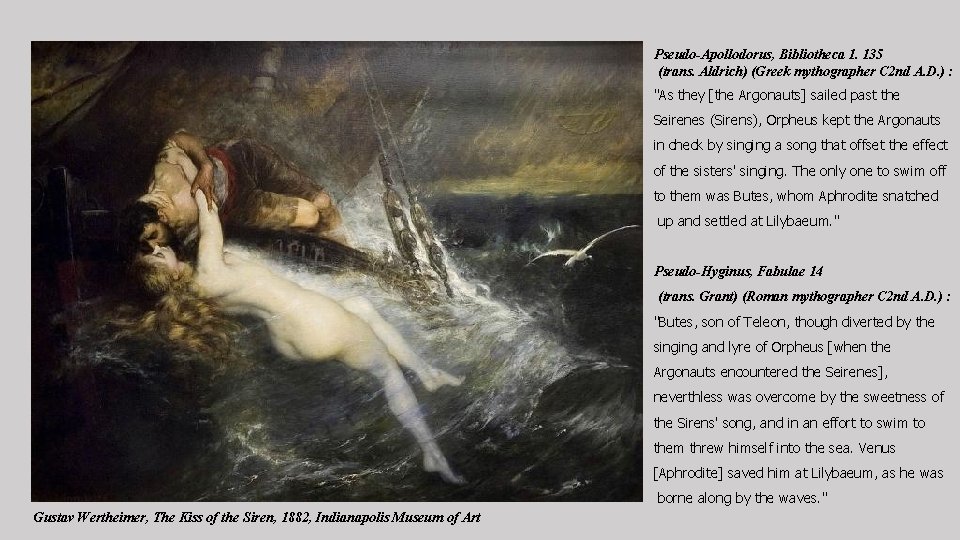
Pseudo-Apollodorus, Bibliotheca 1. 135 (trans. Aldrich) (Greek mythographer C 2 nd A. D. ) : "As they [the Argonauts] sailed past the Seirenes (Sirens), Orpheus kept the Argonauts in check by singing a song that offset the effect of the sisters' singing. The only one to swim off to them was Butes, whom Aphrodite snatched up and settled at Lilybaeum. " Pseudo-Hyginus, Fabulae 14 (trans. Grant) (Roman mythographer C 2 nd A. D. ) : "Butes, son of Teleon, though diverted by the singing and lyre of Orpheus [when the Argonauts encountered the Seirenes], neverthless was overcome by the sweetness of the Sirens' song, and in an effort to swim to them threw himself into the sea. Venus [Aphrodite] saved him at Lilybaeum, as he was borne along by the waves. " Gustav Wertheimer, The Kiss of the Siren, 1882, Indianapolis Museum of Art
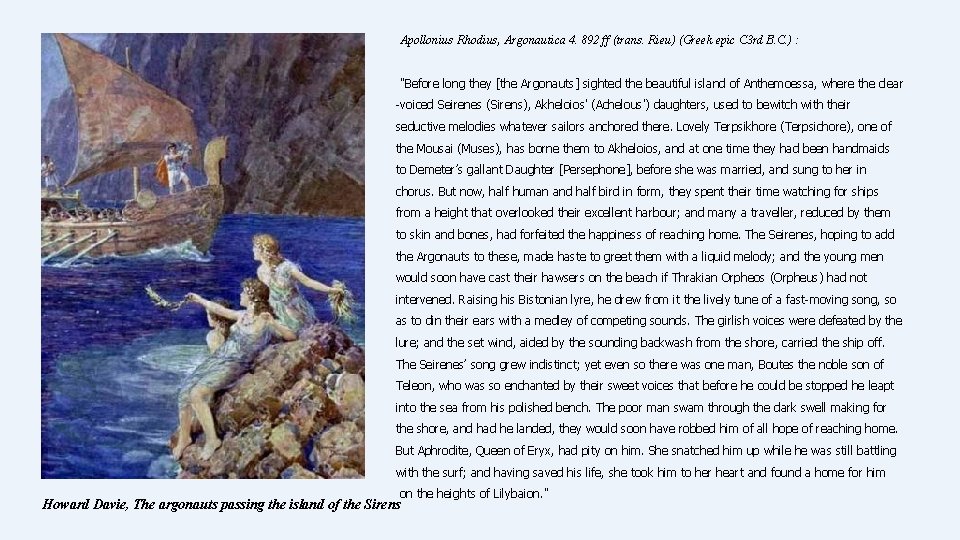
Apollonius Rhodius, Argonautica 4. 892 ff (trans. Rieu) (Greek epic C 3 rd B. C. ) : "Before long they [the Argonauts] sighted the beautiful island of Anthemoessa, where the clear -voiced Seirenes (Sirens), Akheloios' (Achelous') daughters, used to bewitch with their seductive melodies whatever sailors anchored there. Lovely Terpsikhore (Terpsichore), one of the Mousai (Muses), has borne them to Akheloios, and at one time they had been handmaids to Demeter’s gallant Daughter [Persephone], before she was married, and sung to her in chorus. But now, half human and half bird in form, they spent their time watching for ships from a height that overlooked their excellent harbour; and many a traveller, reduced by them to skin and bones, had forfeited the happiness of reaching home. The Seirenes, hoping to add the Argonauts to these, made haste to greet them with a liquid melody; and the young men would soon have cast their hawsers on the beach if Thrakian Orpheos (Orpheus) had not intervened. Raising his Bistonian lyre, he drew from it the lively tune of a fast-moving song, so as to din their ears with a medley of competing sounds. The girlish voices were defeated by the lure; and the set wind, aided by the sounding backwash from the shore, carried the ship off. The Seirenes’ song grew indistinct; yet even so there was one man, Boutes the noble son of Teleon, who was so enchanted by their sweet voices that before he could be stopped he leapt into the sea from his polished bench. The poor man swam through the dark swell making for the shore, and had he landed, they would soon have robbed him of all hope of reaching home. But Aphrodite, Queen of Eryx, had pity on him. She snatched him up while he was still battling with the surf; and having saved his life, she took him to her heart and found a home for him on the heights of Lilybaion. " Howard Davie, The argonauts passing the island of the Sirens
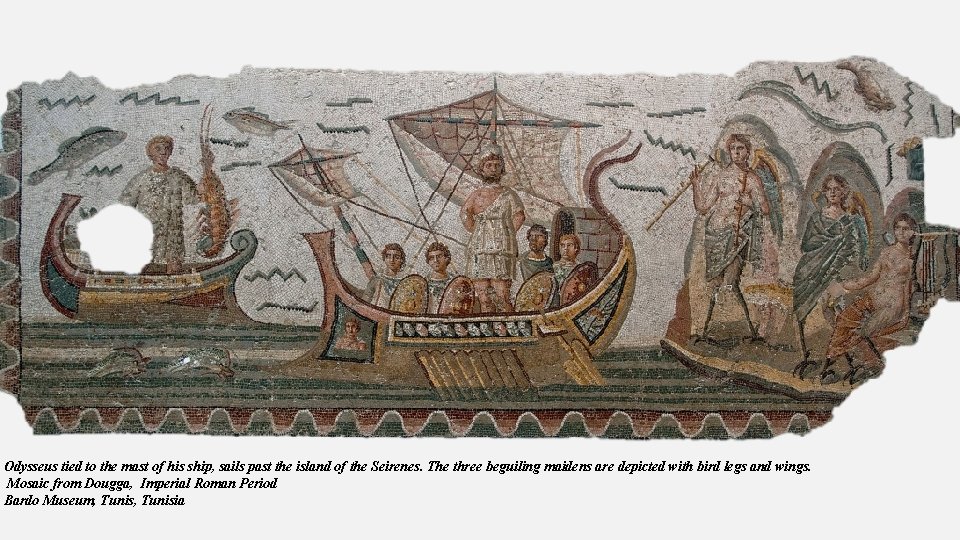
Odysseus tied to the mast of his ship, sails past the island of the Seirenes. The three beguiling maidens are depicted with bird legs and wings. Mosaic from Dougga, Imperial Roman Period Bardo Museum, Tunisia
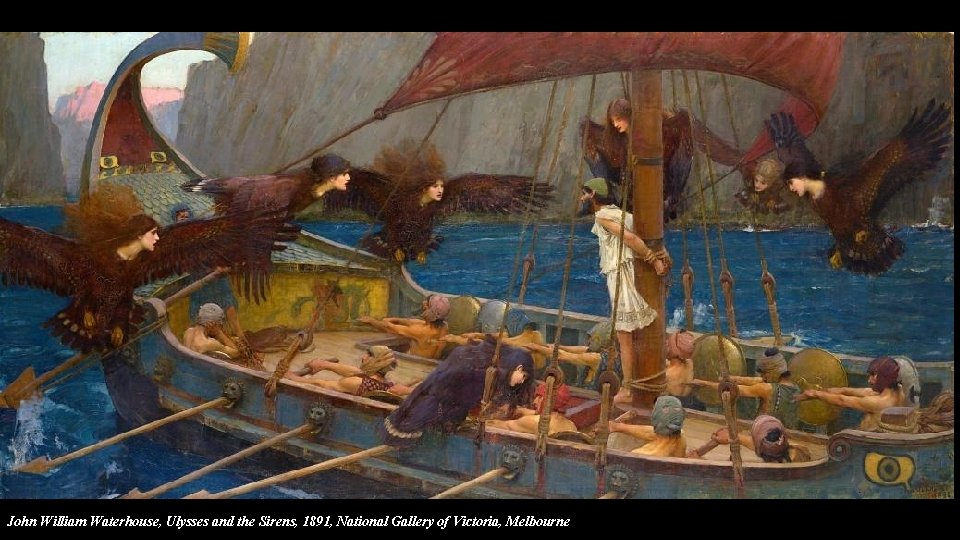
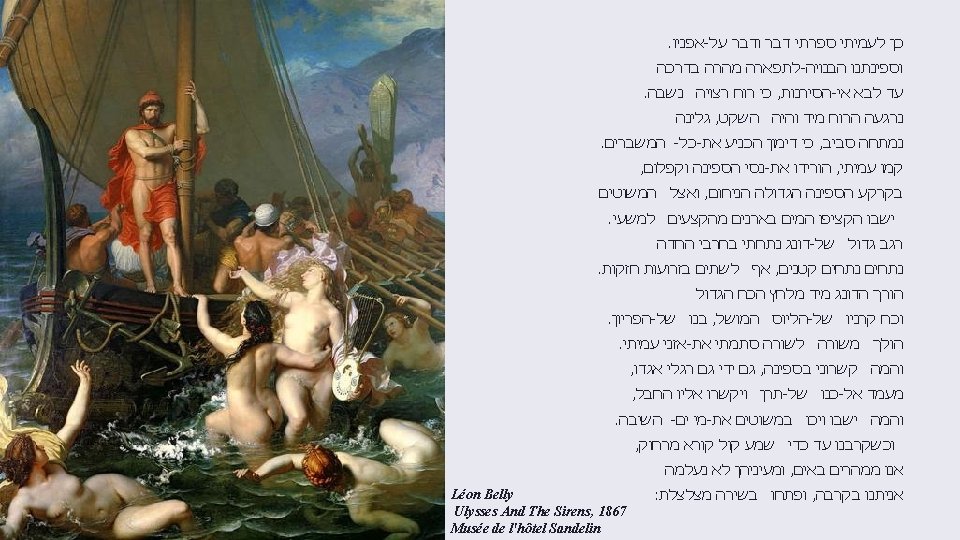
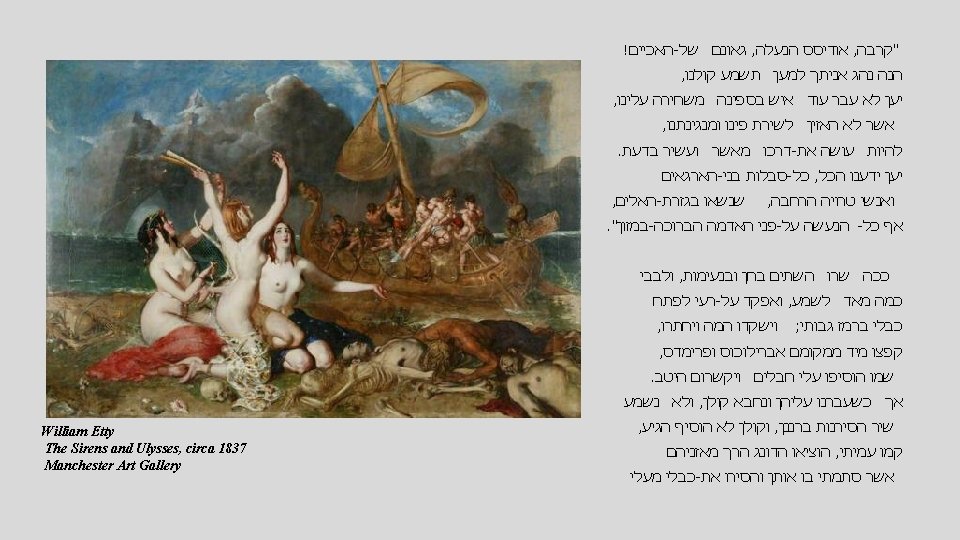
John William Waterhouse, Ulysses and the Sirens, 1891, National Gallery of Victoria, Melbourne
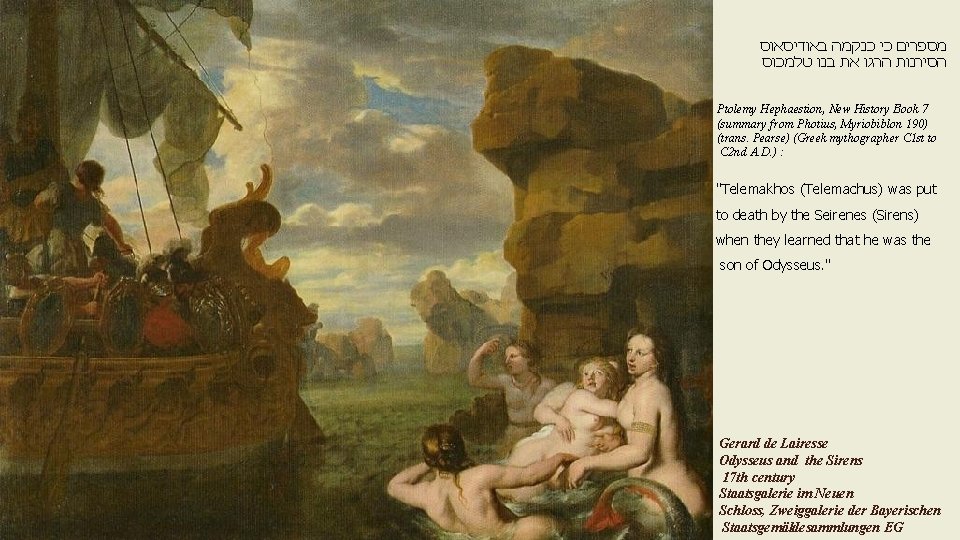
מספרים כי כנקמה באודיסאוס הסירנות הרגו את בנו טלמכוס Ptolemy Hephaestion, New History Book 7 (summary from Photius, Myriobiblon 190) (trans. Pearse) (Greek mythographer C 1 st to C 2 nd A. D. ) : "Telemakhos (Telemachus) was put to death by the Seirenes (Sirens) when they learned that he was the son of Odysseus. " Gerard de Lairesse Odysseus and the Sirens 17 th century Staatsgalerie im Neuen Schloss, Zweiggalerie der Bayerischen Staatsgemäldesammlungen EG
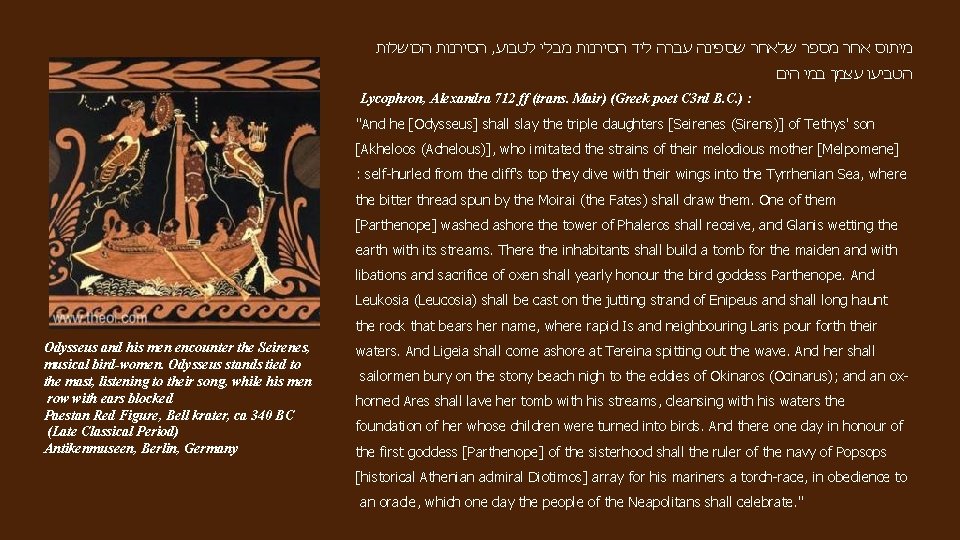
הסירנות הכושלות , מיתוס אחר מספר שלאחר שספינה עברה ליד הסירנות מבלי לטבוע הטביעו עצמן במי הים Lycophron, Alexandra 712 ff (trans. Mair) (Greek poet C 3 rd B. C. ) : "And he [Odysseus] shall slay the triple daughters [Seirenes (Sirens)] of Tethys' son [Akheloos (Achelous)], who imitated the strains of their melodious mother [Melpomene] : self-hurled from the cliff's top they dive with their wings into the Tyrrhenian Sea, where the bitter thread spun by the Moirai (the Fates) shall draw them. One of them [Parthenope] washed ashore the tower of Phaleros shall receive, and Glanis wetting the earth with its streams. There the inhabitants shall build a tomb for the maiden and with libations and sacrifice of oxen shall yearly honour the bird goddess Parthenope. And Leukosia (Leucosia) shall be cast on the jutting strand of Enipeus and shall long haunt the rock that bears her name, where rapid Is and neighbouring Laris pour forth their Odysseus and his men encounter the Seirenes, musical bird-women. Odysseus stands tied to the mast, listening to their song, while his men row with ears blocked Paestan Red Figure, Bell krater, ca 340 BC (Late Classical Period) Antikenmuseen, Berlin, Germany waters. And Ligeia shall come ashore at Tereina spitting out the wave. And her shall sailormen bury on the stony beach nigh to the eddies of Okinaros (Ocinarus); and an oxhorned Ares shall lave her tomb with his streams, cleansing with his waters the foundation of her whose children were turned into birds. And there one day in honour of the first goddess [Parthenope] of the sisterhood shall the ruler of the navy of Popsops [historical Athenian admiral Diotimos] array for his mariners a torch-race, in obedience to an oracle, which one day the people of the Neapolitans shall celebrate. "
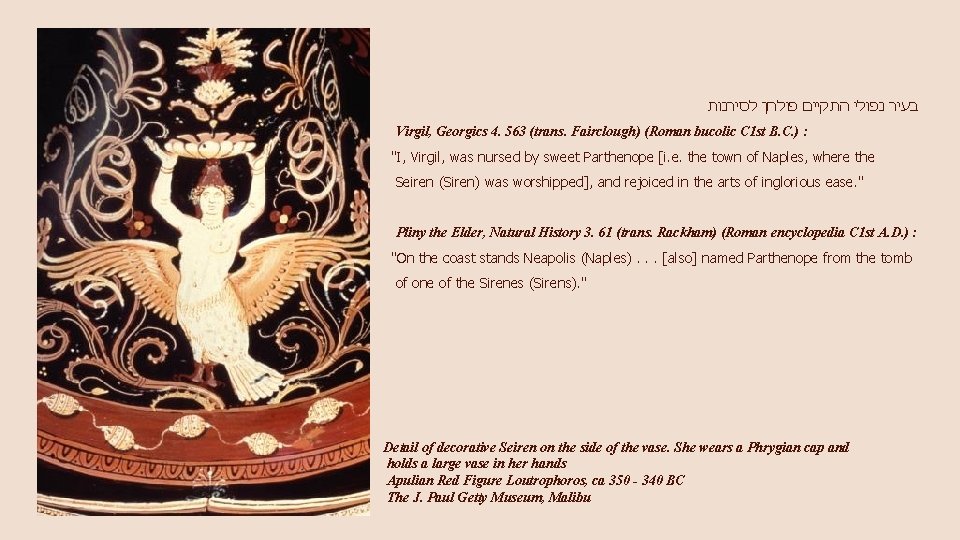
בעיר נפולי התקיים פולחן לסירנות Virgil, Georgics 4. 563 (trans. Fairclough) (Roman bucolic C 1 st B. C. ) : "I, Virgil, was nursed by sweet Parthenope [i. e. the town of Naples, where the Seiren (Siren) was worshipped], and rejoiced in the arts of inglorious ease. " Pliny the Elder, Natural History 3. 61 (trans. Rackham) (Roman encyclopedia C 1 st A. D. ) : "On the coast stands Neapolis (Naples). . . [also] named Parthenope from the tomb of one of the Sirenes (Sirens). " Detail of decorative Seiren on the side of the vase. She wears a Phrygian cap and holds a large vase in her hands Apulian Red Figure Loutrophoros, ca 350 - 340 BC The J. Paul Getty Museum, Malibu
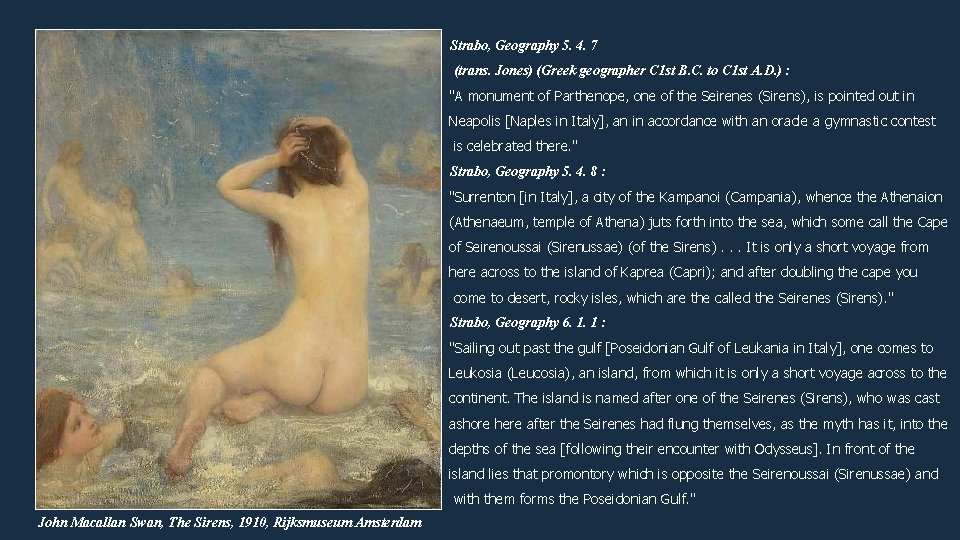
Strabo, Geography 5. 4. 7 (trans. Jones) (Greek geographer C 1 st B. C. to C 1 st A. D. ) : "A monument of Parthenope, one of the Seirenes (Sirens), is pointed out in Neapolis [Naples in Italy], an in accordance with an oracle a gymnastic contest is celebrated there. " . Strabo, Geography 5. 4. 8 : "Surrenton [in Italy], a city of the Kampanoi (Campania), whence the Athenaion (Athenaeum, temple of Athena) juts forth into the sea, which some call the Cape of Seirenoussai (Sirenussae) (of the Sirens). . . It is only a short voyage from here across to the island of Kaprea (Capri); and after doubling the cape you come to desert, rocky isles, which are the called the Seirenes (Sirens). " Strabo, Geography 6. 1. 1 : "Sailing out past the gulf [Poseidonian Gulf of Leukania in Italy], one comes to Leukosia (Leucosia), an island, from which it is only a short voyage across to the continent. The island is named after one of the Seirenes (Sirens), who was cast ashore here after the Seirenes had flung themselves, as the myth has it, into the depths of the sea [following their encounter with Odysseus]. In front of the island lies that promontory which is opposite the Seirenoussai (Sirenussae) and with them forms the Poseidonian Gulf. " John Macallan Swan, The Sirens, 1910, Rijksmuseum Amsterdam
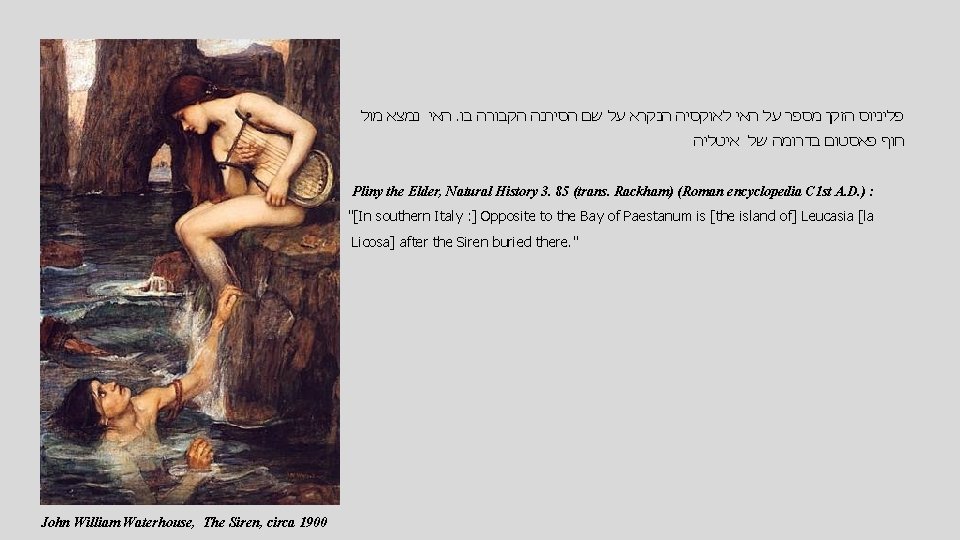
האי נמצא מול. פליניוס הזקן מספר על האי לאוקסיה הנקרא על שם הסירנה הקבורה בו חוף פאסטום בדרומה של איטליה Pliny the Elder, Natural History 3. 85 (trans. Rackham) (Roman encyclopedia C 1 st A. D. ) : "[In southern Italy : ] Opposite to the Bay of Paestanum is [the island of] Leucasia [la Licosa] after the Siren buried there. " John William Waterhouse, The Siren, circa 1900
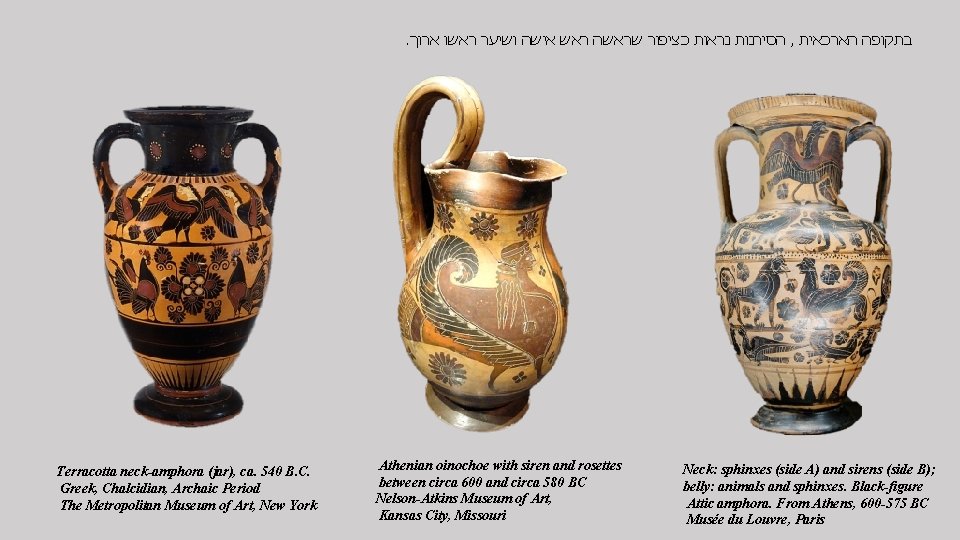
. הסירנות נראות כציפור שראשה ראש אישה ושיער ראשו ארוך , בתקופה הארכאית Terracotta neck-amphora (jar), ca. 540 B. C. Greek, Chalcidian, Archaic Period The Metropolitan Museum of Art, New York Athenian oinochoe with siren and rosettes between circa 600 and circa 580 BC Nelson-Atkins Museum of Art, Kansas City, Missouri Neck: sphinxes (side A) and sirens (side B); belly: animals and sphinxes. Black-figure Attic amphora. From Athens, 600 -575 BC Musée du Louvre, Paris
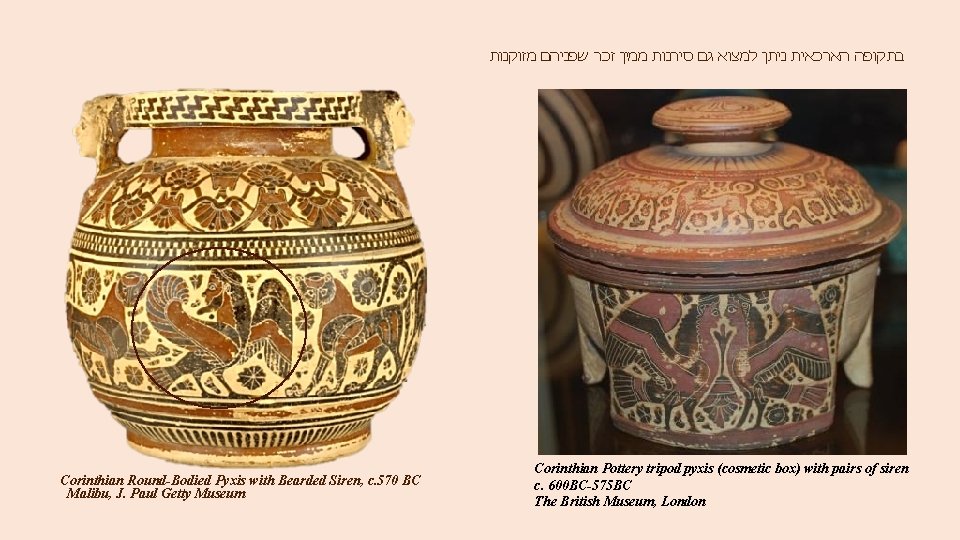
בתקופה הארכאית ניתן למצוא גם סירנות ממין זכר שפניהם מזוקנות Corinthian Round-Bodied Pyxis with Bearded Siren, c. 570 BC Malibu, J. Paul Getty Museum Corinthian Pottery tripod pyxis (cosmetic box) with pairs of siren c. 600 BC-575 BC The British Museum, London
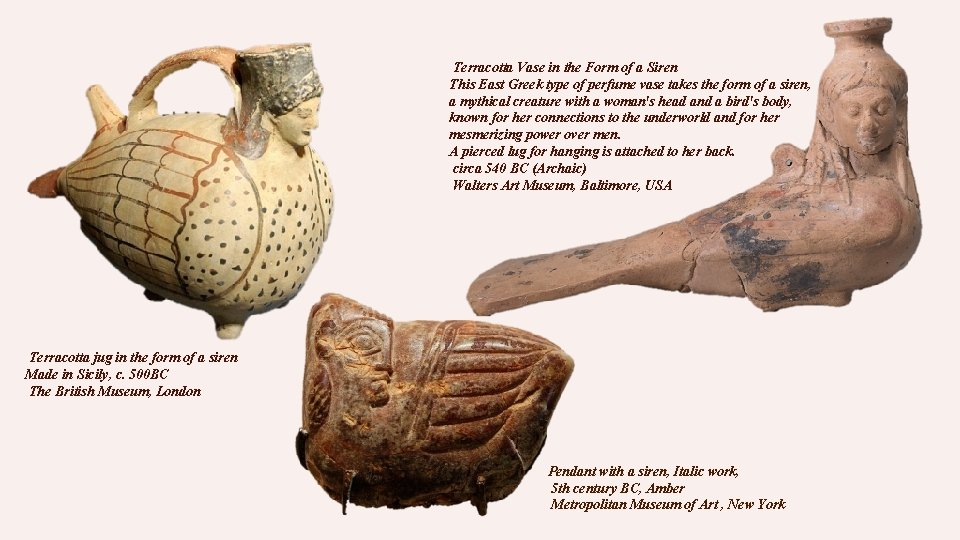
Terracotta Vase in the Form of a Siren This East Greek type of perfume vase takes the form of a siren, a mythical creature with a woman's head and a bird's body, known for her connections to the underworld and for her mesmerizing power over men. A pierced lug for hanging is attached to her back. circa 540 BC (Archaic) Walters Art Museum, Baltimore, USA Terracotta jug in the form of a siren Made in Sicily, c. 500 BC The British Museum, London Pendant with a siren, Italic work, 5 th century BC, Amber Metropolitan Museum of Art , New York
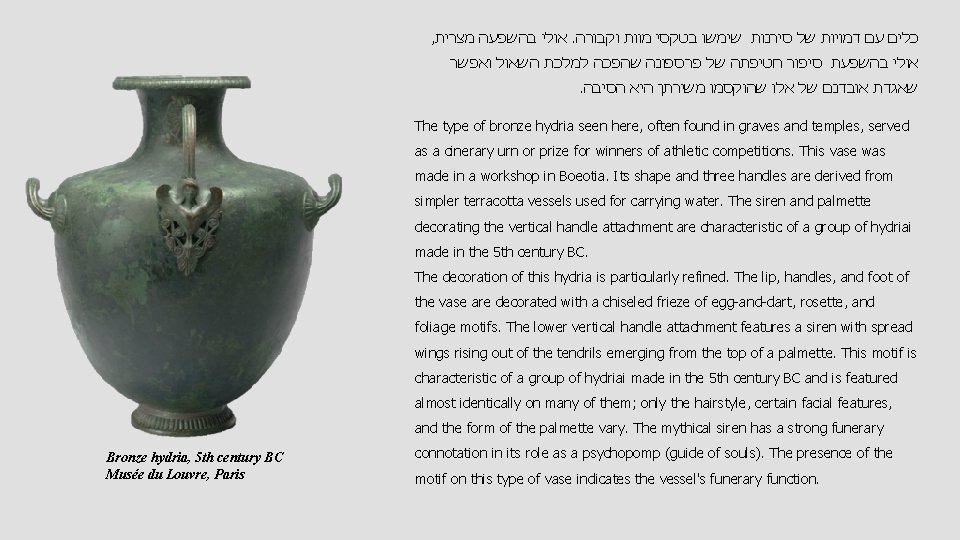
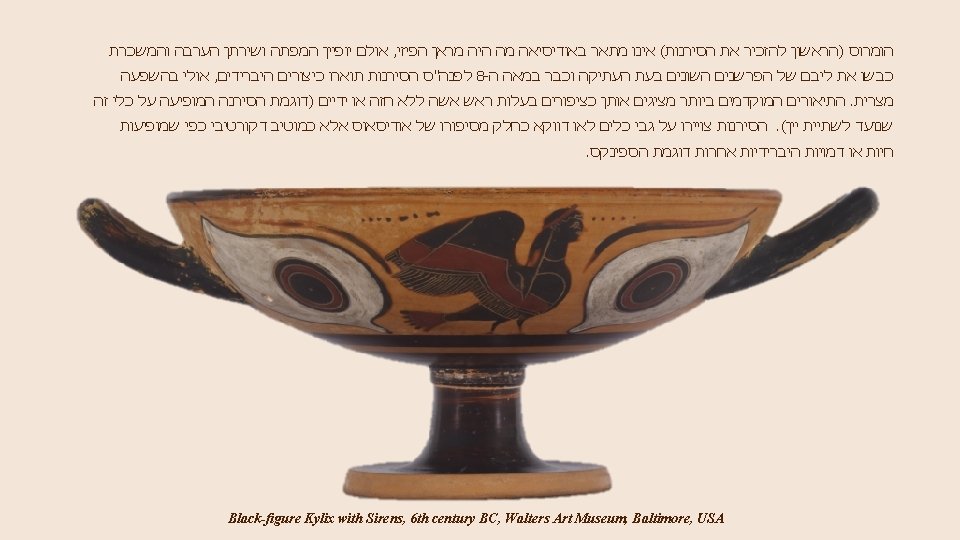
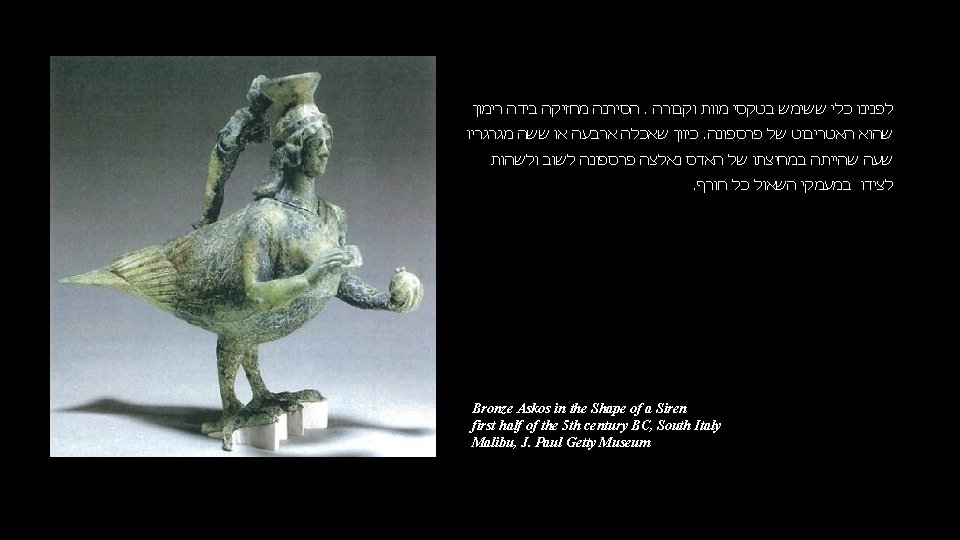
, אולי בהשפעה מצרית. כלים עם דמויות של סירנות שימשו בטקסי מוות וקבורה אולי בהשפעת סיפור חטיפתה של פרספונה שהפכה למלכת השאול ואפשר . שאגדת אובדנם של אלו שהוקסמו משירתן היא הסיבה The type of bronze hydria seen here, often found in graves and temples, served as a cinerary urn or prize for winners of athletic competitions. This vase was made in a workshop in Boeotia. Its shape and three handles are derived from simpler terracotta vessels used for carrying water. The siren and palmette decorating the vertical handle attachment are characteristic of a group of hydriai made in the 5 th century BC. The decoration of this hydria is particularly refined. The lip, handles, and foot of the vase are decorated with a chiseled frieze of egg-and-dart, rosette, and foliage motifs. The lower vertical handle attachment features a siren with spread wings rising out of the tendrils emerging from the top of a palmette. This motif is characteristic of a group of hydriai made in the 5 th century BC and is featured almost identically on many of them; only the hairstyle, certain facial features, and the form of the palmette vary. The mythical siren has a strong funerary Bronze hydria, 5 th century BC Musée du Louvre, Paris connotation in its role as a psychopomp (guide of souls). The presence of the motif on this type of vase indicates the vessel's funerary function.
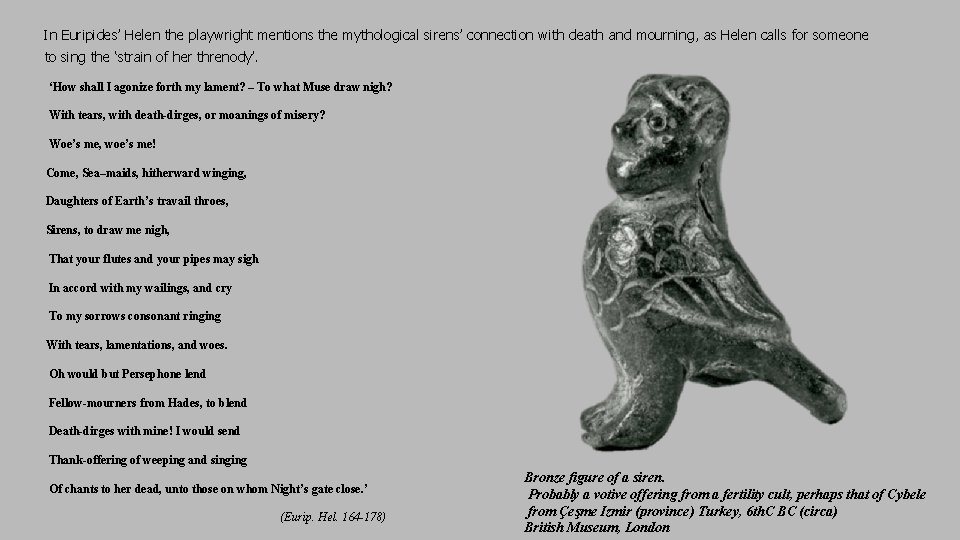
In Euripides’ Helen the playwright mentions the mythological sirens’ connection with death and mourning, as Helen calls for someone to sing the ‘strain of her threnody’. ‘How shall I agonize forth my lament? – To what Muse draw nigh? With tears, with death-dirges, or moanings of misery? Woe’s me, woe’s me! Come, Sea–maids, hitherward winging, Daughters of Earth’s travail throes, Sirens, to draw me nigh, That your flutes and your pipes may sigh In accord with my wailings, and cry To my sorrows consonant ringing With tears, lamentations, and woes. Oh would but Persephone lend Fellow-mourners from Hades, to blend Death-dirges with mine! I would send Thank-offering of weeping and singing Of chants to her dead, unto those on whom Night’s gate close. ’ (Eurip. Hel. 164 -178) Bronze figure of a siren. Probably a votive offering from a fertility cult, perhaps that of Cybele from Çeşme Izmir (province) Turkey, 6 th. C BC (circa) British Museum, London
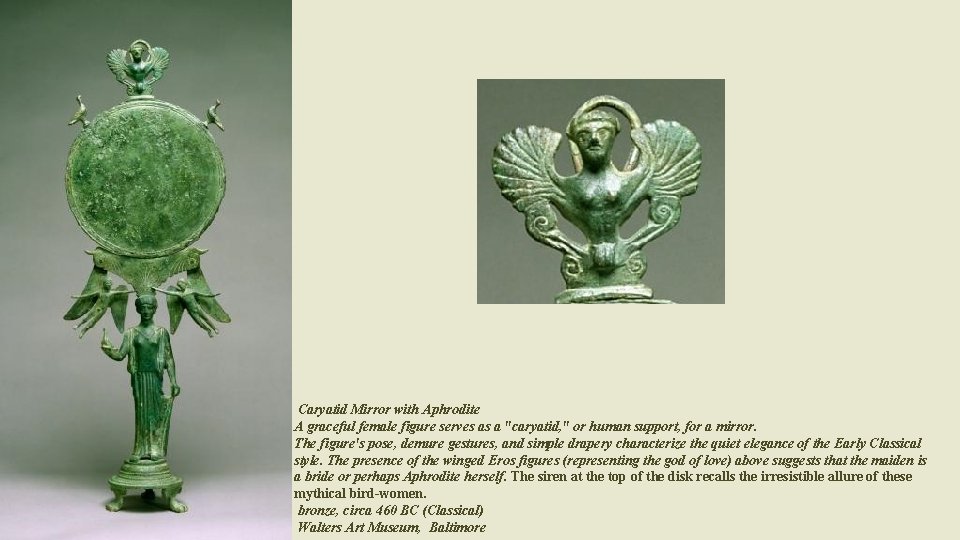
Caryatid Mirror with Aphrodite A graceful female figure serves as a "caryatid, " or human support, for a mirror. The figure's pose, demure gestures, and simple drapery characterize the quiet elegance of the Early Classical style. The presence of the winged Eros figures (representing the god of love) above suggests that the maiden is a bride or perhaps Aphrodite herself. The siren at the top of the disk recalls the irresistible allure of these mythical bird-women. bronze, circa 460 BC (Classical) Walters Art Museum, Baltimore
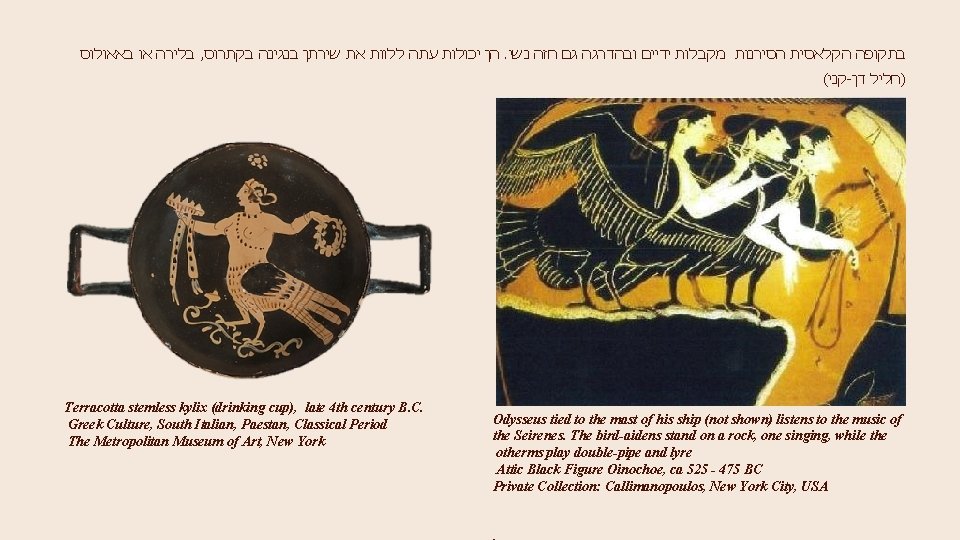
בלירה או באאולוס , הן יכולות עתה ללוות את שירתן בנגינה בקתרוס. בתקופה הקלאסית הסירנות מקבלות ידיים ובהדרגה גם חזה נשי ( קני - )חליל דן Terracotta stemless kylix (drinking cup), late 4 th century B. C. Greek Culture, South Italian, Paestan, Classical Period The Metropolitan Museum of Art, New York Odysseus tied to the mast of his ship (not shown) listens to the music of the Seirenes. The bird-aidens stand on a rock, one singing, while the otherms play double-pipe and lyre Attic Black Figure Oinochoe, ca 525 - 475 BC Private Collection: Callimanopoulos, New York City, USA
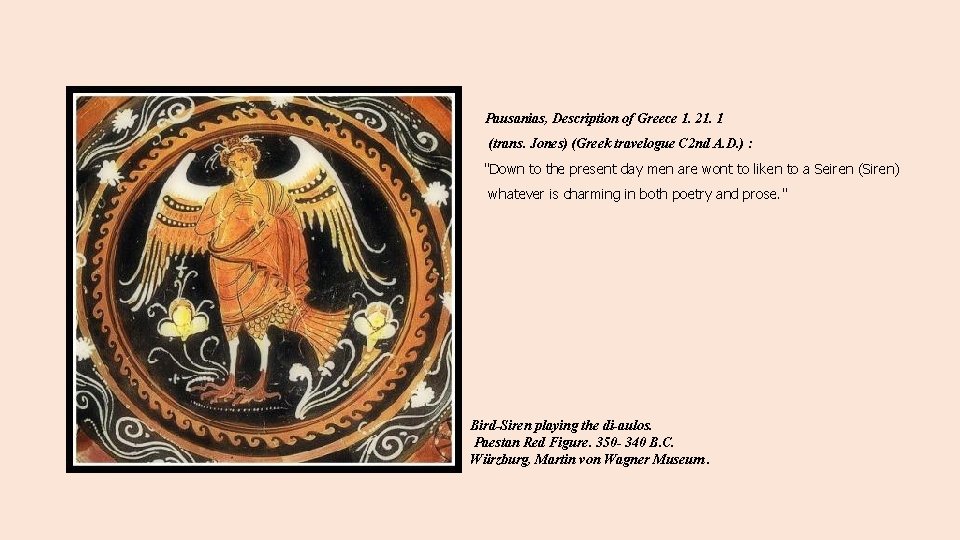
Pausanias, Description of Greece 1. 21. 1 (trans. Jones) (Greek travelogue C 2 nd A. D. ) : "Down to the present day men are wont to liken to a Seiren (Siren) whatever is charming in both poetry and prose. " Bird-Siren playing the di-aulos. Paestan Red Figure. 350 - 340 B. C. Würzburg, Martin von Wagner Museum.
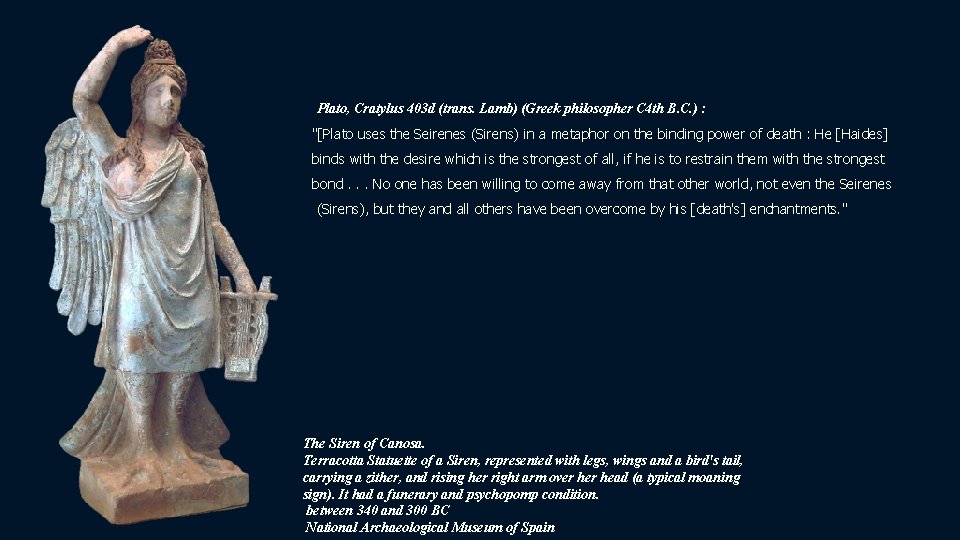
Plato, Cratylus 403 d (trans. Lamb) (Greek philosopher C 4 th B. C. ) : "[Plato uses the Seirenes (Sirens) in a metaphor on the binding power of death : He [Haides] binds with the desire which is the strongest of all, if he is to restrain them with the strongest bond. . . No one has been willing to come away from that other world, not even the Seirenes (Sirens), but they and all others have been overcome by his [death's] enchantments. " The Siren of Canosa. Terracotta Statuette of a Siren, represented with legs, wings and a bird's tail, carrying a zither, and rising her right arm over head (a typical moaning sign). It had a funerary and psychopomp condition. between 340 and 300 BC National Archaeological Museum of Spain

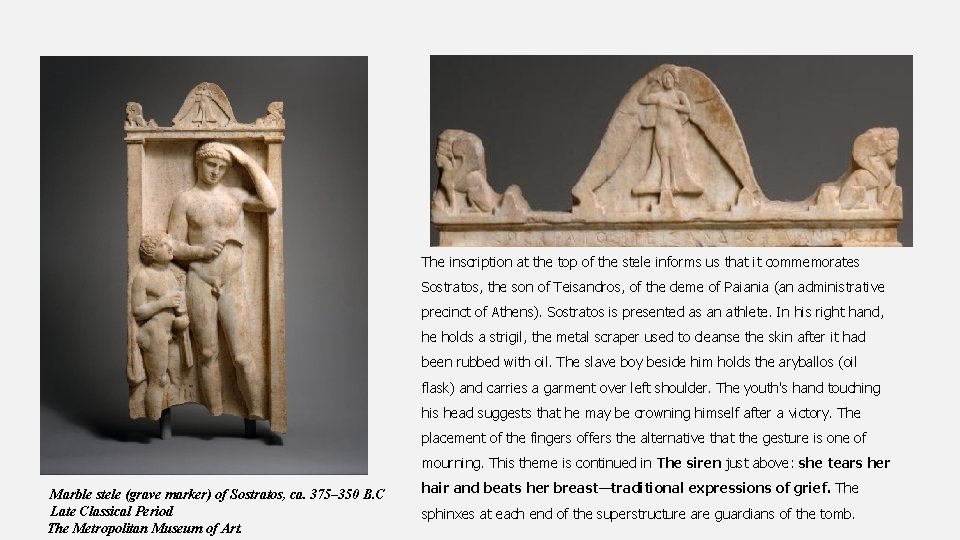
The inscription at the top of the stele informs us that it commemorates Sostratos, the son of Teisandros, of the deme of Paiania (an administrative precinct of Athens). Sostratos is presented as an athlete. In his right hand, he holds a strigil, the metal scraper used to cleanse the skin after it had been rubbed with oil. The slave boy beside him holds the aryballos (oil flask) and carries a garment over left shoulder. The youth's hand touching his head suggests that he may be crowning himself after a victory. The placement of the fingers offers the alternative that the gesture is one of mourning. This theme is continued in The siren just above: she tears her Marble stele (grave marker) of Sostratos, ca. 375– 350 B. C Late Classical Period The Metropolitan Museum of Art. hair and beats her breast—traditional expressions of grief. The sphinxes at each end of the superstructure are guardians of the tomb.
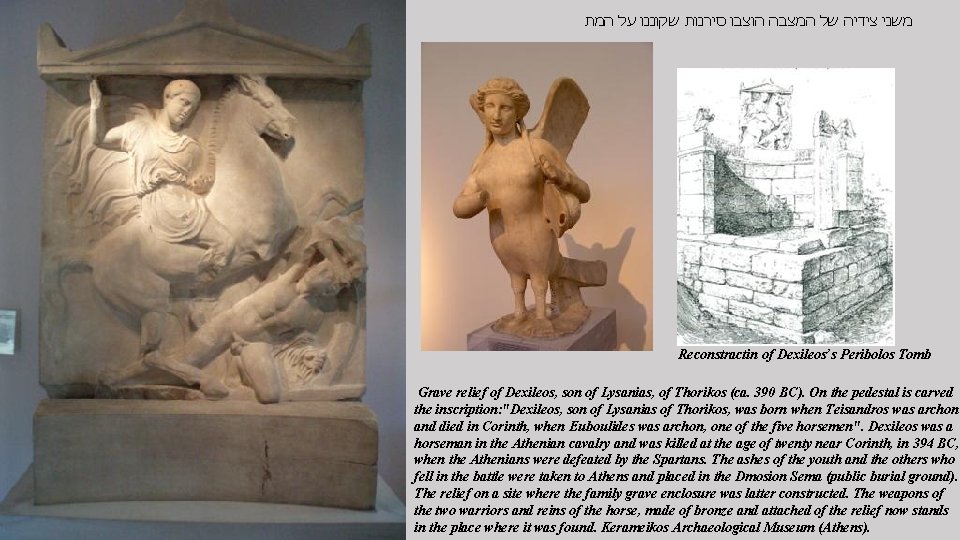
משני צידיה של המצבה הוצבו סירנות שקוננו על המת Reconstractin of Dexileos’s Peribolos Tomb Grave relief of Dexileos, son of Lysanias, of Thorikos (ca. 390 BC). On the pedestal is carved the inscription: "Dexileos, son of Lysanias of Thorikos, was born when Teisandros was archon and died in Corinth, when Euboulides was archon, one of the five horsemen". Dexileos was a horseman in the Athenian cavalry and was killed at the age of twenty near Corinth, in 394 BC, when the Athenians were defeated by the Spartans. The ashes of the youth and the others who fell in the battle were taken to Athens and placed in the Dmosion Sema (public burial ground). The relief on a site where the family grave enclosure was latter constructed. The weapons of the two warriors and reins of the horse, made of bronze and attached of the relief now stands in the place where it was found. Kerameikos Archaeological Museum (Athens).
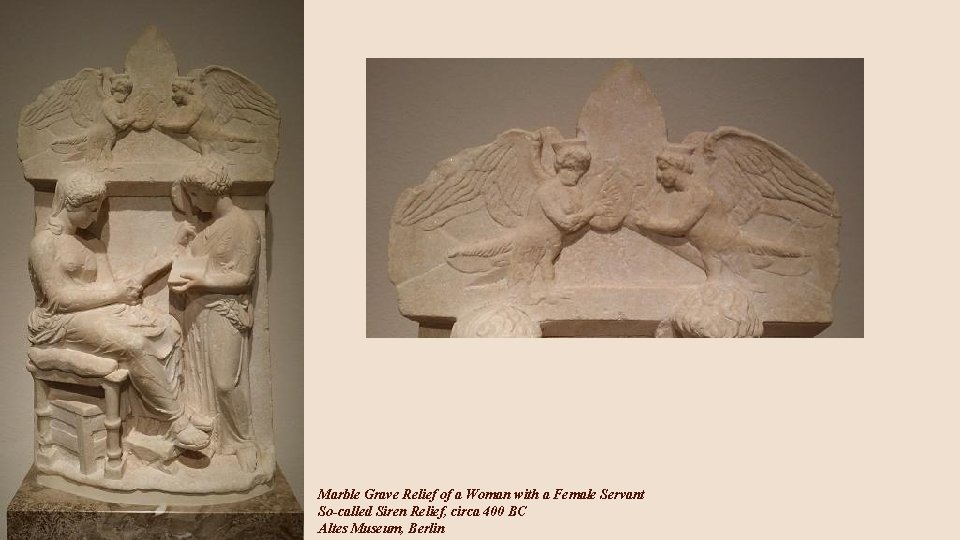
Marble Grave Relief of a Woman with a Female Servant So-called Siren Relief, circa 400 BC Altes Museum, Berlin
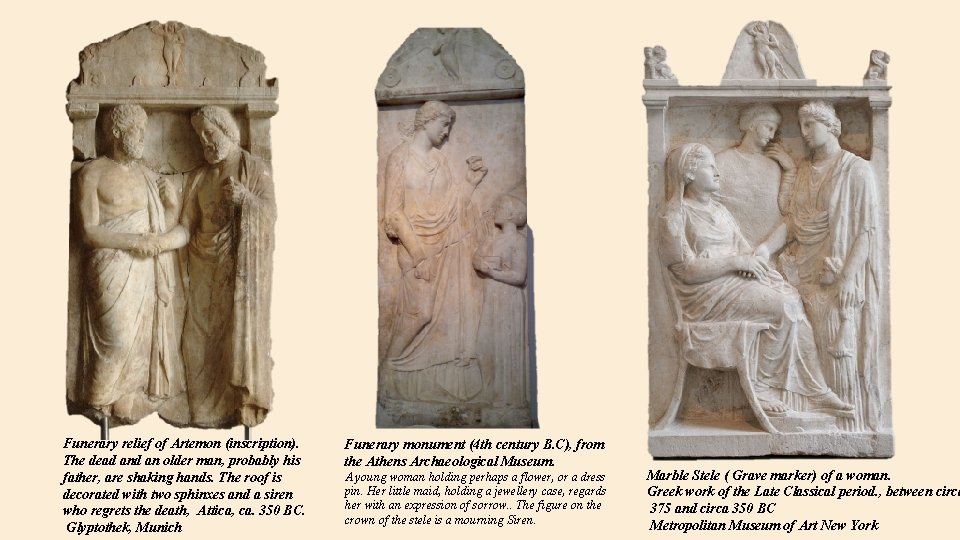
Funerary relief of Artemon (inscription). The dead an older man, probably his father, are shaking hands. The roof is decorated with two sphinxes and a siren who regrets the death, Attica, ca. 350 BC. Glyptothek, Munich Funerary monument (4 th century B. C), from the Athens Archaeological Museum. A young woman holding perhaps a flower, or a dress pin. Her little maid, holding a jewellery case, regards her with an expression of sorrow. . The figure on the crown of the stele is a mourning Siren. Marble Stele ( Grave marker) of a woman. Greek work of the Late Classical period. , between circa 375 and circa 350 BC Metropolitan Museum of Art New York
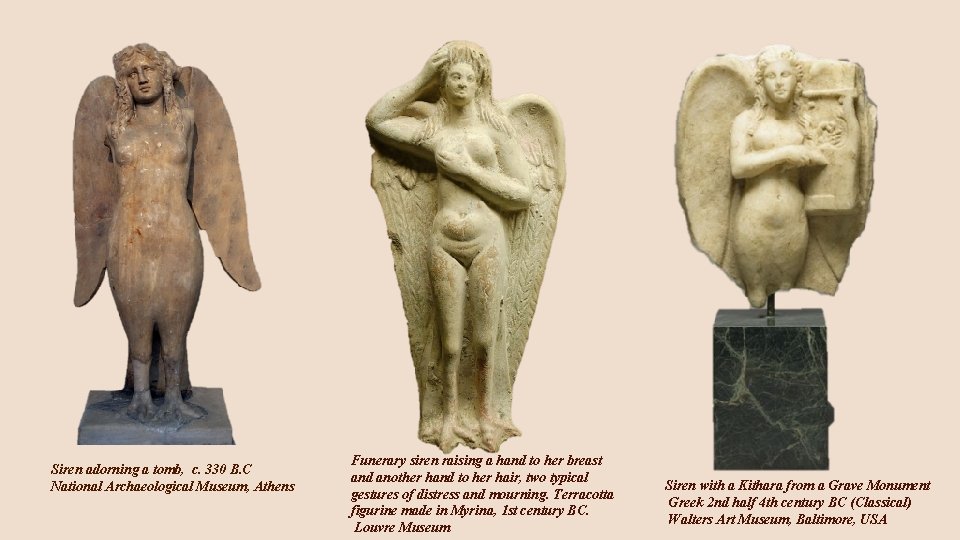
Siren adorning a tomb, c. 330 B. C National Archaeological Museum, Athens Funerary siren raising a hand to her breast and another hand to her hair, two typical gestures of distress and mourning. Terracotta figurine made in Myrina, 1 st century BC. Louvre Museum Siren with a Kithara from a Grave Monument Greek 2 nd half 4 th century BC (Classical) Walters Art Museum, Baltimore, USA
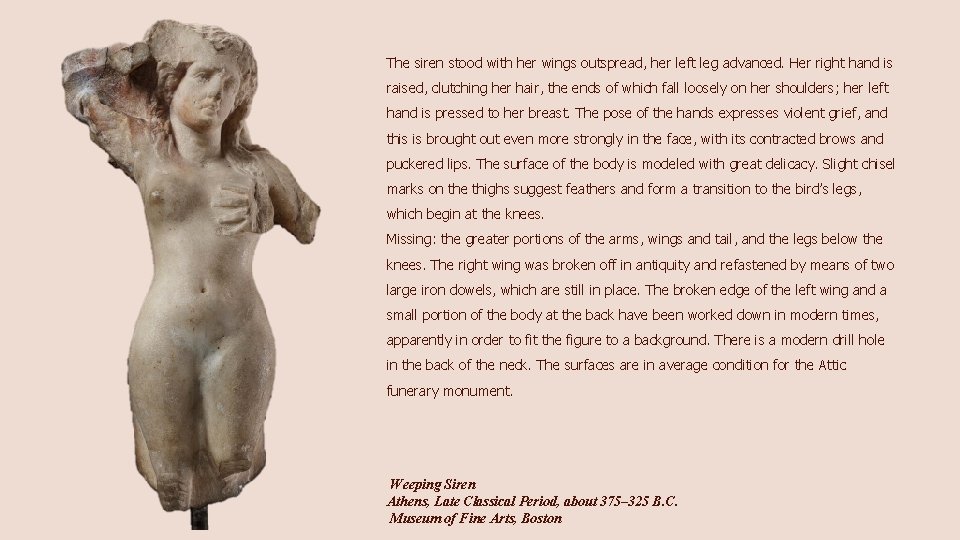
The siren stood with her wings outspread, her left leg advanced. Her right hand is raised, clutching her hair, the ends of which fall loosely on her shoulders; her left hand is pressed to her breast. The pose of the hands expresses violent grief, and this is brought out even more strongly in the face, with its contracted brows and puckered lips. The surface of the body is modeled with great delicacy. Slight chisel marks on the thighs suggest feathers and form a transition to the bird’s legs, which begin at the knees. Missing: the greater portions of the arms, wings and tail, and the legs below the knees. The right wing was broken off in antiquity and refastened by means of two large iron dowels, which are still in place. The broken edge of the left wing and a small portion of the body at the back have been worked down in modern times, apparently in order to fit the figure to a background. There is a modern drill hole in the back of the neck. The surfaces are in average condition for the Attic funerary monument. Weeping Siren Athens, Late Classical Period, about 375– 325 B. C. Museum of Fine Arts, Boston
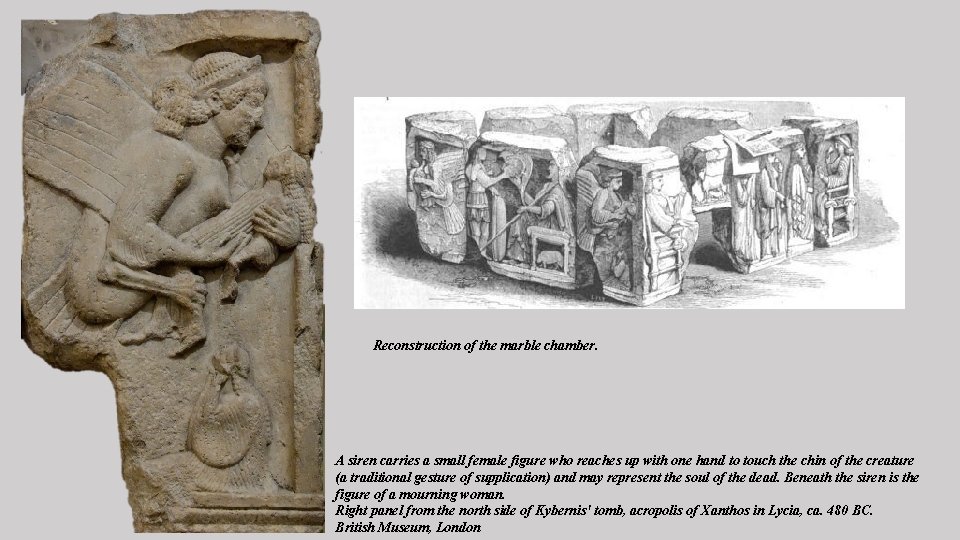
Reconstruction of the marble chamber. A siren carries a small female figure who reaches up with one hand to touch the chin of the creature (a traditional gesture of supplication) and may represent the soul of the dead. Beneath the siren is the figure of a mourning woman. Right panel from the north side of Kybernis' tomb, acropolis of Xanthos in Lycia, ca. 480 BC. British Museum, London
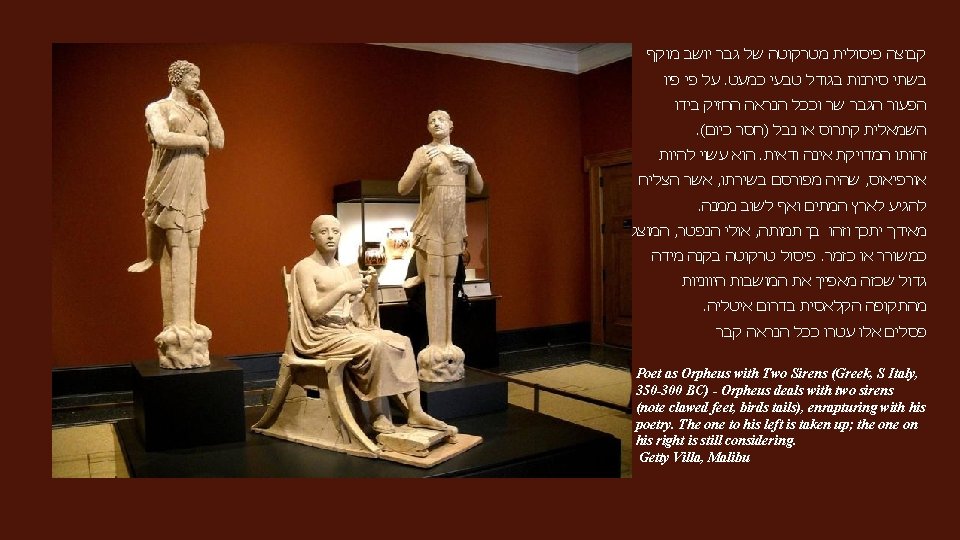
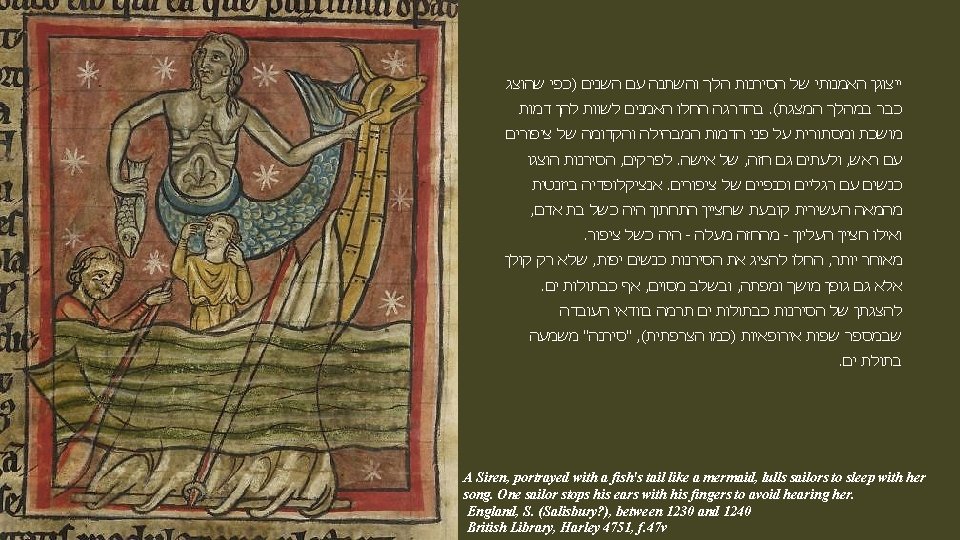
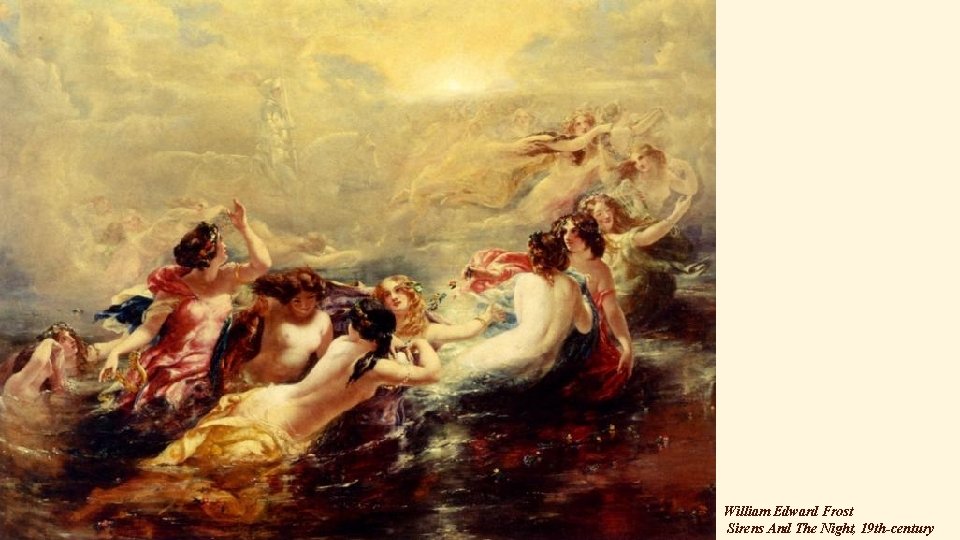
William Edward Frost Sirens And The Night, 19 th-century
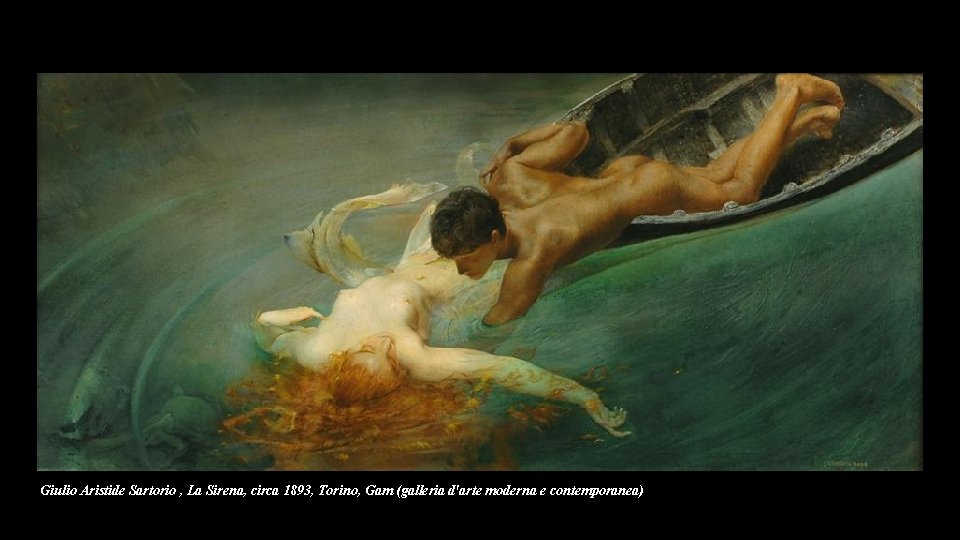
Giulio Aristide Sartorio , La Sirena, circa 1893, Torino, Gam (galleria d'arte moderna e contemporanea)
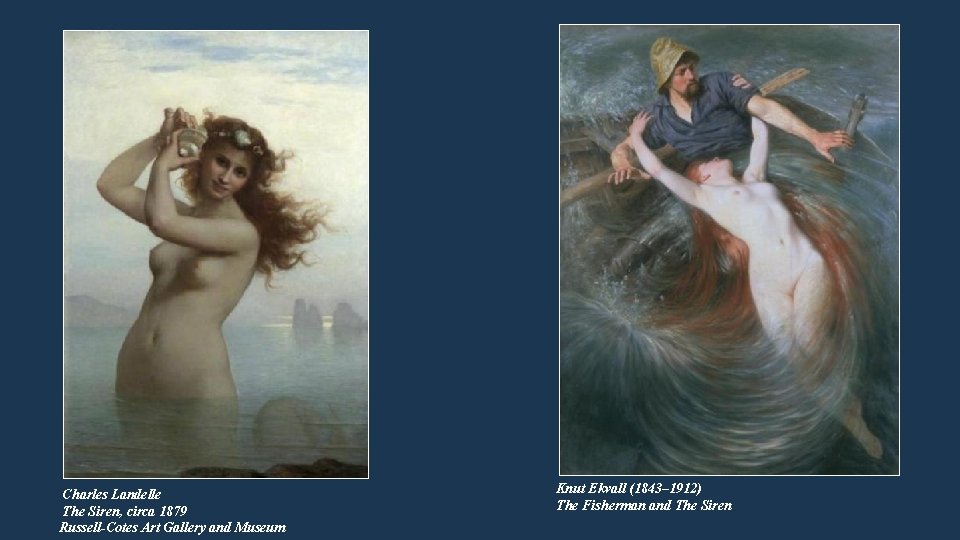
Charles Landelle The Siren, circa 1879 Russell-Cotes Art Gallery and Museum Knut Ekvall (1843– 1912) The Fisherman and The Siren
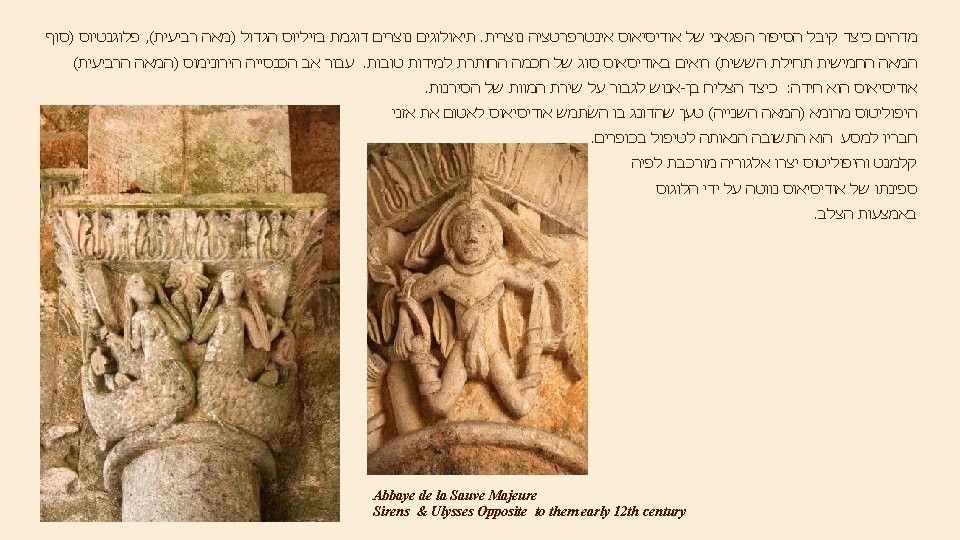
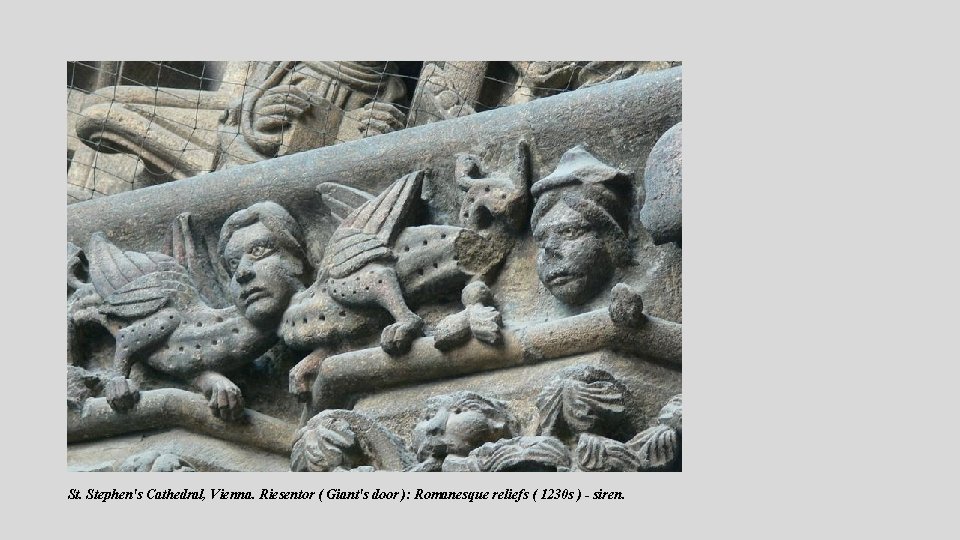
St. Stephen's Cathedral, Vienna. Riesentor ( Giant's door ): Romanesque reliefs ( 1230 s ) - siren.
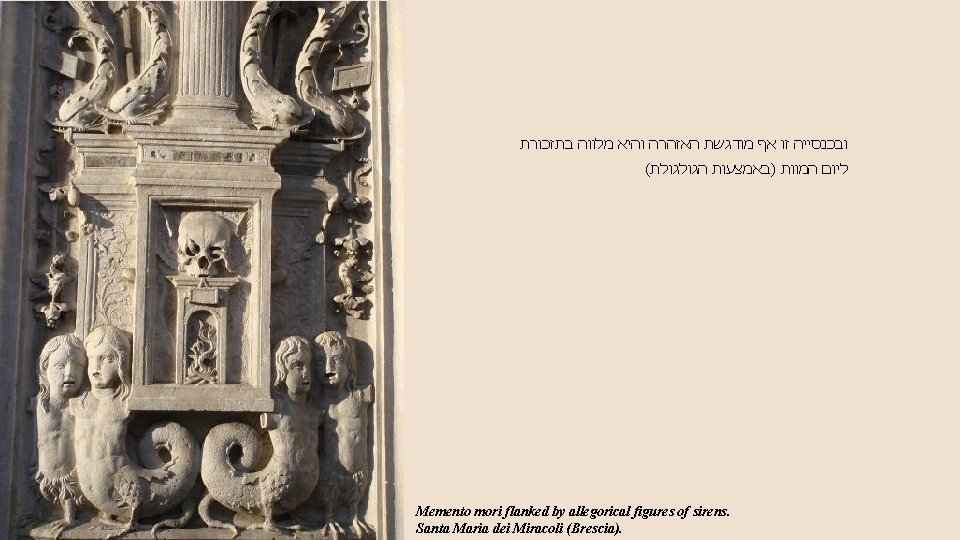
ובכנסייה זו אף מודגשת האזהרה והיא מלווה בתזכורת ( ליום המוות )באמצעות הגולגולת Memento mori flanked by allegorical figures of sirens. Santa Maria dei Miracoli (Brescia).
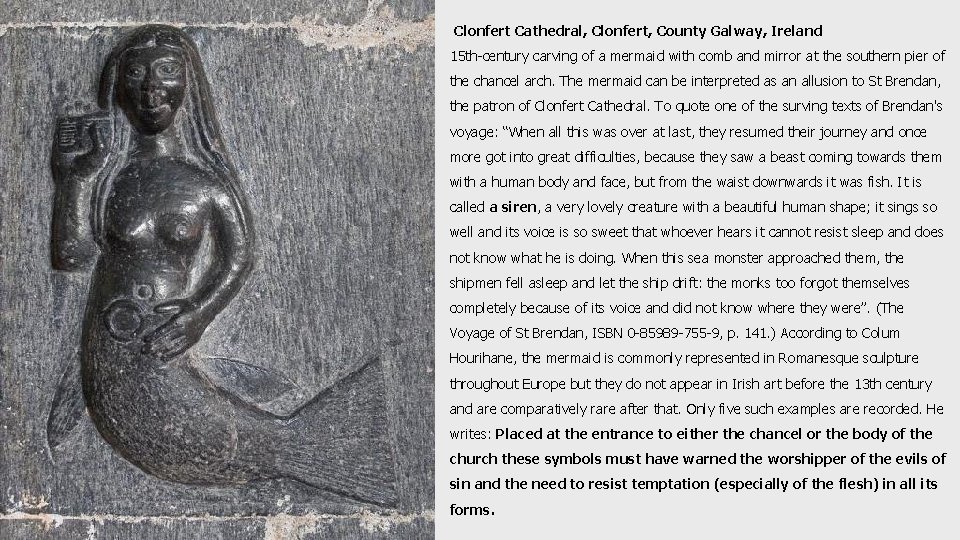
Clonfert Cathedral, Clonfert, County Galway, Ireland 15 th-century carving of a mermaid with comb and mirror at the southern pier of the chancel arch. The mermaid can be interpreted as an allusion to St Brendan, the patron of Clonfert Cathedral. To quote one of the surving texts of Brendan's voyage: “When all this was over at last, they resumed their journey and once more got into great difficulties, because they saw a beast coming towards them with a human body and face, but from the waist downwards it was fish. It is called a siren, a very lovely creature with a beautiful human shape; it sings so well and its voice is so sweet that whoever hears it cannot resist sleep and does not know what he is doing. When this sea monster approached them, the shipmen fell asleep and let the ship drift: the monks too forgot themselves completely because of its voice and did not know where they were”. (The Voyage of St Brendan, ISBN 0 -85989 -755 -9, p. 141. ) According to Colum Hourihane, the mermaid is commonly represented in Romanesque sculpture throughout Europe but they do not appear in Irish art before the 13 th century and are comparatively rare after that. Only five such examples are recorded. He writes: Placed at the entrance to either the chancel or the body of the church these symbols must have warned the worshipper of the evils of sin and the need to resist temptation (especially of the flesh) in all its forms.
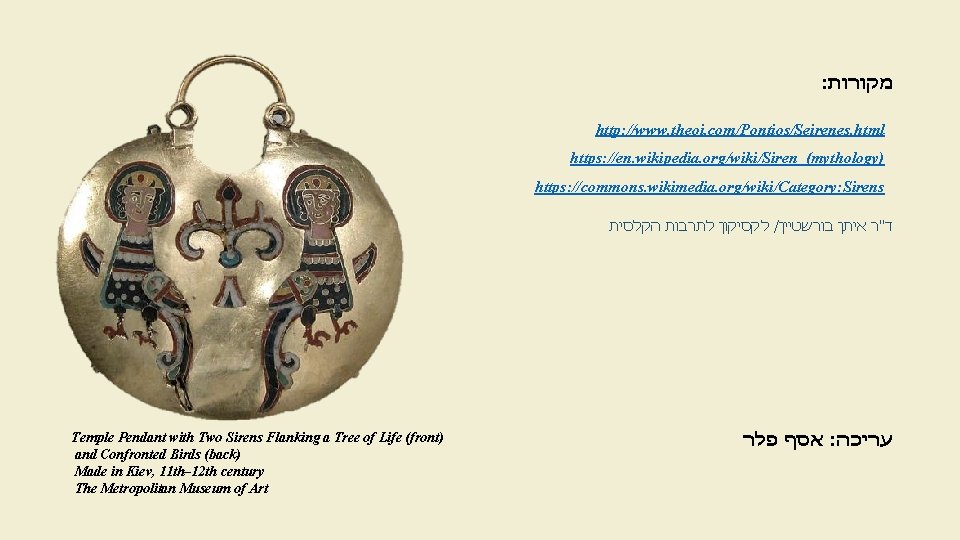
: מקורות http: //www. theoi. com/Pontios/Seirenes. html https: //en. wikipedia. org/wiki/Siren_(mythology) https: //commons. wikimedia. org/wiki/Category: Sirens לקסיקון לתרבות הקלסית / ד"ר איתן בורשטיין Temple Pendant with Two Sirens Flanking a Tree of Life (front) and Confronted Birds (back) Made in Kiev, 11 th– 12 th century The Metropolitan Museum of Art אסף פלר : עריכה
- Slides: 67