
The Simplex Method Susana Barreiro 17 March 2021

The Simplex Method Susana Barreiro 17 March 2021
The Simplex Method • The Simplex Method - formulation (standard form) • The Simplex Method - procedure • The Simplex Method - particular cases o o Tie for the Entering BV Tie for the Leaving BV - degenerate No leaving BV – Unbounded Z Multiple optimal solutions o o o Minimization of the objective function Negative Right Hand Sides Eliminating negative variables Functional constraints in ≥ and = form Eliminating unconstrained variables • The Simplex Method - other cases • The Simplex Method – Exercises

Simplex Method • The graphical approach can be used for two-variable LP problems • Unfortunately, most real-life LPs problems require a method to find optimal solutions capable of dealing with several variables: the simplex algorithm In the classes we will focus on the manual application of the simplex algorithm (using EXCEL), although computer packages to apply the simplex algorithm have been developed (LINDO and LINGO)
Simplex Method Formulation
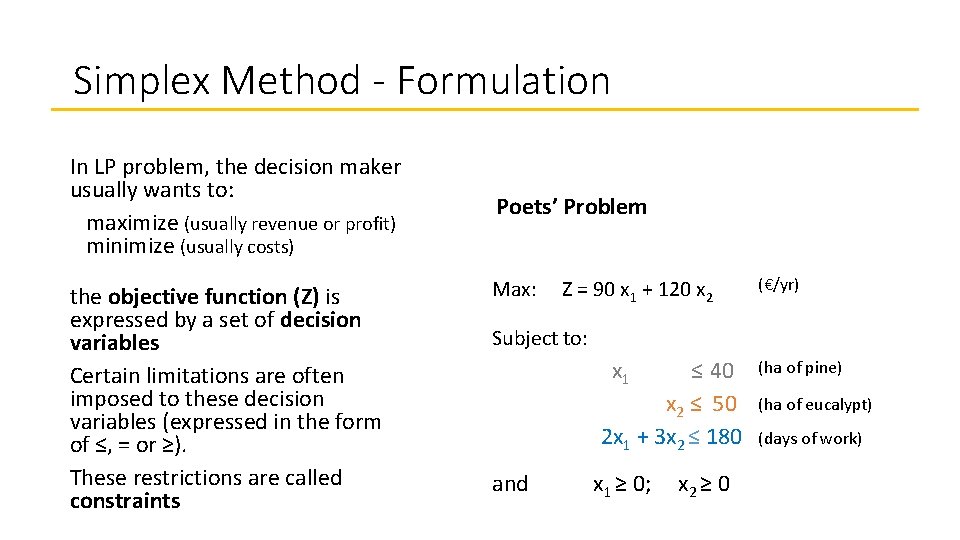
Simplex Method - Formulation In LP problem, the decision maker usually wants to: maximize (usually revenue or profit) mminimize (usually costs) the objective function (Z) is expressed by a set of decision variables Certain limitations are often imposed to these decision variables (expressed in the form of ≤, = or ≥). These restrictions are called constraints Poets’ Problem Max: Z = 90 x 1 + 120 x 2 (€/yr) Subject to: x 1 ≤ 40 x 2 ≤ 50 2 x 1 + 3 x 2 ≤ 180 and x 1 ≥ 0; x 2 ≥ 0 (ha of pine) (ha of eucalypt) (days of work)
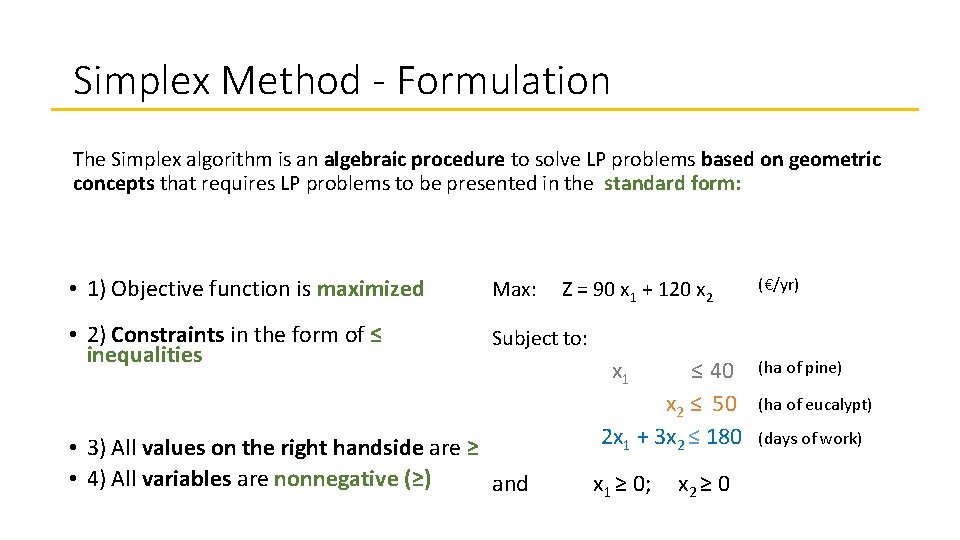
Simplex Method - Formulation The Simplex algorithm is an algebraic procedure to solve LP problems based on geometric concepts that requires LP problems to be presented in the standard form: • 1) Objective function is maximized Max: • 2) Constraints in the form of ≤ inequalities Subject to: • 3) All values on the right handside are ≥ • 4) All variables are nonnegative (≥) and Z = 90 x 1 + 120 x 2 x 1 ≤ 40 x 2 ≤ 50 2 x 1 + 3 x 2 ≤ 180 x 1 ≥ 0; x 2 ≥ 0 (€/yr) (ha of pine) (ha of eucalypt) (days of work)
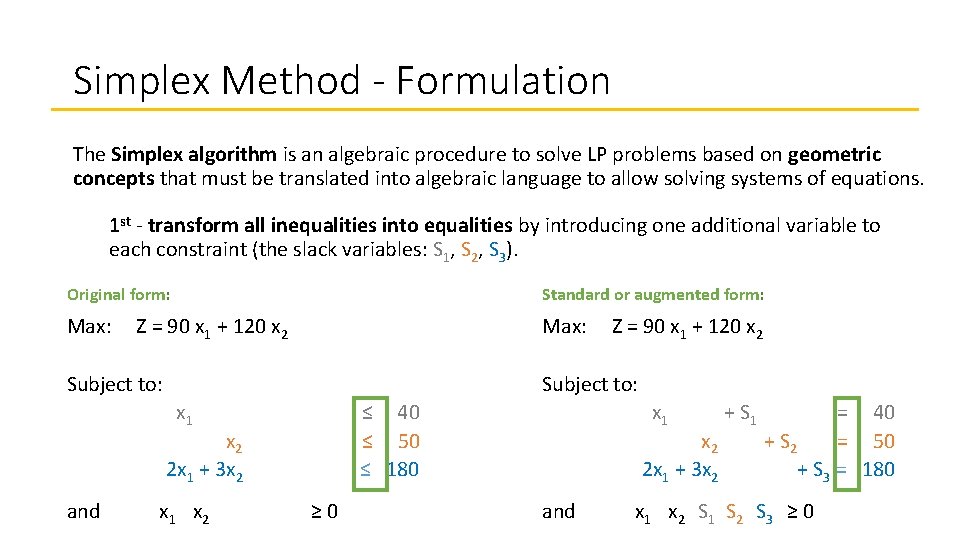
Simplex Method - Formulation The Simplex algorithm is an algebraic procedure to solve LP problems based on geometric concepts that must be translated into algebraic language to allow solving systems of equations. 1 st - transform all inequalities into equalities by introducing one additional variable to each constraint (the slack variables: S 1, S 2, S 3). Original form: Standard or augmented form: Max: Z = 90 x 1 + 120 x 2 Subject to: x 1 x 2 2 x 1 + 3 x 2 and Z = 90 x 1 + 120 x 2 + S 1 x 1 ≤ 40 + S 2 ≤ 50 + S 3 ≤ 180 x 1 x 2 S 1 S 2 S 3 ≥ 0 x 2 2 x 1 + 3 x 2 and + S 1 = 40 + S 2 = 50 + S 3 = 180 x 1 x 2 S 1 S 2 S 3 ≥ 0
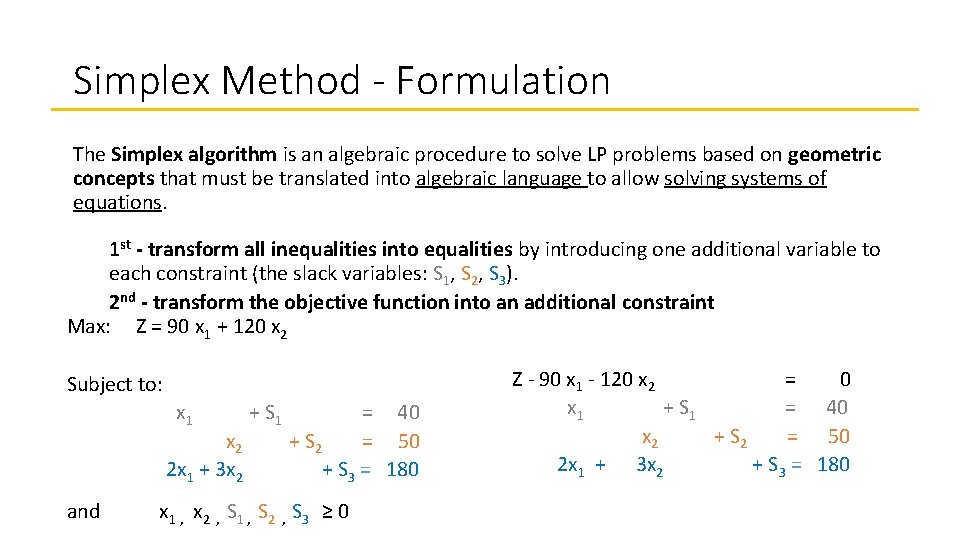
Simplex Method - Formulation The Simplex algorithm is an algebraic procedure to solve LP problems based on geometric concepts that must be translated into algebraic language to allow solving systems of equations. 1 st - transform all inequalities into equalities by introducing one additional variable to each constraint (the slack variables: S 1, S 2, S 3). 2 nd - transform the objective function into an additional constraint Max: Z = 90 x 1 + 120 x 2 Subject to: x 1 x 2 2 x 1 + 3 x 2 and + S 1 = 40 + S 2 = 50 + S 3 = 180 x 1 , x 2 , S 1 , S 2 , S 3 ≥ 0 Z - 90 x 1 - 120 x 2 = 0 x 1 + S 1 = 40 x 2 + S 2 = 50 2 x 1 + 3 x 2 + S 3 = 180
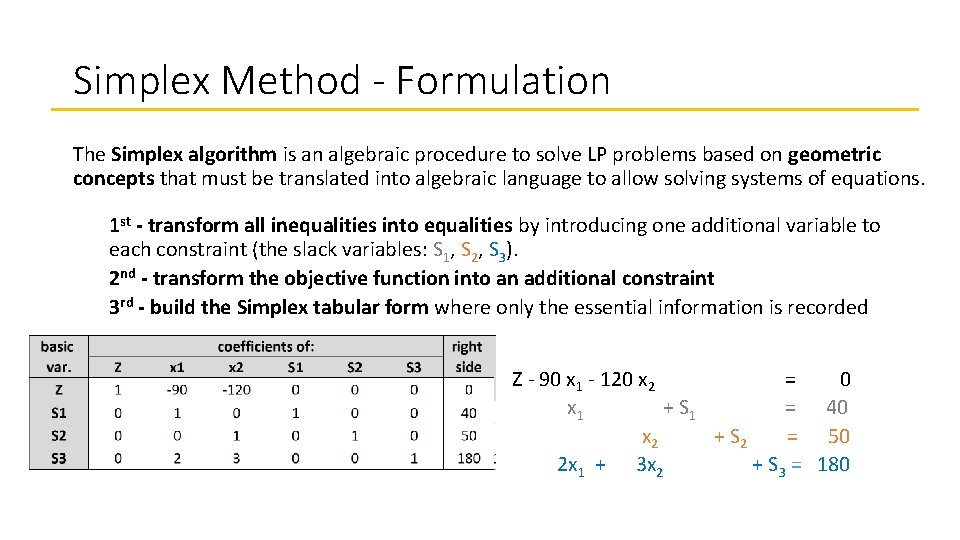
Simplex Method - Formulation The Simplex algorithm is an algebraic procedure to solve LP problems based on geometric concepts that must be translated into algebraic language to allow solving systems of equations. 1 st - transform all inequalities into equalities by introducing one additional variable to each constraint (the slack variables: S 1, S 2, S 3). 2 nd - transform the objective function into an additional constraint 3 rd - build the Simplex tabular form where only the essential information is recorded Z - 90 x 1 - 120 x 2 = 0 x 1 + S 1 = 40 x 2 + S 2 = 50 2 x 1 + 3 x 2 + S 3 = 180
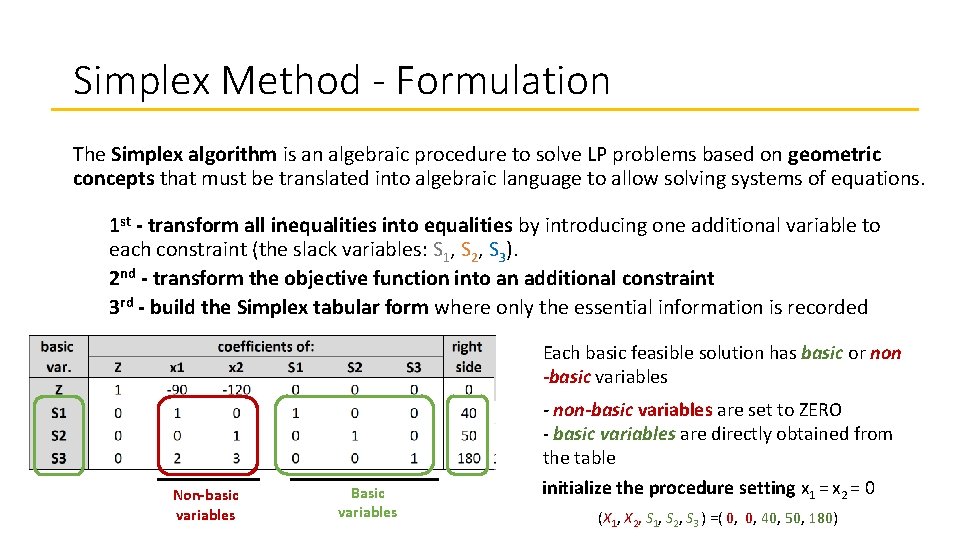
Simplex Method - Formulation The Simplex algorithm is an algebraic procedure to solve LP problems based on geometric concepts that must be translated into algebraic language to allow solving systems of equations. 1 st - transform all inequalities into equalities by introducing one additional variable to each constraint (the slack variables: S 1, S 2, S 3). 2 nd - transform the objective function into an additional constraint 3 rd - build the Simplex tabular form where only the essential information is recorded Each basic feasible solution has basic or non -basic variables - non-basic variables are set to ZERO - basic variables are directly obtained from the table Non-basic variables Basic variables initialize the procedure setting x 1 = x 2 = 0 (X 1, X 2, S 1, S 2, S 3 ) =( 0, 0, 40, 50, 180)
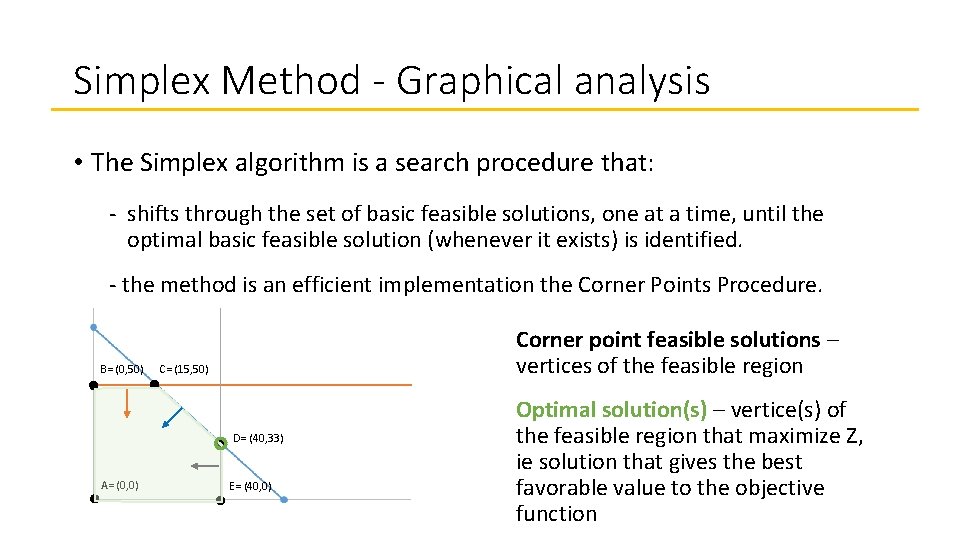
Simplex Method - Graphical analysis • The Simplex algorithm is a search procedure that: - shifts through the set of basic feasible solutions, one at a time, until the optimal basic feasible solution (whenever it exists) is identified. - the method is an efficient implementation the Corner Points Procedure. B= (0, 50) Corner point feasible solutions – vertices of the feasible region C= (15, 50) D= (40, 33) A= (0, 0) E= (40, 0) Optimal solution(s) – vertice(s) of the feasible region that maximize Z, ie solution that gives the best favorable value to the objective function
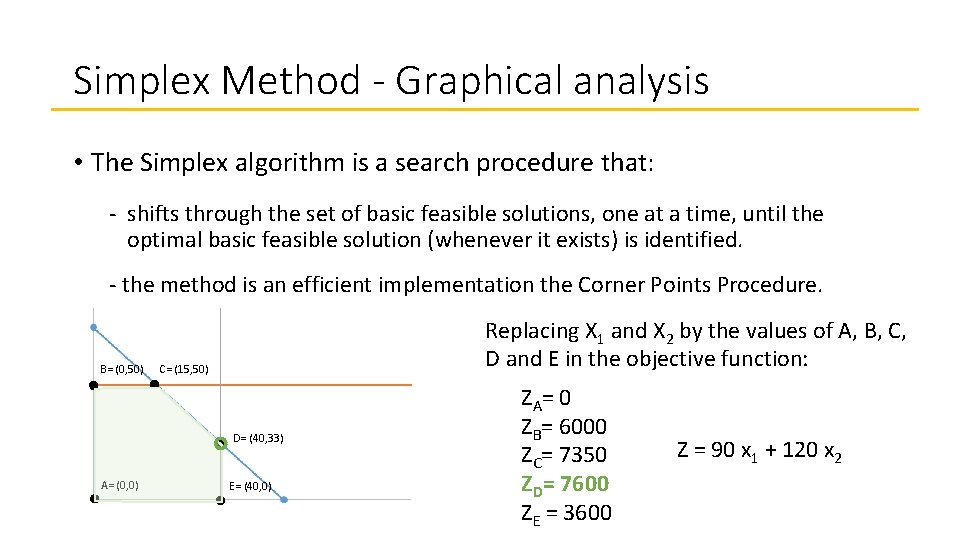
Simplex Method - Graphical analysis • The Simplex algorithm is a search procedure that: - shifts through the set of basic feasible solutions, one at a time, until the optimal basic feasible solution (whenever it exists) is identified. - the method is an efficient implementation the Corner Points Procedure. B= (0, 50) Replacing X 1 and X 2 by the values of A, B, C, D and E in the objective function: C= (15, 50) D= (40, 33) A= (0, 0) E= (40, 0) ZA = 0 ZB= 6000 ZC= 7350 ZD= 7600 ZE = 3600 Z = 90 x 1 + 120 x 2
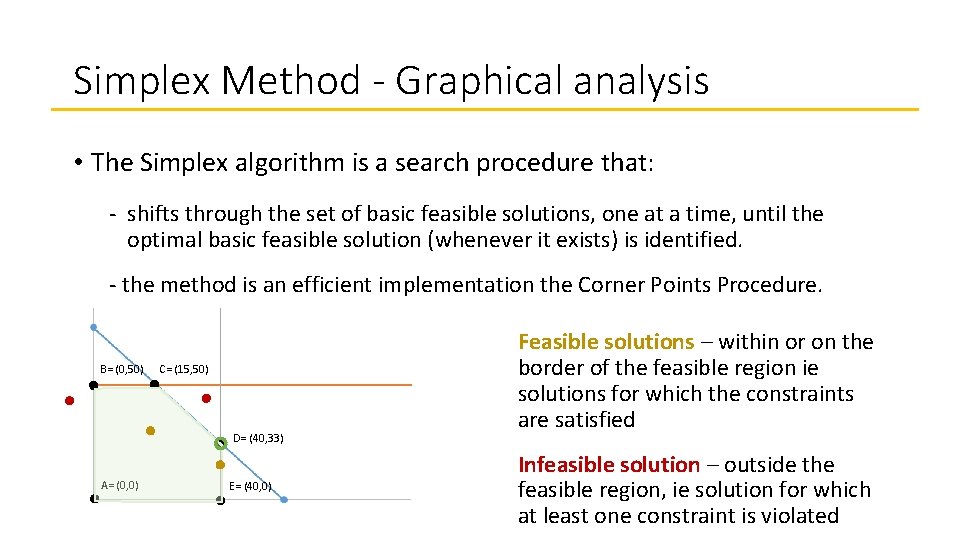
Simplex Method - Graphical analysis • The Simplex algorithm is a search procedure that: - shifts through the set of basic feasible solutions, one at a time, until the optimal basic feasible solution (whenever it exists) is identified. - the method is an efficient implementation the Corner Points Procedure. B= (0, 50) C= (15, 50) D= (40, 33) A= (0, 0) E= (40, 0) Feasible solutions – within or on the border of the feasible region ie solutions for which the constraints are satisfied Infeasible solution – outside the feasible region, ie solution for which at least one constraint is violated
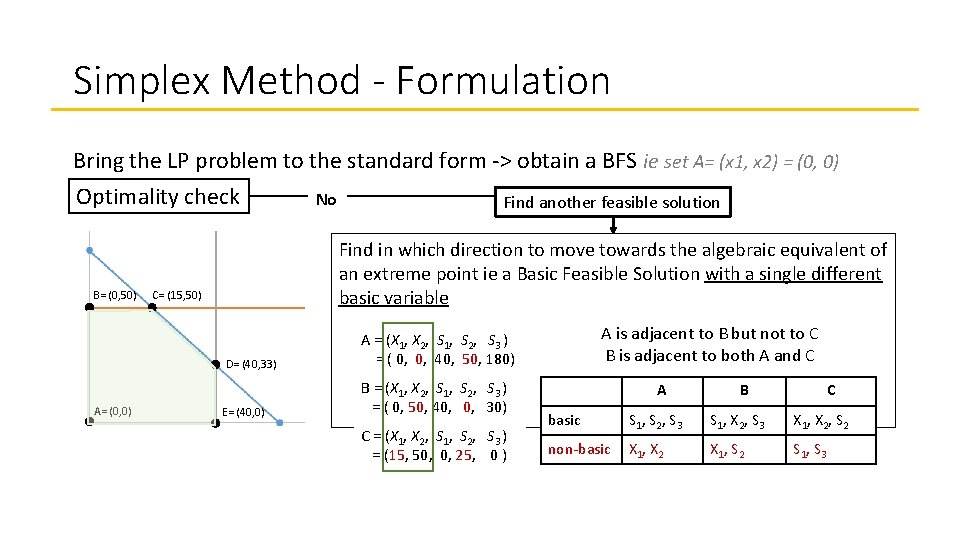
Simplex Method - Formulation Bring the LP problem to the standard form -> obtain a BFS ie set A= (x 1, x 2) = (0, 0) Optimality check B= (0, 50) No Find another feasible solution Find in which direction to move towards the algebraic equivalent of an extreme point ie a Basic Feasible Solution with a single different basic variable C= (15, 50) Swap the, Xnon-basic with. Aone of the to basic variables is adjacent B but not to C A = (X , S , S variable ) 1 D= (40, 33) 2 1 2 3 B is adjacent to both A and C 0, 0, 40, 50, 180) Apply= (Gaussian elimination to transform the new basic variable to B =while (X 1, X 2, solving S 1, S 2, Sfor (0, 1) 3) Z A= (0, 0) E= (40, 0) = ( 0, 50, 40, 0, 30) C = (X 1, X 2, S 1, S 2, S 3 ) = (15, 50, 0, 25, 0 ) A B C basic S 1 , S 2 , S 3 S 1 , X 2 , S 3 X 1 , X 2 , S 2 non-basic X 1 , X 2 X 1 , S 2 S 1 , S 3
Simplex Method Procedure
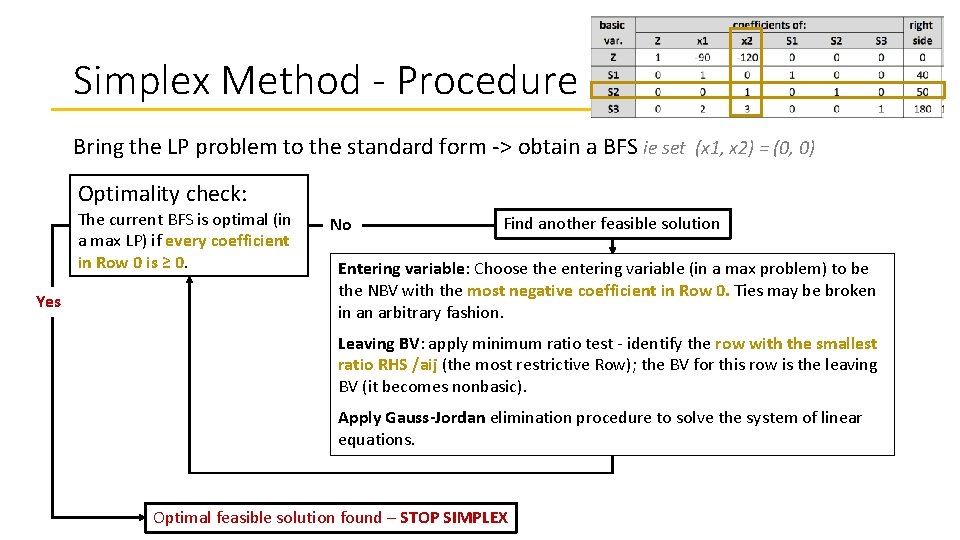
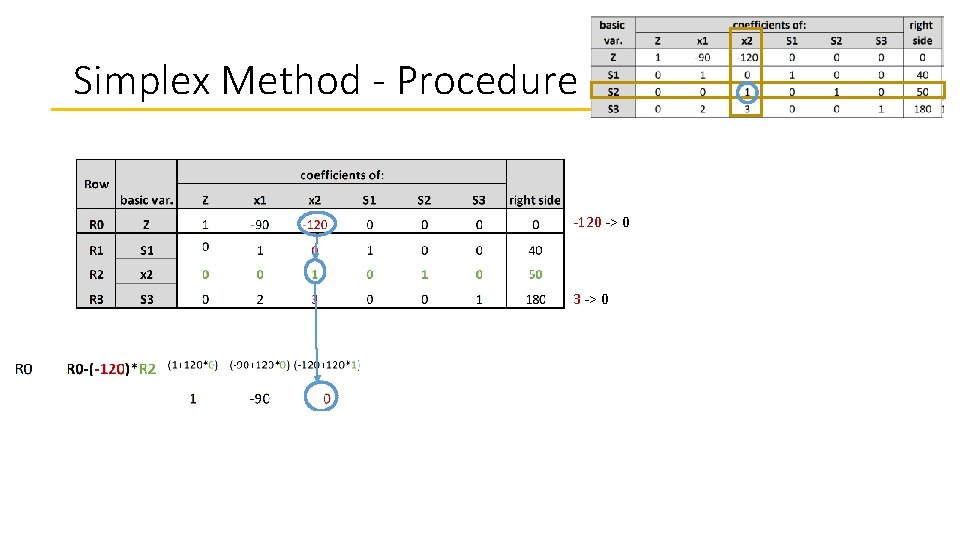
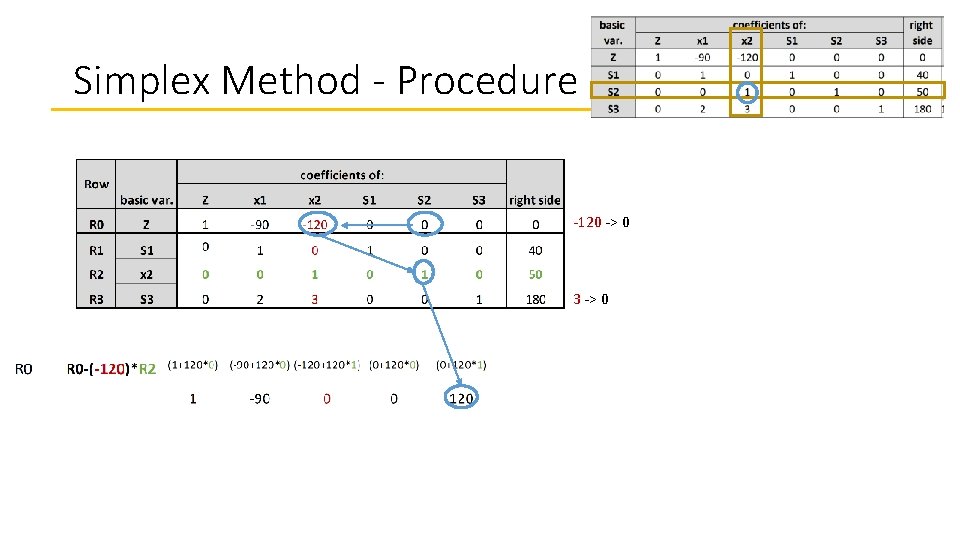
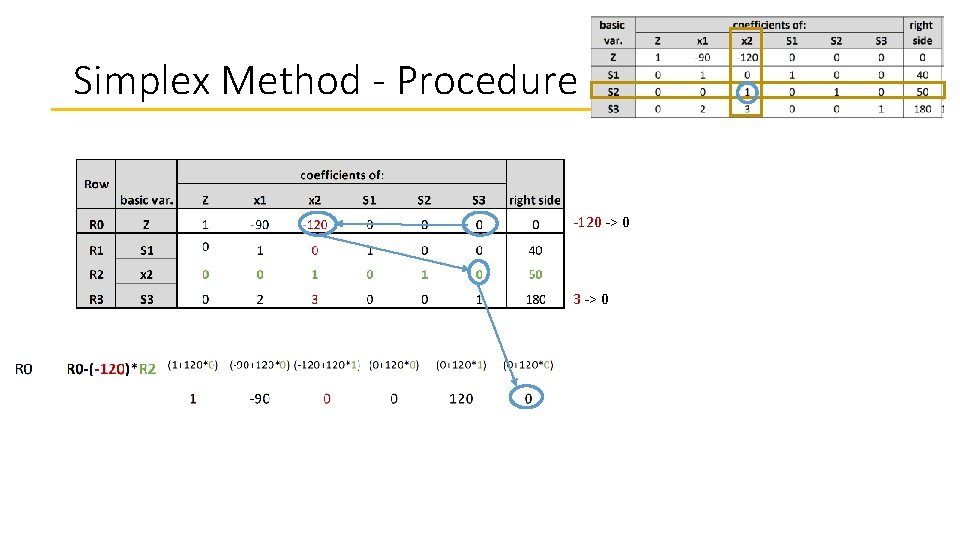
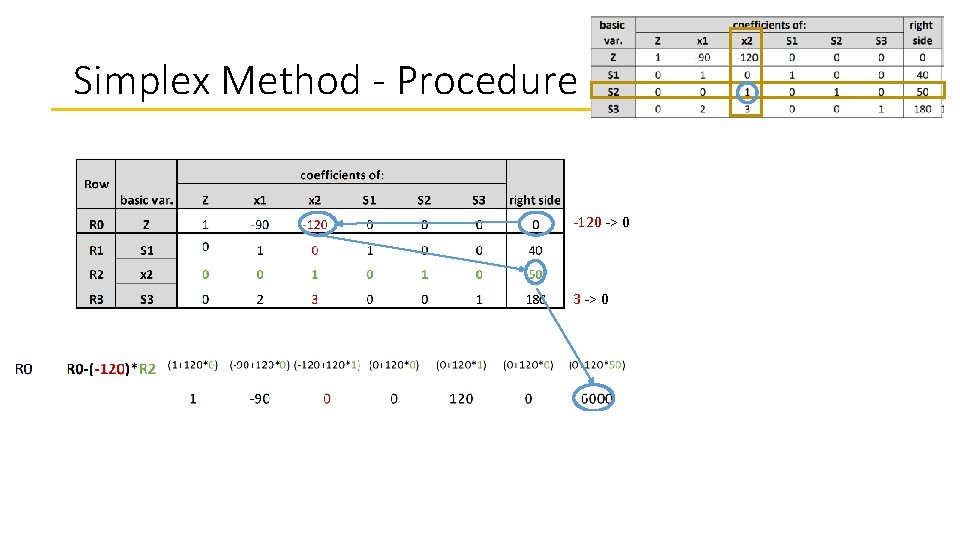
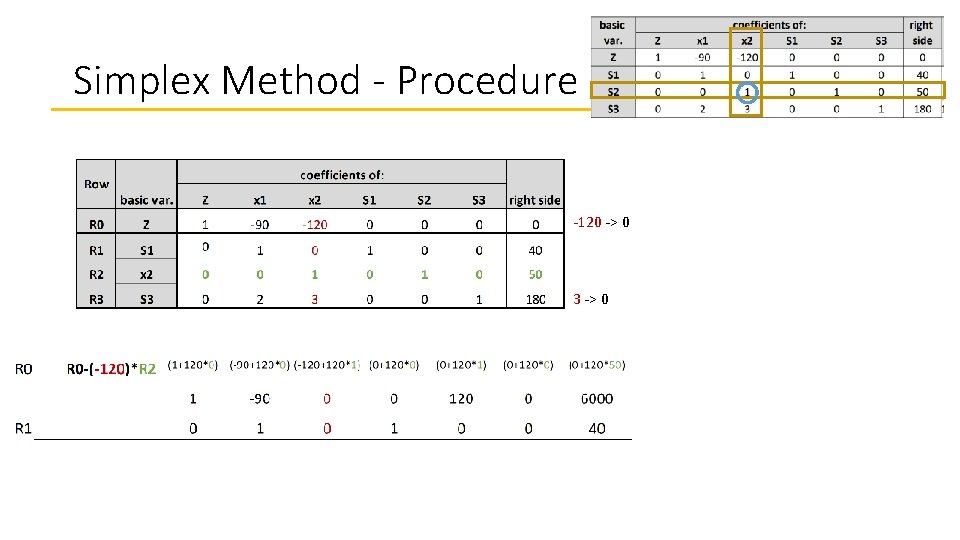
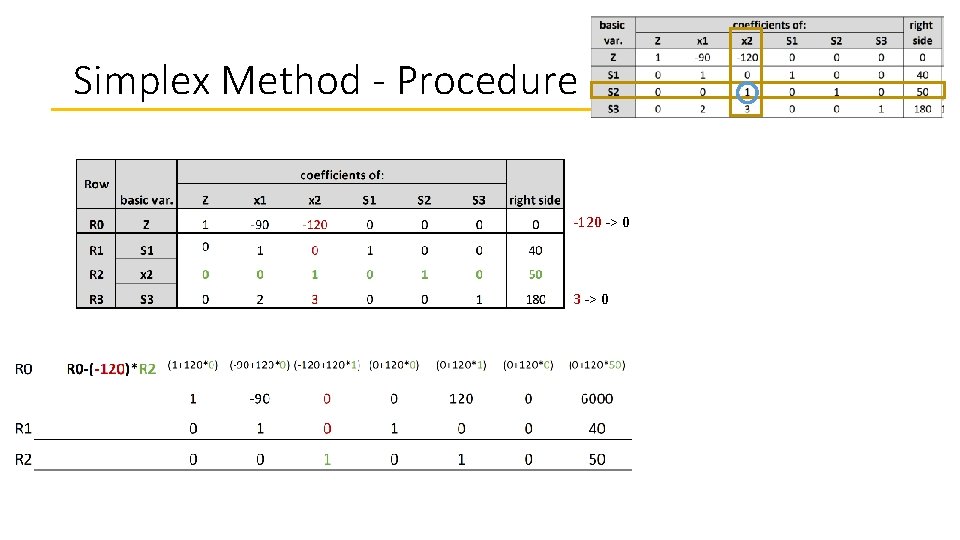
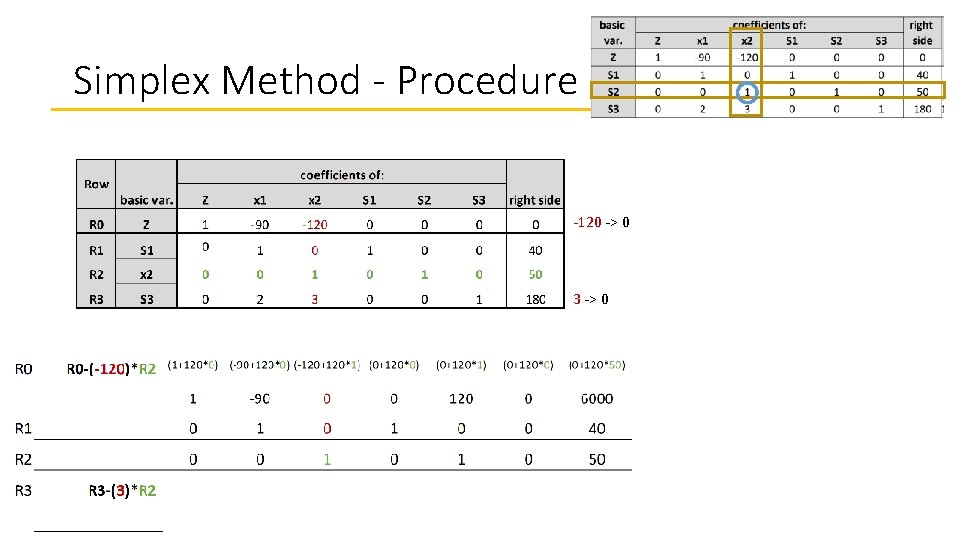
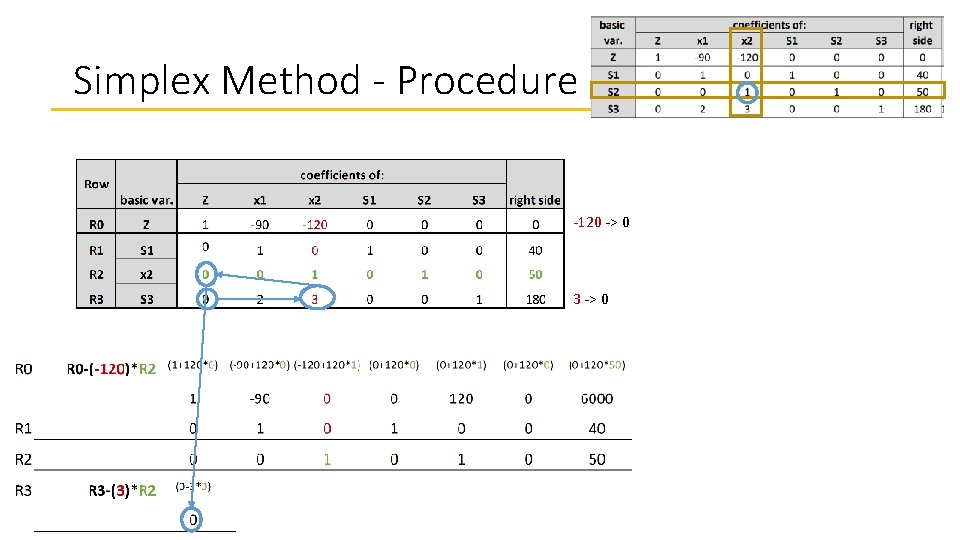
Simplex Method - Procedure Bring the LP problem to the standard form -> obtain a BFS ie set (x 1, x 2) = (0, 0) Optimality check: The current BFS is optimal (in a max LP) if every coefficient in Row 0 is ≥ 0. Yes No Find another feasible solution Entering variable: Choose the entering variable (in a max problem) to be the NBV with the most negative coefficient in Row 0. Ties may be broken in an arbitrary fashion. Leaving BV: apply minimum ratio test - identify the row with the smallest ratio RHS /aij (the most restrictive Row); the BV for this row is the leaving BV (it becomes nonbasic). Apply Gauss-Jordan elimination procedure to solve the system of linear equations. Optimal feasible solution found – STOP SIMPLEX
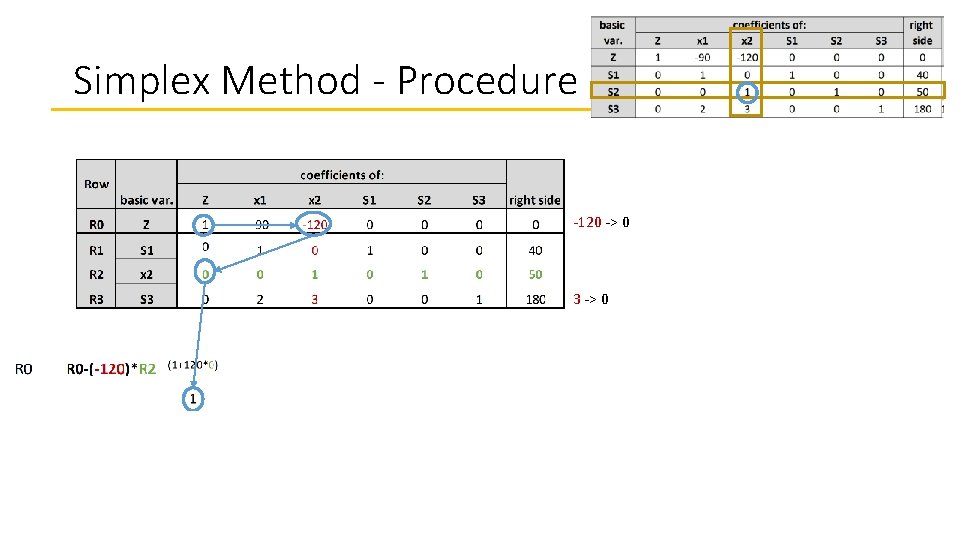
Simplex Method - Procedure -120 -> 0 3 -> 0
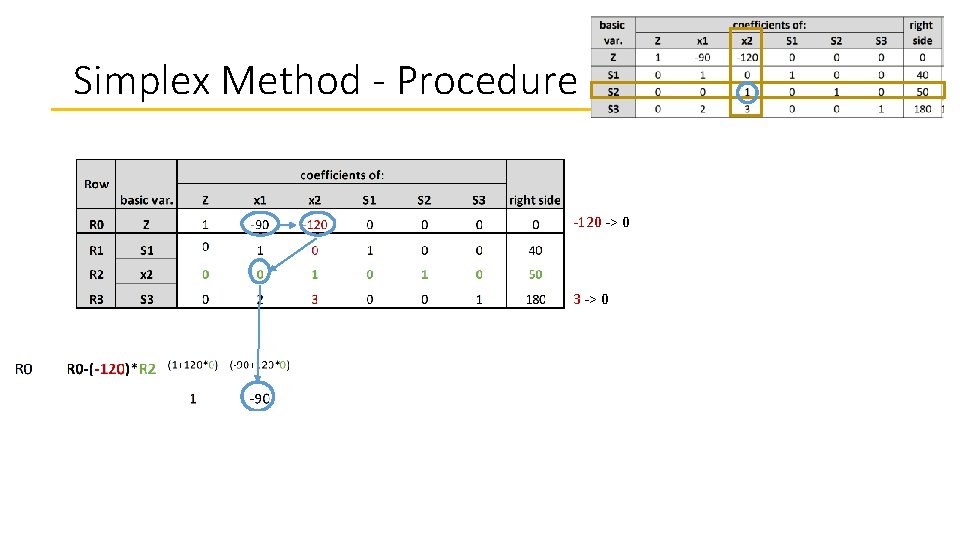
Simplex Method - Procedure -120 -> 0 3 -> 0
Simplex Method - Procedure -120 -> 0 3 -> 0

Simplex Method - Procedure -120 -> 0 3 -> 0
Simplex Method - Procedure -120 -> 0 3 -> 0
Simplex Method - Procedure -120 -> 0 3 -> 0
Simplex Method - Procedure -120 -> 0 3 -> 0
Simplex Method - Procedure -120 -> 0 3 -> 0
Simplex Method - Procedure -120 -> 0 3 -> 0
Simplex Method - Procedure -120 -> 0 3 -> 0
Simplex Method - Procedure -120 -> 0 3 -> 0
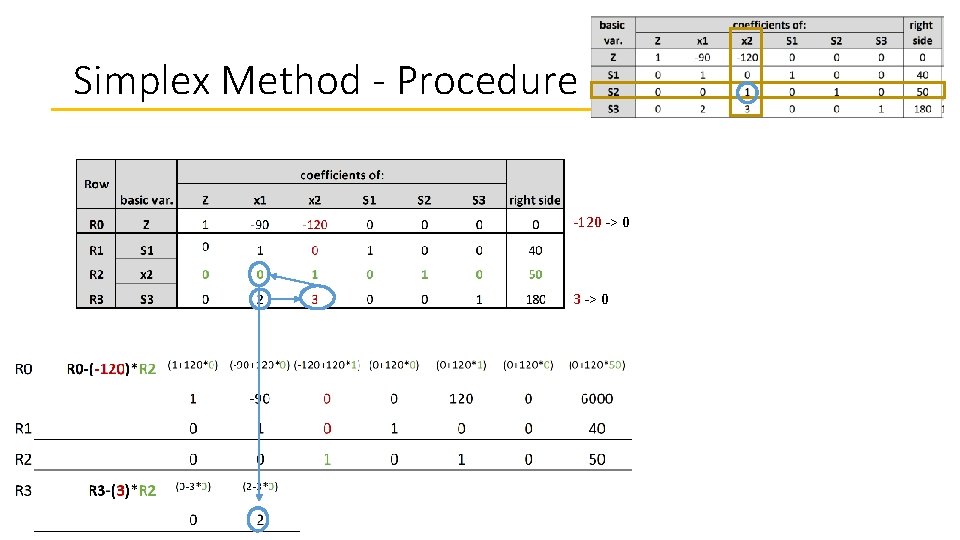
Simplex Method - Procedure -120 -> 0 3 -> 0
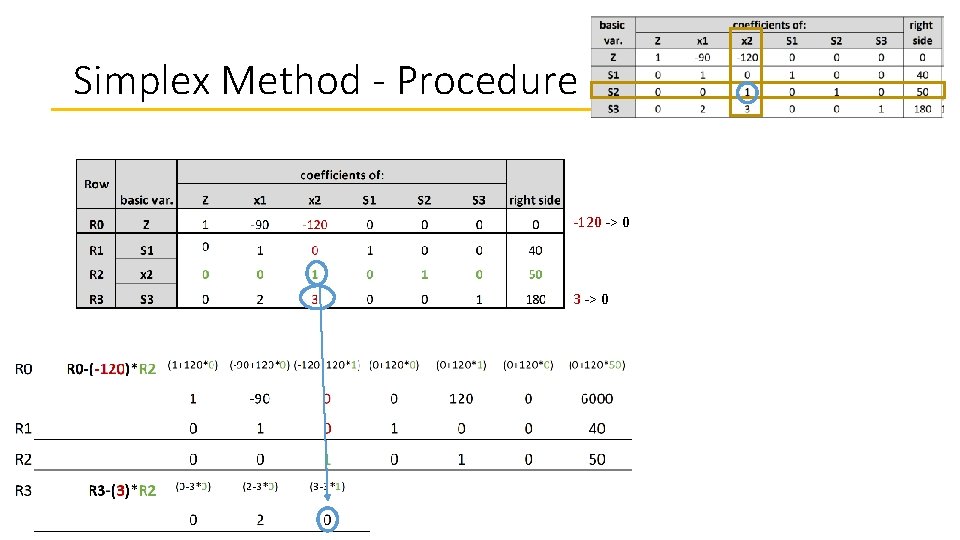
Simplex Method - Procedure -120 -> 0 3 -> 0
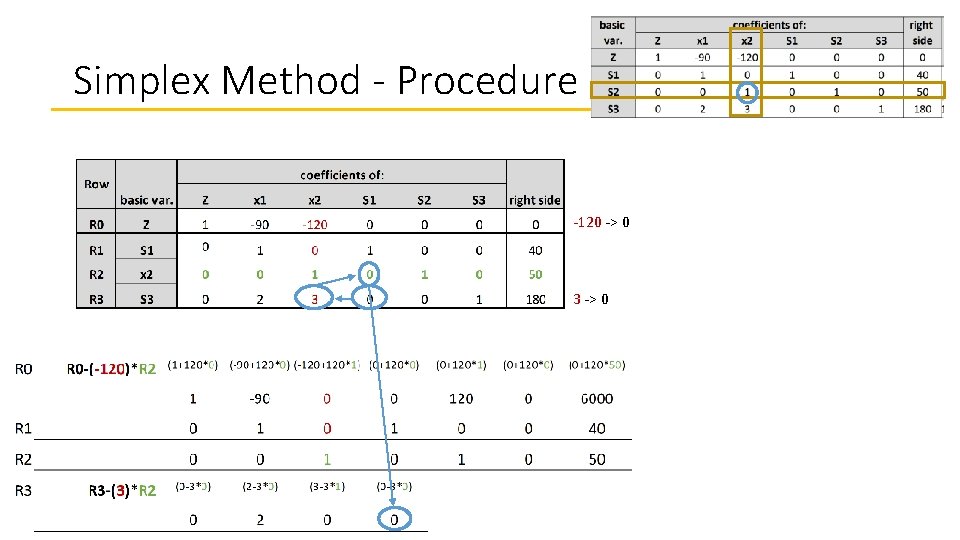
Simplex Method - Procedure -120 -> 0 3 -> 0
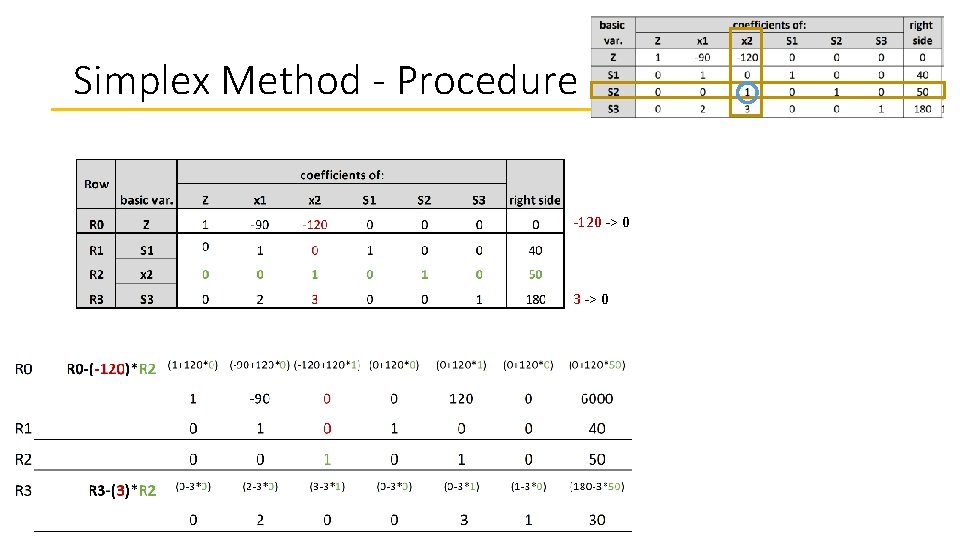
Simplex Method - Procedure -120 -> 0 3 -> 0
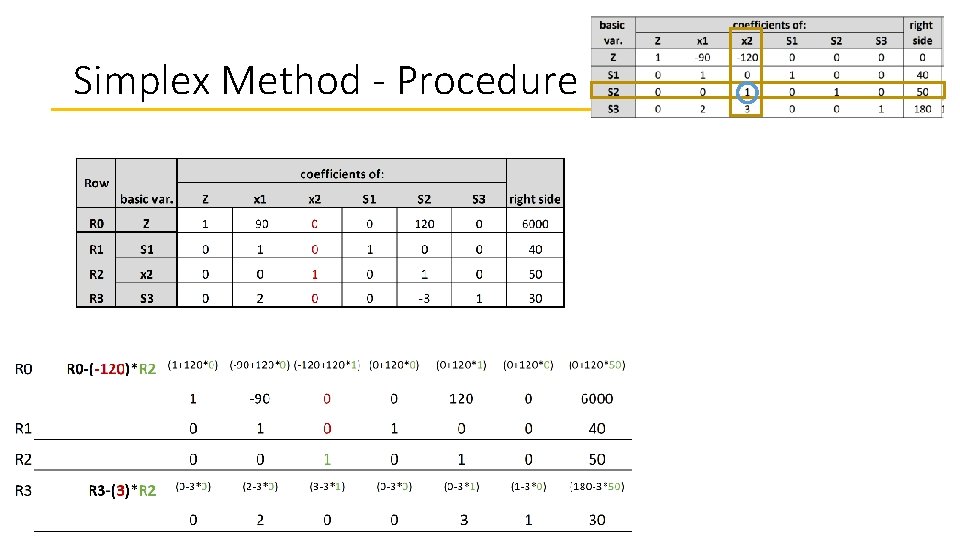
Simplex Method - Procedure
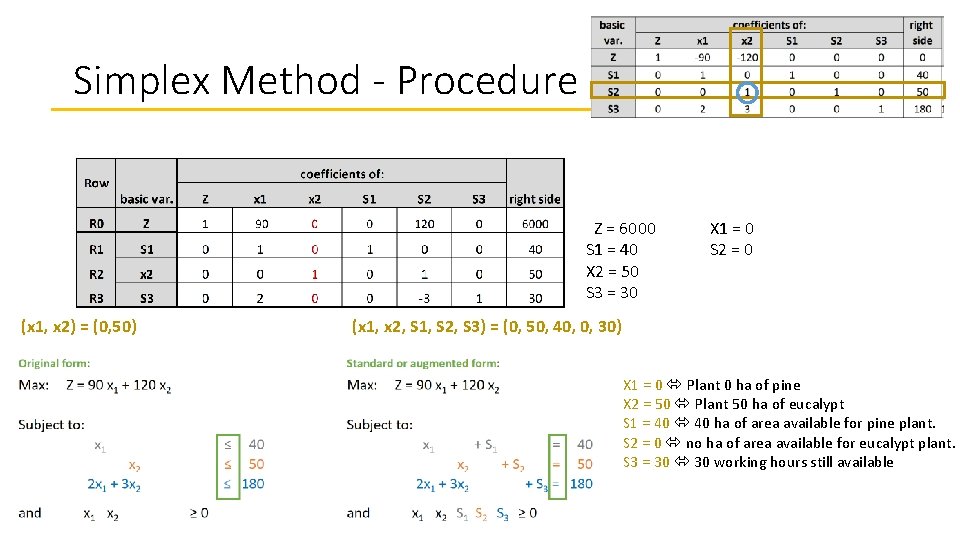
Simplex Method - Procedure Z = 6000 S 1 = 40 X 2 = 50 S 3 = 30 (x 1, x 2) = (0, 50) X 1 = 0 S 2 = 0 (x 1, x 2, S 1, S 2, S 3) = (0, 50, 40, 0, 30) X 1 = 0 Plant 0 ha of pine X 2 = 50 Plant 50 ha of eucalypt S 1 = 40 ha of area available for pine plant. S 2 = 0 no ha of area available for eucalypt plant. S 3 = 30 working hours still available

Simplex Method - Procedure (x 1, x 2) = (0, 0) Z = 6000 S 1 = 40 X 2 = 50 S 3 = 30 (x 1, x 2) = (0, 50) (x 1, x 2, S 1, S 2, S 3) = (0, 0, 40, 50, 180) X 1 = 0 S 2 = 0 (x 1, x 2, S 1, S 2, S 3) = (0, 50, 40, 0, 30) The basic variables in these solutions differ in one single variable (S 1 and S 3 are maintained as basic variables) These are adjacent solutions
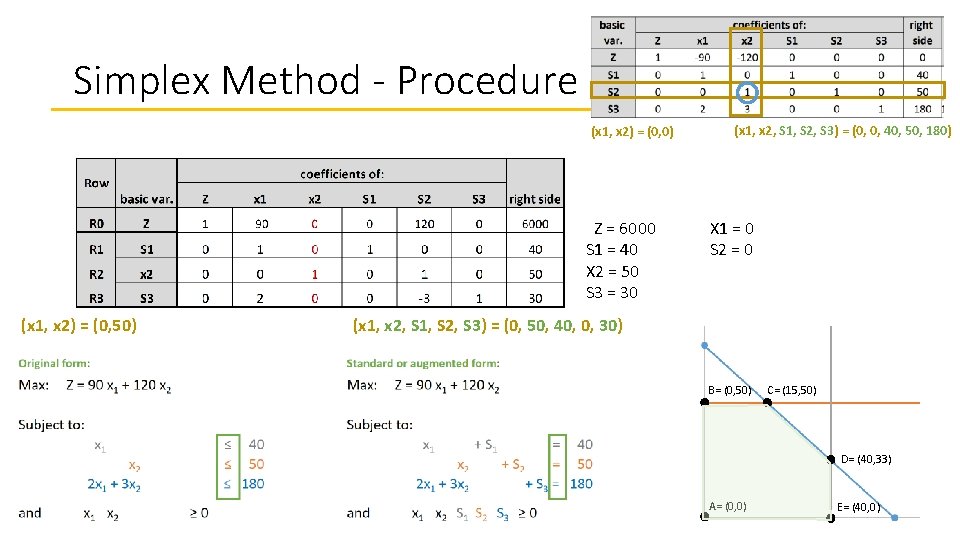
Simplex Method - Procedure (x 1, x 2) = (0, 0) Z = 6000 S 1 = 40 X 2 = 50 S 3 = 30 (x 1, x 2) = (0, 50) (x 1, x 2, S 1, S 2, S 3) = (0, 0, 40, 50, 180) X 1 = 0 S 2 = 0 (x 1, x 2, S 1, S 2, S 3) = (0, 50, 40, 0, 30) B= (0, 50) C= (15, 50) D= (40, 33) A= (0, 0) E= (40, 0)
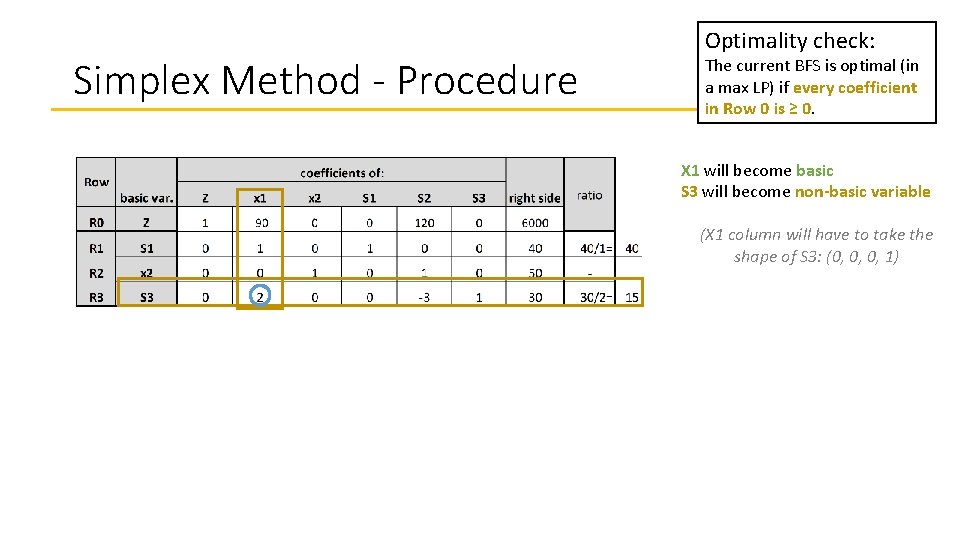
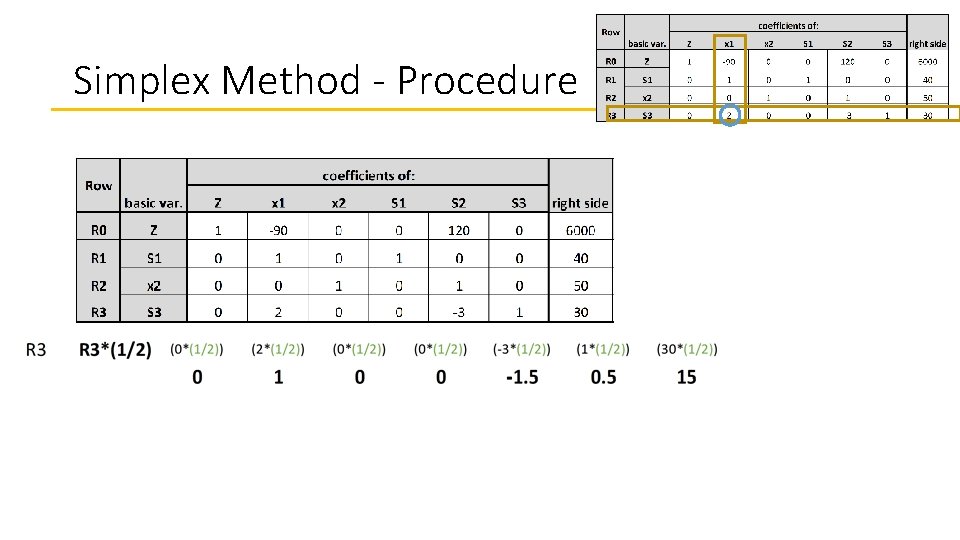
Simplex Method - Procedure Optimality check: The current BFS is optimal (in a max LP) if every coefficient in Row 0 is ≥ 0. X 1 will become basic S 3 will become non-basic variable (X 1 column will have to take the shape of S 3: (0, 0, 0, 1)
Simplex Method - Procedure
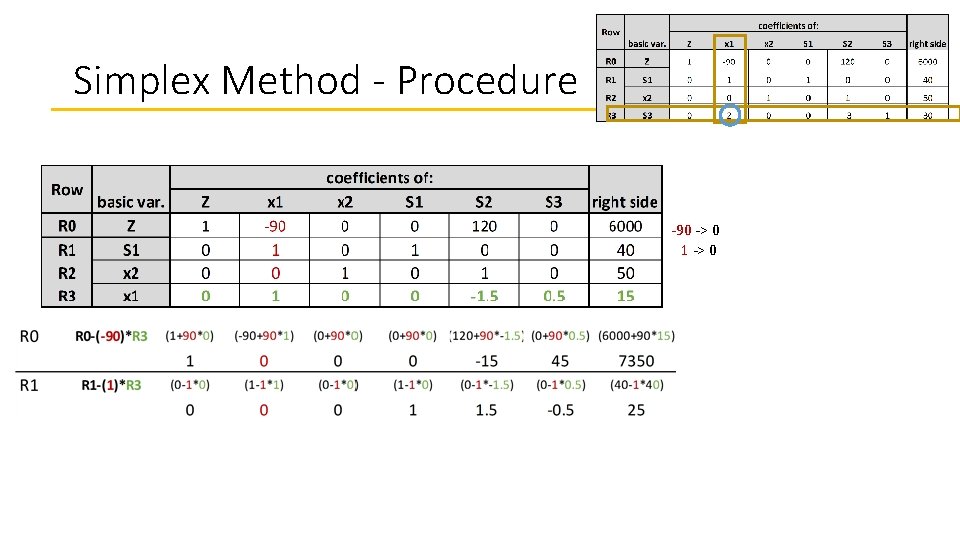
Simplex Method - Procedure -90 -> 0 1 -> 0
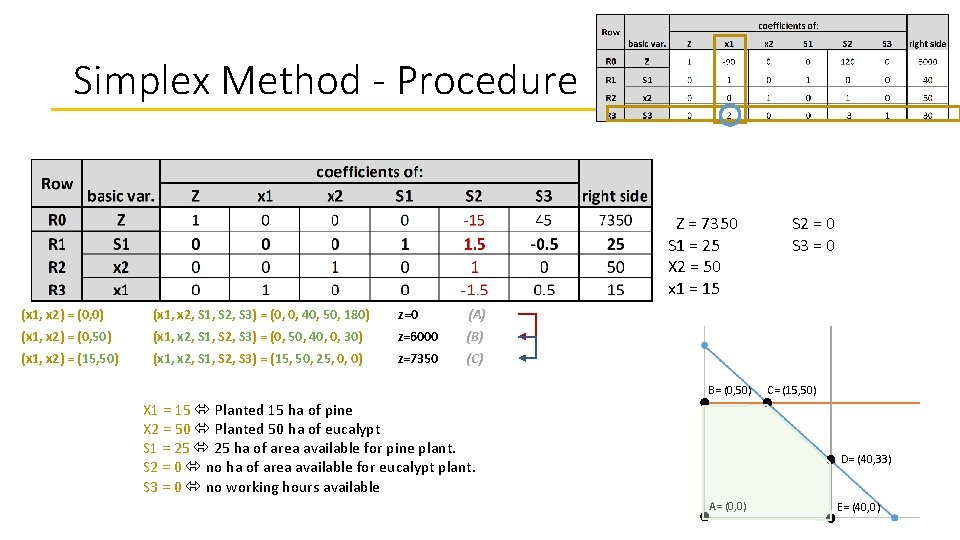
Simplex Method - Procedure Z = 7350 S 1 = 25 X 2 = 50 x 1 = 15 (x 1, x 2) = (0, 0) (x 1, x 2, S 1, S 2, S 3) = (0, 0, 40, 50, 180) z=0 (A) (x 1, x 2) = (0, 50) (x 1, x 2, S 1, S 2, S 3) = (0, 50, 40, 0, 30) z=6000 (B) (x 1, x 2) = (15, 50) (x 1, x 2, S 1, S 2, S 3) = (15, 50, 25, 0, 0) z=7350 (C) B= (0, 50) X 1 = 15 Planted 15 ha of pine X 2 = 50 Planted 50 ha of eucalypt S 1 = 25 ha of area available for pine plant. S 2 = 0 no ha of area available for eucalypt plant. S 3 = 0 no working hours available S 2 = 0 S 3 = 0 C= (15, 50) D= (40, 33) A= (0, 0) E= (40, 0)
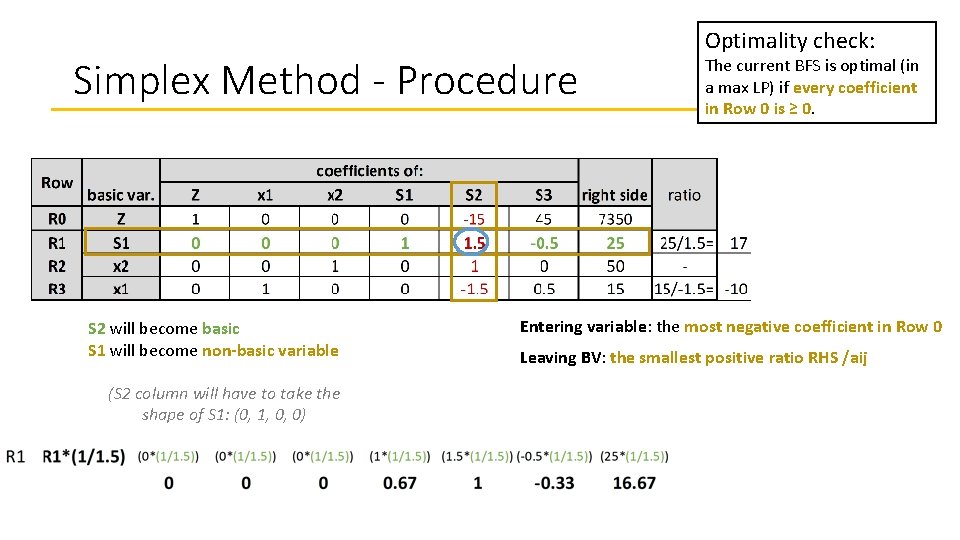
Simplex Method - Procedure S 2 will become basic S 1 will become non-basic variable (S 2 column will have to take the shape of S 1: (0, 1, 0, 0) Optimality check: The current BFS is optimal (in a max LP) if every coefficient in Row 0 is ≥ 0. Entering variable: the most negative coefficient in Row 0 Leaving BV: the smallest positive ratio RHS /aij
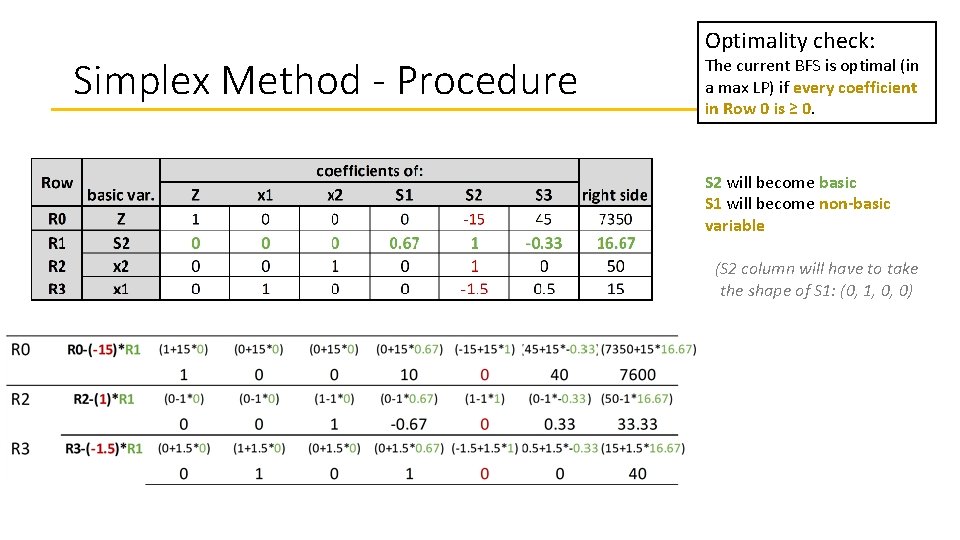
Simplex Method - Procedure Optimality check: The current BFS is optimal (in a max LP) if every coefficient in Row 0 is ≥ 0. S 2 will become basic S 1 will become non-basic variable (S 2 column will have to take the shape of S 1: (0, 1, 0, 0)
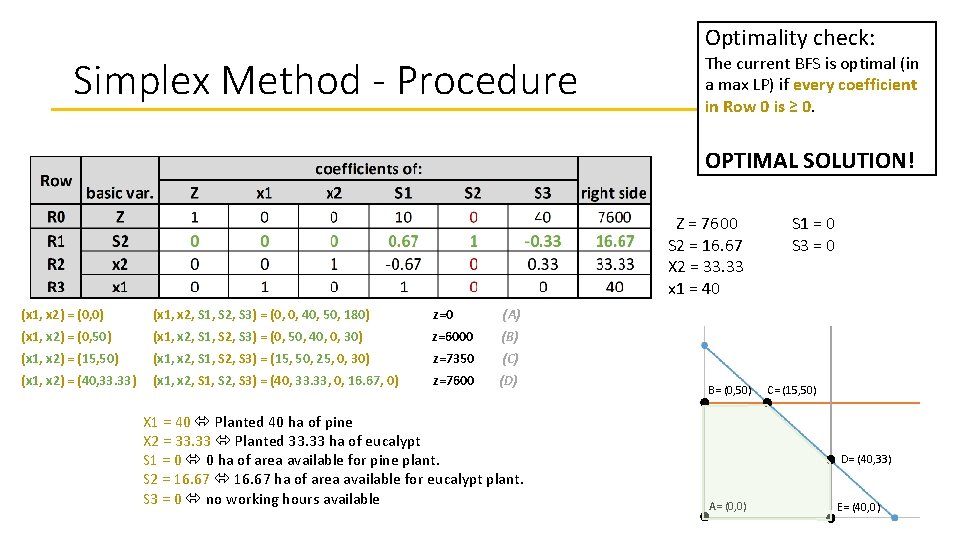
Optimality check: Simplex Method - Procedure The current BFS is optimal (in a max LP) if every coefficient in Row 0 is ≥ 0. OPTIMAL SOLUTION! Z = 7600 S 2 = 16. 67 X 2 = 33. 33 x 1 = 40 (x 1, x 2) = (0, 0) (x 1, x 2, S 1, S 2, S 3) = (0, 0, 40, 50, 180) z=0 (A) (x 1, x 2) = (0, 50) (x 1, x 2, S 1, S 2, S 3) = (0, 50, 40, 0, 30) z=6000 (B) (x 1, x 2) = (15, 50) (x 1, x 2, S 1, S 2, S 3) = (15, 50, 25, 0, 30) z=7350 (C) (x 1, x 2) = (40, 33. 33) (x 1, x 2, S 1, S 2, S 3) = (40, 33. 33, 0, 16. 67, 0) z=7600 (D) X 1 = 40 Planted 40 ha of pine X 2 = 33. 33 Planted 33. 33 ha of eucalypt S 1 = 0 0 ha of area available for pine plant. S 2 = 16. 67 ha of area available for eucalypt plant. S 3 = 0 no working hours available B= (0, 50) S 1 = 0 S 3 = 0 C= (15, 50) D= (40, 33) A= (0, 0) E= (40, 0)
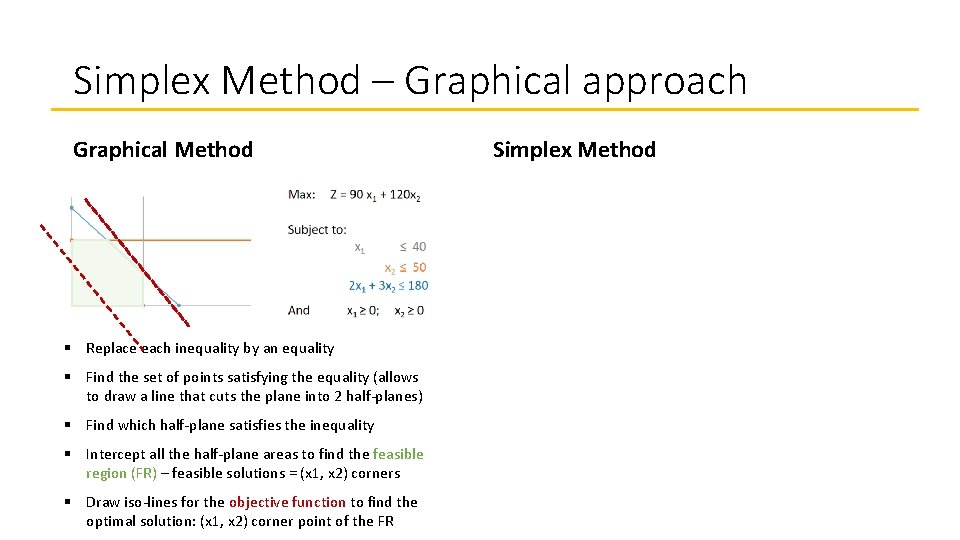
Simplex Method – Graphical approach Graphical Method § Replace each inequality by an equality § Find the set of points satisfying the equality (allows to draw a line that cuts the plane into 2 half-planes) § Find which half-plane satisfies the inequality § Intercept all the half-plane areas to find the feasible region (FR) – feasible solutions = (x 1, x 2) corners § Draw iso-lines for the objective function to find the optimal solution: (x 1, x 2) corner point of the FR Simplex Method
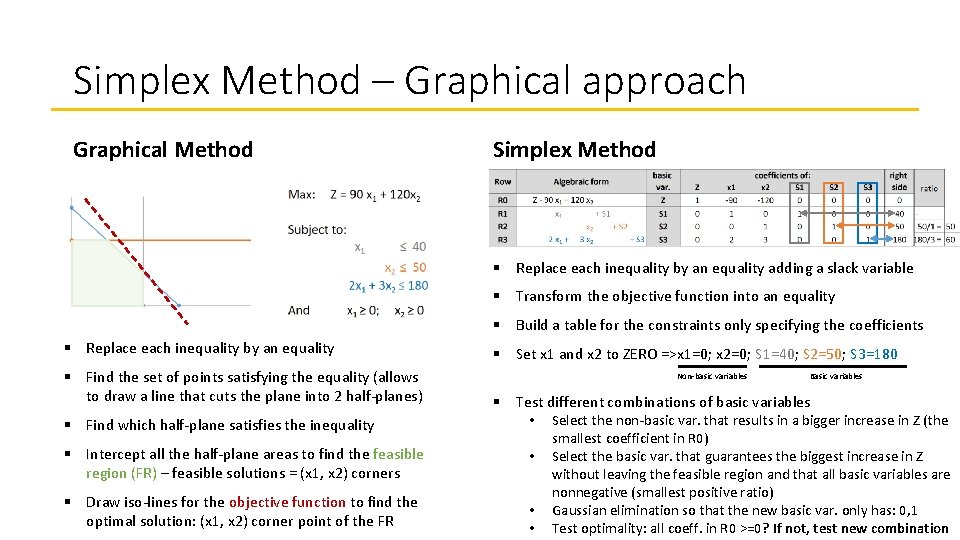
Simplex Method – Graphical approach Graphical Method Simplex Method § Replace each inequality by an equality adding a slack variable § Transform the objective function into an equality § Build a table for the constraints only specifying the coefficients § Replace each inequality by an equality § Find the set of points satisfying the equality (allows to draw a line that cuts the plane into 2 half-planes) § Set x 1 and x 2 to ZERO =>x 1=0; x 2=0; S 1=40; S 2=50; S 3=180 Non-basic variables § Test different combinations of basic variables § Find which half-plane satisfies the inequality • § Intercept all the half-plane areas to find the feasible region (FR) – feasible solutions = (x 1, x 2) corners • § Draw iso-lines for the objective function to find the optimal solution: (x 1, x 2) corner point of the FR Basic variables • • Select the non-basic var. that results in a bigger increase in Z (the smallest coefficient in R 0) Select the basic var. that guarantees the biggest increase in Z without leaving the feasible region and that all basic variables are nonnegative (smallest positive ratio) Gaussian elimination so that the new basic var. only has: 0, 1 Test optimality: all coeff. in R 0 >=0? If not, test new combination
Simplex Method Particular cases
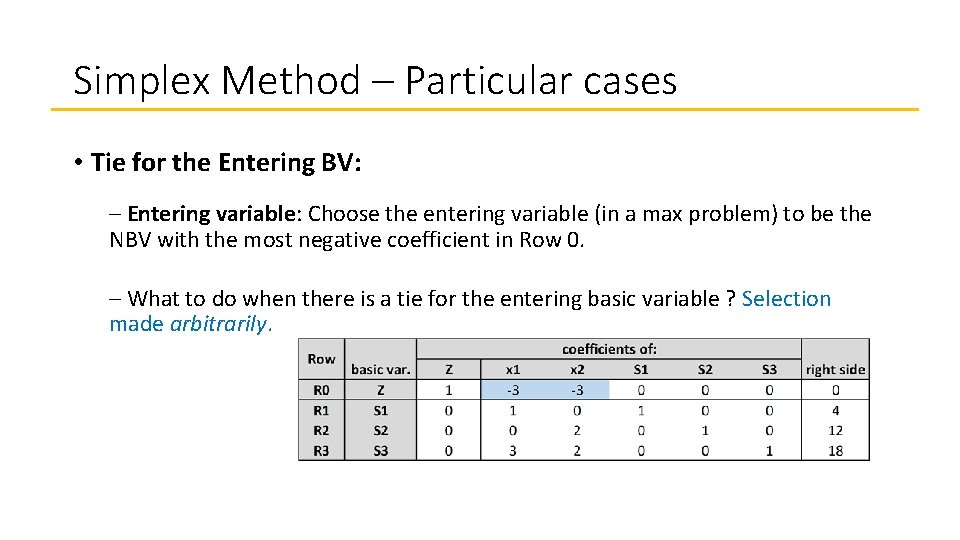
Simplex Method – Particular cases • Tie for the Entering BV: – Entering variable: Choose the entering variable (in a max problem) to be the NBV with the most negative coefficient in Row 0. – What to do when there is a tie for the entering basic variable ? Selection made arbitrarily.
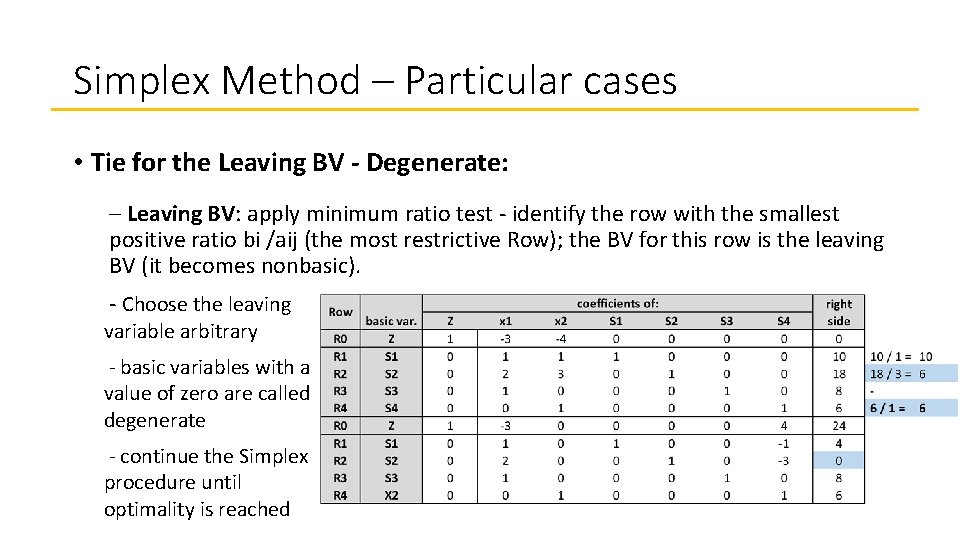
Simplex Method – Particular cases • Tie for the Leaving BV - Degenerate: – Leaving BV: apply minimum ratio test - identify the row with the smallest positive ratio bi /aij (the most restrictive Row); the BV for this row is the leaving BV (it becomes nonbasic). - Choose the leaving variable arbitrary - basic variables with a value of zero are called degenerate - continue the Simplex procedure until optimality is reached
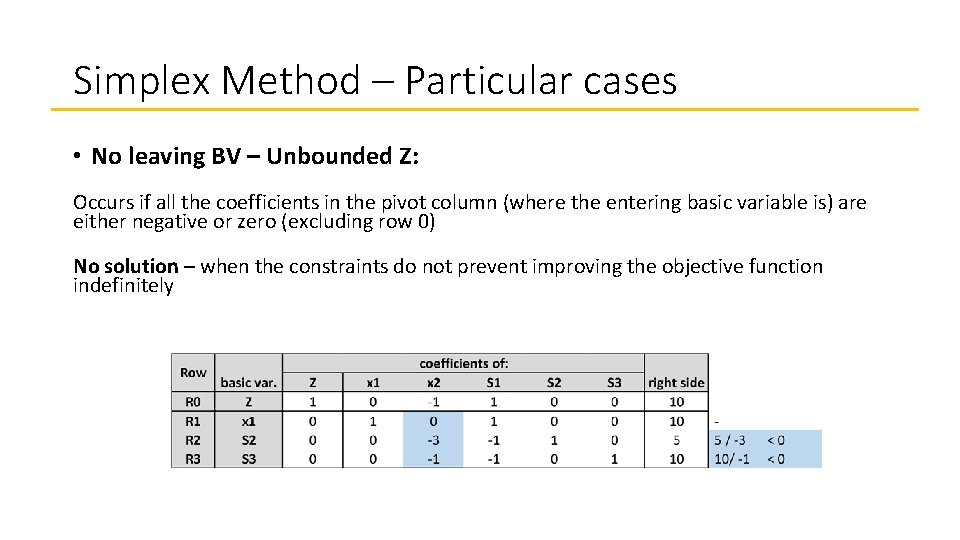
Simplex Method – Particular cases • No leaving BV – Unbounded Z: Occurs if all the coefficients in the pivot column (where the entering basic variable is) are either negative or zero (excluding row 0) No solution – when the constraints do not prevent improving the objective function indefinitely
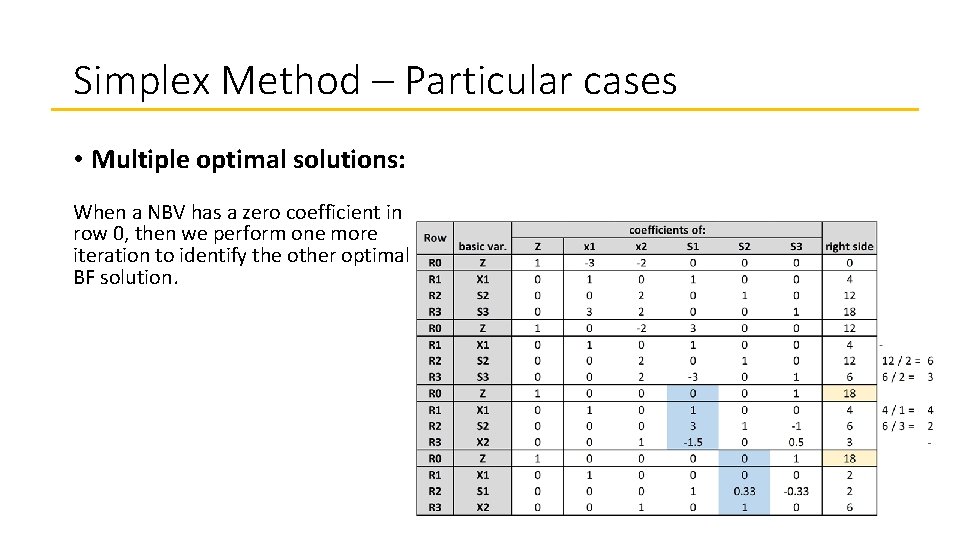
Simplex Method – Particular cases • Multiple optimal solutions: When a NBV has a zero coefficient in row 0, then we perform one more iteration to identify the other optimal BF solution.
Simplex Method Other cases Minimization of the objective function Negative Right Hand Sides Eliminating negative variables Functional constraints in ≥ and = form Eliminating unconstrained variables
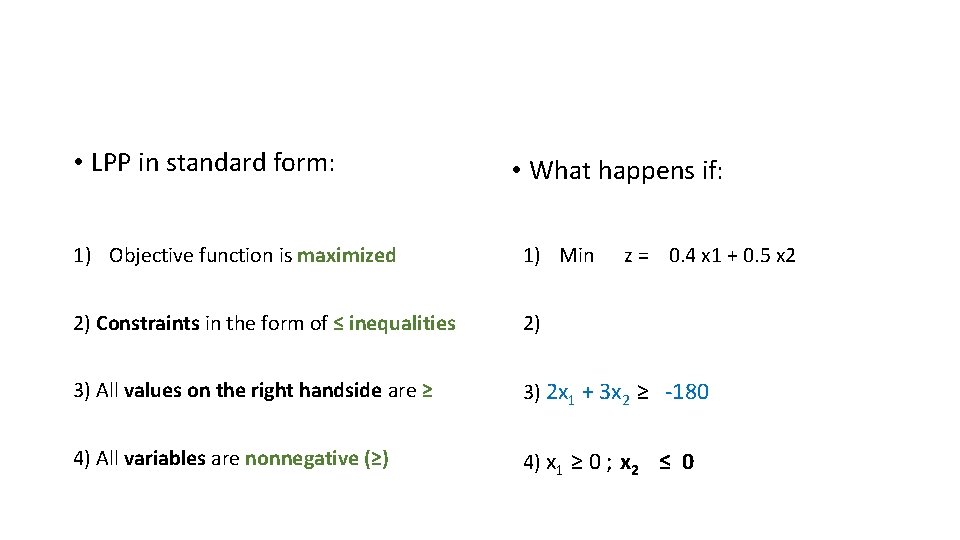
• LPP in standard form: • What happens if: 1) Objective function is maximized 1) Min 2) Constraints in the form of ≤ inequalities 2) 3) All values on the right handside are ≥ 3) 2 x 1 + 3 x 2 ≥ -180 4) All variables are nonnegative (≥) 4) x 1 ≥ 0 ; x 2 ≤ 0 z = 0. 4 x 1 + 0. 5 x 2
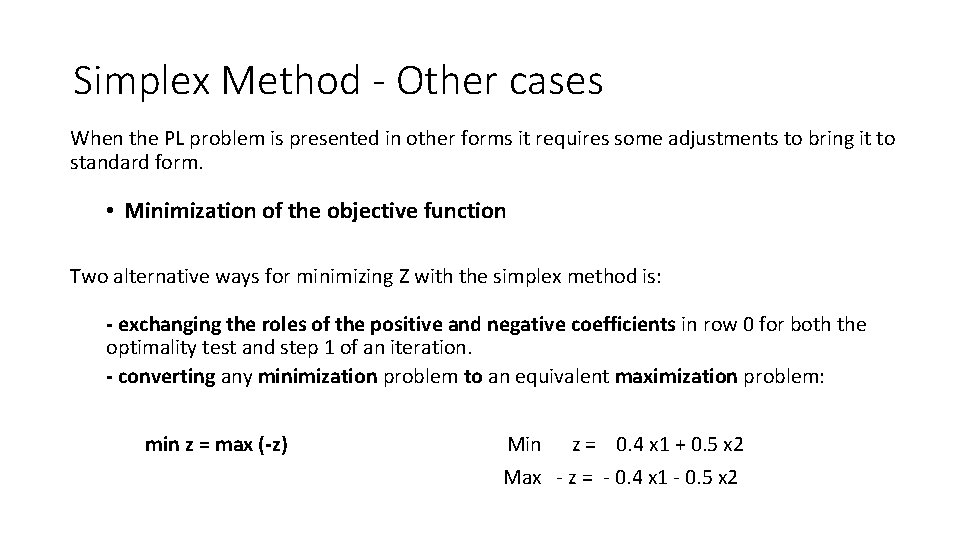
Simplex Method - Other cases When the PL problem is presented in other forms it requires some adjustments to bring it to standard form. • Minimization of the objective function Two alternative ways for minimizing Z with the simplex method is: - exchanging the roles of the positive and negative coefficients in row 0 for both the optimality test and step 1 of an iteration. - converting any minimization problem to an equivalent maximization problem: min z = max (-z) Min z = 0. 4 x 1 + 0. 5 x 2 Max - z = - 0. 4 x 1 - 0. 5 x 2
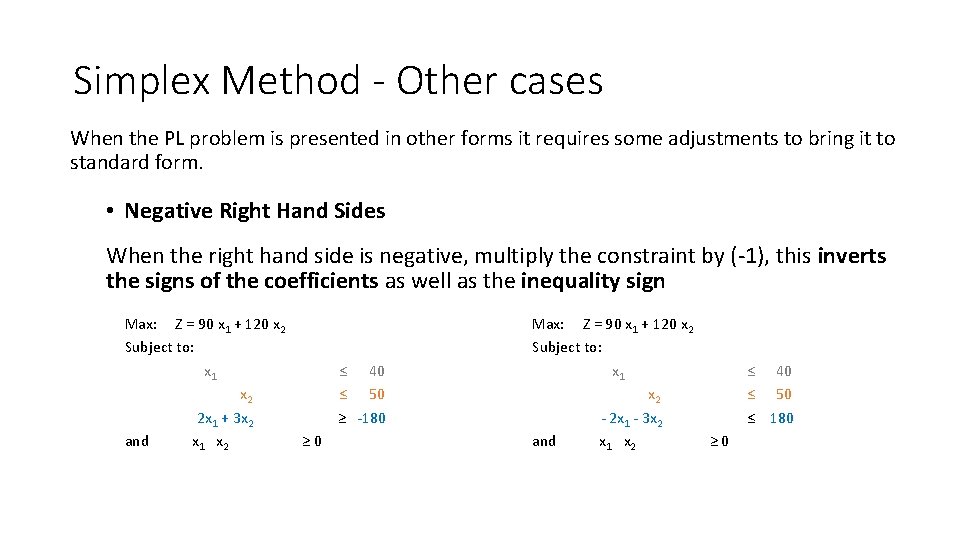
Simplex Method - Other cases When the PL problem is presented in other forms it requires some adjustments to bring it to standard form. • Negative Right Hand Sides When the right hand side is negative, multiply the constraint by (-1), this inverts the signs of the coefficients as well as the inequality sign Max: Z = 90 x 1 + 120 x 2 Subject to: x 1 + S 1 ≤ 40 x 2 + S 2 ≤ 50 2 x 1 + 3 x 2 + S 3 ≥ -180 and x 1 x 2 S 1 S 2 S 3 ≥ 0 Max: Z = 90 x 1 + 120 x 2 Subject to: x 1 + S 1 ≤ 40 x 2 + S 2 ≤ 50 - 2 x 1 - 3 x 2 + S 3 ≤ 180 and x 1 x 2 S 1 S 2 S 3 ≥ 0
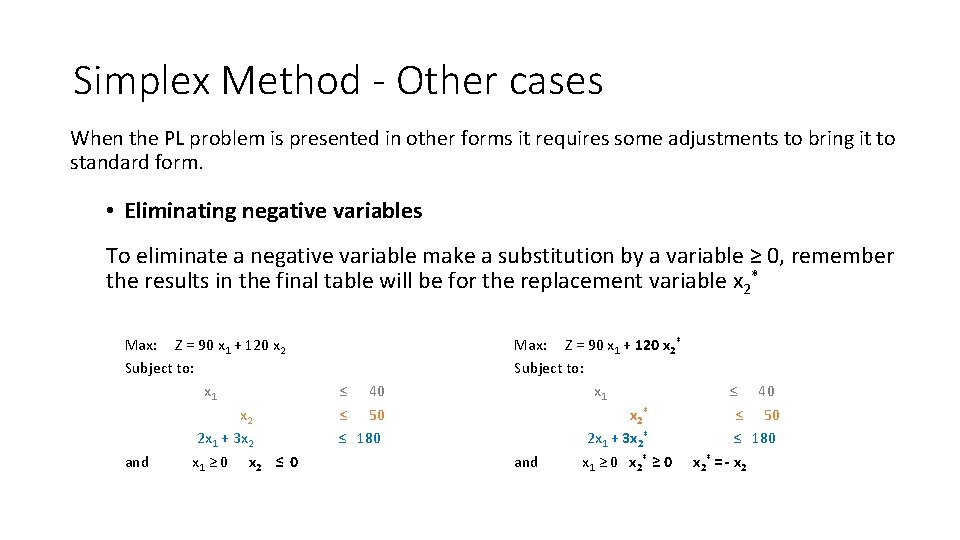
Simplex Method - Other cases When the PL problem is presented in other forms it requires some adjustments to bring it to standard form. • Eliminating negative variables To eliminate a negative variable make a substitution by a variable ≥ 0, remember the results in the final table will be for the replacement variable x 2* Max: Z = 90 x 1 + 120 x 2 Subject to: x 1 + S 1 ≤ 40 x 2 + S 2 ≤ 50 2 x 1 + 3 x 2 + S 3 ≤ 180 and x 1 ≥ 0 x 2 ≤ 0 Max: Z = 90 x 1 + 120 x 2* Subject to: x 1 + S 1 ≤ 40 x 2 * + S 2 ≤ 50 2 x 1 + 3 x 2* + S 3 ≤ 180 and x 1 ≥ 0 x 2 * = - x 2
Simplex Method - Other cases When the PL problem is presented in other forms it requires some adjustments to bring it to standard form. • Functional constraints in ≥ or = forms Require the use the artificial-variable technique, introducing dummy variables or artificial variables into each constraint that needs one. This new variable is introduced just for the purpose of being the initial BV for that equation Non-negativity constraints are placed on these variables, and the objective function also is modified to impose an exorbitant penalty on their having values larger than zero Then the iterations of the simplex method will automatically force the artificial variables to disappear (become zero), one at a time, until they are all gone and the real problem is solved
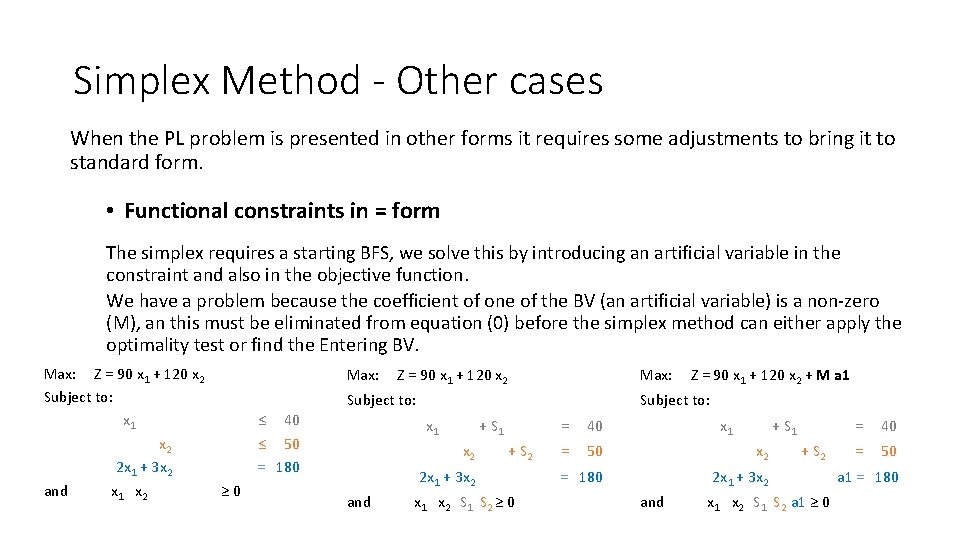
Simplex Method - Other cases When the PL problem is presented in other forms it requires some adjustments to bring it to standard form. • Functional constraints in = form The simplex requires a starting BFS, we solve this by introducing an artificial variable in the constraint and also in the objective function. We have a problem because the coefficient of one of the BV (an artificial variable) is a non-zero (M), an this must be eliminated from equation (0) before the simplex method can either apply the optimality test or find the Entering BV. Max: Z = 90 x 1 + 120 x 2 Subject to: x 1 + S 1 ≤ 40 x 2 + S 2 ≤ 50 2 x 1 + 3 x 2 + S 3 = 180 and x 1 x 2 S 1 S 2 S 3 ≥ 0 Max: Z = 90 x 1 + 120 x 2 Max: Subject to: x 1 + S 1 x 2 = 40 = 50 x 2 + S 3 = 180 2 x 1 + 3 x 2 + S 2 2 x 1 + 3 x 2 and Z = 90 x 1 + 120 x 2 + M a 1 x 2 S 1 S 2 ≥ 0 x 1 and + S 1 + S 2 = 40 = 50 + a 1 = 180 x 1 x 2 S 1 S 2 a 1 ≥ 0
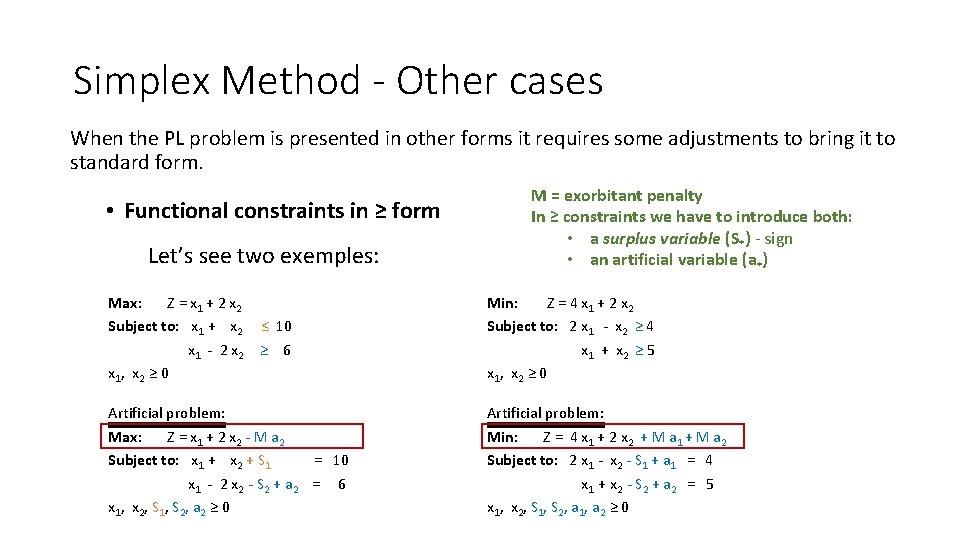
Simplex Method - Other cases When the PL problem is presented in other forms it requires some adjustments to bring it to standard form. • Functional constraints in ≥ form Let’s see two exemples: Max: Z = x 1 + 2 x 2 Subject to: x 1 + x 2 x 1 - 2 x 1 , x 2 ≥ 0 ≤ 10 ≥ 6 Artificial problem: Max: Z = x 1 + 2 x 2 - M a 2 Subject to: x 1 + x 2 + S 1 = 10 x 1 - 2 x 2 - S 2 + a 2 = 6 x 1 , x 2 , S 1 , S 2 , a 2 ≥ 0 M = exorbitant penalty In ≥ constraints we have to introduce both: • a surplus variable (S*) - sign • an artificial variable (a*) Min: Z = 4 x 1 + 2 x 2 Subject to: 2 x 1 - x 2 ≥ 4 x 1 + x 2 ≥ 5 x 1 , x 2 ≥ 0 Artificial problem: Min: Z = 4 x 1 + 2 x 2 + M a 1 + M a 2 Subject to: 2 x 1 - x 2 - S 1 + a 1 = 4 x 1 + x 2 - S 2 + a 2 = 5 x 1 , x 2 , S 1 , S 2 , a 1 , a 2 ≥ 0
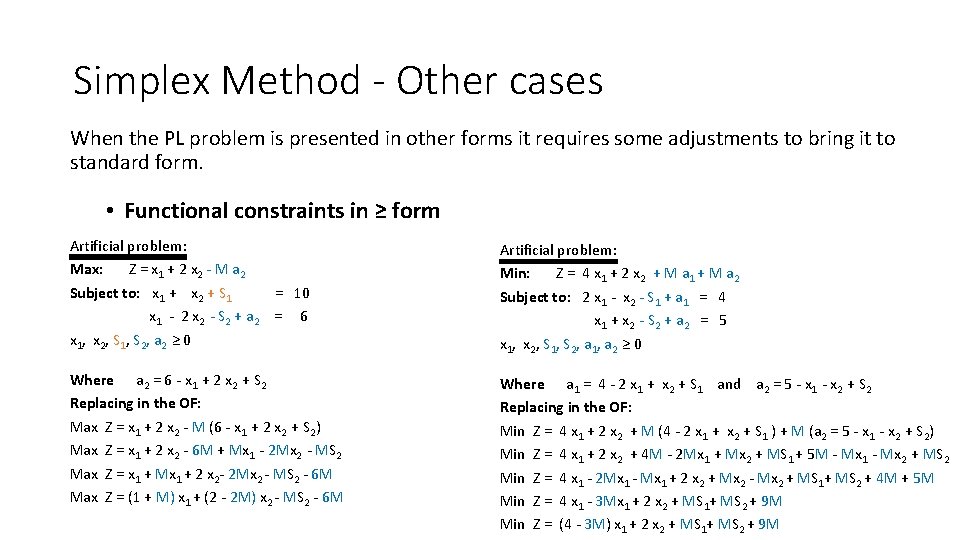
Simplex Method - Other cases When the PL problem is presented in other forms it requires some adjustments to bring it to standard form. • Functional constraints in ≥ form Artificial problem: Max: Z = x 1 + 2 x 2 - M a 2 Subject to: x 1 + x 2 + S 1 = 10 x 1 - 2 x 2 - S 2 + a 2 = 6 x 1 , x 2 , S 1 , S 2 , a 2 ≥ 0 Artificial problem: Min: Z = 4 x 1 + 2 x 2 + M a 1 + M a 2 Subject to: 2 x 1 - x 2 - S 1 + a 1 = 4 x 1 + x 2 - S 2 + a 2 = 5 x 1 , x 2 , S 1 , S 2 , a 1 , a 2 ≥ 0 Where a 2 = 6 - x 1 + 2 x 2 + S 2 Replacing in the OF: Max Z = x 1 + 2 x 2 - M (6 - x 1 + 2 x 2 + S 2) Max Z = x 1 + 2 x 2 - 6 M + Mx 1 - 2 Mx 2 - MS 2 Max Z = x 1 + Mx 1 + 2 x 2 - 2 Mx 2 - MS 2 - 6 M Max Z = (1 + M) x 1 + (2 - 2 M) x 2 - MS 2 - 6 M Where a 1 = 4 - 2 x 1 + x 2 + S 1 and a 2 = 5 - x 1 - x 2 + S 2 Replacing in the OF: Min Z = 4 x 1 + 2 x 2 + M (4 - 2 x 1 + x 2 + S 1 ) + M (a 2 = 5 - x 1 - x 2 + S 2) Min Z = 4 x 1 + 2 x 2 + 4 M - 2 Mx 1 + Mx 2 + MS 1 + 5 M - Mx 1 - Mx 2 + MS 2 Min Z = 4 x 1 - 2 Mx 1 - Mx 1 + 2 x 2 + Mx 2 - Mx 2 + MS 1+ MS 2 + 4 M + 5 M Min Z = 4 x 1 - 3 Mx 1 + 2 x 2 + MS 1+ MS 2 + 9 M Min Z = (4 - 3 M) x 1 + 2 x 2 + MS 1+ MS 2 + 9 M

Simplex Method - Other cases When the PL problem is presented in other forms it requires some adjustments to bring it to standard form. • Functional constraints in ≥ form Tabular form: Max Z = (1 + M) x 1 + (2 - 2 M) x 2 - MS 2 - 6 M Z - (1 + M) x 1 - (2 - 2 M) x 2 + MS 2 + 6 M Tabular form: Min Z = (4 - 3 M) x 1 + 2 x 2 + MS 1+ MS 2 + 9 M Z - (4 - 3 M) x 1 - 2 x 2 - MS 1 - MS 2 = 9 M
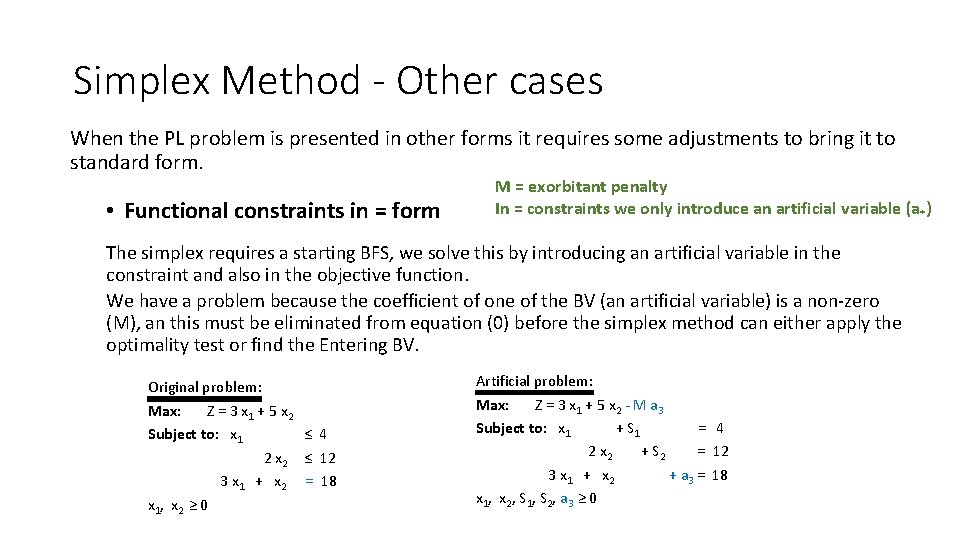
Simplex Method - Other cases When the PL problem is presented in other forms it requires some adjustments to bring it to standard form. • Functional constraints in = form M = exorbitant penalty In = constraints we only introduce an artificial variable (a*) The simplex requires a starting BFS, we solve this by introducing an artificial variable in the constraint and also in the objective function. We have a problem because the coefficient of one of the BV (an artificial variable) is a non-zero (M), an this must be eliminated from equation (0) before the simplex method can either apply the optimality test or find the Entering BV. Original problem: Max: Z = 3 x 1 + 5 x 2 Subject to: x 1 ≤ 4 2 x 2 ≤ 12 3 x 1 + x 2 = 18 x 1 , x 2 ≥ 0 Artificial problem: Max: Z = 3 x 1 + 5 x 2 - M a 3 Subject to: x 1 + S 1 = 4 2 x 2 + S 2 = 12 3 x 1 + x 2 + a 3 = 18 x 1 , x 2 , S 1 , S 2 , a 3 ≥ 0

Simplex Method - Other cases When the PL problem is presented in other forms it requires some adjustments to bring it to standard form. • Functional constraints in = form Artificial problem: Max: Z = 3 x 1 + 5 x 2 - M a 3 Subject to: x 1 + S 1 = 4 2 x 2 + S 2 = 12 3 x 1 + 2 x 2 + a 3 = 18 x 1 , x 2 , S 1 , S 2 , a 3 ≥ 0 Where a 3 = 18 – 3 x 1 -2 x 2 Replacing in the OF: Max Z = 3 x 1 + 5 x 2 - M (18 – 3 x 1 -2 x 2) Max Z = 3 x 1 + 5 x 2 - 18 M + 3 Mx 1 + 2 Mx 2 Max Z = 3 x 1 + 3 Mx 1 + 5 x 2 + 2 Mx 2 - 18 M Max Z = (3 + 3 M) x 1 + (5 + 2 M) x 2 - 18 M Tabular form: Max Z = (3 + 3 M) x 1 + (5 + 2 M) x 2 - 18 M Z - (3 + 3 M) x 1 - (5 - 2 M) x 2 = -18 M
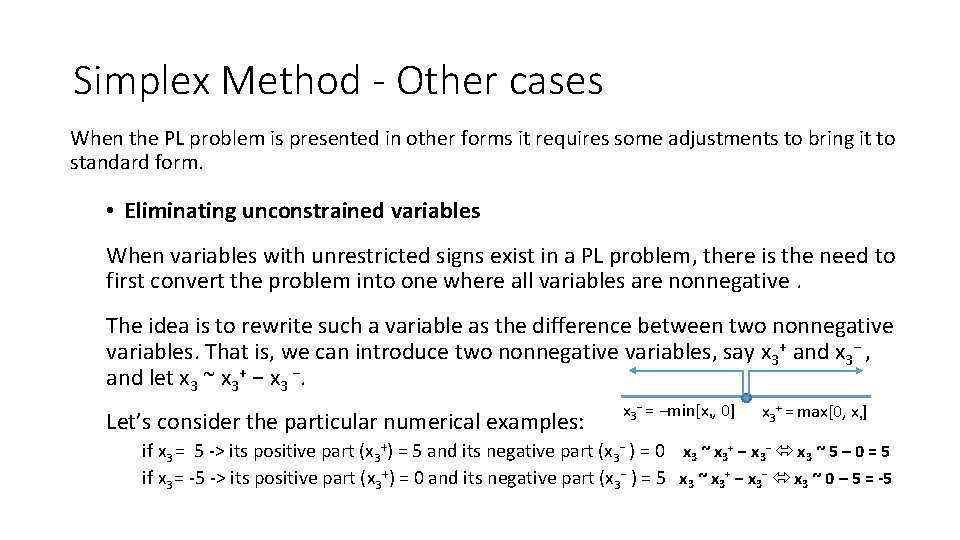
Simplex Method - Other cases When the PL problem is presented in other forms it requires some adjustments to bring it to standard form. • Eliminating unconstrained variables When variables with unrestricted signs exist in a PL problem, there is the need to first convert the problem into one where all variables are nonnegative. The idea is to rewrite such a variable as the difference between two nonnegative variables. That is, we can introduce two nonnegative variables, say x 3+ and x 3− , and let x 3 ~ x 3+ − x 3 −. Let’s consider the particular numerical examples: x 3− = −min[x , 0] 3 x 3+ = max[0, x ] 3 if x 3 = 5 -> its positive part (x 3+) = 5 and its negative part (x 3− ) = 0 x 3 ~ x 3+ − x 3− x 3 ~ 5 – 0 = 5 if x 3 = -5 -> its positive part (x 3+) = 0 and its negative part (x 3− ) = 5 x 3 ~ x 3+ − x 3− x 3 ~ 0 – 5 = -5
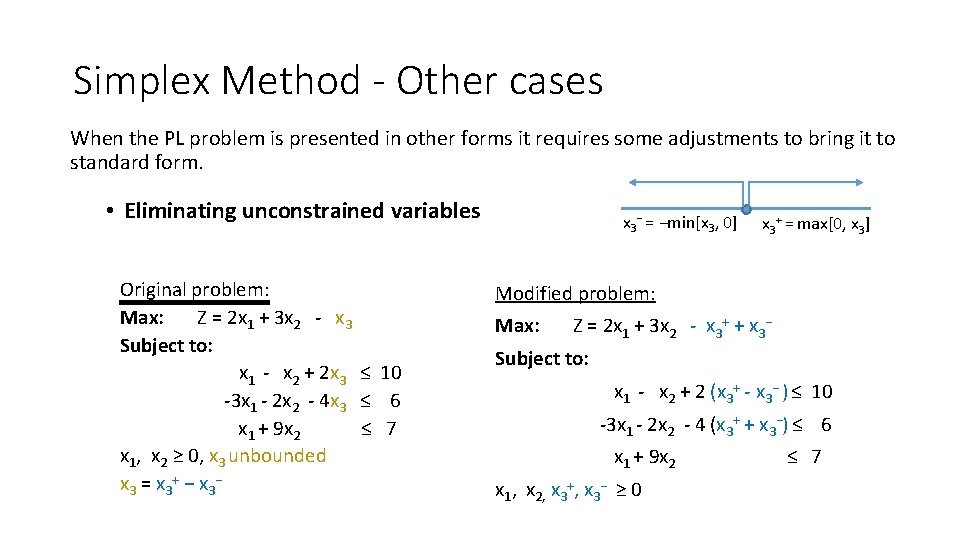
Simplex Method - Other cases When the PL problem is presented in other forms it requires some adjustments to bring it to standard form. • Eliminating unconstrained variables Original problem: Max: Z = 2 x 1 + 3 x 2 - x 3 Subject to: x 1 - x 2 + 2 x 3 ≤ 10 -3 x 1 - 2 x 2 - 4 x 3 ≤ 6 x 1 + 9 x 2 ≤ 7 x 1, x 2 ≥ 0, x 3 unbounded x 3 = x 3 + − x 3− = −min[x 3, 0] x 3+ = max[0, x 3] Modified problem: Max: Z = 2 x 1 + 3 x 2 - x 3+ + x 3− Subject to: x 1 - x 2 + 2 (x 3+ - x 3− ) ≤ 10 -3 x 1 - 2 x 2 - 4 (x 3+ + x 3−) ≤ 6 x 1 + 9 x 2 x 1, x 2, x 3+, x 3− ≥ 0 ≤ 7
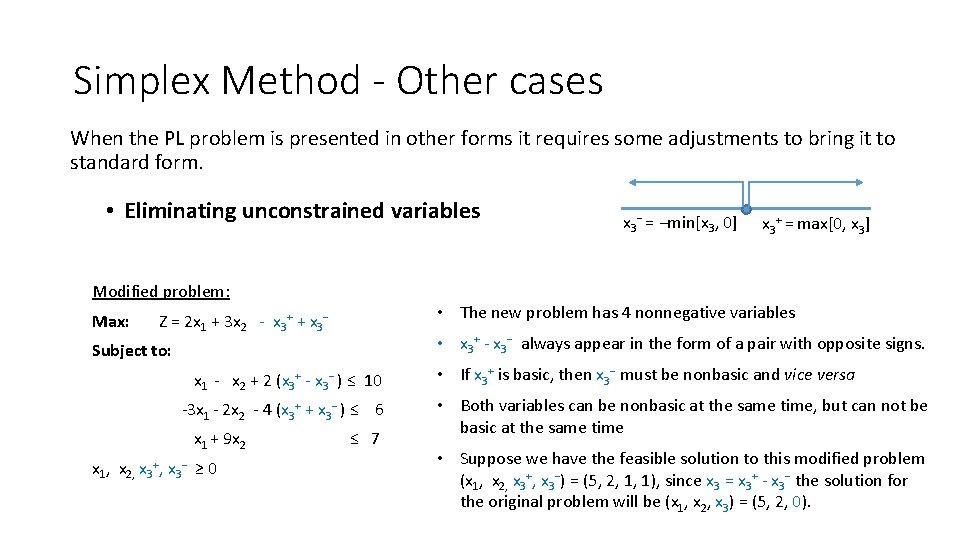
Simplex Method - Other cases When the PL problem is presented in other forms it requires some adjustments to bring it to standard form. • Eliminating unconstrained variables Modified problem: Max: • x 3+ - x 3− always appear in the form of a pair with opposite signs. Subject to: x 1 - x 2 + 2 (x 3+ - x 3− ) ≤ 10 -3 x 1 - 2 x 2 - 4 (x 3+ + x 3− ) ≤ 6 x 1, x 2, x 3+, x 3− ≥ 0 x 3+ = max[0, x 3] • The new problem has 4 nonnegative variables Z = 2 x 1 + 3 x 2 - x 3+ + x 3− x 1 + 9 x 2 x 3− = −min[x 3, 0] ≤ 7 • If x 3+ is basic, then x 3− must be nonbasic and vice versa • Both variables can be nonbasic at the same time, but can not be basic at the same time • Suppose we have the feasible solution to this modified problem (x 1, x 2, x 3+, x 3−) = (5, 2, 1, 1), since x 3 = x 3+ - x 3− the solution for the original problem will be (x 1, x 2, x 3) = (5, 2, 0).
Simplex Method Exercises
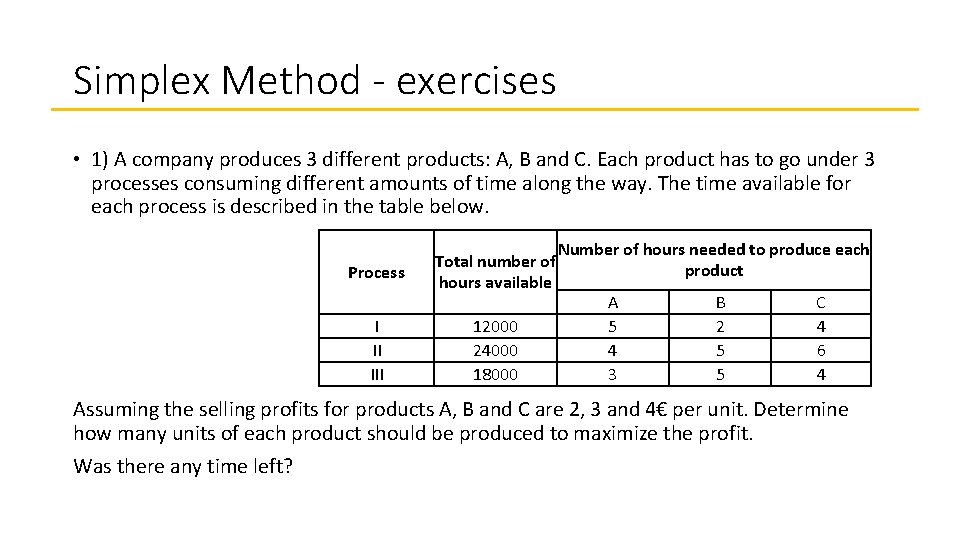
Simplex Method - exercises • 1) A company produces 3 different products: A, B and C. Each product has to go under 3 processes consuming different amounts of time along the way. The time available for each process is described in the table below. Process I II III Total number of hours available 12000 24000 18000 Number of hours needed to produce each product A 5 4 3 B 2 5 5 C 4 6 4 Assuming the selling profits for products A, B and C are 2, 3 and 4€ per unit. Determine how many units of each product should be produced to maximize the profit. Was there any time left?
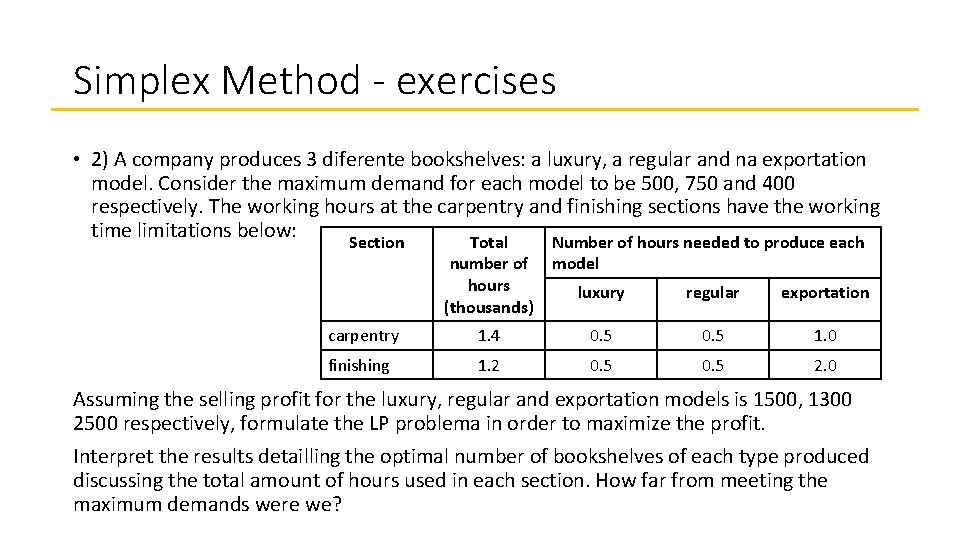
Simplex Method - exercises • 2) A company produces 3 diferente bookshelves: a luxury, a regular and na exportation model. Consider the maximum demand for each model to be 500, 750 and 400 respectively. The working hours at the carpentry and finishing sections have the working time limitations below: Section Total Number of hours needed to produce each number of hours (thousands) model luxury regular exportation carpentry 1. 4 0. 5 1. 0 finishing 1. 2 0. 5 2. 0 Assuming the selling profit for the luxury, regular and exportation models is 1500, 1300 2500 respectively, formulate the LP problema in order to maximize the profit. Interpret the results detailling the optimal number of bookshelves of each type produced discussing the total amount of hours used in each section. How far from meeting the maximum demands were we?
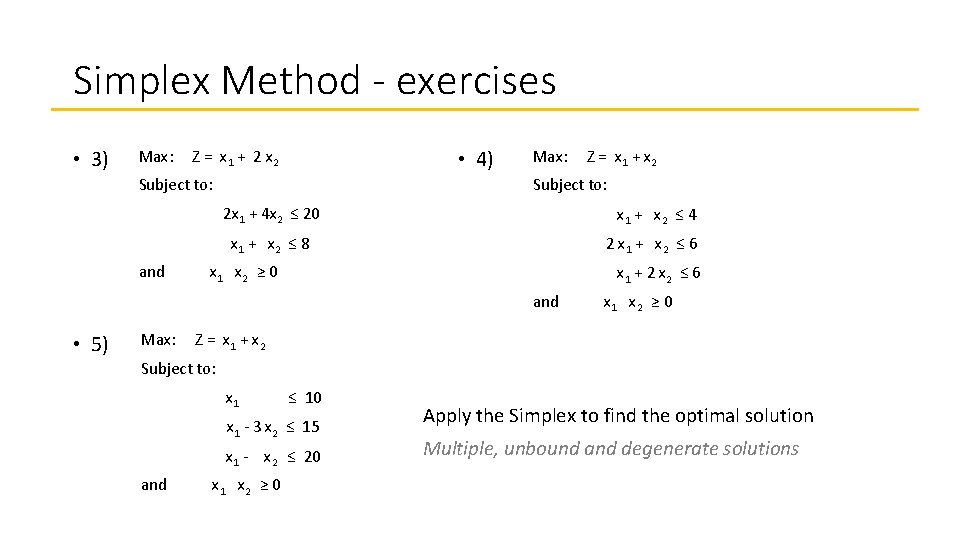
Simplex Method - exercises • 3) Max: Z = x 1 + 2 x 2 Subject to: • 4) Max: Subject to: 2 x 1 + 4 x 2 ≤ 20 x 1 + x 2 ≤ 4 x 1 + x 2 ≤ 8 and 2 x 1 + x 2 ≤ 6 x 1 x 2 ≥ 0 x 1 + 2 x 2 ≤ 6 and • 5) Max: Z = x 1 + x 2 x 1 x 2 ≥ 0 Z = x 1 + x 2 Subject to: x 1 + x 2 ≤ 10 2 x 1 - 3 x 2 ≤ 15 x 1 - 2 x 2 ≤ 20 and x 1 x 2 ≥ 0 Apply the Simplex to find the optimal solution Multiple, unbound and degenerate solutions

Simplex Method - exercises • 6) Min: Z = 2 x 1 - 3 x 2 – 4 x 3 Subject to: • 7) Max: Subject to: • 8) Max: x 1 + x 2 + x 3 ≤ 11 x 1 - x 2 ≤ 20 -3 x 1 + x 2 ≤ -30 and x 1 x 2 x 3 ≥ 0 x 1 ≥ 0 x 2 ≤ 0 Z = - x 2 Subject to: x 1 + x 2 + x 3 ≤ 100 x 1 - 5 x 2 ≤ 40 x 3 ≥ -10 and ≤ 15 x 1 + 5 x 2 - 3 x 3 ≤ 15 5 x 1 – 6 x 2 + x 3 ≤ 4 and Z = 10 x 1 + 30 x 2 x 1 ≥ 0 x 2 ≤ 0 x 3 unbounded Bring the following PL problems to standard form and apply the Simplex to find the optimal solution Minimization, negative RHS, negative and unbounded variables
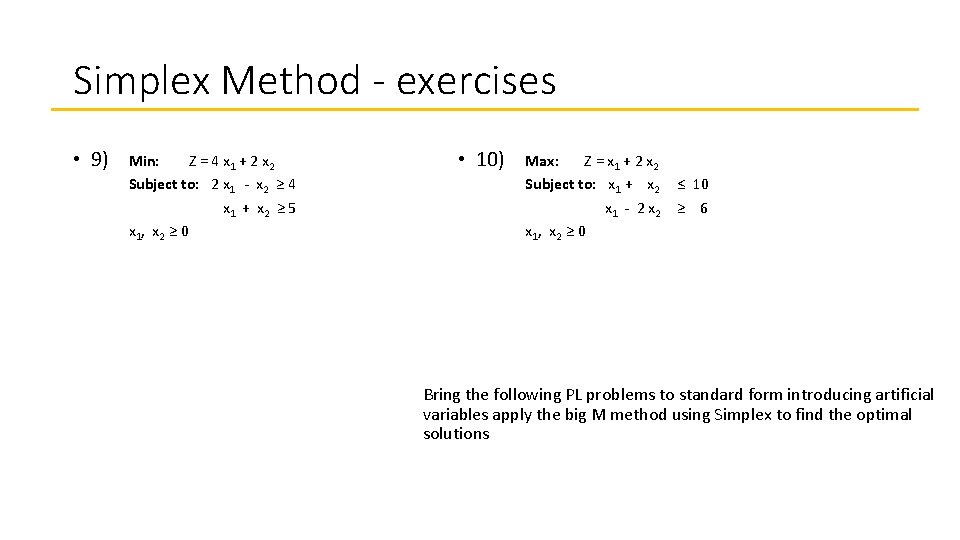
Simplex Method - exercises • 9) Min: Z = 4 x 1 + 2 x 2 Subject to: 2 x 1 - x 2 ≥ 4 x 1 + x 2 ≥ 5 x 1 , x 2 ≥ 0 • 10) Max: Z = x 1 + 2 x 2 Subject to: x 1 + x 2 x 1 - 2 x 1 , x 2 ≥ 0 ≤ 10 ≥ 6 Bring the following PL problems to standard form introducing artificial variables apply the big M method using Simplex to find the optimal solutions

- Slides: 71