
THE SILOVIKI REGIME IN RUSSIA A Illarionov CATO
- Slides: 131
THE SILOVIKI REGIME IN RUSSIA A. Illarionov, CATO Institute, Washington, USA Institute of Economic Analysis, Moscow, Russia Evenings at FEE, Foundation for Economic Education, Irvington-on-Hudson, November 10, 2007 © CATO Institute, Institute of Economic Analysis www. cato. org, www. cato. rg, www. iea. ru © ИЭА
“I’ll buy all, says gold. I’ll take all, responded steel. ” Alexander Pushkin, great Russian poet 2 © ИЭА
The Russian version of the eternal Hamlet question “To be or not to be? ” in today’s Russia sounds like “To be or not to be behind bars? ” 3 © ИЭА
“If you are not behind bars yet it is not your merit, it means the system does not work properly. ” Russian people’s wisdom “Our system must work better. ” From the documents of the Russian government 4 © ИЭА
If you are already behind bars, there are three rules to follow: “Do not trust. Do not be afraid. Do not beg”. Varlam Shalamov, The Kolyma Stories. 5 © ИЭА
In most cases people do not voluntarily chose to stay behind bars. Usually they are forced to be there. The specially trained people in charge of using force (or: sila in Russian) against other people, including decisions to held other people behind bars, are called enforcement personnel, or: siloviki in Russian. Siloviki is a distilled essence of coercion. 6 © ИЭА
Siloviki in today’s Russia are those who are or have been employed in the enforcement agencies of different kinds – military, interior, security, guard, intelligence, prosecutor office, secret police (total 22 agencies). Siloviki have education, training, vision, and overall mentality rather different from civilians. Enforcement in today’s Russia doesn’t necessarily imply enforcement of Law. It means enforcement of Force and Power regardless of Law, often against Law. 7 © ИЭА
Siloviki at power have created the Siloviki Regime. State power has been captured by Siloviki coming mainly from the former Soviet secret police, namely FSB, the historical successor to KGB, MGB, NKVD, OGPU, VCh. K. 8 © ИЭА
The Siloviki form The Corporation, the Corporation of Secret Police (other terms – Brigada, Orden, Artel, Tovarishestvo). The Siloviki Corporation is a type of the organized crime (mafia-type) organizations. Among them one can find both private as well as government organizations like Cosa Nostra, Ndragetta, Tryads, secret police of Cuba, North Korea, Guards of Islamic Revolution in Iran, etc. 9 © ИЭА
The Siloviki Regime is a type of political regime where all powers belong to members of the CSP. Power of Siloviki has a profound effect on contemporary Russia’s Political and Economic Systems, State, Government, Foreign Policy, Society, Ideology. 10 © ИЭА
The Siloviki Regime. 1. Overall description. 2. Ideology. 3. Sociology. 4. Economics. 5. Institutional development. 6. International positioning. 7. Foreign policy. 8. Social behavior. 9. Intermediary conclusion. 10. Western response. 11 © ИЭА
1. Overall Descriptive Approach (1). 1. Appropriation of executive power by the Corporation of Secret Police (CSP). 2. Capture of the bodies of the Russian state (Presidential Administration, Government apparatus, Tax agency, Courts system, Prosecutor offices, MFA, Mo. D, Parliament) as well as business and mass-media by the CSP. Use of them in the interests of the CSP. 3. Concentration and monopolization of all significant resources (political, legal, military, economic, financial, media) in the hands of the CSP. 4. Destruction of the rule of law with its replacement by rule of thugs: the CSP is above law, no people or law above the CSP. 12 © ИЭА
Overall Descriptive Approach (2). 5. Rise of state monopolies with privatization of profits and nationalization of costs as their leading principle. 6. Personal control by the CSP members over main financial flows in the economy. 7. Siloviki-type PPP (public-private partnership) – coercion of private business to fulfill orders of the CSP and bear the costs. 8. Main award of the CSP is “paratrooping” its members (doesn’t matter - whether Russian or foreign) into the state company or state-friendly company. 9. Hierarhization and casting of the Russian society. Political, economic, legal discrimination of the nonmembers of the GSP. 10. The leading method of problems’ solution is coercion not restricted by law, tradition and morale. 13 © ИЭА
Overall Descriptive Approach (3). 11. Secrecy and information asymmetry. 12. Plurality of ideological and propaganda products for consumers inside and outside country. 13. Ideology for CSP members – “chekism” and “nascism” (“our ownism”) with selectiveness/ absence of identical rules as a leading principle. 14. Ideology for Russian general public (non-CSP members) – fortress besieged from outside and undermined by betrayers and traitors from inside. 15. Ideology for the Western political elite – protection against terrorism and fascism. 16. Personal union of the Siloviki leaders with the Western political and business leaders. 14 © ИЭА
2. Ideological Approach. Principles of Chekism and Nacsism. 15 © ИЭА
Secrecy and disregard of people “The people shouldn’t know who governs them. “ Mikhail Boyarsky, Russian popular actor, staunch supporter of Vladimir Putin 16 © ИЭА
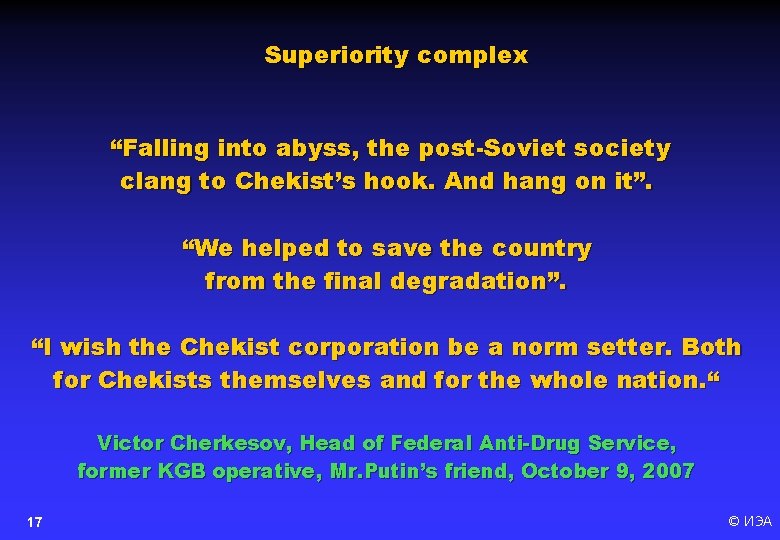
Superiority complex “Falling into abyss, the post-Soviet society clang to Chekist’s hook. And hang on it”. “We helped to save the country from the final degradation”. “I wish the Chekist corporation be a norm setter. Both for Chekists themselves and for the whole nation. “ Victor Cherkesov, Head of Federal Anti-Drug Service, former KGB operative, Mr. Putin’s friend, October 9, 2007 17 © ИЭА
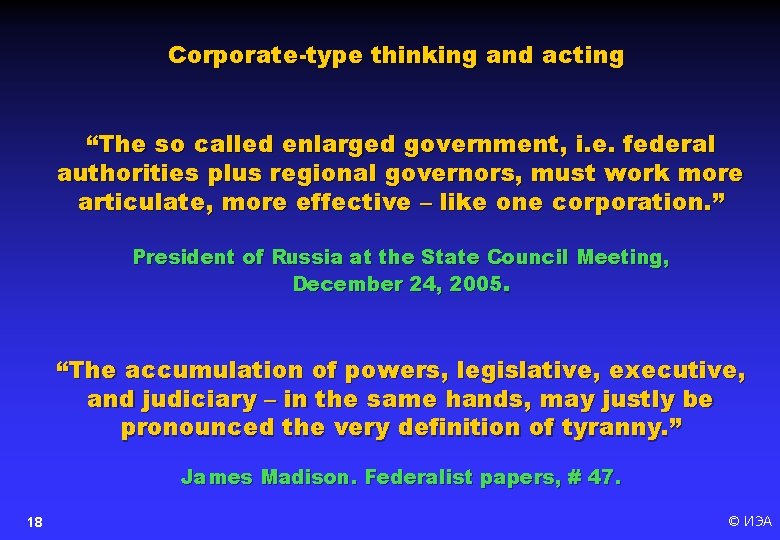
Corporate-type thinking and acting “The so called enlarged government, i. e. federal authorities plus regional governors, must work more articulate, more effective – like one corporation. ” President of Russia at the State Council Meeting, December 24, 2005. “The accumulation of powers, legislative, executive, and judiciary – in the same hands, may justly be pronounced the very definition of tyranny. ” James Madison. Federalist papers, # 47. 18 © ИЭА
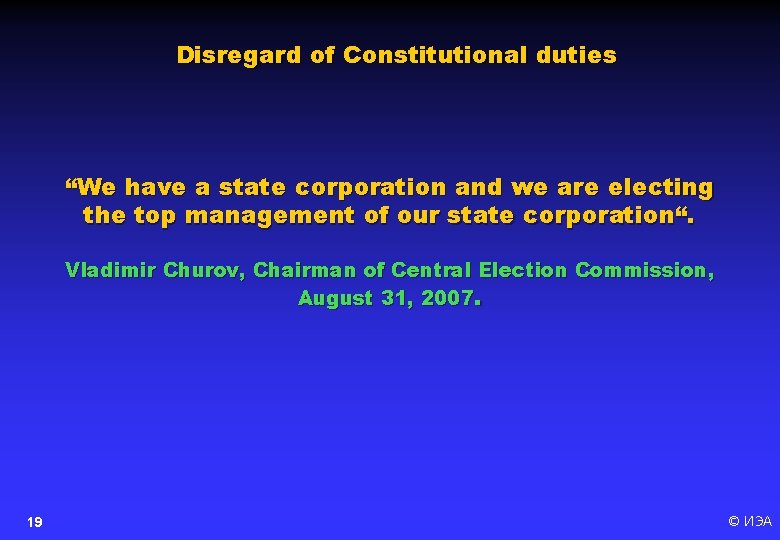
Disregard of Constitutional duties “We have a state corporation and we are electing the top management of our state corporation“. Vladimir Churov, Chairman of Central Election Commission, August 31, 2007. 19 © ИЭА
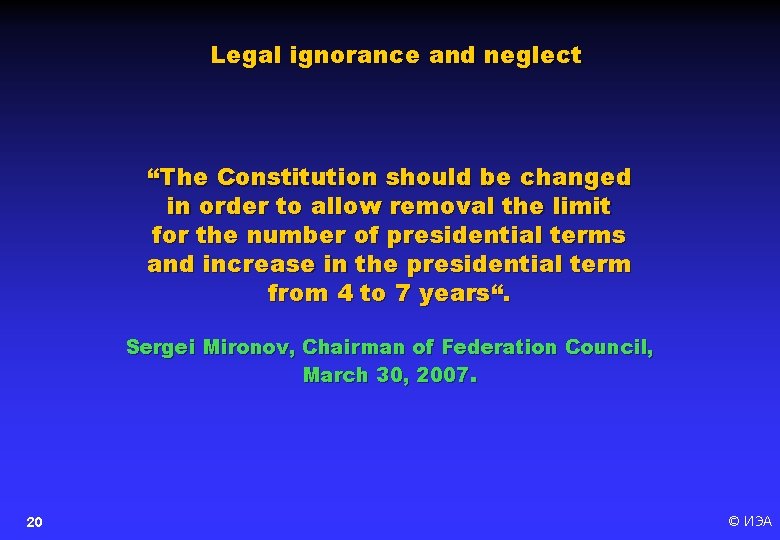
Legal ignorance and neglect “The Constitution should be changed in order to allow removal the limit for the number of presidential terms and increase in the presidential term from 4 to 7 years“. Sergei Mironov, Chairman of Federation Council, March 30, 2007. 20 © ИЭА
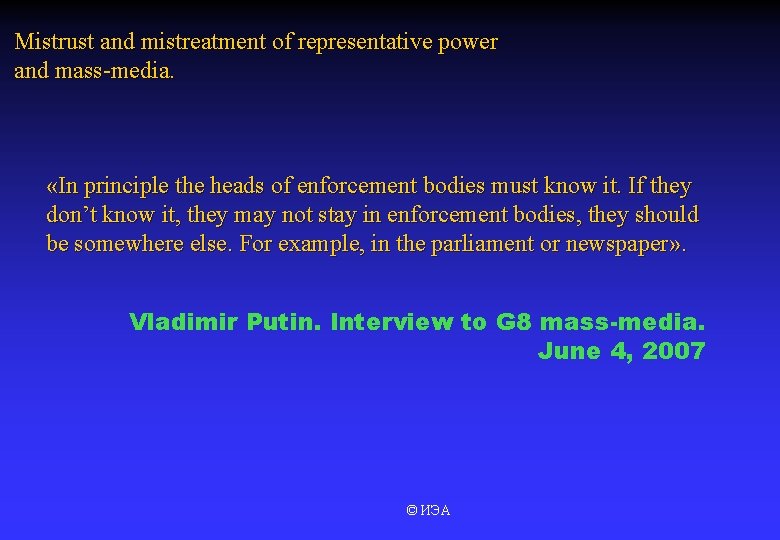
Mistrust and mistreatment of representative power and mass-media. «In principle the heads of enforcement bodies must know it. If they don’t know it, they may not stay in enforcement bodies, they should be somewhere else. For example, in the parliament or newspaper» . Vladimir Putin. Interview to G 8 mass-media. June 4, 2007 © ИЭА
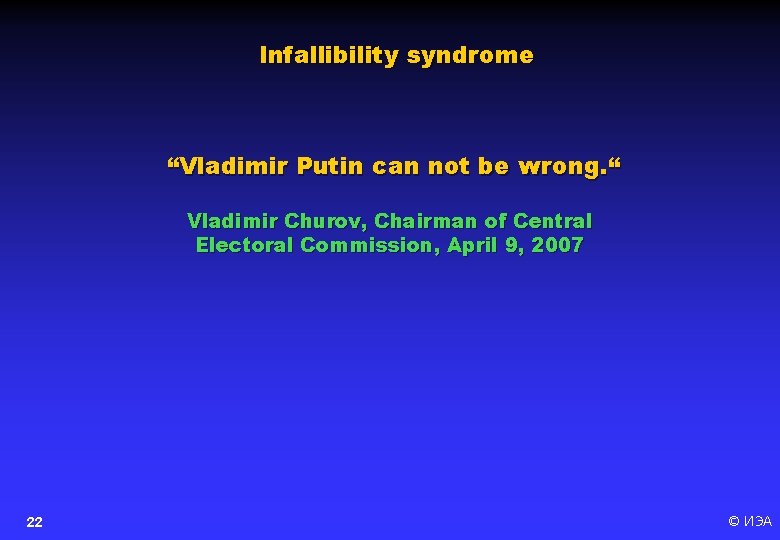
Infallibility syndrome “Vladimir Putin can not be wrong. “ Vladimir Churov, Chairman of Central Electoral Commission, April 9, 2007 22 © ИЭА
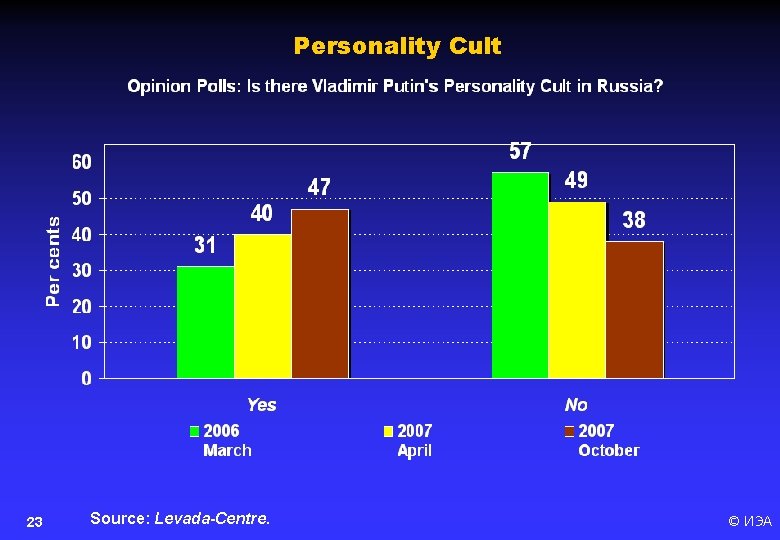
Personality Cult 23 Source: Levada-Centre. © ИЭА
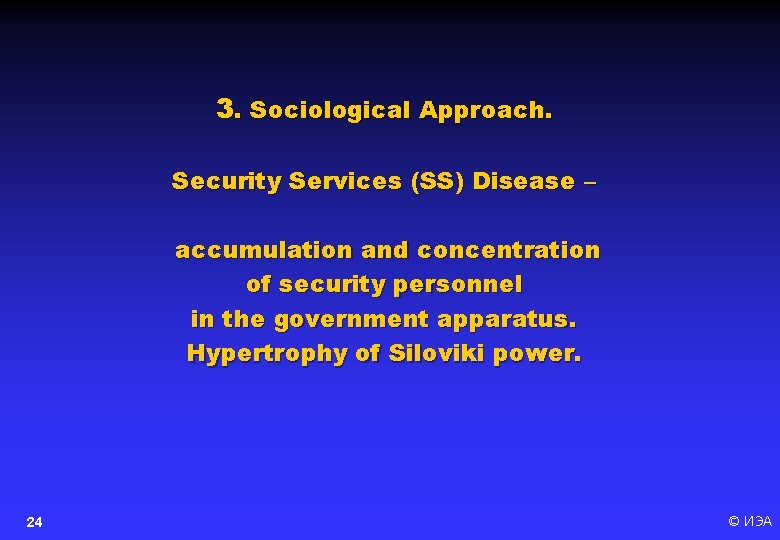
3. Sociological Approach. Security Services (SS) Disease – accumulation and concentration of security personnel in the government apparatus. Hypertrophy of Siloviki power. 24 © ИЭА
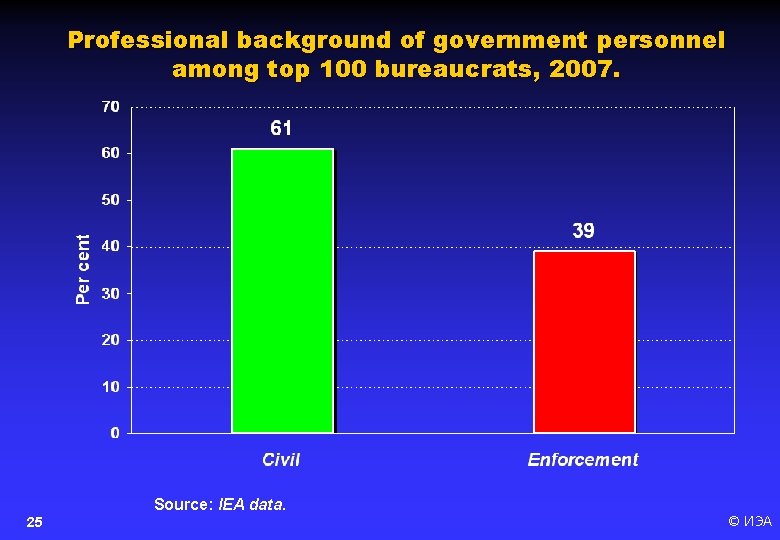
Professional background of government personnel among top 100 bureaucrats, 2007. Source: IEA data. 25 © ИЭА
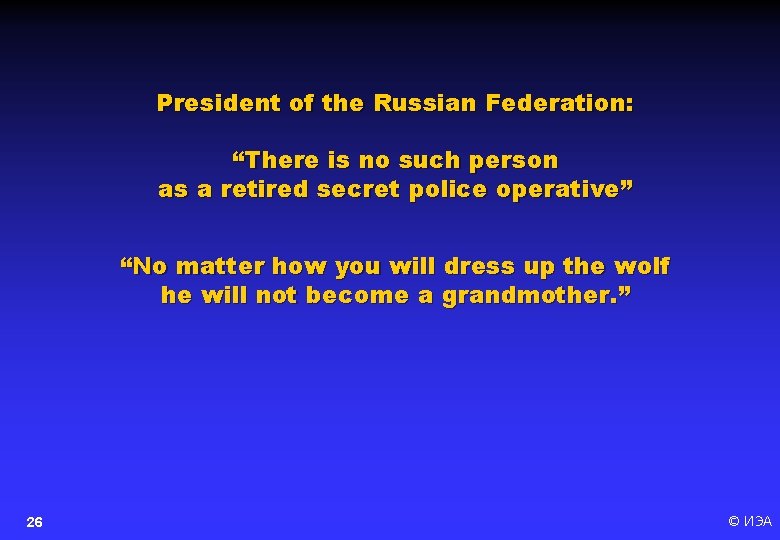
President of the Russian Federation: “There is no such person as a retired secret police operative” “No matter how you will dress up the wolf he will not become a grandmother. ” 26 © ИЭА
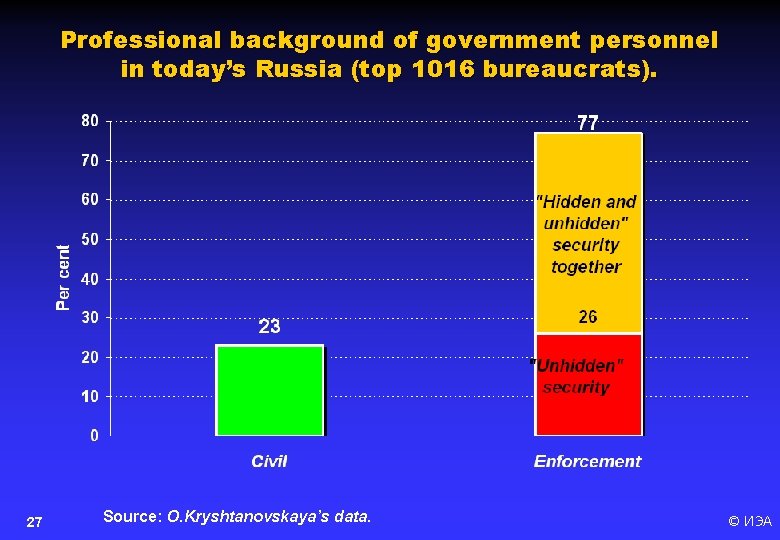
Professional background of government personnel in today’s Russia (top 1016 bureaucrats). 27 Source: O. Kryshtanovskaya’s data. © ИЭА
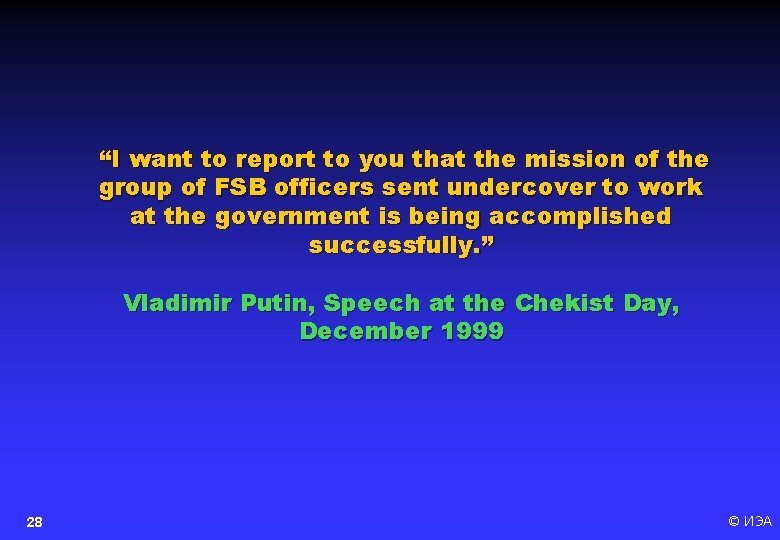
“I want to report to you that the mission of the group of FSB officers sent undercover to work at the government is being accomplished successfully. ” Vladimir Putin, Speech at the Chekist Day, December 1999 28 © ИЭА
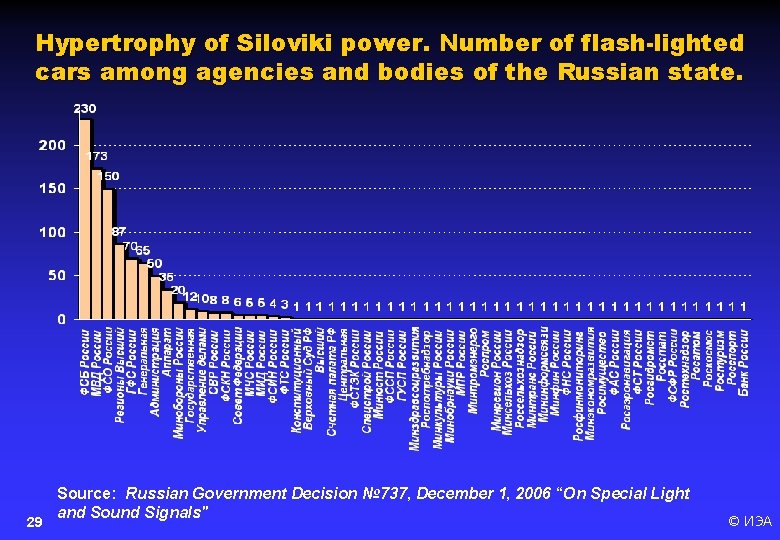
Hypertrophy of Siloviki power. Number of flash-lighted cars among agencies and bodies of the Russian state. 29 Source: Russian Government Decision № 737, December 1, 2006 “On Special Light and Sound Signals" © ИЭА
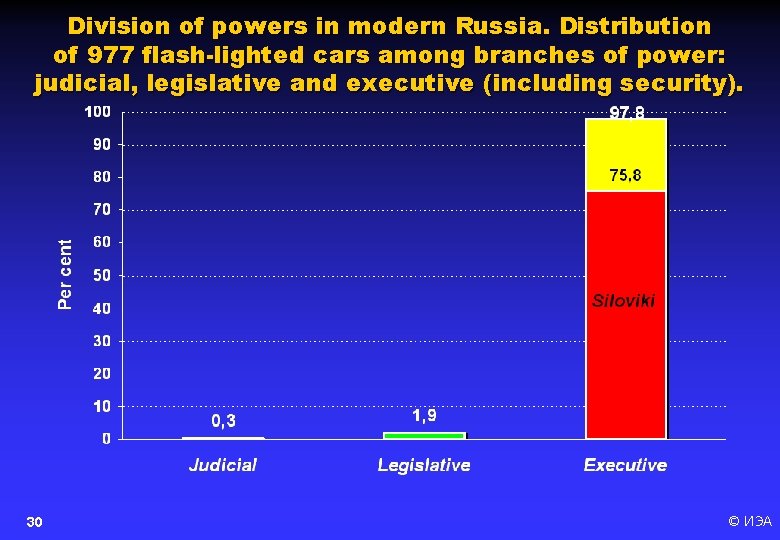
Division of powers in modern Russia. Distribution of 977 flash-lighted cars among branches of power: judicial, legislative and executive (including security). 30 © ИЭА
4. Economic Approach. 4 a. “Soviet Disease” – concentration of economic resources at the federal level. 31 © ИЭА
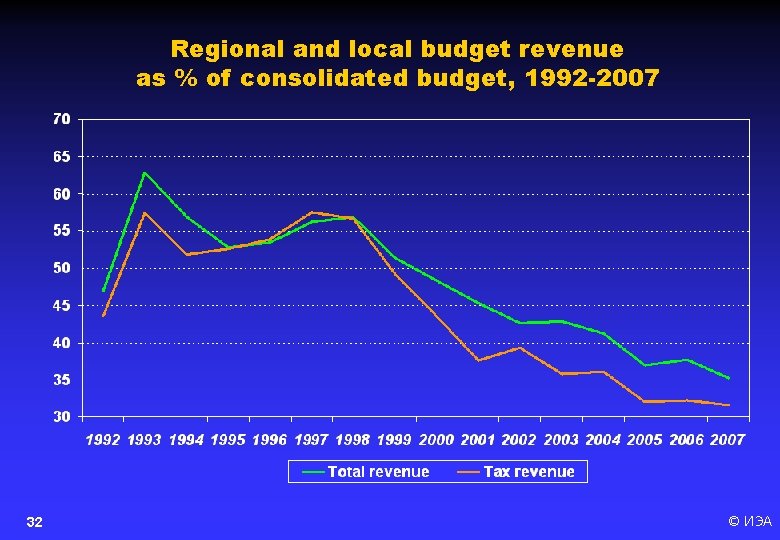
Regional and local budget revenue as % of consolidated budget, 1992 -2007 32 © ИЭА
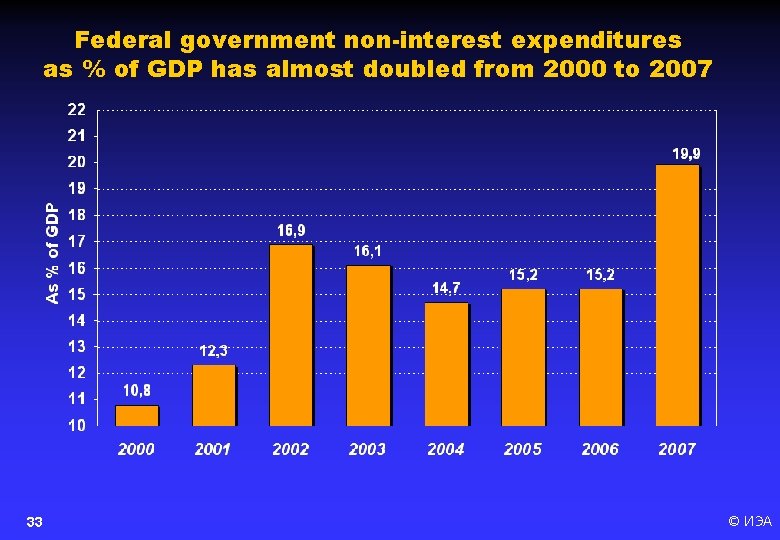
Federal government non-interest expenditures as % of GDP has almost doubled from 2000 to 2007 33 © ИЭА
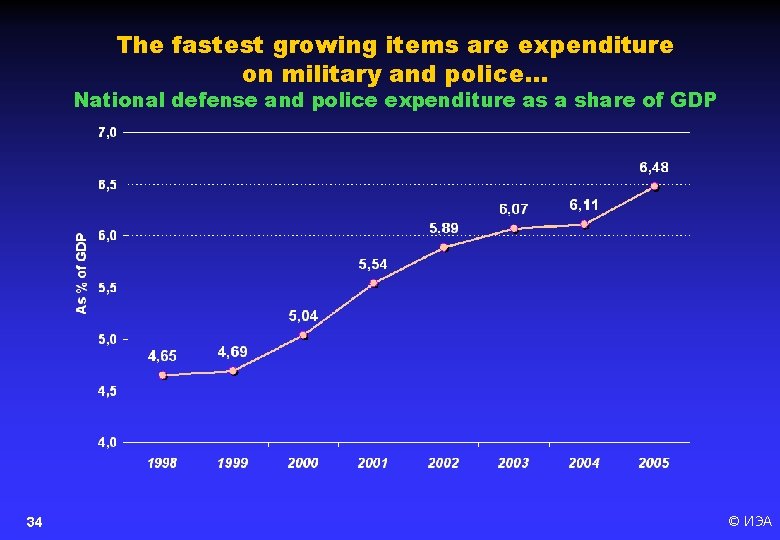
The fastest growing items are expenditure on military and police… National defense and police expenditure as a share of GDP 34 © ИЭА
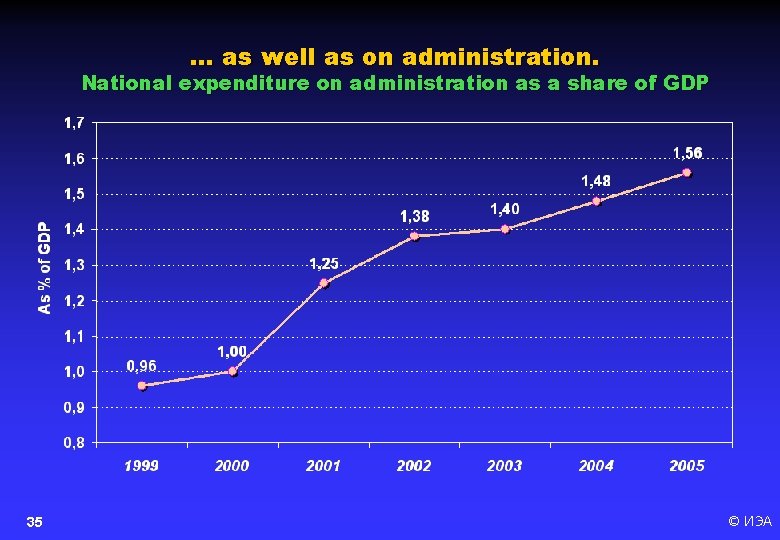
… as well as on administration. National expenditure on administration as a share of GDP 35 © ИЭА
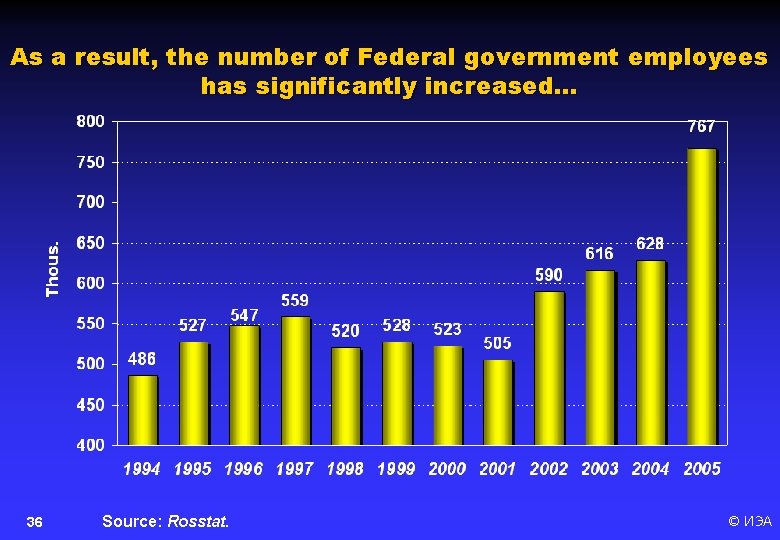
As a result, the number of Federal government employees has significantly increased… 36 Source: Rosstat. © ИЭА
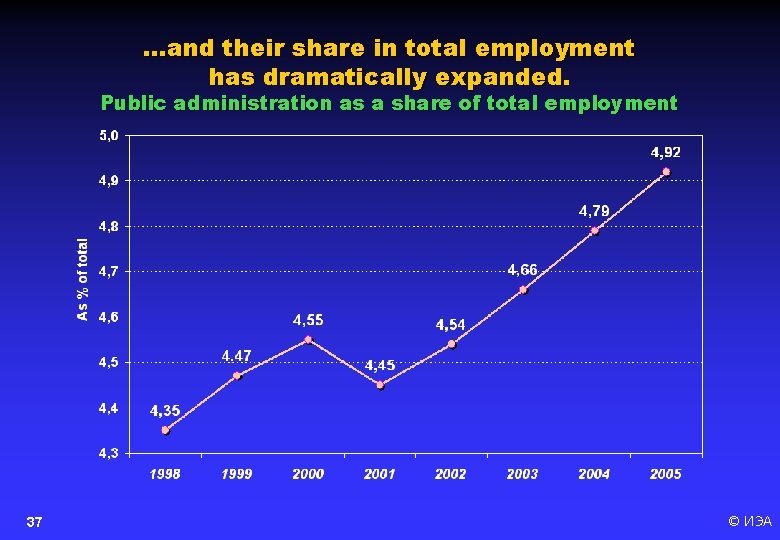
…and their share in total employment has dramatically expanded. Public administration as a share of total employment 37 © ИЭА
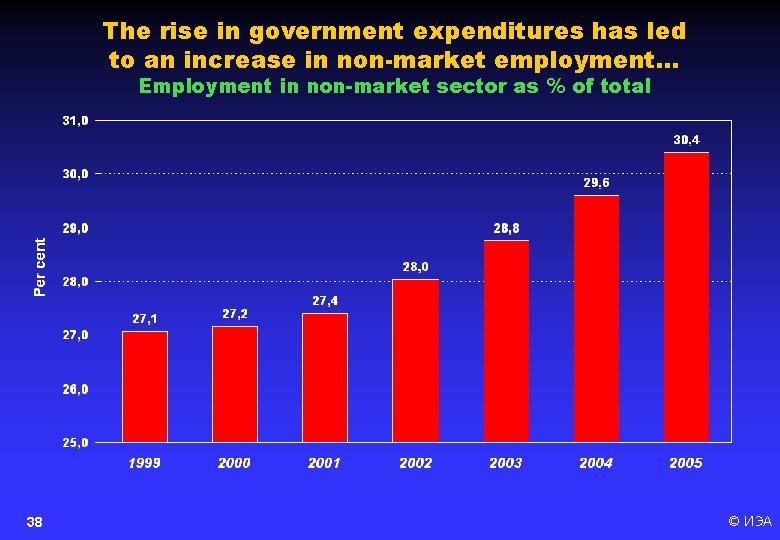
The rise in government expenditures has led to an increase in non-market employment… Employment in non-market sector as % of total 38 © ИЭА
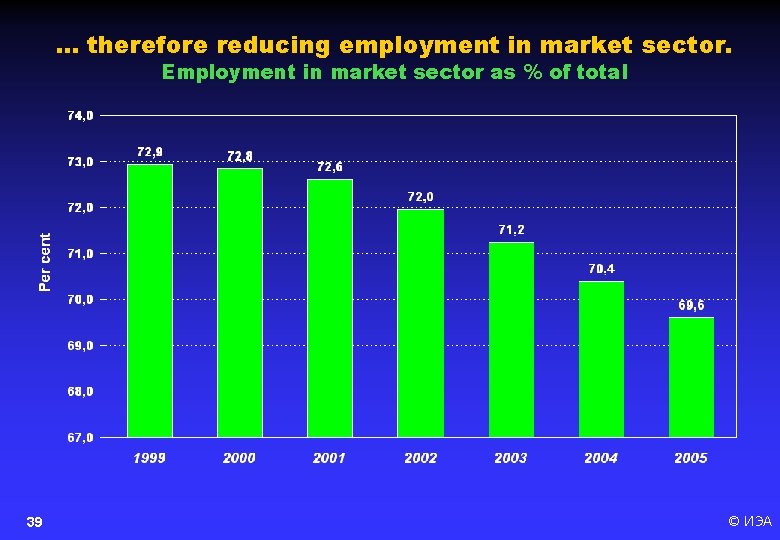
… therefore reducing employment in market sector. Employment in market sector as % of total 39 © ИЭА
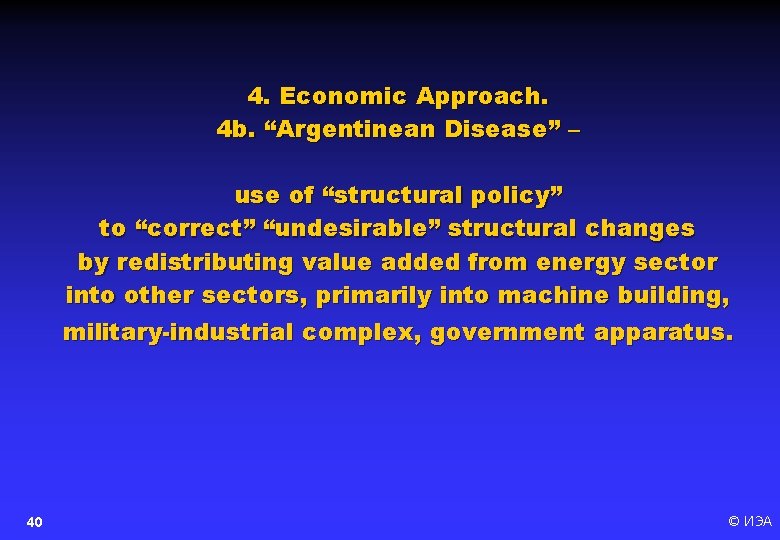
4. Economic Approach. 4 b. “Argentinean Disease” – use of “structural policy” to “correct” “undesirable” structural changes by redistributing value added from energy sector into other sectors, primarily into machine building, military-industrial complex, government apparatus. 40 © ИЭА
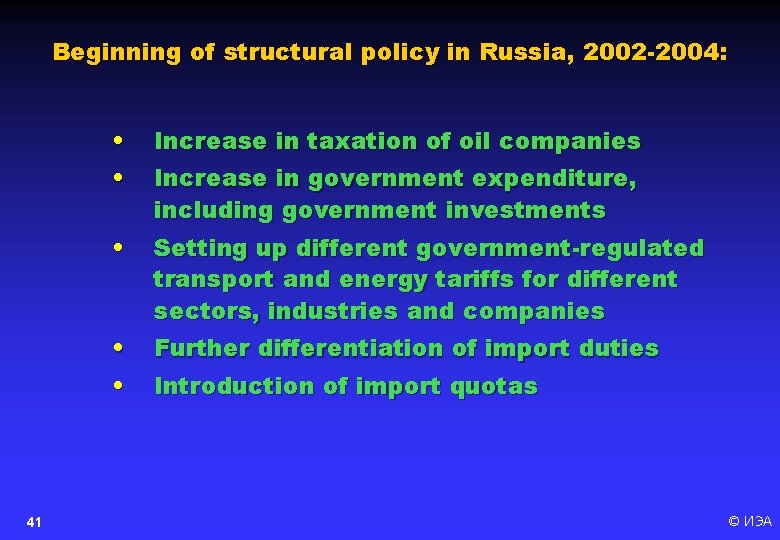
Beginning of structural policy in Russia, 2002 -2004 : 41 • • Increase in taxation of oil companies • Setting up different government-regulated transport and energy tariffs for different sectors, industries and companies • • Further differentiation of import duties Increase in government expenditure, including government investments Introduction of import quotas © ИЭА
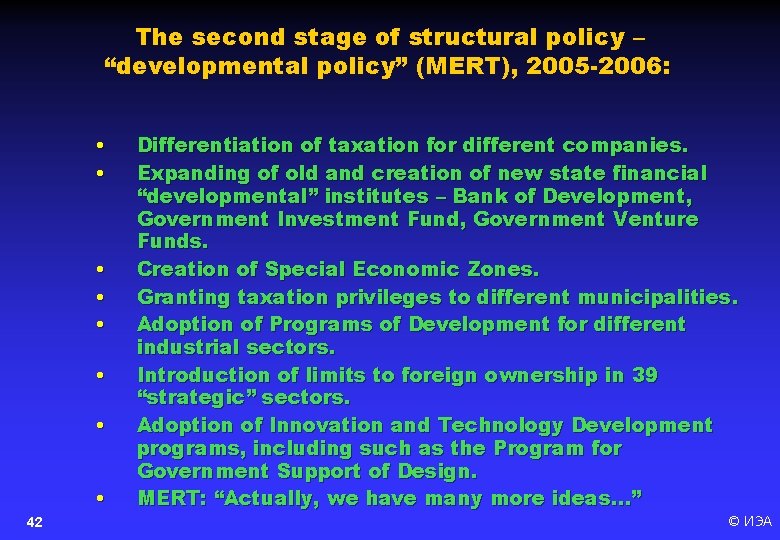
The second stage of structural policy – “developmental policy” (MERT), 2005 -2006: • • 42 Differentiation of taxation for different companies. Expanding of old and creation of new state financial “developmental” institutes – Bank of Development, Government Investment Fund, Government Venture Funds. Creation of Special Economic Zones. Granting taxation privileges to different municipalities. Adoption of Programs of Development for different industrial sectors. Introduction of limits to foreign ownership in 39 “strategic” sectors. Adoption of Innovation and Technology Development programs, including such as the Program for Government Support of Design. MERT: “Actually, we have many more ideas. . . ” © ИЭА
4. Economic Approach. 4 c. “Venezuelan Disease” – nationalization and quasi-nationalization of private assets in oil and gas as well as in transportation, construction, automobile industry, aviation, shipbuilding, etc. 43 © ИЭА
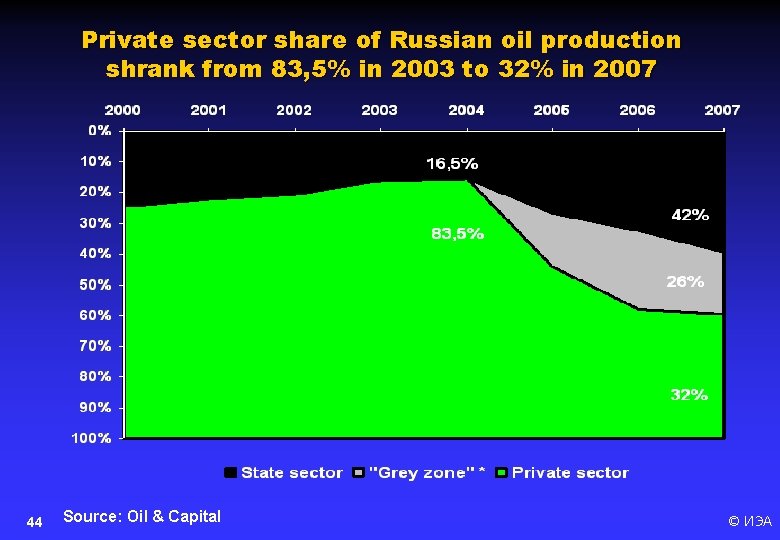
Private sector share of Russian oil production shrank from 83, 5% in 2003 to 32% in 2007 44 Source: Oil & Capital © ИЭА
“Are you seriously thinking that could be companies independent of the state? ” Yuri Trutnev, Minister for Natural Resources, August 30, 2007 45 © ИЭА
4. Economic Approach. 4 d. “State Corporativist Disease” – appropriation of public financial resources through and by state corporations. 46 © ИЭА
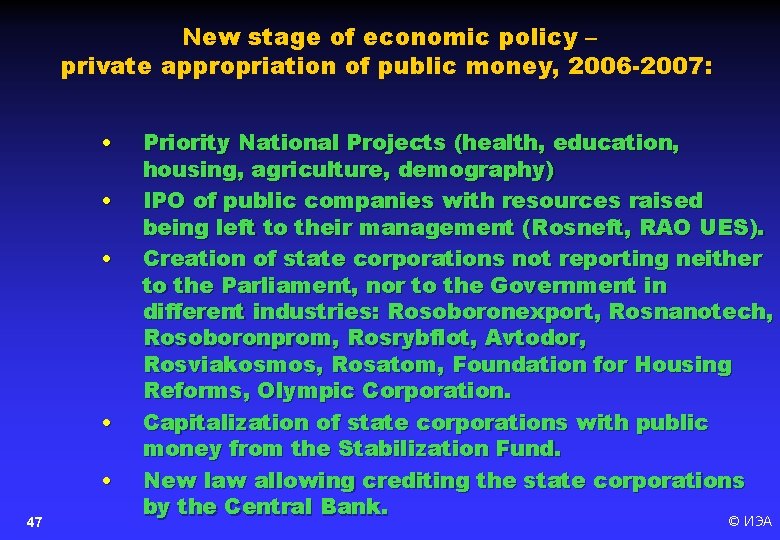
New stage of economic policy – private appropriation of public money, 2006 -2007 : • • • 47 Priority National Projects (health, education, housing, agriculture, demography) IPO of public companies with resources raised being left to their management (Rosneft, RAO UES). Creation of state corporations not reporting neither to the Parliament, nor to the Government in different industries: Rosoboronexport, Rosnanotech, Rosoboronprom, Rosrybflot, Avtodor, Rosviakosmos, Rosatom, Foundation for Housing Reforms, Olympic Corporation. Capitalization of state corporations with public money from the Stabilization Fund. New law allowing crediting the state corporations by the Central Bank. © ИЭА
“We should create big corporations and support their international expansion”. Dmitry Medvedev, Deputy Prime Minister, June 8, 2007 “Yes, many want to be there [in the state corporations]. It’s better to be there than here, in the government. Because you will have more money there, but you will do the same as we, in the government, do here. And you don’t need to steal!” Mikhail Fradkov, Prime Minister, 2004 -2007 48 © ИЭА
4 e. Intermediary Economic Results 49 © ИЭА
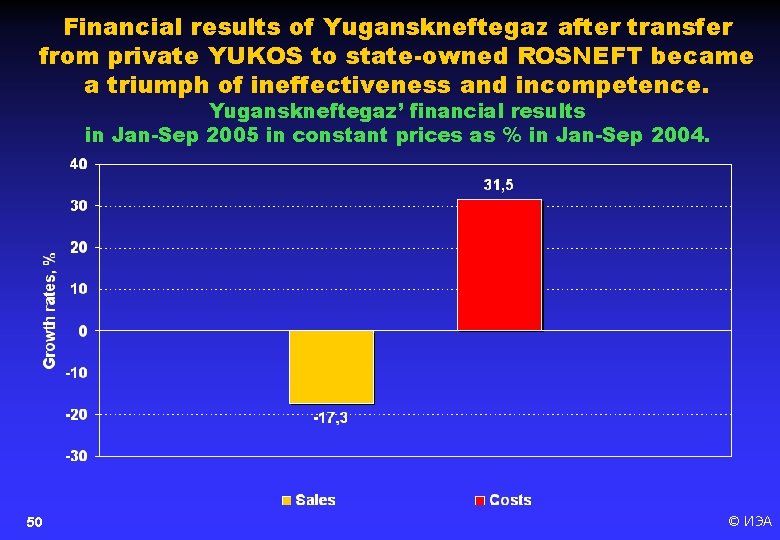
Financial results of Yuganskneftegaz after transfer from private YUKOS to state-owned ROSNEFT became a triumph of ineffectiveness and incompetence. Yuganskneftegaz’ financial results in Jan-Sep 2005 in constant prices as % in Jan-Sep 2004. 50 © ИЭА
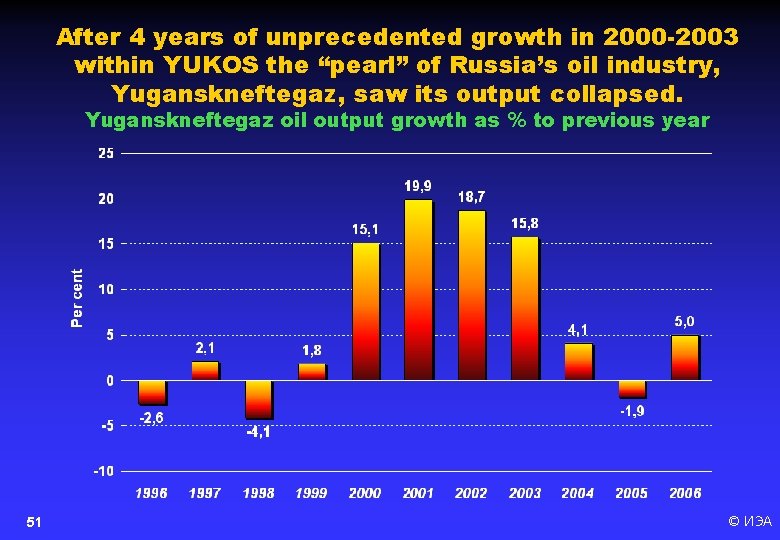
After 4 years of unprecedented growth in 2000 -2003 within YUKOS the “pearl” of Russia’s oil industry, Yuganskneftegaz, saw its output collapsed. Yuganskneftegaz oil output growth as % to previous year 51 © ИЭА
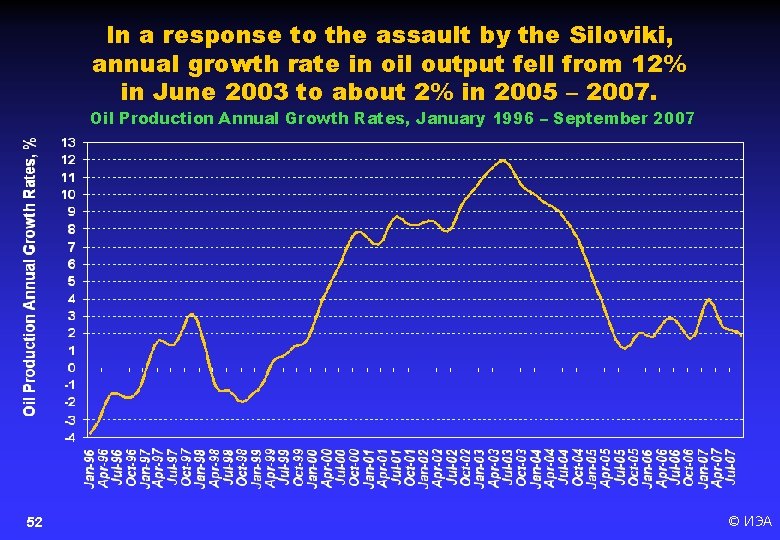
In a response to the assault by the Siloviki, annual growth rate in oil output fell from 12% in June 2003 to about 2% in 2005 – 2007. Oil Production Annual Growth Rates, January 1996 – September 2007 52 © ИЭА
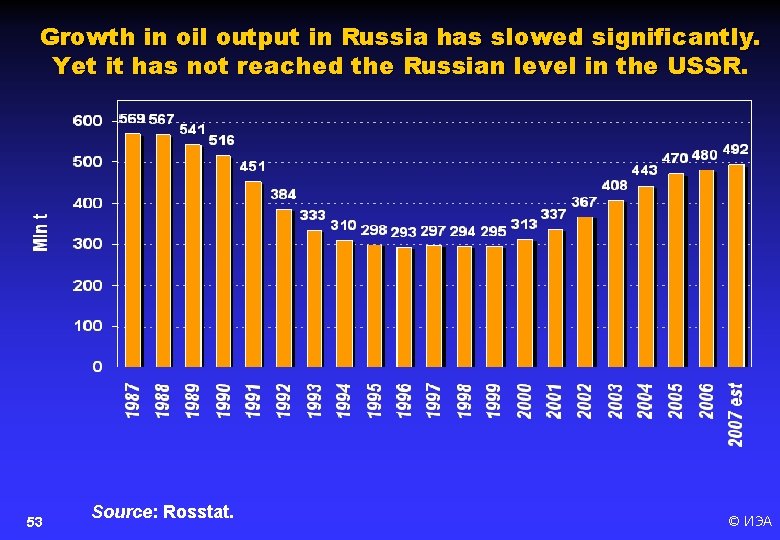
Growth in oil output in Russia has slowed significantly. Yet it has not reached the Russian level in the USSR. 53 Source: Rosstat. © ИЭА
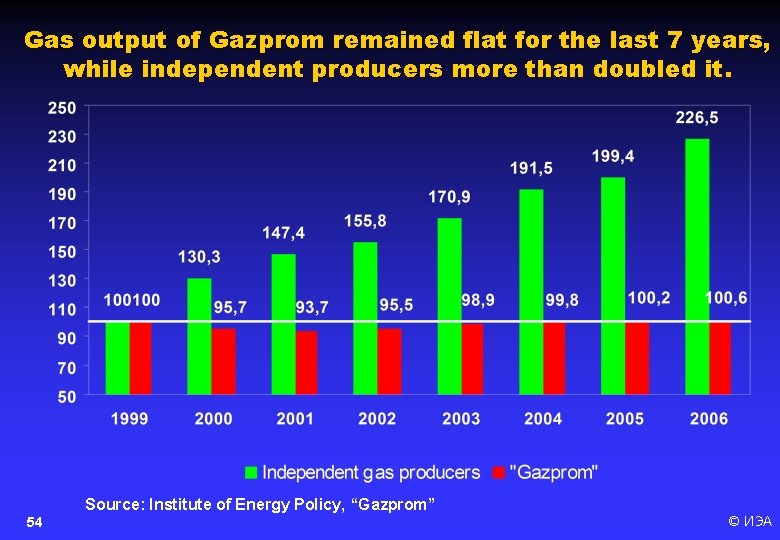
Gas output of Gazprom remained flat for the last 7 years, while independent producers more than doubled it. it Source: Institute of Energy Policy, “Gazprom” 54 © ИЭА
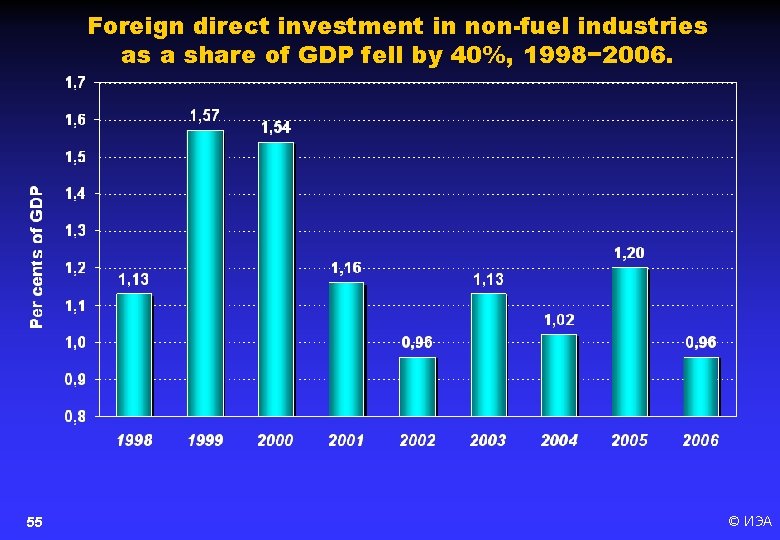
Foreign direct investment in non-fuel industries as a share of GDP fell by 40%, 1998− 2006. 55 © ИЭА
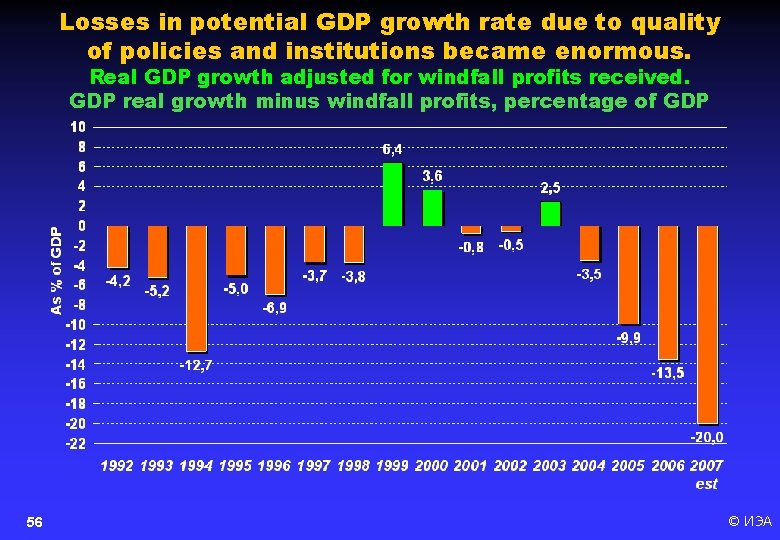
Losses in potential GDP growth rate due to quality of policies and institutions became enormous. Real GDP growth adjusted for windfall profits received. GDP real growth minus windfall profits, percentage of GDP 56 © ИЭА
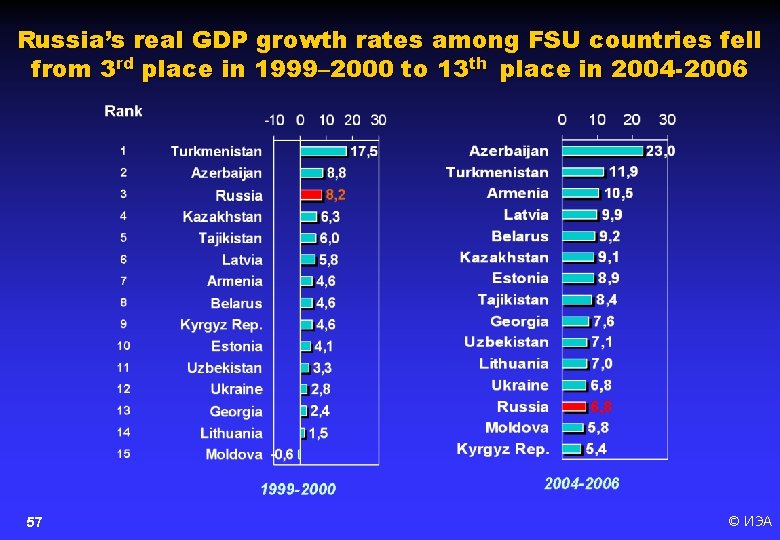
Russia’s real GDP growth rates among FSU countries fell from 3 rd place in 1999– 2000 to 13 th place in 2004 -2006 57 © ИЭА
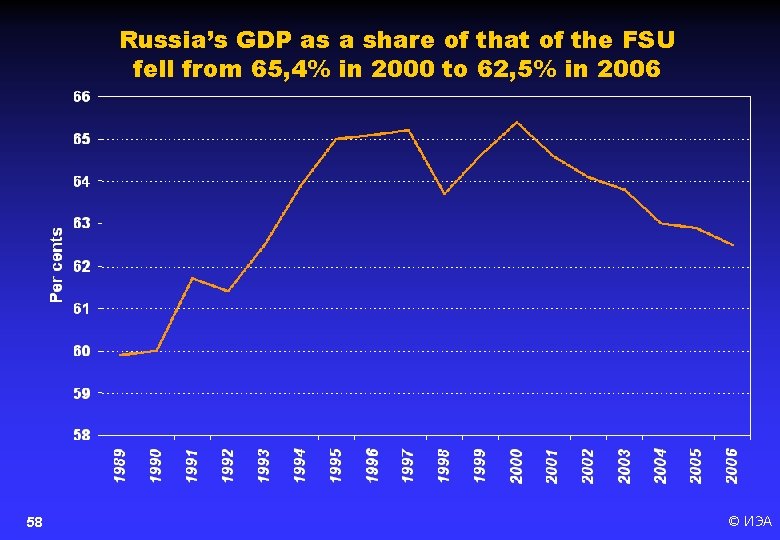
Russia’s GDP as a share of that of the FSU fell from 65, 4% in 2000 to 62, 5% in 2006 58 © ИЭА
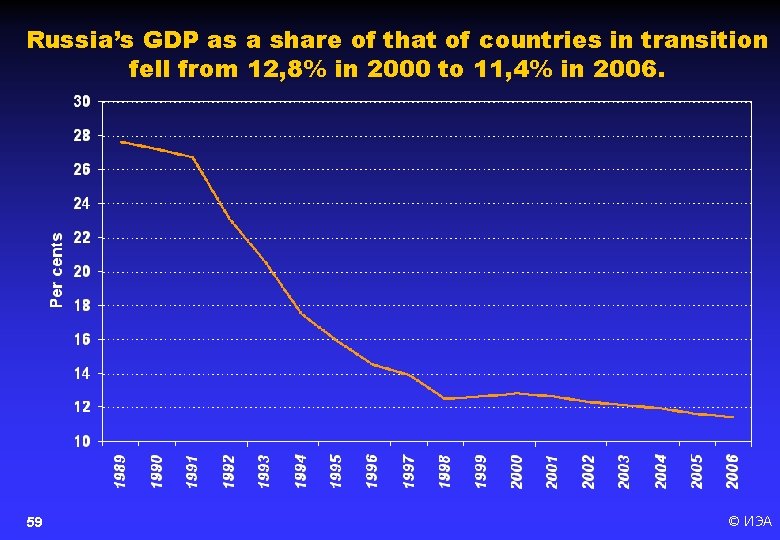
Russia’s GDP as a share of that of countries in transition fell from 12, 8% in 2000 to 11, 4% in 2006. 59 © ИЭА
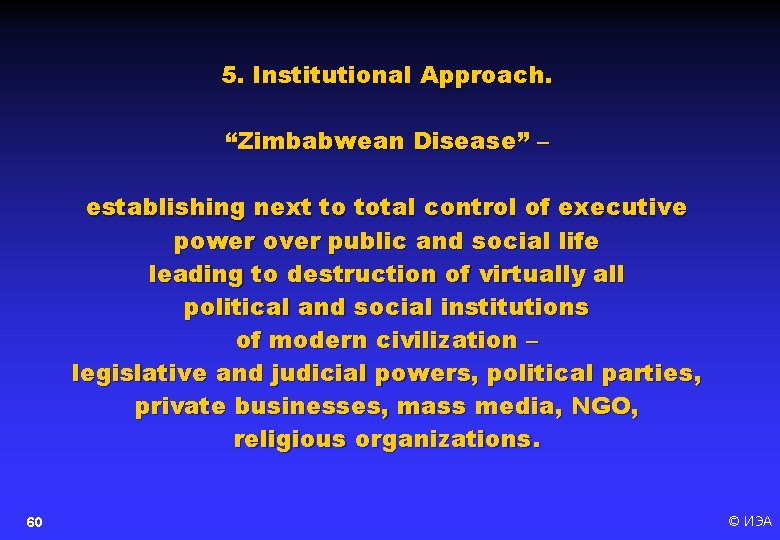
5. Institutional Approach. “Zimbabwean Disease” – establishing next to total control of executive power over public and social life leading to destruction of virtually all political and social institutions of modern civilization – legislative and judicial powers, political parties, private businesses, mass media, NGO, religious organizations. 60 © ИЭА
“The most important task for us is to learn how to use state instruments for securing all freedoms – personal freedom, entrepreneurial freedom, freedom of development of institutes of civil society”. Vladimir Putin, State of Russia Address, July 8, 2000 61 © ИЭА
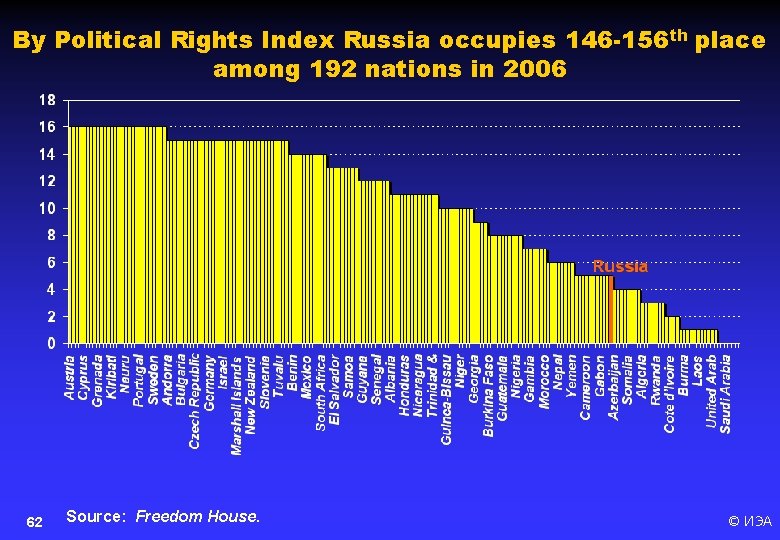
By Political Rights Index Russia occupies 146 -156 th place among 192 nations in 2006 62 Source: Freedom House. © ИЭА
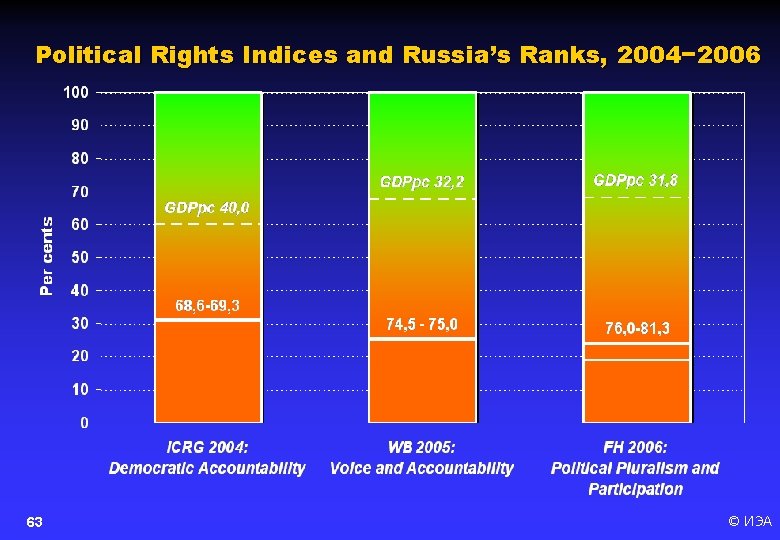
Political Rights Indices and Russia’s Ranks, 2004− 2006 63 © ИЭА
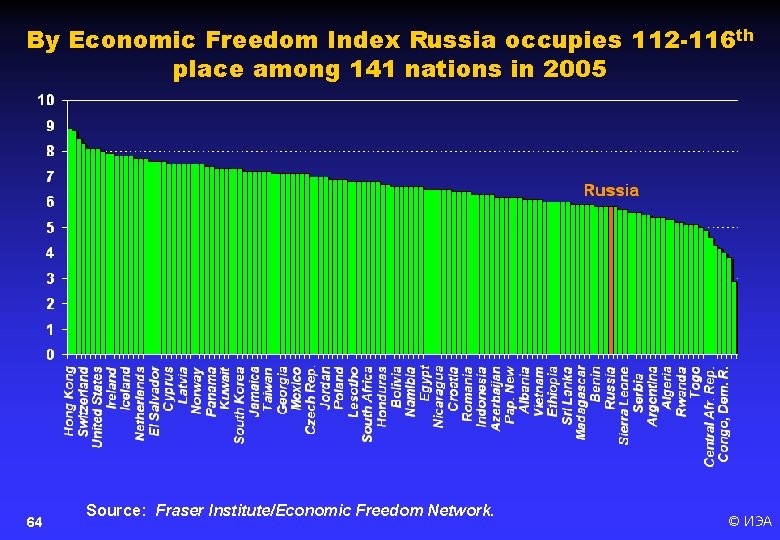
By Economic Freedom Index Russia occupies 1 12 -116 th place among 141 nations in 2005 64 Source: Fraser Institute/Economic Freedom Network. © ИЭА
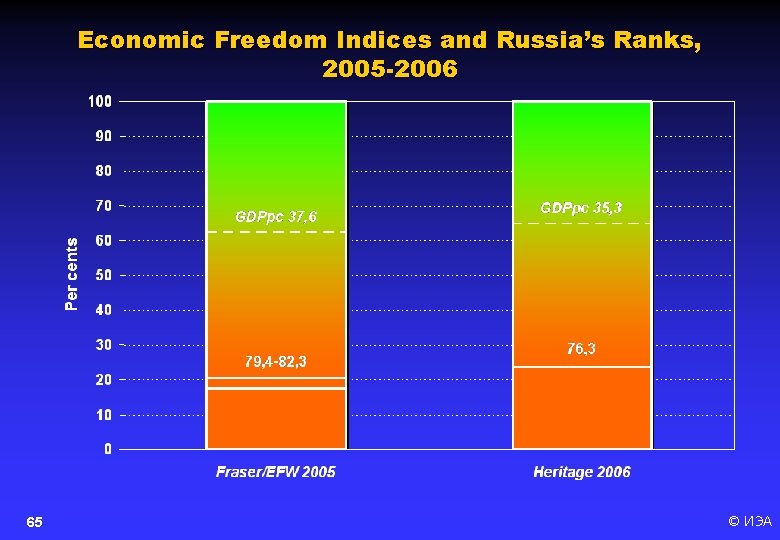
Economic Freedom Indices and Russia’s Ranks, 2005 -2006 65 © ИЭА
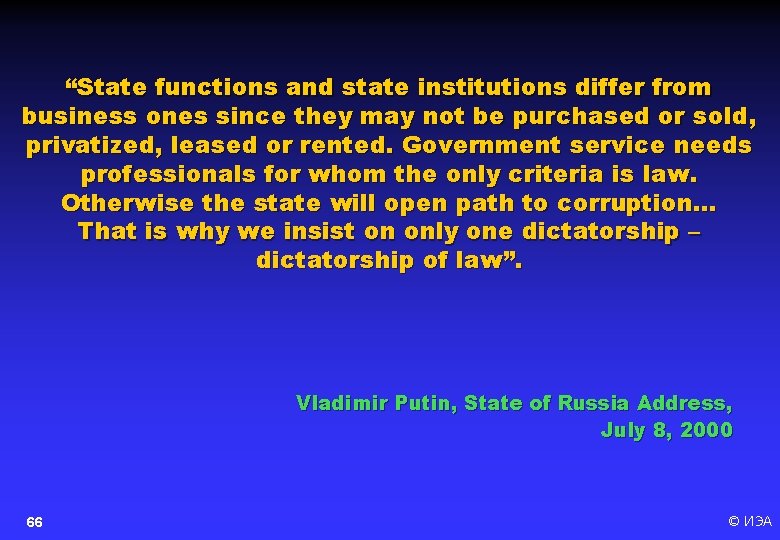
“State functions and state institutions differ from business ones since they may not be purchased or sold , privatized, leased or rented. Government service needs professionals for whom the only criteria is law. Otherwise the state will open path to corruption… That is why we insist on only one dictatorship – dictatorship of law”. Vladimir Putin, State of Russia Address, July 8, 2000 66 © ИЭА
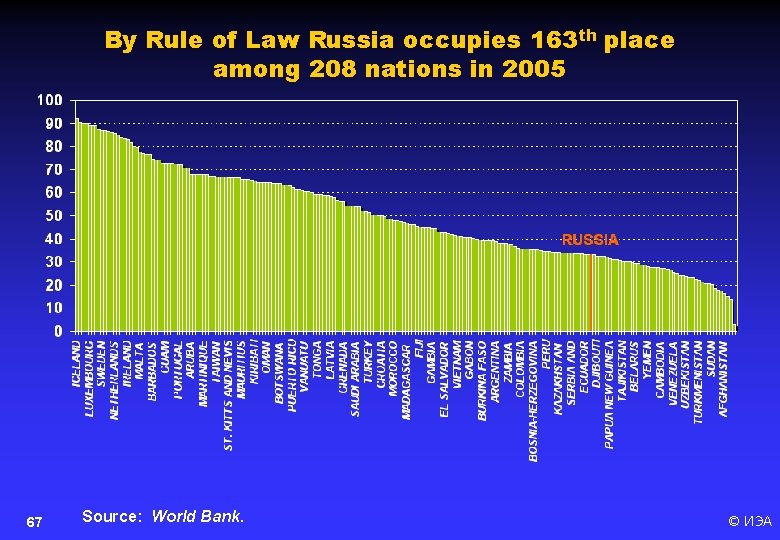
By Rule of Law Russia occupies 163 th place among 208 nations in 2005 67 Source: World Bank. © ИЭА
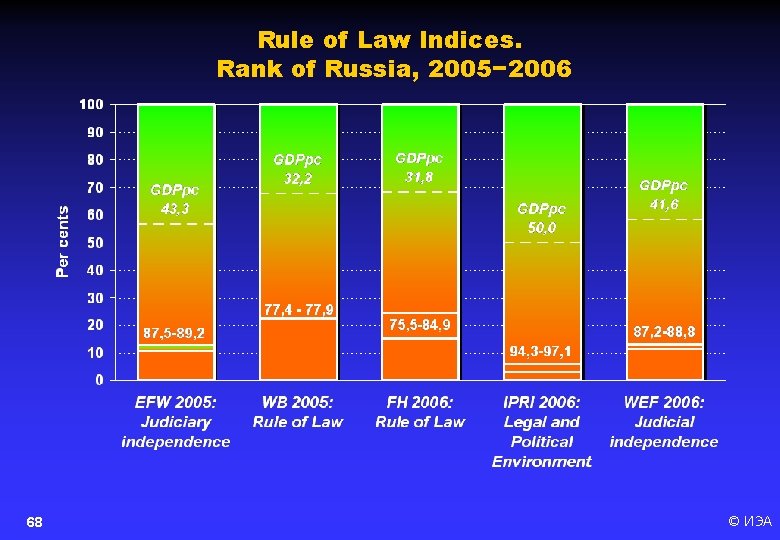
Rule of Law Indices. Rank of Russia, 2005− 2006 68 © ИЭА
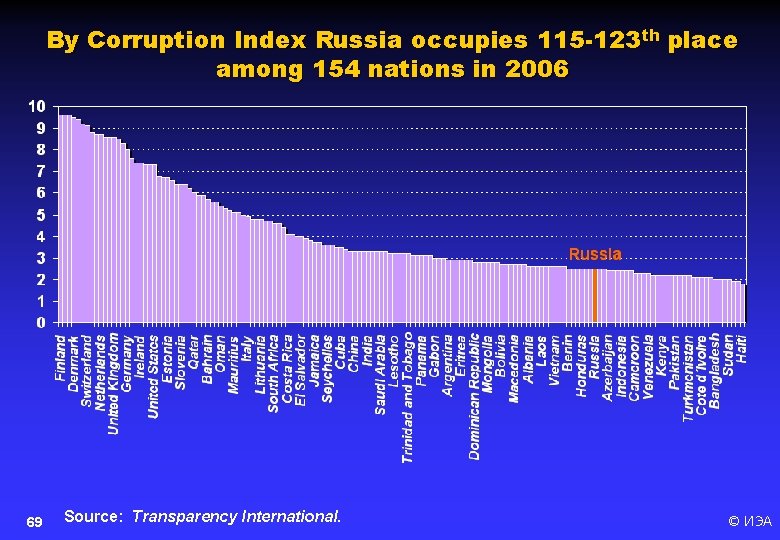
By Corruption Index Russia occupies 115 -123 th place among 154 nations in 2006 69 Source: Transparency International. © ИЭА
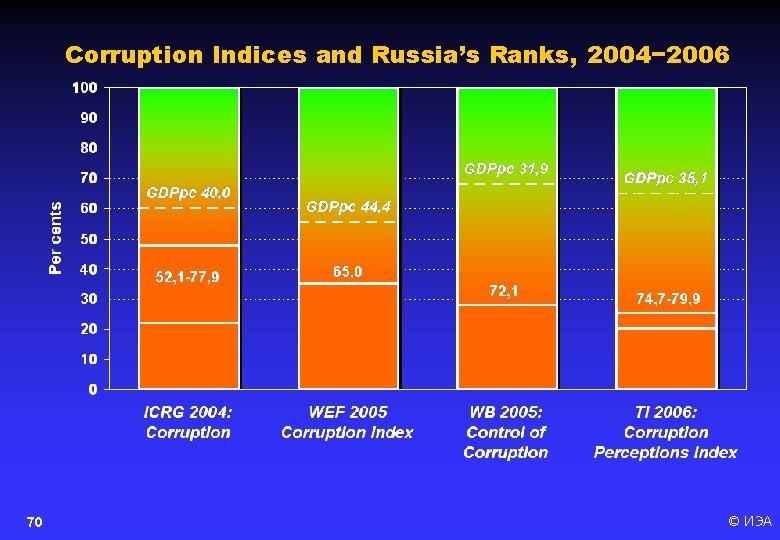
Corruption Indices and Russia’s Ranks, 2004− 2006 70 © ИЭА
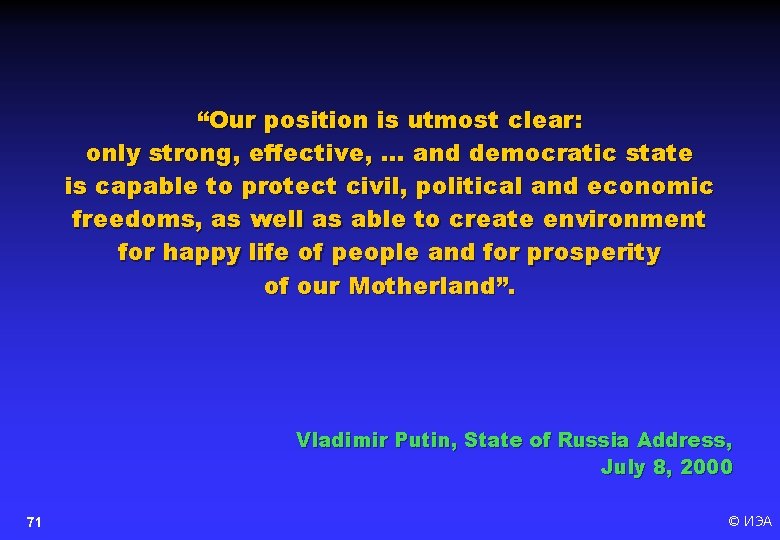
“Our position is utmost clear: only strong, effective, … and democratic state is capable to protect civil, political and economic freedoms, as well as able to create environment for happy life of people and for prosperity of our Motherland”. Vladimir Putin, State of Russia Address, July 8, 2000 71 © ИЭА
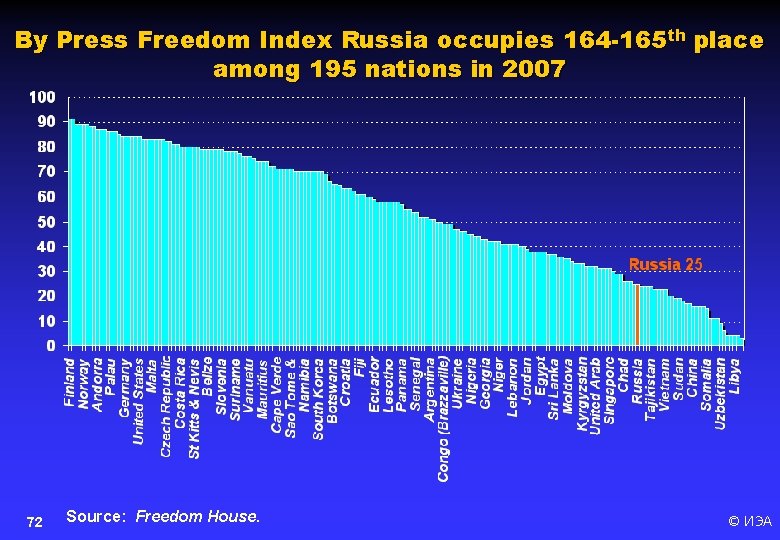
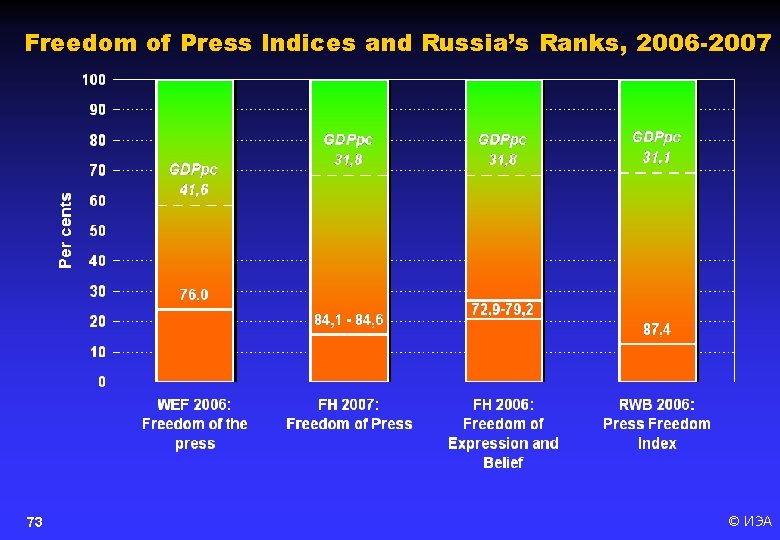
By Press Freedom Index Russia occupies 164 -165 th place among 195 nations in 2007 72 Source: Freedom House. © ИЭА
Freedom of Press Indices and Russia’s Ranks, 2006 -2007 73 © ИЭА
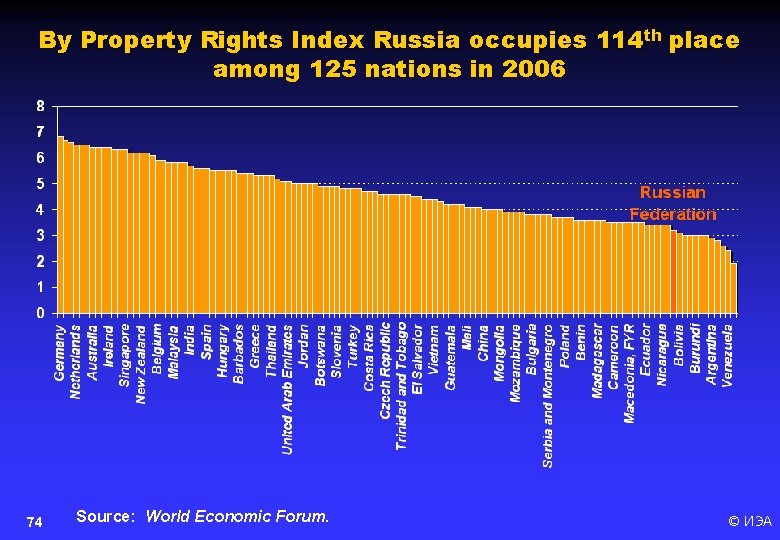
By Property Rights Index Russia occupies 114 th place among 125 nations in 2006 74 Source: World Economic Forum. © ИЭА
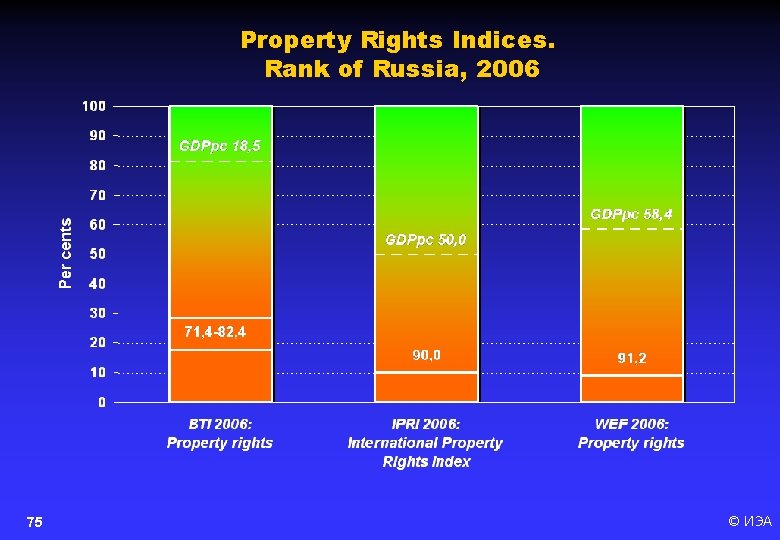
Property Rights Indices. Rank of Russia, 2006 75 © ИЭА
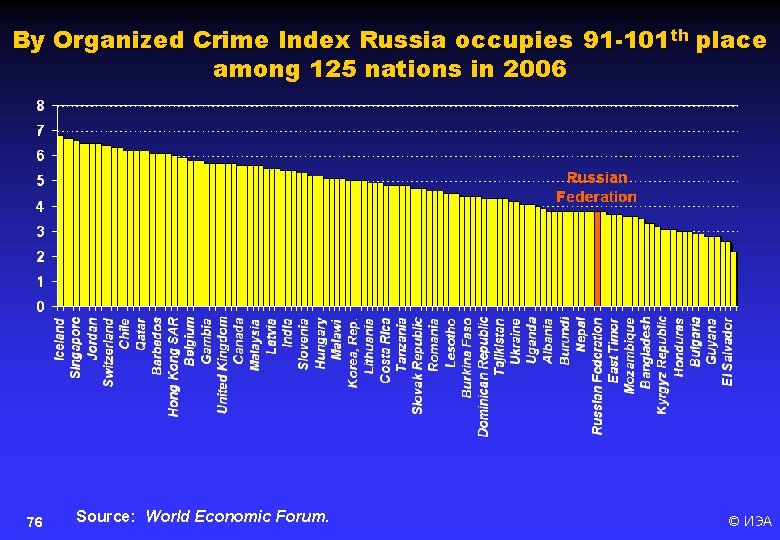
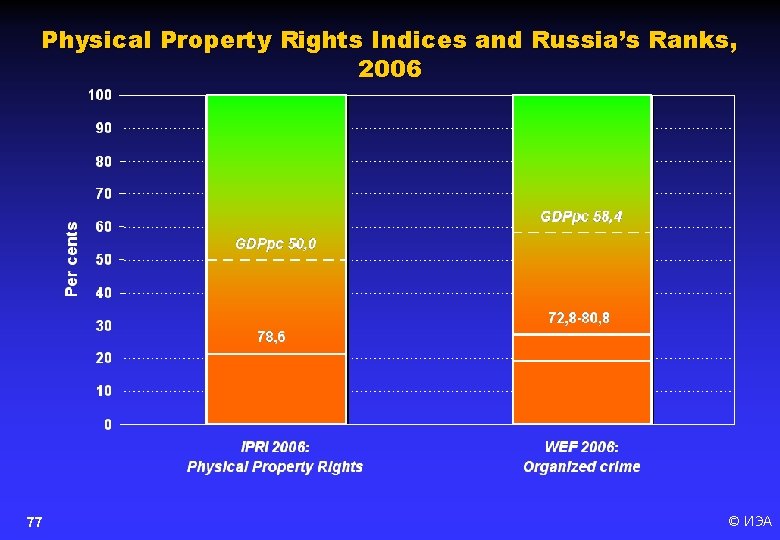
By Organized Crime Index Russia occupies 91 -101 th place among 125 nations in 2006 76 Source: World Economic Forum. © ИЭА
Physical Property Rights Indices and Russia’s Ranks, 2006 77 © ИЭА
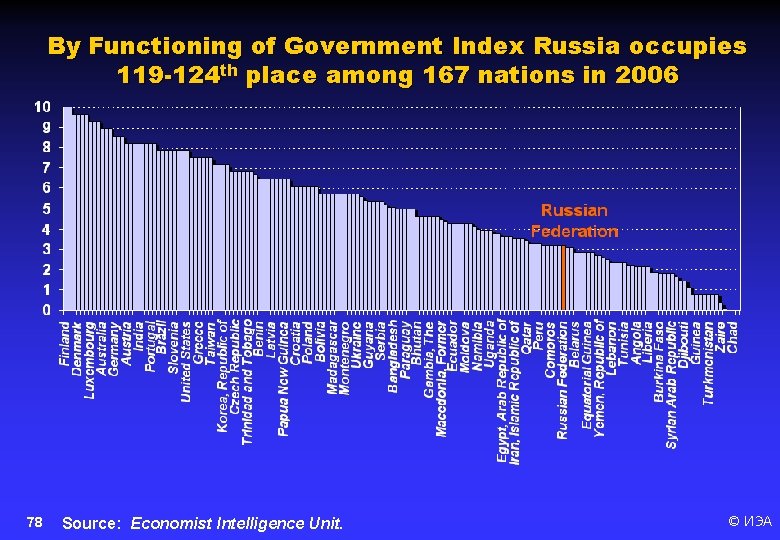
By Functioning of Government Index Russia occupies 119 -124 th place among 167 nations in 2006 78 Source: Economist Intelligence Unit. © ИЭА
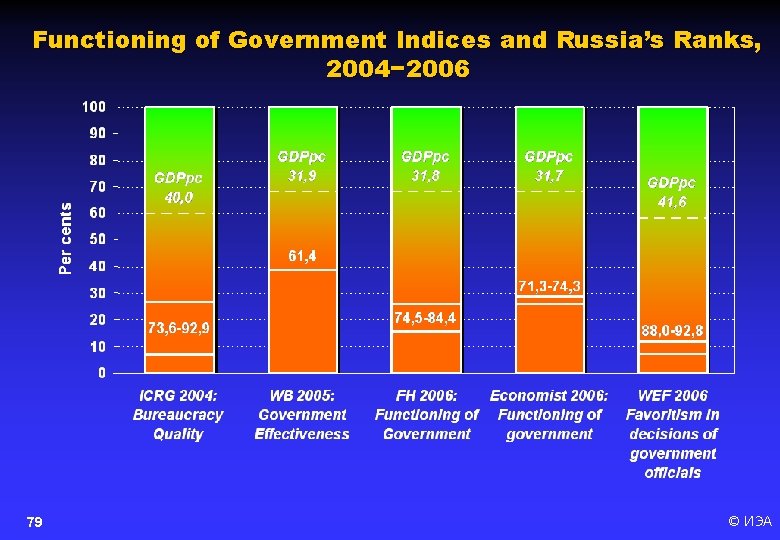
Functioning of Government Indices and Russia’s Ranks, 2004− 2006 79 © ИЭА
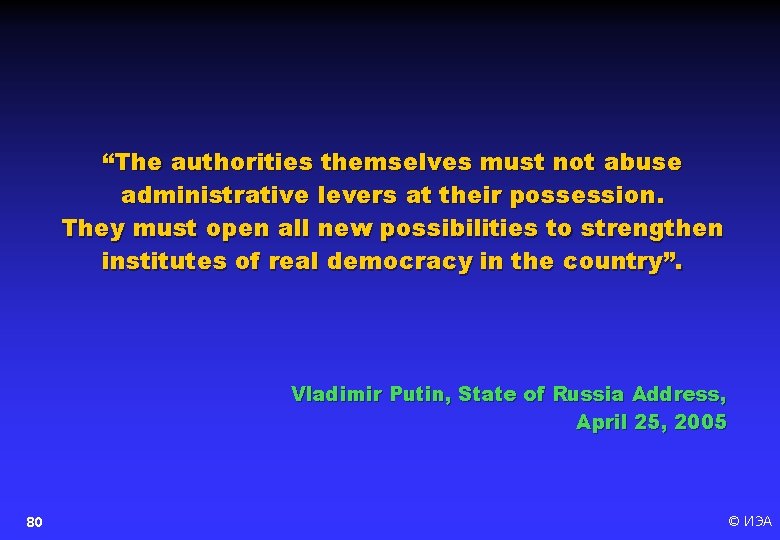
“The authorities themselves must not abuse administrative levers at their possession. They must open all new possibilities to strengthen institutes of real democracy in the country”. Vladimir Putin, State of Russia Address, April 25, 2005 80 © ИЭА
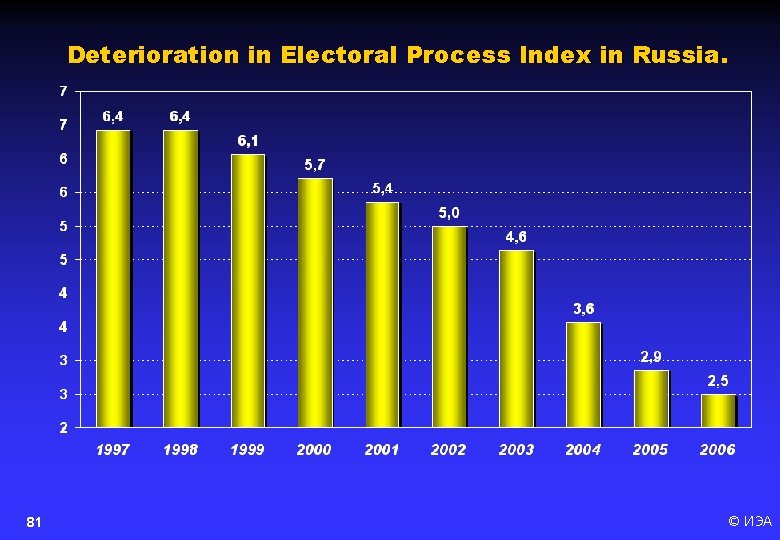
Deterioration in Electoral Process Index in Russia. 81 © ИЭА
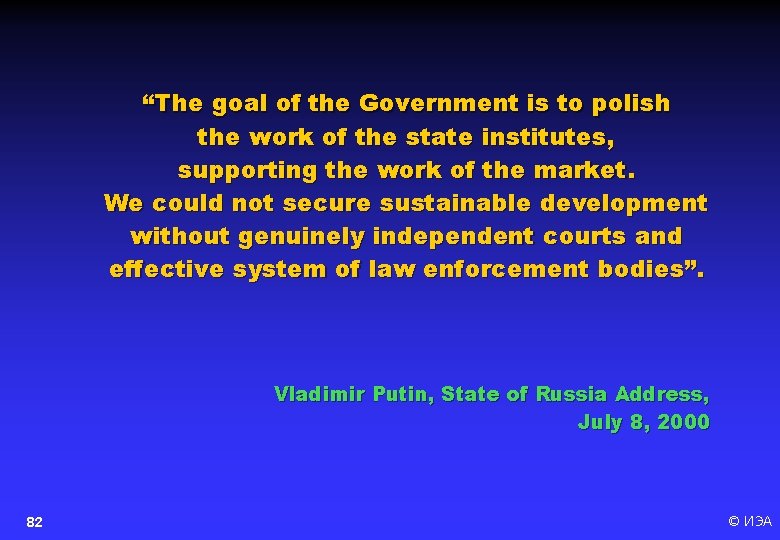
“The goal of the Government is to polish the work of the state institutes, supporting the work of the market. We could not secure sustainable development without genuinely independent courts and effective system of law enforcement bodies”. Vladimir Putin, State of Russia Address, July 8, 2000 82 © ИЭА
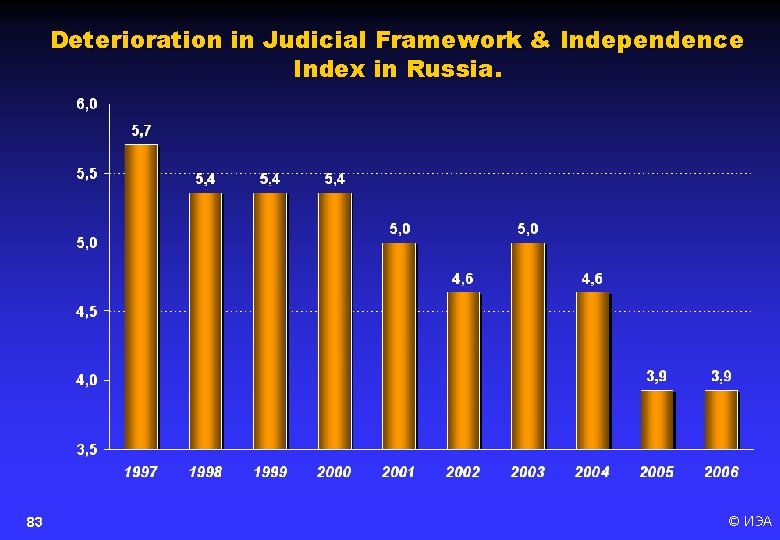
Deterioration in Judicial Framework & Independence Index in Russia. 83 © ИЭА
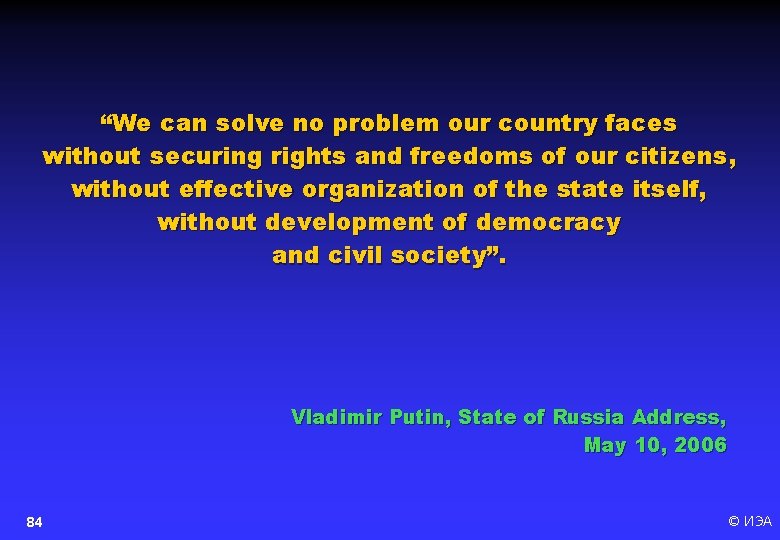
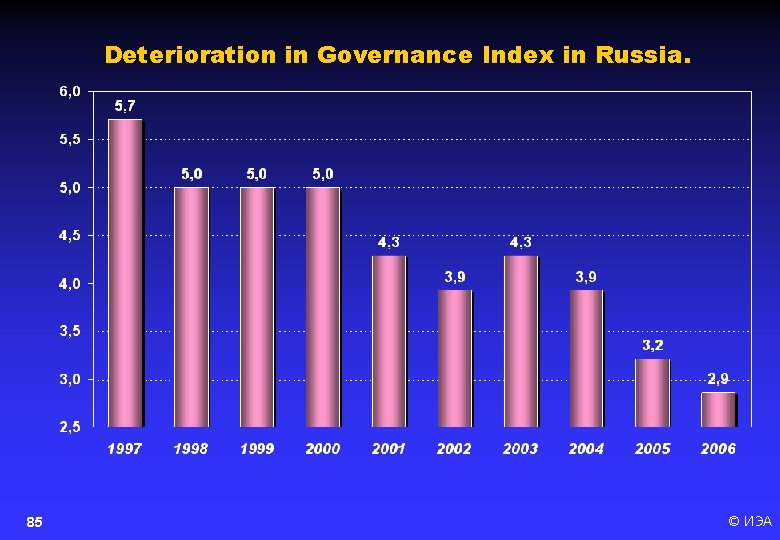
“We can solve no problem our country faces without securing rights and freedoms of our citizens , without effective organization of the state itself, without development of democracy and civil society”. Vladimir Putin, State of Russia Address, May 10, 2006 84 © ИЭА
Deterioration in Governance Index in Russia. 85 © ИЭА
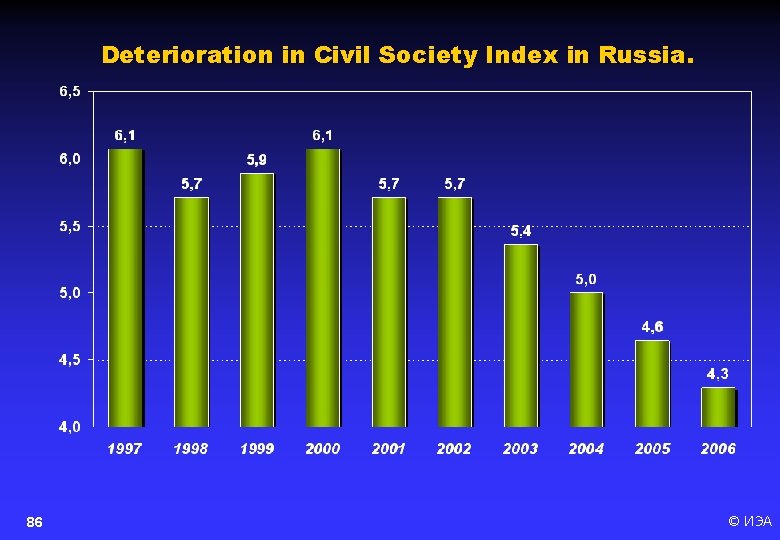
Deterioration in Civil Society Index in Russia. 86 © ИЭА
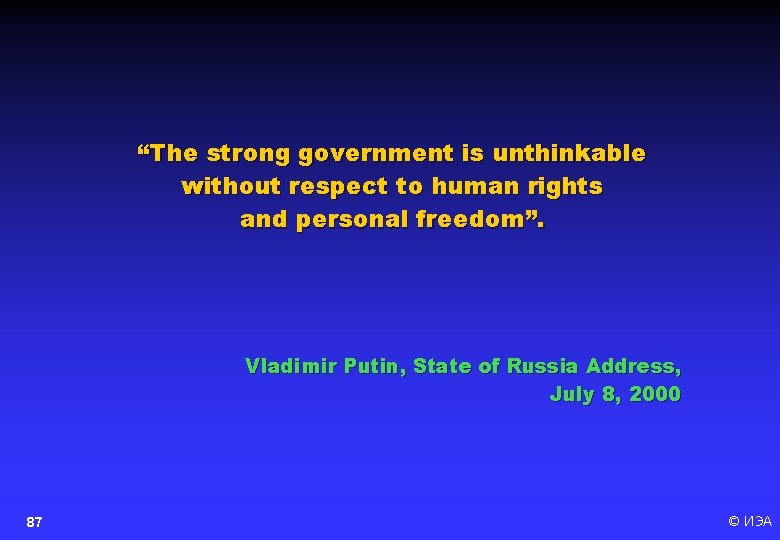
“The strong government is unthinkable without respect to human rights and personal freedom”. Vladimir Putin, State of Russia Address, July 8, 2000 87 © ИЭА
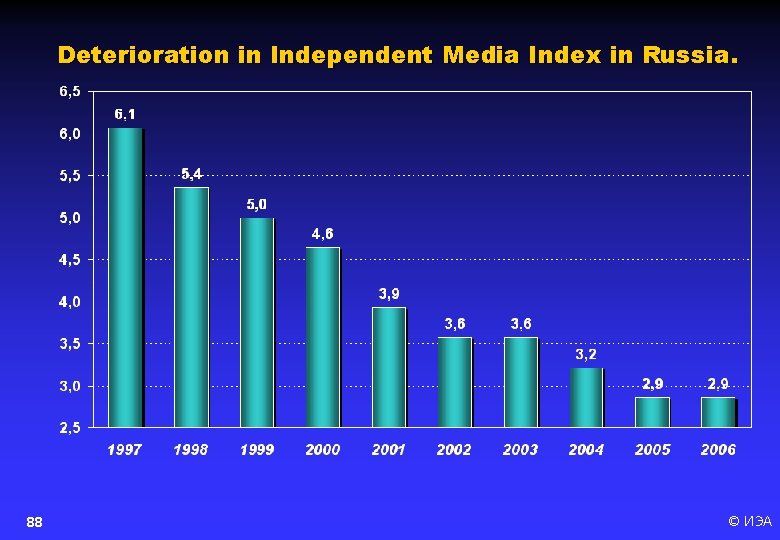
Deterioration in Independent Media Index in Russia. 88 © ИЭА
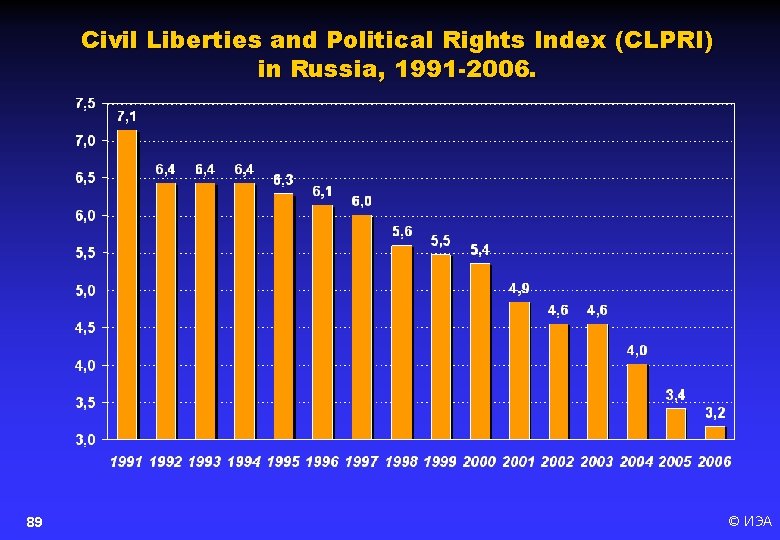
Civil Liberties and Political Rights Index (CLPRI) in Russia, 1991 -2006. 89 © ИЭА
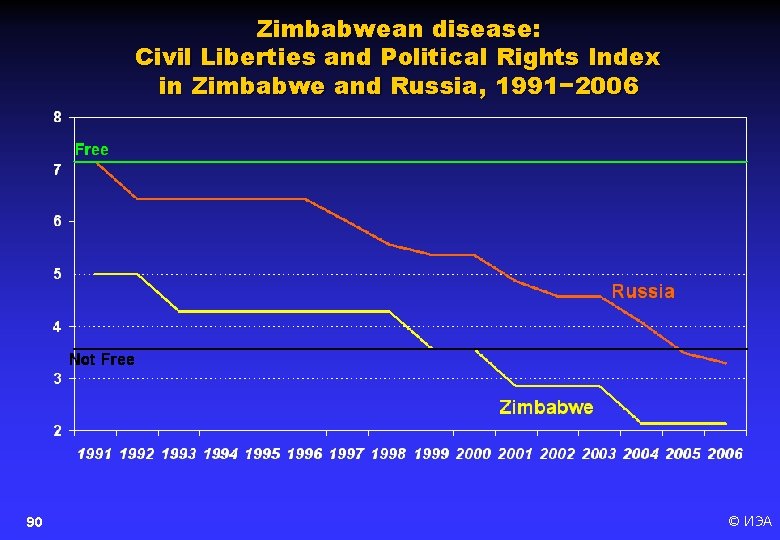
Zimbabwean disease: Civil Liberties and Political Rights Index in Zimbabwe and Russia, 1991− 2006 90 © ИЭА
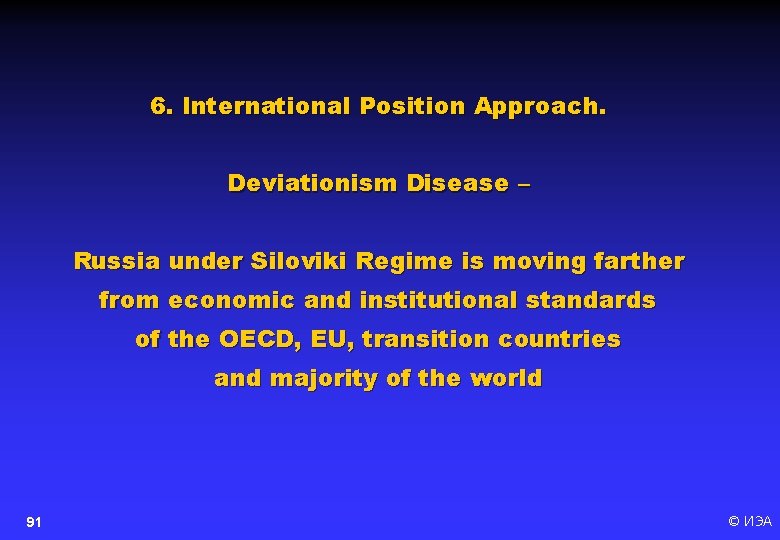
6. International Position Approach. Deviationism Disease – Russia under Siloviki Regime is moving farther from economic and institutional standards of the OECD, EU, transition countries and majority of the world 91 © ИЭА
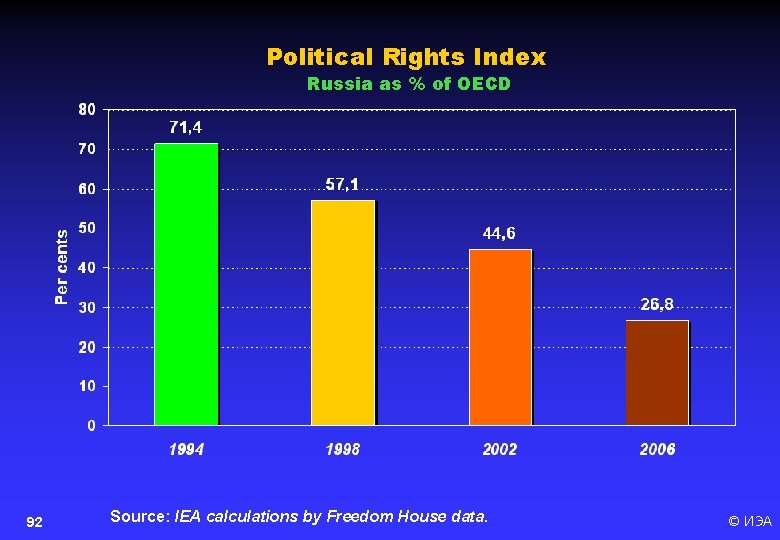
Political Rights Index Russia as % of OECD 92 Source: IEA calculations by Freedom House data. © ИЭА
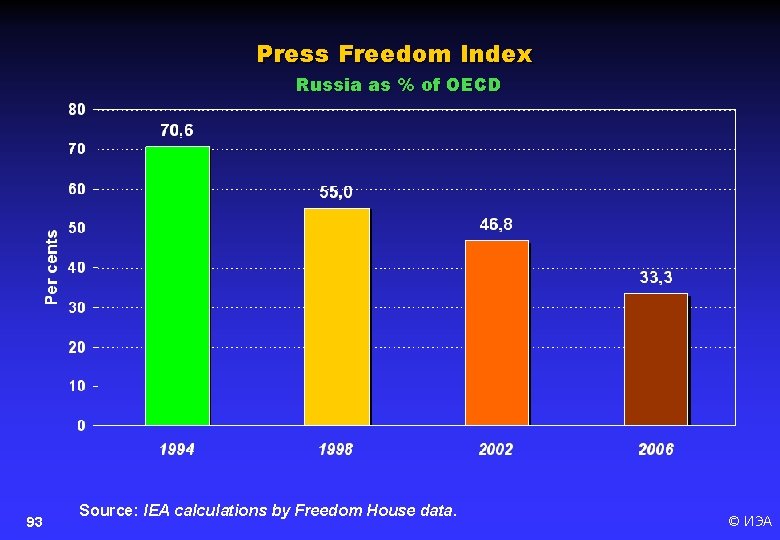
Press Freedom Index Russia as % of OECD 93 Source: IEA calculations by Freedom House data. © ИЭА
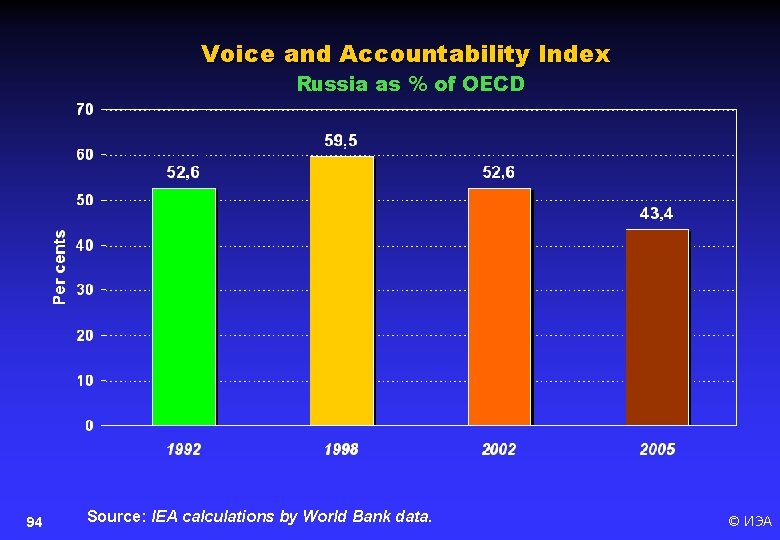
Voice and Accountability Index Russia as % of OECD 94 Source: IEA calculations by World Bank data. © ИЭА
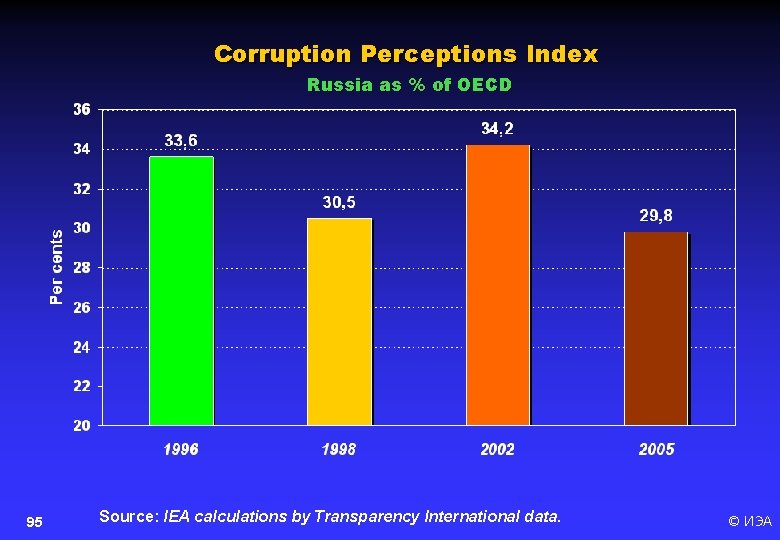
Corruption Perceptions Index Russia as % of OECD 95 Source: IEA calculations by Transparency International data. © ИЭА
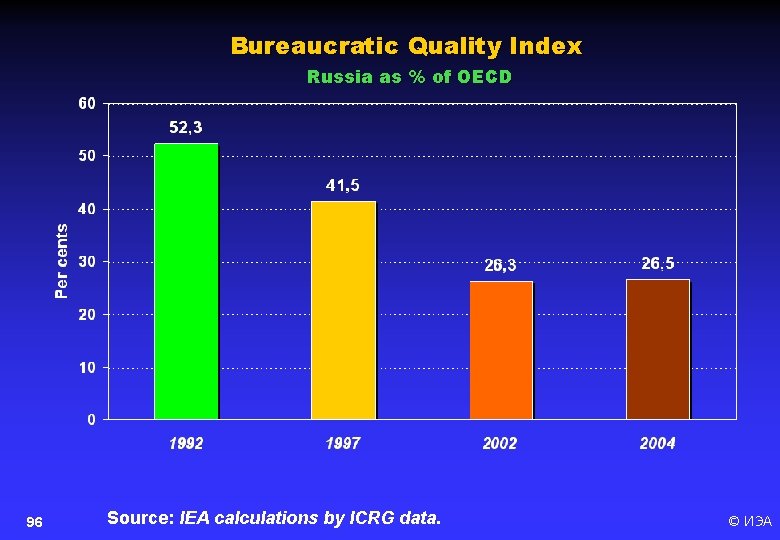
Bureaucratic Quality Index Russia as % of OECD 96 Source: IEA calculations by ICRG data. © ИЭА
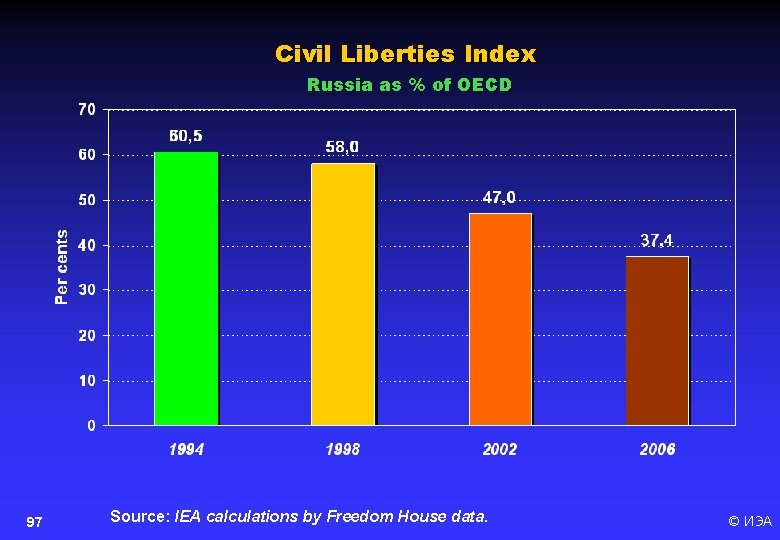
Civil Liberties Index Russia as % of OECD 97 Source: IEA calculations by Freedom House data. © ИЭА
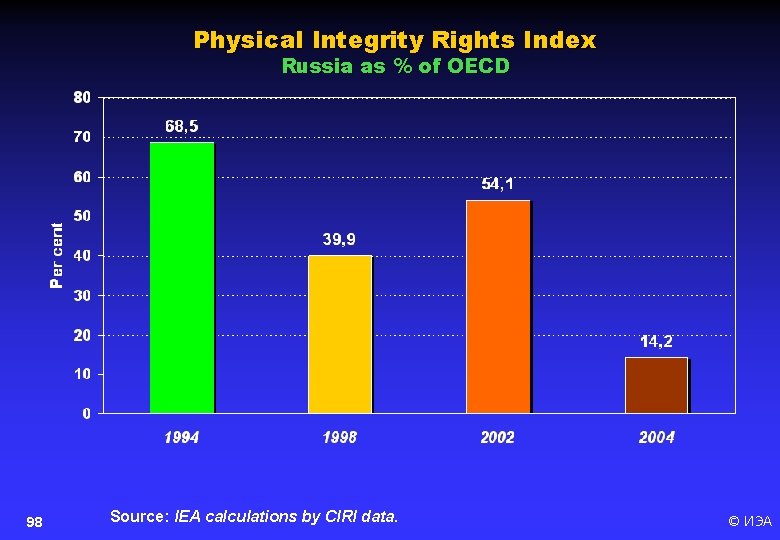
Physical Integrity Rights Index Russia as % of OECD 98 Source: IEA calculations by CIRI data. © ИЭА
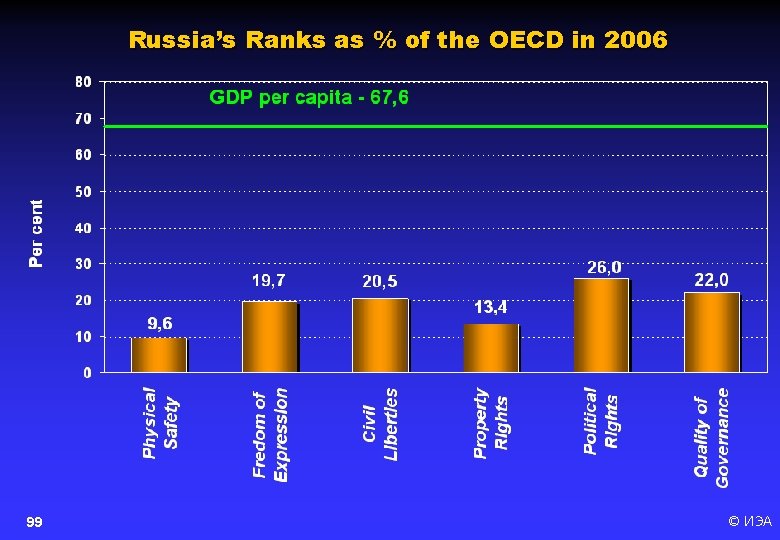
Russia’s Ranks as % of the OECD in 2006 99 © ИЭА
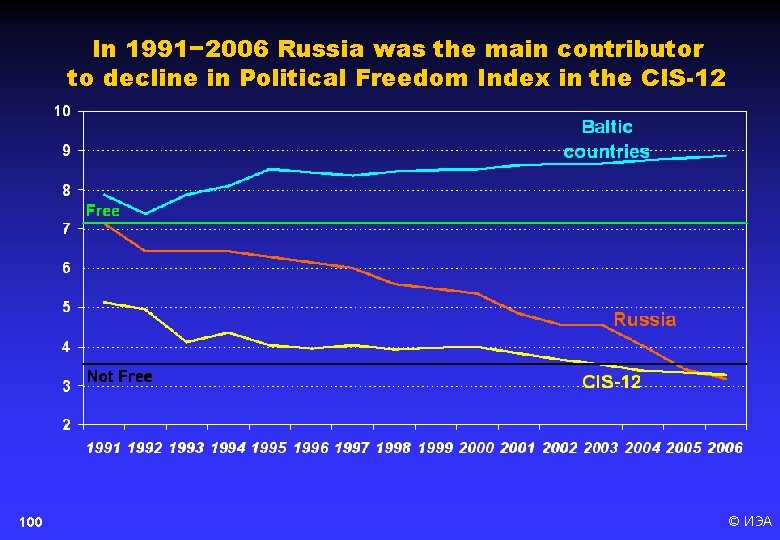
In 1991− 2006 Russia was the main contributor to decline in Political Freedom Index in the CIS-12 100 © ИЭА
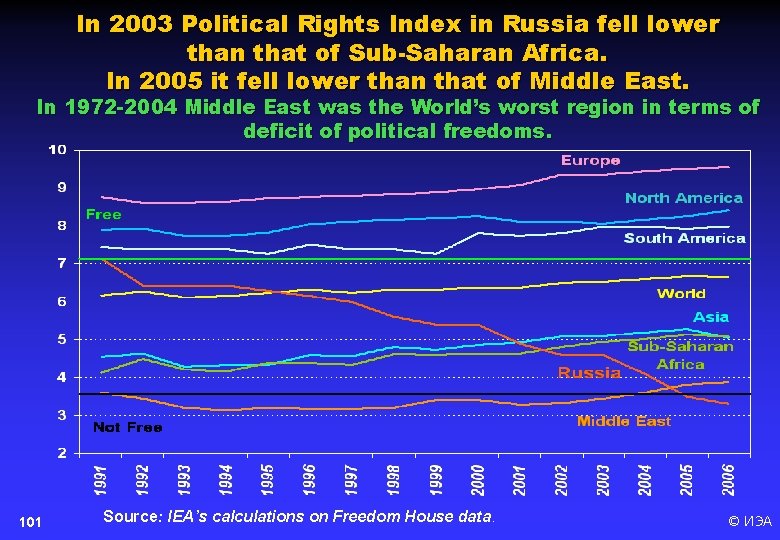
In 2003 Political Rights Index in Russia fell lower than that of Sub-Saharan Africa. In 2005 it fell lower than that of Middle East. In 1972 -2004 Middle East was the World’s worst region in terms of deficit of political freedoms. 101 Source: IEA’s calculations on Freedom House data. © ИЭА
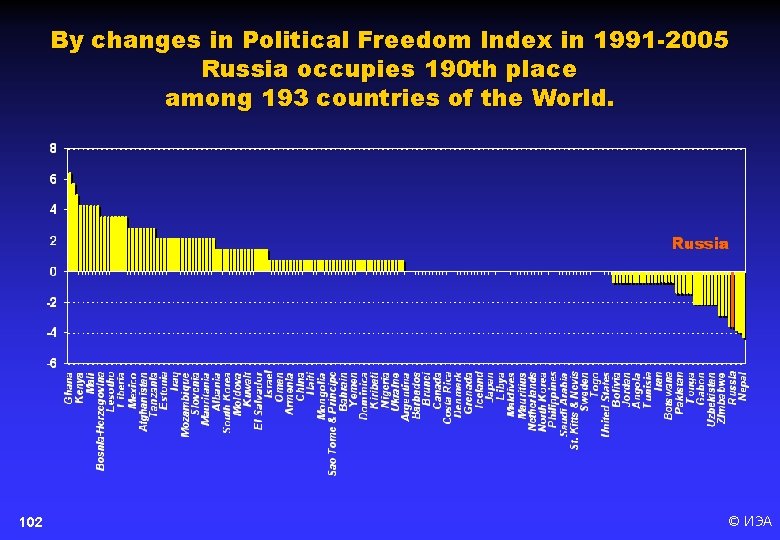
By changes in Political Freedom Index in 1991 -2005 Russia occupies 190 th place among 193 countries of the World. 102 © ИЭА
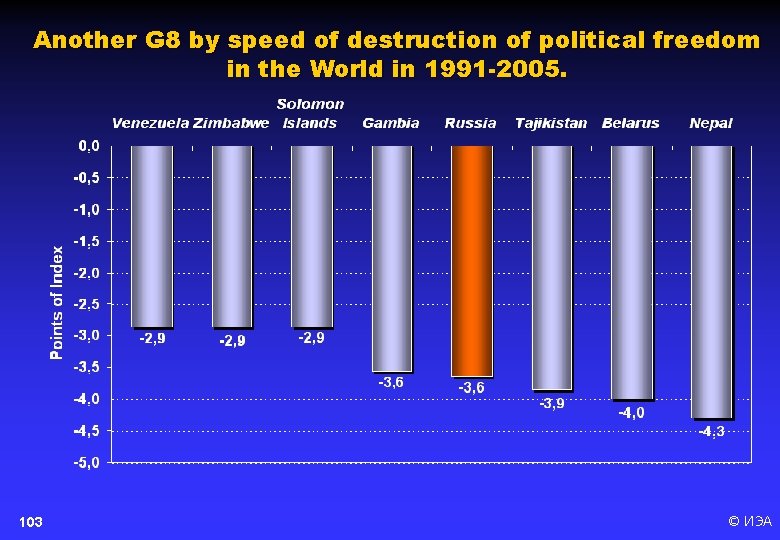
Another G 8 by speed of destruction of political freedom in the World in 1991 -2005. 103 © ИЭА
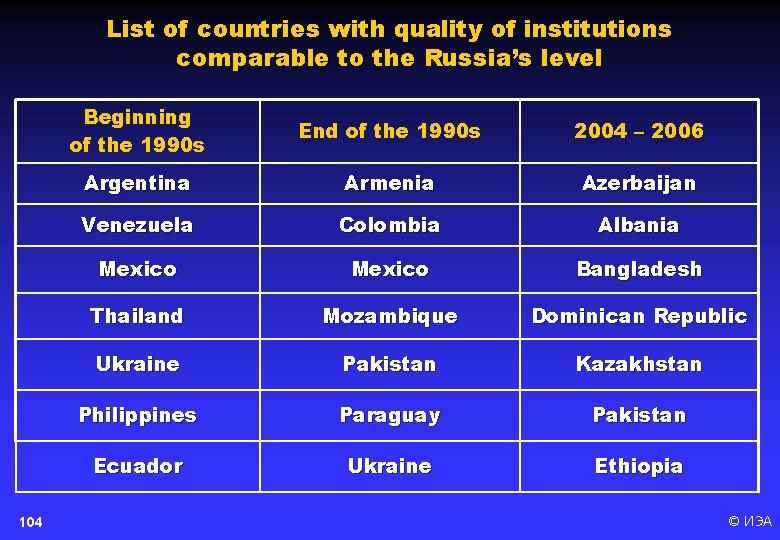
List of countries with quality of institutions comparable to the Russia’s level 104 Beginning of the 1990 s End of the 1990 s 2004 – 2006 Argentina Armenia Azerbaijan Venezuela Colombia Albania Mexico Bangladesh Thailand Mozambique Dominican Republic Ukraine Pakistan Kazakhstan Philippines Paraguay Pakistan Ecuador Ukraine Ethiopia © ИЭА
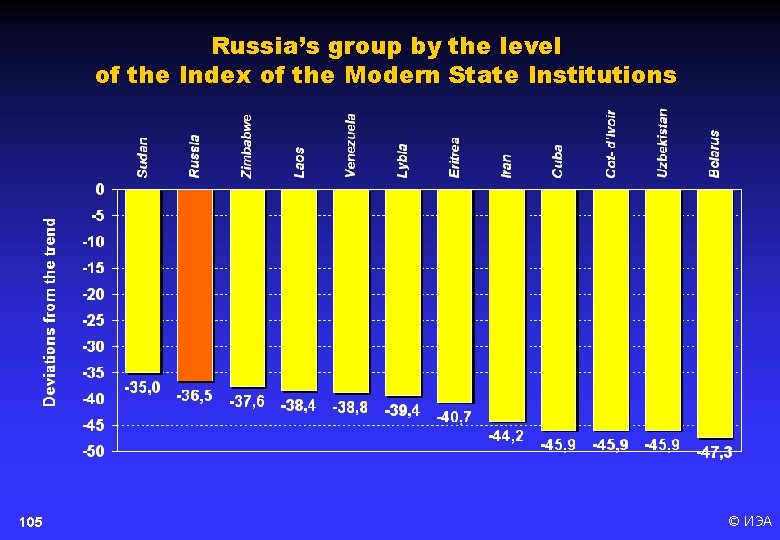
Russia’s group by the level of the Index of the Modern State Institutions 105 © ИЭА
7. Foreign Policy Approach. 7 a. Isolationism. The Siloviki Model in the international relations led to failure of Russian-Western integration and growing isolation Russia from the Enlarged West and even from the CIS. 106 © ИЭА
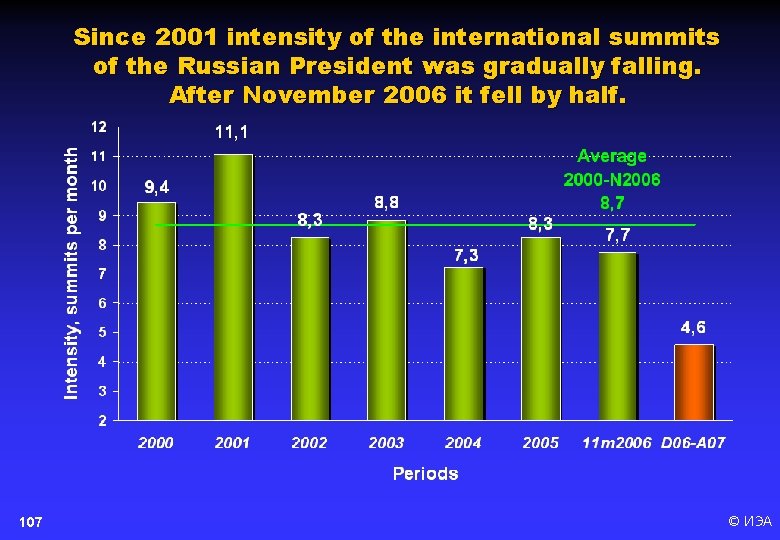
Since 2001 intensity of the international summits of the Russian President was gradually falling. After November 2006 it fell by half. 107 © ИЭА
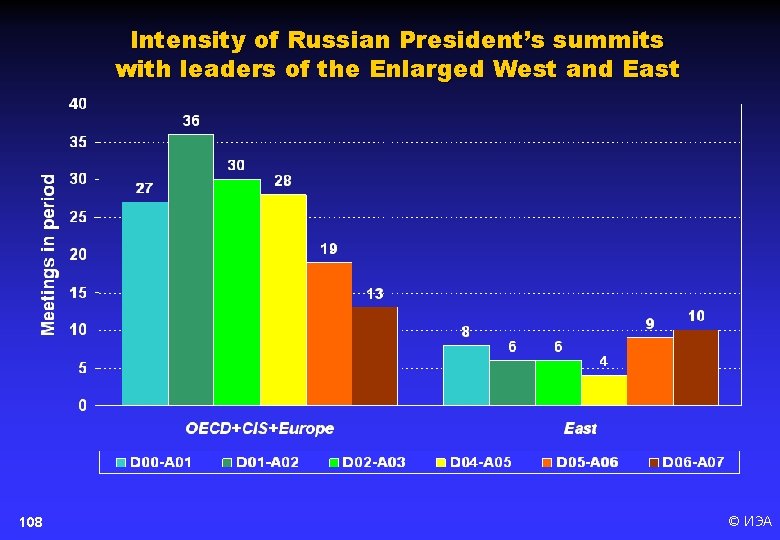
Intensity of Russian President’s summits with leaders of the Enlarged West and East 108 © ИЭА
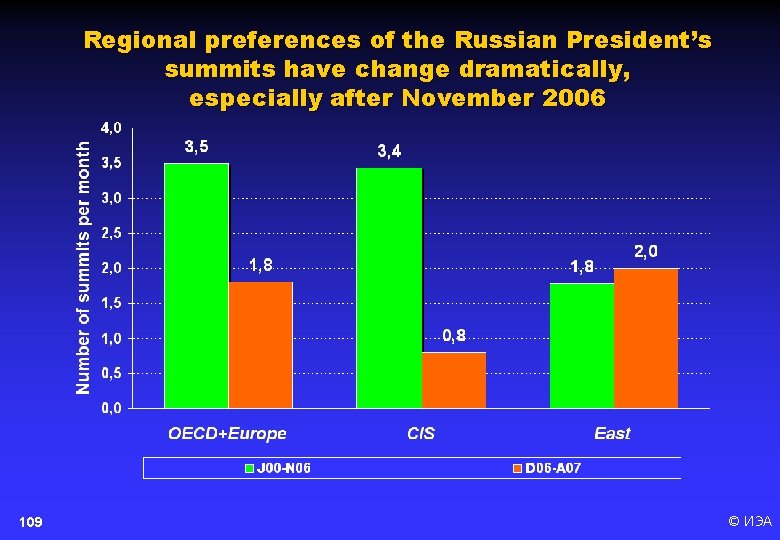
Regional preferences of the Russian President’s summits have change dramatically, especially after November 2006 109 © ИЭА
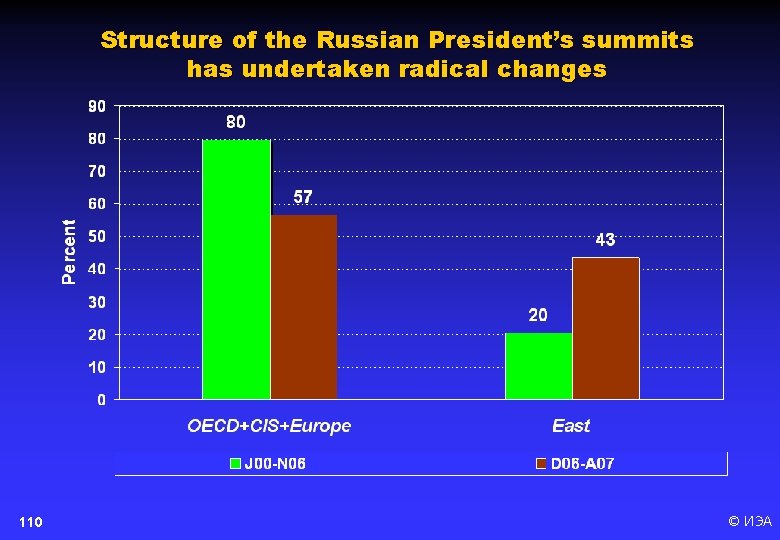
Structure of the Russian President’s summits has undertaken radical changes 110 © ИЭА
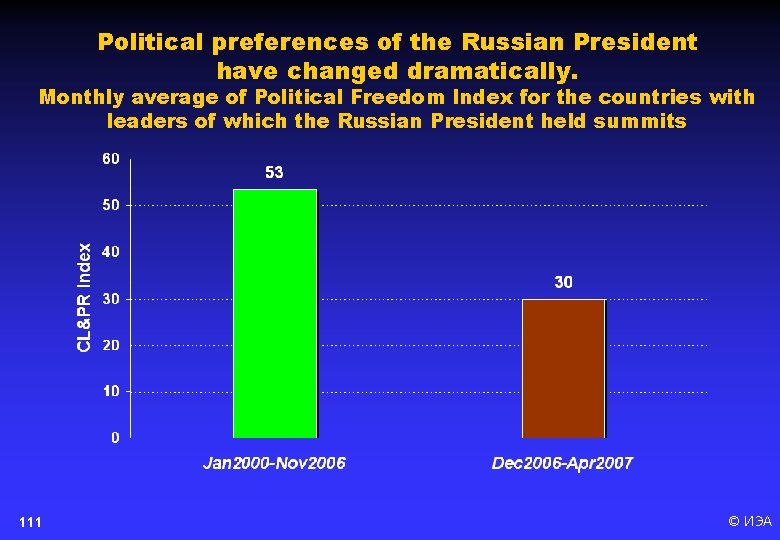
Political preferences of the Russian President have changed dramatically. Monthly average of Political Freedom Index for the countries with leaders of which the Russian President held summits 111 © ИЭА
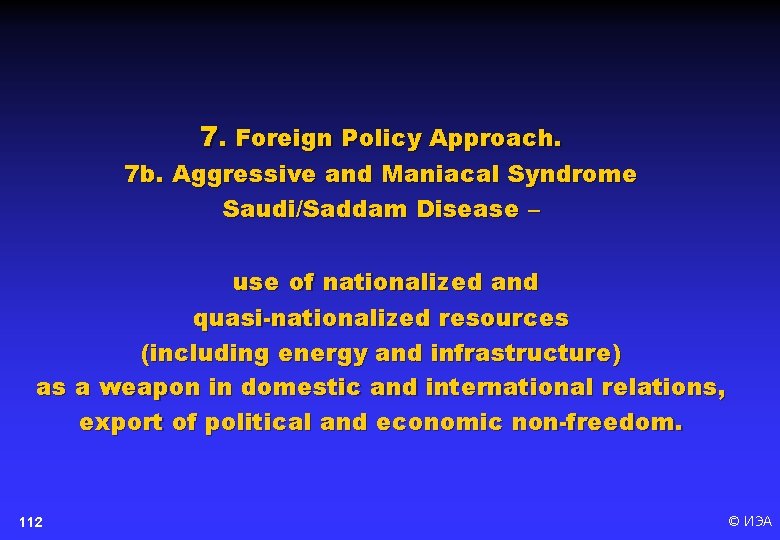
7. Foreign Policy Approach. 7 b. Aggressive and Maniacal Syndrome Saudi/Saddam Disease – use of nationalized and quasi-nationalized resources (including energy and infrastructure) as a weapon in domestic and international relations, export of political and economic non-freedom. 112 © ИЭА
Backed by an unstoppable influx of financial resources into the country the Siloviki’s foreign policy becomes more assertive, more arrogant and more aggressive. Foreign policy warfare has been used against Ukraine, Moldova, Georgia, Poland, Lithuania, Belarus, Estonia… 113 © ИЭА
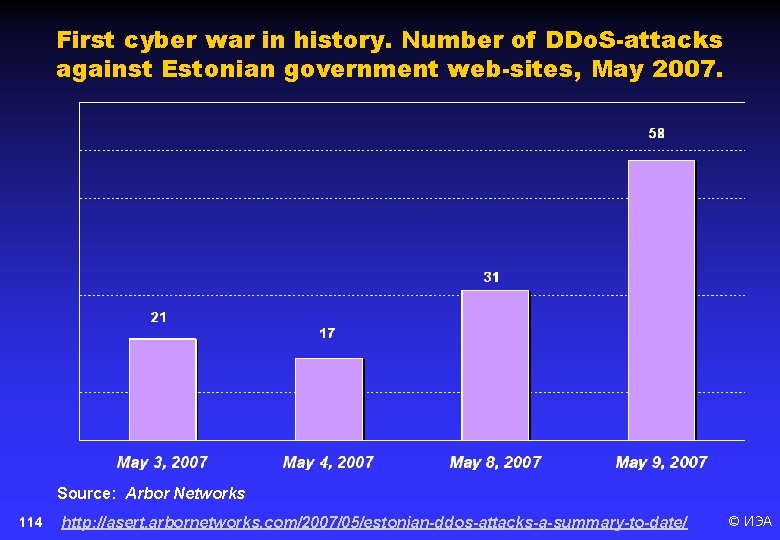
First cyber war in history. Number of DDo. S-attacks against Estonian government web-sites, May 2007. Source: Arbor Networks 114 http: //asert. arbornetworks. com/2007/05/estonian-ddos-attacks-a-summary-to-date/ © ИЭА
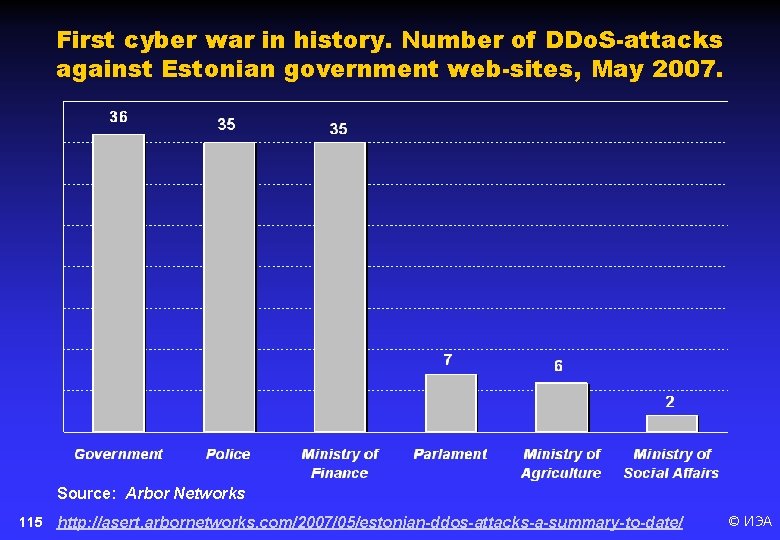
First cyber war in history. Number of DDo. S-attacks against Estonian government web-sites, May 2007. Source: Arbor Networks 115 http: //asert. arbornetworks. com/2007/05/estonian-ddos-attacks-a-summary-to-date/ © ИЭА
8. Social Behavior. Sicilian Disease – use of coercion and violent force unrestricted by law, tradition, morale and now even economic resources. It is the essence of the Siloviki Regime. 116 © ИЭА
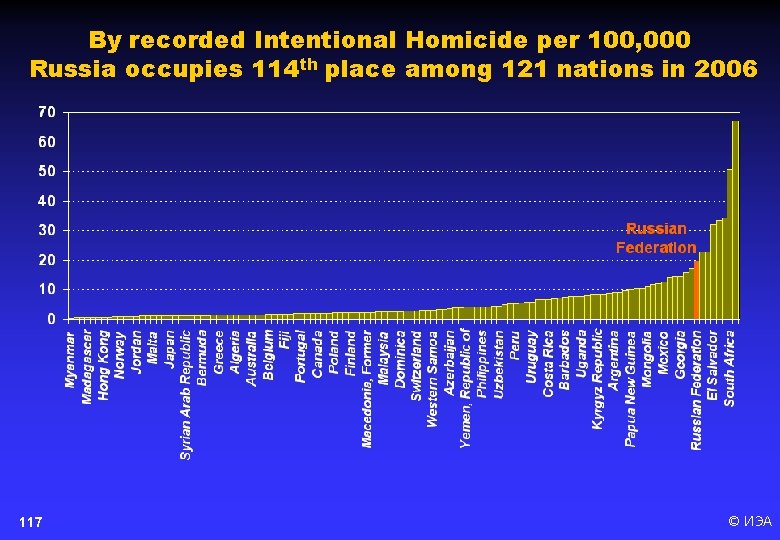
By recorded Intentional Homicide per 100, 000 Russia occupies 114 th place among 121 nations in 2006 117 © ИЭА
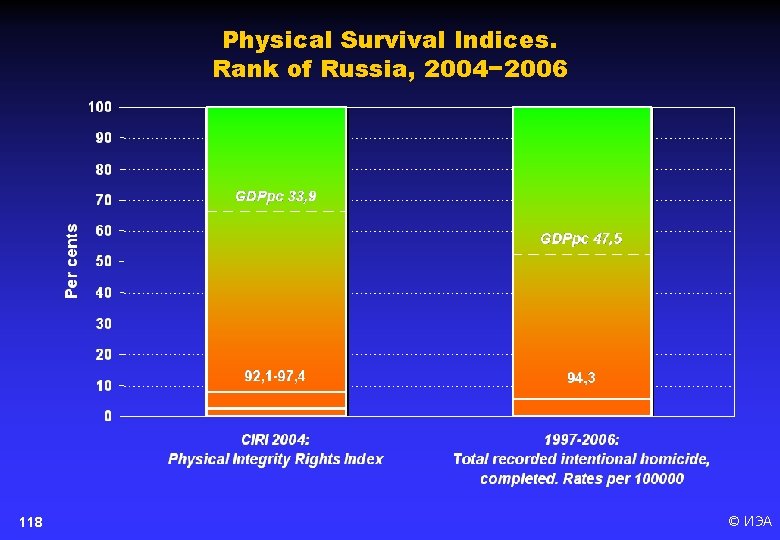
Physical Survival Indices. Rank of Russia, 2004− 2006 118 © ИЭА
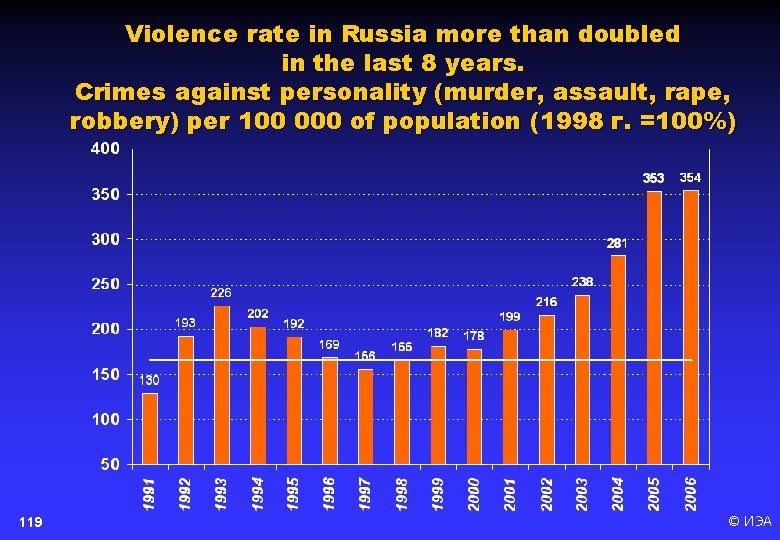
Violence rate in Russia more than doubled in the last 8 years. Crimes against personality (murder, assault, rape, robbery) per 100 000 of population (1998 г. =100%) 119 © ИЭА
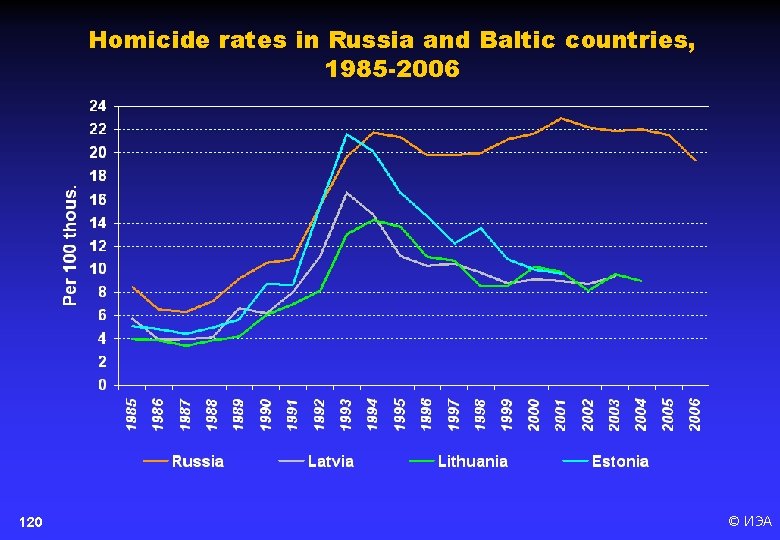
Homicide rates in Russia and Baltic countries, 1985 -2006 120 © ИЭА
The key criteria of the effectiveness of any political regime: – safety, freedom and relative prosperity of citizen – fell sharply. Violence rate skyrocketed. 121 © ИЭА
9. Intermediary conclusion 122 © ИЭА
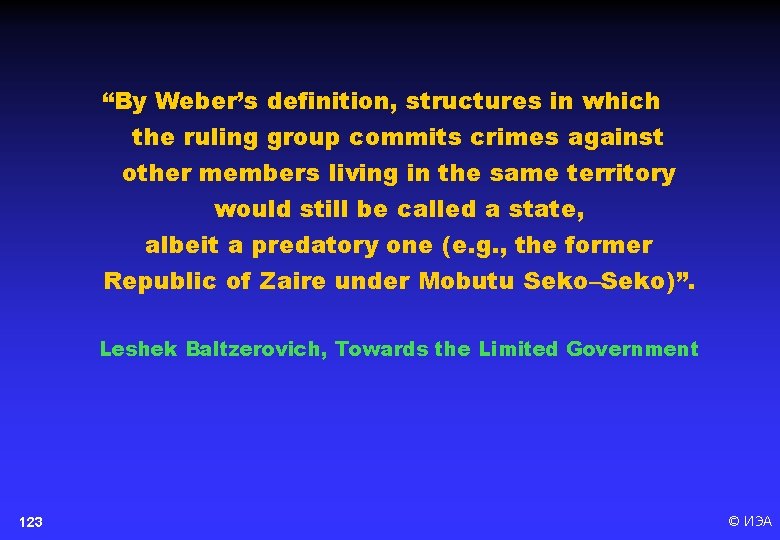
“By Weber’s definition, structures in which the ruling group commits crimes against other members living in the same territory would still be called a state, albeit a predatory one (e. g. , the former Republic of Zaire under Mobutu Seko–Seko)”. Leshek Baltzerovich, Towards the Limited Government 123 © ИЭА
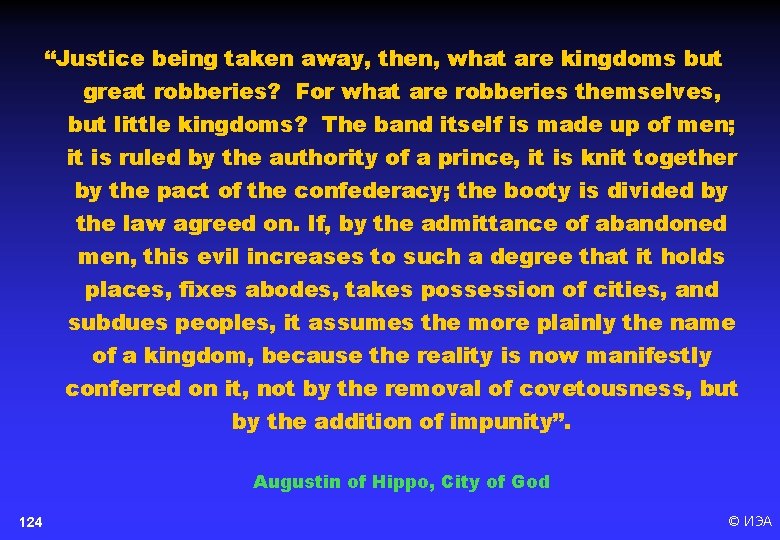
“Justice being taken away, then, what are kingdoms but great robberies? For what are robberies themselves, but little kingdoms? The band itself is made up of men; it is ruled by the authority of a prince, it is knit together by the pact of the confederacy; the booty is divided by the law agreed on. If, by the admittance of abandoned men, this evil increases to such a degree that it holds places, fixes abodes, takes possession of cities, and subdues peoples, it assumes the more plainly the name of a kingdom, because the reality is now manifestly conferred on it, not by the removal of covetousness, but by the addition of impunity”. Augustin of Hippo, City of God 124 © ИЭА
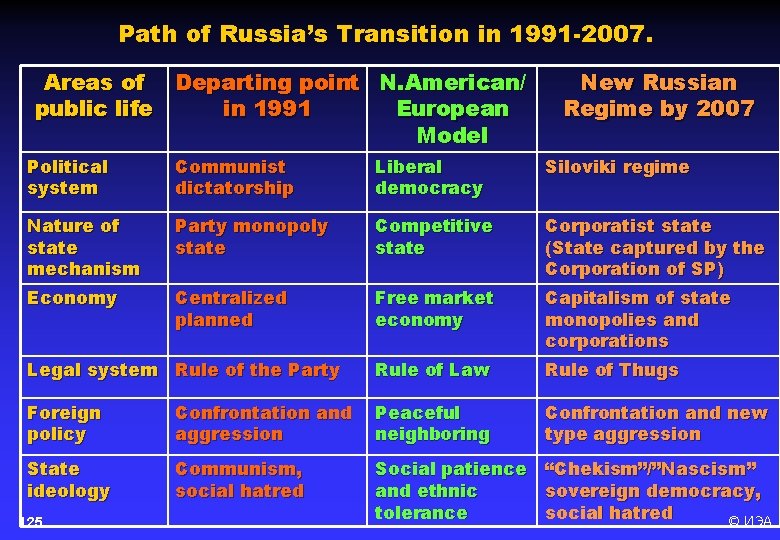
Path of Russia’s Transition in 1991 -2007. Areas of Departing point N. American/ public life in 1991 European Model New Russian Regime by 2007 Political system Communist dictatorship Liberal democracy Siloviki regime Nature of state mechanism Party monopoly state Competitive state Corporatist state (State captured by the Corporation of SP) Economy Centralized planned Free market economy Capitalism of state monopolies and corporations Legal system Rule of the Party Rule of Law Rule of Thugs Foreign policy Confrontation and aggression Peaceful neighboring Confrontation and new type aggression State ideology Communism, social hatred Social patience and ethnic tolerance “Chekism”/”Nascism” sovereign democracy, social hatred © ИЭА 125
10. Western Approach. 10 a. Policy of Appeasement Disease – encouragement of aggressive behavior in domestic and international affairs 126 © ИЭА
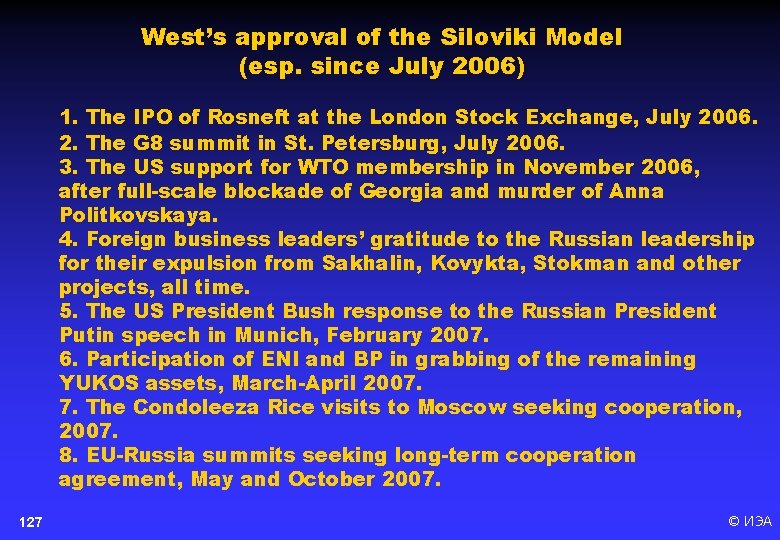
West’s approval of the Siloviki Model (esp. since July 2006) 1. The IPO of Rosneft at the London Stock Exchange, July 2006. 2. The G 8 summit in St. Petersburg, July 2006. 3. The US support for WTO membership in November 2006, after full-scale blockade of Georgia and murder of Anna Politkovskaya. 4. Foreign business leaders’ gratitude to the Russian leadership for their expulsion from Sakhalin, Kovykta, Stokman and other projects, all time. 5. The US President Bush response to the Russian President Putin speech in Munich, February 2007. 6. Participation of ENI and BP in grabbing of the remaining YUKOS assets, March-April 2007. 7. The Condoleeza Rice visits to Moscow seeking cooperation, 2007. 8. EU-Russia summits seeking long-term cooperation agreement, May and October 2007. 127 © ИЭА
10. Western Approach. 10 b. Great Leader Appreciation Disease – irresistible passion to be thankful for everything under the Sun to the Great Leader (Stalin, Mao, Kim Il Sen, Turkmenbashi). Personality cult. 128 © ИЭА
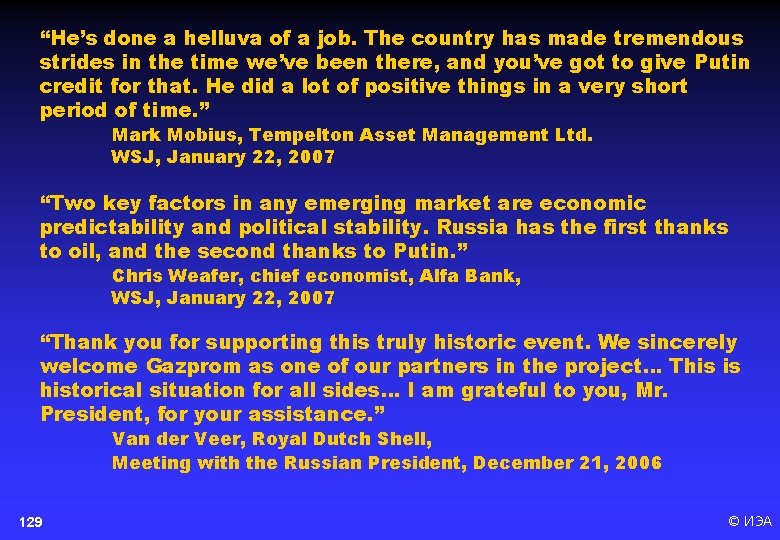
“He’s done a helluva of a job. The country has made tremendous strides in the time we’ve been there, and you’ve got to give Putin credit for that. He did a lot of positive things in a very short period of time. ” Mark Mobius, Tempelton Asset Management Ltd. WSJ, January 22, 2007 “Two key factors in any emerging market are economic predictability and political stability. Russia has the first thanks to oil, and the second thanks to Putin. ” Chris Weafer, chief economist, Alfa Bank, WSJ, January 22, 2007 “Thank you for supporting this truly historic event. We sincerely welcome Gazprom as one of our partners in the project… This is historical situation for all sides… I am grateful to you, Mr. President, for your assistance. ” Van der Veer, Royal Dutch Shell, Meeting with the Russian President, December 21, 2006 129 © ИЭА
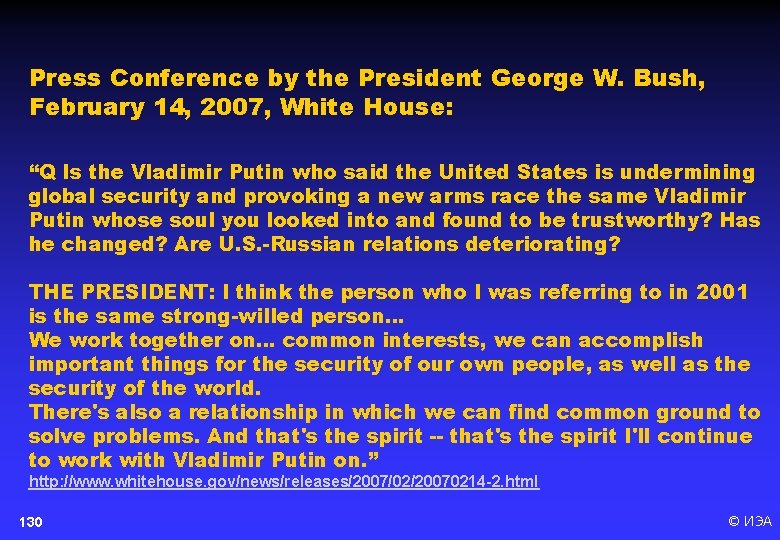
Press Conference by the President George W. Bush, February 14, 2007, White House: “Q Is the Vladimir Putin who said the United States is undermining global security and provoking a new arms race the same Vladimir Putin whose soul you looked into and found to be trustworthy? Has he changed? Are U. S. -Russian relations deteriorating? THE PRESIDENT: I think the person who I was referring to in 2001 is the same strong-willed person… We work together on… common interests, we can accomplish important things for the security of our own people, as well as the security of the world. There's also a relationship in which we can find common ground to solve problems. And that's the spirit -- that's the spirit I'll continue to work with Vladimir Putin on. ” http: //www. whitehouse. gov/news/releases/2007/02/20070214 -2. html 130 © ИЭА
THE SILOVIKI REGIME IN RUSSIA A. Illarionov, CATO Institute, Washington, USA Institute of Economic Analysis, Moscow, Russia Evenings at FEE, Foundation for Economic Education, Irvington-on-Hudson, November 10, 2007 © CATO Institute, Institute of Economic Analysis www. cato. org, www. cato. rg, www. iea. ru © ИЭА