
The Silent PPO Dilemma Californias Medical Providers Harmed
- Slides: 30
The Silent PPO Dilemma: California’s Medical Providers Harmed by Stealth Contracts Thursday, May 1, 2008 11: 00 a. m. Pacific Time By Reid L. Steinfeld, Esq. & David Bryan Leonard, Esq.
Important Terminology • Preferred Provider Organizations (PPO) give discounts for increased patient volume. • PPO Contract- A contract entered into by the provider and a network. The provider receives a referral, steerage, and/or preference, in return the provider discounts its medical fees. • Health Care Contract- policies are issued to ensure members are identified by membership ID cards.
Important Terminology Continued • Silent PPO- A “Silent PPO” is created when the PPO gains additional revenue by selling its reduced provider rates to payors (i. e. Work Comp Insurers) who are not a part to the preferred rate agreement with provider panels and who do not provide incentives for their beneficiaries to see these providers.
TWO TYPES OF PPO CONTRACTS Ø A contract in which the network contracts with the provider, for the network to sell its health care services at the contract rates agreed upon in turn for additional patients. Ø A Health Care Insurance Company that enters into contract with provider to treat their members of the insurance company issuing policy to its members at the discounted contract rates.
THE PROBLEM • A billion dollar industry has been created by selling the contract discounts of PPO’s, for patients that are not members of the network for a fee.
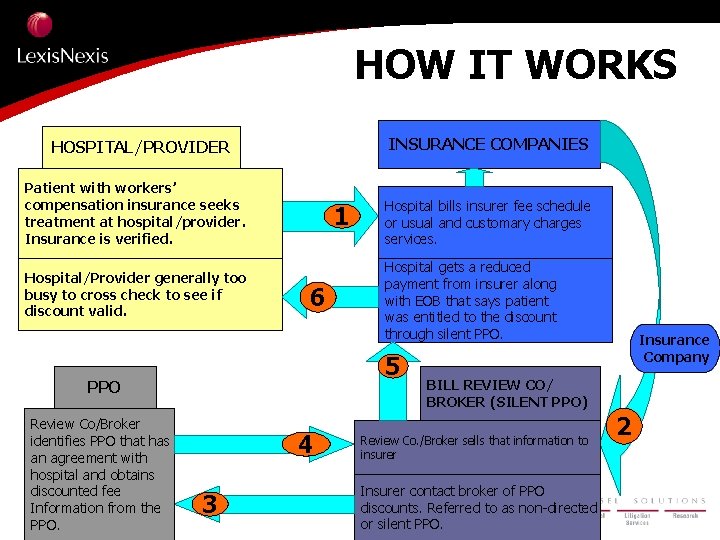
HOW IT WORKS INSURANCE COMPANIES HOSPITAL/PROVIDER Patient with workers’ compensation insurance seeks treatment at hospital/provider. Insurance is verified. Hospital/Provider generally too busy to cross check to see if discount valid. 1 6 Hospital gets a reduced payment from insurer along with EOB that says patient was entitled to the discount through silent PPO. 5 PPO Review Co/Broker identifies PPO that has an agreement with hospital and obtains discounted fee Information from the PPO. Hospital bills insurer fee schedule or usual and customary charges services. 4 3 Insurance Company BILL REVIEW CO/ BROKER (SILENT PPO) Review Co. /Broker sells that information to insurer Insurer contact broker of PPO discounts. Referred to as non-directed or silent PPO. 2
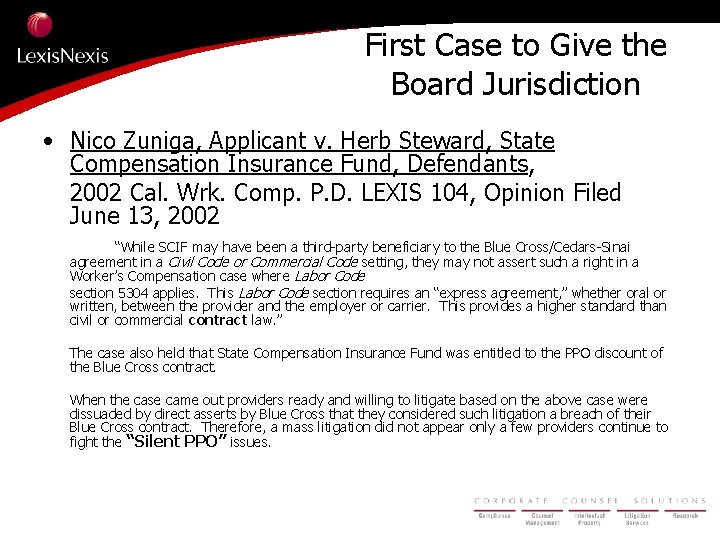
First Case to Give the Board Jurisdiction • Nico Zuniga, Applicant v. Herb Steward, State Compensation Insurance Fund, Defendants, 2002 Cal. Wrk. Comp. P. D. LEXIS 104, Opinion Filed June 13, 2002 “While SCIF may have been a third-party beneficiary to the Blue Cross/Cedars-Sinai agreement in a Civil Code or Commercial Code setting, they may not assert such a right in a Worker’s Compensation case where Labor Code section 5304 applies. This Labor Code section requires an “express agreement, ” whether oral or written, between the provider and the employer or carrier. This provides a higher standard than civil or commercial contract law. ” The case also held that State Compensation Insurance Fund was entitled to the PPO discount of the Blue Cross contract. When the case came out providers ready and willing to litigate based on the above case were dissuaded by direct asserts by Blue Cross that they considered such litigation a breach of their Blue Cross contract. Therefore, a mass litigation did not appear only a few providers continue to fight the “Silent PPO” issues.
OTHER CASES THAT ADDRESS LABOR CODE 5304 (JURISDICTION) • Maria Molina, Applicant v. Best Western Park Place Inn, State Compensation Insurance Fund, Defendants, 2005 Cal. Wrk. Comp. P. D. LEXIS 19, Opinion Filed February 7, 2005. • Labor Code Section 5304 states: • “The appeals board has jurisdiction over any controversy relating to or arising out of Sections 4600 to 4605 inclusive, unless an
OTHER CASES THAT ADDRESS LABOR CODE 5304 (JURISDICTION) • Virginia Woodruff, Applicant v. Greenfield Trucking, State Compensation Insurance Fund, Defendants, 2007 Cal. Wrk. Comp. P. D. LEXIS 93, Opinion Filed September 4, 2007 Labor Code Section 5304 provides: “The appeals board has jurisdiction over any controversy relating to or arising out of Sections 4600 to 4605 inclusive, unless an express agreement fixing the amounts to be paid for medical, surgical, or hospital treatment as such treatment is described in those sections has been made between the persons or institutions rendering such treatment and the employer or insurer. ” In this case, there is no evidence of an express agreement between the rendering institution, Good Samaritan Hospital and the insurer State Compensation Insurance Fund (SCIF). The only express agreements in evidence are between Good Samaritan Hospital and Blue Cross, and a separate agreement between Blue Cross and SCIF Two years separates the two agreements. At best, SCIF is a third party beneficiary, in a contractual sense, to the Good Samaritan/Blue Cross agreement. Since there is no express agreement between the institution rendering treatment (Good Samaritan Hospital) and the insurer(SCIF), the appeals board has proper jurisdiction over the matter under Labor Code section 5304.
JURISDICTION UNDER LABOR CODE 5304 • This case differs from the previous in that it was a brokerage contract. The case stated that since there were three contracts that was sufficient to deny the WCAB of Jurisdiction. Sarah Waters, Applicant v. Los Angeles Clippers Basketball Club, Inc. TIG Specialty Insurance Solutions c/o Cambridge Integrated Services Group, Inc. , Defendants, 2005 Cal. Wrk. Comp. P. D. LEXIS 15, Opinions Filed February 7, 2005 and April 26, 2005 “The background to this issue is that CCN is in the business of preparing contracts and referring patients to doctors or hospitals, and there are other various aspects of its business as well, and CCN entered into a contract with Good Samaritan Hospital, under the terms of which Good Samaritan Hospital would accept for payment of medical treatment according to a scheduled fee. Later on, CCN entered into a separate contract with TIG. ”
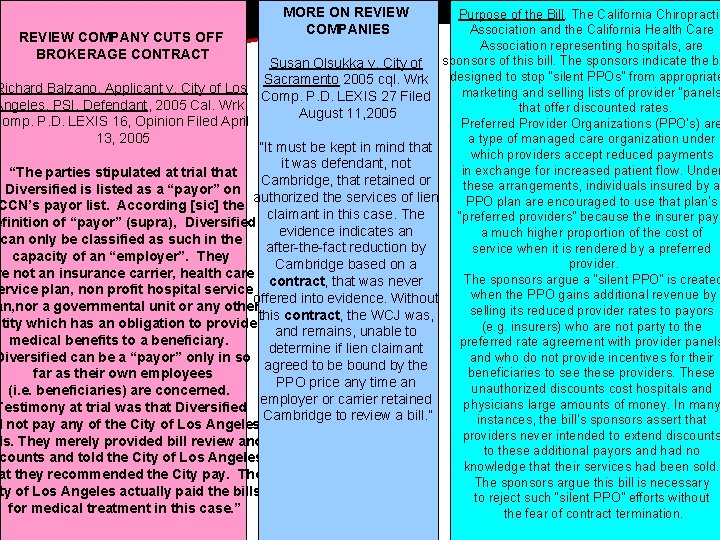
REVIEW COMPANY CUTS OFF BROKERAGE CONTRACT Richard Balzano, Applicant v. City of Los Angeles, PSI, Defendant, 2005 Cal. Wrk. Comp. P. D. LEXIS 16, Opinion Filed April 13, 2005 “The parties stipulated at trial that Diversified is listed as a “payor” on CCN’s payor list. According [sic] the definition of “payor” (supra), Diversified can only be classified as such in the capacity of an “employer”. They are not an insurance carrier, health care service plan, non profit hospital service plan, nor a governmental unit or any other entity which has an obligation to provide medical benefits to a beneficiary. Diversified can be a “payor” only in so far as their own employees (i. e. beneficiaries) are concerned. Testimony at trial was that Diversified did not pay any of the City of Los Angeles’ bills. They merely provided bill review and discounts and told the City of Los Angeles what they recommended the City pay. The City of Los Angeles actually paid the bills for medical treatment in this case. ”
MORE ON REVIEW COMPANIES Susan Olsukka v. City of Sacramento 2005 cql. Wrk Comp. P. D. LEXIS 27 Filed August 11, 2005 “It must be kept in mind that it was defendant, not Cambridge, that retained or authorized the services of lien claimant in this case. The evidence indicates an after-the-fact reduction by Cambridge based on a contract, that was never offered into evidence. Without this contract, the WCJ was, and remains, unable to determine if lien claimant agreed to be bound by the PPO price any time an employer or carrier retained Cambridge to review a bill. ”
NO PRIVITY NO CONTRACT John Miranda, Jr. , Applicant v. The Pacific Lumber Company, Defendant, 2004 Cal. Wrk. Comp. P. D. LEXIS 90, Opinion Filed October 12, 2004 “WCAB found that there was insufficient evidence to establish the existence of an express agreement between defendant and lien claimant/medical provider fixing amounts to be paid for medical services, so as to remove the lien issue from WCAB jurisdiction under Labor Code Section 5304, when defendant was neither a “claims payor, ” “beneficiary, ” nor “employer” under the terms of lien claimant’s PPO contract and there was no privity of contract between the parties. ”
OBLIGATION TO PAY ACCORDING TO THE FEE SCHEDULE Maria Molina, Applicant v. Best Western Park Place Inn, State Compensation Insurance Fund, Defendants, 2005 Cal. Wrk. Comp. P. D. LEXIS 19, Opinion Filed February 7, 2005 “…, the WCAB has jurisdiction to resolve the fee dispute herein as the treatment in question was rendered to relieve or cure the applicant from the effects of an industrial injury. Further, SCIF was not a party to the agreement between BMC and Blue Cross. Thus, it is the opinion of this Court that SCIF has no standing to force the matter into arbitration. ”
Virginia Woodruff, Applicant v. Greenfield Trucking, State Compensation Insurance Fund, Defendants, 2007 Cal. Wrk. Comp. P. D. LEXIS 93, Opinion Filed September 4, 2007 • “Thus, it would appear that as a matter of public policy, that unless there is an absolutely clear and unambiguous agreement to the contrary, the OMFS amounts should apply. There is no clear and unambiguous agreement between the provider Good Samaritan and SCIF in this case. As such, all else being equal, the OMFS should prevail. ” • The undersigned WCJ agrees with the general proposition asserted by Good Samaritan in its Response to SCIF’s Petition for Reconsideration that there is no showing that SCIF has complied with the provision of Labor Code 4609 and that such a so called “Silent PPO” is statutorily prohibited. In this case, contrary to the provisions of Labor Code 4609, Blue Cross appears to have sold its PPO discount to SCIF in contravention of this labor code provision.
Virginia Woodruff, Applicant v. Greenfield Trucking, State Compensation Insurance Fund, Defendants, 2007 Cal. Wrk. Comp. P. D. LEXIS 93, Opinion Filed September 4, 2007 “The term “other payor” as argued by the lien claimant is meant to refer to Blue Cross (card carrying) members, and there is no evidence that SCIF, an insurance company in and of itself was a member of Blue Cross or that applicant was a member of Blue Cross. SCIF or Blue Cross could have easily cleared up this ambiguity in the terms of the contracts by obtaining a contemporaneous addendum to the Blue Cross SCIF Agreement signed on behalf of Good Samaritan agreeing to be bound by the deep PPO discount. The parties failed to do this, leaving the ambiguous language in place. Obviously, Good Samaritan does not consider itself an “other payor” or it would not be litigating the matter. If the basic definition for a contract is that of a meeting of the minds between the contracting parties then no such meeting of the minds is demonstrated in this case. ”
Maria Molina, Applicant v. Best Western Park Place Inn, State Compensation Insurance Fund, Defendants, 2005 Cal. Wrk. Comp. P. D. LEXIS 19, Opinion Filed February 7, 2005 “SCIF contends that paragraph 2. 2 of the agreement between BMC and Blue Cross (Defendant’s Exhibit F) identifies SCIF as a party defendant to the agreement. No such language exists that specifically identifies SCIF as a party, nor did SCIF execute the agreement. SCIF contends that any dispute regarding payment of BMC’s billings must be resolved via binding arbitration as set forth in the agreement between BMC and Blue Cross. As stated above, the WCAB has jurisdiction to resolve the fee dispute herein as the treatment in question was rendered to relieve or cure the applicant from the effects of an industrial injury. Further, SCIF was not a party to the agreement between BMC and Blue Cross. Thus, it is the opinion of this Court that SCIF has no standing to force the matter into arbitration. ”
LABOR CODE SECTION 4609 (Silent PPO) Virginia Woodruff, Applicant v. Greenfield Trucking, State Compensation Insurance Fund, Defendants, 2007 Cal. Wrk. Comp. P. D. LEXIS 93, Opinion Filed September 4, 2007 “The undersigned WCJ agrees with the general proposition asserted by Good Samaritan in its Response to SCIF’s Petition for Reconsideration that there is no showing that SCIF has complied with the provision of Labor Code 4609 and that such a so called “Silent PPO” is statutorily prohibited. In this case, contrary to the provisions of Labor Code 4609, Blue Cross appears to have sold its PPO Discount to SCIF in contravention of this labor code provision. ”
LABOR CODE SECTION 4609 begins with the intent of the code: that being prohibiting the selling of contract discounts “a) In order to prevent the improper selling, leasing, or transferring of a health care provider’s contract…” SB 559, which is the bill that created Labor Code Section 4609 in the Assembly Analysis as to the purpose of the bill, stated as follows: Purpose of the Bill. The California Chiropractic Association and the California Health Care Association representing hospitals, are sponsors of this bill. The sponsors indicate the bill is designed to stop “silent PPOs” from inappropriately marketing and selling lists of provider “panels” that offer discounted rates. Preferred Provider Organizations (PPO’s) are a type of managed care organization under which providers accept reduced payments in exchange for increased patient flow. Under these arrangements, individuals insured by a PPO plan are encouraged to use that plan’s “preferred providers” because the insurer pays a much higher proportion of the cost of service when it is rendered by a preferred
LABOR CODE SECTION 4609 The sponsors argue a “silent PPO” is created when the PPO gains additional revenue by selling its reduced provider rates to payors (e. g. insurers) who are not party to the preferred rate agreement with provider panels and who do not provide incentives for their beneficiaries to see these providers. These unauthorized discounts cost hospitals and physicians large amounts of money. In many instances, the bill’s sponsors assert that providers never intended to
LABOR CODE SECTION 4609 The State of California and the former Governor of California has recognized that the improper selling of PPO discounts has cost the providers and the citizens of California millions of dollars every year. The American Medical Association case called the “Silent PPO” fraudulent. Most states, including California, have created laws specifically prohibiting this practice.
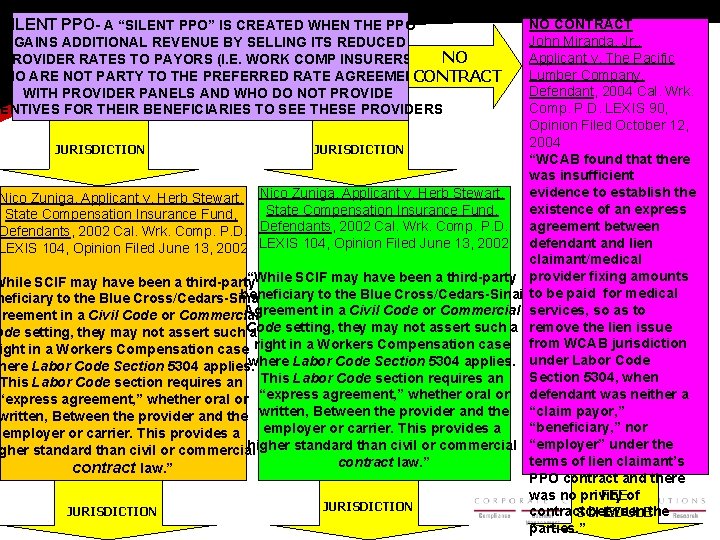
SILENT PPO- A “SILENT PPO” IS CREATED WHEN THE PPO GAINS ADDITIONAL REVENUE BY SELLING ITS REDUCED NO PROVIDER RATES TO PAYORS (I. E. WORK COMP INSURERS) WHO ARE NOT PARTY TO THE PREFERRED RATE AGREEMENT CONTRACT WITH PROVIDER PANELS AND WHO DO NOT PROVIDE CENTIVES FOR THEIR BENEFICIARIES TO SEE THESE PROVIDERS JURISDICTION Nico Zuniga, Applicant v. Herb Stewart, State Compensation Insurance Fund, Defendants, 2002 Cal. Wrk. Comp. P. D. LEXIS 104, Opinion Filed June 13, 2002 “While SCIF may have been a third-party beneficiary to the Blue Cross/Cedars-Sinai Agreement in a Civil Code or Commercial setting, they may not assert such a ode setting, they may not assert such Code a ight in a Workers Compensation case right in a Workers Compensation case here Labor Code Section 5304 applies. where Labor Code Section 5304 applies. This Labor Code section requires an “express agreement, ” whether oral or written, Between the provider and the employer or carrier. This provides a higher standard than civil or commercial contract law. ” JURISDICTION NO CONTRACT John Miranda, Jr. , Applicant v. The Pacific Lumber Company, Defendant, 2004 Cal. Wrk. Comp. P. D. LEXIS 90, Opinion Filed October 12, 2004 “WCAB found that there was insufficient evidence to establish the existence of an express agreement between defendant and lien claimant/medical provider fixing amounts to be paid for medical services, so as to remove the lien issue from WCAB jurisdiction under Labor Code Section 5304, when defendant was neither a “claim payor, ” “beneficiary, ” nor “employer” under the terms of lien claimant’s PPO contract and there was no privity FEEof contract. SCHEDULE between the parties. ”
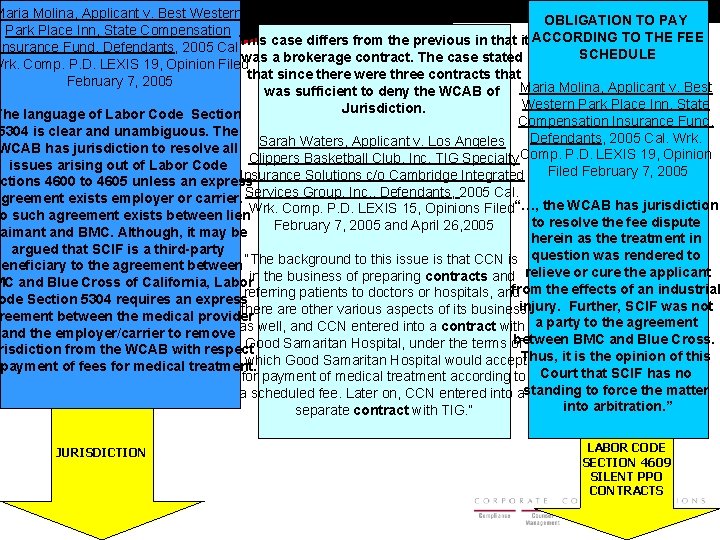
Maria Molina, Applicant v. Best Western OBLIGATION TO PAY Park Place Inn, State Compensation ACCORDING TO THE FEE Insurance Fund, Defendants, 2005 Cal. This case differs from the previous in that it SCHEDULE was a brokerage contract. The case stated Wrk. Comp. P. D. LEXIS 19, Opinion Filed that since there were three contracts that February 7, 2005 was sufficient to deny the WCAB of Maria Molina, Applicant v. Best Western Park Place Inn, State Jurisdiction. The language of Labor Code Section Compensation Insurance Fund, 5304 is clear and unambiguous. The Defendants, 2005 Cal. Wrk. WCAB has jurisdiction to resolve all Sarah Waters, Applicant v. Los Angeles Comp. P. D. LEXIS 19, Opinion Clippers Basketball Club, Inc. TIG Specialty issues arising out of Labor Code Filed February 7, 2005 Insurance Solutions c/o Cambridge Integrated ctions 4600 to 4605 unless an express agreement exists employer or carrier. Services Group, Inc. , Defendants, 2005 Cal. “…, the WCAB has jurisdiction o such agreement exists between lien. Wrk. Comp. P. D. LEXIS 15, Opinions Filed to resolve the fee dispute February 7, 2005 and April 26, 2005 laimant and BMC. Although, it may be herein as the treatment in argued that SCIF is a third-party question was rendered to beneficiary to the agreement between “The background to this issue is that CCN is relieve or cure the applicant MC and Blue Cross of California, Laborin the business of preparing contracts andfrom the effects of an industrial ode Section 5304 requires an expressreferring patients to doctors or hospitals, andinjury. Further, SCIF was not there are other various aspects of its business reement between the medical provider a party to the agreement and the employer/carrier to remove as well, and CCN entered into a contract with between BMC and Blue Cross. Good Samaritan Hospital, under the terms of risdiction from the WCAB with respect which Good Samaritan Hospital would accept. Thus, it is the opinion of this payment of fees for medical treatment. for payment of medical treatment according to Court that SCIF has no a scheduled fee. Later on, CCN entered into astanding to force the matter into arbitration. ” separate contract with TIG. ” JURISDICTION LABOR CODE SECTION 4609 SILENT PPO CONTRACTS
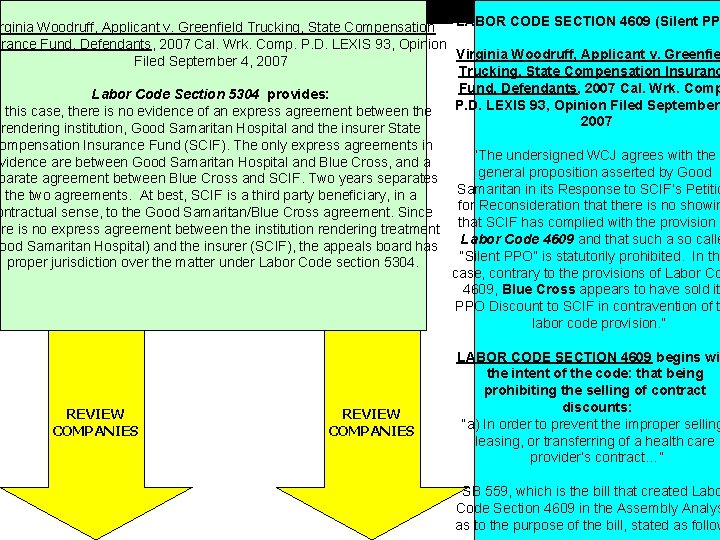
LABOR CODE SECTION 4609 (Silent PP rginia Woodruff, Applicant v. Greenfield Trucking, State Compensation urance Fund, Defendants, 2007 Cal. Wrk. Comp. P. D. LEXIS 93, Opinion Virginia Woodruff, Applicant v. Greenfie Filed September 4, 2007 Trucking, State Compensation Insuranc Fund, Defendants, 2007 Cal. Wrk. Comp Labor Code Section 5304 provides: P. D. LEXIS 93, Opinion Filed September n this case, there is no evidence of an express agreement between the 2007 rendering institution, Good Samaritan Hospital and the insurer State ompensation Insurance Fund (SCIF). The only express agreements in vidence are between Good Samaritan Hospital and Blue Cross, and a parate agreement between Blue Cross and SCIF. Two years separates the two agreements. At best, SCIF is a third party beneficiary, in a ontractual sense, to the Good Samaritan/Blue Cross agreement. Since ere is no express agreement between the institution rendering treatment ood Samaritan Hospital) and the insurer (SCIF), the appeals board has proper jurisdiction over the matter under Labor Code section 5304. REVIEW COMPANIES “The undersigned WCJ agrees with the general proposition asserted by Good Samaritan in its Response to SCIF’s Petitio for Reconsideration that there is no showin that SCIF has complied with the provision o Labor Code 4609 and that such a so calle “Silent PPO” is statutorily prohibited. In thi case, contrary to the provisions of Labor Co 4609, Blue Cross appears to have sold it PPO Discount to SCIF in contravention of t labor code provision. ” LABOR CODE SECTION 4609 begins wit the intent of the code: that being prohibiting the selling of contract discounts: “a) In order to prevent the improper selling leasing, or transferring of a health care provider’s contract…” SB 559, which is the bill that created Labo Code Section 4609 in the Assembly Analys as to the purpose of the bill, stated as follow
MORE ON REVIEW COMPANIES Purpose of the Bill. The California Chiropractic Association and the California Health Care REVIEW COMPANY CUTS OFF Association representing hospitals, are BROKERAGE CONTRACT Susan Olsukka v. City of sponsors of this bill. The sponsors indicate the bi designed to stop “silent PPOs” from appropriate Sacramento 2005 cql. Wrk Richard Balzano, Applicant v. City of Los marketing and selling lists of provider “panels Comp. P. D. LEXIS 27 Filed Angeles, PSI, Defendant, 2005 Cal. Wrk. that offer discounted rates. August 11, 2005 Comp. P. D. LEXIS 16, Opinion Filed April Preferred Provider Organizations (PPO’s) are 13, 2005 a type of managed care organization under “It must be kept in mind that which providers accept reduced payments it was defendant, not in exchange for increased patient flow. Under “The parties stipulated at trial that Cambridge, that retained or these arrangements, individuals insured by a Diversified is listed as a “payor” on authorized the services of lien PPO plan are encouraged to use that plan’s CCN’s payor list. According [sic] the claimant in this case. The “preferred providers” because the insurer pays efinition of “payor” (supra), Diversified evidence indicates an a much higher proportion of the cost of can only be classified as such in the after-the-fact reduction by service when it is rendered by a preferred capacity of an “employer”. They provider. Cambridge based on a re not an insurance carrier, health care The sponsors argue a “silent PPO” is created contract, that was never ervice plan, non profit hospital service when the PPO gains additional revenue by offered into evidence. Without an, nor a governmental unit or any other selling its reduced provider rates to payors this contract, the WCJ was, ntity which has an obligation to provide (e. g. insurers) who are not party to the and remains, unable to medical benefits to a beneficiary. preferred rate agreement with provider panels determine if lien claimant Diversified can be a “payor” only in so and who do not provide incentives for their agreed to be bound by the beneficiaries to see these providers. These far as their own employees PPO price any time an unauthorized discounts cost hospitals and (i. e. beneficiaries) are concerned. employer or carrier retained physicians large amounts of money. In many Testimony at trial was that Diversified Cambridge to review a bill. ” instances, the bill’s sponsors assert that d not pay any of the City of Los Angeles’ providers never intended to extend discounts ls. They merely provided bill review and to these additional payors and had no counts and told the City of Los Angeles knowledge that their services had been sold. at they recommended the City pay. The sponsors argue this bill is necessary ty of Los Angeles actually paid the bills to reject such “silent PPO” efforts without for medical treatment in this case. ” the fear of contract termination.
The State of California and the former Governor of California ha LABOR CODE SECTION recognized that the improper se 4609 (SILENT PPO CONTRACTS) of PPO discounts has cost the providers and the citizens of Ca millions of dollars every year. Th American Medical Association c called the “Silent PPO” fraudule states, including California, have created laws specifically prohibi this practice.
CONCLUSION This presentation is an attempt to show the participants a guide to understanding the PPO dilemma in California. With the use of flow charts and cases, the hope is that sufficient information has been presented to support the proposition that “Silent PPO’s” are harming the providers and ultimately will harm society if the providers are unable or unwilling to treat Workers Compensation patients. Because of deep and severe discounts, the providers will be unable to afford to handle said patients. The presenters suggest that the providers look closely at all of their contracts and when negotiating, make certain that their contracts are not susceptible to the “Silent PPO” practice, as well as, contacting their legislatures, as other states have done, including but not limited to Texas, Louisiana, and Ohio. Laws have been passed in these states dealing specifically with the “Silent PPO” dilemma. The quickest and easiest solution to this problem would be that the patients provide a “membership card” at the time of treatment so that there will not be any surprises when the provider’s bill is paid.
REFERENCES • Nico Zuniga, Applicant v. Herb Stewart, State Compensation Insurance Fund, Defendants, 2002 Cal. Wrk. Comp. P. D. LEXIS 104, Opinion Filed June 13, 2002 • Maria Molina, Applicant v. Best Western Park Place Inn, State Compensation Insurance Fund, Defendants, 2005 Cal. Wrk. Comp. P. D. LEXIS 19, Opinion Filed February 7, 2005 • Virginia Woodruff, Applicant v. Greenfield Trucking, State Compensation Insurance Fund, Defendants, 2007 Cal. Wrk. Comp. P. D. LEXIS 93, Opinion Filed September 4, 2007
REFERENCES • Sarah Waters, Applicant v. Los Angeles Clipper Basketball Club, Inc. , TIG Specialty Insurance Solutions c/o Cambridge Integrated Services Group, Inc. , Defendants, 2005 Cal. Wrk. Comp. P. D. LEXIS 15, Opinions Filed February 7, 2005 and April 26, 2005 • Richard Balzano, Applicant v. City of Los Angeles, PSI, Defendant, 2005 Cal. Wrk. Comp. P. D. LEXIS 16, Opinion Filed April 13, 2005 • Susan Olsukka v. City of Sacramento 2005 cql. Wrk. Comp. P. D. Lexis 27 Filed August 11, 2005 • John Miranda Jr. , Applicant v. The Pacific Lumber Company, Defendant, 2004 Cal. Wrk. Comp. P. D. LEXIS 90, Opinion Filed October 12, 2004
REFERENCES • SB 559 • Labor Code Section 4609 • Labor Code Section 5304