
The SILC Project Si LC Silicon tracking for
- Slides: 49
The SILC Project (Si. LC: Silicon tracking for the International Linear Collider) Aurore Savoy-Navarro, LPNHE-UPMC/IN 2 P 3 -CNRS on behalf of the SILC R&D Collaboration (with material from last Si. LC meeting in Vienna) JORNADAS SOBRE EL FUTURO COLISIONADOR LINEAL Palacio Ducal, GANDÍA, 1 al 3 de Diciembre 2005
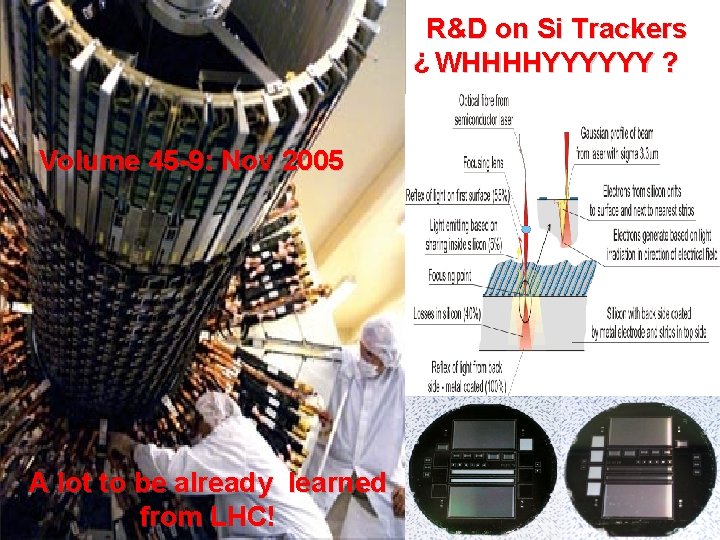
R&D on Si Trackers WHHHHYYYYYY ? ? Volume 45 -9: Nov 2005 A lot to be already learned from LHC!
But material budget is not the ONLY reason
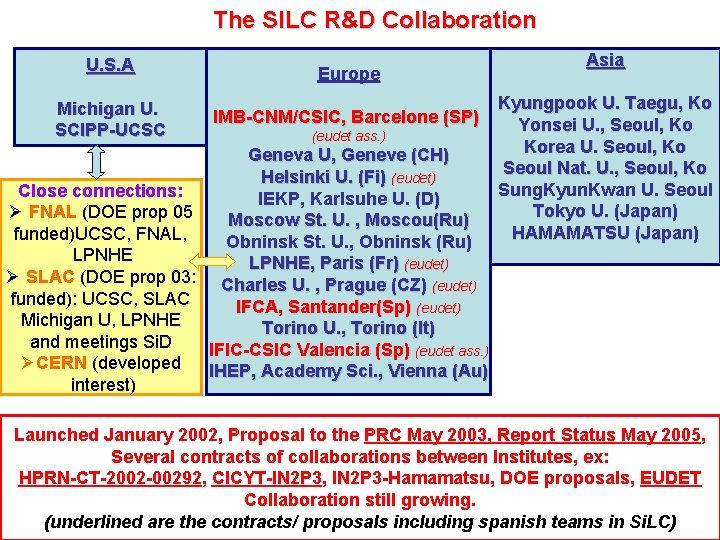
The SILC R&D Collaboration U. S. A Europe Michigan U. SCIPP-UCSC IMB-CNM/CSIC, Barcelone (SP) (eudet ass. ) Geneva U, Geneve (CH) Helsinki U. (Fi) (eudet) Close connections: IEKP, Karlsuhe U. (D) Ø FNAL (DOE prop 05 Moscow St. U. , Moscou(Ru) funded)UCSC, FNAL, Obninsk St. U. , Obninsk (Ru) LPNHE, Paris (Fr) (eudet) Ø SLAC (DOE prop 03: Charles U. , Prague (CZ) (eudet) funded): UCSC, SLAC IFCA, Santander(Sp) (eudet) Michigan U, LPNHE Torino U. , Torino (It) and meetings Si. D IFIC-CSIC Valencia (Sp) (eudet ass. ) ØCERN (developed IHEP, Academy Sci. , Vienna (Au) interest) Asia Kyungpook U. Taegu, Ko Yonsei U. , Seoul, Ko Korea U. Seoul, Ko Seoul Nat. U. , Seoul, Ko Sung. Kyun. Kwan U. Seoul Tokyo U. (Japan) HAMAMATSU (Japan) Launched January 2002, Proposal to the PRC May 2003, Report Status May 2005, Several contracts of collaborations between Institutes, ex: HPRN-CT-2002 -00292, CICYT-IN 2 P 3, IN 2 P 3 -Hamamatsu, DOE proposals, EUDET Collaboration still growing. (underlined are the contracts/ proposals including spanish teams in Si. LC)
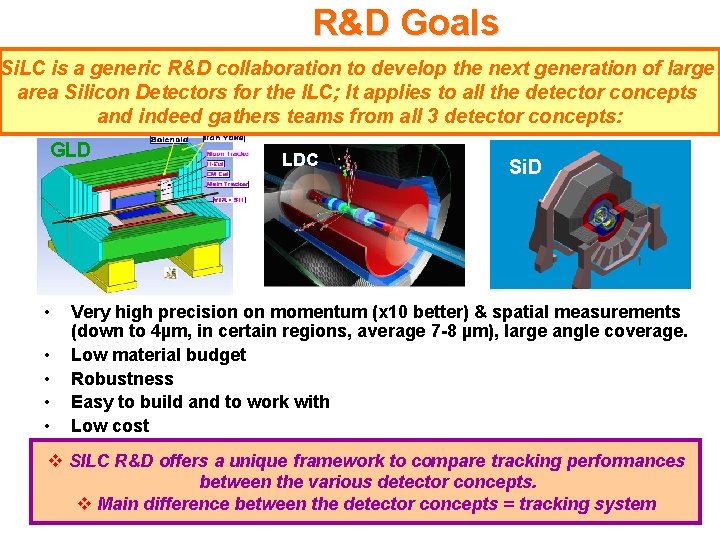
R&D Goals Si. LC is a generic R&D collaboration to develop the next generation of large area Silicon Detectors for the ILC; It applies to all the detector concepts and indeed gathers teams from all 3 detector concepts: GLD LDC Si. D LDC • • • Very high precision on momentum (x 10 better) & spatial measurements (down to 4µm, in certain regions, average 7 -8 µm), large angle coverage. Low material budget Robustness Easy to build and to work with Low cost v SILC R&D offers a unique framework to compare tracking performances between the various detector concepts. v Main difference between the detector concepts = tracking system
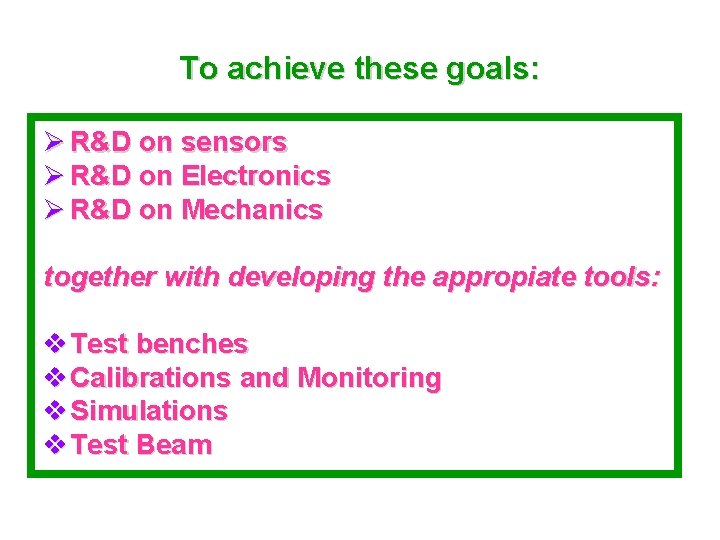
To achieve these goals: Ø R&D on sensors Ø R&D on Electronics Ø R&D on Mechanics together with developing the appropiate tools: v Test benches v Calibrations and Monitoring v Simulations v Test Beam
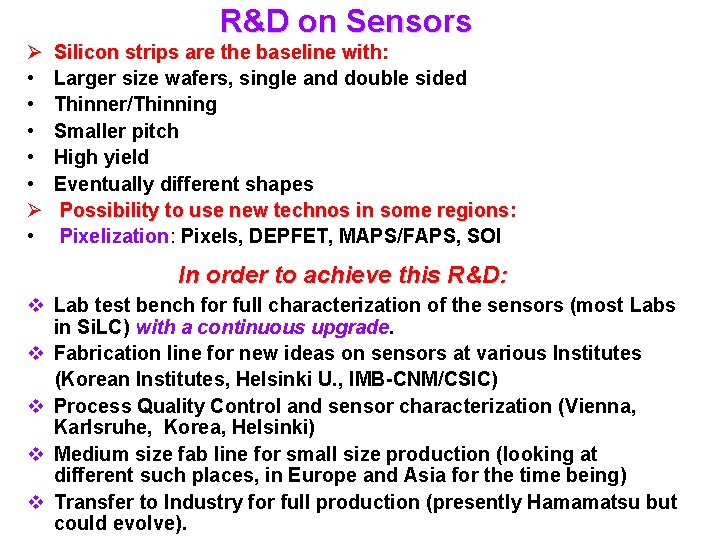
R&D on Sensors Ø • • • Ø • Silicon strips are the baseline with: Larger size wafers, single and double sided Thinner/Thinning Smaller pitch High yield Eventually different shapes Possibility to use new technos in some regions: Pixelization: Pixels, DEPFET, MAPS/FAPS, SOI In order to achieve this R&D: v Lab test bench for full characterization of the sensors (most Labs in Si. LC) with a continuous upgrade. v Fabrication line for new ideas on sensors at various Institutes (Korean Institutes, Helsinki U. , IMB-CNM/CSIC) v Process Quality Control and sensor characterization (Vienna, Karlsruhe, Korea, Helsinki) v Medium size fab line for small size production (looking at different such places, in Europe and Asia for the time being) v Transfer to Industry for full production (presently Hamamatsu but could evolve).
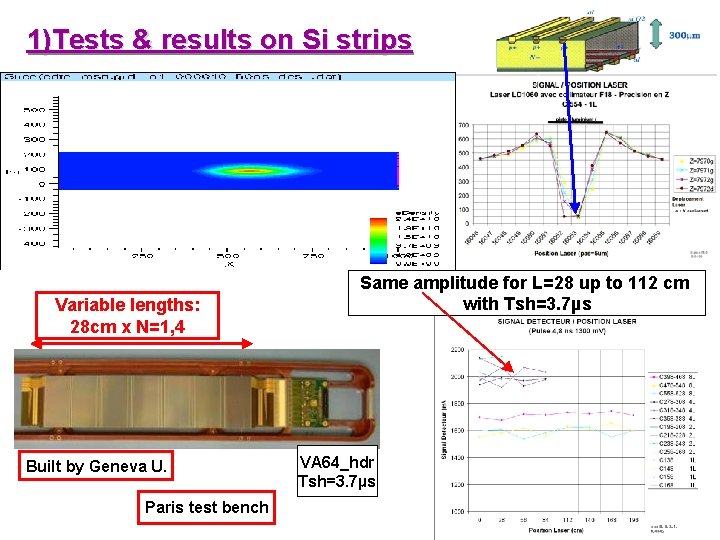
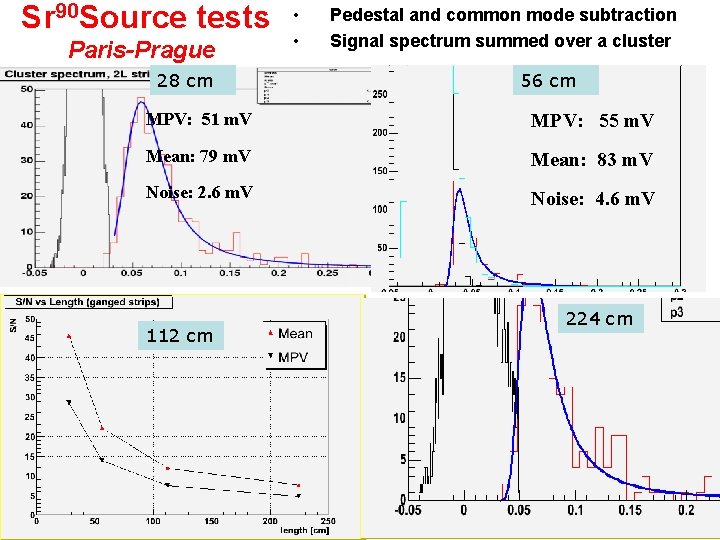
1)Tests & results on Si strips Variable lengths: 28 cm x N=1, 4 Built by Geneva U. Paris test bench Same amplitude for L=28 up to 112 cm with Tsh=3. 7µs VA 64_hdr Tsh=3. 7µs
Sr 90 Source tests Paris-Prague • • Pedestal and common mode subtraction Signal spectrum summed over a cluster 28 cm MPV: 51 m. V • • Pedestal and common mode Mean: 79 m. V subtraction Noise: 2. 6 m. V Signal spectrum summed over a cluster 112 cm 56 cm MPV: 55 m. V Mean: 83 m. V Noise: 4. 6 m. V 224 cm
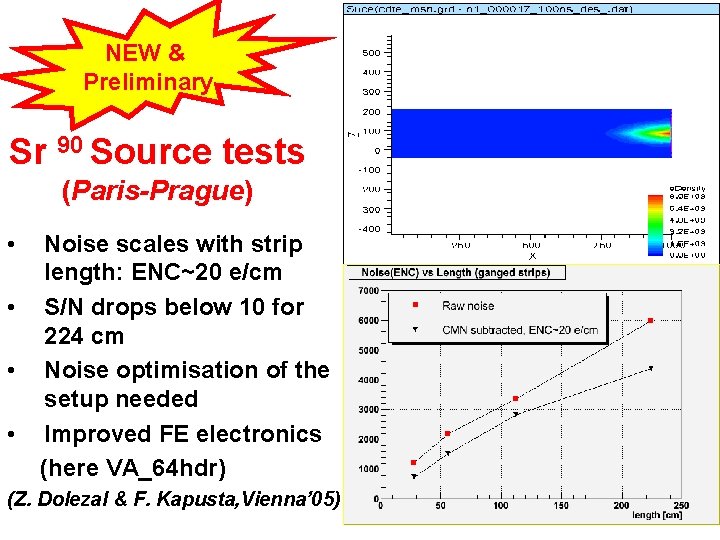
NEW & Preliminary Sr 90 Source tests (Paris-Prague) • • Noise scales with strip length: ENC~20 e/cm S/N drops below 10 for 224 cm Noise optimisation of the setup needed Improved FE electronics (here VA_64 hdr) (Z. Dolezal & F. Kapusta, Vienna’ 05)
2) R&D on new sensors Several Institutions in SILC are developing new sensor research lines (IMB-CNM/CSIC, Helsinki, Si. Lab, Korea) Strategy: Ø The research Labs develop & test new ideas Ø transfer to small fabs for reduced prod. Ø Large production, high quality and reliability: HAMAMATSU Monopoly
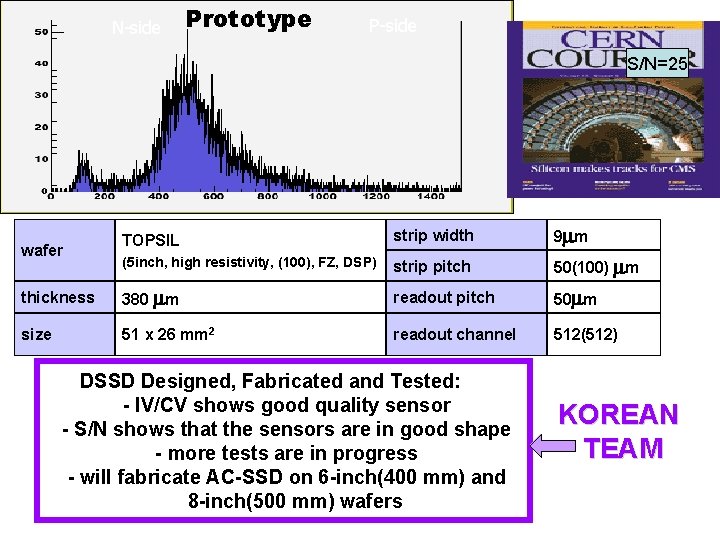
N-side Prototype P-side S/N=25 TOPSIL strip width 9 m m (5 inch, high resistivity, (100), FZ, DSP) strip pitch 50(100) mm thickness 380 mm readout pitch 50 mm size 51 x 26 mm 2 readout channel 512(512) wafer DSSD Designed, Fabricated and Tested: - IV/CV shows good quality sensor - S/N shows that the sensors are in good shape - more tests are in progress - will fabricate AC-SSD on 6 -inch(400 mm) and 8 -inch(500 mm) wafers KOREAN TEAM
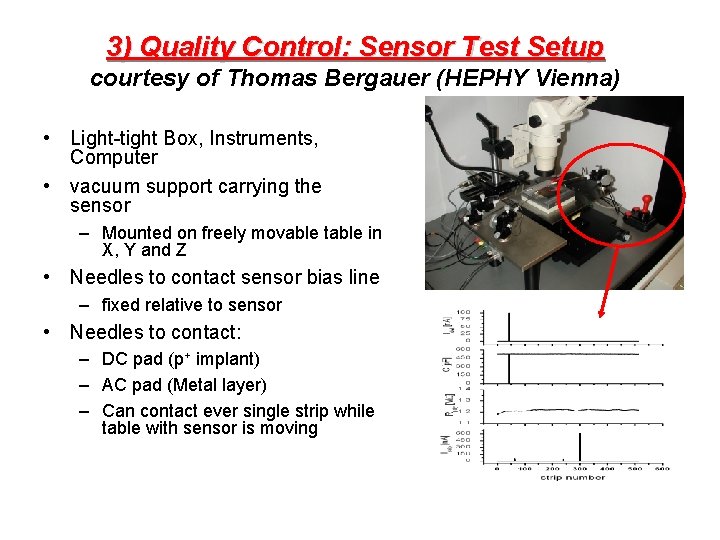
3) Quality Control: Sensor Test Setup courtesy of Thomas Bergauer (HEPHY Vienna) • Light-tight Box, Instruments, Computer • vacuum support carrying the sensor – Mounted on freely movable table in X, Y and Z • Needles to contact sensor bias line – fixed relative to sensor • Needles to contact: – DC pad (p+ implant) – AC pad (Metal layer) – Can contact ever single strip while table with sensor is moving
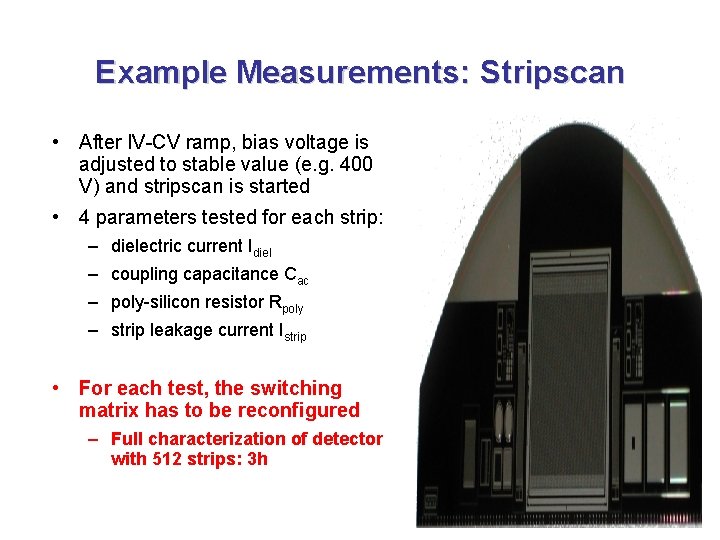
Example Measurements: Stripscan • After IV-CV ramp, bias voltage is adjusted to stable value (e. g. 400 V) and stripscan is started • 4 parameters tested for each strip: – dielectric current Idiel – coupling capacitance Cac – poly-silicon resistor Rpoly – strip leakage current Istrip • For each test, the switching matrix has to be reconfigured – Full characterization of detector with 512 strips: 3 h
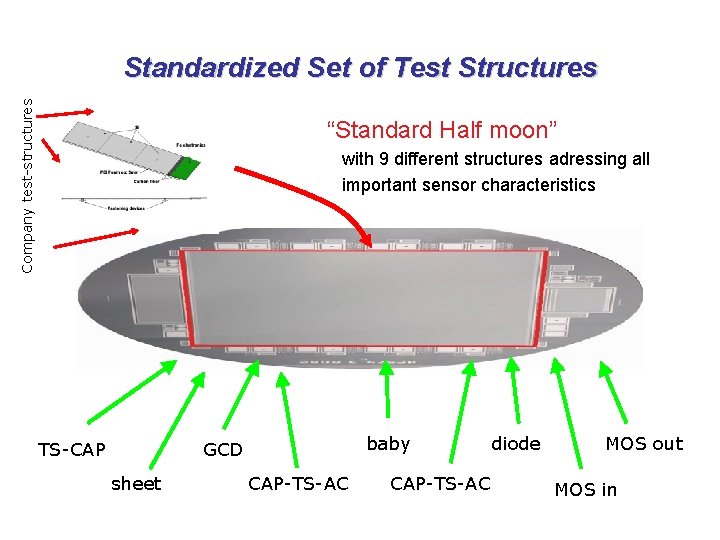
Company test-structures Standardized Set of Test Structures “Standard Half moon” with 9 different structures adressing all important sensor characteristics TS-CAP baby GCD sheet CAP-TS-AC diode MOS out MOS in
Summary • Future experiments with large tracker require huge number of sensors. – CMS Si Tracker: 206 m 2 , 24. 244 sensors, 9. 316. 352 channels • Fabrication will last many months (years) and a stable production during the whole production time is mandatory. • Strip-by-strip test of detectors is necessary but not sufficient – Slow, reduced set of parameters to test • Measurements on dedicated test-structures is a powerful possibility to monitor the fabrication process • – During a long production time – Also on parameters which are not accessible on the main sensor (e. g. MOS) – Destructive tests possible – Fast measurement allows high throughput Test structures must be optimized by improving with • Smaller structures • Better design of some structures (e. g. diode, sheet) • To put it on unused space of their wafer design
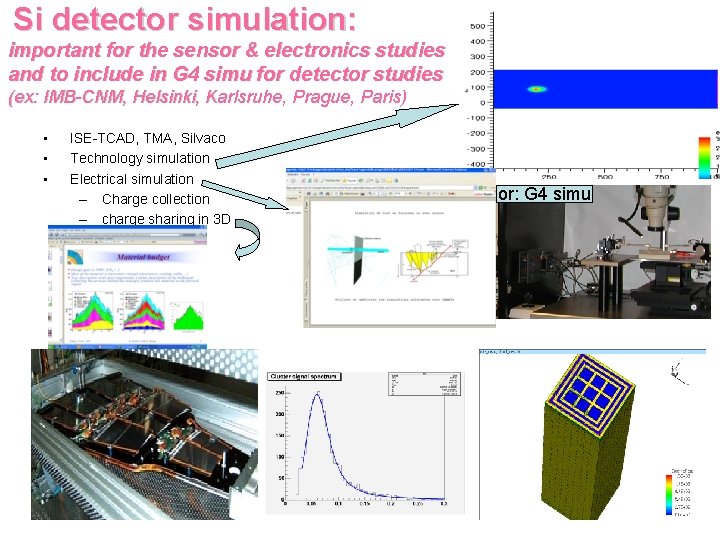
Si detector simulation: important for the sensor & electronics studies and to include in G 4 simu for detector studies (ex: IMB-CNM, Helsinki, Karlsruhe, Prague, Paris) • • • ISE-TCAD, TMA, Silvaco Technology simulation Electrical simulation – Charge collection – charge sharing in 3 D or: G 4 simu
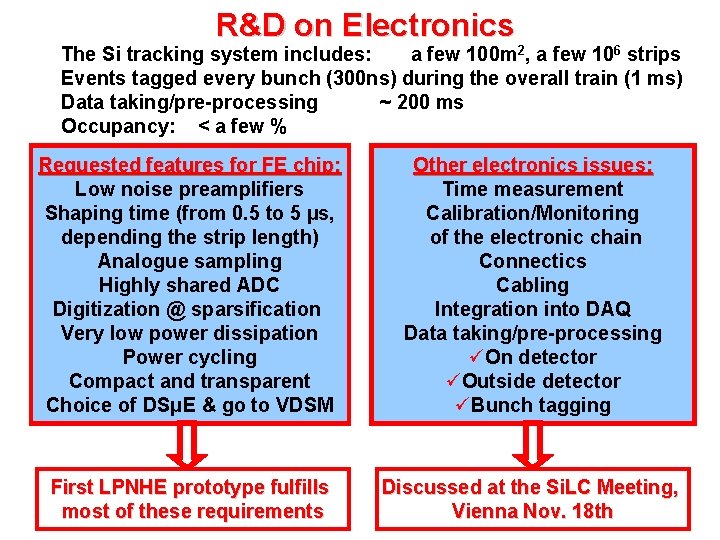
R&D on Electronics The Si tracking system includes: a few 100 m 2, a few 106 strips Events tagged every bunch (300 ns) during the overall train (1 ms) Data taking/pre-processing ~ 200 ms Occupancy: < a few % Requested features for FE chip: Low noise preamplifiers Shaping time (from 0. 5 to 5 µs, depending the strip length) Analogue sampling Highly shared ADC Digitization @ sparsification Very low power dissipation Power cycling Compact and transparent Choice of DSμE & go to VDSM Other electronics issues: Time measurement Calibration/Monitoring of the electronic chain Connectics Cabling Integration into DAQ Data taking/pre-processing üOn detector üOutside detector üBunch tagging First LPNHE prototype fulfills most of these requirements Discussed at the Si. LC Meeting, Vienna Nov. 18 th
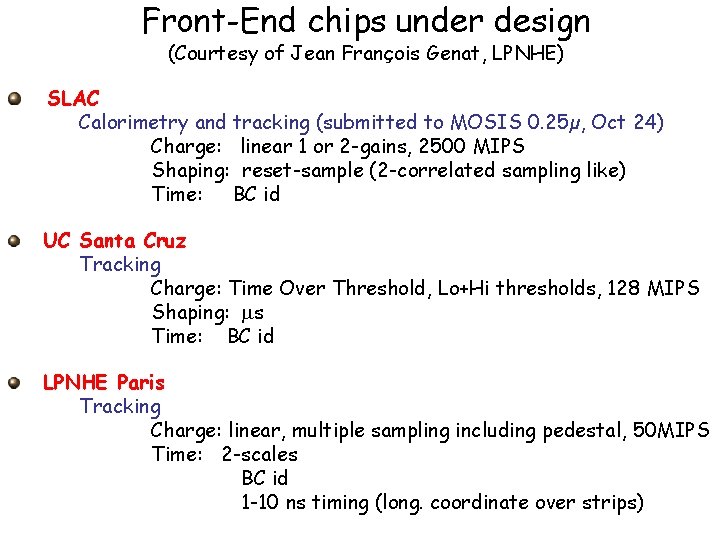
Front-End chips under design (Courtesy of Jean François Genat, LPNHE) SLAC Calorimetry and tracking (submitted to MOSIS 0. 25µ, Oct 24) Charge: linear 1 or 2 -gains, 2500 MIPS Shaping: reset-sample (2 -correlated sampling like) Time: BC id UC Santa Cruz Tracking Charge: Time Over Threshold, Lo+Hi thresholds, 128 MIPS Shaping: ms Time: BC id LPNHE Paris Tracking Charge: linear, multiple sampling including pedestal, 50 MIPS Time: 2 -scales BC id 1 -10 ns timing (long. coordinate over strips)
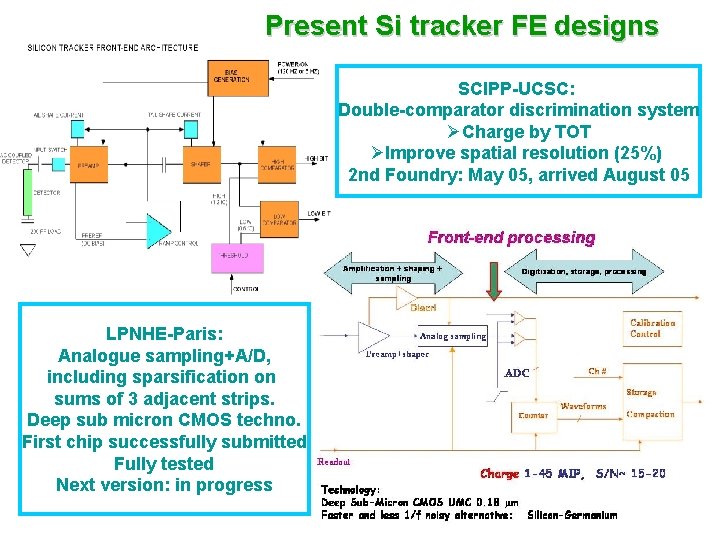
Present Si tracker FE designs SCIPP-UCSC: Double-comparator discrimination system ØCharge by TOT ØImprove spatial resolution (25%) 2 nd Foundry: May 05, arrived August 05 LPNHE-Paris: Analogue sampling+A/D, including sparsification on sums of 3 adjacent strips. Deep sub micron CMOS techno. First chip successfully submitted Fully tested Next version: in progress
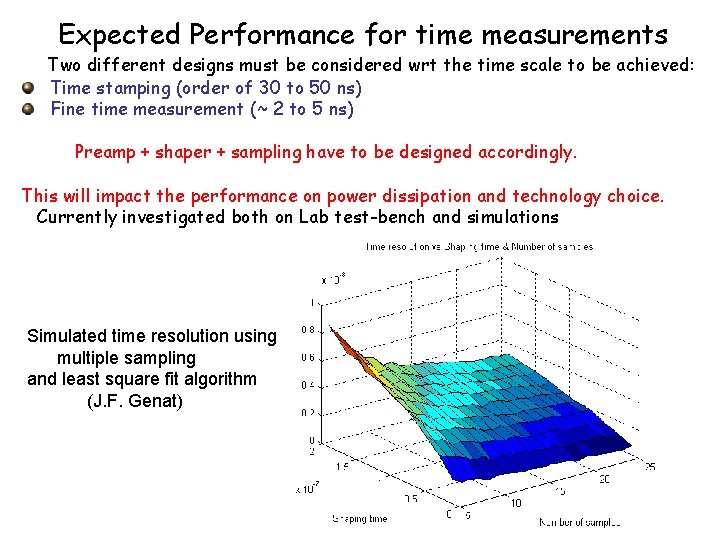
Expected Performance for time measurements Two different designs must be considered wrt the time scale to be achieved: Time stamping (order of 30 to 50 ns) Fine time measurement (~ 2 to 5 ns) Preamp + shaper + sampling have to be designed accordingly. This will impact the performance on power dissipation and technology choice. Currently investigated both on Lab test-bench and simulations Simulated time resolution using multiple sampling and least square fit algorithm (J. F. Genat)
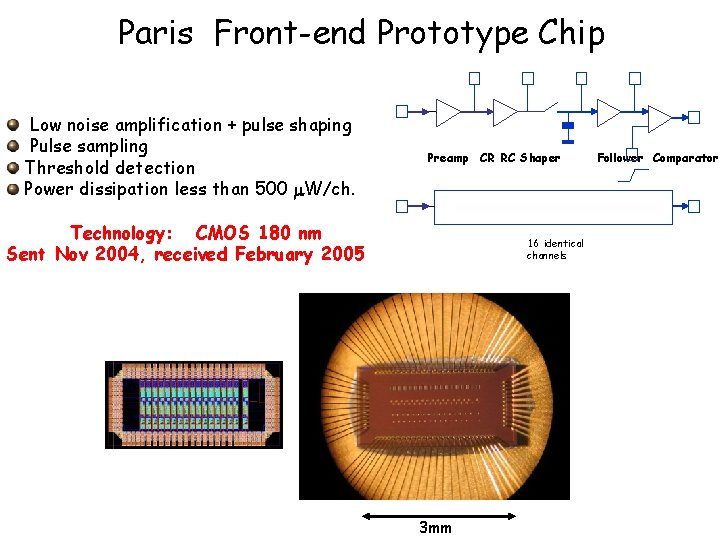
Paris Front-end Prototype Chip Low noise amplification + pulse shaping Pulse sampling Threshold detection Power dissipation less than 500 m. W/ch. Preamp CR RC Shaper Technology: CMOS 180 nm Sent Nov 2004, received February 2005 16 identical channels 3 mm Follower Comparator
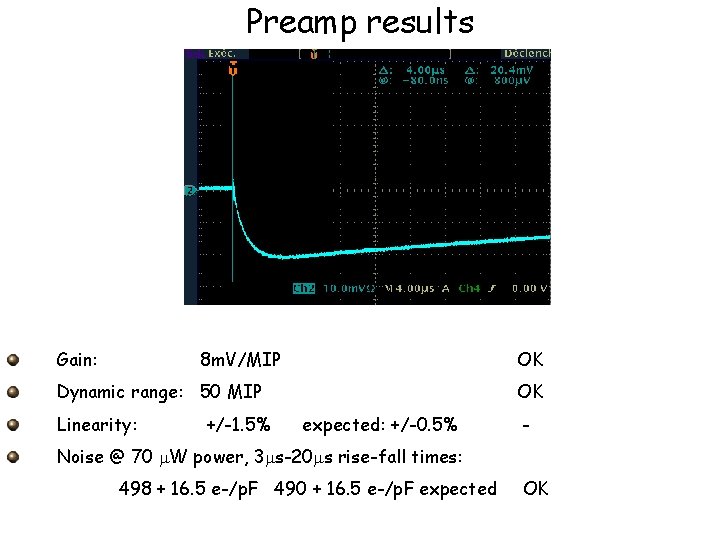
Preamp results Gain: 8 m. V/MIP OK Dynamic range: 50 MIP Linearity: +/-1. 5% OK expected: +/-0. 5% - Noise @ 70 m. W power, 3 ms-20 ms rise-fall times: 498 + 16. 5 e-/p. F 490 + 16. 5 e-/p. F expected OK
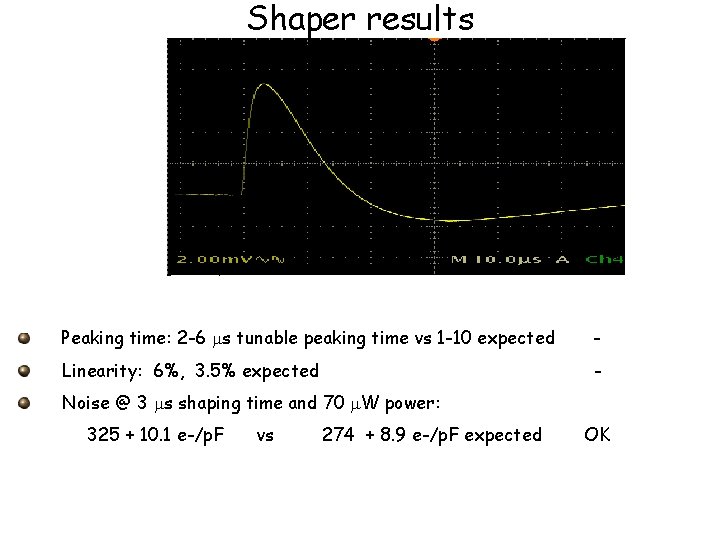
Shaper results Peaking time: 2 -6 ms tunable peaking time vs 1 -10 expected - Linearity: 6%, 3. 5% expected - Noise @ 3 ms shaping time and 70 m. W power: 325 + 10. 1 e-/p. F vs 274 + 8. 9 e-/p. F expected OK
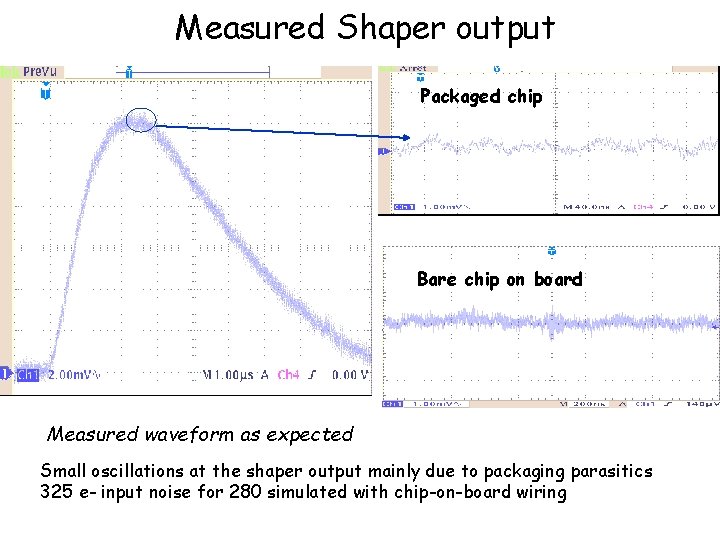
Measured Shaper output Packaged chip Bare chip on board Measured waveform as expected Small oscillations at the shaper output mainly due to packaging parasitics 325 e- input noise for 280 simulated with chip-on-board wiring
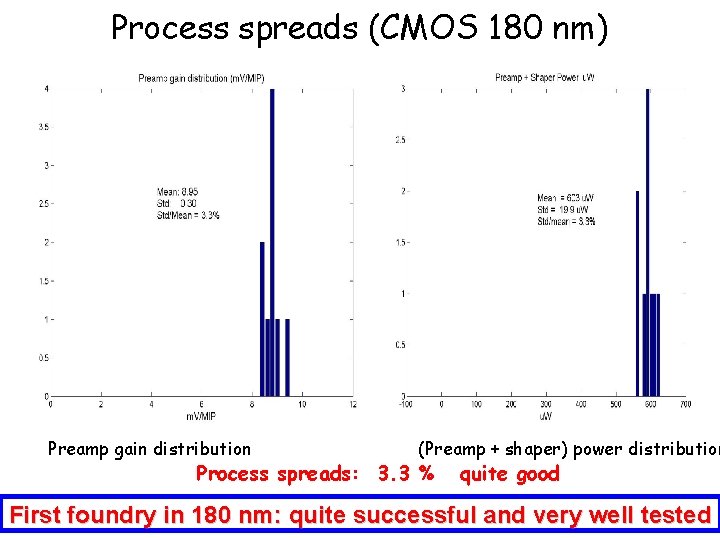
Process spreads (CMOS 180 nm) Preamp gain distribution (Preamp + shaper) power distribution Process spreads: 3. 3 % quite good First foundry in 180 nm: quite successful and very well tested
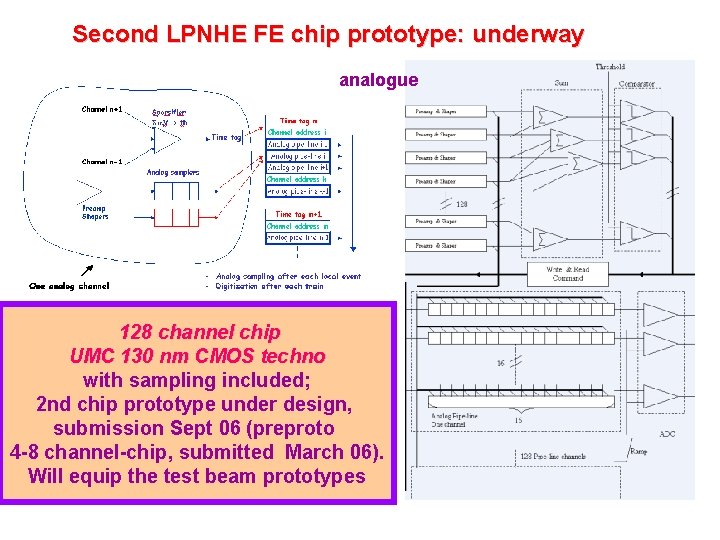
Second LPNHE FE chip prototype: underway analogue 128 channel chip UMC 130 nm CMOS techno with sampling included; 2 nd chip prototype under design, submission Sept 06 (preproto 4 -8 channel-chip, submitted March 06). Will equip the test beam prototypes
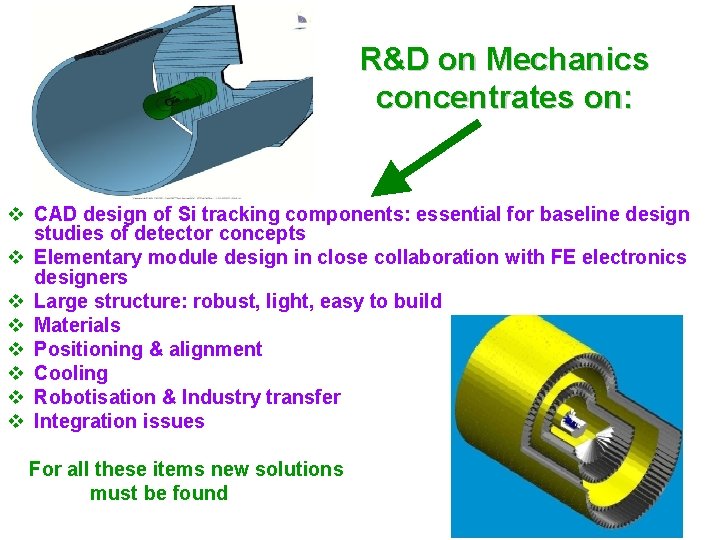
R&D on Mechanics concentrates on: v CAD design of Si tracking components: essential for baseline design studies of detector concepts v Elementary module design in close collaboration with FE electronics designers v Large structure: robust, light, easy to build v Materials v Positioning & alignment v Cooling v Robotisation & Industry transfer v Integration issues For all these items new solutions must be found
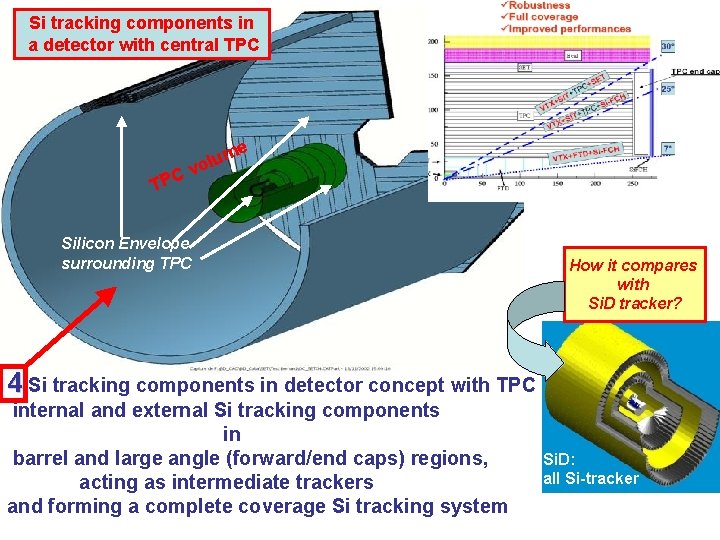
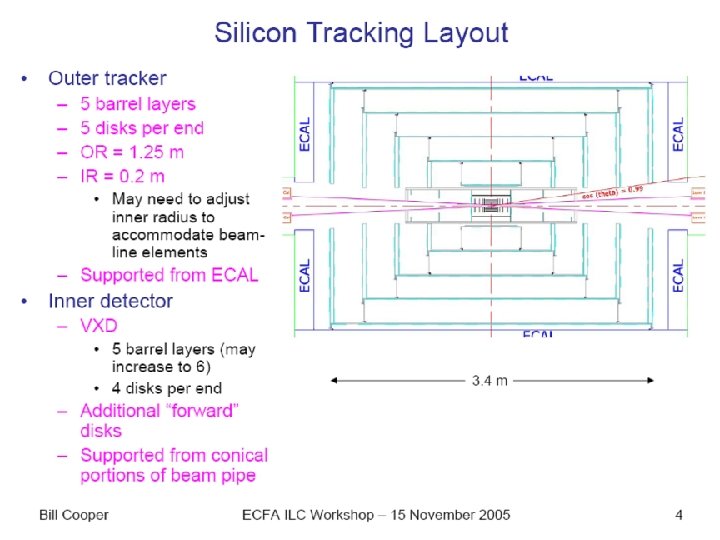
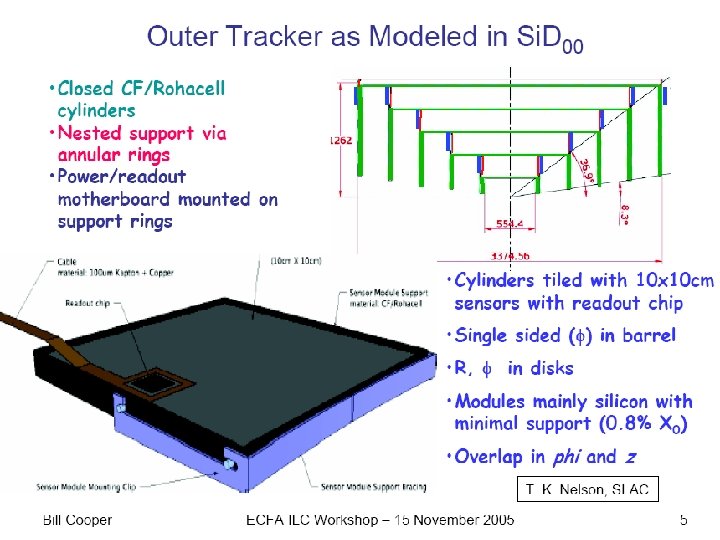
Si tracking components in a detector with central TPC e TPC um vol Silicon Envelope surrounding TPC How it compares with Si. D tracker? 4 Si tracking components in detector concept with TPC internal and external Si tracking components in barrel and large angle (forward/end caps) regions, acting as intermediate trackers and forming a complete coverage Si tracking system Si. D: all Si-tracker
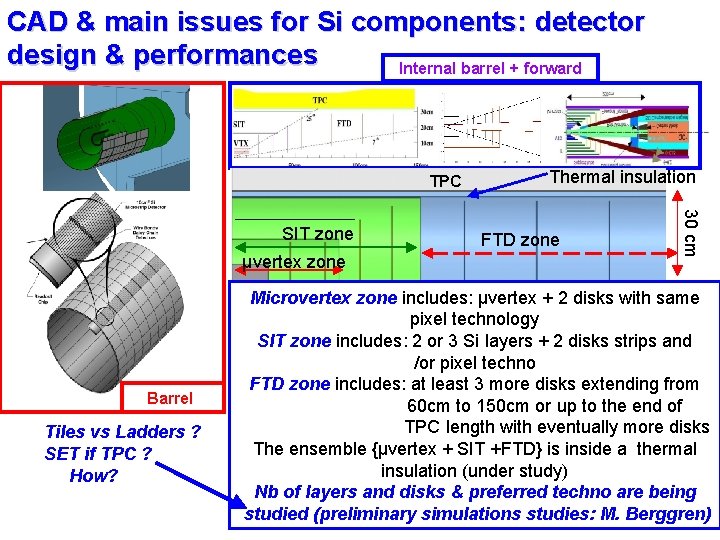
CAD & main issues for Si components: detector design & performances Internal barrel + forward TPC µvertex zone Barrel Tiles vs Ladders ? SET if TPC ? How? FTD zone 30 cm SIT zone Thermal insulation Microvertex zone includes: µvertex + 2 disks with same pixel technology SIT zone includes: 2 or 3 Si layers + 2 disks strips and /or pixel techno FTD zone includes: at least 3 more disks extending from 60 cm to 150 cm or up to the end of TPC length with eventually more disks The ensemble {µvertex + SIT +FTD} is inside a thermal insulation (under study) Nb of layers and disks & preferred techno are being studied (preliminary simulations studies: M. Berggren)
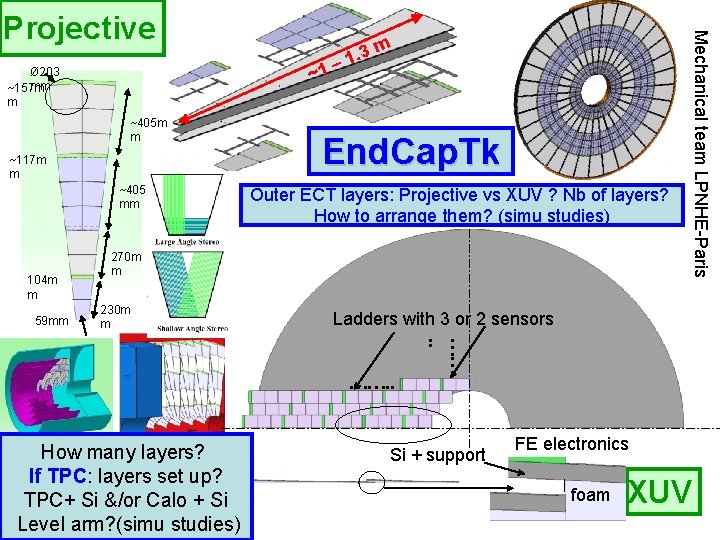
~1 Ø 203 mm ~157 m m ~405 m m ~117 m m ~405 mm m End. Cap. Tk Outer ECT layers: Projective vs XUV ? Nb of layers? How to arrange them? (simu studies) 270 m m 104 m m 59 mm . 3 – 1 230 m m Ladders with 3 or 2 sensors ……. . sens or How many layers? If TPC: layers set up? TPC+ Si &/or Calo + Si Level arm? (simu studies) Mechanical team LPNHE-Paris Projective Si + support FE electronics foam XUV
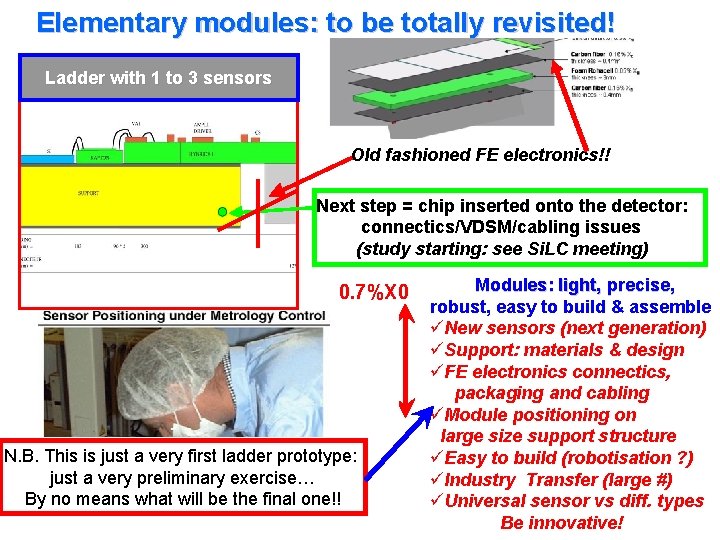
Elementary modules: to be totally revisited! Ladder with 1 to 3 sensors Old fashioned FE electronics!! Next step = chip inserted onto the detector: connectics/VDSM/cabling issues (study starting: see Si. LC meeting) 0. 7%X 0 N. B. This is just a very first ladder prototype: just a very preliminary exercise… By no means what will be the final one!! Modules: light, precise, robust, easy to build & assemble üNew sensors (next generation) üSupport: materials & design üFE electronics connectics, packaging and cabling üModule positioning on large size support structure üEasy to build (robotisation ? ) üIndustry Transfer (large #) üUniversal sensor vs diff. types Be innovative!
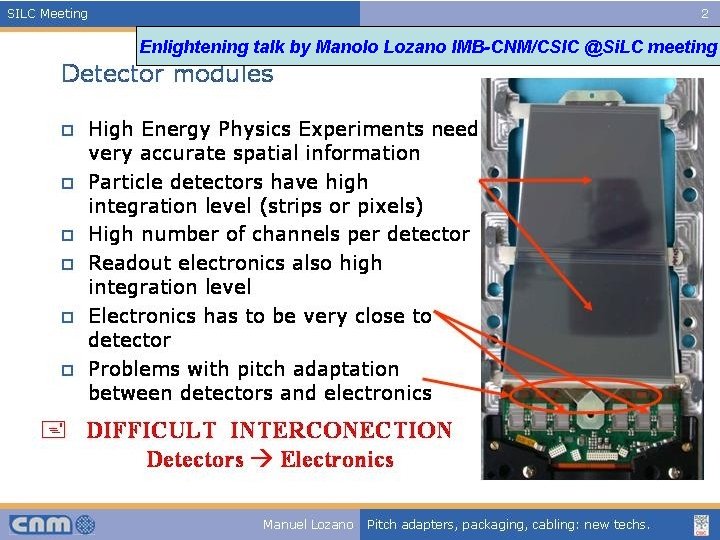
Enlightening talk by Manolo Lozano IMB-CNM/CSIC @Si. LC meeting
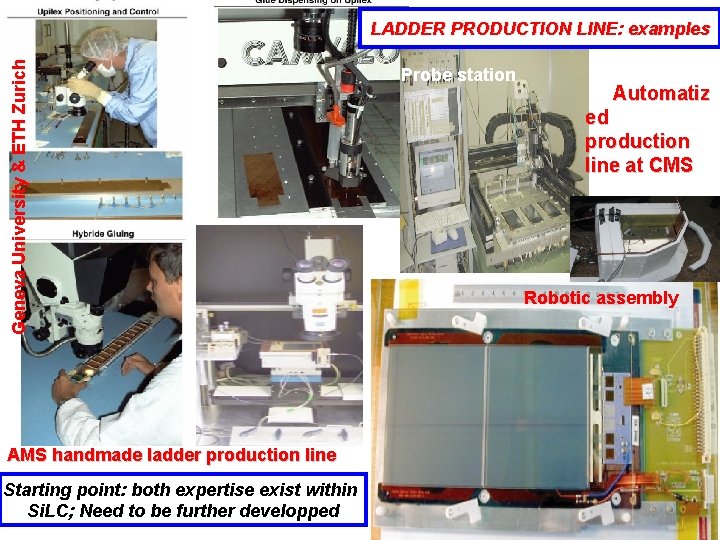
Geneva University & ETH Zurich LADDER PRODUCTION LINE: examples AMS handmade ladder production line Starting point: both expertise exist within Si. LC; Need to be further developped Probe station Automatiz ed production line at CMS Robotic assembly
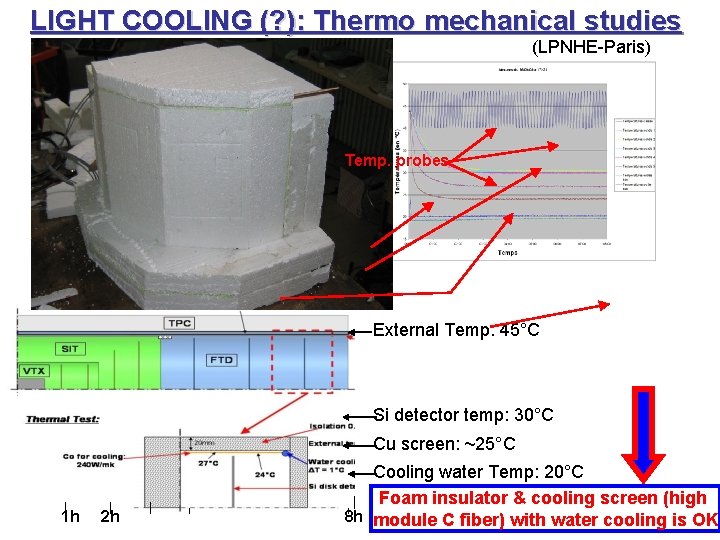
LIGHT COOLING (? ): Thermo mechanical studies (LPNHE-Paris) Temp. probes External Temp: 45°C Si detector temp: 30°C Cu screen: ~25°C 1 h 2 h Cooling water Temp: 20°C Foam insulator & cooling screen (high 8 h module C fiber) with water cooling is OK
Alignment(s) To ensure the challenging high precision performances of the Silicon tracking system in an ILC experiment, one crucial key issue is the alignment Two techniques are so far developed in the collaboration: Ø Frequency Scanned Interferometry (FSI) (quite advanced) Precision below 1µm by the University of Michigan Embedded Straightness Monitor (just starting) by the IFCA-Cantabria University (EUDET)
Embedded straightness monitor - Conceptual Design (courtesy, C. Rivero & I. Vila) • Collimated laser beam (IR spectrum) going through silicon detector modules. The laser beam would be detected directly in the Si-modules. • Based on previous AMS-1 experience we can project that few microns resolutions would be achieved. • Main advantages: – Particle tracks and laser beam share the same sensors removing the need of any mechanical transfer. – No precise positioning of the aiming of the collimators. The number of measurements has to be redundant enough
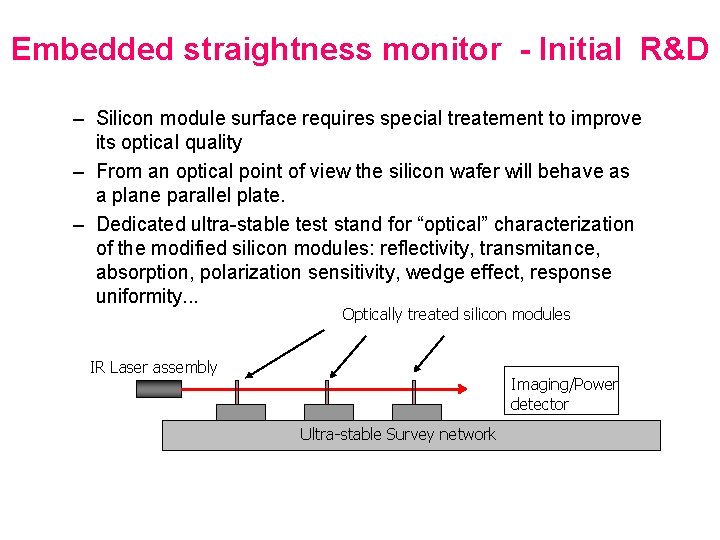
Embedded straightness monitor - Initial R&D – Silicon module surface requires special treatement to improve its optical quality – From an optical point of view the silicon wafer will behave as a plane parallel plate. – Dedicated ultra-stable test stand for “optical” characterization of the modified silicon modules: reflectivity, transmitance, absorption, polarization sensitivity, wedge effect, response uniformity. . . Optically treated silicon modules IR Laser assembly Imaging/Power detector Ultra-stable Survey network
Embedded straightness monitor - Initial R&D Start up plan: – Study/selection of precise laser wavelength(s)* adequated to the Si module sensibility. – Small laser test stand for Si-mod readout: determine spatial resolution achievable. – Study of feasibility of optical treatment of the Si wafer. (*) Using more than one wavelengths may allow us to correct for “atmosferic” effects that will deflect the laser beams.
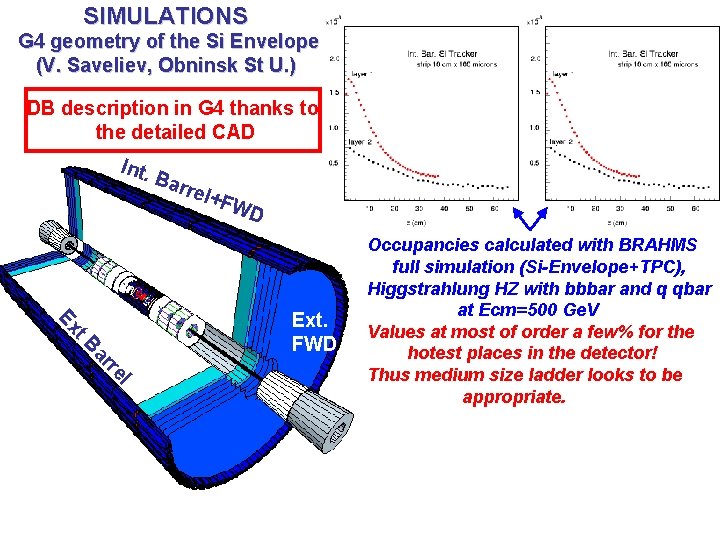
SIMULATIONS G 4 geometry of the Si Envelope (V. Saveliev, Obninsk St U. ) DB description in G 4 thanks to the detailed CAD Int. Bar re l+F WD l re ar t. B Ex Ext. FWD Occupancies calculated with BRAHMS full simulation (Si-Envelope+TPC), Higgstrahlung HZ with bbbar and q qbar Ext. at Ecm=500 Ge. V FWD Values at most of order a few% for the hotest places in the detector! Thus medium size ladder looks to be appropriate.
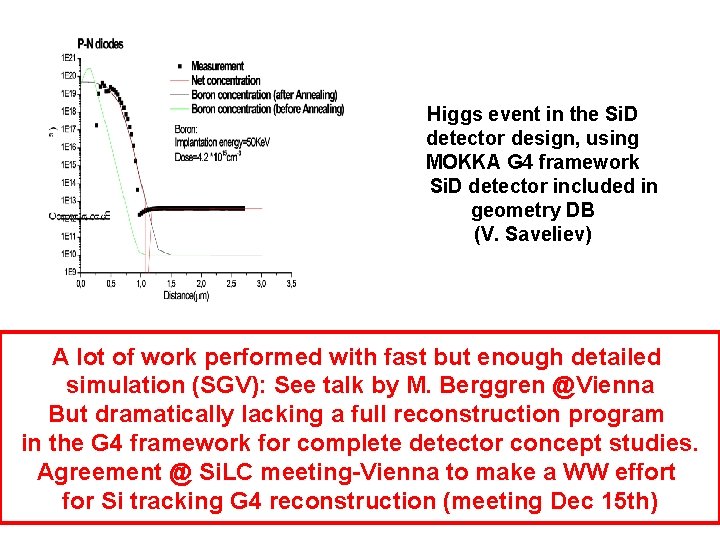
Higgs event in the Si. D detector design, using MOKKA G 4 framework Si. D detector included in geometry DB (V. Saveliev) A lot of work performed with fast but enough detailed simulation (SGV): See talk by M. Berggren @Vienna But dramatically lacking a full reconstruction program in the G 4 framework for complete detector concept studies. Agreement @ Si. LC meeting-Vienna to make a WW effort for Si tracking G 4 reconstruction (meeting Dec 15 th)
Test beams: Goals Ø To qualify in conditions closest to the real life: prototypes of detectors (including New Si technologies) and of the associated FE and readout electronics. Ø Detection efficiency vs operational parameters Ø Spatial resolution, cluster size Ø Signal/Bruit Ø Effect of magnetic field (Lorenz angle determination) Ø Angular scans, bias scans Ø Integration with other sub-detectors Ø Alignment Ø Cooling (including power cycling) Ø In the specific & new ILC conditions.
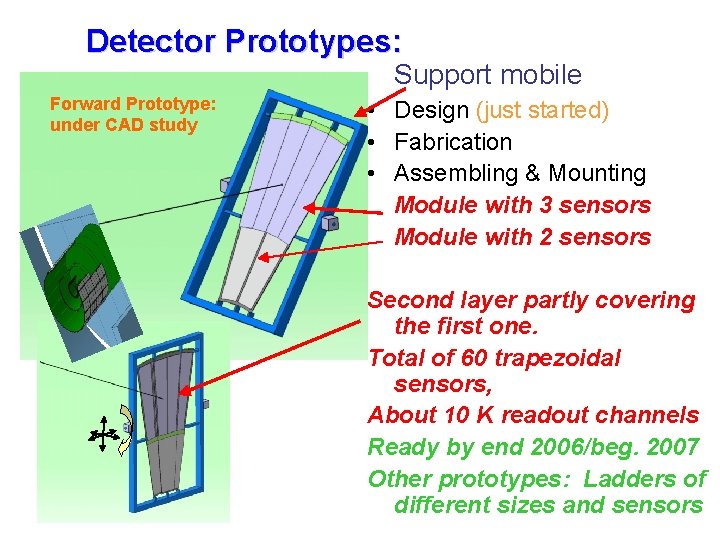
Detector Prototypes: Support mobile Forward Prototype: under CAD study • Design (just started) • Fabrication • Assembling & Mounting Module with 3 sensors Module with 2 sensors Second layer partly covering the first one. Total of 60 trapezoidal sensors, About 10 K readout channels Ready by end 2006/beg. 2007 Other prototypes: Ladders of different sizes and sensors
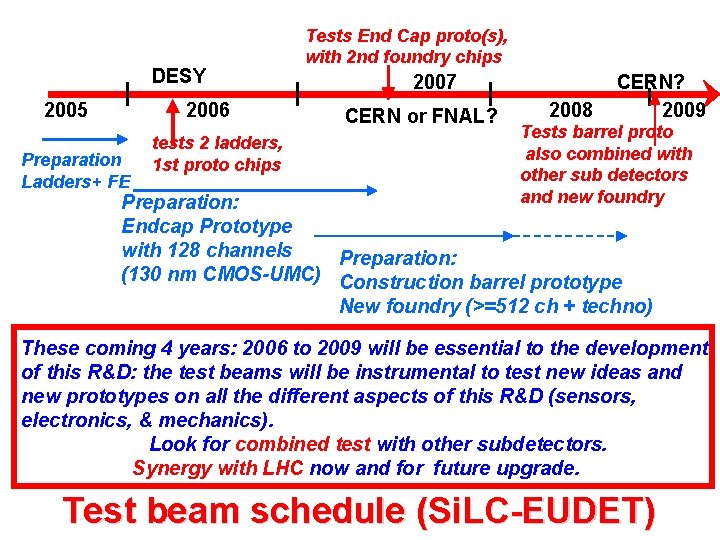
DESY 2005 2006 Preparation Ladders+ FE tests 2 ladders, 1 st proto chips Tests End Cap proto(s), with 2 nd foundry chips 2007 CERN or FNAL? 2008 CERN? 2009 Tests barrel proto also combined with other sub detectors and new foundry Preparation: Endcap Prototype with 128 channels Preparation: (130 nm CMOS-UMC) Construction barrel prototype New foundry (>=512 ch + techno) These coming 4 years: 2006 to 2009 will be essential to the development of this R&D: the test beams will be instrumental to test new ideas and new prototypes on all the different aspects of this R&D (sensors, electronics, & mechanics). Look for combined test with other subdetectors. Synergy with LHC now and for future upgrade. Test beam schedule (Si. LC-EUDET)
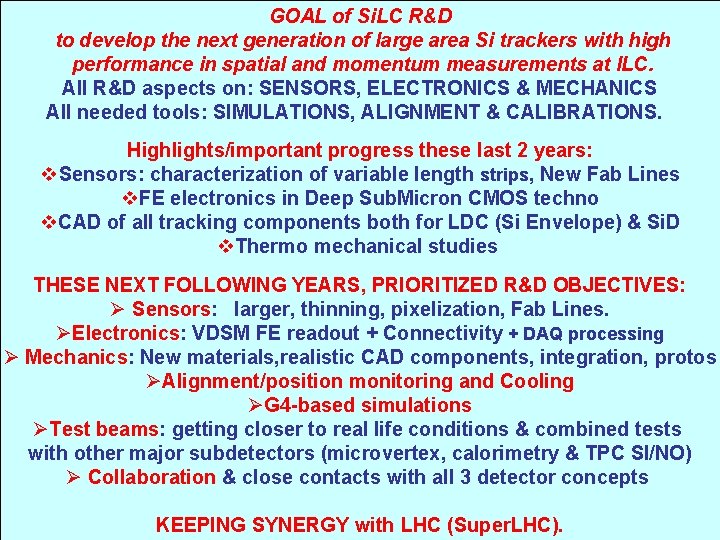
GOAL of Si. LC R&D to develop the next generation of large area Si trackers with high performance in spatial and momentum measurements at ILC. All R&D aspects on: SENSORS, ELECTRONICS & MECHANICS All needed tools: SIMULATIONS, ALIGNMENT & CALIBRATIONS. Highlights/important progress these last 2 years: v. Sensors: characterization of variable length strips, New Fab Lines v. FE electronics in Deep Sub. Micron CMOS techno v. CAD of all tracking components both for LDC (Si Envelope) & Si. D v. Thermo mechanical studies THESE NEXT FOLLOWING YEARS, PRIORITIZED R&D OBJECTIVES: Ø Sensors: larger, thinning, pixelization, Fab Lines. ØElectronics: VDSM FE readout + Connectivity + DAQ processing Ø Mechanics: New materials, realistic CAD components, integration, protos ØAlignment/position monitoring and Cooling ØG 4 -based simulations ØTest beams: getting closer to real life conditions & combined tests with other major subdetectors (microvertex, calorimetry & TPC SI/NO) Ø Collaboration & close contacts with all 3 detector concepts KEEPING SYNERGY with LHC (Super. LHC).