
THE SHOULDER ANATOMY Bones Sternum middle of chest
THE SHOULDER
ANATOMY
Bones Sternum - middle of chest 2. Clavicle - collar bone 3. Humerus - upper arm 4. Scapula - shoulder blade 1. • Acromion process (knob on top of shoulder) • Glenoid fossa (socket for the humerus)

SHOULDER COMPLEX JOINTS w Sternoclavicular (SC) Joint • Only bony attachment between the axial skeleton and the upper extremity
SHOULDER COMPLEX JOINTS w Acromioclavicular (AC) Joint • Between the lateral end of the clavicle and the acromion process of the scapula • Held together by two sets of ligaments • Painful when injured

SHOULDER COMPLEX JOINTS w Glenohumeral (GH Joint) • True shoulder joint • Between the head of the humerus and the glenoid fossa of the scapula • Most freely movable joint of the body • Very unstable • Head of the humerus is 60% bigger than the glenoid (golf ball on a tee)
SHOULDER MUSCLES w Pectoralis Major • Front of chest • Horizontal Adduction (like bench press)
SHOULDER MUSCLES w Deltoid • Over the top of the shoulder • Abduction
SHOULDER MUSCLES w Latissimus Dorsi • Back of shoulder • Extension
SHOULDER MUSCLES w Rotator Cuff • • Supraspinatus Infraspinatus Teres Minor Subscapularis • Internal and External Rotation
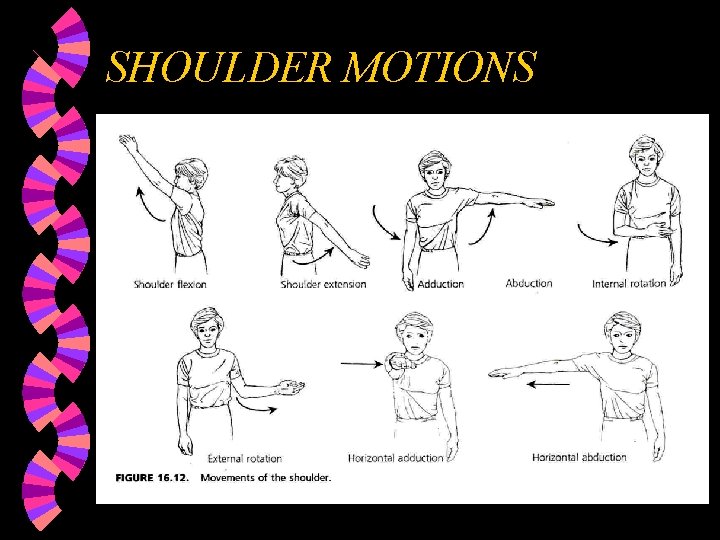
SHOULDER MOTIONS
INJURIES 8 slides with LOTS of info!
Clavicle Fracture Most fracture sites are in middle 1/3 w Most common in adolescents and pre-adolescents w Cause: w • Fall on outstretched arm OR tip of shoulder • Direct impact w S/S • Tilts head to side that is injured • Supports that arm with other arm • Clavicle is tender w Care: Immobilize, ice, x-ray, figure-8 brace
Humerus Fracture Not a common injury in sports w Cause w • Direct impact • Fall on outstretched arm w S/S • Inability to move arm • Pain and swelling in upper arm w Care • Splint, sling • Immediate referral to ER
Sternoclavicular (SC) Sprain Not a common injury - mostly in contact sports w Cause w • Fall on shoulder - force goes up the clavicle w S/S – (can be 3 grades) • Usually dislocates anterior and superior - obvious deformity • Unable abduct or horizontally adduct arm w Care • RICE, Immobilize shoulder • Life threatening if it goes posteriorly
Acromioclavicular (AC) Sprain Very common in athletics w Cause w • Fall on outstretched arm OR tip of shoulder w S/S • 1 st and 2 nd degree - tenderness around joint, will not want to flex or horizontally adduct • 3 rd degree sprain has obvious deformity w Care • RICE, Immobilize shoulder • X-rays will determine the degree best – holding weight
Glenohumeral (GH) Dislocation w 95% of all dislocations are anterior • Can also go inferior or posterior Once it happens, it is very likely to happen again w Cause (anterior): w • Arm is abducted and externally rotated with extra force w S/S • Deltoid will appear flat • They will hold arm at side and internally rotated • Unable to use the arm w Treatment • Immobilization, ice and referral to MD to reduce
Labral Tear – SLAP Lesion w Causes • Fall on shoulder • Overuse (throwing, lifting) • GH Dislocation w S/S • • w Pain (especially with overhead throwing) Catching Instability Pain with biceps involvement Tx • Rest and rehab first • If that does not work - surgical repair (arthroscopy)
Shoulder Impingement Syndrome w Cause • Repetitive overhead motion (i. e. throwing, swimming, volleyball, etc) • The supraspinatus tendon, a bursa and biceps tendon get trapped in a small space w S/S • Pain with overhead motion • Weakness in abduction and external rotation w Care • Ice and rest for pain • Fix the bad habits (biomechanics) that caused the problem
Rotator Cuff Strains Can go hand in hand with impingement w Supraspinatus (SSP) is most often injured w Cause w • Overhead motions with force or heavy weight w S/S • Pain – down into deltoid • Weakness – may not be able to abduct arm with full tear of the SSP w Care • Decrease overhead activity • Ice or heat • Rehab to strengthen rotator cuff
Biceps Tendinitis Common in athletes who use a lot of overhead motion (throwers) w Can go hand in hand with impingement w Cause w • Overhead motion w S/S • Pain is in anterior, proximal humerus • Pain with O/H motion w Treatment • Deep heat • Ice after activity
- Slides: 21