
The Shortest Path problem in graphs with selfish

The Shortest Path problem in graphs with selfish edges
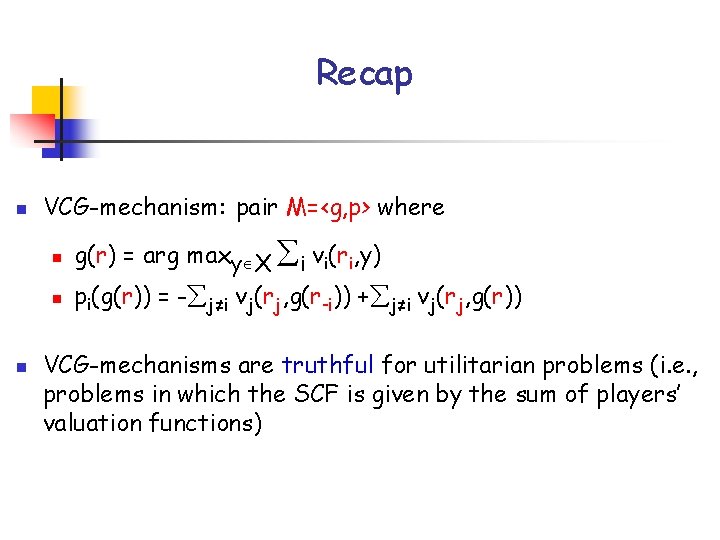
Recap n VCG-mechanism: pair M=<g, p> where n n n g(r) = arg maxy X i vi(ri, y) pi(g(r)) = - j≠i vj(rj, g(r-i)) + j≠i vj(rj, g(r)) VCG-mechanisms are truthful for utilitarian problems (i. e. , problems in which the SCF is given by the sum of players’ valuation functions)
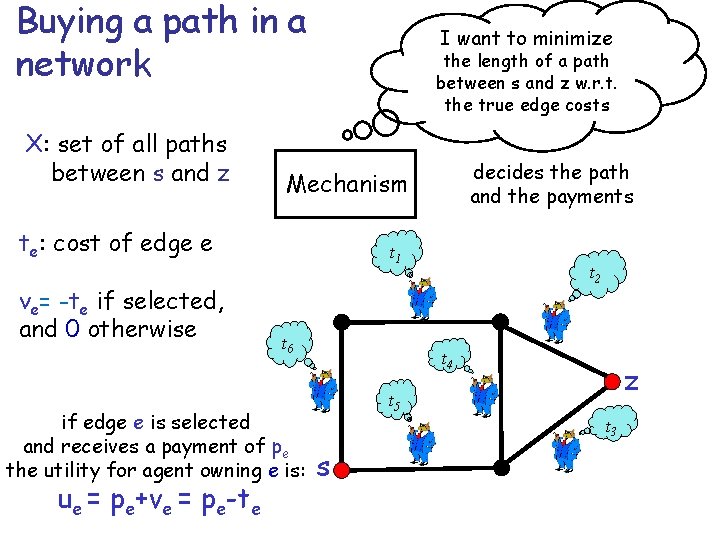
Buying a path in a network X: set of all paths between s and z I want to minimize the length of a path between s and z w. r. t. the true edge costs te: cost of edge e ve= -te if selected, and 0 otherwise t 1 t 6 if edge e is selected and receives a payment of pe the utility for agent owning e is: ue = pe+ve = pe-te decides the path and the payments Mechanism t 2 t 4 z t 5 t 3 s
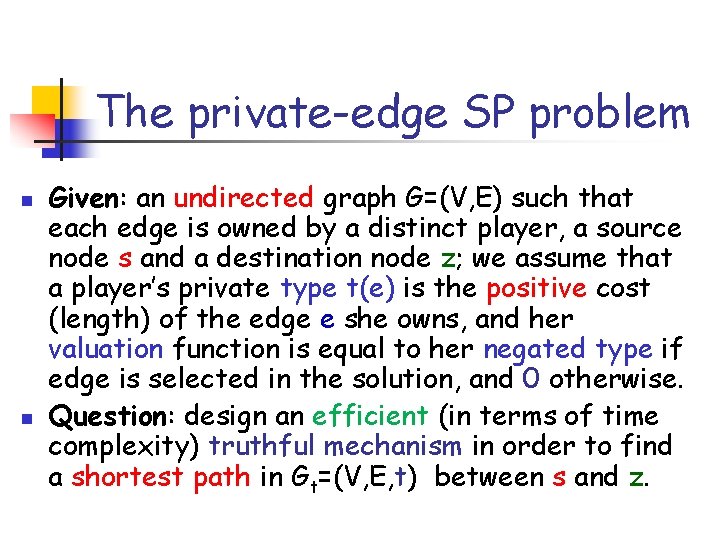
The private-edge SP problem n n Given: an undirected graph G=(V, E) such that each edge is owned by a distinct player, a source node s and a destination node z; we assume that a player’s private type t(e) is the positive cost (length) of the edge e she owns, and her valuation function is equal to her negated type if edge is selected in the solution, and 0 otherwise. Question: design an efficient (in terms of time complexity) truthful mechanism in order to find a shortest path in Gt=(V, E, t) between s and z.
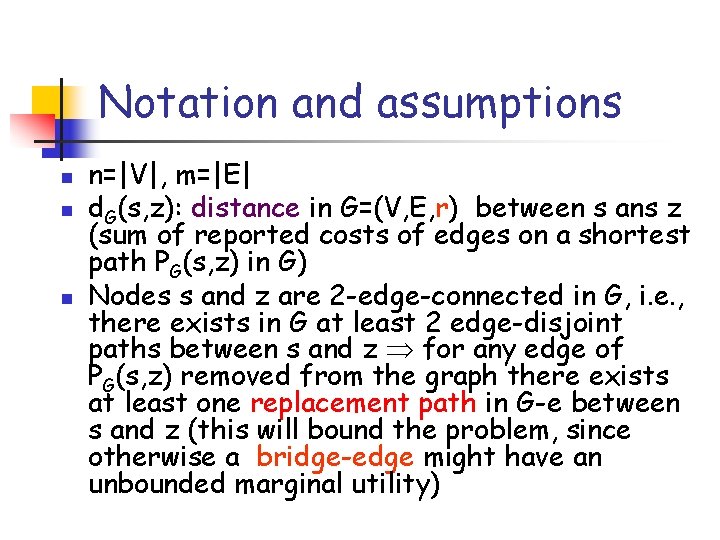
Notation and assumptions n n=|V|, m=|E| d. G(s, z): distance in G=(V, E, r) between s ans z (sum of reported costs of edges on a shortest path PG(s, z) in G) Nodes s and z are 2 -edge-connected in G, i. e. , there exists in G at least 2 edge-disjoint paths between s and z for any edge of PG(s, z) removed from the graph there exists at least one replacement path in G-e between s and z (this will bound the problem, since otherwise a bridge-edge might have an unbounded marginal utility)
VCG mechanism n The problem is utilitarian (indeed, the SCF is given by the sum of valuations) VCG-mechanism M=<g, p>: n g: computes arg maxy X e E ve(r(e), y), i. e. , PG(s, z) in G=(V, E, r), where r(e) denotes the reported cost of e; indeed, valuation functions are negative, so maximizing their sum means to compute a cheapest path; n p (Clarke payments): for each e E: pe =- j≠e vj(r(j), g(r-e)) + j≠e vj(r(j), g(r)), namely { d. G-e(s, z)-[d. G(s, z)-r(e)] = d. G-e(s, z)-d. G(s, z) + r(e) if e PG(s, z) d. G(s, z)-d. G(s, z) = 0 otherwise For each e PG(s, z), we have to compute d. G-e(s, z), namely the length of a replacement shortest path in G-e =(V, E{e}, r-e) between s and z. Remark: Notice that G is 2 -edge-connected since otherwise d. G-e(s, z) may become + according to the payment scheme, agent owning e would get an unbounded payment! pe =

The replacement shortest path s 2 4 5 5 3 PG(s, z) d. G(s, z)=11 6 e 2 10 12 5 PG-e(s, z) d. G-e(s, z)=12 z pe=d. G-e(s, z)-d. G(s, z) + r(e) = 12 -11+2=3 Remark: ue = pe+ve= pe- te = pe- r(e) = d. G-e(s, z)-d. G(s, z)+ r(e) - r(e) , and since d. G-e(s, z) ≥d. G(s, z) ue 0
A trivial but costly implementation Step 1: First of all, apply Dijkstra to compute PG(s, z) this costs O(m + n log n) time by using Fibonacci heaps. n Step 2: Then, e PG(s, z) apply Dijkstra in G-e to compute PG-e(s, z) we spend O(m + n log n) time for each of the O(n) edges in PG(s, z), i. e. , O(mn + n 2 log n) time Overall complexity: O(mn + n 2 log n) time n We will see an efficient solution costing O(m + n log n) time, which is equal to the fastest centralized algorithm (Dijkstra using Fibonacci heaps) n
Notation n n SG(s), SG(z): single-source shortestpath trees rooted at s and z Ms(e): set of nodes in SG(s) not descending from edge e (i. e. , the set of nodes whose shortest path from s does not use e) Ns(e)=V/Ms(e) Mz(e), Nz(e) defined analogously
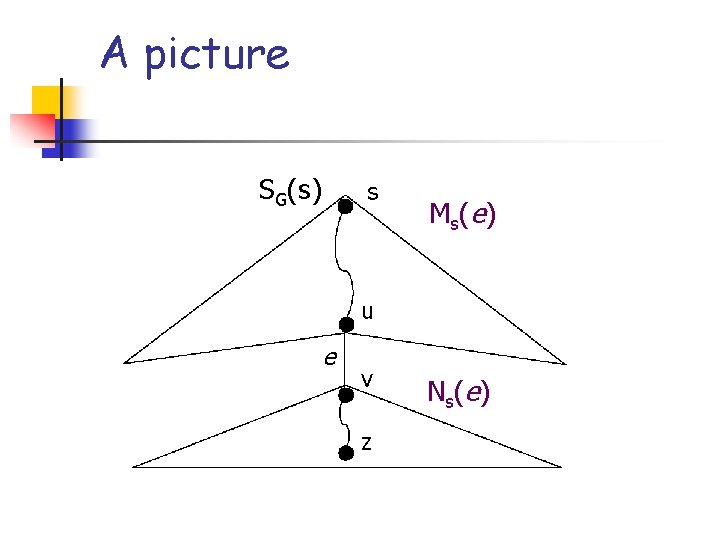
A picture SG(s) s M s( e ) u e v z N s( e )
Crossing edges n n (Ms(e), Ns(e)) is a cut in G Cs(e)={(x, y) E{e}: x Ms(e), y Ns(e)} edges “crossing” the cut: crossing edges
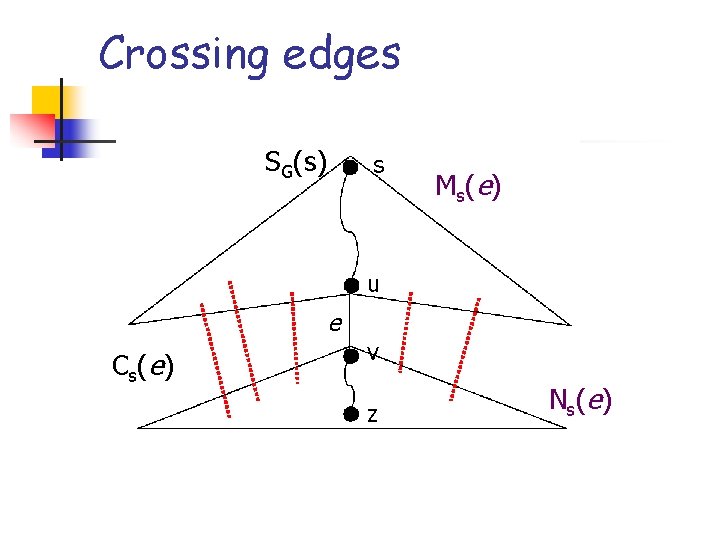
Crossing edges SG(s) s M s( e ) u e C s( e ) v z N s( e )
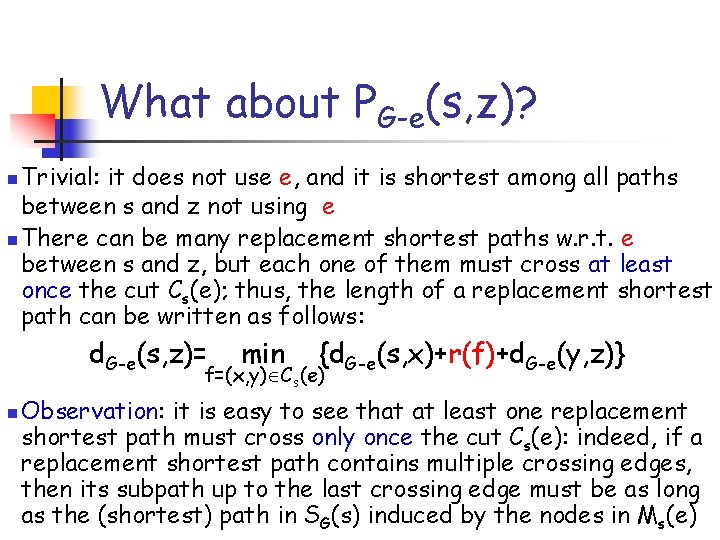
What about PG-e(s, z)? Trivial: it does not use e, and it is shortest among all paths between s and z not using e n There can be many replacement shortest paths w. r. t. e between s and z, but each one of them must cross at least once the cut Cs(e); thus, the length of a replacement shortest path can be written as follows: n d. G-e(s, z)= min {d. G-e(s, x)+r(f)+d. G-e(y, z)} f=(x, y) Cs(e) n Observation: it is easy to see that at least one replacement shortest path must cross only once the cut Cs(e): indeed, if a replacement shortest path contains multiple crossing edges, then its subpath up to the last crossing edge must be as long as the (shortest) path in SG(s) induced by the nodes in Ms(e)
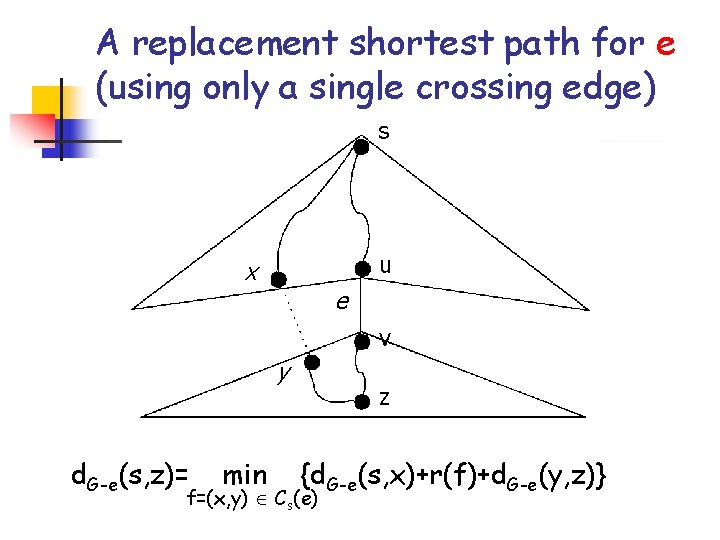
A replacement shortest path for e (using only a single crossing edge) s u x e v y d. G-e(s, z)= min z {d. G-e(s, x)+r(f)+d. G-e(y, z)} f=(x, y) Cs(e)
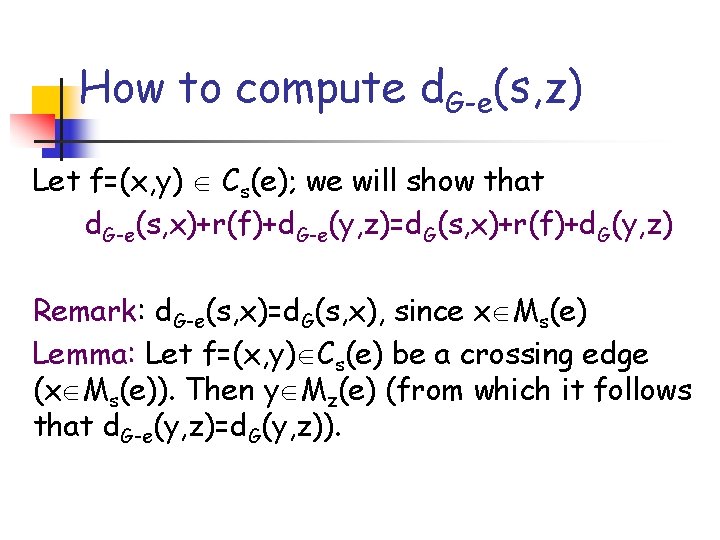
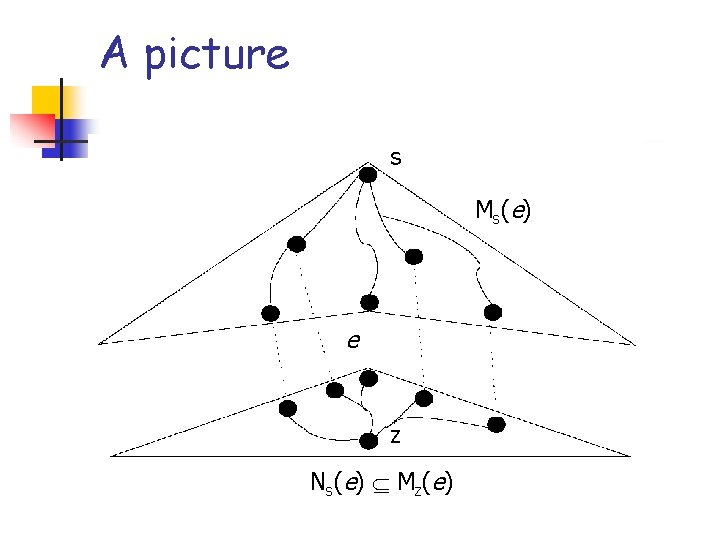
How to compute d. G-e(s, z) Let f=(x, y) Cs(e); we will show that d. G-e(s, x)+r(f)+d. G-e(y, z)=d. G(s, x)+r(f)+d. G(y, z) Remark: d. G-e(s, x)=d. G(s, x), since x Ms(e) Lemma: Let f=(x, y) Cs(e) be a crossing edge (x Ms(e)). Then y Mz(e) (from which it follows that d. G-e(y, z)=d. G(y, z)).
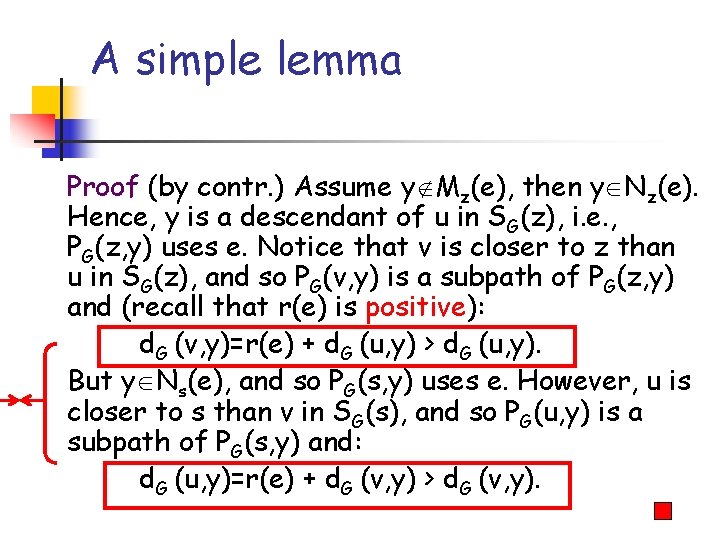
A simple lemma Proof (by contr. ) Assume y Mz(e), then y Nz(e). Hence, y is a descendant of u in SG(z), i. e. , PG(z, y) uses e. Notice that v is closer to z than u in SG(z), and so PG(v, y) is a subpath of PG(z, y) and (recall that r(e) is positive): d. G (v, y)=r(e) + d. G (u, y) > d. G (u, y). But y Ns(e), and so PG(s, y) uses e. However, u is closer to s than v in SG(s), and so PG(u, y) is a subpath of PG(s, y) and: d. G (u, y)=r(e) + d. G (v, y) > d. G (v, y).
A picture s M s( e ) e z N s( e ) M z( e )
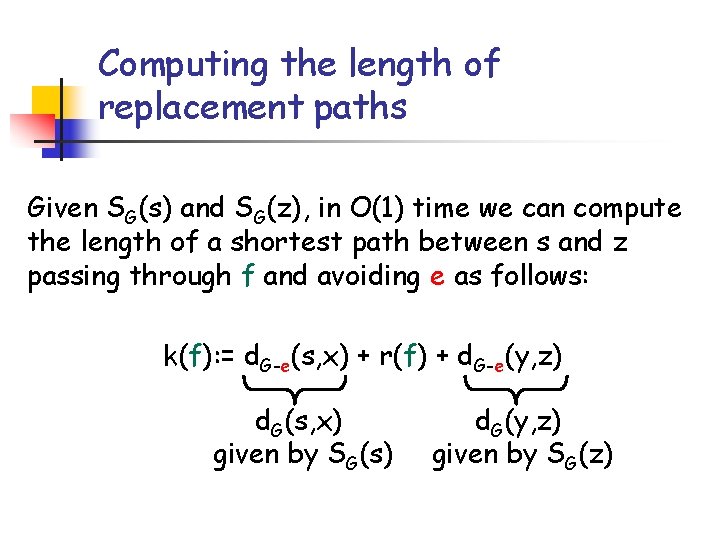
Computing the length of replacement paths Given SG(s) and SG(z), in O(1) time we can compute the length of a shortest path between s and z passing through f and avoiding e as follows: k(f): = d. G-e(s, x) + r(f) + d. G-e(y, z) d. G(s, x) given by SG(s) d. G(y, z) given by SG(z)
A corresponding algorithm Step 1: Compute SG(s) and SG(z) (assume that both contain a same PG(s, z)) Step 2: e PG(s, z) check all the crossing edges in Cs(e), and take the minimum w. r. t. the key k. Time complexity Step 1: O(m + n log n) time Step 2: O(m) crossing edges for each of the O(n) edges on PG(s, z): since we can establish whether an edge of G is currently a crossing edge in O(1) time (it suffices to compute initially in O(n) time Ms(e) and Ns(e)), Step 2 costs O(mn) time Overall complexity: O(mn) time Improves on O(mn + n 2 log n) if m=o(n log n)

A more efficient solution: the Malik, Mittal and Gupta algorithm (1989) n n MMG have solved in O(m + n log n) time the following related problem: given a SP PG(s, z), compute its most vital edge, namely an edge whose removal induces the worst (i. e. , longest) replacement shortest path between s and z. Their approach computes efficiently all the replacement shortest paths between s and z… …but this is exactly what we are looking for in our VCG-mechanism!
The MMG algorithm at work The basic idea of the algorithm is that when an edge e on PG(s, z) is considered, then we have a priority queue H containing the set of nodes in Ns(e); with each node y H remains associated a key k(y) and a corresponding crossing edge, defined as follows: k(y) = min {d. G(s, x)+r(x, y)+d. G(y, z)} (x, y) E, x Ms(e) k(y) is the length of a SP in G-e from s to z passing through node y, and so the minimum key is associated with a replacement shortest path for e
The MMG algorithm at work (2) n n Initially, H =V, and k(y)=+ for each y V Let PG(s, z) = {e 1, e 2, …, eq}, and consider these edges one after the other. When edge ei is considered, modify H as follows: n n n Remove from H all the nodes in Ws(ei)=Ns(ei-1)Ns(ei) (for i=1, set Ns(ei-1)=V) Consider all the edges (x, y) s. t. x Ws(ei) and y H (these are new crossing edges), and compute k’(y)=d. G(s, x)+r(x, y)+d. G(y, z). If k’(y)<k(y), decrease k(y) to k’(y), and update the corresponding crossing edge to (x, y) Then, find the minimum in H w. r. t. k, which returns the length of a replacement shortest path for ei (i. e. , d. G-ei(s, z)), along with the selected crossing edge
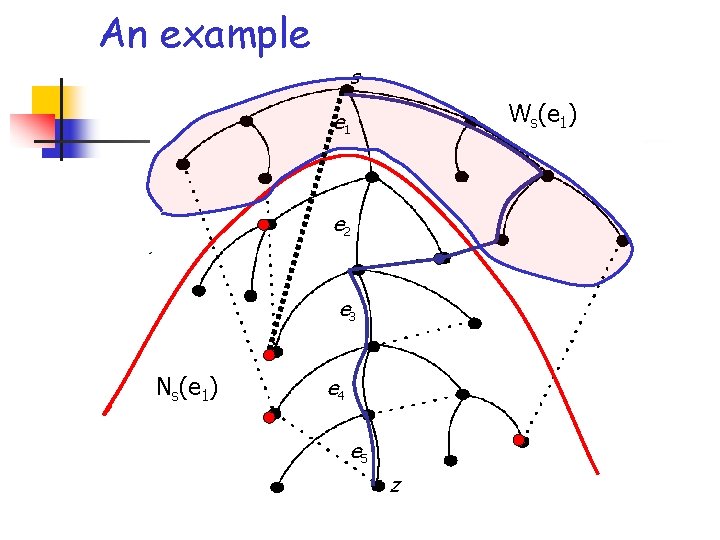
An example s Ws(e 1) e 1 e 2 e 3 Ns(e 1) e 4 e 5 z
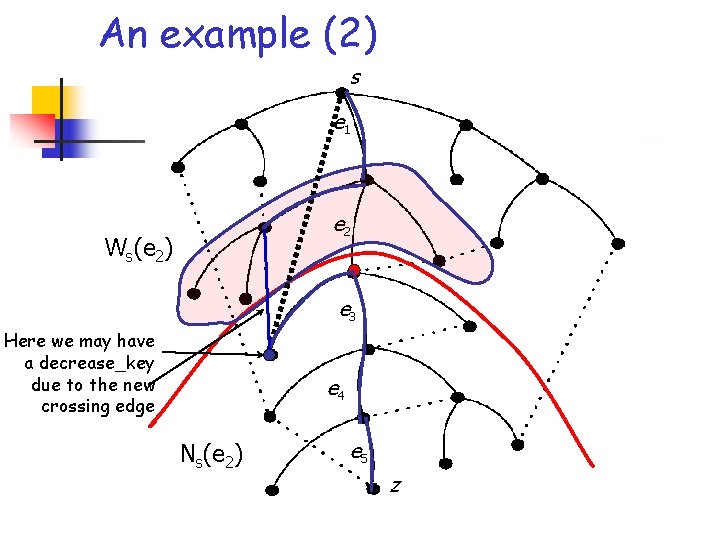
An example (2) s e 1 e 2 Ws(e 2) e 3 Here we may have a decrease_key due to the new crossing edge e 4 Ns(e 2) e 5 z
Time complexity of MMG Theorem: Given a shortest path between two nodes s and z in a graph G with n vertices and m edges, all the replacement shortest paths between s and z can be computed in O(m + n log n) time.
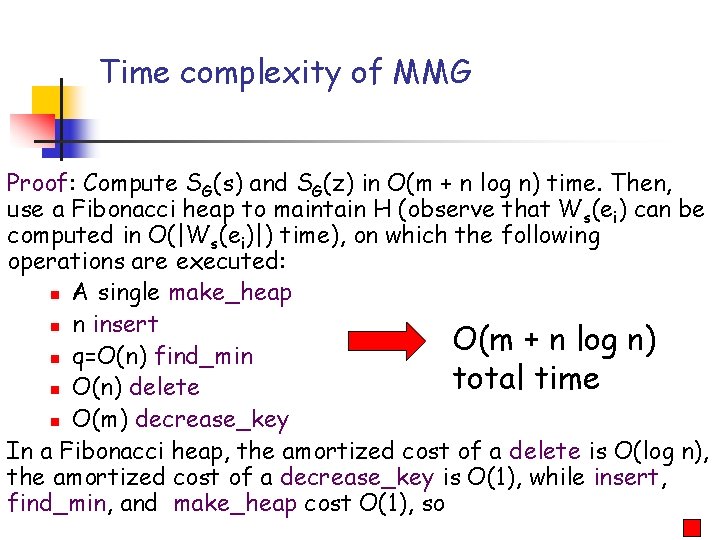
Time complexity of MMG Proof: Compute SG(s) and SG(z) in O(m + n log n) time. Then, use a Fibonacci heap to maintain H (observe that Ws(ei) can be computed in O(|Ws(ei)|) time), on which the following operations are executed: n A single make_heap n n insert O(m + n log n) n q=O(n) find_min total time n O(n) delete n O(m) decrease_key In a Fibonacci heap, the amortized cost of a delete is O(log n), the amortized cost of a decrease_key is O(1), while insert, find_min, and make_heap cost O(1), so

Plugging-in the MMG algorithm into the VCG-mechanism Corollary There exists a VCG-mechanism for the privateedge SP problem running in O(m + n log n) time. Proof. Running time for the mechanism’s algorithm: O(m + n log n) (Dijkstra). Running time for computing the payments: O(m + n log n), by applying MMG to compute all the distances d. G-e(s, z).
- Slides: 27