
The Shona People Shona People Fast Facts Shona

- Slides: 13
The Shona People
Shona People Fast Facts • Shona people gained independence in 1980 with the birth of the nation-state Zimbabwe. Until then they were defeated by Europeans and other African ethnic groups. • The mbira is an important traditional instrument – players see it as a close friend. • Mbira music are part of rituals of spirit possessions. • Music played an important role in the war of liberation. • Mbira music connects the Shona people with their ancestral spirits.
A Little History • Around 1900, English-speaking settlers pushed their culture and economies upon the Shona people. • The settlers left the Shonas impoverished, and hated and made fun of African culture, to the point the people doubted their identities. • Spirit mediums (those who allowed their bodies to be taken over by spiritual ancestors) were leaders in the war against the settlers. • A war of liberation occurred between 1966 -1979 and gave birth to Zimbabwe. • Today they populate most of Zimbabwe, trade with the Arab, Persian, and Indian people, and create amazing architectures. • Mbira and Chimurenga music were very important during the war; it spread secret messages and the mbira became an important symbol of cultural identity.
So what about these spirits? • There are four classes of spirits: • Spirits of chiefs • Can possess one person for the good of the community. • Family members • Nonrelatives or animals • Witches • Spirits are invisible; however, they still use their senses, feel emotions, and help their descendents. • Mbira music helps connect the living with their ancestors, along with dancing. • Humans and spirits communicate by possession trances, letting the spirit live in them and guide them for a short period of time. • These are done as an all-night, family-based, communal rituals.
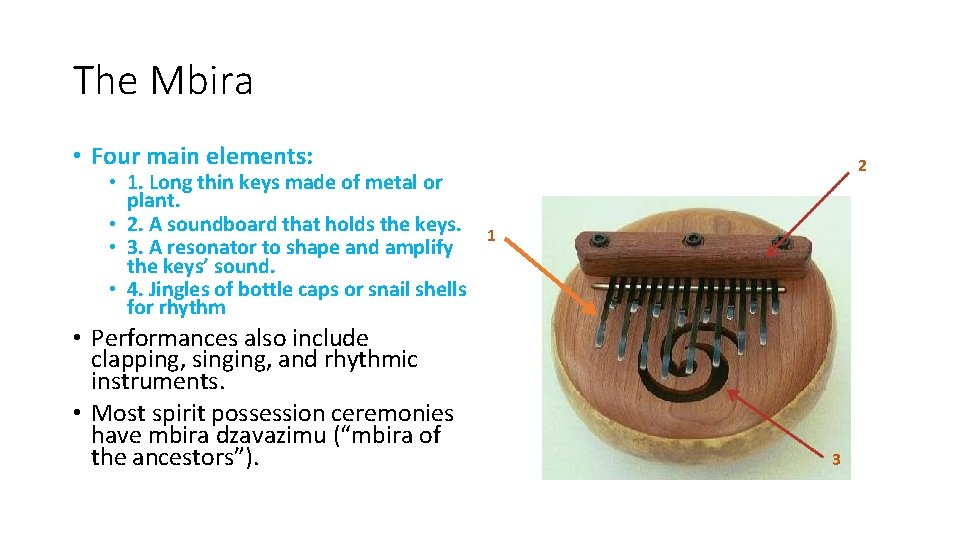
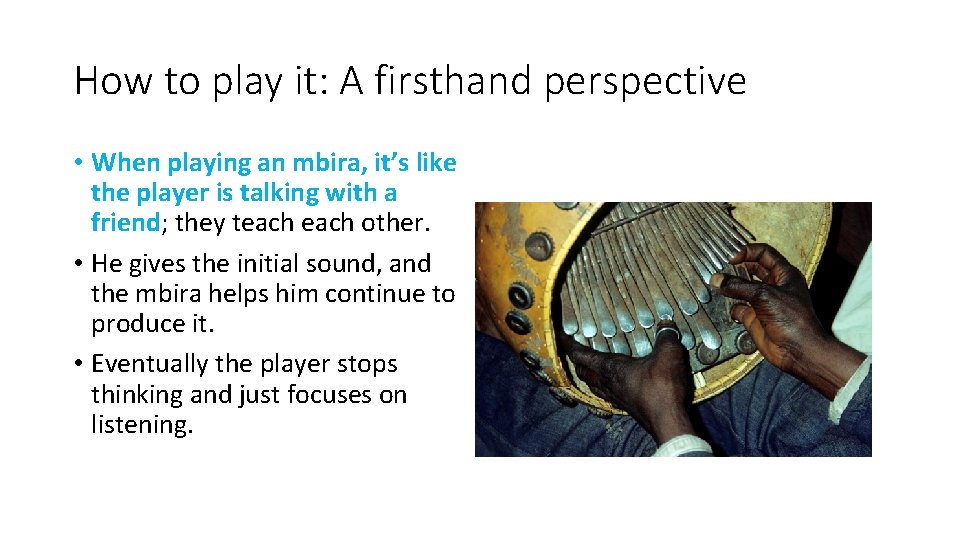
The Mbira • Four main elements: • 1. Long thin keys made of metal or plant. • 2. A soundboard that holds the keys. • 3. A resonator to shape and amplify the keys’ sound. • 4. Jingles of bottle caps or snail shells for rhythm • Performances also include clapping, singing, and rhythmic instruments. • Most spirit possession ceremonies have mbira dzavazimu (“mbira of the ancestors”). 2 1 3
How to play it: A firsthand perspective • When playing an mbira, it’s like the player is talking with a friend; they teach other. • He gives the initial sound, and the mbira helps him continue to produce it. • Eventually the player stops thinking and just focuses on listening.
The Role of Music in the Ceremony • Ancestral spirits love to hear their favorite mbira pieces, including this one. • Music acts as an offering that calls them near. • This makes it easy to keep a group of songs alive for centuries. • They are as complicated and deep as a symphony. • Along with the mbira, there are special singing styles including: • Mahonyera (vocables, or nonsense syllables). • Kudeketera (poetry). • Huro (yodeling).
Nhemamusasa (Cutting Branches for Shelter) • This song is one of the oldest and most important songs of the Shona people. • It is played for Chaminuka, a spirit who protects the entire Shona nation. • This is a song for war. • The Shona would march to war to stop soldiers, and cut branches to make shelter. • The song is very powerful, which makes it a great offering during the spirit ceremonies.
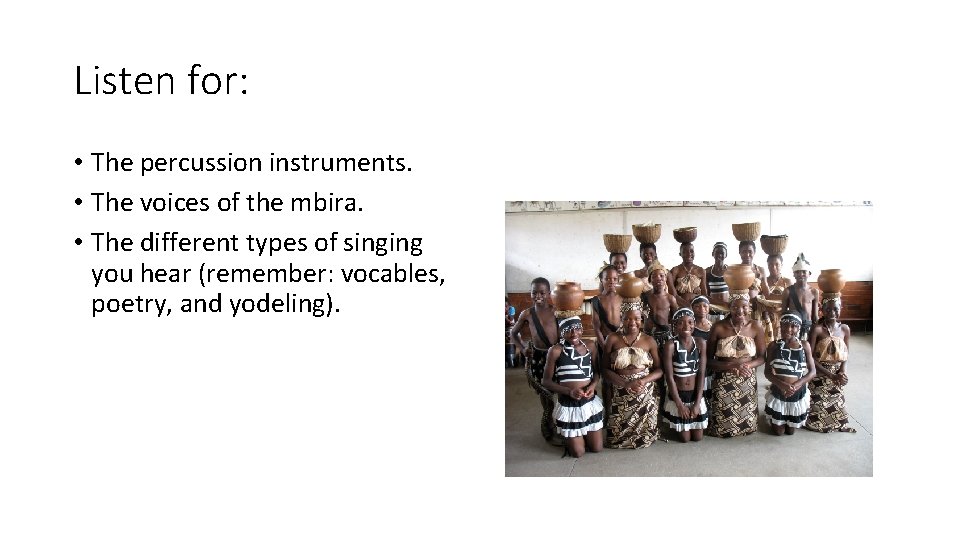
Listen for: • The percussion instruments. • The voices of the mbira. • The different types of singing you hear (remember: vocables, poetry, and yodeling).
Chimurenga Music • • Modern traditional music with ties to the mbira. Literally means “struggle” music. Recreational music for dance parties and comments on social issues. Chimurenga helps us realize that tradition doesn’t have to be boring, not important, or not relevant to us today. • How is it doing this? • Do you believe that tradition is still important to us today? • In the 1970 s, this music became popular to Africans despite white censorship because it has codes to speak to the African people. • Championed by Thomas Mapfumo and later recorded by Bhundu Boys and Stella Chiweshe
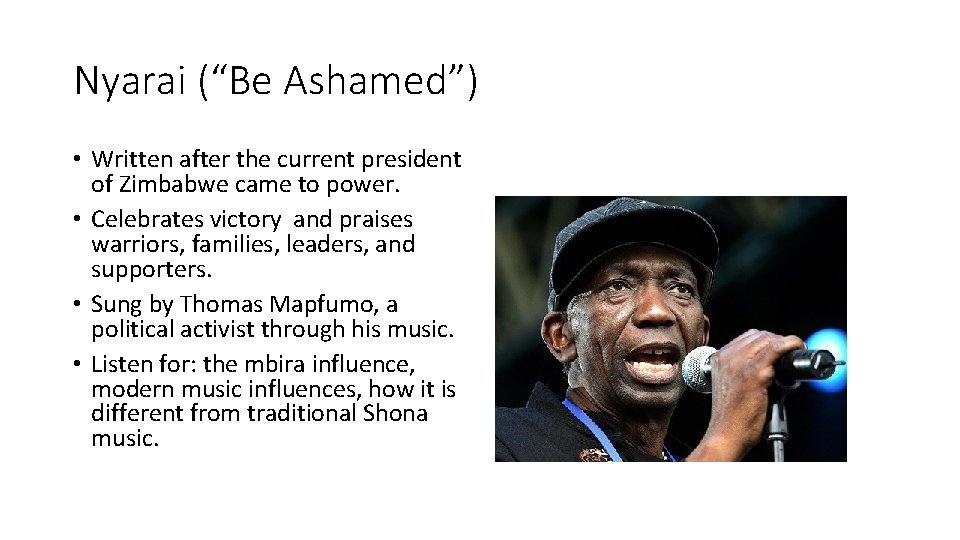
Nyarai (“Be Ashamed”) • Written after the current president of Zimbabwe came to power. • Celebrates victory and praises warriors, families, leaders, and supporters. • Sung by Thomas Mapfumo, a political activist through his music. • Listen for: the mbira influence, modern music influences, how it is different from traditional Shona music.
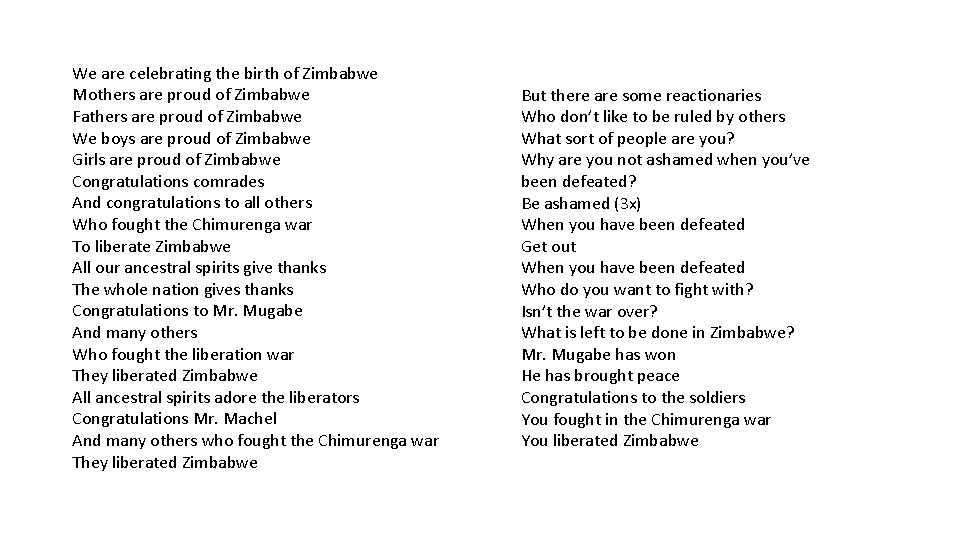
We are celebrating the birth of Zimbabwe Mothers are proud of Zimbabwe Fathers are proud of Zimbabwe We boys are proud of Zimbabwe Girls are proud of Zimbabwe Congratulations comrades And congratulations to all others Who fought the Chimurenga war To liberate Zimbabwe All our ancestral spirits give thanks The whole nation gives thanks Congratulations to Mr. Mugabe And many others Who fought the liberation war They liberated Zimbabwe All ancestral spirits adore the liberators Congratulations Mr. Machel And many others who fought the Chimurenga war They liberated Zimbabwe But there are some reactionaries Who don’t like to be ruled by others What sort of people are you? Why are you not ashamed when you’ve been defeated? Be ashamed (3 x) When you have been defeated Get out When you have been defeated Who do you want to fight with? Isn’t the war over? What is left to be done in Zimbabwe? Mr. Mugabe has won He has brought peace Congratulations to the soldiers You fought in the Chimurenga war You liberated Zimbabwe
Exit slip: How is mbira music and Chimurenga music affect your previous beliefs about African music?