
The Shape of the Earth Oblate Spheroid Blue
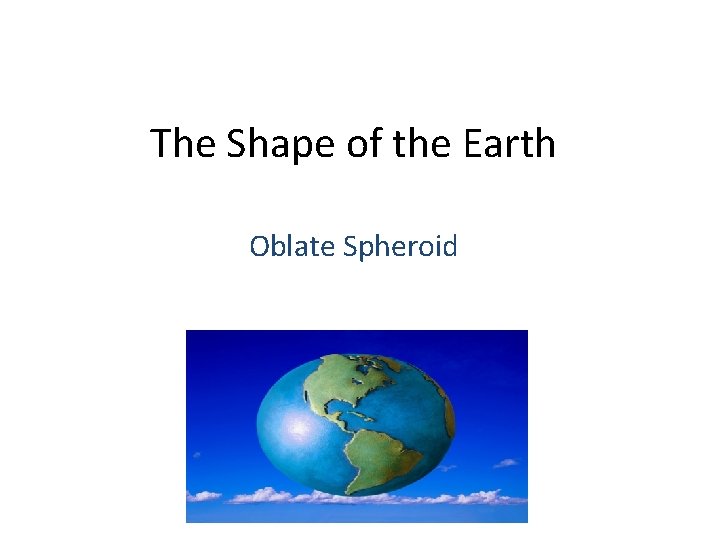
The Shape of the Earth Oblate Spheroid
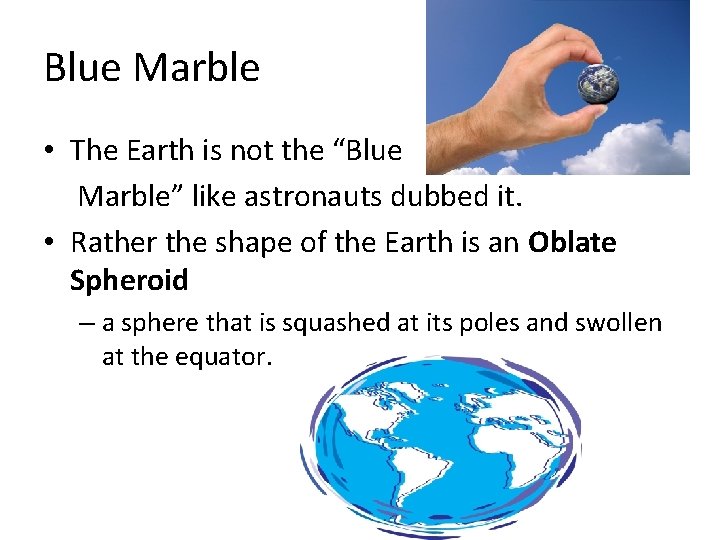
Blue Marble • The Earth is not the “Blue Marble” like astronauts dubbed it. • Rather the shape of the Earth is an Oblate Spheroid – a sphere that is squashed at its poles and swollen at the equator.

Earth’s Distances • The equatorial circumference is about 40, 076 km. • The polar circumference is slightly shorter at 40, 008 km. • The radius of Earth's center to sea level is roughly 21 kilometers (13 miles) greater at the equator than at the poles.

Why is it shaped like this? • The spinning Earth has a bit of plasticity that allows the shape to deform very slightly. • Our globe, however, is not even a perfect oblate spheroid, because mass is distributed unevenly within the planet. • The greater a concentration of mass is, the stronger its gravitational pull, creating bumps around the globe.

The earth’s bulge Equatorial bulge.

Earth’s Changing Shape • Earth's shape also changes over time. • Mass shifts around inside the planet, altering those gravitational anomalies. • Mountains and valleys emerge and disappear due to plate tectonics. • The gravitational pull of the moon and sun causes tides as well.
Stabilizing Earth • To even out Earth's imbalanced distribution of mass and stabilize its spin, the entire surface of the Earth will rotate and try to redistribute mass along the equator, a process called true polar wandering.
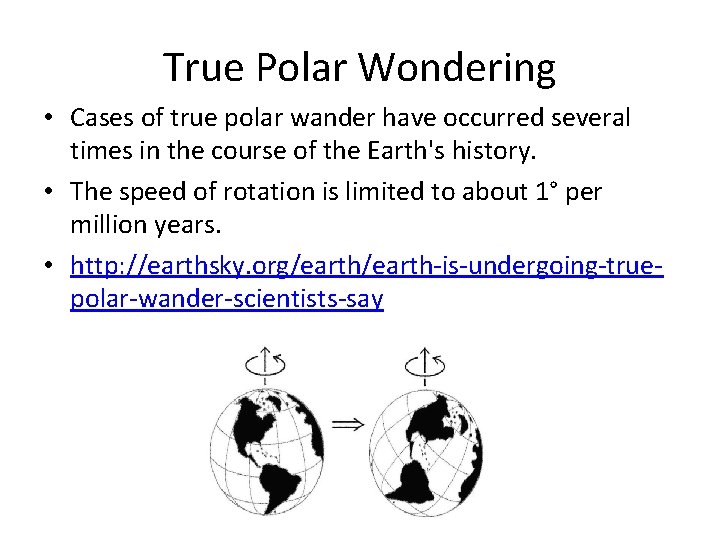
True Polar Wondering • Cases of true polar wander have occurred several times in the course of the Earth's history. • The speed of rotation is limited to about 1° per million years. • http: //earthsky. org/earth-is-undergoing-truepolar-wander-scientists-say
- Slides: 8