
The Shape and Fate of the Universe Assumptions
- Slides: 21
The Shape and Fate of the Universe • • • Assumptions in cosmology Olber’s paradox Expansion of the Universe Curvature of the Universe Fate of the Universe
Assumptions in Cosmology Copernican principle: – We do not occupy a special place. – There are no special places. – The universe is homogeneous if viewed at sufficently large scales. – The laws of physics are the same everywhere.
Implications of the Copernican Principle • The average density of matter and energy is the same throughout the Universe. • The same Hubble expansion law is seen for all observers anywhere in the Universe. • The curvature of the Universe is the same everywhere.
How can we test the Copernican principle? • Does the Universe look the same in all directions? (Isotropy) • Are the spectral lines from atoms the same in distant galaxies? • Do the same laws of gravity apply in other galaxies?
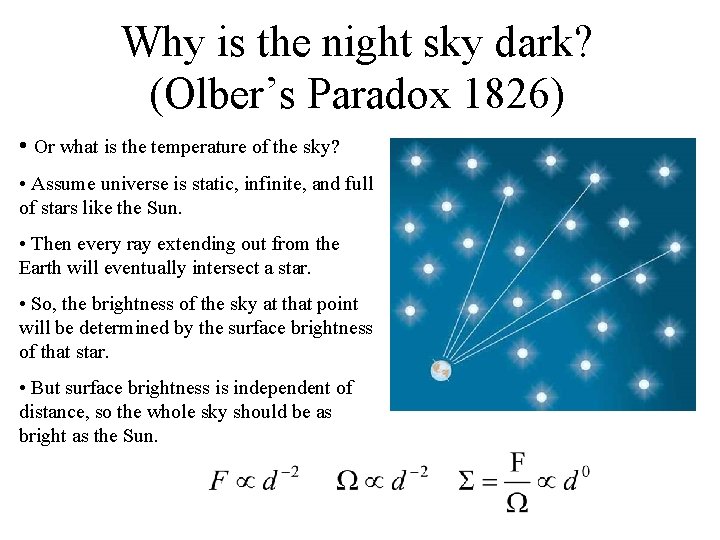
Why is the night sky dark? (Olber’s Paradox 1826) • Or what is the temperature of the sky? • Assume universe is static, infinite, and full of stars like the Sun. • Then every ray extending out from the Earth will eventually intersect a star. • So, the brightness of the sky at that point will be determined by the surface brightness of that star. • But surface brightness is independent of distance, so the whole sky should be as bright as the Sun.
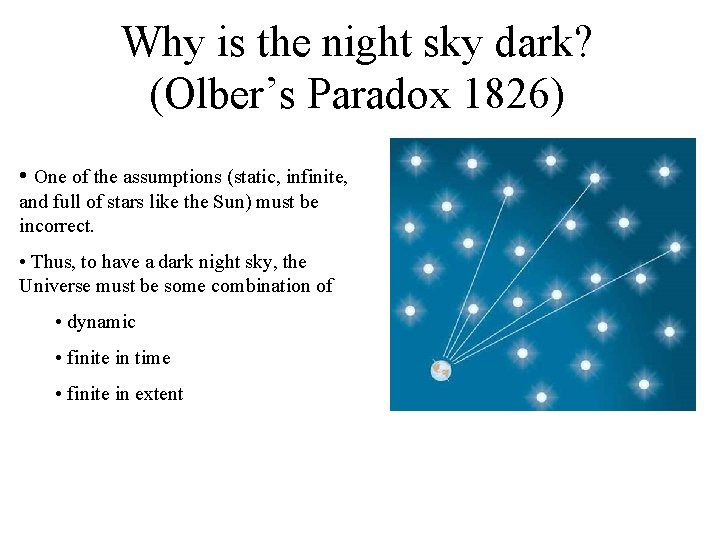
Why is the night sky dark? (Olber’s Paradox 1826) • One of the assumptions (static, infinite, and full of stars like the Sun) must be incorrect. • Thus, to have a dark night sky, the Universe must be some combination of • dynamic • finite in time • finite in extent
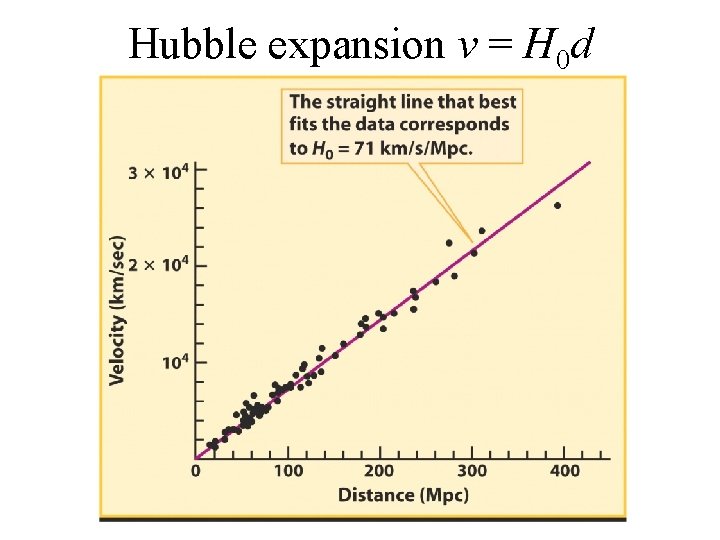
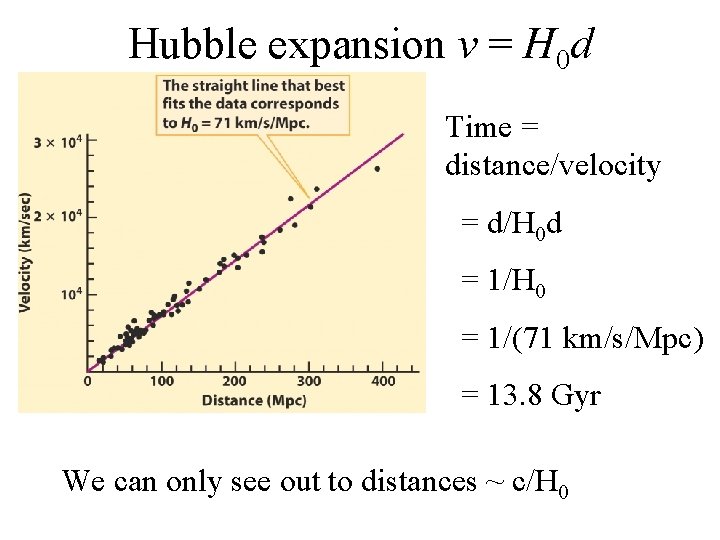
Hubble expansion v = H 0 d
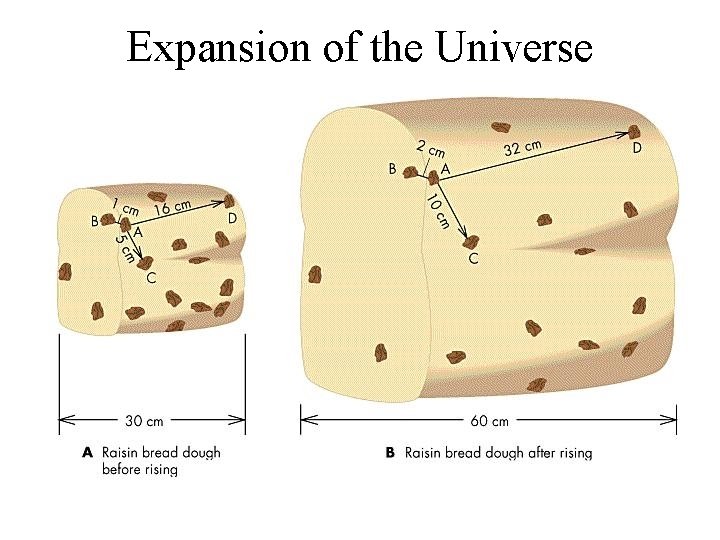
Expansion of the Universe
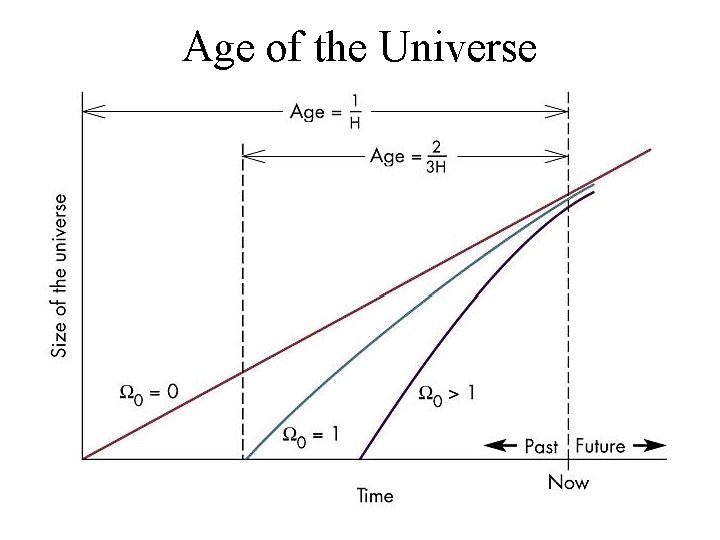
Hubble expansion v = H 0 d Time = distance/velocity = d/H 0 d = 1/H 0 = 1/(71 km/s/Mpc) = 13. 8 Gyr We can only see out to distances ~ c/H 0
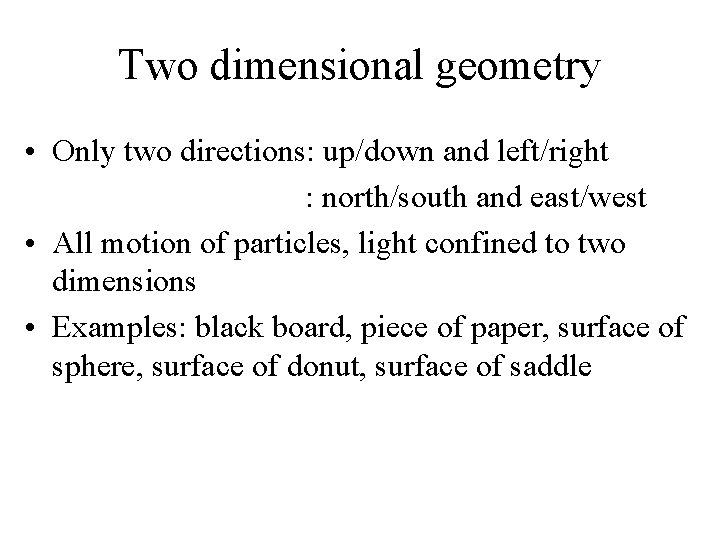
Two dimensional geometry • Only two directions: up/down and left/right : north/south and east/west • All motion of particles, light confined to two dimensions • Examples: black board, piece of paper, surface of sphere, surface of donut, surface of saddle
Geometry • How are the diameter and circumference of a circle related? • What is the sum of all of the angles in a triangle?
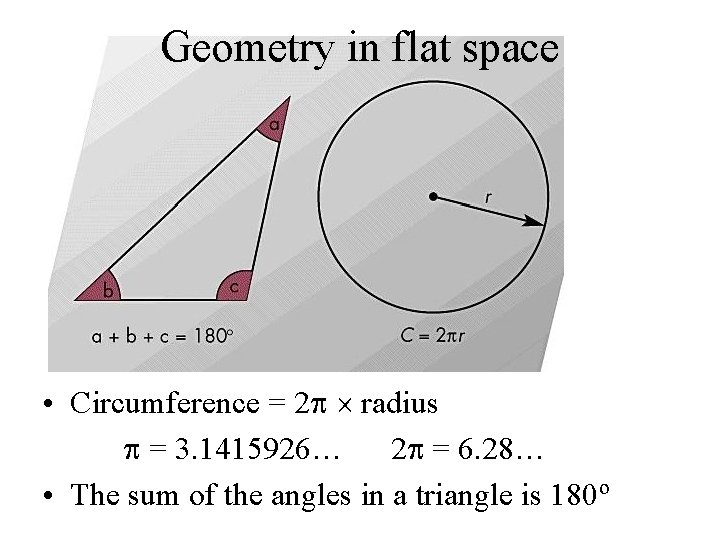
Geometry in flat space • Circumference = 2 radius = 3. 1415926… 2 = 6. 28… • The sum of the angles in a triangle is 180º
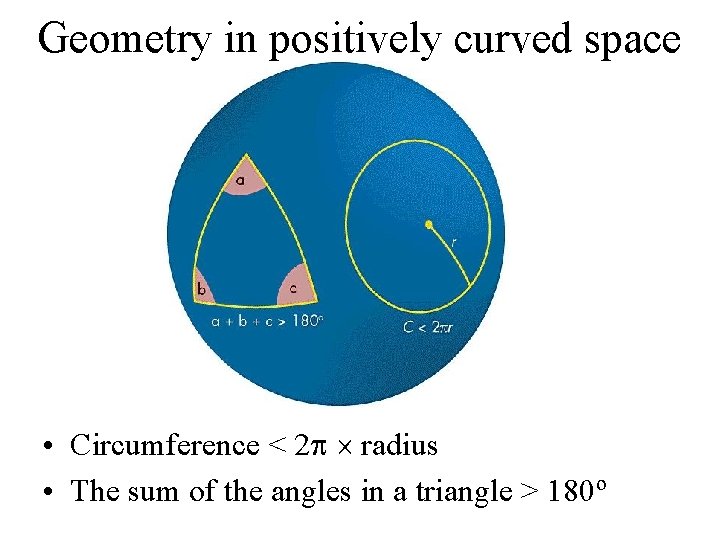
Geometry in positively curved space • Circumference < 2 radius • The sum of the angles in a triangle > 180º
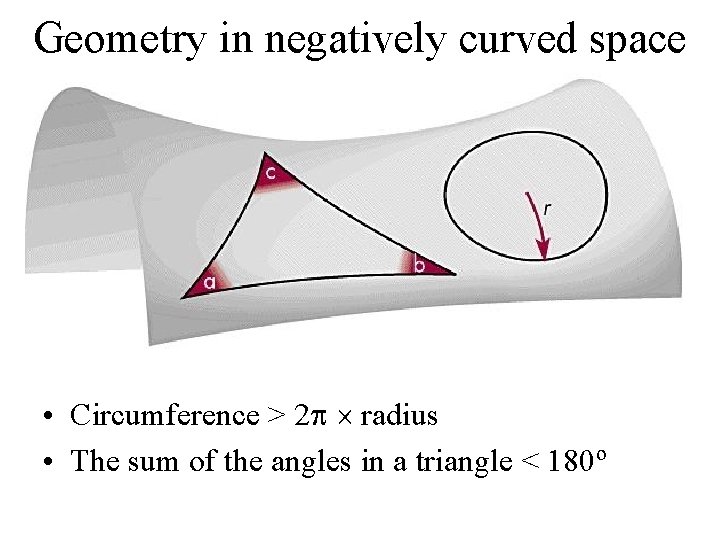
Geometry in negatively curved space • Circumference > 2 radius • The sum of the angles in a triangle < 180º
Curvature of the Universe The curvature of the Universe is determined by: • the density of matter and energy – higher density produces positive curvature • the expansion of the Universe – more rapid expansion produces negative curvature
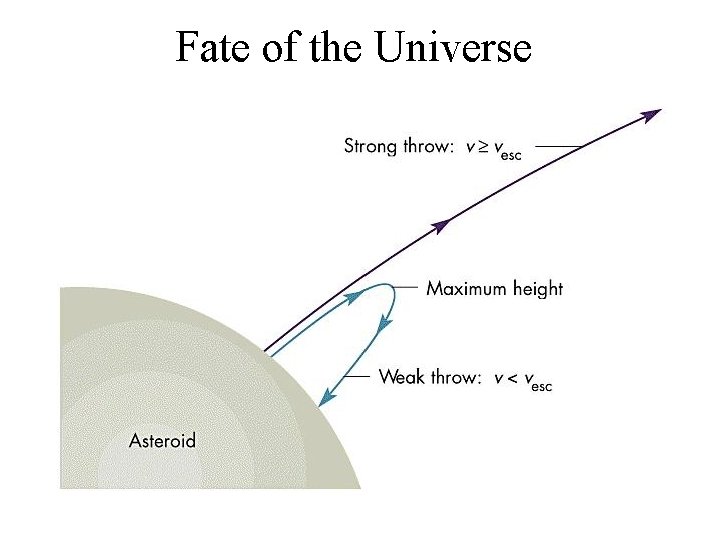
Fate of the Universe
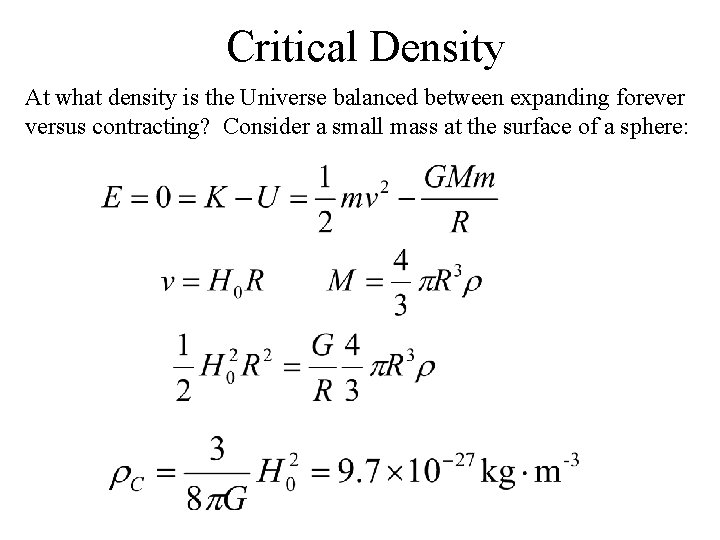
Critical Density At what density is the Universe balanced between expanding forever versus contracting? Consider a small mass at the surface of a sphere:
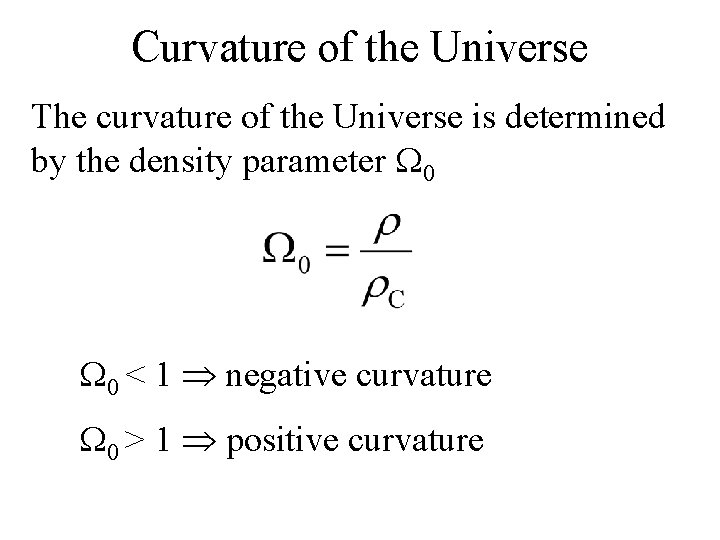
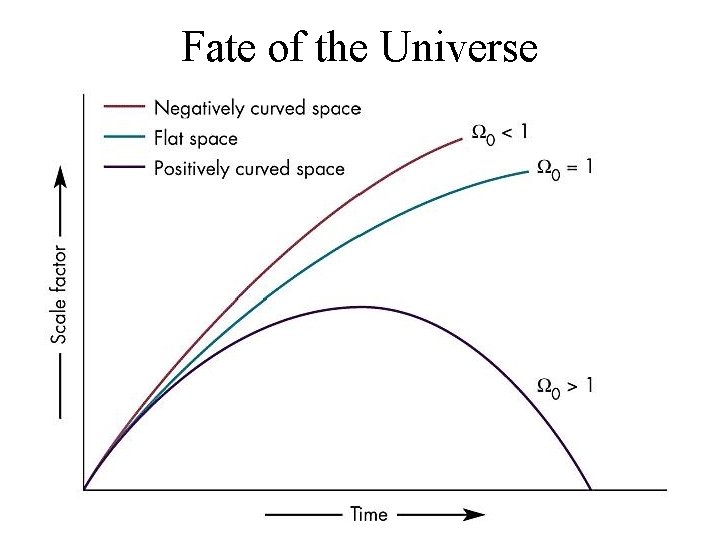
Curvature of the Universe The curvature of the Universe is determined by the density parameter 0 0 < 1 negative curvature 0 > 1 positive curvature
Fate of the Universe
Age of the Universe
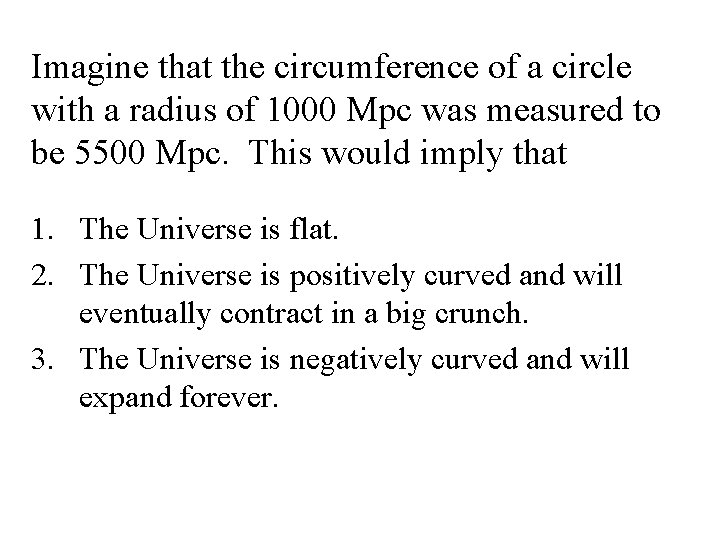
Imagine that the circumference of a circle with a radius of 1000 Mpc was measured to be 5500 Mpc. This would imply that 1. The Universe is flat. 2. The Universe is positively curved and will eventually contract in a big crunch. 3. The Universe is negatively curved and will expand forever.