
The Seven Steps in Cape Identity A matrix
- Slides: 25
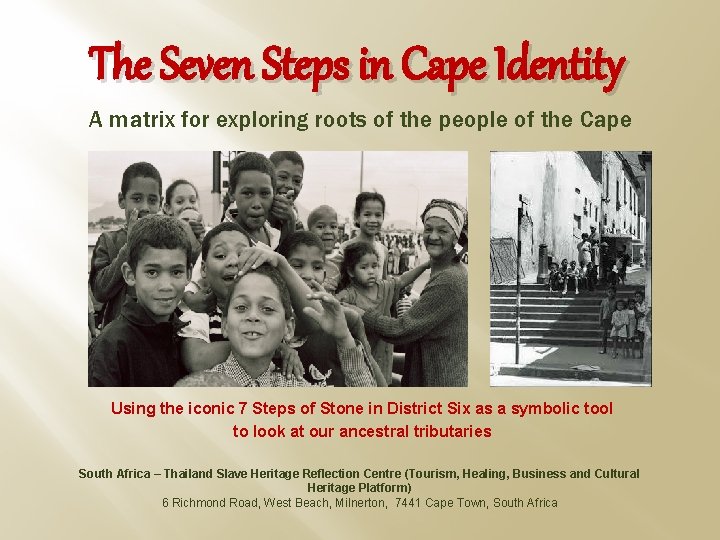
The Seven Steps in Cape Identity A matrix for exploring roots of the people of the Cape Using the iconic 7 Steps of Stone in District Six as a symbolic tool to look at our ancestral tributaries South Africa – Thailand Slave Heritage Reflection Centre (Tourism, Healing, Business and Cultural Heritage Platform) 6 Richmond Road, West Beach, Milnerton, 7441 Cape Town, South Africa
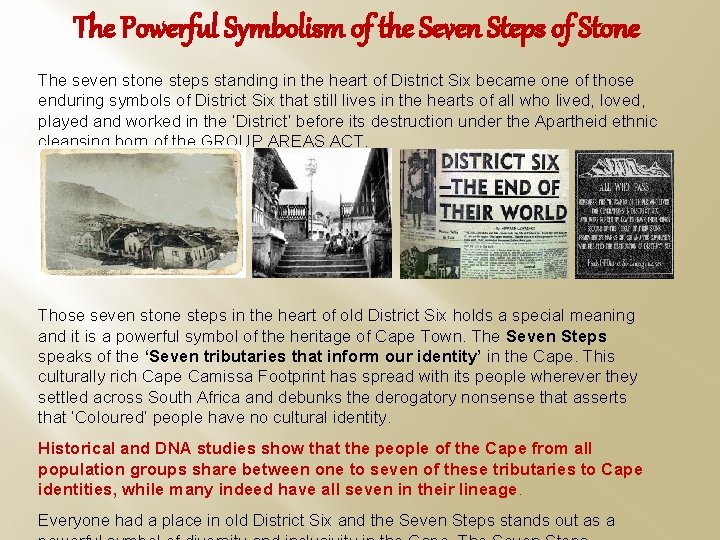
The Powerful Symbolism of the Seven Steps of Stone The seven stone steps standing in the heart of District Six became one of those enduring symbols of District Six that still lives in the hearts of all who lived, loved, played and worked in the ‘District’ before its destruction under the Apartheid ethnic cleansing born of the GROUP AREAS ACT. Those seven stone steps in the heart of old District Six holds a special meaning and it is a powerful symbol of the heritage of Cape Town. The Seven Steps speaks of the ‘Seven tributaries that inform our identity’ in the Cape. This culturally rich Cape Camissa Footprint has spread with its people wherever they settled across South Africa and debunks the derogatory nonsense that asserts that ‘Coloured’ people have no cultural identity. Historical and DNA studies show that the people of the Cape from all population groups share between one to seven of these tributaries to Cape identities, while many indeed have all seven in their lineage. Everyone had a place in old District Six and the Seven Steps stands out as a
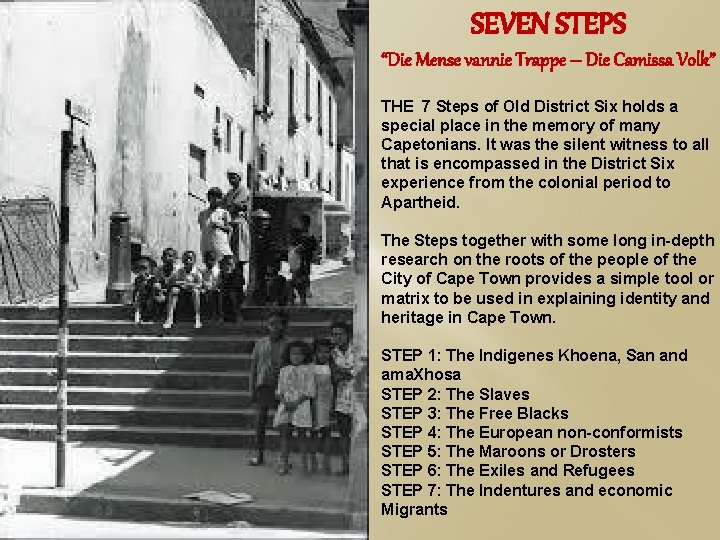
SEVEN STEPS “Die Mense vannie Trappe – Die Camissa Volk” THE 7 Steps of Old District Six holds a special place in the memory of many Capetonians. It was the silent witness to all that is encompassed in the District Six experience from the colonial period to Apartheid. The Steps together with some long in-depth research on the roots of the people of the City of Cape Town provides a simple tool or matrix to be used in explaining identity and heritage in Cape Town. STEP 1: The Indigenes Khoena, San and ama. Xhosa STEP 2: The Slaves STEP 3: The Free Blacks STEP 4: The European non-conformists STEP 5: The Maroons or Drosters STEP 6: The Exiles and Refugees STEP 7: The Indentures and economic Migrants
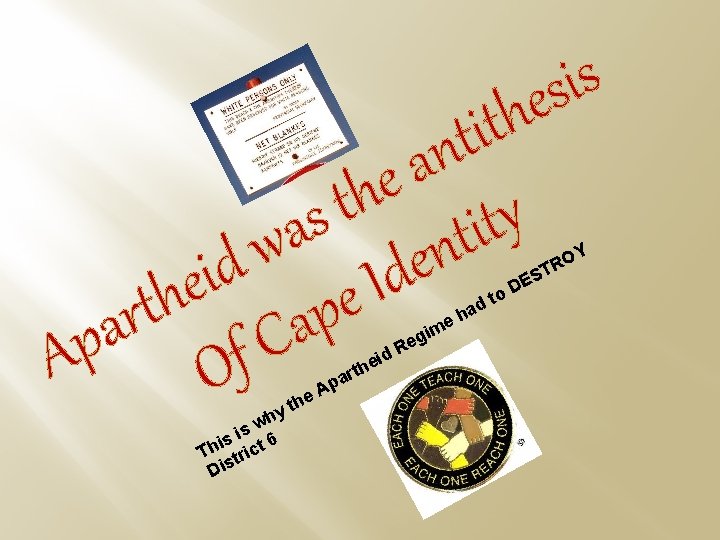
s i s e h t i t n a e h t y s t i a t w n e d i d I e h e t p r a a C p f A O e gim e d. R ei h t ar hy w is 6 s i Th trict Dis Ap e th dt a h E o. D S O TR Y
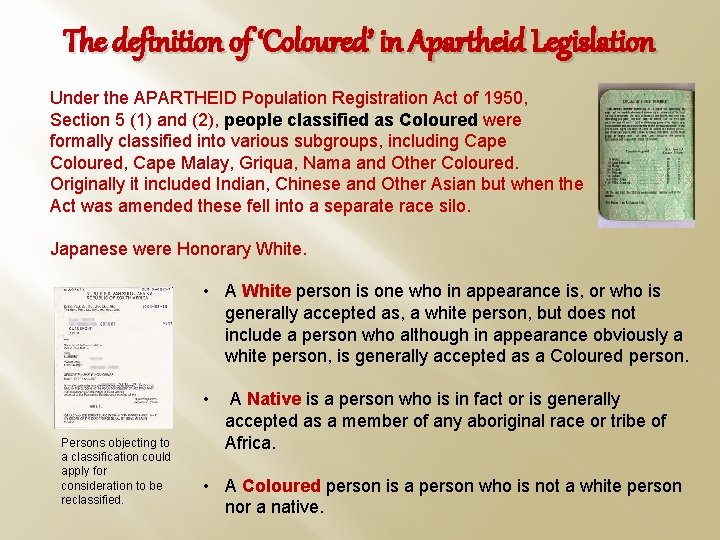
The definition of ‘Coloured’ in Apartheid Legislation Under the APARTHEID Population Registration Act of 1950, Section 5 (1) and (2), people classified as Coloured were formally classified into various subgroups, including Cape Coloured, Cape Malay, Griqua, Nama and Other Coloured. Originally it included Indian, Chinese and Other Asian but when the Act was amended these fell into a separate race silo. Japanese were Honorary White. • A White person is one who in appearance is, or who is generally accepted as, a white person, but does not include a person who although in appearance obviously a white person, is generally accepted as a Coloured person. Persons objecting to a classification could apply for consideration to be reclassified. • A Native is a person who is in fact or is generally accepted as a member of any aboriginal race or tribe of Africa. • A Coloured person is a person who is not a white person nor a native.
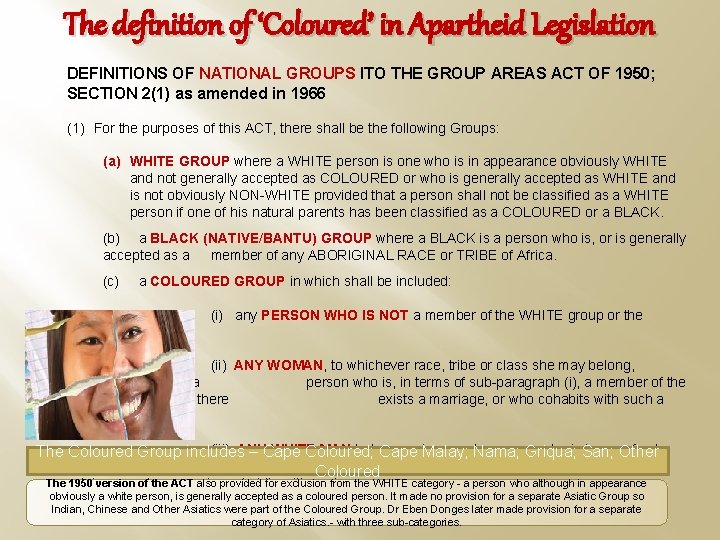
The definition of ‘Coloured’ in Apartheid Legislation DEFINITIONS OF NATIONAL GROUPS ITO THE GROUP AREAS ACT OF 1950; SECTION 2(1) as amended in 1966 (1) For the purposes of this ACT, there shall be the following Groups: (a) WHITE GROUP where a WHITE person is one who is in appearance obviously WHITE and not generally accepted as COLOURED or who is generally accepted as WHITE and is not obviously NON-WHITE provided that a person shall not be classified as a WHITE person if one of his natural parents has been classified as a COLOURED or a BLACK. (b) a BLACK (NATIVE/BANTU) GROUP where a BLACK is a person who is, or is generally accepted as a member of any ABORIGINAL RACE or TRIBE of Africa. (c) a COLOURED GROUP in which shall be included: (i) any PERSON WHO IS NOT a member of the WHITE group or the BLACK group; (ii) ANY WOMAN, to whichever race, tribe or class she may belong, between whom and a person who is, in terms of sub-paragraph (i), a member of the COLOURED group, there exists a marriage, or who cohabits with such a person. (iii) ANY WHITE MAN between whom and a woman who in terms of sub. The Coloured Group includes – Cape Coloured; Cape Malay; Nama; Griqua; San; Other paragraph (i) is a of the COLOURED group, there Coloured The exists a marriage, or who cohabits with such a woman. 1950 version of the ACT also provided for exclusion from the WHITE category - a person who although in appearance obviously a white person, is generally accepted as a coloured person. It made no provision for a separate Asiatic Group so Indian, Chinese and Other Asiatics were part of the Coloured Group. Dr Eben Donges later made provision for a separate category of Asiatics. - with three sub-categories.
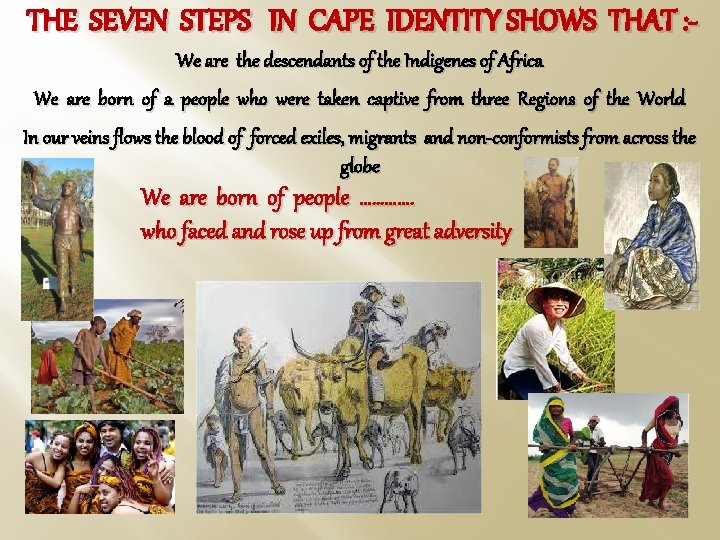
THE SEVEN STEPS IN CAPE IDENTITY SHOWS THAT : We are the descendants of the Indigenes of Africa We are born of a people who were taken captive from three Regions of the World In our veins flows the blood of forced exiles, migrants and non-conformists from across the globe We are born of people …………. who faced and rose up from great adversity .
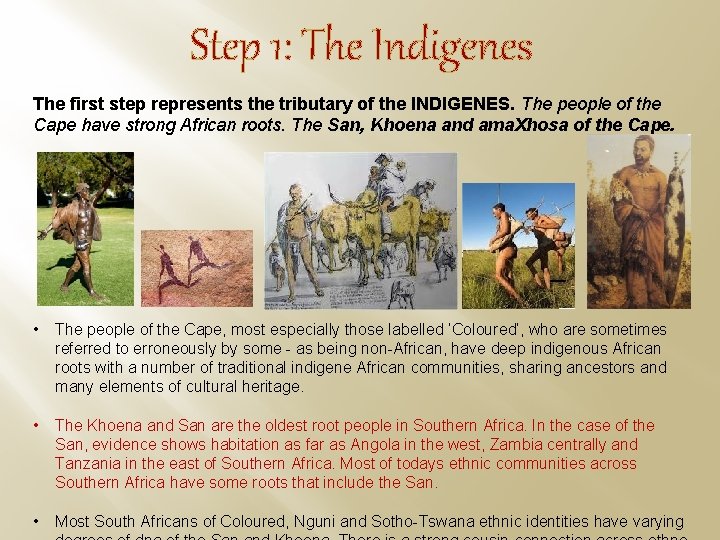
Step 1: The Indigenes The first step represents the tributary of the INDIGENES. The people of the Cape have strong African roots. The San, Khoena and ama. Xhosa of the Cape. • • • The people of the Cape, most especially those labelled ‘Coloured’, who are sometimes referred to erroneously by some - as being non-African, have deep indigenous African roots with a number of traditional indigene African communities, sharing ancestors and many elements of cultural heritage. The Khoena and San are the oldest root people in Southern Africa. In the case of the San, evidence shows habitation as far as Angola in the west, Zambia centrally and Tanzania in the east of Southern Africa. Most of todays ethnic communities across Southern Africa have some roots that include the San. Most South Africans of Coloured, Nguni and Sotho-Tswana ethnic identities have varying
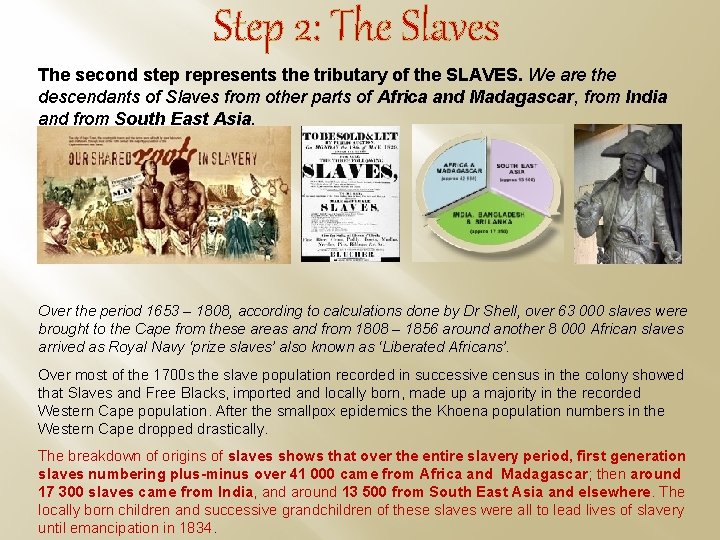
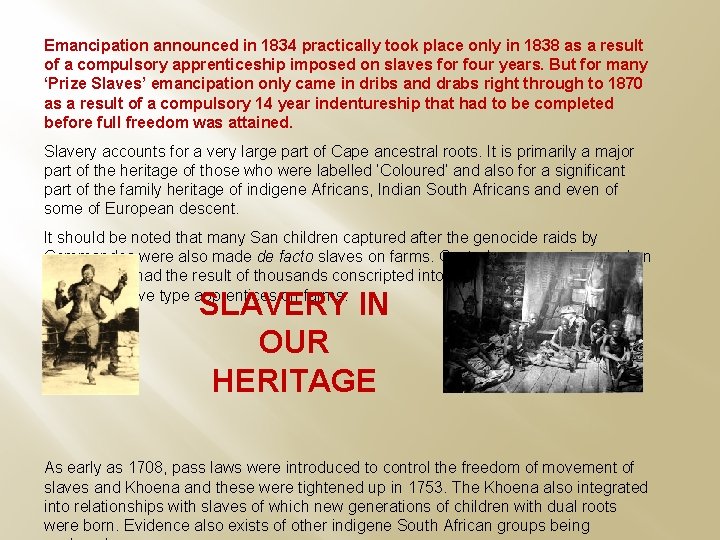
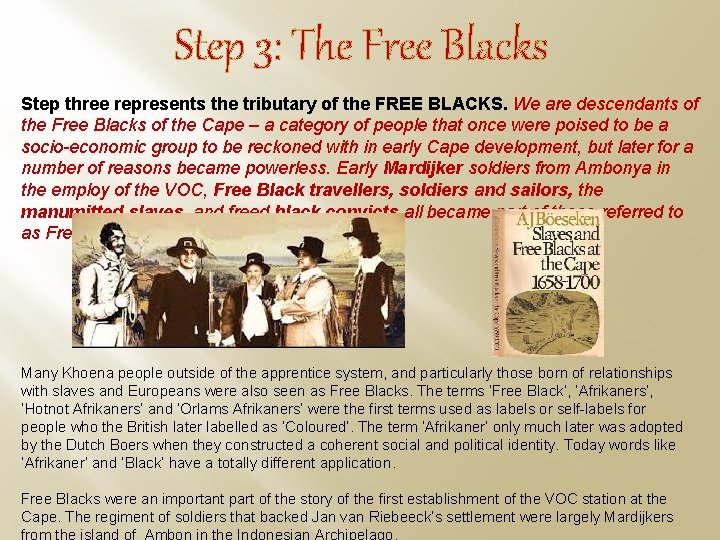
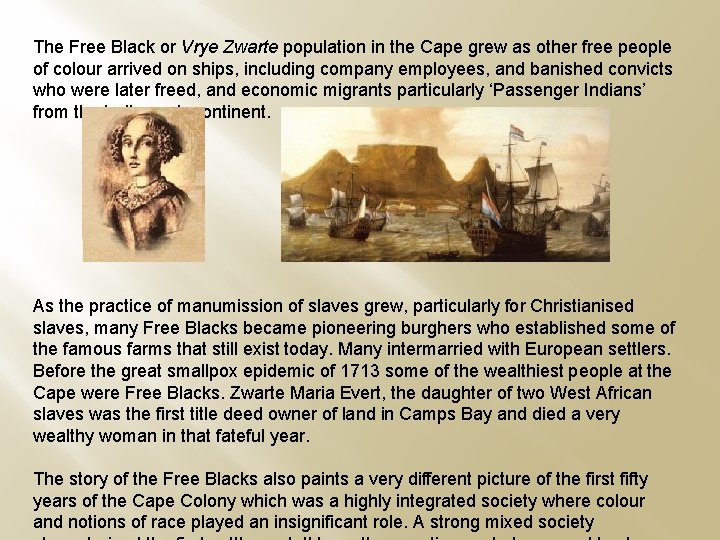
Step 2: The Slaves The second step represents the tributary of the SLAVES. We are the descendants of Slaves from other parts of Africa and Madagascar, from India and from South East Asia. Over the period 1653 – 1808, according to calculations done by Dr Shell, over 63 000 slaves were brought to the Cape from these areas and from 1808 – 1856 around another 8 000 African slaves arrived as Royal Navy ‘prize slaves’ also known as ‘Liberated Africans’. Over most of the 1700 s the slave population recorded in successive census in the colony showed that Slaves and Free Blacks, imported and locally born, made up a majority in the recorded Western Cape population. After the smallpox epidemics the Khoena population numbers in the Western Cape dropped drastically. The breakdown of origins of slaves shows that over the entire slavery period, first generation slaves numbering plus-minus over 41 000 came from Africa and Madagascar; then around 17 300 slaves came from India, and around 13 500 from South East Asia and elsewhere. The locally born children and successive grandchildren of these slaves were all to lead lives of slavery until emancipation in 1834.
Emancipation announced in 1834 practically took place only in 1838 as a result of a compulsory apprenticeship imposed on slaves for four years. But for many ‘Prize Slaves’ emancipation only came in dribs and drabs right through to 1870 as a result of a compulsory 14 year indentureship that had to be completed before full freedom was attained. Slavery accounts for a very large part of Cape ancestral roots. It is primarily a major part of the heritage of those who were labelled ‘Coloured’ and also for a significant part of the family heritage of indigene Africans, Indian South Africans and even of some of European descent. It should be noted that many San children captured after the genocide raids by Commandos were also made de facto slaves on farms. Control measures imposed on the Khoena, had the result of thousands conscripted into Militias and forced into becoming slave type apprentices on farms. SLAVERY IN OUR HERITAGE As early as 1708, pass laws were introduced to control the freedom of movement of slaves and Khoena and these were tightened up in 1753. The Khoena also integrated into relationships with slaves of which new generations of children with dual roots were born. Evidence also exists of other indigene South African groups being
Step 3: The Free Blacks Step three represents the tributary of the FREE BLACKS. We are descendants of the Free Blacks of the Cape – a category of people that once were poised to be a socio-economic group to be reckoned with in early Cape development, but later for a number of reasons became powerless. Early Mardijker soldiers from Ambonya in the employ of the VOC, Free Black travellers, soldiers and sailors, the manumitted slaves, and freed black convicts all became part of those referred to as Free Blacks. Many Khoena people outside of the apprentice system, and particularly those born of relationships with slaves and Europeans were also seen as Free Blacks. The terms ‘Free Black’, ‘Afrikaners’, ‘Hotnot Afrikaners’ and ‘Orlams Afrikaners’ were the first terms used as labels or self-labels for people who the British later labelled as ‘Coloured’. The term ‘Afrikaner’ only much later was adopted by the Dutch Boers when they constructed a coherent social and political identity. Today words like ‘Afrikaner’ and ‘Black’ have a totally different application. Free Blacks were an important part of the story of the first establishment of the VOC station at the Cape. The regiment of soldiers that backed Jan van Riebeeck’s settlement were largely Mardijkers
The Free Black or Vrye Zwarte population in the Cape grew as other free people of colour arrived on ships, including company employees, and banished convicts who were later freed, and economic migrants particularly ‘Passenger Indians’ from the Indian sub-continent. As the practice of manumission of slaves grew, particularly for Christianised slaves, many Free Blacks became pioneering burghers who established some of the famous farms that still exist today. Many intermarried with European settlers. Before the great smallpox epidemic of 1713 some of the wealthiest people at the Cape were Free Blacks. Zwarte Maria Evert, the daughter of two West African slaves was the first title deed owner of land in Camps Bay and died a very wealthy woman in that fateful year. The story of the Free Blacks also paints a very different picture of the first fifty years of the Cape Colony which was a highly integrated society where colour and notions of race played an insignificant role. A strong mixed society
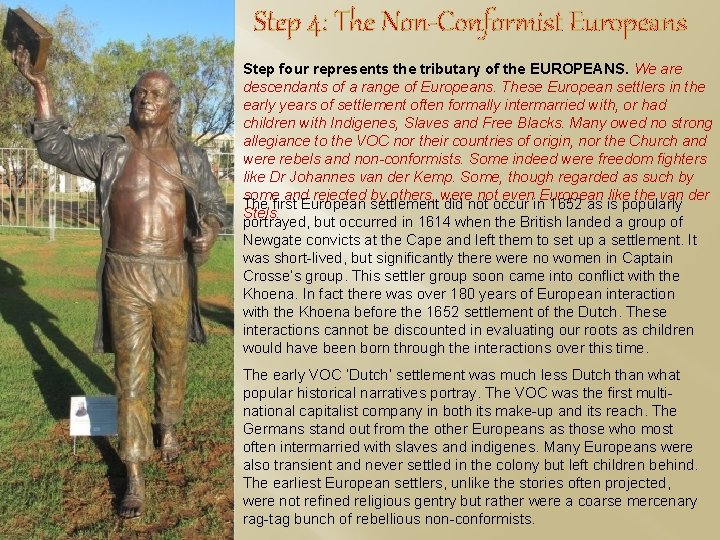
Step 4: The Non-Conformist Europeans Step four represents the tributary of the EUROPEANS. We are descendants of a range of Europeans. These European settlers in the early years of settlement often formally intermarried with, or had children with Indigenes, Slaves and Free Blacks. Many owed no strong allegiance to the VOC nor their countries of origin, nor the Church and were rebels and non-conformists. Some indeed were freedom fighters like Dr Johannes van der Kemp. Some, though regarded as such by some and rejected by others, were not even European like the van der The first European settlement did not occur in 1652 as is popularly Stels. portrayed, but occurred in 1614 when the British landed a group of Newgate convicts at the Cape and left them to set up a settlement. It was short-lived, but significantly there were no women in Captain Crosse’s group. This settler group soon came into conflict with the Khoena. In fact there was over 180 years of European interaction with the Khoena before the 1652 settlement of the Dutch. These interactions cannot be discounted in evaluating our roots as children would have been born through the interactions over this time. The early VOC ‘Dutch’ settlement was much less Dutch than what popular historical narratives portray. The VOC was the first multinational capitalist company in both its make-up and its reach. The Germans stand out from the other Europeans as those who most often intermarried with slaves and indigenes. Many Europeans were also transient and never settled in the colony but left children behind. The earliest European settlers, unlike the stories often projected, were not refined religious gentry but rather were a coarse mercenary rag-tag bunch of rebellious non-conformists.
The strong feature of formal marriages across colour lines in the official records shows that ‘rape and abuse’ of indigenes and slaves cannot be the only yardstick used in evaluating early human relations in the colony. Though van Riebeeck is recorded for a while as promoting an unofficial policy of ‘fructification’ of slaves, according to historian Upham Mansell Cross colourline marriages and relationships carried on when the English, Irish, Scots and new generations of Germans arrived in large numbers in the Eastern Cape of South Africa in the 1800 s. Missionaries throughout our history in particular were noted for intermarriages with freed slaves and Khoena. Intermarriages and relationships are often reduced to have occurred only between Khoena indigenes, slaves and Europeans as a result of denialism of Nguni-Sotho roots. But many children were also born of Europeans and those referred to as ‘Bantu’ peoples. FROM COENRAD DU BUYS & VAN DER KEMP TO BRAM FISCHER & JOE SLOVO The colonial history script and narrative is a dominating one. But even in the history and heritage of European settlers there is an alternative political story of non-conformists. Generations of youth never hear about the settlers who defied the successive colonial administrations and lived their whole lives in indigene controlled areas, intermarried and had children. There are many amazing stories in this muted narrative that are waiting to be brought out into mainstream discourse. For example the stories of Coenrad du Buys or Bloem both of whom also had numerous indigene wives and made their lives amongst indigenes. In the 20 th century this continued with a significant number joining the liberation movement, some laying down their lives for freedom.
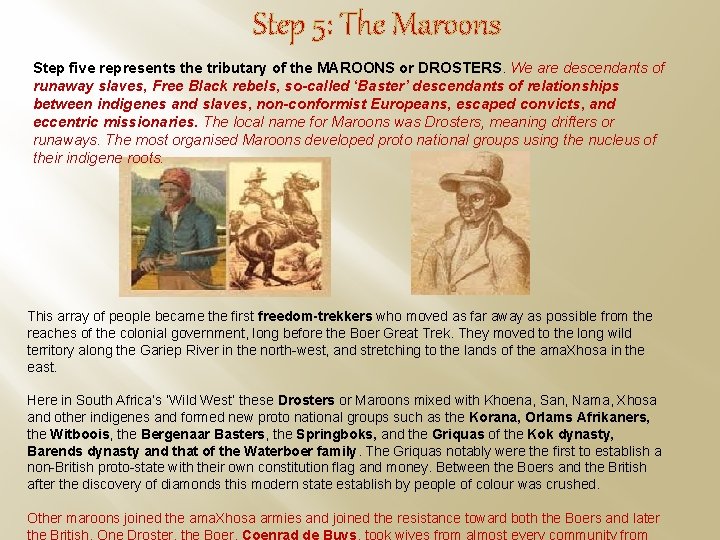
Step 5: The Maroons Step five represents the tributary of the MAROONS or DROSTERS. We are descendants of runaway slaves, Free Black rebels, so-called ‘Baster’ descendants of relationships between indigenes and slaves, non-conformist Europeans, escaped convicts, and eccentric missionaries. The local name for Maroons was Drosters, meaning drifters or runaways. The most organised Maroons developed proto national groups using the nucleus of their indigene roots. This array of people became the first freedom-trekkers who moved as far away as possible from the reaches of the colonial government, long before the Boer Great Trek. They moved to the long wild territory along the Gariep River in the north-west, and stretching to the lands of the ama. Xhosa in the east. Here in South Africa’s ‘Wild West’ these Drosters or Maroons mixed with Khoena, San, Nama, Xhosa and other indigenes and formed new proto national groups such as the Korana, Orlams Afrikaners, the Witboois, the Bergenaar Basters, the Springboks, and the Griquas of the Kok dynasty, Barends dynasty and that of the Waterboer family. The Griquas notably were the first to establish a non-British proto-state with their own constitution flag and money. Between the Boers and the British after the discovery of diamonds this modern state establish by people of colour was crushed. Other maroons joined the ama. Xhosa armies and joined the resistance toward both the Boers and later the British. One Droster, the Boer, Coenrad de Buys, took wives from almost every community from
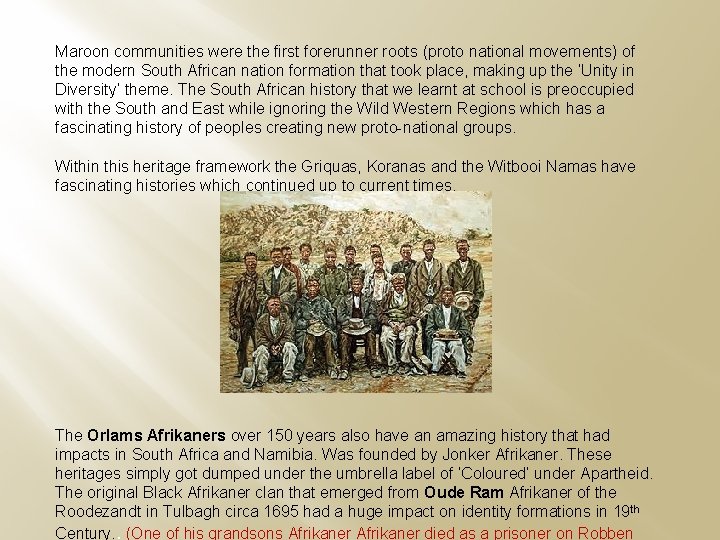
Maroon communities were the first forerunner roots (proto national movements) of the modern South African nation formation that took place, making up the ‘Unity in Diversity’ theme. The South African history that we learnt at school is preoccupied with the South and East while ignoring the Wild Western Regions which has a fascinating history of peoples creating new proto-national groups. Within this heritage framework the Griquas, Koranas and the Witbooi Namas have fascinating histories which continued up to current times. The Orlams Afrikaners over 150 years also have an amazing history that had impacts in South Africa and Namibia. Was founded by Jonker Afrikaner. These heritages simply got dumped under the umbrella label of ‘Coloured’ under Apartheid. The original Black Afrikaner clan that emerged from Oude Ram Afrikaner of the Roodezandt in Tulbagh circa 1695 had a huge impact on identity formations in 19 th Century. . (One of his grandsons Afrikaner died as a prisoner on Robben
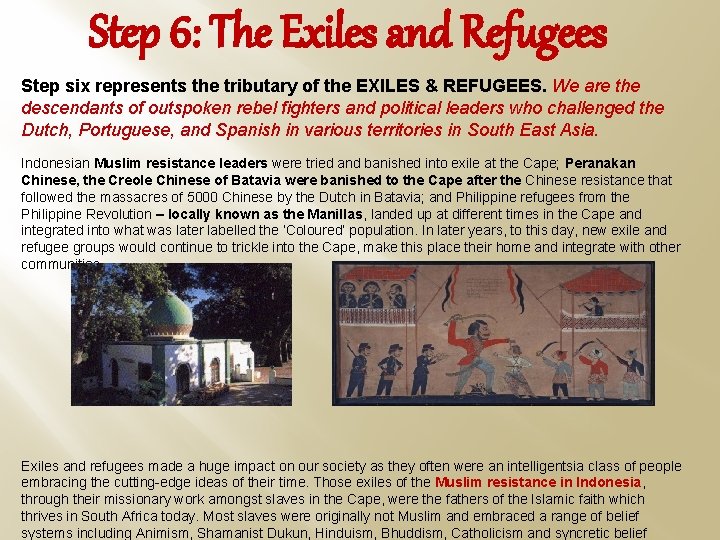
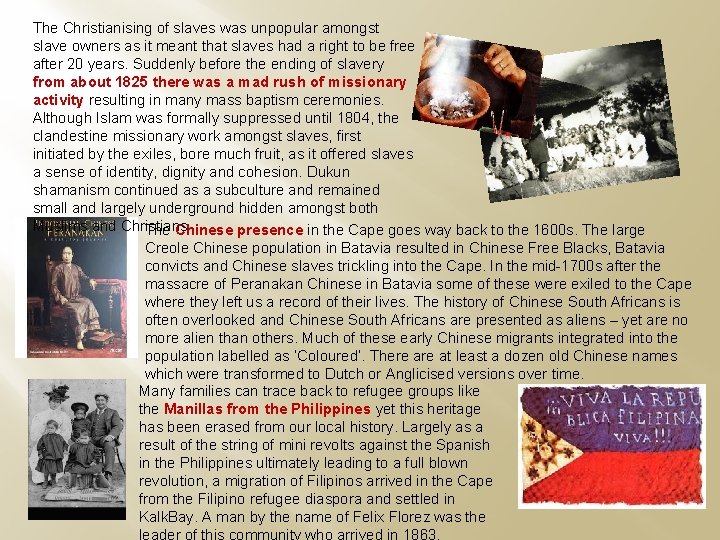
Step 6: The Exiles and Refugees Step six represents the tributary of the EXILES & REFUGEES. We are the descendants of outspoken rebel fighters and political leaders who challenged the Dutch, Portuguese, and Spanish in various territories in South East Asia. Indonesian Muslim resistance leaders were tried and banished into exile at the Cape; Peranakan Chinese, the Creole Chinese of Batavia were banished to the Cape after the Chinese resistance that followed the massacres of 5000 Chinese by the Dutch in Batavia; and Philippine refugees from the Philippine Revolution – locally known as the Manillas, landed up at different times in the Cape and integrated into what was later labelled the ‘Coloured’ population. In later years, to this day, new exile and refugee groups would continue to trickle into the Cape, make this place their home and integrate with other communities. Exiles and refugees made a huge impact on our society as they often were an intelligentsia class of people embracing the cutting-edge ideas of their time. Those exiles of the Muslim resistance in Indonesia, through their missionary work amongst slaves in the Cape, were the fathers of the Islamic faith which thrives in South Africa today. Most slaves were originally not Muslim and embraced a range of belief systems including Animism, Shamanist Dukun, Hinduism, Bhuddism, Catholicism and syncretic belief
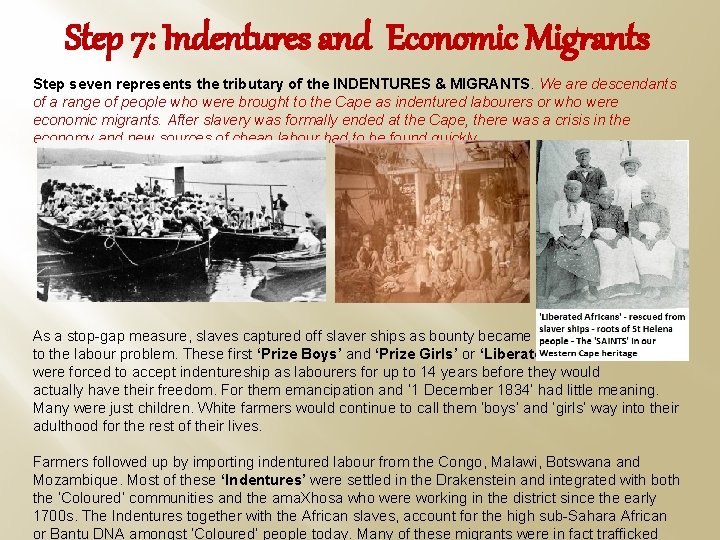
The Christianising of slaves was unpopular amongst slave owners as it meant that slaves had a right to be free after 20 years. Suddenly before the ending of slavery from about 1825 there was a mad rush of missionary activity resulting in many mass baptism ceremonies. Although Islam was formally suppressed until 1804, the clandestine missionary work amongst slaves, first initiated by the exiles, bore much fruit, as it offered slaves a sense of identity, dignity and cohesion. Dukun shamanism continued as a subculture and remained small and largely underground hidden amongst both Muslims and Christians The Chinese presence in the Cape goes way back to the 1600 s. The large Creole Chinese population in Batavia resulted in Chinese Free Blacks, Batavia convicts and Chinese slaves trickling into the Cape. In the mid-1700 s after the massacre of Peranakan Chinese in Batavia some of these were exiled to the Cape where they left us a record of their lives. The history of Chinese South Africans is often overlooked and Chinese South Africans are presented as aliens – yet are no more alien than others. Much of these early Chinese migrants integrated into the population labelled as ‘Coloured’. There at least a dozen old Chinese names which were transformed to Dutch or Anglicised versions over time. Many families can trace back to refugee groups like the Manillas from the Philippines yet this heritage has been erased from our local history. Largely as a result of the string of mini revolts against the Spanish in the Philippines ultimately leading to a full blown revolution, a migration of Filipinos arrived in the Cape from the Filipino refugee diaspora and settled in Kalk. Bay. A man by the name of Felix Florez was the leader of this community who arrived in 1863.
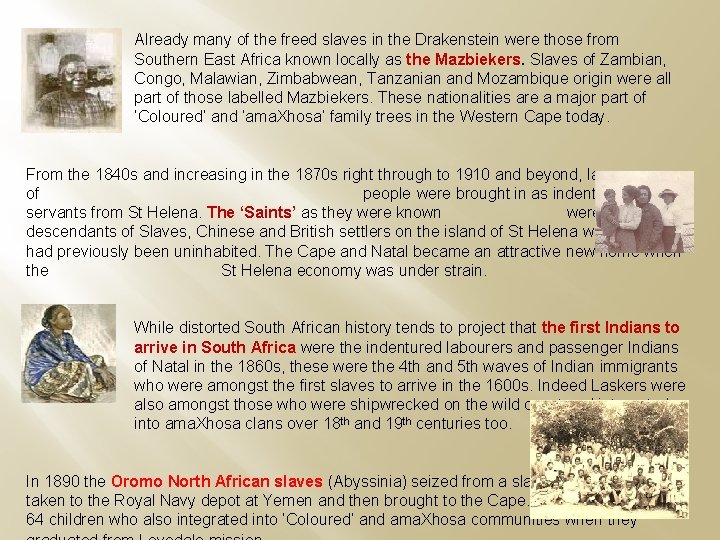
Step 7: Indentures and Economic Migrants Step seven represents the tributary of the INDENTURES & MIGRANTS. We are descendants of a range of people who were brought to the Cape as indentured labourers or who were economic migrants. After slavery was formally ended at the Cape, there was a crisis in the economy and new sources of cheap labour had to be found quickly. As a stop-gap measure, slaves captured off slaver ships as bounty became the first solution to the labour problem. These first ‘Prize Boys’ and ‘Prize Girls’ or ‘Liberated Africans’ were forced to accept indentureship as labourers for up to 14 years before they would actually have their freedom. For them emancipation and ‘ 1 December 1834’ had little meaning. Many were just children. White farmers would continue to call them ‘boys’ and ‘girls’ way into their adulthood for the rest of their lives. Farmers followed up by importing indentured labour from the Congo, Malawi, Botswana and Mozambique. Most of these ‘Indentures’ were settled in the Drakenstein and integrated with both the ‘Coloured’ communities and the ama. Xhosa who were working in the district since the early 1700 s. The Indentures together with the African slaves, account for the high sub-Sahara African or Bantu DNA amongst ‘Coloured’ people today. Many of these migrants were in fact trafficked
Already many of the freed slaves in the Drakenstein were those from Southern East Africa known locally as the Mazbiekers. Slaves of Zambian, Congo, Malawian, Zimbabwean, Tanzanian and Mozambique origin were all part of those labelled Mazbiekers. These nationalities are a major part of ‘Coloured’ and ‘ama. Xhosa’ family trees in the Western Cape today. From the 1840 s and increasing in the 1870 s right through to 1910 and beyond, large groups of people were brought in as indentured servants from St Helena. The ‘Saints’ as they were known were also descendants of Slaves, Chinese and British settlers on the island of St Helena which had previously been uninhabited. The Cape and Natal became an attractive new home when the St Helena economy was under strain. While distorted South African history tends to project that the first Indians to arrive in South Africa were the indentured labourers and passenger Indians of Natal in the 1860 s, these were the 4 th and 5 th waves of Indian immigrants who were amongst the first slaves to arrive in the 1600 s. Indeed Laskers were also amongst those who were shipwrecked on the wild coast and integrated into ama. Xhosa clans over 18 th and 19 th centuries too. In 1890 the Oromo North African slaves (Abyssinia) seized from a slaver ship were taken to the Royal Navy depot at Yemen and then brought to the Cape. These were 64 children who also integrated into ‘Coloured’ and ama. Xhosa communities when they
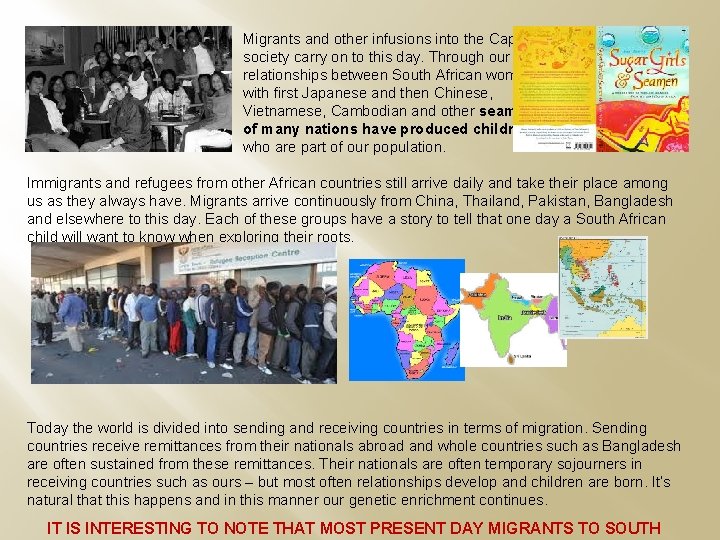
Migrants and other infusions into the Cape society carry on to this day. Through our sea ports, relationships between South African women with first Japanese and then Chinese, Vietnamese, Cambodian and other seaman of many nations have produced children who are part of our population. Immigrants and refugees from other African countries still arrive daily and take their place among us as they always have. Migrants arrive continuously from China, Thailand, Pakistan, Bangladesh and elsewhere to this day. Each of these groups have a story to tell that one day a South African child will want to know when exploring their roots. Today the world is divided into sending and receiving countries in terms of migration. Sending countries receive remittances from their nationals abroad and whole countries such as Bangladesh are often sustained from these remittances. Their nationals are often temporary sojourners in receiving countries such as ours – but most often relationships develop and children are born. It’s natural that this happens and in this manner our genetic enrichment continues. IT IS INTERESTING TO NOTE THAT MOST PRESENT DAY MIGRANTS TO SOUTH
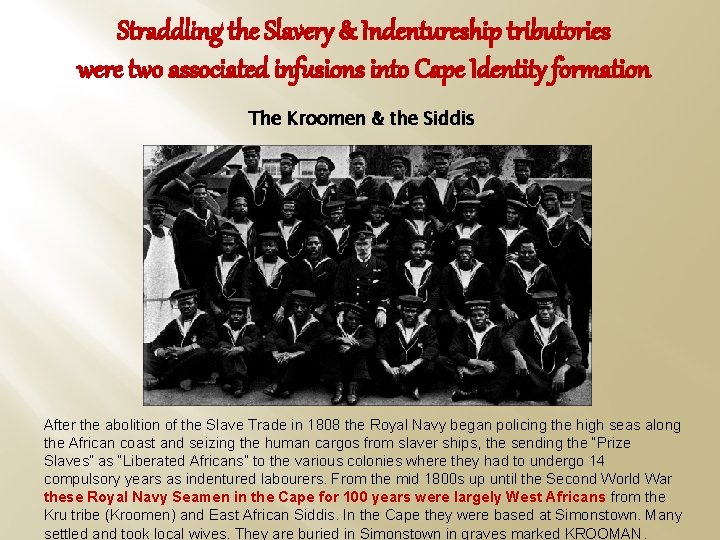
Straddling the Slavery & Indentureship tributories were two associated infusions into Cape Identity formation The Kroomen & the Siddis After the abolition of the Slave Trade in 1808 the Royal Navy began policing the high seas along the African coast and seizing the human cargos from slaver ships, the sending the “Prize Slaves” as “Liberated Africans” to the various colonies where they had to undergo 14 compulsory years as indentured labourers. From the mid 1800 s up until the Second World War these Royal Navy Seamen in the Cape for 100 years were largely West Africans from the Kru tribe (Kroomen) and East African Siddis. In the Cape they were based at Simonstown. Many settled and took local wives. They are buried in Simonstown in graves marked KROOMAN.
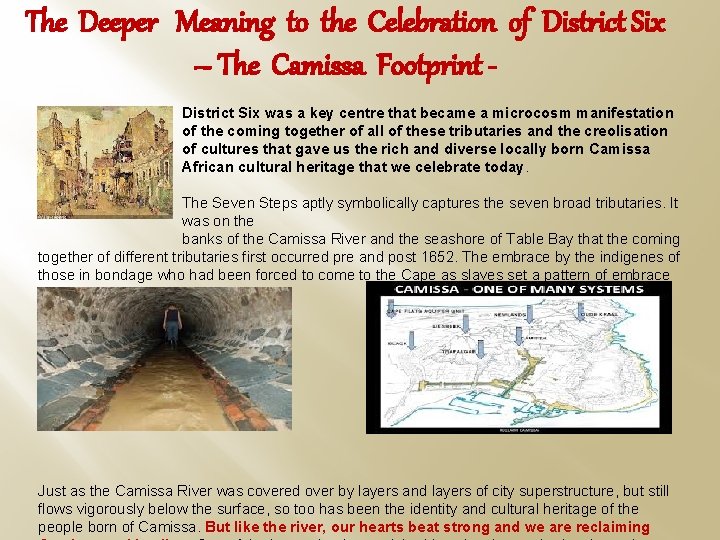
The Deeper Meaning to the Celebration of District Six – The Camissa Footprint District Six was a key centre that became a microcosm manifestation of the coming together of all of these tributaries and the creolisation of cultures that gave us the rich and diverse locally born Camissa African cultural heritage that we celebrate today. The Seven Steps aptly symbolically captures the seven broad tributaries. It was on the banks of the Camissa River and the seashore of Table Bay that the coming together of different tributaries first occurred pre and post 1652. The embrace by the indigenes of those in bondage who had been forced to come to the Cape as slaves set a pattern of embrace that is at the heart of Cape identity. Just as the Camissa River was covered over by layers and layers of city superstructure, but still flows vigorously below the surface, so too has been the identity and cultural heritage of the people born of Camissa. But like the river, our hearts beat strong and we are reclaiming
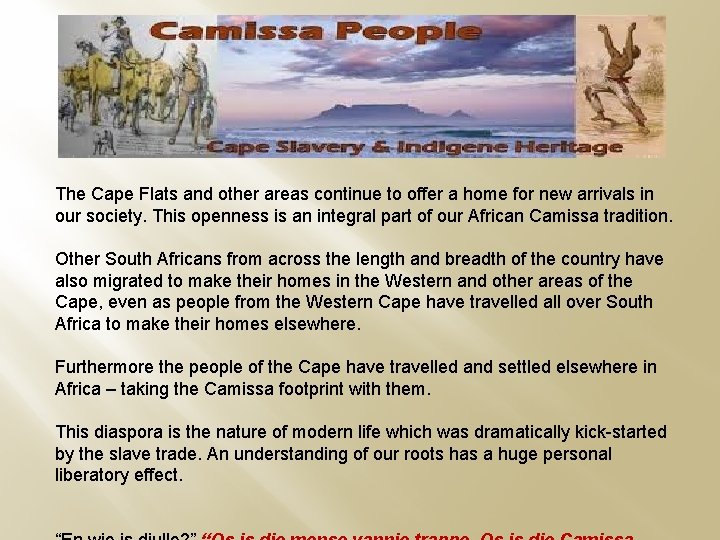
The Cape Flats and other areas continue to offer a home for new arrivals in our society. This openness is an integral part of our African Camissa tradition. Other South Africans from across the length and breadth of the country have also migrated to make their homes in the Western and other areas of the Cape, even as people from the Western Cape have travelled all over South Africa to make their homes elsewhere. Furthermore the people of the Cape have travelled and settled elsewhere in Africa – taking the Camissa footprint with them. This diaspora is the nature of modern life which was dramatically kick-started by the slave trade. An understanding of our roots has a huge personal liberatory effect.
ASIRAWAN SIAM HEALING HOUSE & SA-Thai Slave Heritage Reflection Centre (Asira Bunpaburut – the SA-Thai Connection cc) Developed & Produced by Patric Tariq Mellet OPEN SOURCE: The materials of the SA-Thai Slave Heritage Reflection Centre are open source for non-commercial heritage education purposes only on condition that