
The sentence and its types Or How To
- Slides: 21
The sentence and its types Or How To Really Impress People With Your Sentence Variety
Types of Sentences n Once a writer knows the difference between the three sentence types (simple, compound, and complex), it is possible to write with sentence variety. Sentence variety helps make your writing more interesting.
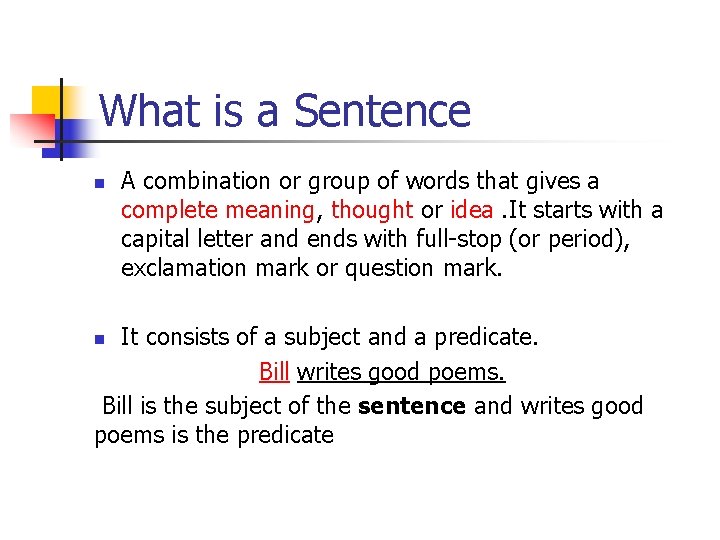
What is a Sentence n A combination or group of words that gives a complete meaning, thought or idea. It starts with a capital letter and ends with full-stop (or period), exclamation mark or question mark. It consists of a subject and a predicate. Bill writes good poems. Bill is the subject of the sentence and writes good poems is the predicate n
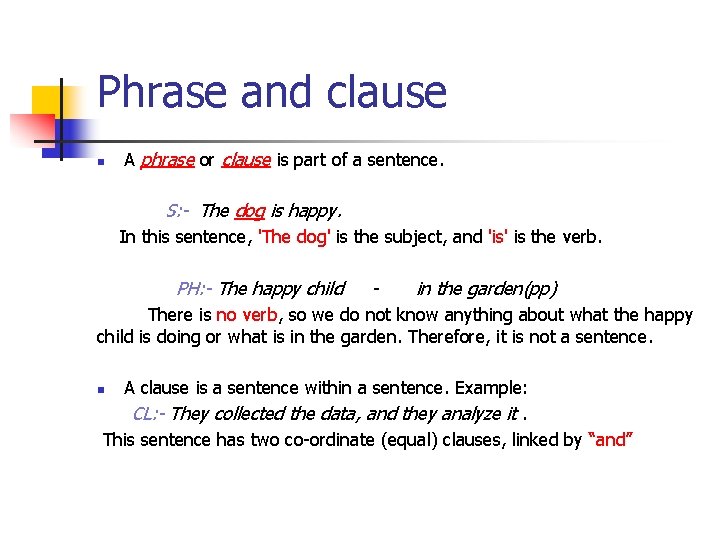
Phrase and clause n A phrase or clause is part of a sentence. S: - The dog is happy. In this sentence, 'The dog' is the subject, and 'is' is the verb. PH: - The happy child - in the garden(pp) There is no verb, so we do not know anything about what the happy child is doing or what is in the garden. Therefore, it is not a sentence. A clause is a sentence within a sentence. Example: CL: - They collected the data, and they analyze it. This sentence has two co-ordinate (equal) clauses, linked by “and” n
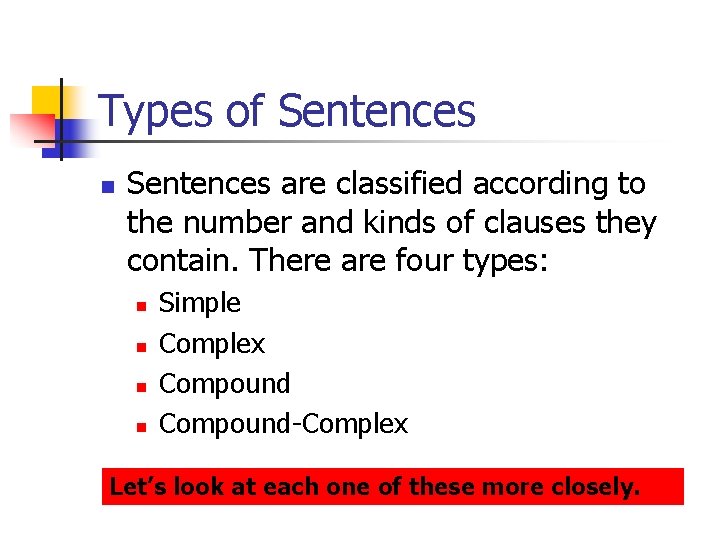
Types of Sentences n Sentences are classified according to the number and kinds of clauses they contain. There are four types: n n Simple Complex Compound-Complex Let’s look at each one of these more closely.
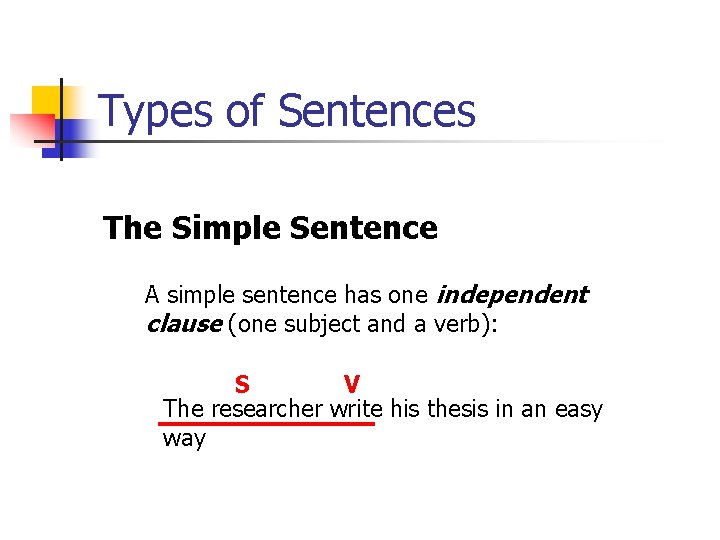
Types of Sentences The Simple Sentence A simple sentence has one independent clause (one subject and a verb): V S The researcher write his thesis in an easy way
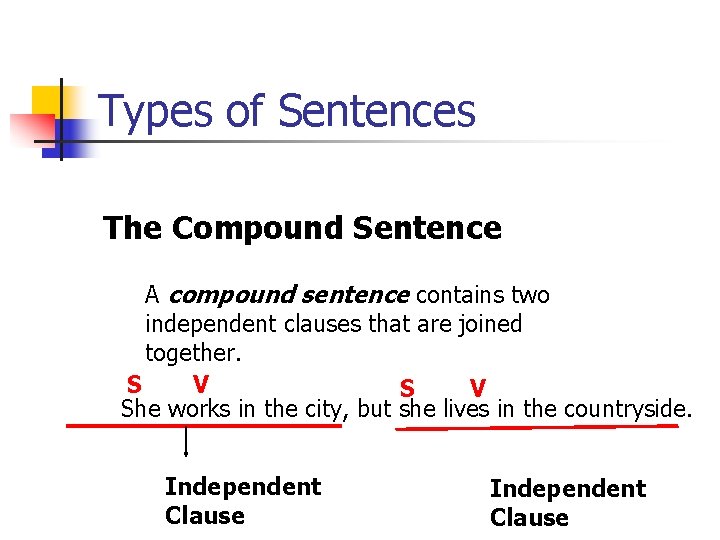
Types of Sentences The Compound Sentence A compound sentence contains two independent clauses that are joined together. S V She works in the city, but she lives in the countryside. Independent Clause
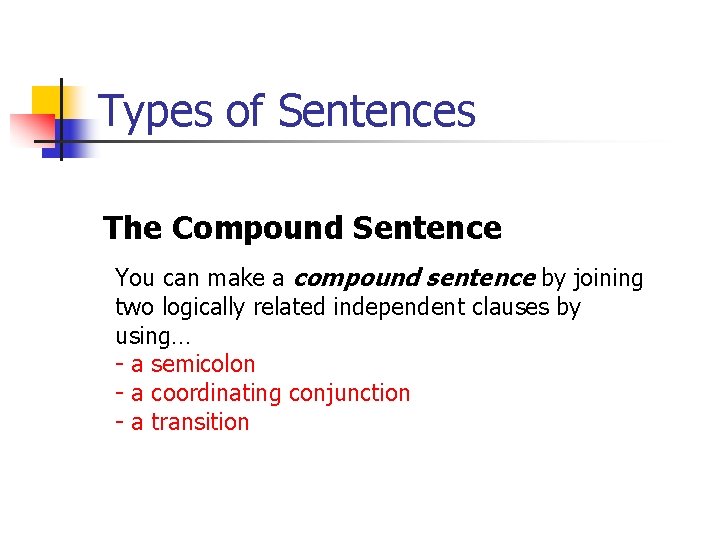
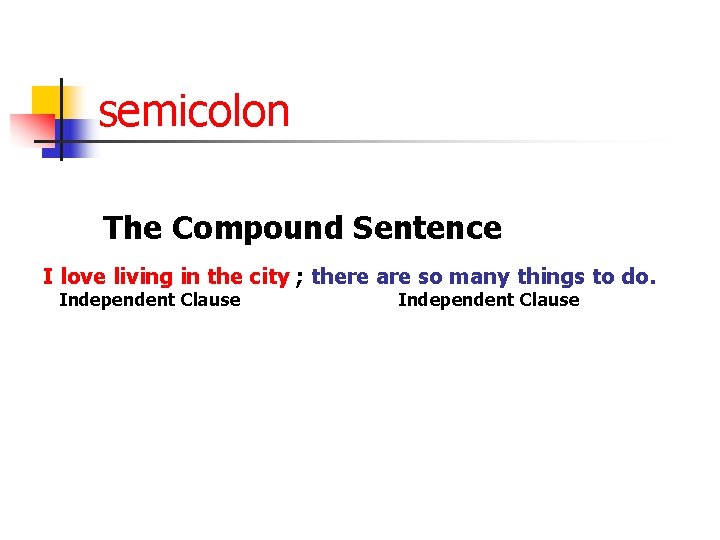
Types of Sentences The Compound Sentence You can make a compound sentence by joining two logically related independent clauses by using… - a semicolon - a coordinating conjunction - a transition
semicolon The Compound Sentence I love living in the city ; there are so many things to do. Independent Clause
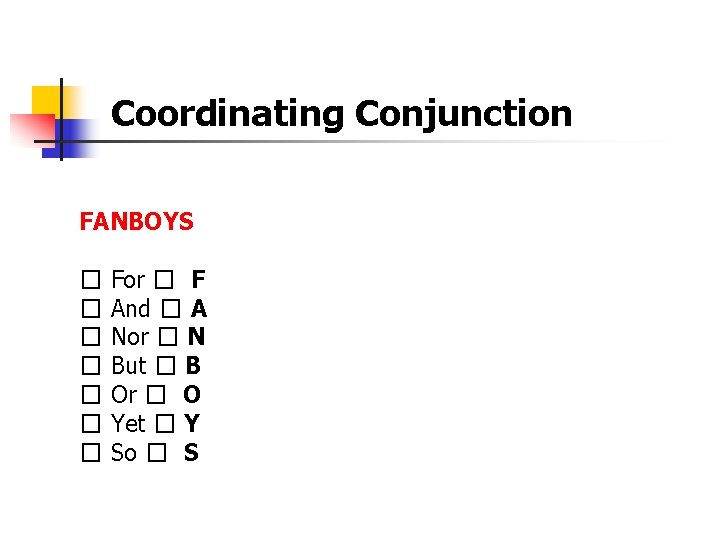
Coordinating Conjunction FANBOYS � � � � For � F And � A Nor � N But � B Or � O Yet � Y So � S
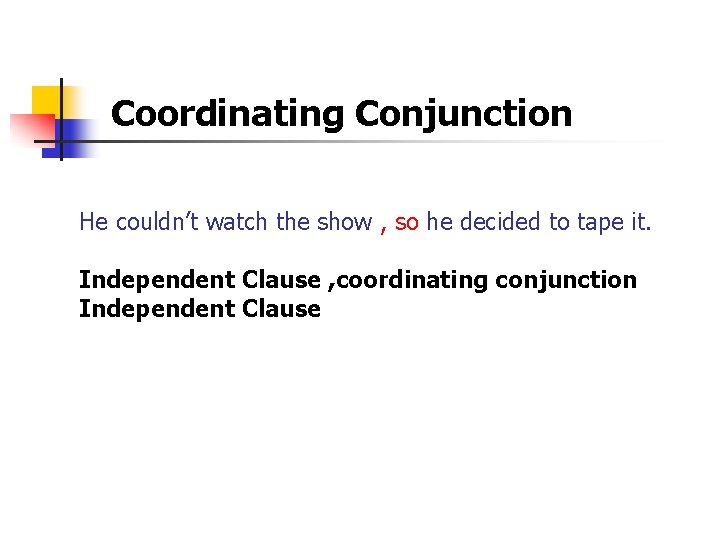
Coordinating Conjunction He couldn’t watch the show , so he decided to tape it. Independent Clause , coordinating conjunction Independent Clause
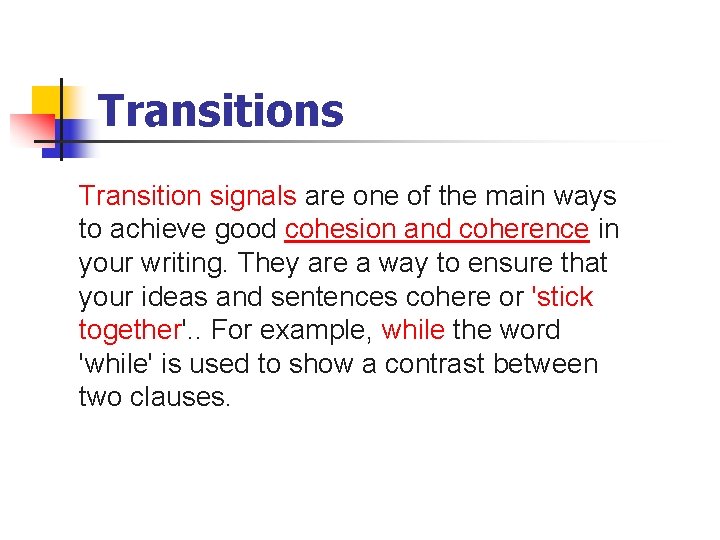
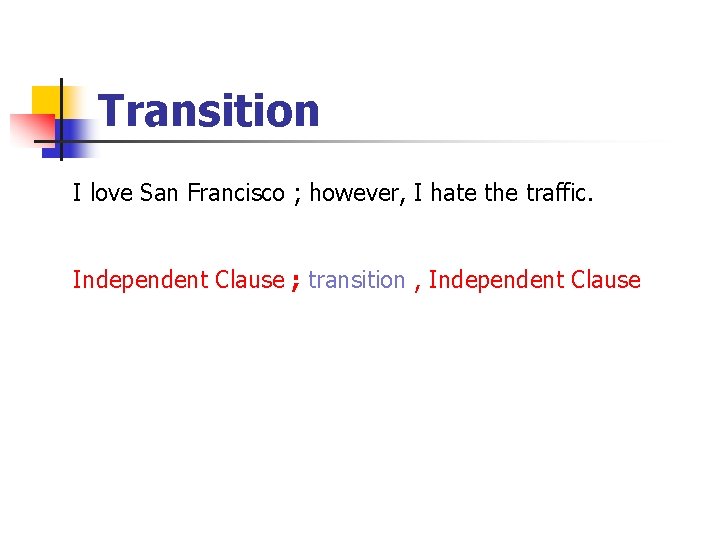
Transitions Transition signals are one of the main ways to achieve good cohesion and coherence in your writing. They are a way to ensure that your ideas and sentences cohere or 'stick together'. . For example, while the word 'while' is used to show a contrast between two clauses.
Transition I love San Francisco ; however, I hate the traffic. Independent Clause ; transition , Independent Clause
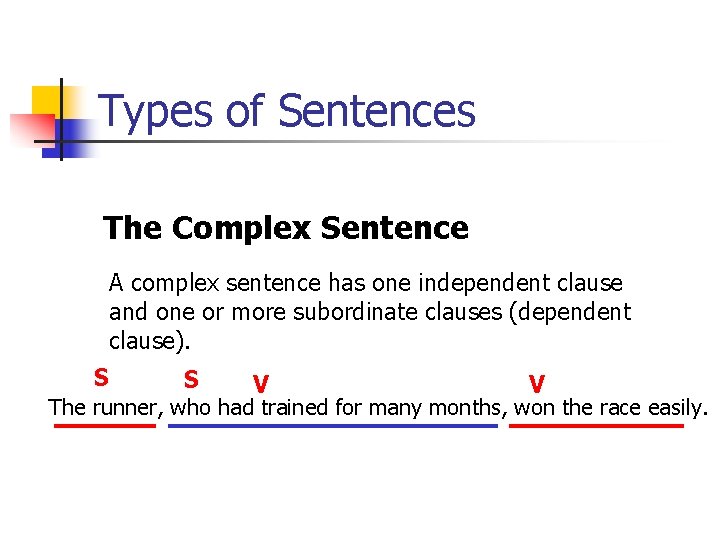
Types of Sentences The Complex Sentence A complex sentence has one independent clause and one or more subordinate clauses (dependent clause). S S V V The runner, who had trained for many months, won the race easily.
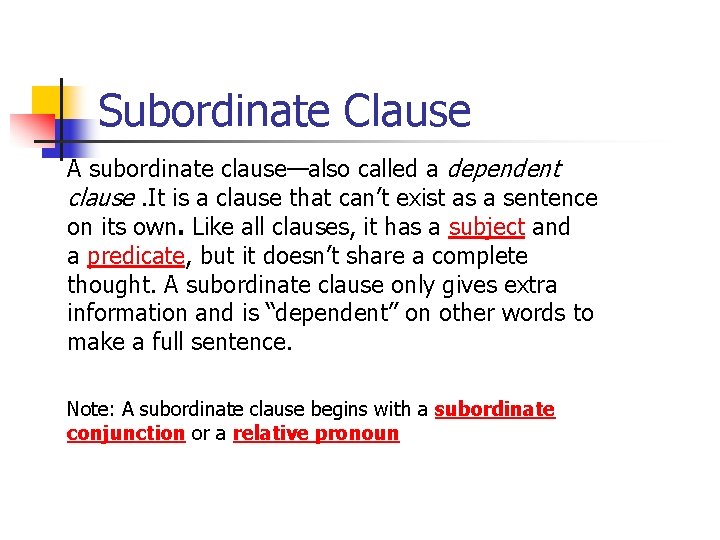
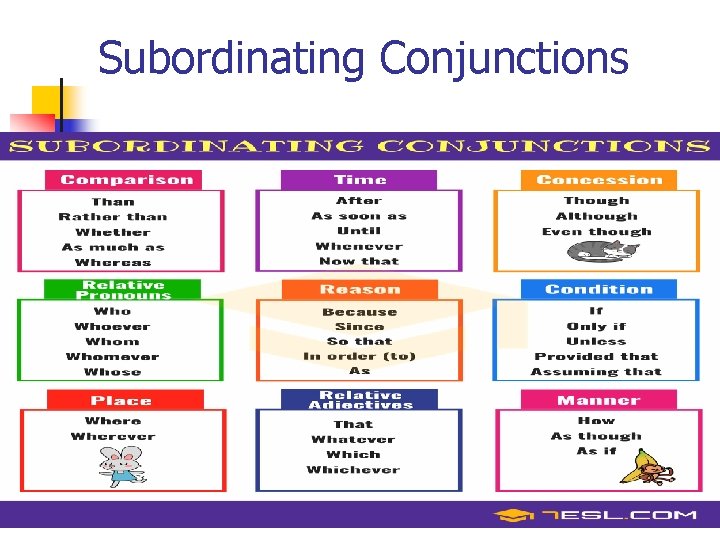
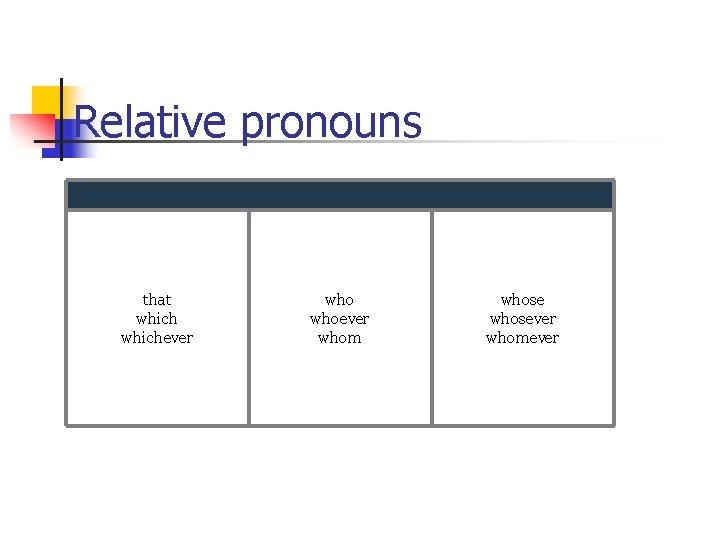
Subordinate Clause A subordinate clause—also called a dependent clause. It is a clause that can’t exist as a sentence on its own. Like all clauses, it has a subject and a predicate, but it doesn’t share a complete thought. A subordinate clause only gives extra information and is “dependent” on other words to make a full sentence. Note: A subordinate clause begins with a subordinate conjunction or a relative pronoun
Subordinating Conjunctions
Relative pronouns that whichever whoever whom whosever whomever
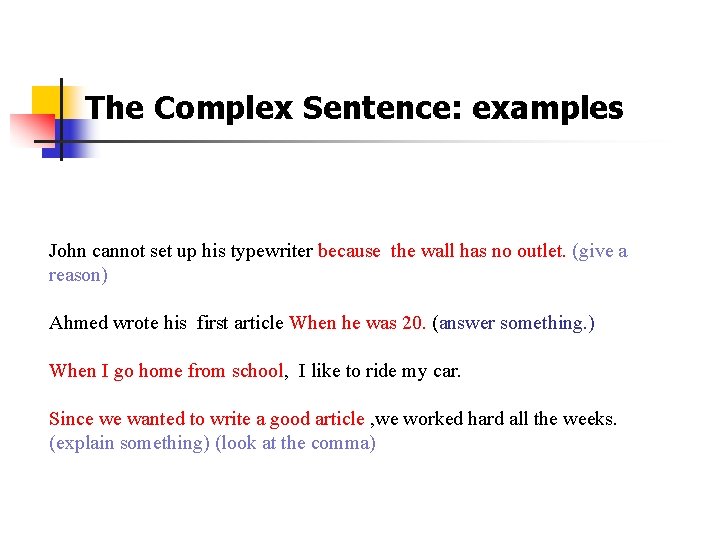
The Complex Sentence: examples John cannot set up his typewriter because the wall has no outlet. (give a reason) Ahmed wrote his first article When he was 20. (answer something. ) When I go home from school, I like to ride my car. Since we wanted to write a good article , we worked hard all the weeks. (explain something) (look at the comma)
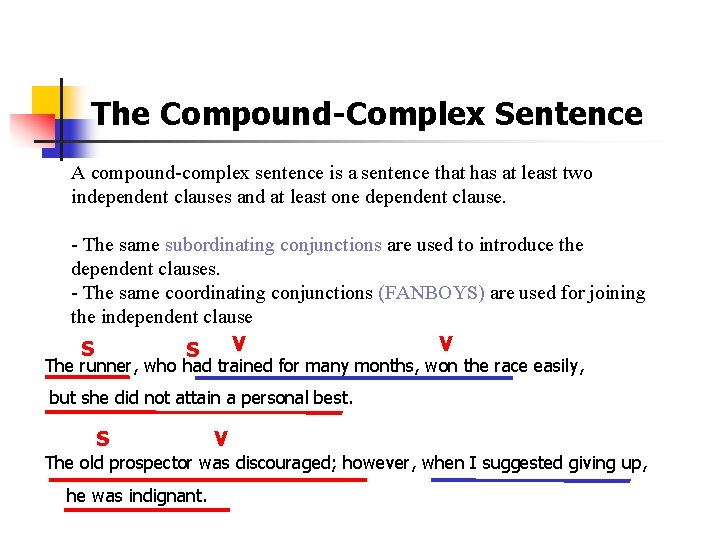
The Compound-Complex Sentence A compound-complex sentence is a sentence that has at least two independent clauses and at least one dependent clause. - The same subordinating conjunctions are used to introduce the dependent clauses. - The same coordinating conjunctions (FANBOYS) are used for joining the independent clause V V S S The runner, who had trained for many months, won the race easily, but she did not attain a personal best. S V The old prospector was discouraged; however, when I suggested giving up, he was indignant.
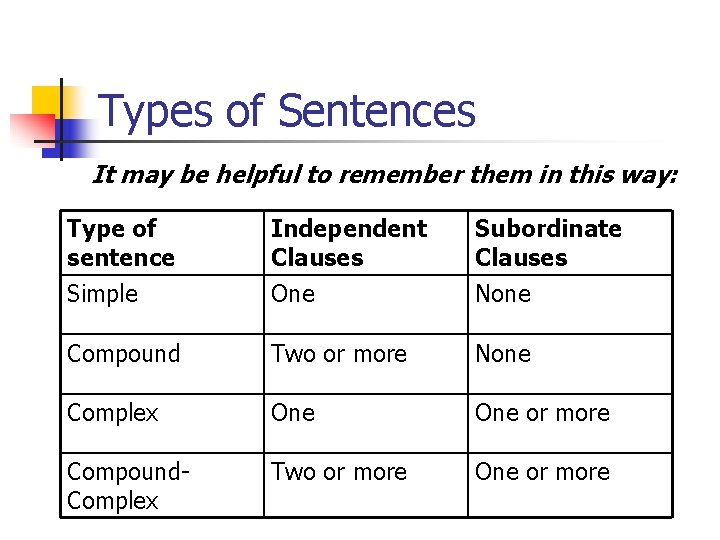
Types of Sentences It may be helpful to remember them in this way: Type of sentence Independent Clauses Subordinate Clauses Simple One None Compound Two or more None Complex One or more Compound. Complex Two or more One or more
Which one is better to be used in writing a research?