
THE SEMANTICS OF SENTENCE ELEMENTS Chapter Eight This







- Slides: 26
THE SEMANTICS OF SENTENCE ELEMENTS Chapter Eight (This explanation is for Fourth Class, Section B)
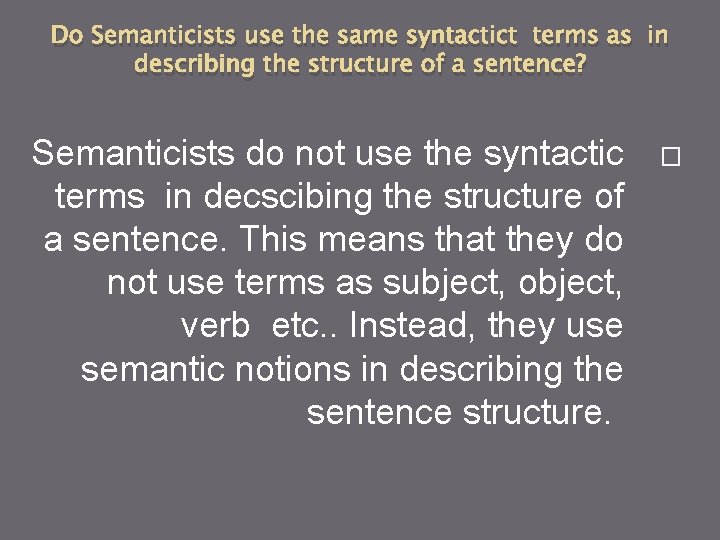
Do Semanticists use the same syntactict terms as in describing the structure of a sentence? Semanticists do not use the syntactic terms in decscibing the structure of a sentence. This means that they do not use terms as subject, object, verb etc. . Instead, they use semantic notions in describing the sentence structure. �
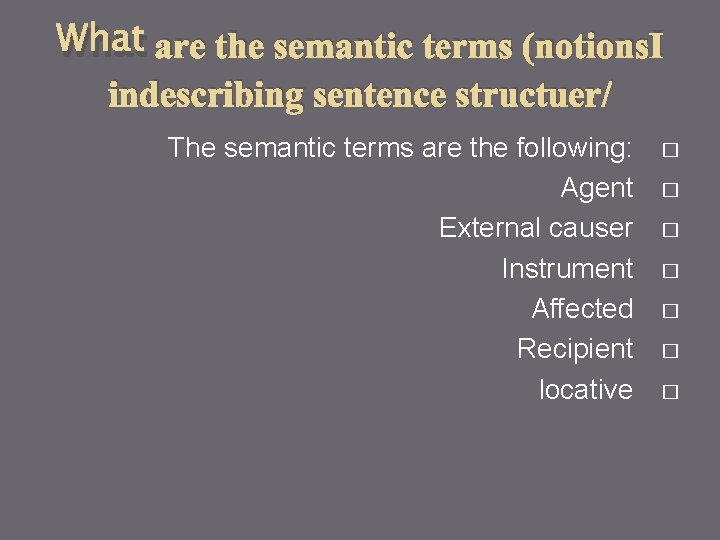
What are the semantic terms (notions. I indescribing sentence structuer/ The semantic terms are the following: Agent External causer Instrument Affected Recipient locative � � � �
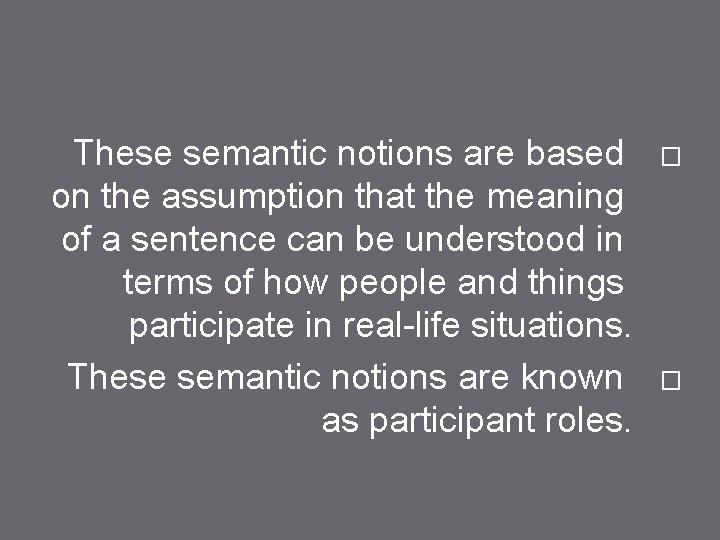
These semantic notions are based on the assumption that the meaning of a sentence can be understood in terms of how people and things participate in real-life situations. These semantic notions are known as participant roles. � �
agent The agent of a sentences the animate being that causes the action described by the verb in that sentence. In the following examples , the subject is the agent: John opened the door The sweeper cleaned the floor. The cat chased a rat. � � �
Experincer It is the subject of a copular verb or a transitive verb of perception, cognotion, or emotion. Ex: Jane is very sad. The old man felt a pain in his knees. Martha loves John.
External Causer It is the inanimate entitiy that causes the action described by the verb. Ex: The flood destroyed the harvest. � �
Positioner the animate being that is in a situation or stance that no change takes place in its position during this situation. Ex: The guests are staying in a hotel. My father live din London for three years.
attribute The semantic role of the subject complement or the object complement of a sentence is known as the attribute. Ex: She is a teacher. We made him wise.
Affected It is the animate or inanimate participant upon which the action is carried out. Ex: I bought an apartment last week. John is eating an apple. � �
Resultant It is the thing that comes into existence because of the activity indicated by the verb/ Ex: she painted a picture. My mother made an omelette forme. � � �
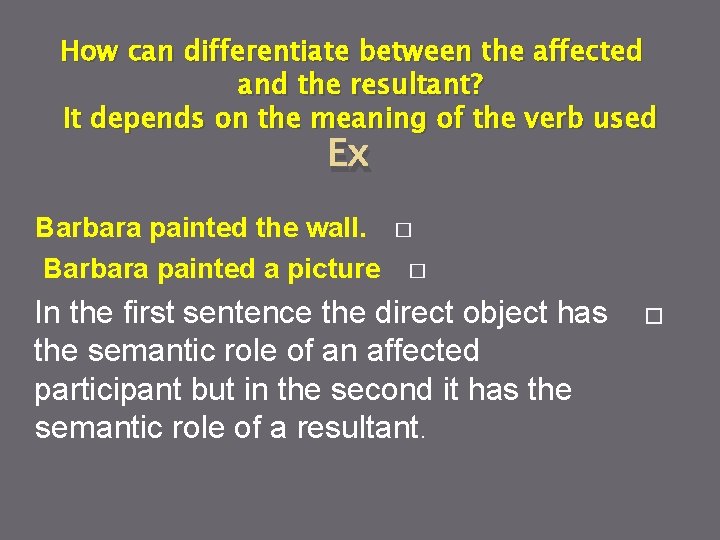
How can differentiate between the affected and the resultant? It depends on the meaning of the verb used Ex Barbara painted the wall. Barbara painted a picture � � In the first sentence the direct object has the semantic role of an affected participant but in the second it has the semantic role of a resultant. �
eventive It refers to man-made events as opposed to external causers which are forces of nature Ex: Their quarrels have upset me. Everyone like her dance. The final match will be held next week. � � �
reciepent it is the refernt of the indirect object. It is the person fro whose benefit the action described by the verb in a sentence is performed. Ex: will you pleaselend me some money?
beneficiary It is the intended recipient as the opposed of the actual recipient. She borrowed from me some money Her father bought her a car. � � �
instrument It is the thing by means of which the agent performs the action described by the verb: Ex: The policeman killed the robber with a pistol. � �
locative It refers to the place of the action I met you in Tokyo. He saw a beggar dying in the middle of the road. � � �
Goal It is the place towards which a living or a non-living entity moves: Ex: The army is advancing towards the capital. The children are going to the school.
source It is the starting point of a movement, i. e. , the place from where a living or non-living entity starts moving (towards its goal): She has come from London. The rabbit jumped out of the cage. � � �
Temporal It refers to the time of the state of the action described by the verb in a sentence: He was very tired yesterday. � �
Is there a one –to- one relation between elemnts and the participant roles There is no one-to-one relation. The subjet of a sentence can be an agent , an instrument, or an affected particpiant Ex: Barbara(the agent) opened the door with a key The key (the instrument) opened the door. The door (the affected participant) opened. � � �
The semantic Constarint on the choice of the subject Whether the gramtical slot for the subject of a sentecnec is filled by the agent or the affected or the instrument or ant other participant is not a matter of free choice for the user of the langauge. In English, this choice is determined by a certain rigid rule of grammar. �
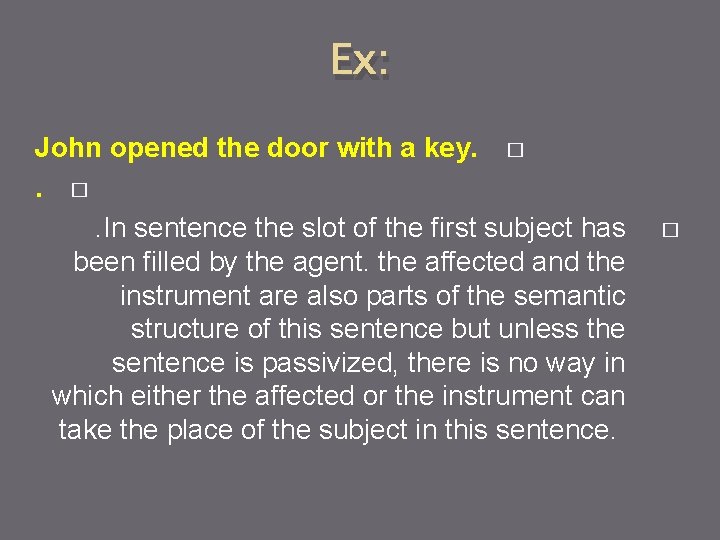
Ex: John opened the door with a key. �. �. In sentence the slot of the first subject has been filled by the agent. the affected and the instrument are also parts of the semantic structure of this sentence but unless the sentence is passivized, there is no way in which either the affected or the instrument can take the place of the subject in this sentence. �
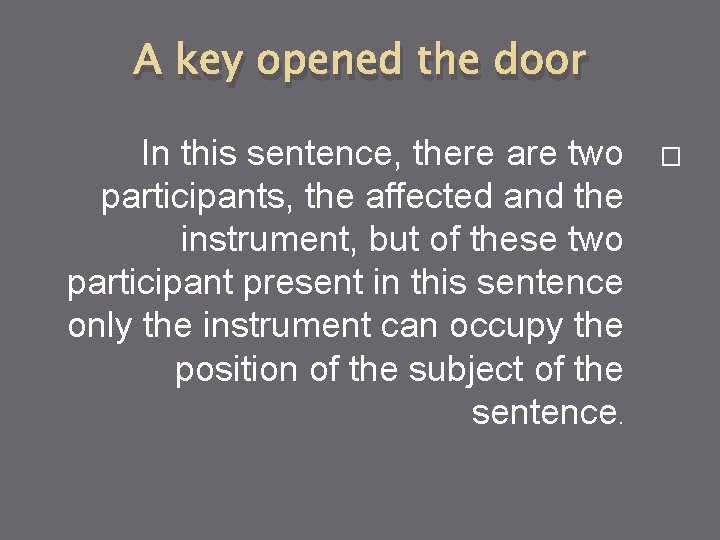
A key opened the door In this sentence, there are two participants, the affected and the instrument, but of these two participant present in this sentence only the instrument can occupy the position of the subject of the sentence. �
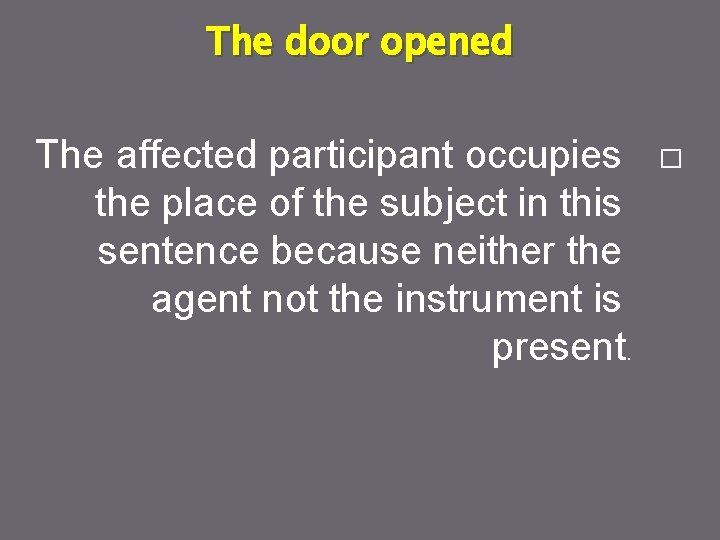
The door opened The affected participant occupies the place of the subject in this sentence because neither the agent not the instrument is present. �
Many Thanks �