
The Semantic Web Stack Tim BernersLee via Steve
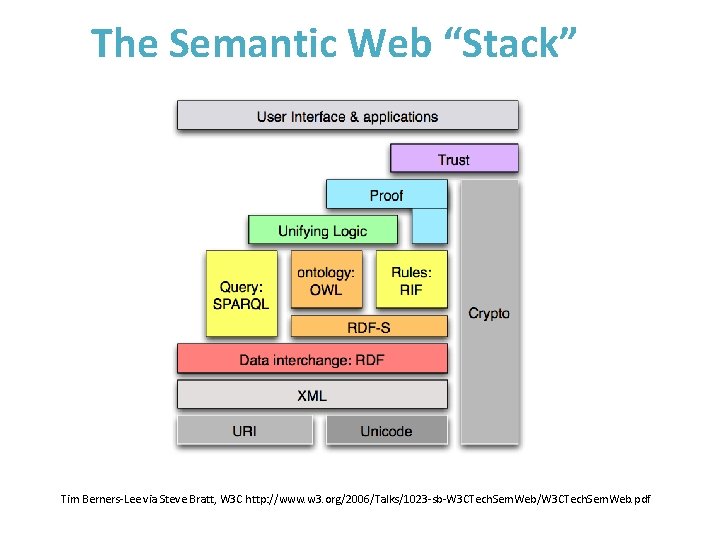
The Semantic Web “Stack” Tim Berners-Lee via Steve Bratt, W 3 C http: //www. w 3. org/2006/Talks/1023 -sb-W 3 CTech. Sem. Web/W 3 CTech. Sem. Web. pdf
RDF is a language for modeling data, and representing objects (resources) on the Web • • W 3 C recommendation Directed graphs– resources and connecting properties Triple structure, and HTTP URI’s! Linked Data rdf: Description, rdf: about, rdf: resource rdf: type, rdf: subject, rdf: predicate, rdf: object, rdf: value rdf: Property, rdf: Statement “Invent” your own, or re-use other’s— rdf: type’s & rdf: Property(ies)
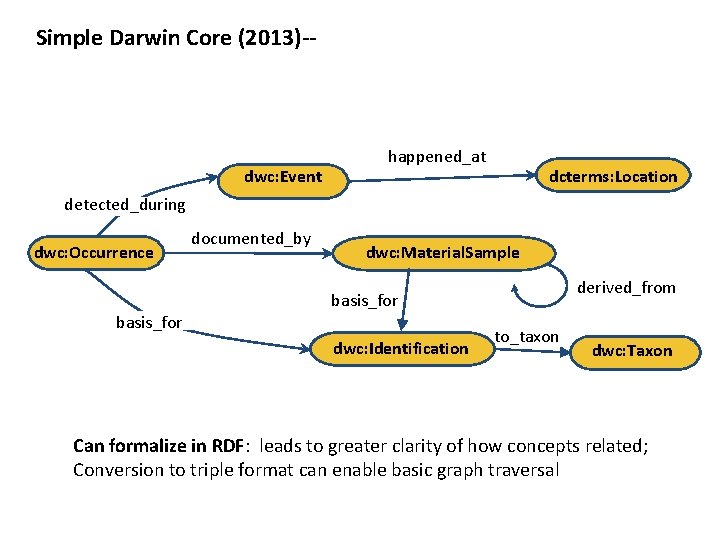
Simple Darwin Core (2013)-- dwc: Event happened_at dcterms: Location detected_during dwc: Occurrence basis_for documented_by dwc: Material. Sample derived_from basis_for dwc: Identification to_taxon dwc: Taxon Can formalize in RDF: leads to greater clarity of how concepts related; Conversion to triple format can enable basic graph traversal
RDF Schema RDFS is a language that builds on RDF, and better enables re-usable, domain-specific vocabularies • • W 3 C recommendation “vocabulary description language” for RDF Write in RDF/XML Adds Classes, Sub-classes, and Sub-properties rdfs: Class, rdfs: sub. Class. Of, rdfs: sub. Property. Of rdfs: domain, rdfs: range … Class and property hierarchies provide machine-automated inferencing up the hierarchy, using, e. g. the free “Jena”
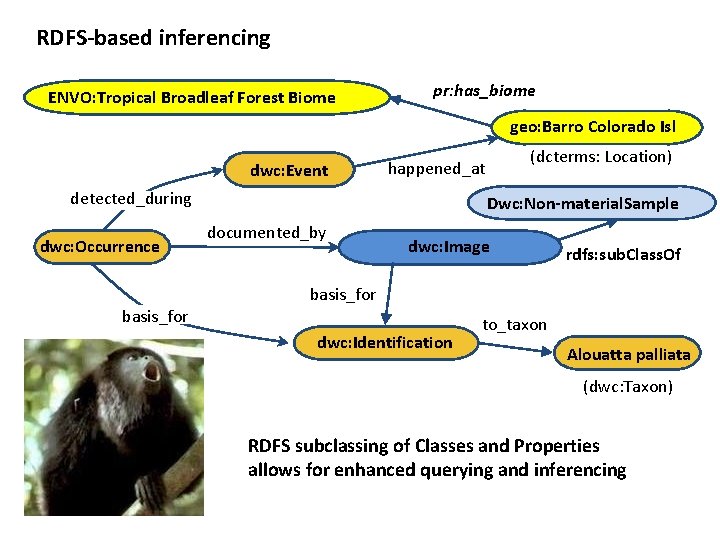
RDFS-based inferencing ENVO: Tropical Broadleaf Forest Biome pr: has_biome geo: Barro Colorado Isl dwc: Event detected_during dwc: Occurrence basis_for (dcterms: Location) happened_at Dwc: Non-material. Sample documented_by dwc: Image rdfs: sub. Class. Of basis_for dwc: Identification to_taxon Alouatta palliata (dwc: Taxon) RDFS subclassing of Classes and Properties allows for enhanced querying and inferencing
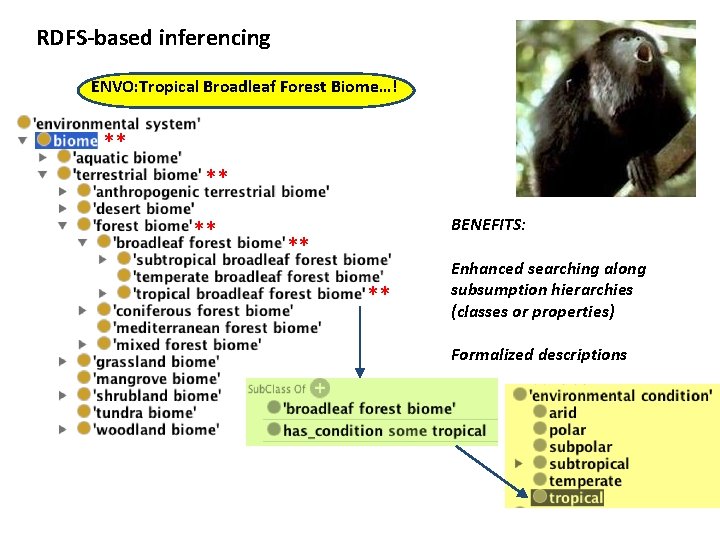
RDFS-based inferencing ENVO: Tropical Broadleaf Forest Biome…! ** ** ** BENEFITS: ** ** Enhanced searching along subsumption hierarchies (classes or properties) Formalized descriptions
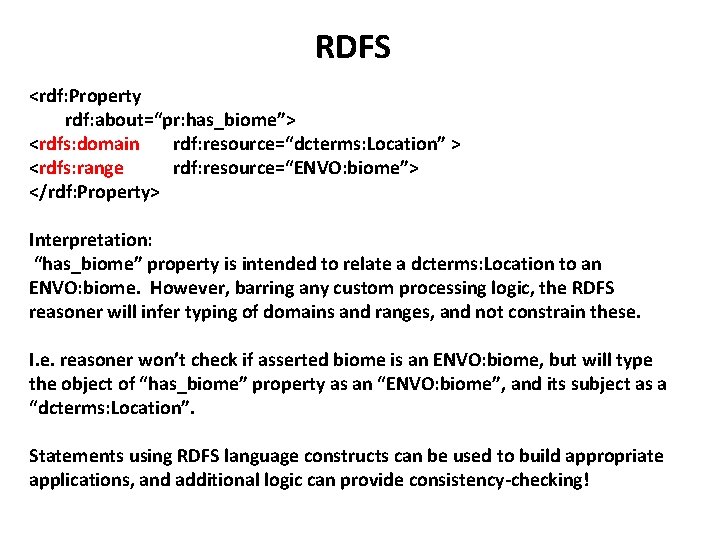
RDFS <rdf: Property rdf: about=“pr: has_biome”> <rdfs: domain rdf: resource=“dcterms: Location” > <rdfs: range rdf: resource=“ENVO: biome”> </rdf: Property> Interpretation: “has_biome” property is intended to relate a dcterms: Location to an ENVO: biome. However, barring any custom processing logic, the RDFS reasoner will infer typing of domains and ranges, and not constrain these. I. e. reasoner won’t check if asserted biome is an ENVO: biome, but will type the object of “has_biome” property as an “ENVO: biome”, and its subject as a “dcterms: Location”. Statements using RDFS language constructs can be used to build appropriate applications, and additional logic can provide consistency-checking!
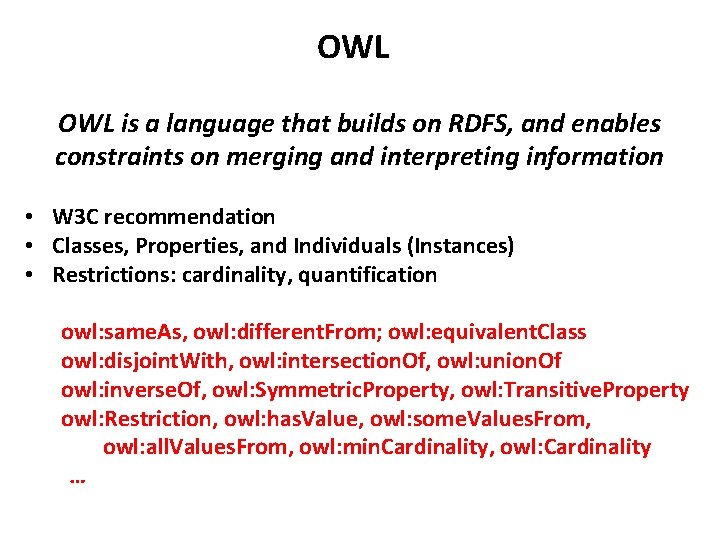
OWL is a language that builds on RDFS, and enables constraints on merging and interpreting information • W 3 C recommendation • Classes, Properties, and Individuals (Instances) • Restrictions: cardinality, quantification owl: same. As, owl: different. From; owl: equivalent. Class owl: disjoint. With, owl: intersection. Of, owl: union. Of owl: inverse. Of, owl: Symmetric. Property, owl: Transitive. Property owl: Restriction, owl: has. Value, owl: some. Values. From, owl: all. Values. From, owl: min. Cardinality, owl: Cardinality …
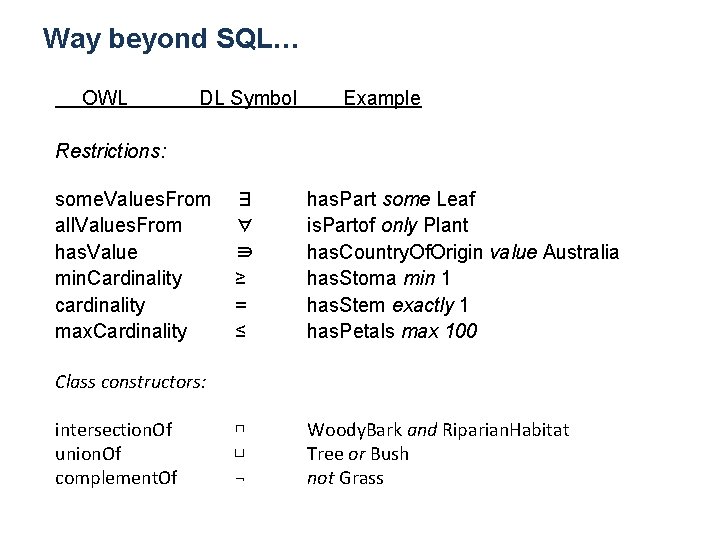
Way beyond SQL… OWL DL Symbol Example Restrictions: some. Values. From all. Values. From has. Value min. Cardinality cardinality max. Cardinality ∃ ∀ ∋ ≥ = ≤ has. Part some Leaf is. Partof only Plant has. Country. Of. Origin value Australia has. Stoma min 1 has. Stem exactly 1 has. Petals max 100 ⊓ ⊔ ¬ Woody. Bark and Riparian. Habitat Tree or Bush not Grass Class constructors: intersection. Of union. Of complement. Of
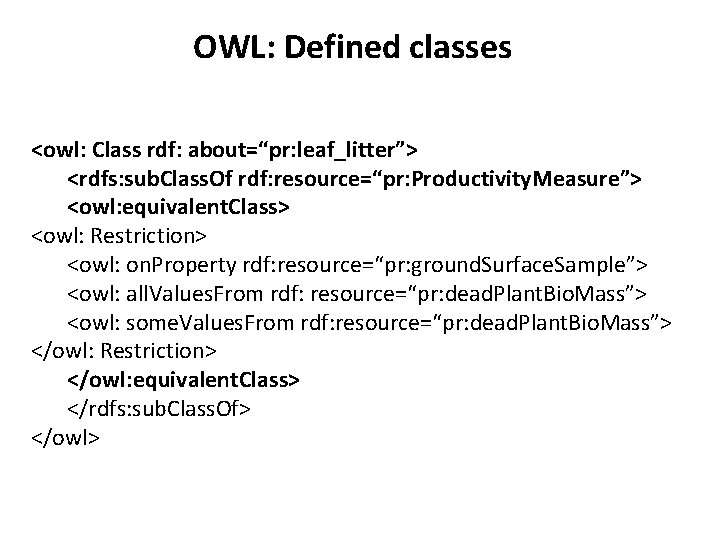
OWL: Defined classes <owl: Class rdf: about=“pr: leaf_litter”> <rdfs: sub. Class. Of rdf: resource=“pr: Productivity. Measure”> <owl: equivalent. Class> <owl: Restriction> <owl: on. Property rdf: resource=“pr: ground. Surface. Sample”> <owl: all. Values. From rdf: resource=“pr: dead. Plant. Bio. Mass”> <owl: some. Values. From rdf: resource=“pr: dead. Plant. Bio. Mass”> </owl: Restriction> </owl: equivalent. Class> </rdfs: sub. Class. Of> </owl>
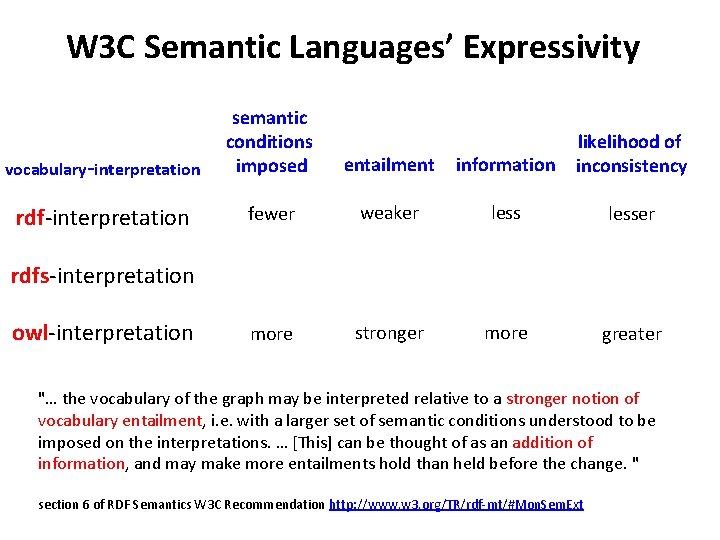
W 3 C Semantic Languages’ Expressivity vocabulary-interpretation semantic conditions imposed entailment information likelihood of inconsistency rdf-interpretation fewer weaker lesser more stronger more greater rdfs-interpretation owl-interpretation "… the vocabulary of the graph may be interpreted relative to a stronger notion of vocabulary entailment, i. e. with a larger set of semantic conditions understood to be imposed on the interpretations. … [This] can be thought of as an addition of information, and may make more entailments hold than held before the change. " section 6 of RDF Semantics W 3 C Recommendation http: //www. w 3. org/TR/rdf-mt/#Mon. Sem. Ext
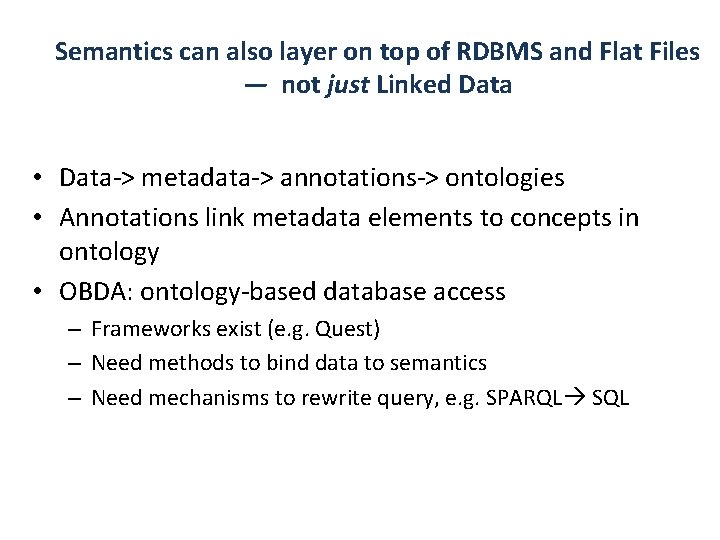
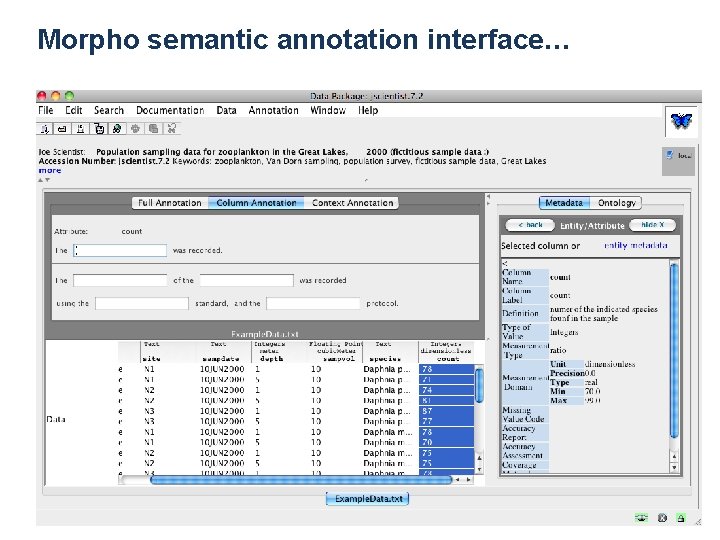
Semantics can also layer on top of RDBMS and Flat Files — not just Linked Data • Data-> metadata-> annotations-> ontologies • Annotations link metadata elements to concepts in ontology • OBDA: ontology-based database access – Frameworks exist (e. g. Quest) – Need methods to bind data to semantics – Need mechanisms to rewrite query, e. g. SPARQL SQL
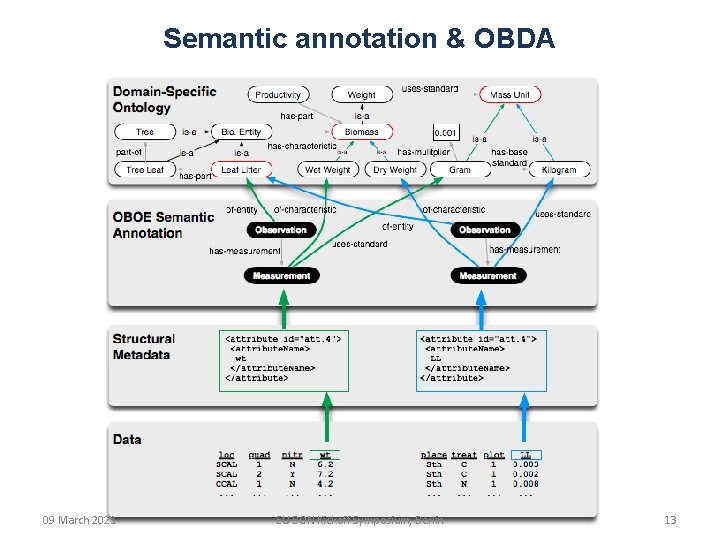
Semantic annotation & OBDA Attribute mappings 09 March 2021 EU BON Kickoff Symposium, Berlin 13
Morpho semantic annotation interface…
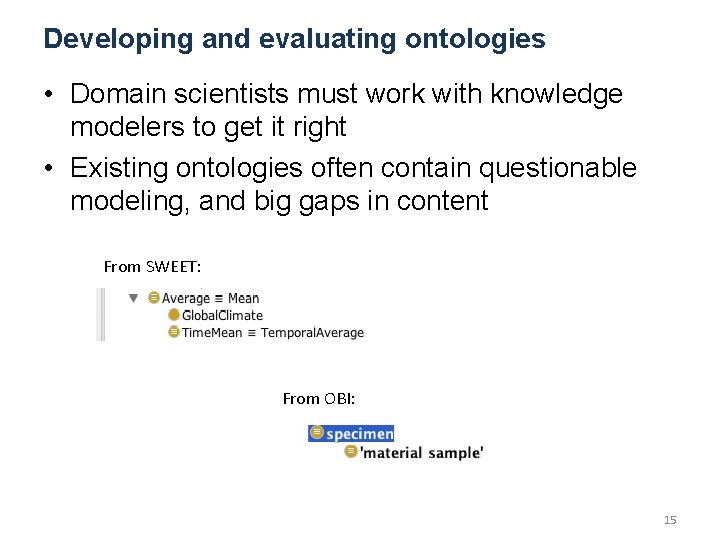
Developing and evaluating ontologies • Domain scientists must work with knowledge modelers to get it right • Existing ontologies often contain questionable modeling, and big gaps in content From SWEET: From OBI: 15
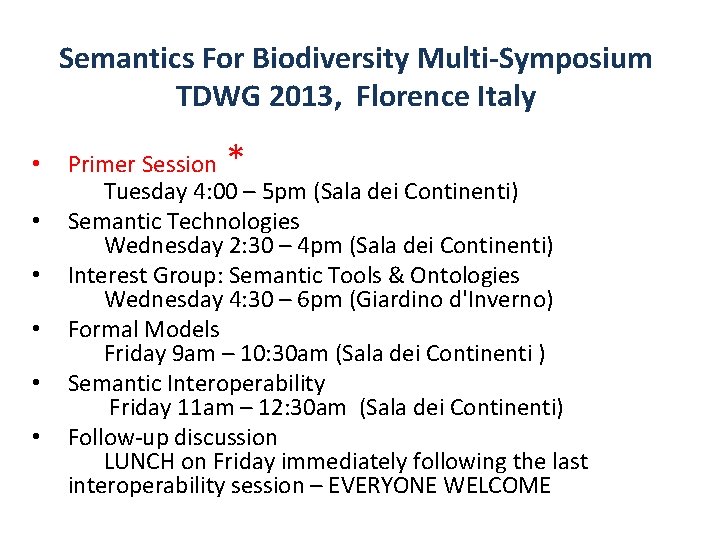
Semantics For Biodiversity Multi-Symposium TDWG 2013, Florence Italy • • • * Primer Session Tuesday 4: 00 – 5 pm (Sala dei Continenti) Semantic Technologies Wednesday 2: 30 – 4 pm (Sala dei Continenti) Interest Group: Semantic Tools & Ontologies Wednesday 4: 30 – 6 pm (Giardino d'Inverno) Formal Models Friday 9 am – 10: 30 am (Sala dei Continenti ) Semantic Interoperability Friday 11 am – 12: 30 am (Sala dei Continenti) Follow-up discussion LUNCH on Friday immediately following the last interoperability session – EVERYONE WELCOME
Acknowledgements This material is based upon work supported by: The National Science Foundation under Grant Numbers 9980154, 9904777, 0131178, 9905838, 0129792, and 0225676, 0743429, 0753144. The National Center for Ecological Analysis and Synthesis, a Center funded by NSF (Grant Number 0072909), the University of California, and the UC Santa Barbara campus. PBI Collaborators: NCEAS, San Diego Supercomputer Center, University of Kansas (Center for Biodiversity Research), University of New Mexico (Long Term Ecological Research Network Office)
- Slides: 17