
The Semantic Blessings of XSLT Diederik Gerth van
The Semantic Blessings of XSLT Diederik Gerth van Wijk dg@doxatrix. nl XML Holland 2008 Planetarium Gaasperplas, Amsterdam, 20 november DOXATRIX
Intended audience Understands English Knows what XML is about Cares about meaning, processing and validation Does not need to know about XSLT Does not need to be a programmer But might be aware that computers need to be programmed Diederik Gerth van Wijk Semantic Blessings of XSLT 2
Semantic? Blessings? XSLT? XML is about the structure of a document Semantics are about “meaning” A schema can say that a document should have a title (structure) The documentation might add that a title is used for identification (unique within a set of documents), and give a clue about what the document is about (semantics) The words used in the title are really semantics Blessings are good, helpful, you want them What is XSLT? How can XSLT help you in adding, verifying and using semantic markup? Diederik Gerth van Wijk Semantic Blessings of XSLT 3
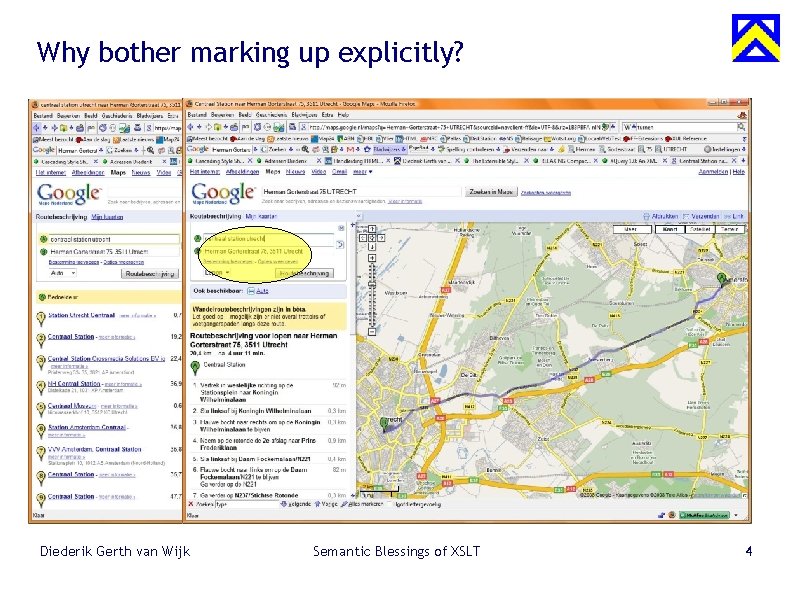
Why bother marking up explicitly? Diederik Gerth van Wijk Semantic Blessings of XSLT 4
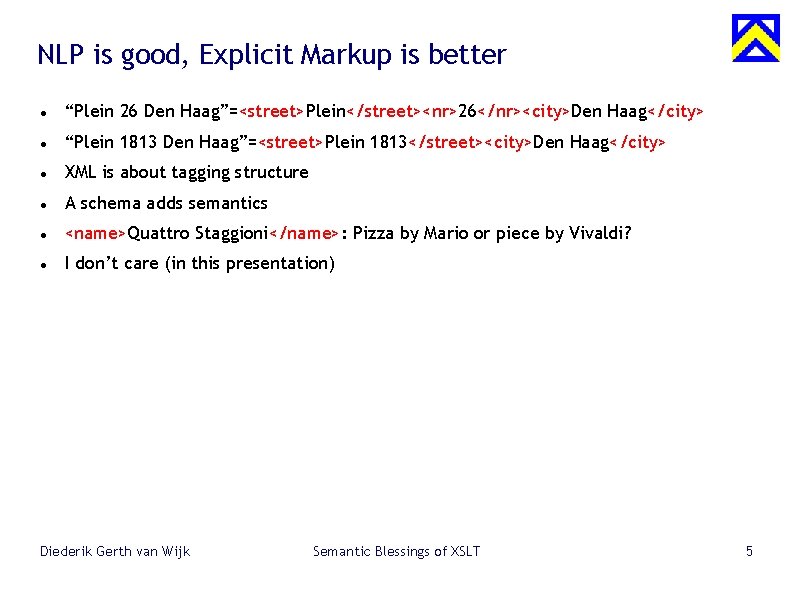
NLP is good, Explicit Markup is better “Plein 26 Den Haag”=<street>Plein</street><nr>26</nr><city>Den Haag</city> “Plein 1813 Den Haag”=<street>Plein 1813</street><city>Den Haag</city> XML is about tagging structure A schema adds semantics <name>Quattro Staggioni</name>: Pizza by Mario or piece by Vivaldi? I don’t care (in this presentation) Diederik Gerth van Wijk Semantic Blessings of XSLT 5
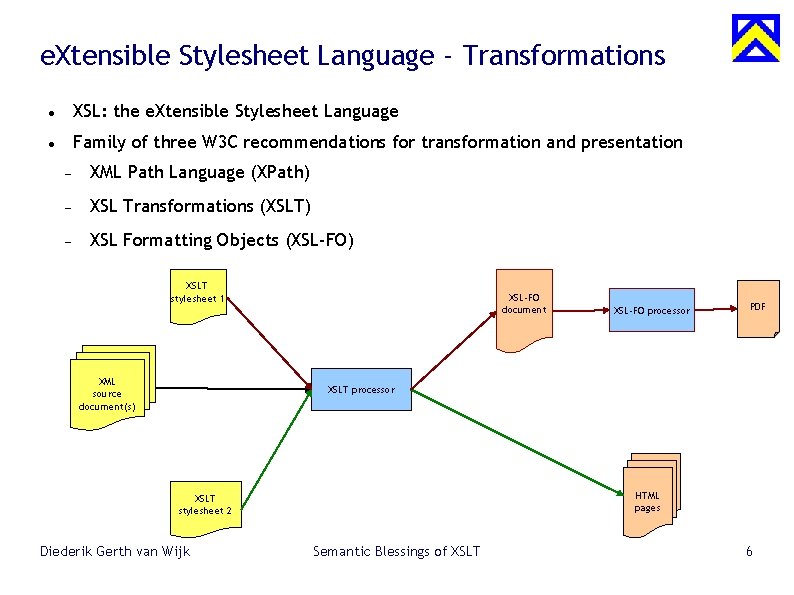
e. Xtensible Stylesheet Language - Transformations XSL: the e. Xtensible Stylesheet Language Family of three W 3 C recommendations for transformation and presentation XML Path Language (XPath) XSL Transformations (XSLT) XSL Formatting Objects (XSL-FO) XSLT stylesheet 1 XML source document(s) XSL-FO document XSL-FO processor PDF XSLT processor HTML pages XSLT stylesheet 2 Diederik Gerth van Wijk Semantic Blessings of XSLT 6
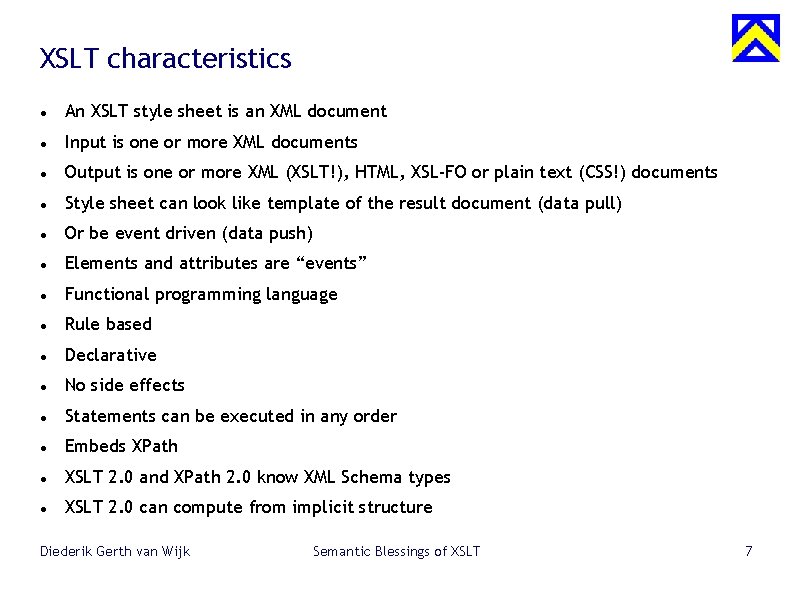
XSLT characteristics An XSLT style sheet is an XML document Input is one or more XML documents Output is one or more XML (XSLT!), HTML, XSL-FO or plain text (CSS!) documents Style sheet can look like template of the result document (data pull) Or be event driven (data push) Elements and attributes are “events” Functional programming language Rule based Declarative No side effects Statements can be executed in any order Embeds XPath XSLT 2. 0 and XPath 2. 0 know XML Schema types XSLT 2. 0 can compute from implicit structure Diederik Gerth van Wijk Semantic Blessings of XSLT 7
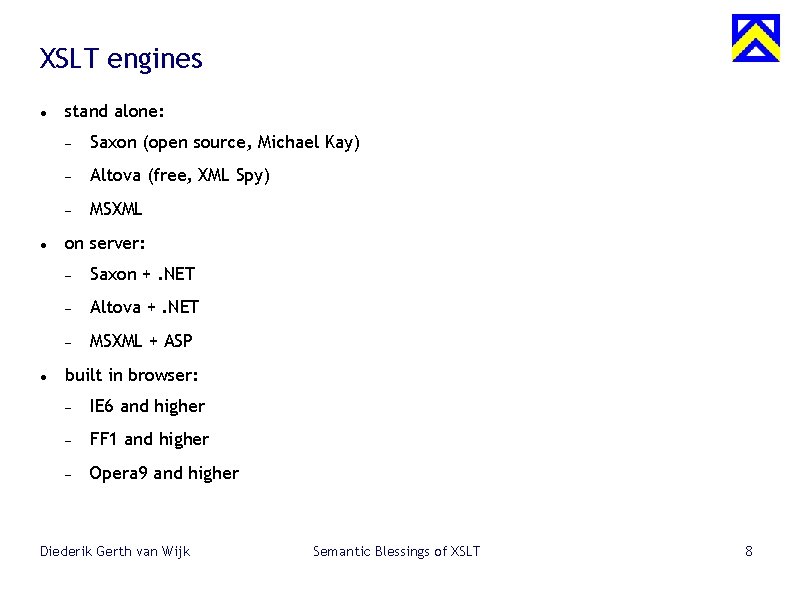
XSLT engines stand alone: Saxon (open source, Michael Kay) Altova (free, XML Spy) MSXML on server: Saxon +. NET Altova +. NET MSXML + ASP built in browser: IE 6 and higher FF 1 and higher Opera 9 and higher Diederik Gerth van Wijk Semantic Blessings of XSLT 8
What’s the competition? CSS (Cascading Style Sheets) Easier, simpler Don’t transform Perl, Python, Java. Script, C(++), (V)Basic Generic programming or scripting languages No built in knowledge of XML, but lots of libraries for DOM or SAX JSP, ASP, PHP Server side processing Not really XML aware Little or no transformation IS-10179 DSSSL: Document Style Semantics and Specification Language SGML based Rarely used Diederik Gerth van Wijk Semantic Blessings of XSLT 9
XSLT and semantics. . . XML elements describe what the content is (semantics) XSLT stylesheets what to do (processing) with them How can a processing stylesheet be a semantic blessing? Diederik Gerth van Wijk Semantic Blessings of XSLT 10
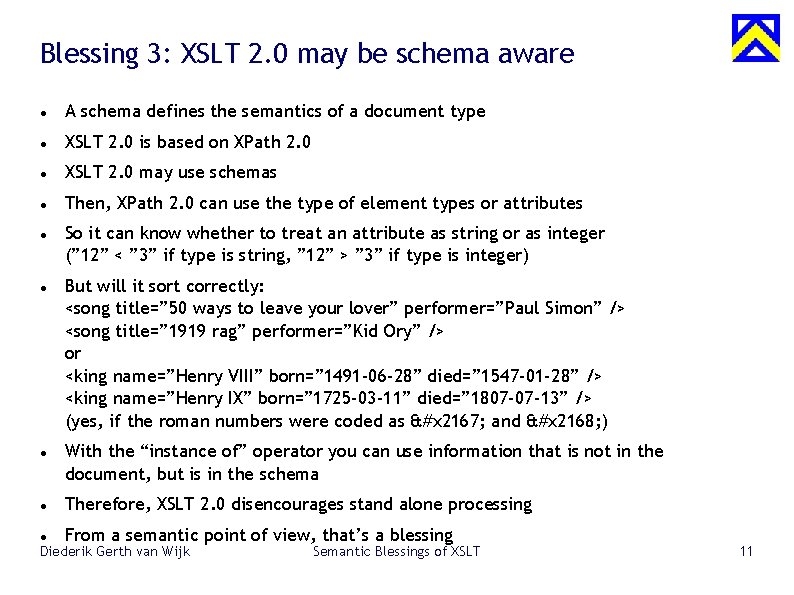
Blessing 3: XSLT 2. 0 may be schema aware A schema defines the semantics of a document type XSLT 2. 0 is based on XPath 2. 0 XSLT 2. 0 may use schemas Then, XPath 2. 0 can use the type of element types or attributes So it can know whether to treat an attribute as string or as integer (” 12” < ” 3” if type is string, ” 12” > ” 3” if type is integer) But will it sort correctly: <song title=” 50 ways to leave your lover” performer=”Paul Simon” /> <song title=” 1919 rag” performer=”Kid Ory” /> or <king name=”Henry VIII” born=” 1491 -06 -28” died=” 1547 -01 -28” /> <king name=”Henry IX” born=” 1725 -03 -11” died=” 1807 -07 -13” /> (yes, if the roman numbers were coded as &#x 2167; and &#x 2168; ) With the “instance of” operator you can use information that is not in the document, but is in the schema Therefore, XSLT 2. 0 disencourages stand alone processing From a semantic point of view, that’s a blessing Diederik Gerth van Wijk Semantic Blessings of XSLT 11
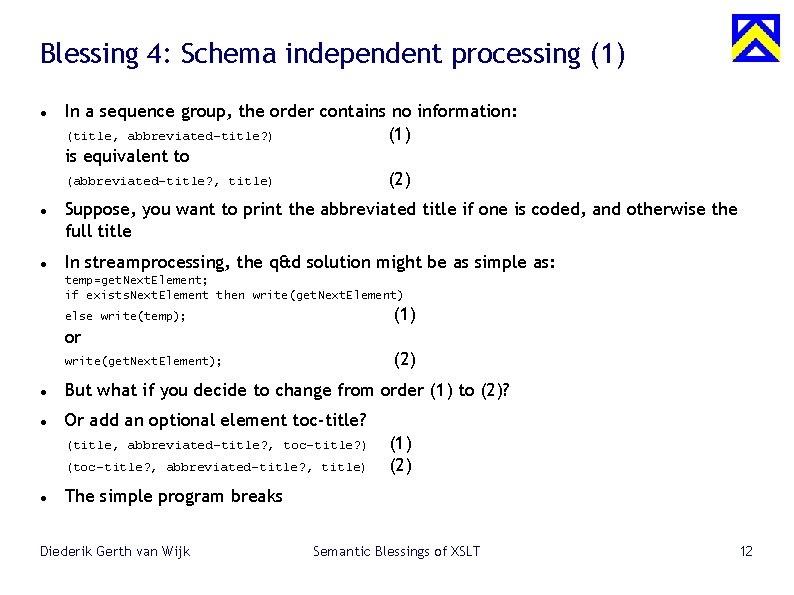
Blessing 4: Schema independent processing (1) In a sequence group, the order contains no information: (title, abbreviated-title? ) (1) is equivalent to (abbreviated-title? , title) (2) Suppose, you want to print the abbreviated title if one is coded, and otherwise the full title In streamprocessing, the q&d solution might be as simple as: temp=get. Next. Element; if exists. Next. Element then write(get. Next. Element) (1) else write(temp); or (2) write(get. Next. Element); But what if you decide to change from order (1) to (2)? Or add an optional element toc-title? (title, abbreviated-title? , toc-title? ) (toc-title? , abbreviated-title? , title) (1) (2) The simple program breaks Diederik Gerth van Wijk Semantic Blessings of XSLT 12
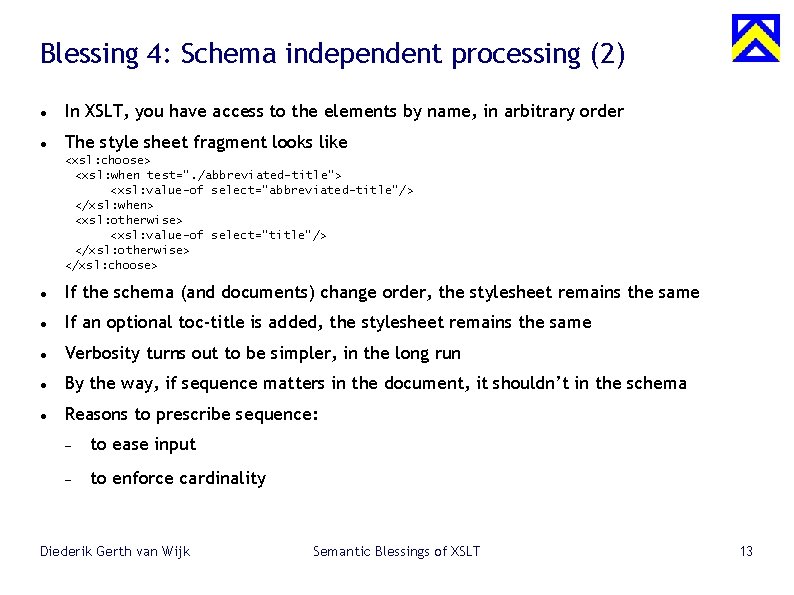
Blessing 4: Schema independent processing (2) In XSLT, you have access to the elements by name, in arbitrary order The style sheet fragment looks like <xsl: choose> <xsl: when test=". /abbreviated-title"> <xsl: value-of select="abbreviated-title"/> </xsl: when> <xsl: otherwise> <xsl: value-of select="title"/> </xsl: otherwise> </xsl: choose> If the schema (and documents) change order, the stylesheet remains the same If an optional toc-title is added, the stylesheet remains the same Verbosity turns out to be simpler, in the long run By the way, if sequence matters in the document, it shouldn’t in the schema Reasons to prescribe sequence: to ease input to enforce cardinality Diederik Gerth van Wijk Semantic Blessings of XSLT 13
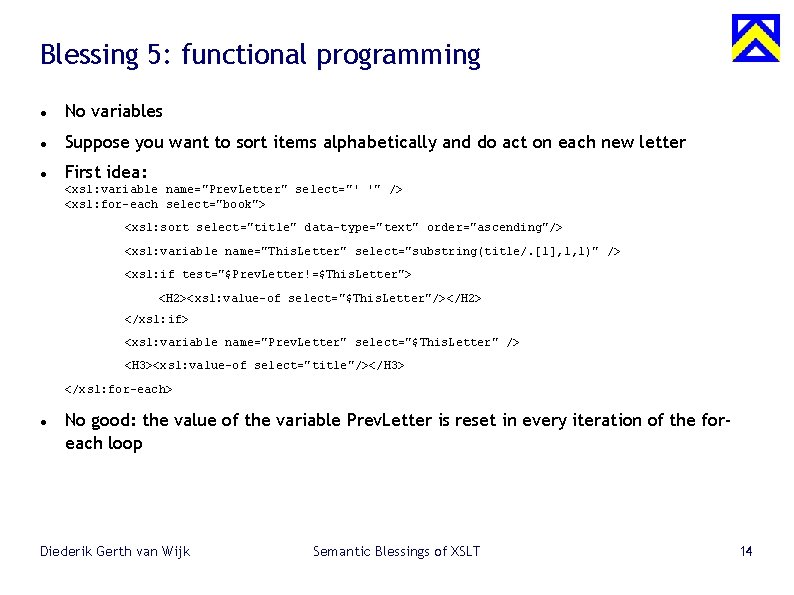
Blessing 5: functional programming No variables Suppose you want to sort items alphabetically and do act on each new letter First idea: <xsl: variable name="Prev. Letter" select="' '" /> <xsl: for-each select="book"> <xsl: sort select="title" data-type="text" order="ascending"/> <xsl: variable name="This. Letter" select="substring(title/. [1], 1, 1)" /> <xsl: if test="$Prev. Letter!=$This. Letter"> <H 2><xsl: value-of select="$This. Letter"/></H 2> </xsl: if> <xsl: variable name="Prev. Letter" select="$This. Letter" /> <H 3><xsl: value-of select="title"/></H 3> </xsl: for-each> No good: the value of the variable Prev. Letter is reset in every iteration of the foreach loop Diederik Gerth van Wijk Semantic Blessings of XSLT 14
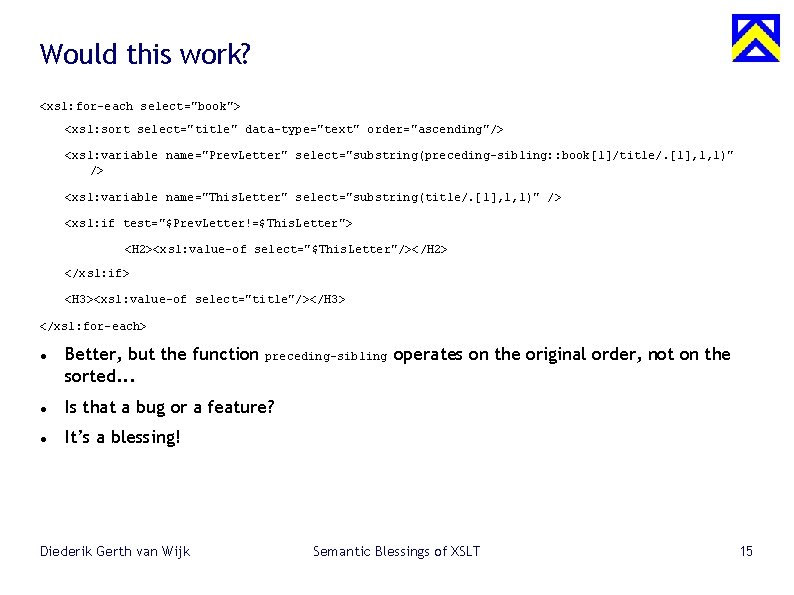
Would this work? <xsl: for-each select="book"> <xsl: sort select="title" data-type="text" order="ascending"/> <xsl: variable name="Prev. Letter" select="substring(preceding-sibling: : book[1]/title/. [1], 1, 1)" /> <xsl: variable name="This. Letter" select="substring(title/. [1], 1, 1)" /> <xsl: if test="$Prev. Letter!=$This. Letter"> <H 2><xsl: value-of select="$This. Letter"/></H 2> </xsl: if> <H 3><xsl: value-of select="title"/></H 3> </xsl: for-each> Better, but the function sorted. . . preceding-sibling Is that a bug or a feature? It’s a blessing! Diederik Gerth van Wijk operates on the original order, not on the Semantic Blessings of XSLT 15
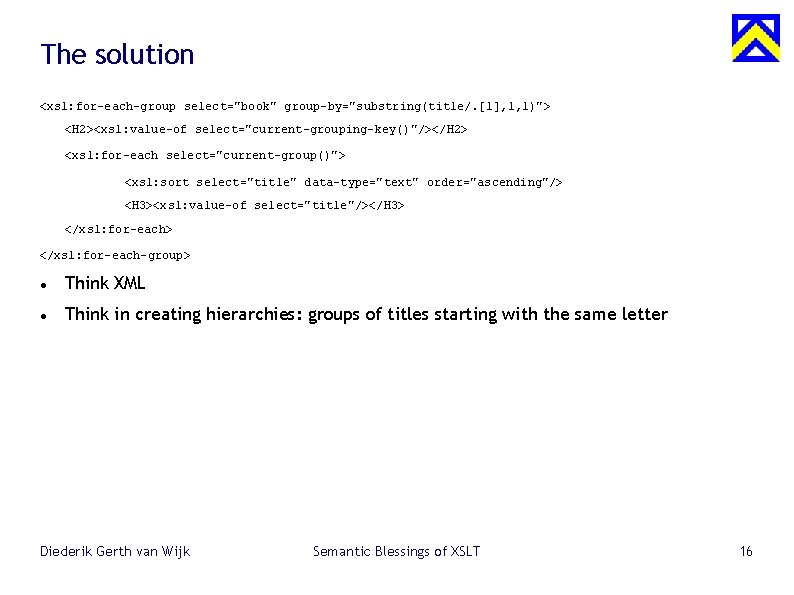
The solution <xsl: for-each-group select="book" group-by="substring(title/. [1], 1, 1)"> <H 2><xsl: value-of select="current-grouping-key()"/></H 2> <xsl: for-each select="current-group()"> <xsl: sort select="title" data-type="text" order="ascending"/> <H 3><xsl: value-of select="title"/></H 3> </xsl: for-each-group> Think XML Think in creating hierarchies: groups of titles starting with the same letter Diederik Gerth van Wijk Semantic Blessings of XSLT 16
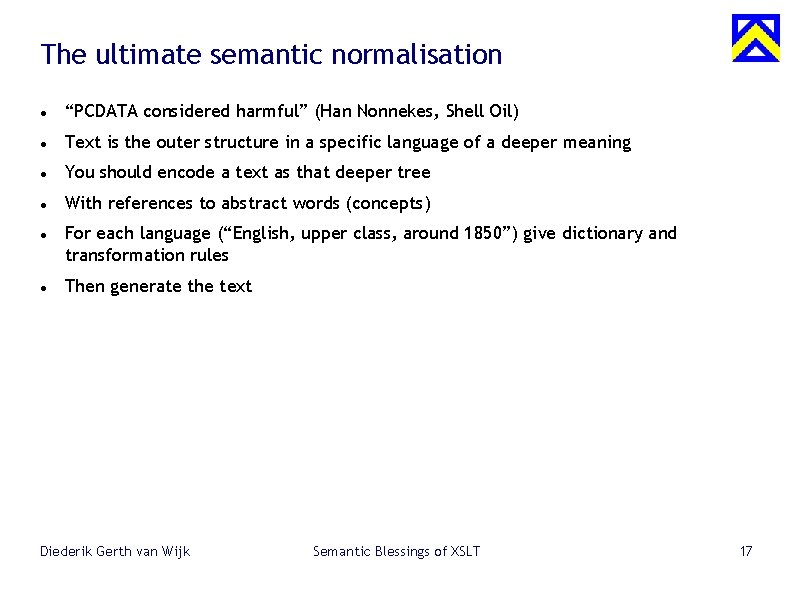
The ultimate semantic normalisation “PCDATA considered harmful” (Han Nonnekes, Shell Oil) Text is the outer structure in a specific language of a deeper meaning You should encode a text as that deeper tree With references to abstract words (concepts) For each language (“English, upper class, around 1850”) give dictionary and transformation rules Then generate the text Diederik Gerth van Wijk Semantic Blessings of XSLT 17
Questions? Ask me now Ask me during lunch or tea break Ask me during buffet Mail dg@doxatrix. nl Presentation can be downloaded from www. xmlholland 2008. nl www. doxatrix. nl/dg Diederik Gerth van Wijk Semantic Blessings of XSLT 18
Diederik Gerth van Wijk Semantic Blessings of XSLT 19
- Slides: 19