
The Selkirk Settlement Horizons pages 143 148 Background

The Selkirk Settlement Horizons pages 143 - 148
Background � 1700 s - Many tenant farmers in Scotland were being evicted because landowners wanted to convert their farms to sheep pasture. � Sheep brought more money than the rent paid by tenant farmers.

The Earl of Selkirk � Thomas Douglas, the fifth Earl of Selkirk was determined to help the displaced farmers. � Selkirk was a director for the HBC, and he used his position to acquire 300, 000 square km in Red River for displaced Scottish tenant farmers. � Scottish farmers would receive land to farm, and the food would be used by the HBC – this was cheaper than the HBC shipping food from England.

The Selkirk Grant Modern map of the area
The Selkirk Settlement � The HBC believed they had a right to the land because it was part of Rupert’s Land. However, there were First Nations and Metis living in the area. � 1811 – The Selkirk Grant was created; 36 Scottish and Irish labourers left England under the leadership of Miles Macdonell. � The journey did not go well – arrived in York Factory late; arrived in Red River Aug. 1812. Had to rely on pemmican to get through the winter.
The Selkirk Settlement � Oct 1812 – 100 men, women, children arrive in Red River. � Spring 1814 – 83 more colonists arrive. � The colony is not going well. Between 1812 – 1814 harvests failed, and colonists relied on existing food to survive.
The Pemmican Proclamation � The Metis in the area made and sold Pemmican to the NWC for money. � Jan 1814 – Miles Macdonell (HBC) issues the Pemmican Proclamation – a law that prevents the export of Pemmican outside of the Red River Valley. � Why did Miles Macdonell make this Proclamation? � To prevent food from leaving so that more food for the Selkirk colonists would be available
The Pemmican Proclamation � How do you think the Metis felt about this law? � They do not like it because selling Pemmican is a major income source. � The law increased tensions between the two companies (HBC & NWC)
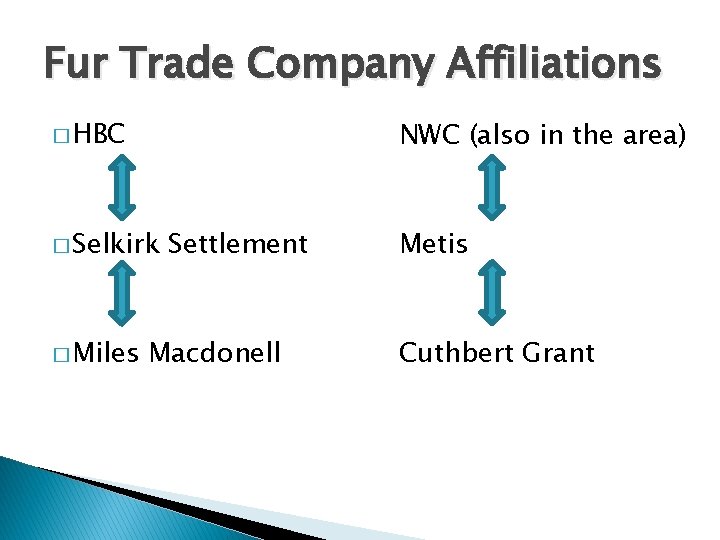
Fur Trade Company Affiliations � HBC NWC (also in the area) � Selkirk � Miles Settlement Macdonell Metis Cuthbert Grant
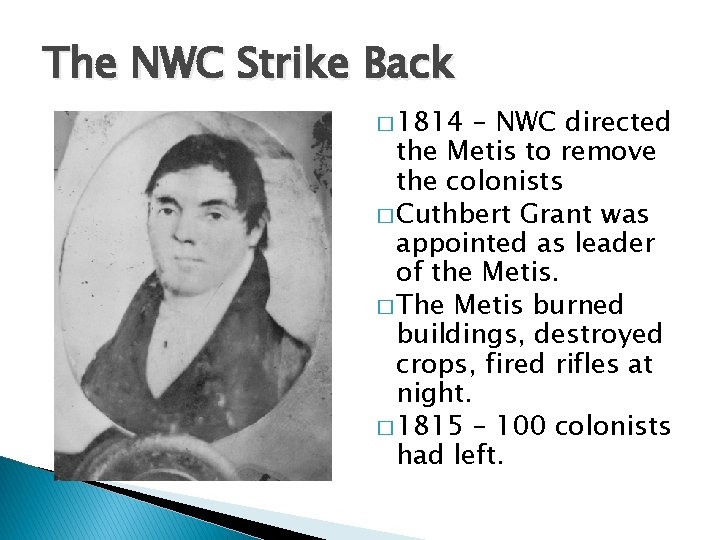
The NWC Strike Back � 1814 – NWC directed the Metis to remove the colonists � Cuthbert Grant was appointed as leader of the Metis. � The Metis burned buildings, destroyed crops, fired rifles at night. � 1815 – 100 colonists had left.
� The Metis recognized they were a powerful force that could fight for their rights and land.
The Battle of Seven Oaks � 1816 – Colin Robertson (HBC) led the colonists back to Red River. He tried to make peace with the NWC. � However, Robert Semple (HBC), the new governor of the colony, arrived and ordered the burning of Fort Gibralter – an abandoned NWC fort. � May 1816 – Cuthbert Grant (NWC) raided HBC York boats. A large supply of pemmican was taken.
The Battle of Seven Oaks/Frog Plain � Grant (NWC) tried to move the pemmican to Lake Winnipeg without being seen. � On June 19, 1816, Grant and the Metis were spotted. � Semple (HBC) and 28 men rode out to confront the Metis. � A parlay was attempted; however, a colonist fired at the Metis, and a gunfight began.
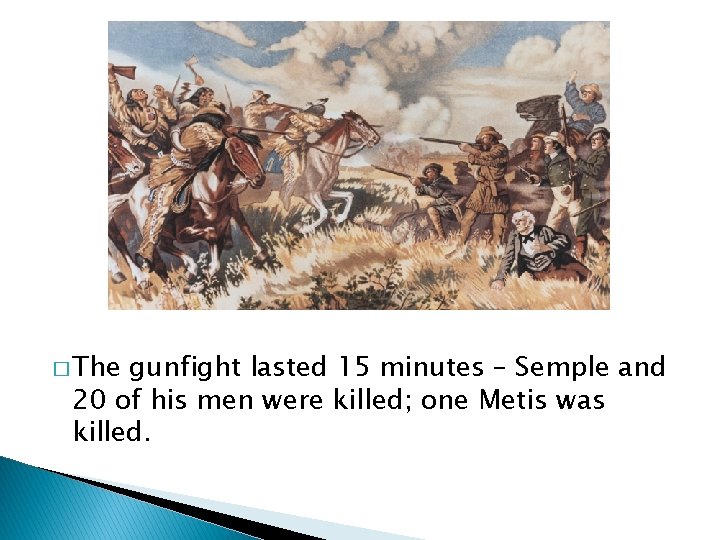
� The gunfight lasted 15 minutes – Semple and 20 of his men were killed; one Metis was killed.
Aftermath � Selkirk travelled to the Red River Valley with 100 Swiss soldiers and took control of the area. � Colonists returned to the settlement. � Selkirk signed treaties with the Anishinabe and Cree Nation to lease the land. � The inhabitants of Red River (colonists, HBC and NWC employees, Metis, First Nations) live in peace until the late 1860 s.
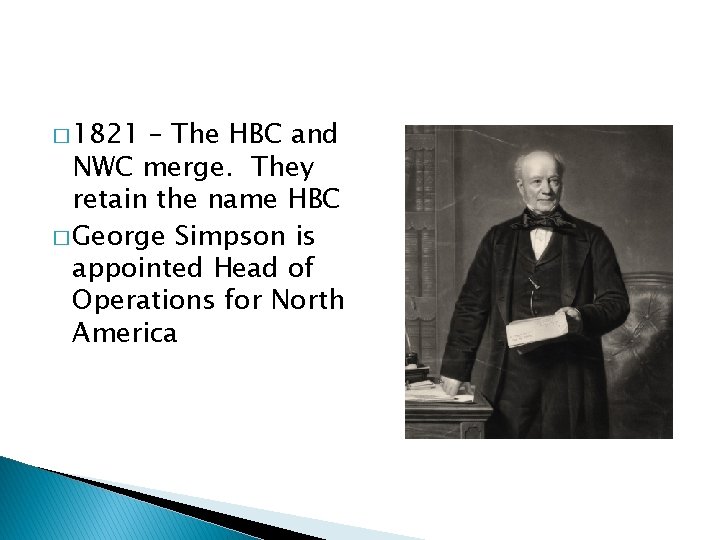
� 1821 – The HBC and NWC merge. They retain the name HBC � George Simpson is appointed Head of Operations for North America
References � All information and most illustrations are from Horizons pages 143 to 147. � Thomas Douglas portrait taken from Wikipedia.
- Slides: 17