
The SelfDirected Violence Classification System SDVCS The Utility


- Slides: 45
The Self-Directed Violence Classification System (SDVCS) The Utility of a Common Language for Suicidal Ideation and Behavior Rocky Mountain Mental Illness, Research, Education and Clinical Center (MIRECC)
Disclosure Statement This presentation is based on work supported, in part, by the Department of Veterans Affairs, but does not necessarily represent the views of the Department of Veterans Affairs or the United States Government.
Training Overview Objective: to learn and begin using a new nomenclature for self-directed violence 1. Why is it important to have a common language? 2. A Solution to the Problem 3. What does SDVCS look like? 4. How do I use it?
1. The Language of Self-Directed Violence Why is it important to have a common language?
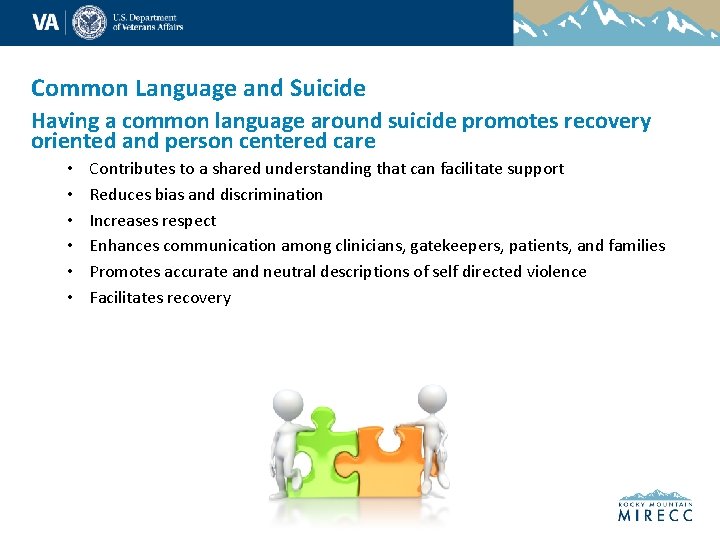
Common Language and Suicide • Having a common language around suicide promotes recovery Having a common language around oriented and person centered care suicide promotes recovery oriented and person centered care • • • Contributes to a shared understanding that can that facilitate • Contributes to a shared understanding can support facilitate support Reduces bias and • Reduces biasdiscrimination and discrimination Increases respect • Increases respect Enhances communication among clinicians, gatekeepers, patients, and families • Enhances communication among clinicians, gatekeepers, Promotes accurate and neutral descriptions of self directed violence patients, and families • Promotes accurate and neutral descriptions of self directed Facilitates recovery violence • Facilitates recovery
Why do we need this for self-directed violence? A healthy 24 -year-old female is brought by her boyfriend to the Emergency Department after she ingested all remaining pills in a bottle of regular strength Tylenol. She estimates there were 4 to 6 pills total in the bottle and she reports no ill effects. Lab tests done at the time of admission to the ED reported her acetaminophen level within therapeutic range. During triage, she states that before she took the pills she was upset from arguing with her boyfriend and just wanted to die. She feels better now and requests to go home. What would you call this behavior? q q q Gesture? Threat? Acting Out/Manipulation? Attempt? Cry for help? Other? What criteria did you use to decide? q q q Lethality of method? Expressed intent? Number of pills ingested? Lab results? Other?
The Problem Aborted Suicide Attempted Suicide Committed Suicide Cry for Help Death Rehearsals Deliberate Self-Harm Failed Attempts Failed Completion Failed Suicide Intentional Self-Murder Intentional Suicide Non-Suicidal Self-injury Parasuicide Rational Suicide Self-Harm Behavior Self-Inflicted Behavior Self-Injurious Behavior Suicidal Episode Suicidal Gesture Suicidal Manipulation Suicidal Rehearsal Suicide Victim Successful Attempt Successful Suicide Unintentional Suicide
Implications of the Problem Clinical • Impedes communication between and among clinicians, patients and patients’ families Research • Introduces challenges for conducting longitudinal research with those who have attempted suicide Public Health • Difficult to accurately count the number of suicides and suicide attempts that occur annually Public Policy • Difficult to establish suicide as a major public health problem that warrants investment of resources
2. A Solution to the Problem Nomenclature Classification System
What is a nomenclature? Nomenclature (def. ) - a set of terms that are: • Commonly understood • Widely acceptable • Comprehensive What is the purpose of a nomenclature? • Enhance clarity of communication • Have applicability across clinical settings • Be theory and culturally neutral • Use mutually exclusive terms that encompass the spectrum of thoughts and actions
What is a Classification System? • Classification Builds upon a nomenclature(e. g. , terminology) • “Exhaustive” categorization and breakdown of subtypes of related behaviors (e. g. , covers all possibilities) • Further differentiates amongst phenomena that appear to be similar by use of modifiers
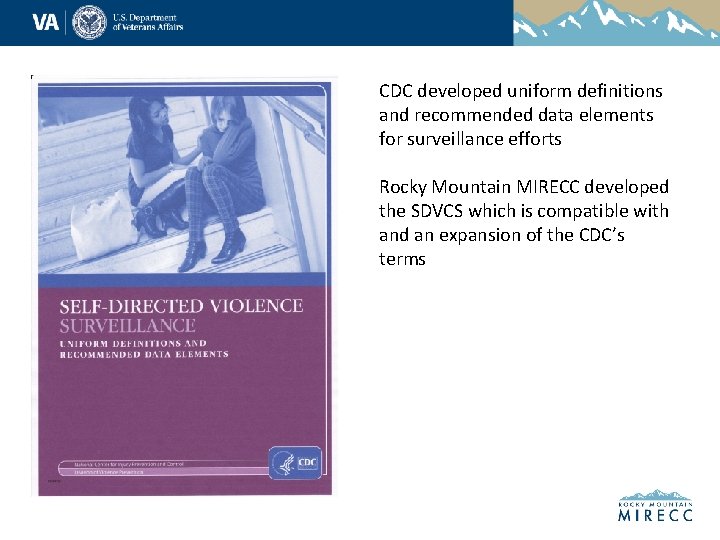
CDC developed uniform definitions and recommended data elements for surveillance efforts Rocky Mountain MIRECC developed the SDVCS which is compatible with and an expansion of the CDC’s terms
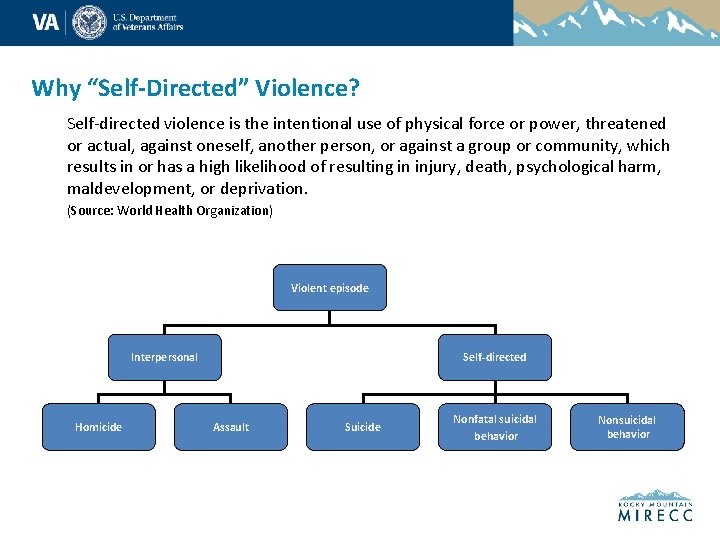
Why “Self-Directed” Violence? Self-directed violence is the intentional use of physical force or power, threatened or actual, against oneself, another person, or against a group or community, which results in or has a high likelihood of resulting in injury, death, psychological harm, maldevelopment, or deprivation. (Source: World Health Organization) Violent episode Interpersonal Homicide Self-directed Assault Suicide Nonfatal suicidal behavior Nonsuicidal behavior
3. What does SDVCS look like?
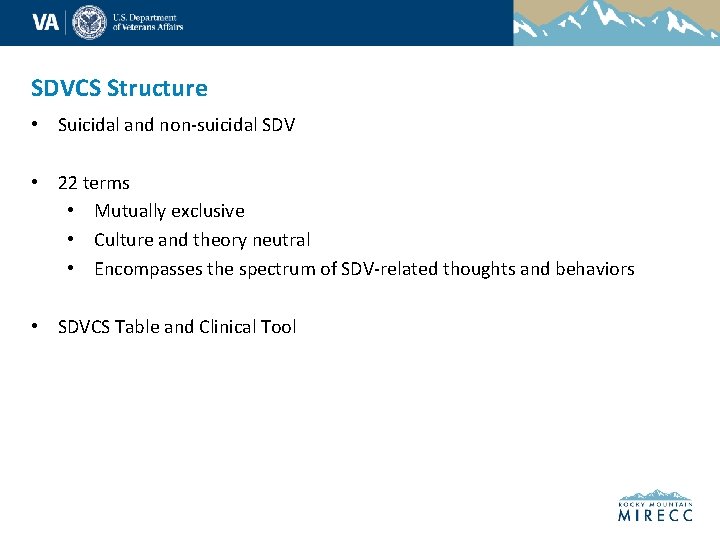
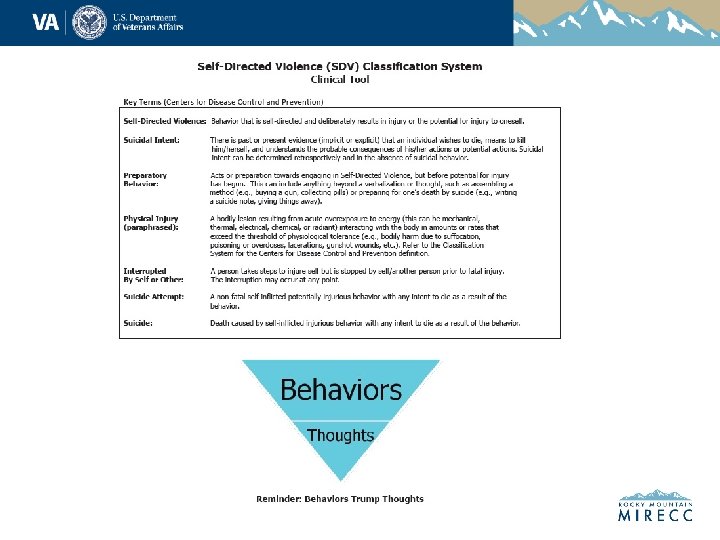
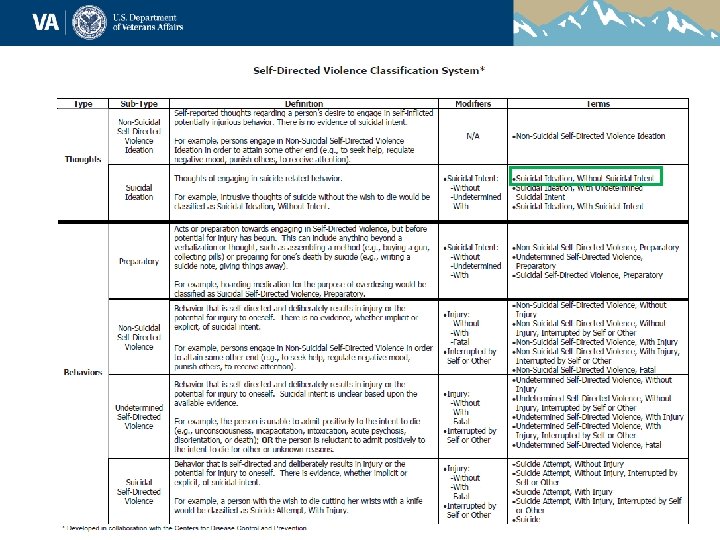
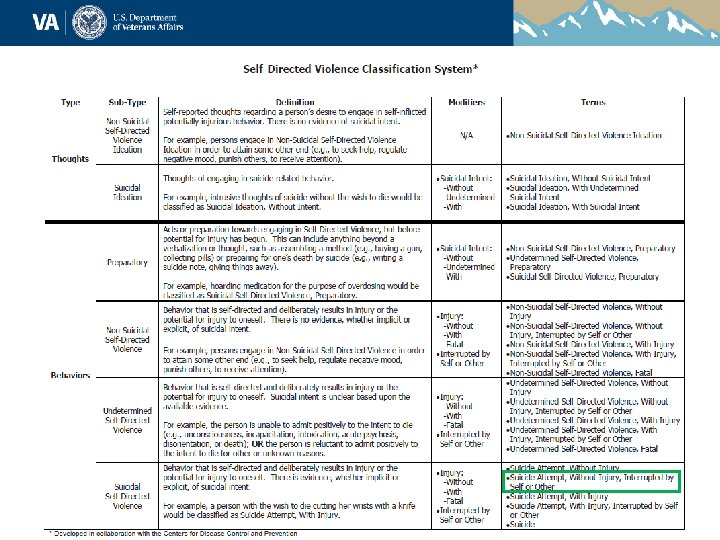
SDVCS Structure • Suicidal and non-suicidal SDV • 22 terms • Mutually exclusive • Culture and theory neutral • Encompasses the spectrum of SDV-related thoughts and behaviors • SDVCS Table and Clinical Tool
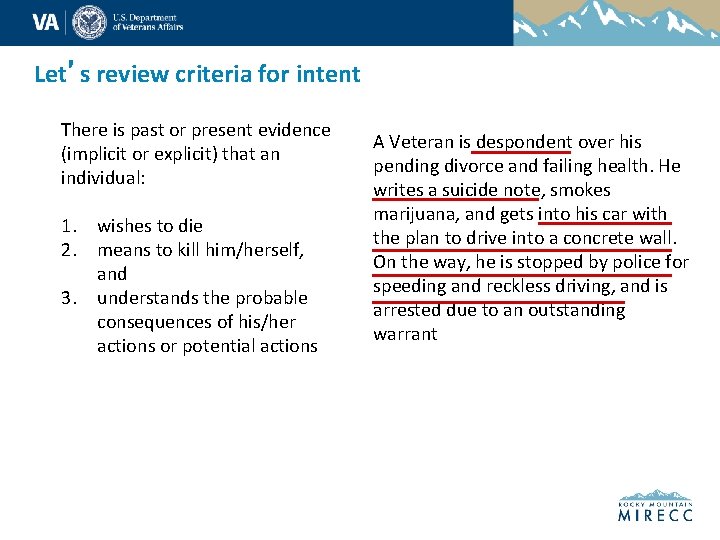
Key Concept- Suicidal Intent There is past or present evidence (implicit or explicit) that an individual: 1. Wishes to die 2. Means to kill him/herself, and 3. Understands the probable consequences of his/her actions or potential actions
4. How do I use it?
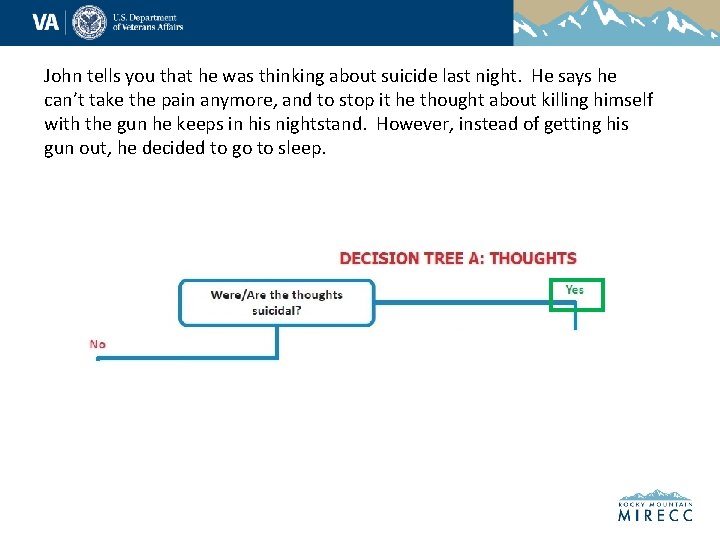
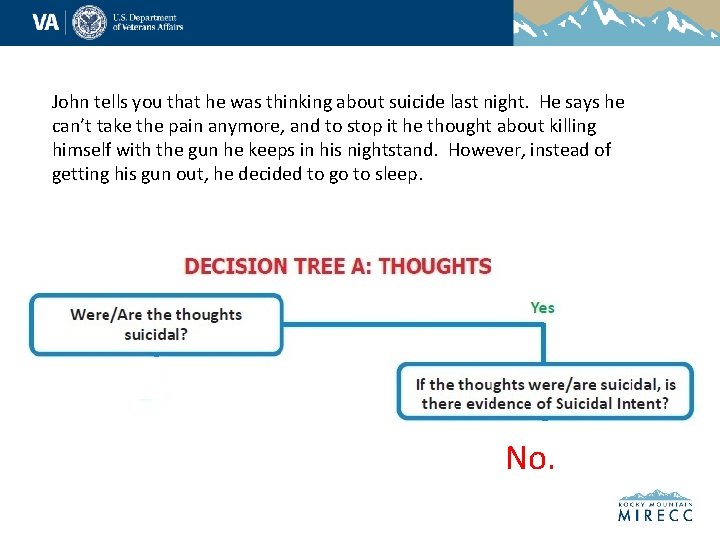
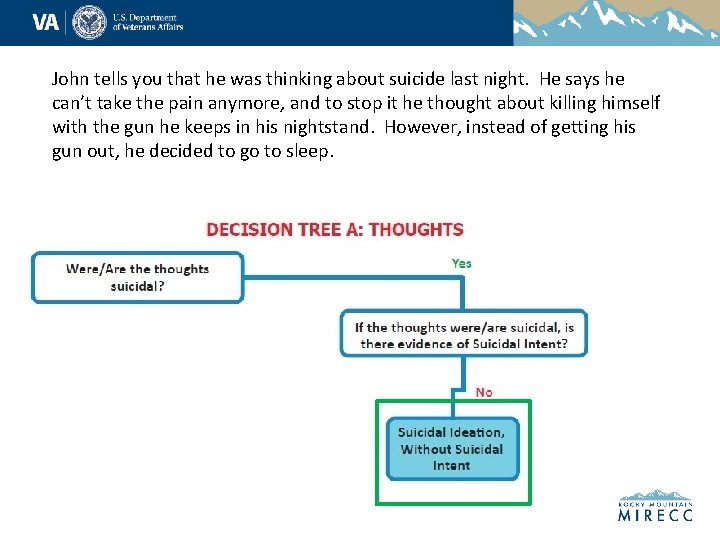
Example - John tells you that he was thinking about suicide last night. He says he can’t take the pain anymore, and to stop it he thought about killing himself with the gun he keeps in his nightstand. However, instead of getting his gun out, he decided to go to sleep.
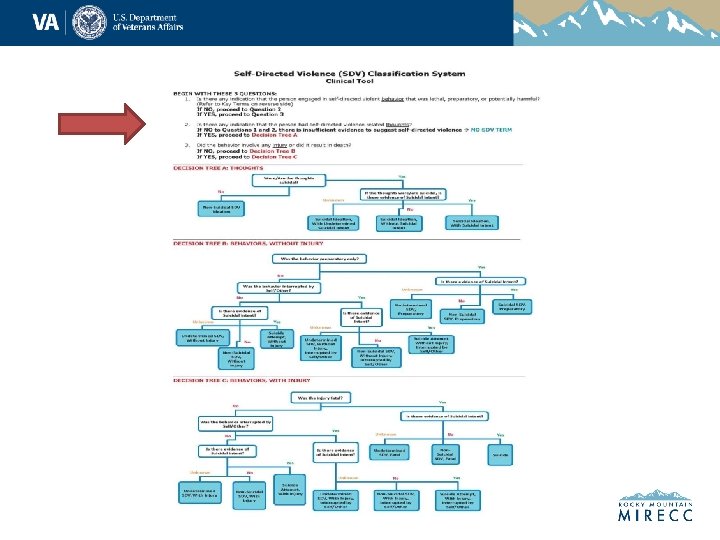
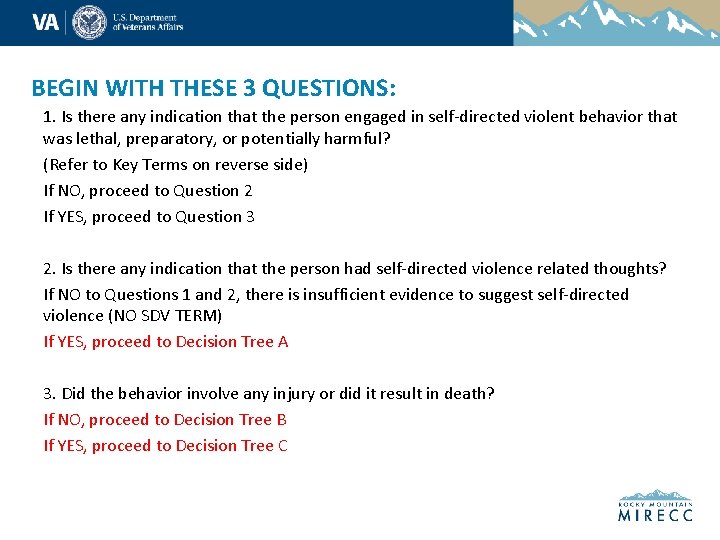
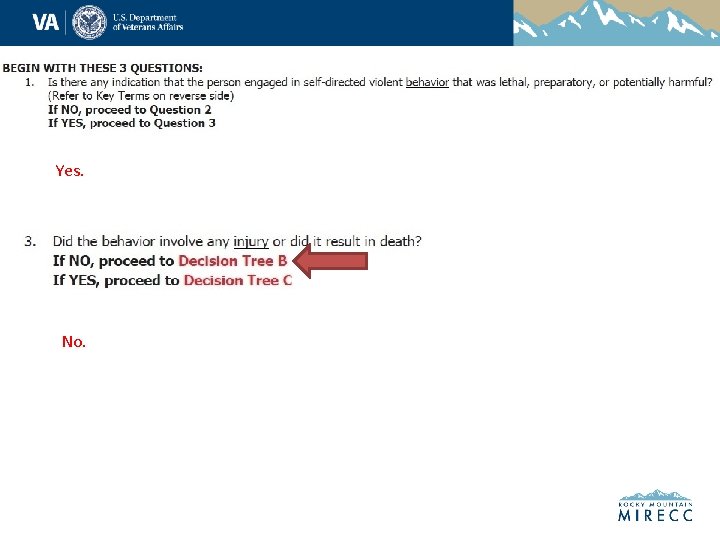
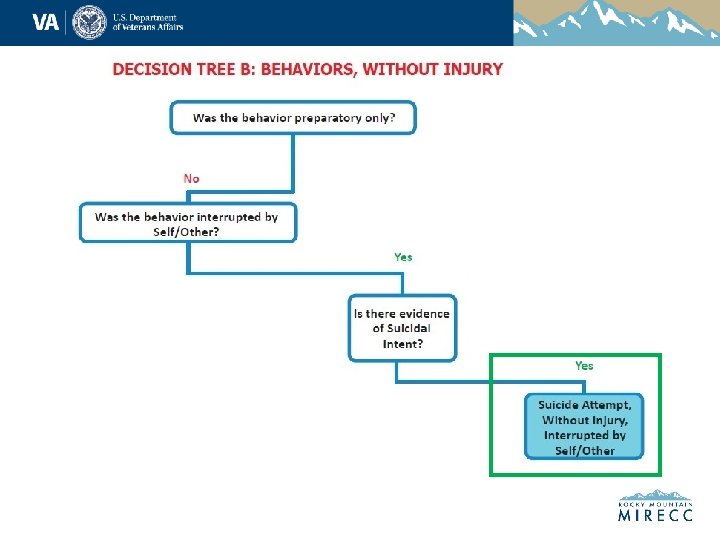
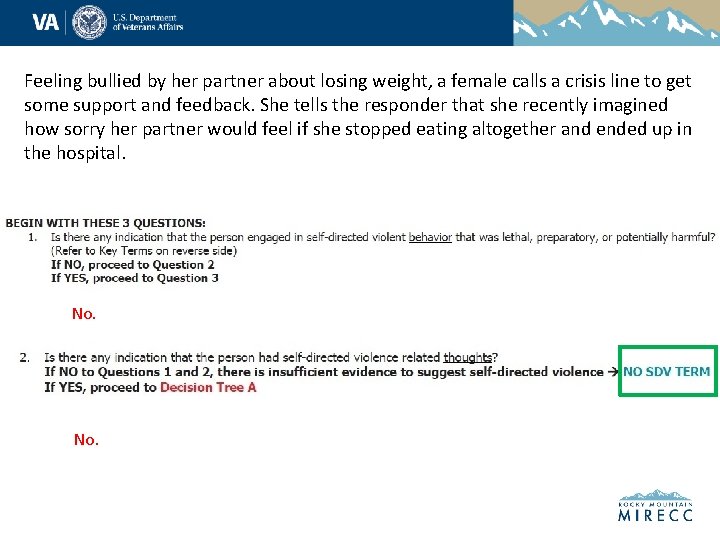
BEGIN WITH THESE 3 QUESTIONS: 1. Is there any indication that the person engaged in self-directed violent behavior that was lethal, preparatory, or potentially harmful? (Refer to Key Terms on reverse side) If NO, proceed to Question 2 If YES, proceed to Question 3 2. Is there any indication that the person had self-directed violence related thoughts? If NO to Questions 1 and 2, there is insufficient evidence to suggest self-directed violence (NO SDV TERM) If YES, proceed to Decision Tree A 3. Did the behavior involve any injury or did it result in death? If NO, proceed to Decision Tree B If YES, proceed to Decision Tree C
Example 1 1. Is there any indication that the person engaged in self-directed violent behavior that was lethal, preparatory, or potentially harmful? (Refer to Key Terms on reverse side) No. If NO, proceed to Question 2 If YES, proceed to Question 3
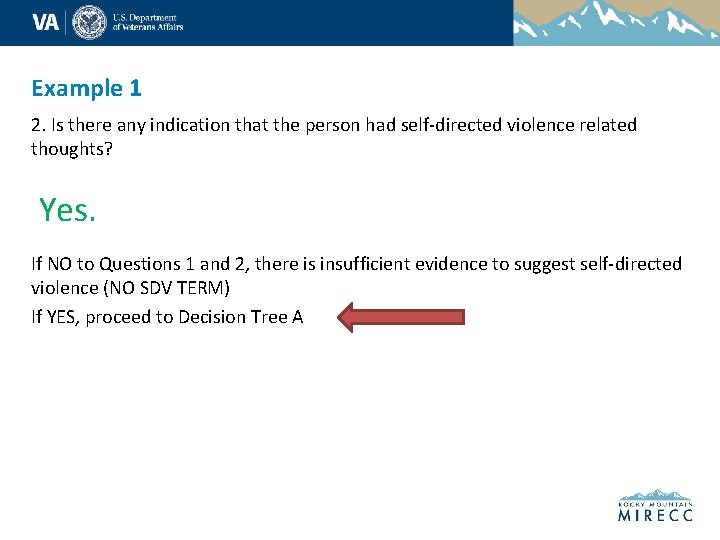
Example 1 2. Is there any indication that the person had self-directed violence related thoughts? Yes. If NO to Questions 1 and 2, there is insufficient evidence to suggest self-directed violence (NO SDV TERM) If YES, proceed to Decision Tree A
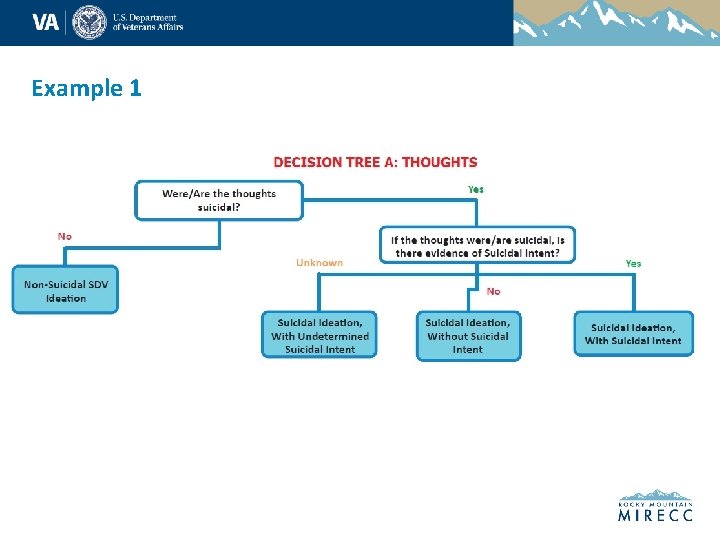
Example 1
John tells you that he was thinking about suicide last night. He says he can’t take the pain anymore, and to stop it he thought about killing himself with the gun he keeps in his nightstand. However, instead of getting his gun out, he decided to go to sleep.
John tells you that he was thinking about suicide last night. He says he can’t take the pain anymore, and to stop it he thought about killing himself with the gun he keeps in his nightstand. However, instead of getting his gun out, he decided to go to sleep. No.
John tells you that he was thinking about suicide last night. He says he can’t take the pain anymore, and to stop it he thought about killing himself with the gun he keeps in his nightstand. However, instead of getting his gun out, he decided to go to sleep.
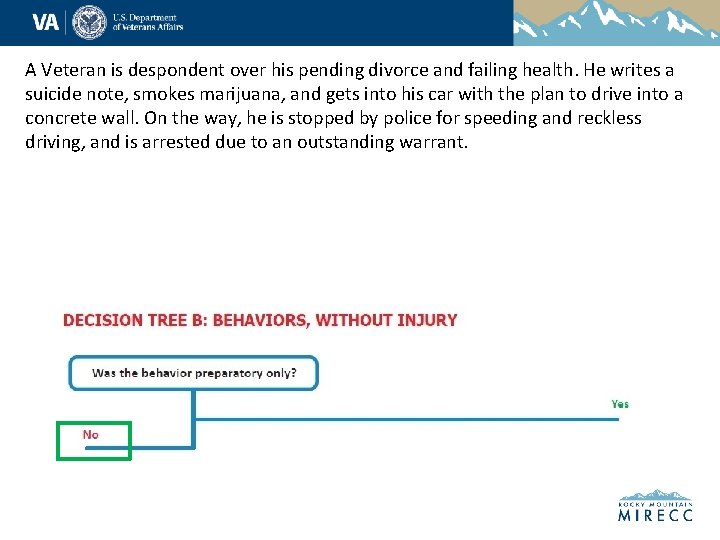
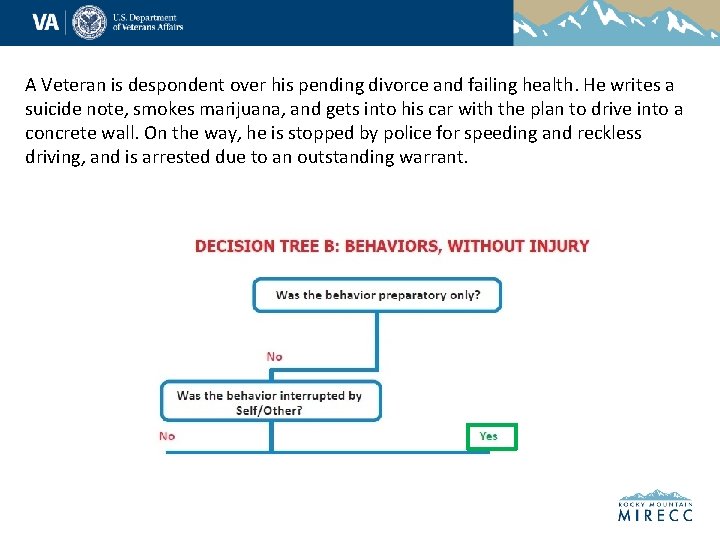
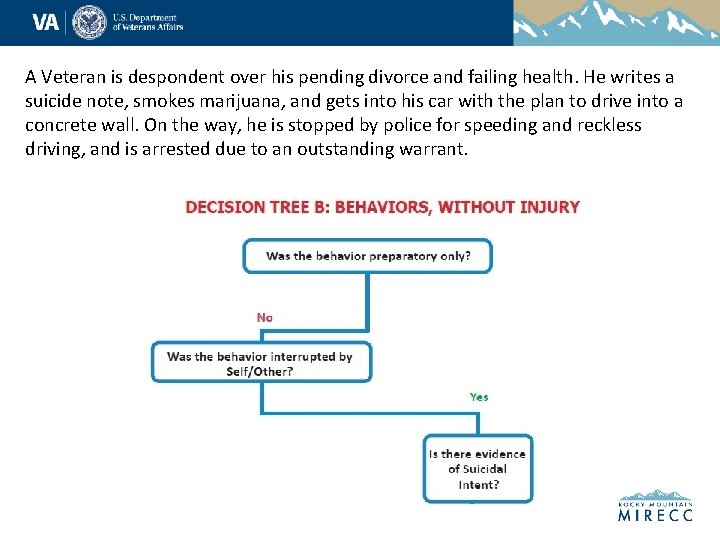
Example 2 A Veteran is despondent over his pending divorce and failing health. He writes a suicide note, smokes marijuana, and gets into his car with the plan to drive into a concrete wall. On the way, he is stopped by police for speeding and reckless driving, and is arrested due to an outstanding warrant.
Yes. No.
A Veteran is despondent over his pending divorce and failing health. He writes a suicide note, smokes marijuana, and gets into his car with the plan to drive into a concrete wall. On the way, he is stopped by police for speeding and reckless driving, and is arrested due to an outstanding warrant.
A Veteran is despondent over his pending divorce and failing health. He writes a suicide note, smokes marijuana, and gets into his car with the plan to drive into a concrete wall. On the way, he is stopped by police for speeding and reckless driving, and is arrested due to an outstanding warrant.
A Veteran is despondent over his pending divorce and failing health. He writes a suicide note, smokes marijuana, and gets into his car with the plan to drive into a concrete wall. On the way, he is stopped by police for speeding and reckless driving, and is arrested due to an outstanding warrant.
Let’s review criteria for intent There is past or present evidence (implicit or explicit) that an individual: 1. wishes to die 2. means to kill him/herself, and 3. understands the probable consequences of his/her actions or potential actions A Veteran is despondent over his pending divorce and failing health. He writes a suicide note, smokes marijuana, and gets into his car with the plan to drive into a concrete wall. On the way, he is stopped by police for speeding and reckless driving, and is arrested due to an outstanding warrant
Example- Rhonda Feeling bullied by her partner about losing weight, Rhonda calls a crisis line to get some support and feedback. She tells the responder that she recently imagined how sorry her partner would feel if she stopped eating altogether and ended up in the hospital.
Feeling bullied by her partner about losing weight, a female calls a crisis line to get some support and feedback. She tells the responder that she recently imagined how sorry her partner would feel if she stopped eating altogether and ended up in the hospital. No.
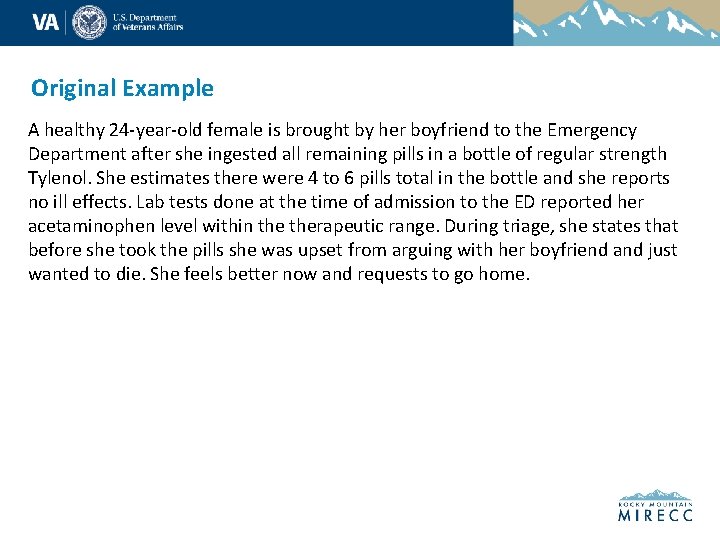
Original Example A healthy 24 -year-old female is brought by her boyfriend to the Emergency Department after she ingested all remaining pills in a bottle of regular strength Tylenol. She estimates there were 4 to 6 pills total in the bottle and she reports no ill effects. Lab tests done at the time of admission to the ED reported her acetaminophen level within therapeutic range. During triage, she states that before she took the pills she was upset from arguing with her boyfriend and just wanted to die. She feels better now and requests to go home.
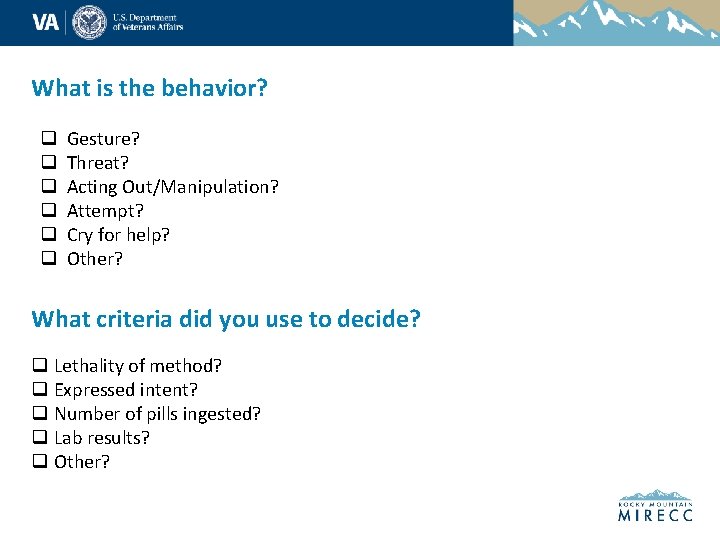
What is the behavior? q q q Gesture? Threat? Acting Out/Manipulation? Attempt? Cry for help? Other? What criteria did you use to decide? q Lethality of method? q Expressed intent? q Number of pills ingested? q Lab results? q Other?
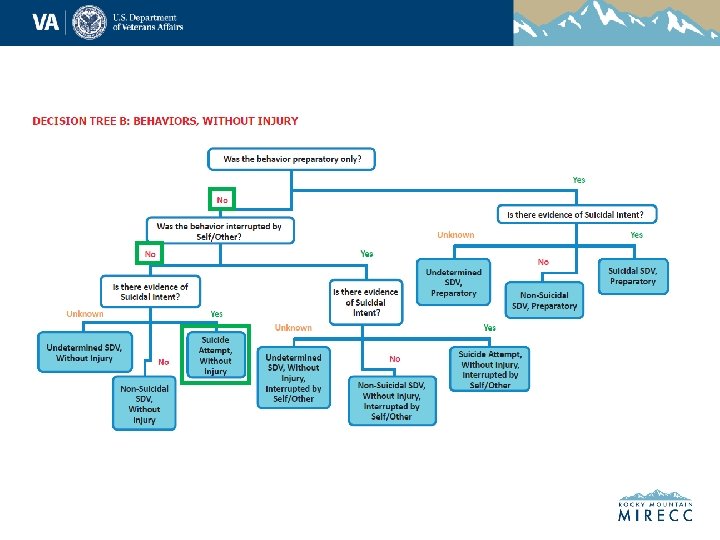
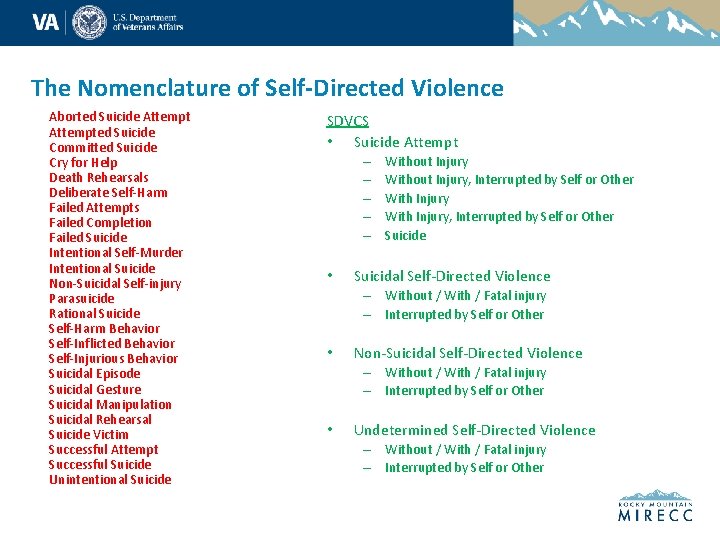
The Nomenclature of Self-Directed Violence Aborted Suicide Attempted Suicide Committed Suicide Cry for Help Death Rehearsals Deliberate Self-Harm Failed Attempts Failed Completion Failed Suicide Intentional Self-Murder Intentional Suicide Non-Suicidal Self-injury Parasuicide Rational Suicide Self-Harm Behavior Self-Inflicted Behavior Self-Injurious Behavior Suicidal Episode Suicidal Gesture Suicidal Manipulation Suicidal Rehearsal Suicide Victim Successful Attempt Successful Suicide Unintentional Suicide SDVCS • Suicide Attempt – – – • Without Injury, Interrupted by Self or Other With Injury, Interrupted by Self or Other Suicide Suicidal Self-Directed Violence – Without / With / Fatal injury – Interrupted by Self or Other • Non-Suicidal Self-Directed Violence – Without / With / Fatal injury – Interrupted by Self or Other • Undetermined Self-Directed Violence – Without / With / Fatal injury – Interrupted by Self or Other
See Rocky Mountain MIRECC SDVCS Website for further training https: //www. mirecc. va. gov/visn 19/education /nomenclature. asp
Thank you! Questions/Comments? http: //www. mirecc. va. gov/visn 19
References Brenner, L. A. , Bresbears, R. E. , Betthauser, L. E. , Bellon, K. K. , Holman, E. , Harwood, J. E. , … Nagamoto, H. T. (2011). Implementation of a suicide nomenclature within two VA healthcare settings. Journal of Clinical Psychology in Medical Settings, 18, 116 -128.