
THE SECOND WORLD WAR PART THREE NEVER SURRENDER
- Slides: 20
THE SECOND WORLD WAR PART THREE: NEVER SURRENDER by Mark Tibbles MSc.
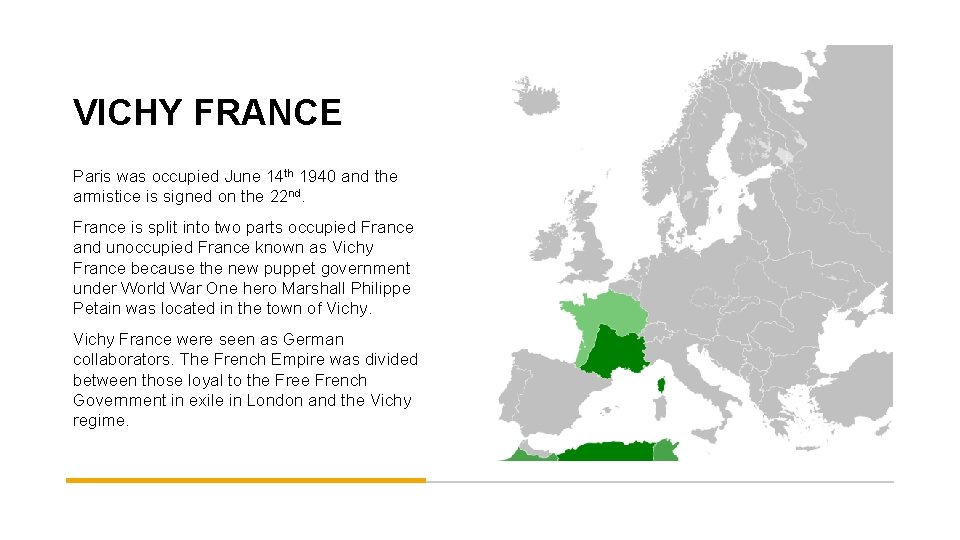
VICHY FRANCE Paris was occupied June 14 th 1940 and the armistice is signed on the 22 nd. France is split into two parts occupied France and unoccupied France known as Vichy France because the new puppet government under World War One hero Marshall Philippe Petain was located in the town of Vichy France were seen as German collaborators. The French Empire was divided between those loyal to the French Government in exile in London and the Vichy regime.
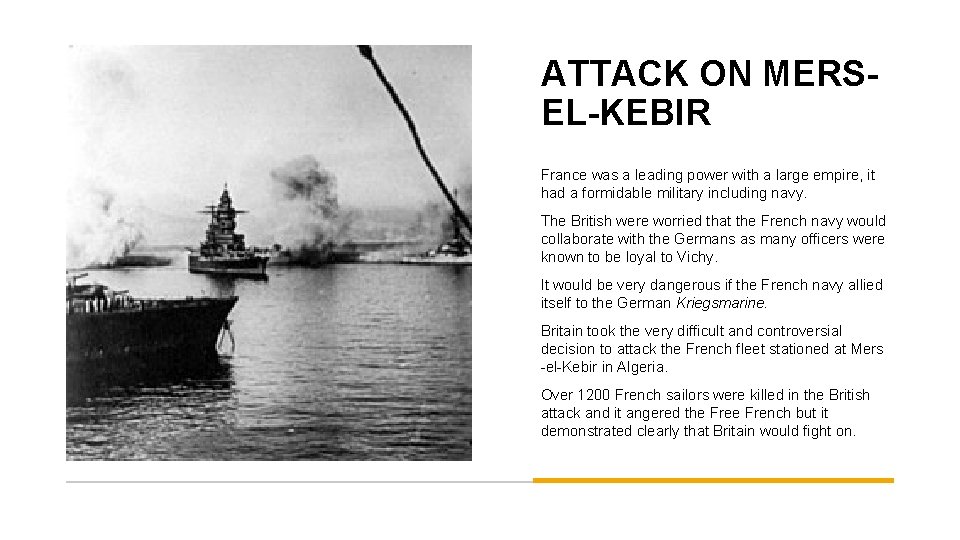
ATTACK ON MERSEL-KEBIR France was a leading power with a large empire, it had a formidable military including navy. The British were worried that the French navy would collaborate with the Germans as many officers were known to be loyal to Vichy. It would be very dangerous if the French navy allied itself to the German Kriegsmarine. Britain took the very difficult and controversial decision to attack the French fleet stationed at Mers -el-Kebir in Algeria. Over 1200 French sailors were killed in the British attack and it angered the French but it demonstrated clearly that Britain would fight on.
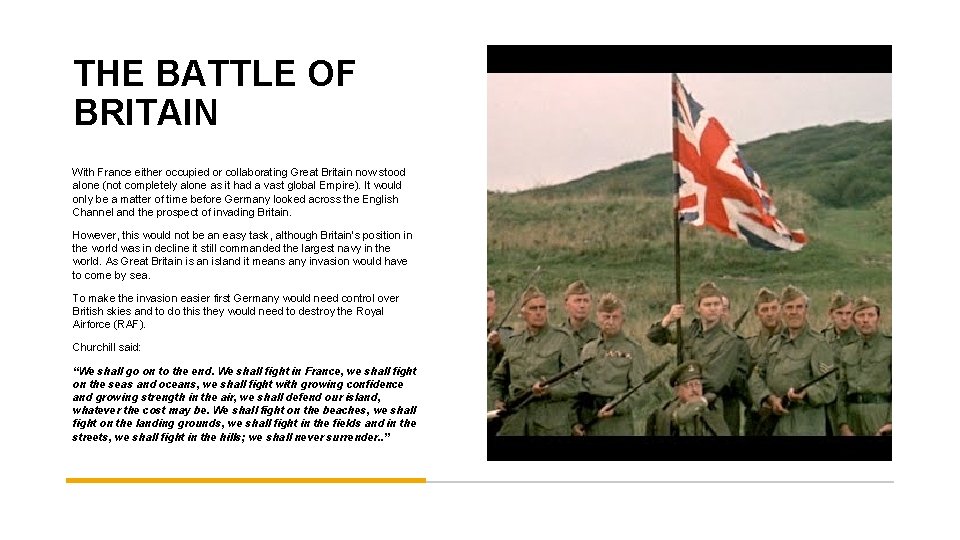
THE BATTLE OF BRITAIN With France either occupied or collaborating Great Britain now stood alone (not completely alone as it had a vast global Empire). It would only be a matter of time before Germany looked across the English Channel and the prospect of invading Britain. However, this would not be an easy task, although Britain‘s position in the world was in decline it still commanded the largest navy in the world. As Great Britain is an island it means any invasion would have to come by sea. To make the invasion easier first Germany would need control over British skies and to do this they would need to destroy the Royal Airforce (RAF). Churchill said: “We shall go on to the end. We shall fight in France, we shall fight on the seas and oceans, we shall fight with growing confidence and growing strength in the air, we shall defend our island, whatever the cost may be. We shall fight on the beaches, we shall fight on the landing grounds, we shall fight in the fields and in the streets, we shall fight in the hills; we shall never surrender. . ”
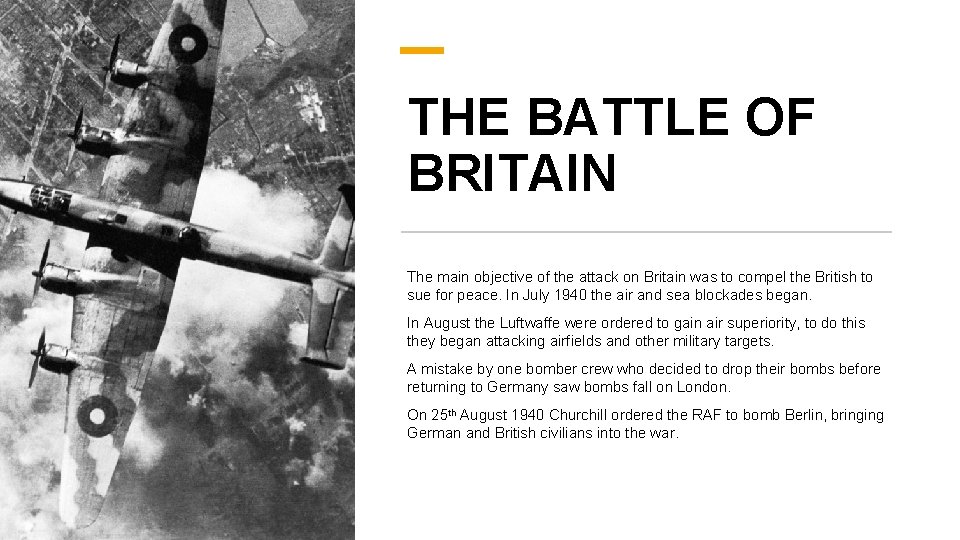
THE BATTLE OF BRITAIN The main objective of the attack on Britain was to compel the British to sue for peace. In July 1940 the air and sea blockades began. In August the Luftwaffe were ordered to gain air superiority, to do this they began attacking airfields and other military targets. A mistake by one bomber crew who decided to drop their bombs before returning to Germany saw bombs fall on London. On 25 th August 1940 Churchill ordered the RAF to bomb Berlin, bringing German and British civilians into the war.
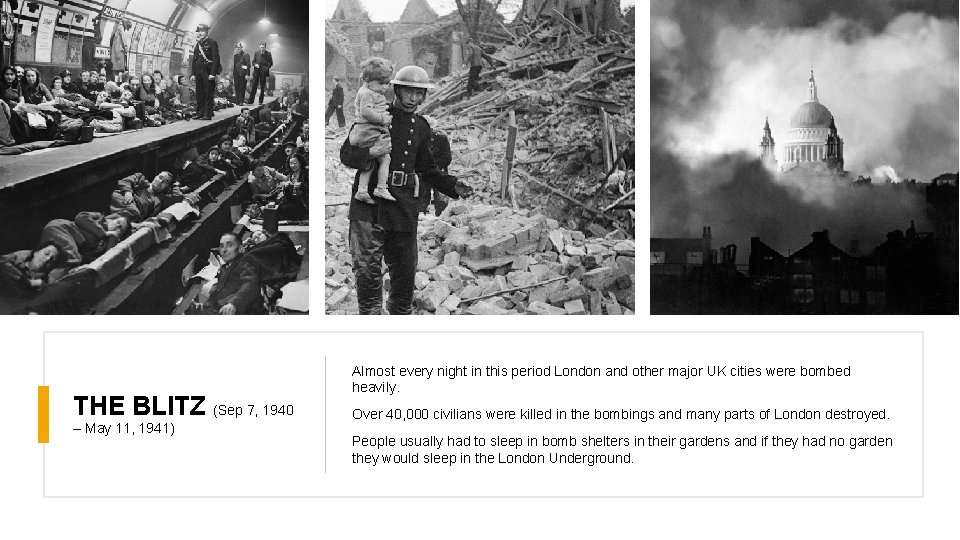
THE BLITZ (Sep 7, 1940 – May 11, 1941) Almost every night in this period London and other major UK cities were bombed heavily. Over 40, 000 civilians were killed in the bombings and many parts of London destroyed. People usually had to sleep in bomb shelters in their gardens and if they had no garden they would sleep in the London Underground.
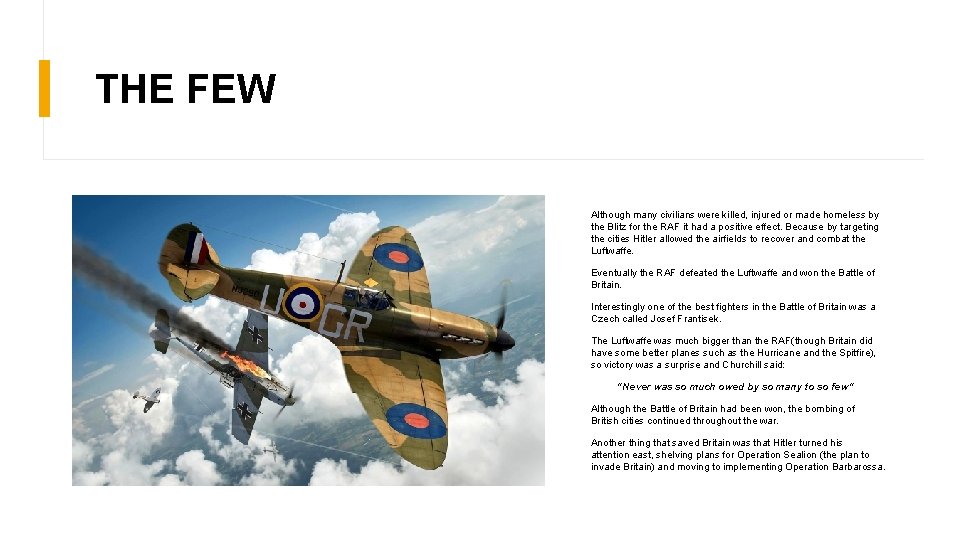
THE FEW Although many civilians were killed, injured or made homeless by the Blitz for the RAF it had a positive effect. Because by targeting the cities Hitler allowed the airfields to recover and combat the Luftwaffe. Eventually the RAF defeated the Luftwaffe and won the Battle of Britain. Interestingly one of the best fighters in the Battle of Britain was a Czech called Josef Frantisek. The Luftwaffe was much bigger than the RAF(though Britain did have some better planes such as the Hurricane and the Spitfire), so victory was a surprise and Churchill said: "Never was so much owed by so many to so few“ Although the Battle of Britain had been won, the bombing of British cities continued throughout the war. Another thing that saved Britain was that Hitler turned his attention east, shelving plans for Operation Sealion (the plan to invade Britain) and moving to implementing Operation Barbarossa.
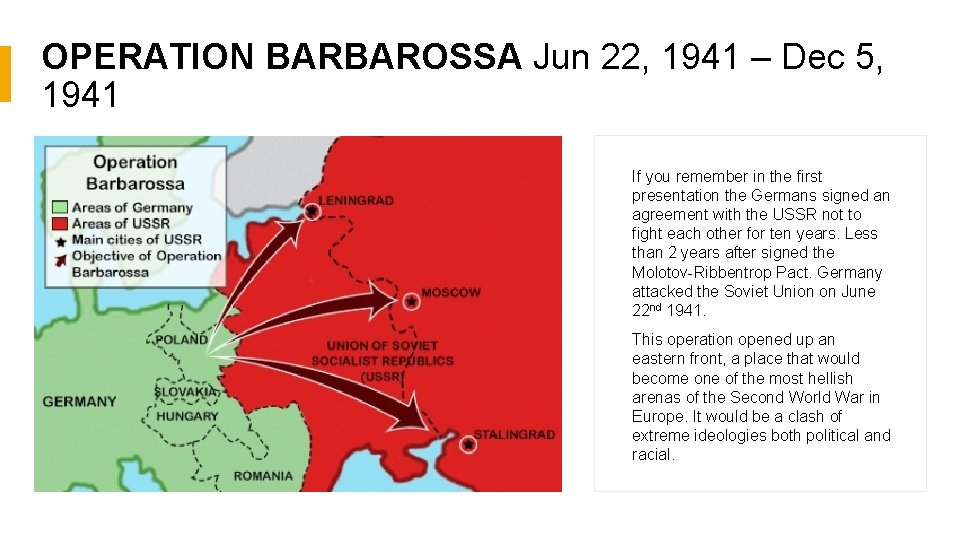
OPERATION BARBAROSSA Jun 22, 1941 – Dec 5, 1941 If you remember in the first presentation the Germans signed an agreement with the USSR not to fight each other for ten years. Less than 2 years after signed the Molotov-Ribbentrop Pact. Germany attacked the Soviet Union on June 22 nd 1941. This operation opened up an eastern front, a place that would become one of the most hellish arenas of the Second World War in Europe. It would be a clash of extreme ideologies both political and racial.
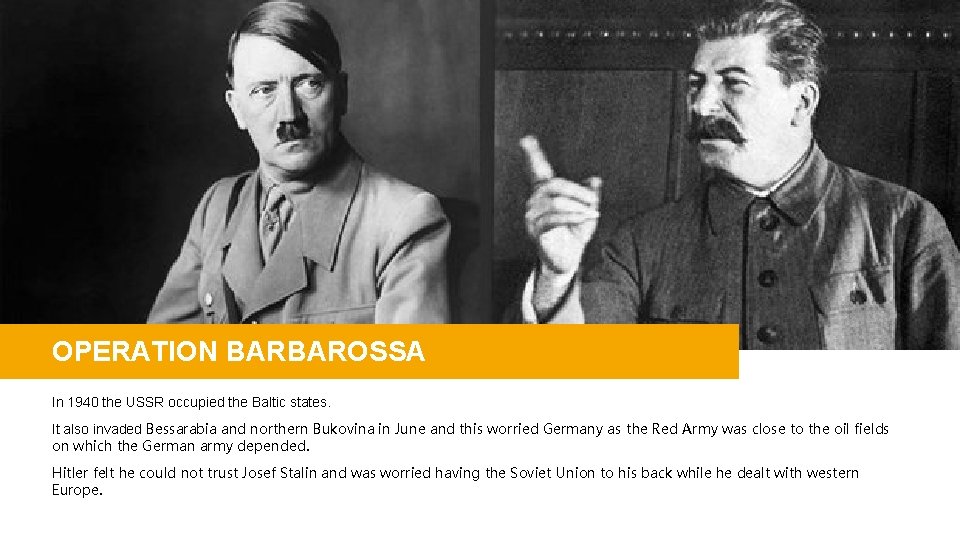
OPERATION BARBAROSSA In 1940 the USSR occupied the Baltic states. It also invaded Bessarabia and northern Bukovina in June and this worried Germany as the Red Army was close to the oil fields on which the German army depended. Hitler felt he could not trust Josef Stalin and was worried having the Soviet Union to his back while he dealt with western Europe.
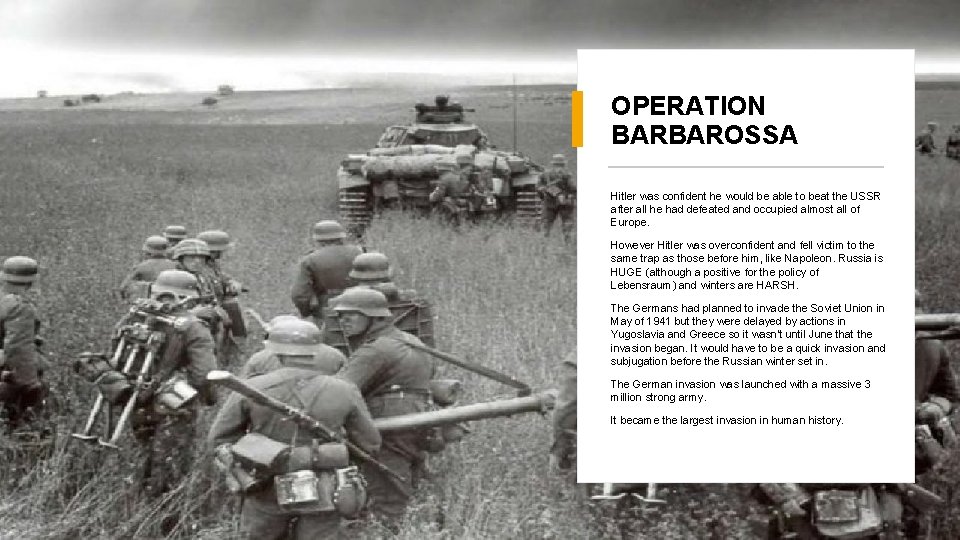
OPERATION BARBAROSSA Hitler was confident he would be able to beat the USSR after all he had defeated and occupied almost all of Europe. However Hitler was overconfident and fell victim to the same trap as those before him, like Napoleon. Russia is HUGE (although a positive for the policy of Lebensraum) and winters are HARSH. The Germans had planned to invade the Soviet Union in May of 1941 but they were delayed by actions in Yugoslavia and Greece so it wasn’t until June that the invasion began. It would have to be a quick invasion and subjugation before the Russian winter set in. The German invasion was launched with a massive 3 million strong army. It became the largest invasion in human history.
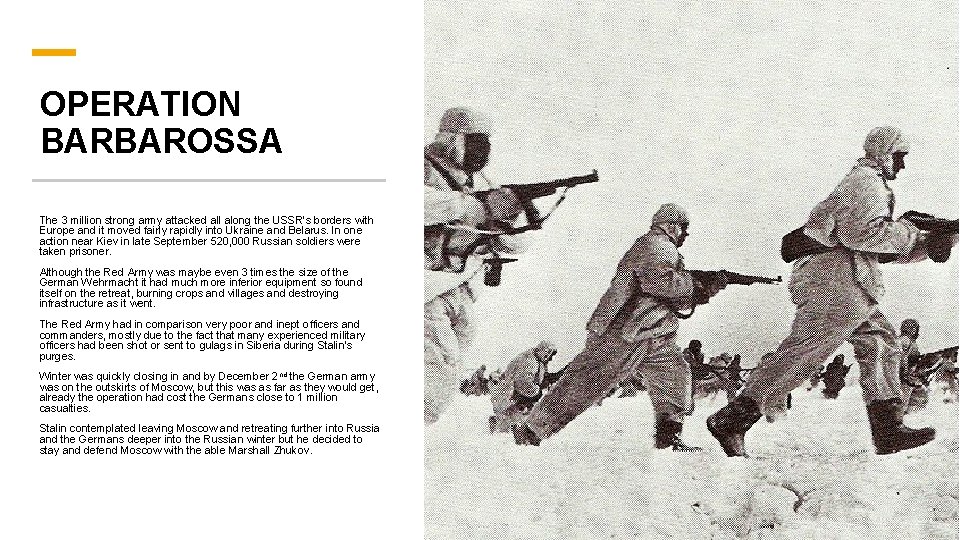
OPERATION BARBAROSSA The 3 million strong army attacked all along the USSR’s borders with Europe and it moved fairly rapidly into Ukraine and Belarus. In one action near Kiev in late September 520, 000 Russian soldiers were taken prisoner. Although the Red Army was maybe even 3 times the size of the German Wehrmacht it had much more inferior equipment so found itself on the retreat, burning crops and villages and destroying infrastructure as it went. The Red Army had in comparison very poor and inept officers and commanders, mostly due to the fact that many experienced military officers had been shot or sent to gulags in Siberia during Stalin’s purges. Winter was quickly closing in and by December 2 nd the German army was on the outskirts of Moscow, but this was as far as they would get, already the operation had cost the Germans close to 1 million casualties. Stalin contemplated leaving Moscow and retreating further into Russia and the Germans deeper into the Russian winter but he decided to stay and defend Moscow with the able Marshall Zhukov.
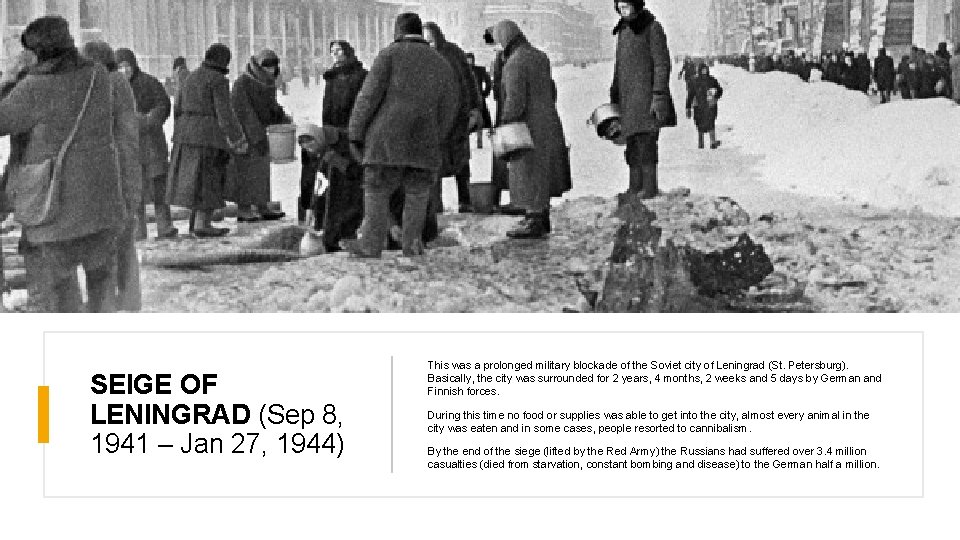
SEIGE OF LENINGRAD (Sep 8, 1941 – Jan 27, 1944) This was a prolonged military blockade of the Soviet city of Leningrad (St. Petersburg). Basically, the city was surrounded for 2 years, 4 months, 2 weeks and 5 days by German and Finnish forces. During this time no food or supplies was able to get into the city, almost every animal in the city was eaten and in some cases, people resorted to cannibalism. By the end of the siege (lifted by the Red Army) the Russians had suffered over 3. 4 million casualties (died from starvation, constant bombing and disease) to the German half a million.
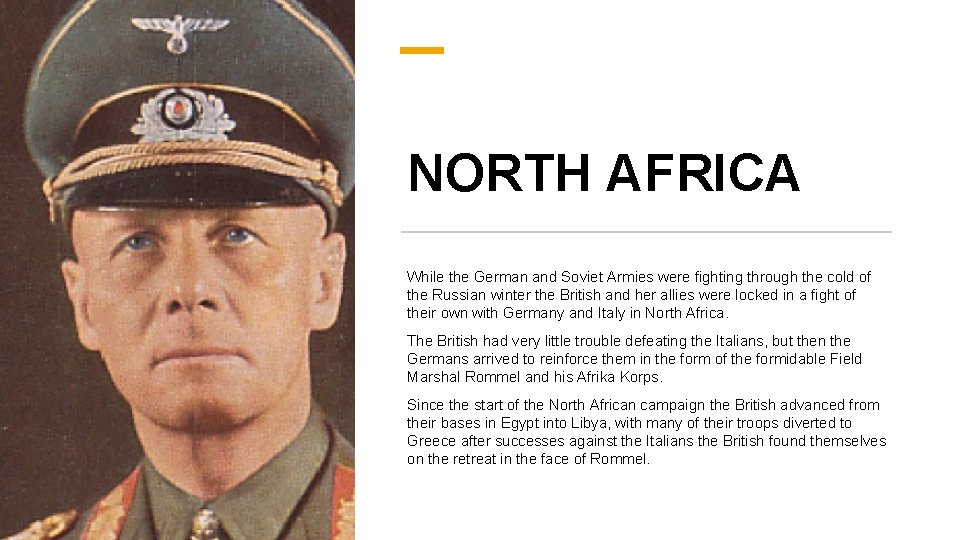
NORTH AFRICA While the German and Soviet Armies were fighting through the cold of the Russian winter the British and her allies were locked in a fight of their own with Germany and Italy in North Africa. The British had very little trouble defeating the Italians, but then the Germans arrived to reinforce them in the form of the formidable Field Marshal Rommel and his Afrika Korps. Since the start of the North African campaign the British advanced from their bases in Egypt into Libya, with many of their troops diverted to Greece after successes against the Italians the British found themselves on the retreat in the face of Rommel.
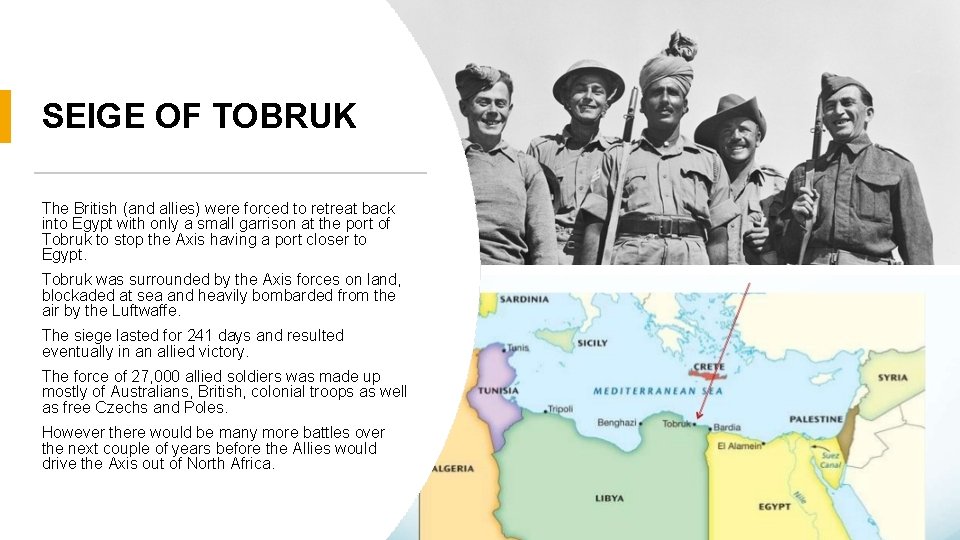
SEIGE OF TOBRUK The British (and allies) were forced to retreat back into Egypt with only a small garrison at the port of Tobruk to stop the Axis having a port closer to Egypt. Tobruk was surrounded by the Axis forces on land, blockaded at sea and heavily bombarded from the air by the Luftwaffe. The siege lasted for 241 days and resulted eventually in an allied victory. The force of 27, 000 allied soldiers was made up mostly of Australians, British, colonial troops as well as free Czechs and Poles. However there would be many more battles over the next couple of years before the Allies would drive the Axis out of North Africa.
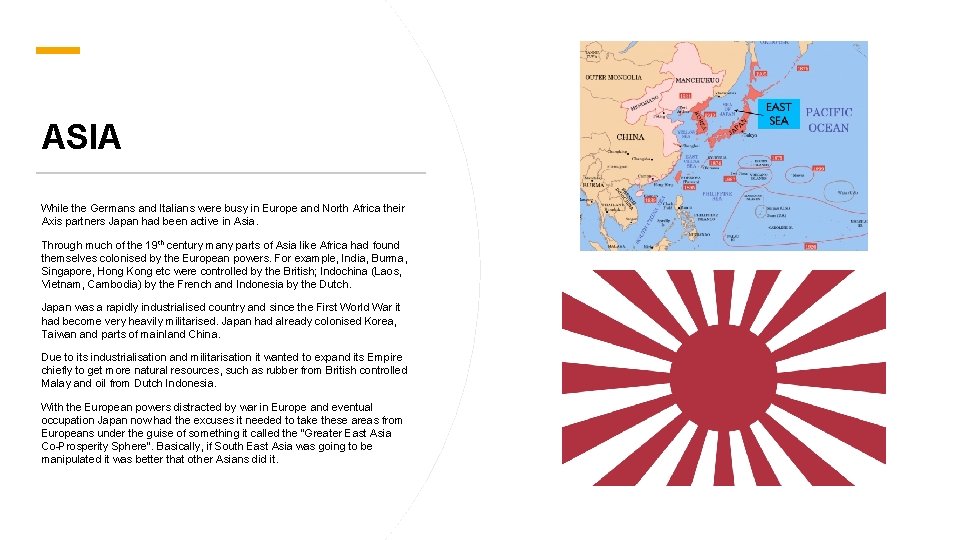
ASIA While the Germans and Italians were busy in Europe and North Africa their Axis partners Japan had been active in Asia. Through much of the 19 th century many parts of Asia like Africa had found themselves colonised by the European powers. For example, India, Burma, Singapore, Hong Kong etc were controlled by the British; Indochina (Laos, Vietnam, Cambodia) by the French and Indonesia by the Dutch. Japan was a rapidly industrialised country and since the First World War it had become very heavily militarised. Japan had already colonised Korea, Taiwan and parts of mainland China. Due to its industrialisation and militarisation it wanted to expand its Empire chiefly to get more natural resources, such as rubber from British controlled Malay and oil from Dutch Indonesia. With the European powers distracted by war in Europe and eventual occupation Japan now had the excuses it needed to take these areas from Europeans under the guise of something it called the "Greater East Asia Co-Prosperity Sphere“. Basically, if South East Asia was going to be manipulated it was better that other Asians did it.
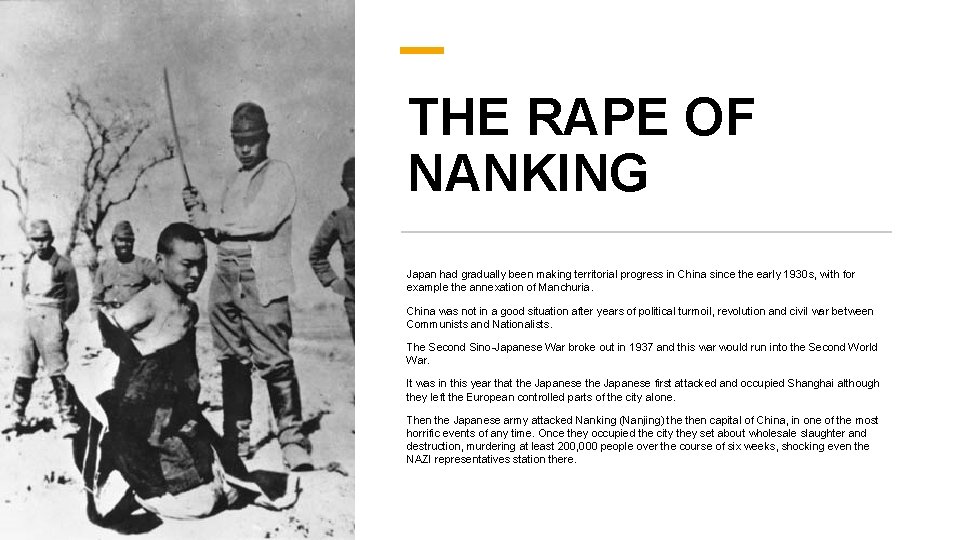
THE RAPE OF NANKING Japan had gradually been making territorial progress in China since the early 1930 s, with for example the annexation of Manchuria. China was not in a good situation after years of political turmoil, revolution and civil war between Communists and Nationalists. The Second Sino-Japanese War broke out in 1937 and this war would run into the Second World War. It was in this year that the Japanese first attacked and occupied Shanghai although they left the European controlled parts of the city alone. Then the Japanese army attacked Nanking (Nanjing) then capital of China, in one of the most horrific events of any time. Once they occupied the city they set about wholesale slaughter and destruction, murdering at least 200, 000 people over the course of six weeks, shocking even the NAZI representatives station there.
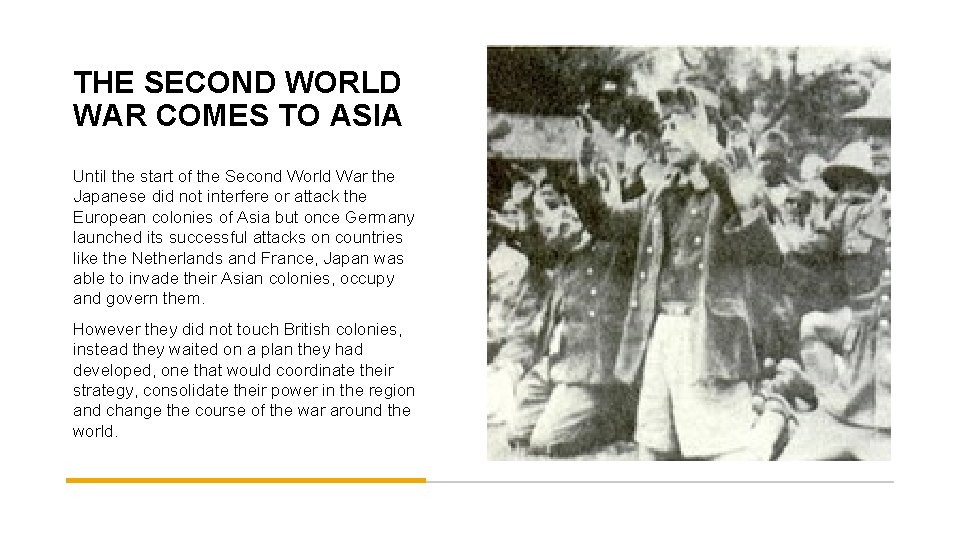
THE SECOND WORLD WAR COMES TO ASIA Until the start of the Second World War the Japanese did not interfere or attack the European colonies of Asia but once Germany launched its successful attacks on countries like the Netherlands and France, Japan was able to invade their Asian colonies, occupy and govern them. However they did not touch British colonies, instead they waited on a plan they had developed, one that would coordinate their strategy, consolidate their power in the region and change the course of the war around the world.
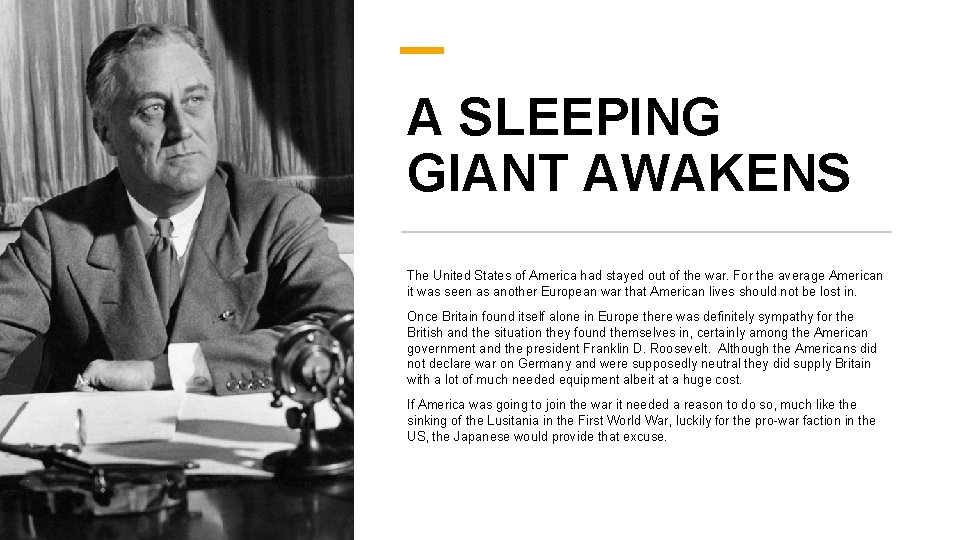
A SLEEPING GIANT AWAKENS The United States of America had stayed out of the war. For the average American it was seen as another European war that American lives should not be lost in. Once Britain found itself alone in Europe there was definitely sympathy for the British and the situation they found themselves in, certainly among the American government and the president Franklin D. Roosevelt. Although the Americans did not declare war on Germany and were supposedly neutral they did supply Britain with a lot of much needed equipment albeit at a huge cost. If America was going to join the war it needed a reason to do so, much like the sinking of the Lusitania in the First World War, luckily for the pro-war faction in the US, the Japanese would provide that excuse.
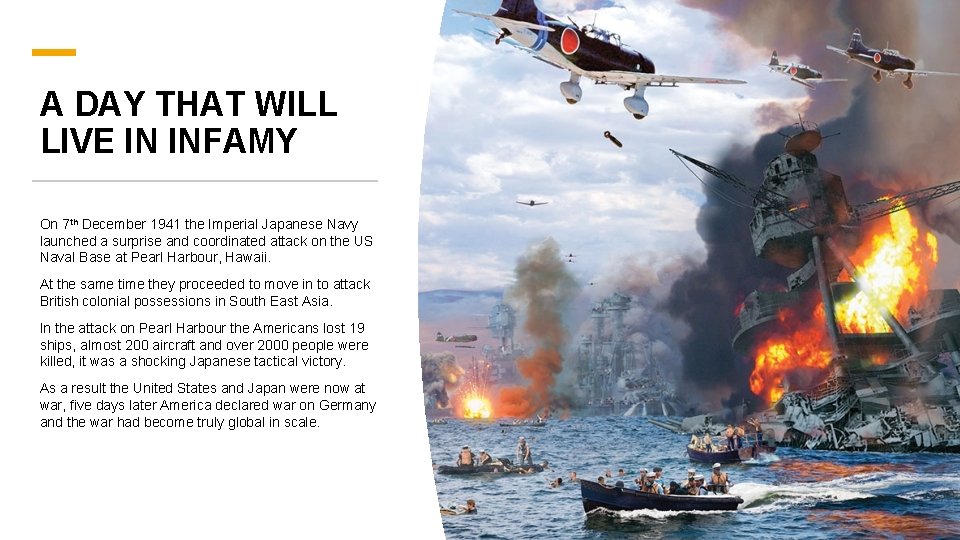
A DAY THAT WILL LIVE IN INFAMY On 7 th December 1941 the Imperial Japanese Navy launched a surprise and coordinated attack on the US Naval Base at Pearl Harbour, Hawaii. At the same time they proceeded to move in to attack British colonial possessions in South East Asia. In the attack on Pearl Harbour the Americans lost 19 ships, almost 200 aircraft and over 2000 people were killed, it was a shocking Japanese tactical victory. As a result the United States and Japan were now at war, five days later America declared war on Germany and the war had become truly global in scale.
TO BE CONTINUED