
The Second Law of Thermodynamics The statement of
- Slides: 61
The Second Law of Thermodynamics The statement of 2 nd law, The heat engine, Carnot engine, Entropy balance
Introduction • The first law of thermodynamics: Ø Does not differentiate between energy added to or removed from a system as heat and energy added to or removed from a system as work. Ø Heat and work are equivalent. However, we know that heat and work are not equivalent in all ways. • Work is spontaneously converted to heat all around us, and we can find many examples where work is fully converted to heat. The classical example of this is the historic experiments of Joule where he stirred fluids and measured the amount of work done and the temperature rise of the fluids. Chemical Engineering Dept. MU Eng. Thermodynamics
Introduction l However, there are no examples of energy in the form of heat being spontaneously and completely converted to work, despite centuries of effort directed at constructing a device that would do so. l This suggests that there is some sense in which work is a higher or more valuable form of energy than heat, and in fact if that were not the case, there would not be much need to differentiate between the two. This idea is formalized and quantified in the second law of thermodynamics. Chemical Engineering Dept. MU Eng. Thermodynamics
Introduction (cont. ) The second law helps us to: determine the quality as well as the degree of degradation of energy during a process. determine theoretical limits for the performance of engineering systems such as power plants, heat engines and refrigerators. predict the degree of completion of chemical reactions. Chemical Engineering Dept. MU Eng. Thermodynamics
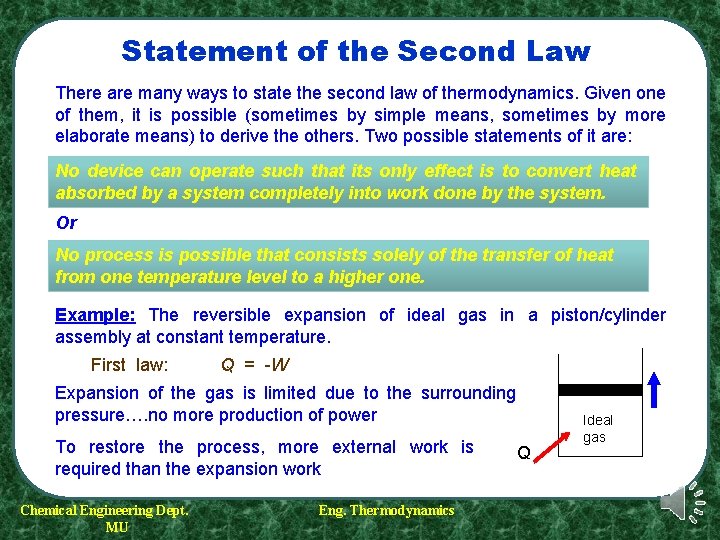
Statement of the Second Law There are many ways to state the second law of thermodynamics. Given one of them, it is possible (sometimes by simple means, sometimes by more elaborate means) to derive the others. Two possible statements of it are: No device can operate such that its only effect is to convert heat absorbed by a system completely into work done by the system. Or No process is possible that consists solely of the transfer of heat from one temperature level to a higher one. Example: The reversible expansion of ideal gas in a piston/cylinder assembly at constant temperature. First law: Q = -W Expansion of the gas is limited due to the surrounding pressure…. no more production of power To restore the process, more external work is required than the expansion work Chemical Engineering Dept. MU Eng. Thermodynamics Q Ideal gas
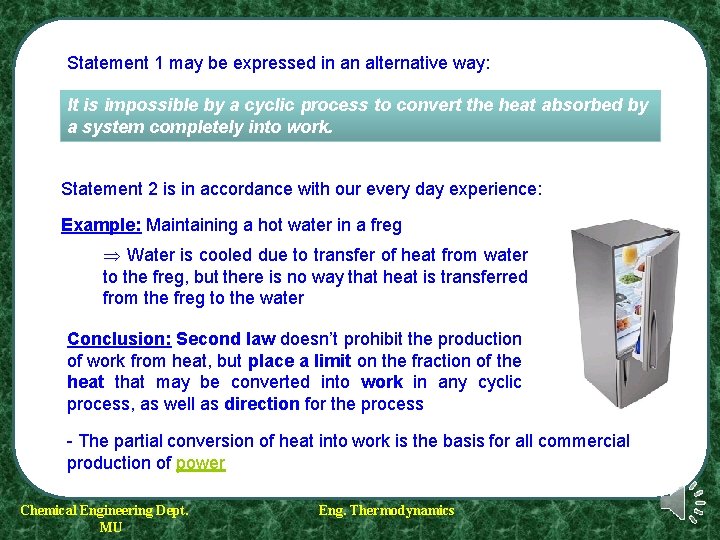
Statement 1 may be expressed in an alternative way: It is impossible by a cyclic process to convert the heat absorbed by a system completely into work. Statement 2 is in accordance with our every day experience: Example: Maintaining a hot water in a freg Water is cooled due to transfer of heat from water to the freg, but there is no way that heat is transferred from the freg to the water Conclusion: Second law doesn’t prohibit the production of work from heat, but place a limit on the fraction of the heat that may be converted into work in any cyclic process, as well as direction for the process - The partial conversion of heat into work is the basis for all commercial production of power Chemical Engineering Dept. MU Eng. Thermodynamics
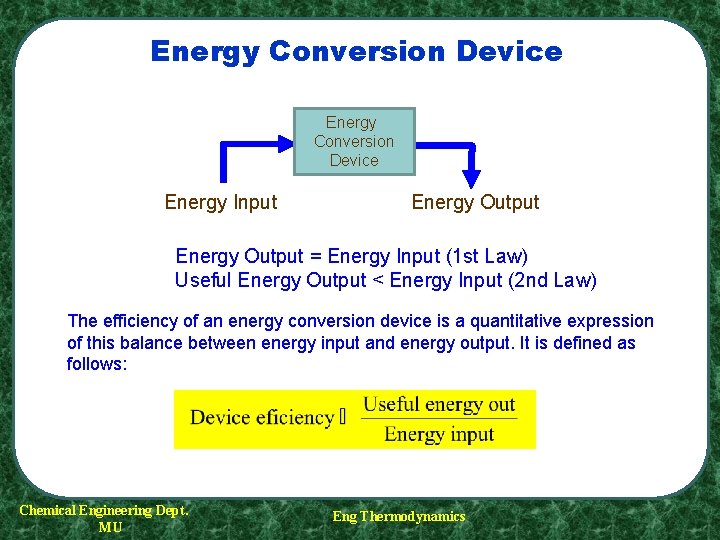
Energy Conversion Device Energy Input Energy Output = Energy Input (1 st Law) Useful Energy Output < Energy Input (2 nd Law) The efficiency of an energy conversion device is a quantitative expression of this balance between energy input and energy output. It is defined as follows: Chemical Engineering Dept. MU Eng Thermodynamics
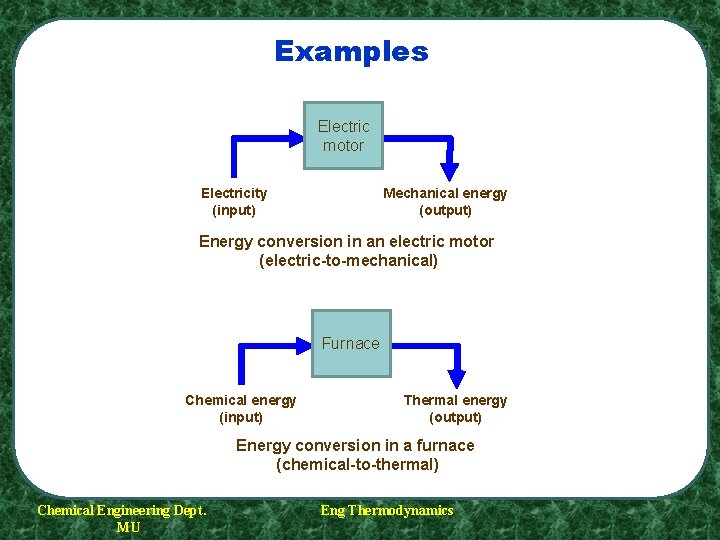
Examples Electric motor Electricity (input) Mechanical energy (output) Energy conversion in an electric motor (electric-to-mechanical) Furnace Chemical energy (input) Thermal energy (output) Energy conversion in a furnace (chemical-to-thermal) Chemical Engineering Dept. MU Eng Thermodynamics
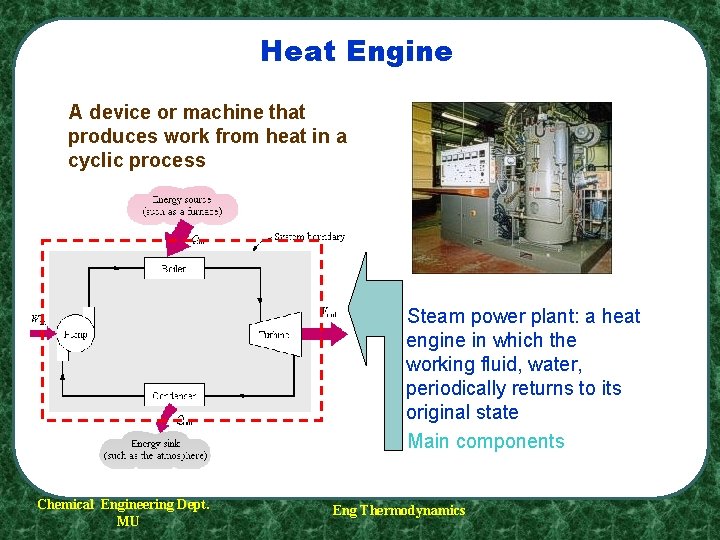
Heat Engine A device or machine that produces work from heat in a cyclic process Steam power plant: a heat engine in which the working fluid, water, periodically returns to its original state Main components Chemical Engineering Dept. MU Eng Thermodynamics
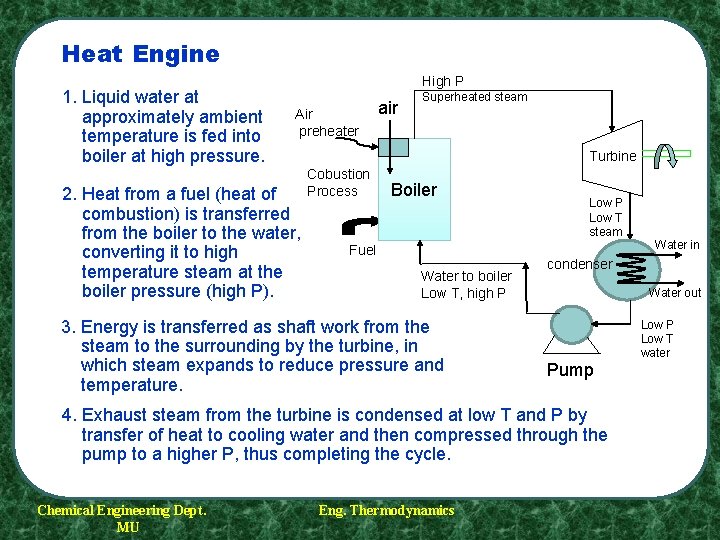
Heat Engine 1. Liquid water at approximately ambient temperature is fed into boiler at high pressure. High P Air preheater 2. Heat from a fuel (heat of combustion) is transferred from the boiler to the water, converting it to high temperature steam at the boiler pressure (high P). air Superheated steam Turbine Cobustion Process Boiler Fuel Water to boiler Low T, high P 3. Energy is transferred as shaft work from the steam to the surrounding by the turbine, in which steam expands to reduce pressure and temperature. Low P Low T steam condenser Water out Pump 4. Exhaust steam from the turbine is condensed at low T and P by transfer of heat to cooling water and then compressed through the pump to a higher P, thus completing the cycle. Chemical Engineering Dept. MU Eng. Thermodynamics Water in Low P Low T water
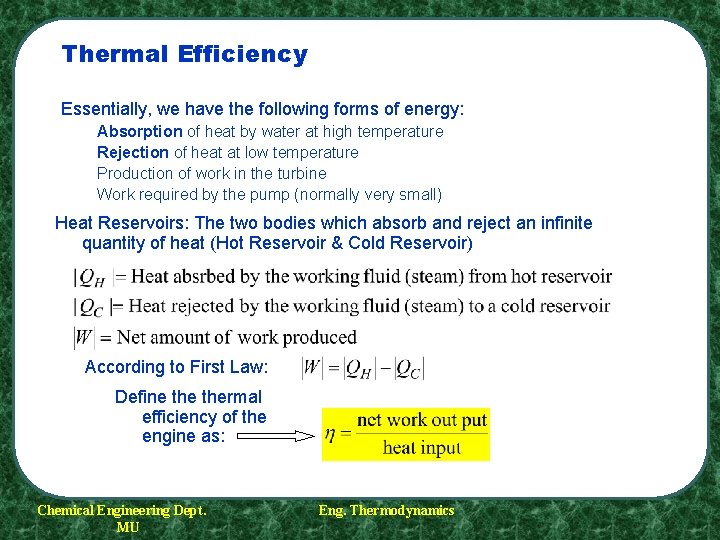
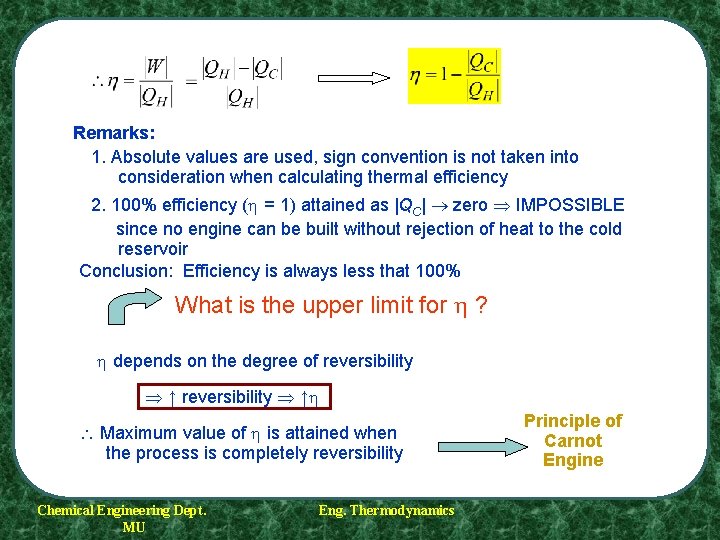
Thermal Efficiency Essentially, we have the following forms of energy: Absorption of heat by water at high temperature Rejection of heat at low temperature Production of work in the turbine Work required by the pump (normally very small) Heat Reservoirs: The two bodies which absorb and reject an infinite quantity of heat (Hot Reservoir & Cold Reservoir) According to First Law: Define thermal efficiency of the engine as: Chemical Engineering Dept. MU Eng. Thermodynamics
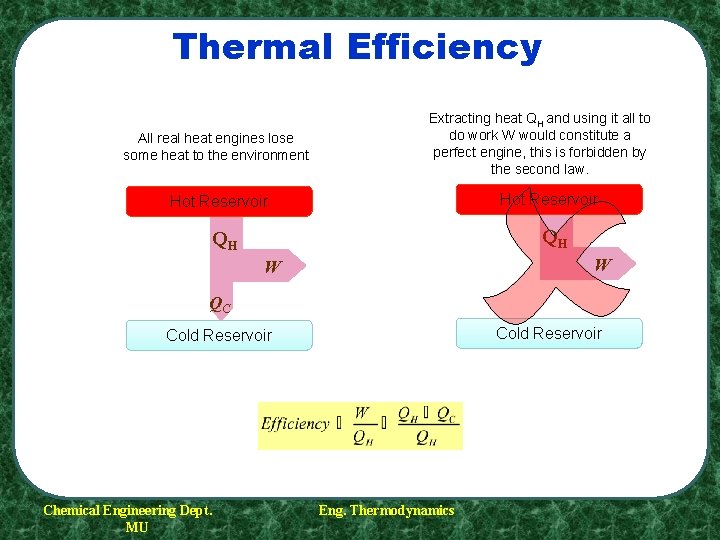
Thermal Efficiency All real heat engines lose some heat to the environment Extracting heat QH and using it all to do work W would constitute a perfect engine, this is forbidden by the second law. Hot Reservoir QH QH W W QC Cold Reservoir Chemical Engineering Dept. MU Eng. Thermodynamics
Remarks: 1. Absolute values are used, sign convention is not taken into consideration when calculating thermal efficiency 2. 100% efficiency ( = 1) attained as |QC| zero IMPOSSIBLE since no engine can be built without rejection of heat to the cold reservoir Conclusion: Efficiency is always less that 100% What is the upper limit for ? depends on the degree of reversibility ↑ Maximum value of is attained when the process is completely reversibility Chemical Engineering Dept. MU Eng. Thermodynamics Principle of Carnot Engine
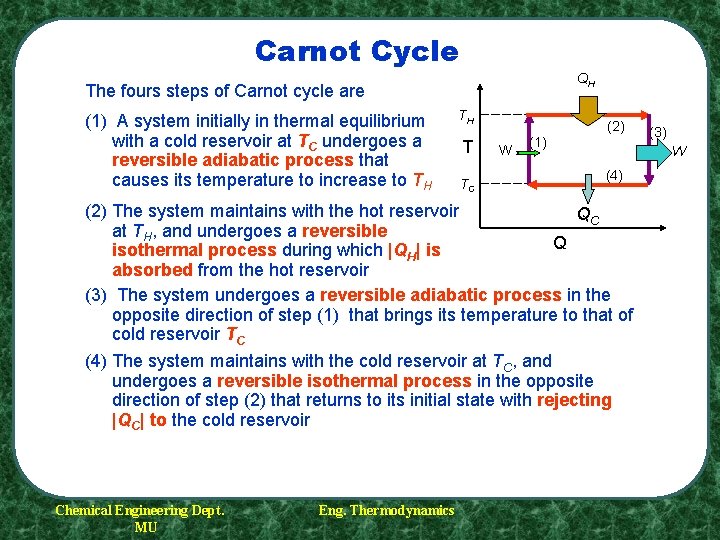
Carnot Cycle QH The fours steps of Carnot cycle are (1) A system initially in thermal equilibrium with a cold reservoir at TC undergoes a reversible adiabatic process that causes its temperature to increase to TH TH T TC (2) W (1) W (4) (2) The system maintains with the hot reservoir QC at TH, and undergoes a reversible Q isothermal process during which |QH| is absorbed from the hot reservoir (3) The system undergoes a reversible adiabatic process in the opposite direction of step (1) that brings its temperature to that of cold reservoir TC (4) The system maintains with the cold reservoir at TC, and undergoes a reversible isothermal process in the opposite direction of step (2) that returns to its initial state with rejecting |QC| to the cold reservoir Chemical Engineering Dept. MU Eng. Thermodynamics (3)
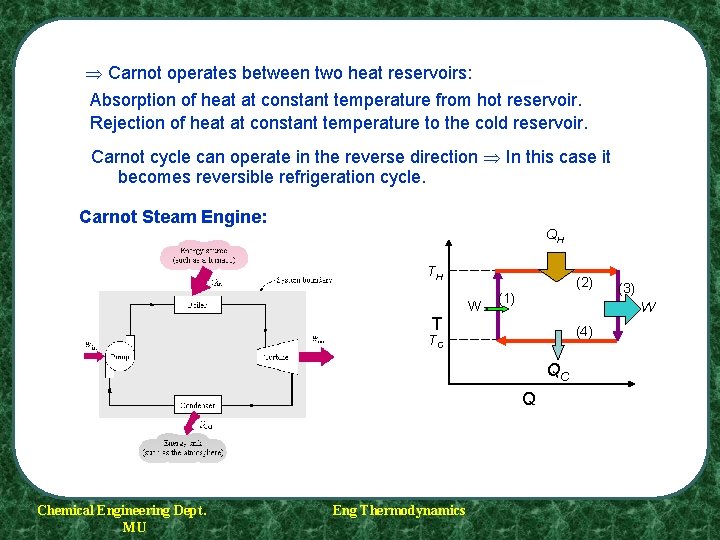
Carnot operates between two heat reservoirs: Absorption of heat at constant temperature from hot reservoir. Rejection of heat at constant temperature to the cold reservoir. Carnot cycle can operate in the reverse direction In this case it becomes reversible refrigeration cycle. Carnot Steam Engine: QH TH T (2) W (1) W (4) TC QC Q Chemical Engineering Dept. MU Eng Thermodynamics (3)
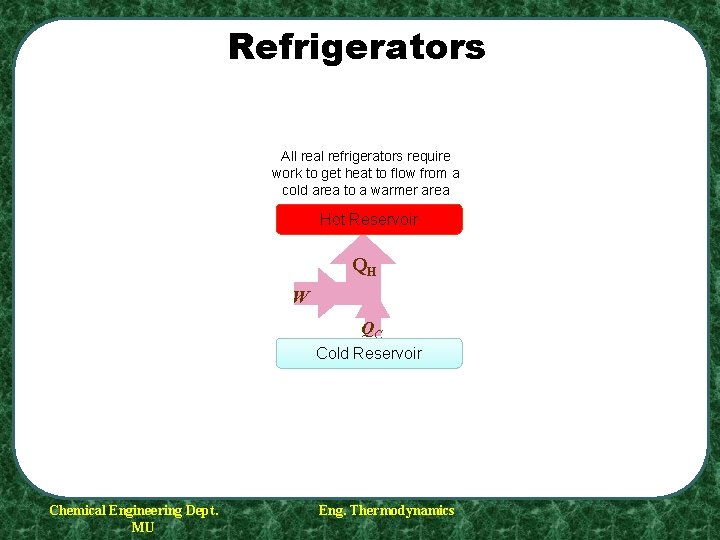
Refrigerators All real refrigerators require work to get heat to flow from a cold area to a warmer area Hot Reservoir QH W QC Cold Reservoir Chemical Engineering Dept. MU Eng. Thermodynamics
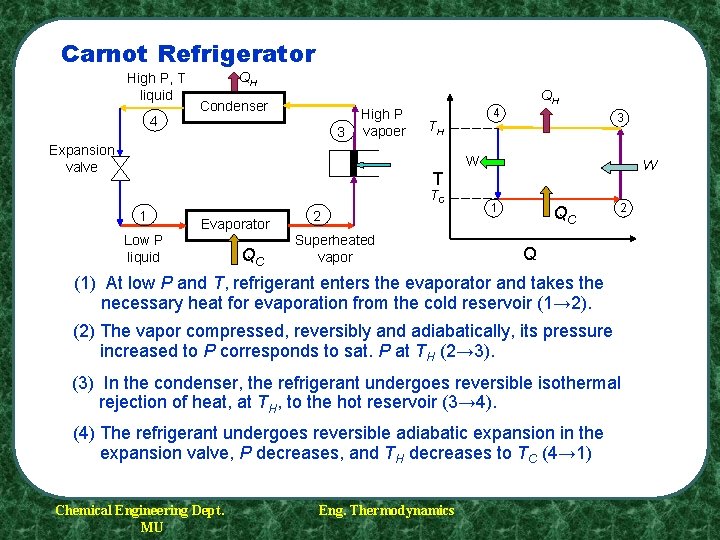
Carnot Refrigerator High P, T liquid 4 QH QH Condenser 3 High P vapoer Expansion valve T TC 1 Evaporator Low P liquid QC 4 TH 2 Superheated vapor 3 W W 1 QC 2 Q (1) At low P and T, refrigerant enters the evaporator and takes the necessary heat for evaporation from the cold reservoir (1→ 2). (2) The vapor compressed, reversibly and adiabatically, its pressure increased to P corresponds to sat. P at TH (2→ 3). (3) In the condenser, the refrigerant undergoes reversible isothermal rejection of heat, at TH, to the hot reservoir (3→ 4). (4) The refrigerant undergoes reversible adiabatic expansion in the expansion valve, P decreases, and TH decreases to TC (4→ 1) Chemical Engineering Dept. MU Eng. Thermodynamics
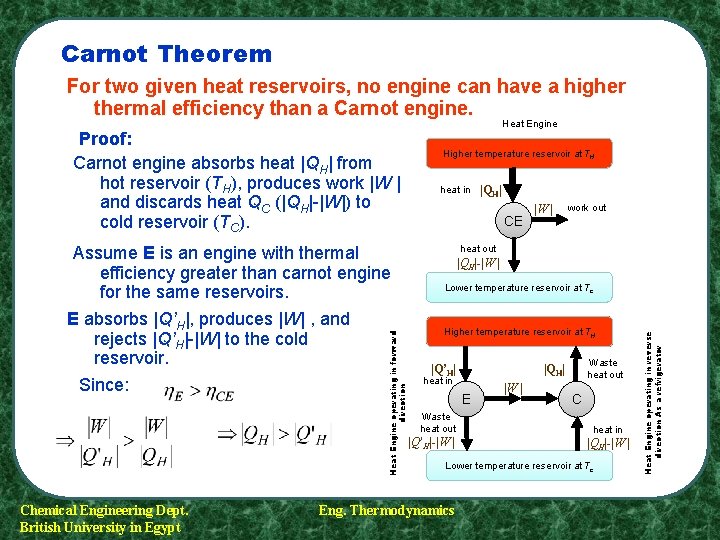
Carnot Theorem For two given heat reservoirs, no engine can have a higher thermal efficiency than a Carnot engine. Heat Engine Proof: Carnot engine absorbs heat |QH| from hot reservoir (TH), produces work |W | and discards heat QC (|QH|-|W|) to cold reservoir (TC). Higher temperature reservoir at TH heat in CE Assume E is an engine with thermal efficiency greater than carnot engine for the same reservoirs. heat out Lower temperature reservoir at Tc Higher temperature reservoir at TH |Q’H| E Waste heat out |QH| heat in |Q’H|-|W | Chemical Engineering Dept. British University in Egypt work out |W | C heat in |QH|-|W | Lower temperature reservoir at Tc Eng. Thermodynamics Heat Engine operating in reverse direction As a refrigerator Since: |W | |QH|-|W | Heat Engine operating in forward direction E absorbs |Q’H|, produces |W| , and rejects |Q’H|-|W| to the cold reservoir. |QH|
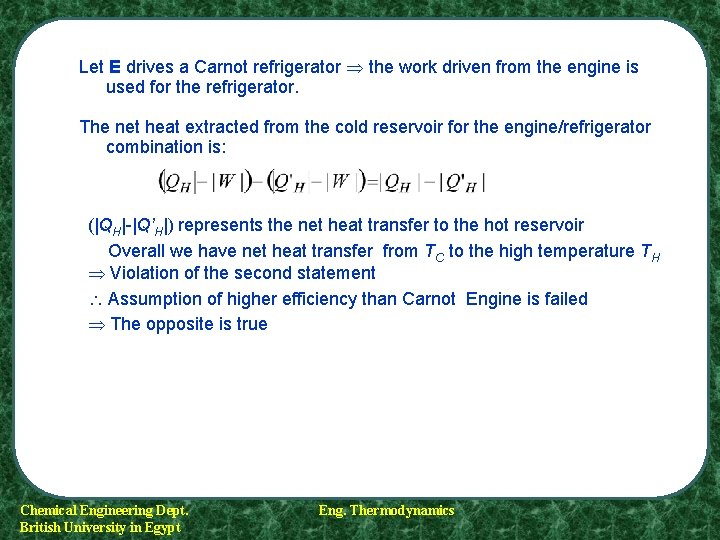
Let E drives a Carnot refrigerator the work driven from the engine is used for the refrigerator. The net heat extracted from the cold reservoir for the engine/refrigerator combination is: (|QH|-|Q’H|) represents the net heat transfer to the hot reservoir Overall we have net heat transfer from TC to the high temperature TH Violation of the second statement Assumption of higher efficiency than Carnot Engine is failed The opposite is true Chemical Engineering Dept. British University in Egypt Eng. Thermodynamics
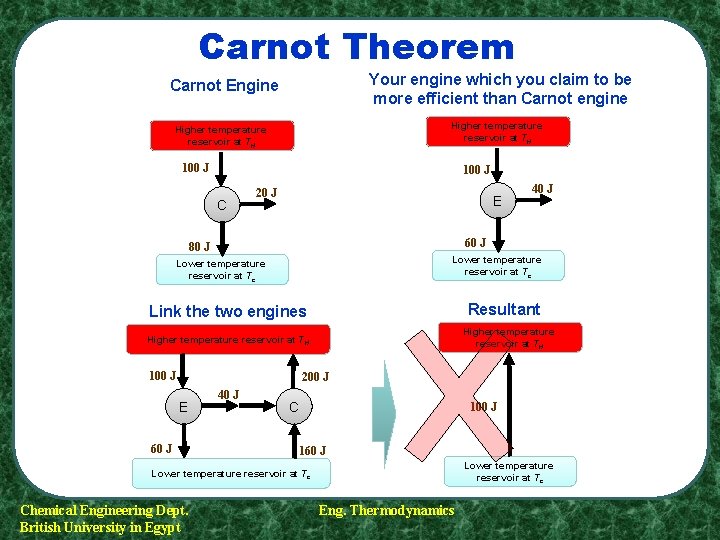
Carnot Theorem Your engine which you claim to be more efficient than Carnot engine Carnot Engine Higher temperature reservoir at TH 100 J C 20 J E 40 J 60 J 80 J Lower temperature reservoir at Tc Resultant Link the two engines Higher temperature reservoir at TH 100 J 200 J E 60 J 40 J C 100 J 160 J Lower temperature reservoir at Tc Chemical Engineering Dept. British University in Egypt Eng. Thermodynamics
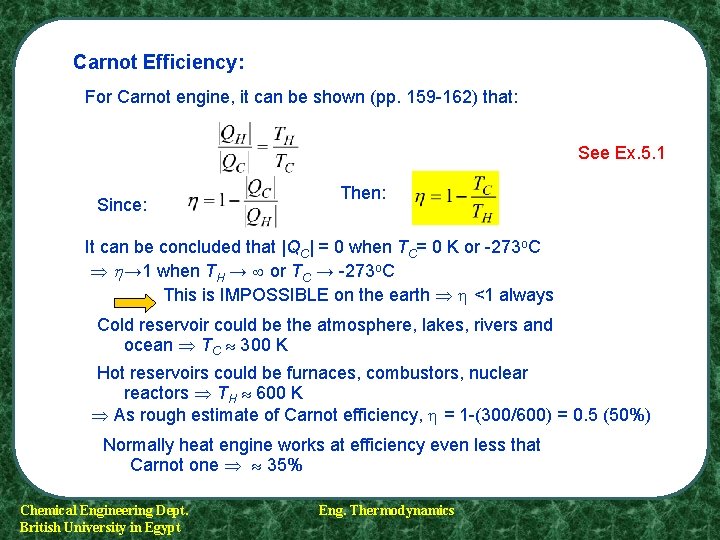
Carnot Efficiency: For Carnot engine, it can be shown (pp. 159 -162) that: See Ex. 5. 1 Since: Then: It can be concluded that |QC| = 0 when TC= 0 K or -273 o. C → 1 when TH → or TC → -273 o. C This is IMPOSSIBLE on the earth <1 always Cold reservoir could be the atmosphere, lakes, rivers and ocean TC 300 K Hot reservoirs could be furnaces, combustors, nuclear reactors TH 600 K As rough estimate of Carnot efficiency, = 1 -(300/600) = 0. 5 (50%) Normally heat engine works at efficiency even less that Carnot one 35% Chemical Engineering Dept. British University in Egypt Eng. Thermodynamics
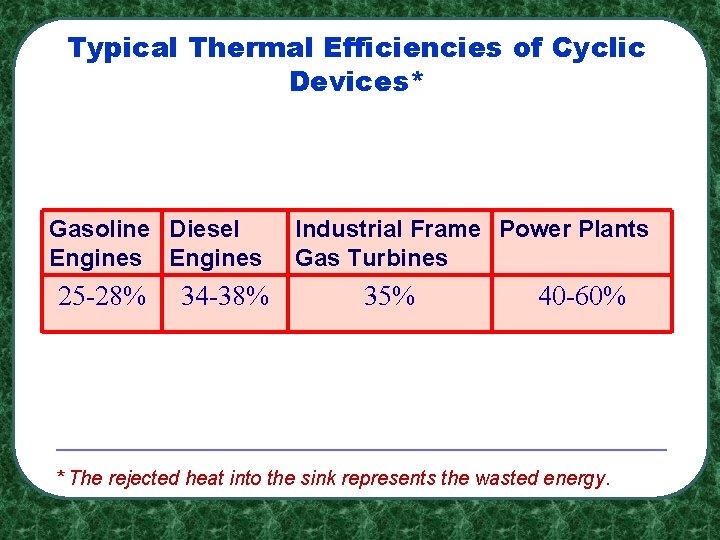
Typical Thermal Efficiencies of Cyclic Devices* Gasoline Diesel Engines 25 -28% 34 -38% Industrial Frame Power Plants Gas Turbines 35% 40 -60% _______________________________ * The rejected heat into the sink represents the wasted energy.
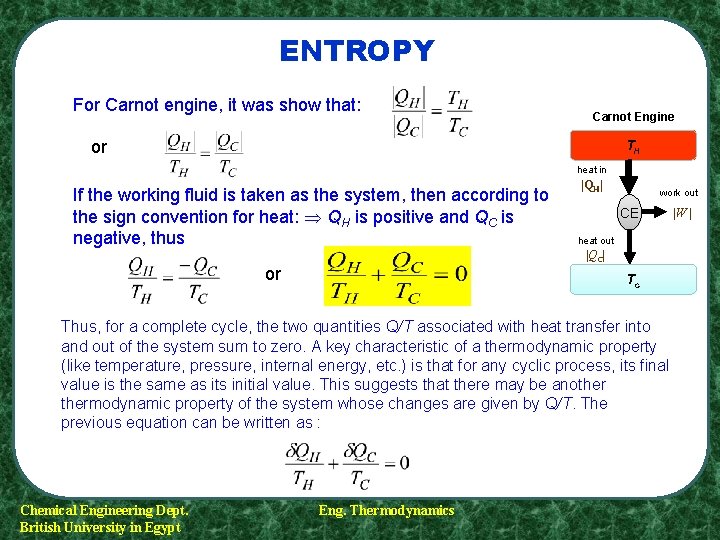
ENTROPY For Carnot engine, it was show that: Carnot Engine or TH heat in If the working fluid is taken as the system, then according to the sign convention for heat: QH is positive and QC is negative, thus |QH| work out CE heat out |QC| or Tc Thus, for a complete cycle, the two quantities Q/T associated with heat transfer into and out of the system sum to zero. A key characteristic of a thermodynamic property (like temperature, pressure, internal energy, etc. ) is that for any cyclic process, its final value is the same as its initial value. This suggests that there may be anothermodynamic property of the system whose changes are given by Q/T. The previous equation can be written as : Chemical Engineering Dept. British University in Egypt Eng. Thermodynamics |W |
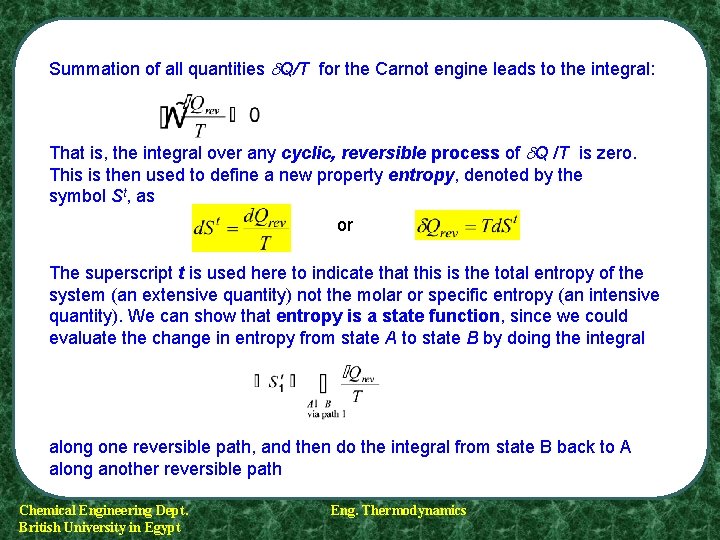
Summation of all quantities Q/T for the Carnot engine leads to the integral: That is, the integral over any cyclic, reversible process of Q /T is zero. This is then used to define a new property entropy, denoted by the symbol St, as or The superscript t is used here to indicate that this is the total entropy of the system (an extensive quantity) not the molar or specific entropy (an intensive quantity). We can show that entropy is a state function, since we could evaluate the change in entropy from state A to state B by doing the integral along one reversible path, and then do the integral from state B back to A along another reversible path Chemical Engineering Dept. British University in Egypt Eng. Thermodynamics
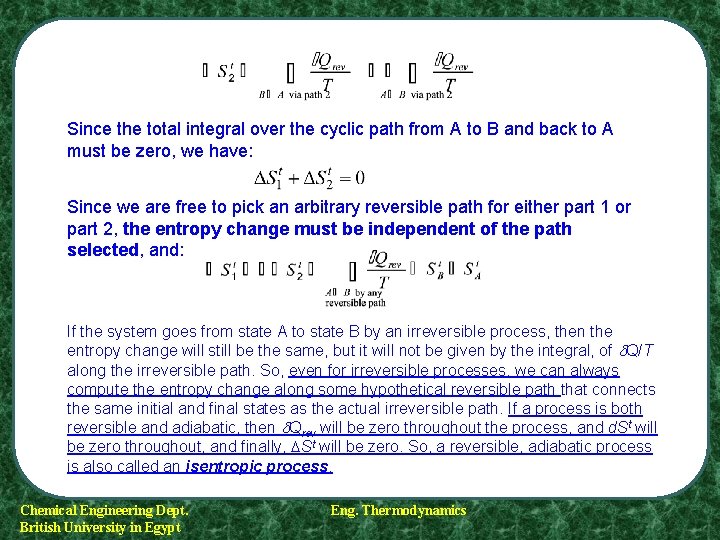
Since the total integral over the cyclic path from A to B and back to A must be zero, we have: Since we are free to pick an arbitrary reversible path for either part 1 or part 2, the entropy change must be independent of the path selected, and: If the system goes from state A to state B by an irreversible process, then the entropy change will still be the same, but it will not be given by the integral, of Q/T along the irreversible path. So, even for irreversible processes, we can always compute the entropy change along some hypothetical reversible path that connects the same initial and final states as the actual irreversible path. If a process is both reversible and adiabatic, then Qrev will be zero throughout the process, and d. St will be zero throughout, and finally, St will be zero. So, a reversible, adiabatic process is also called an isentropic process. Chemical Engineering Dept. British University in Egypt Eng. Thermodynamics
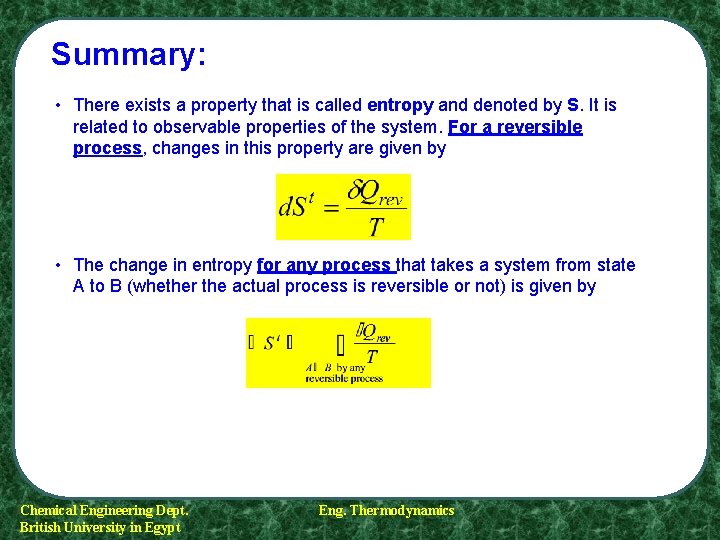
Summary: • There exists a property that is called entropy and denoted by S. It is related to observable properties of the system. For a reversible process, changes in this property are given by • The change in entropy for any process that takes a system from state A to B (whether the actual process is reversible or not) is given by Chemical Engineering Dept. British University in Egypt Eng. Thermodynamics
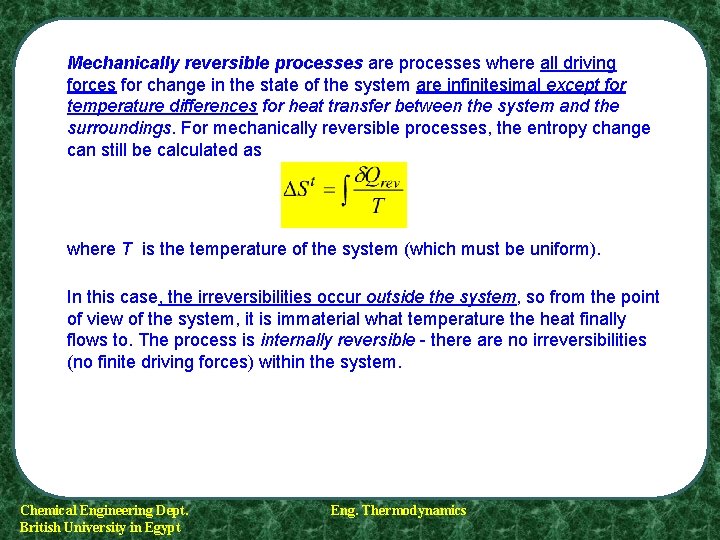
Mechanically reversible processes are processes where all driving forces for change in the state of the system are infinitesimal except for temperature differences for heat transfer between the system and the surroundings. For mechanically reversible processes, the entropy change can still be calculated as where T is the temperature of the system (which must be uniform). In this case, the irreversibilities occur outside the system, so from the point of view of the system, it is immaterial what temperature the heat finally flows to. The process is internally reversible - there are no irreversibilities (no finite driving forces) within the system. Chemical Engineering Dept. British University in Egypt Eng. Thermodynamics
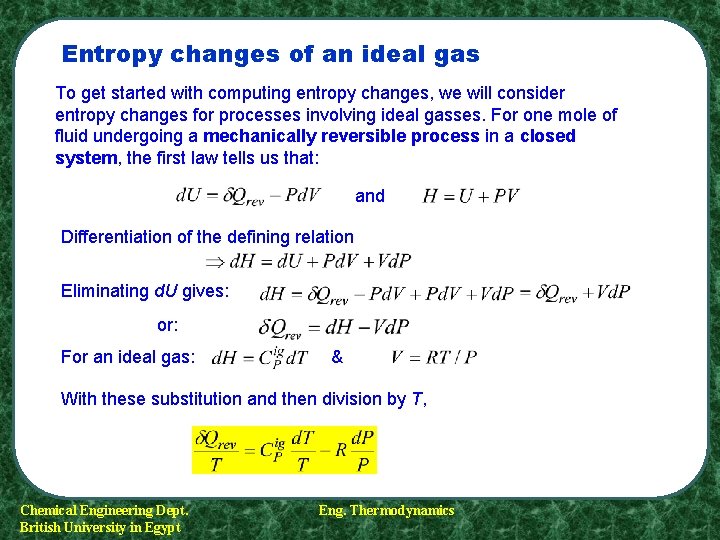
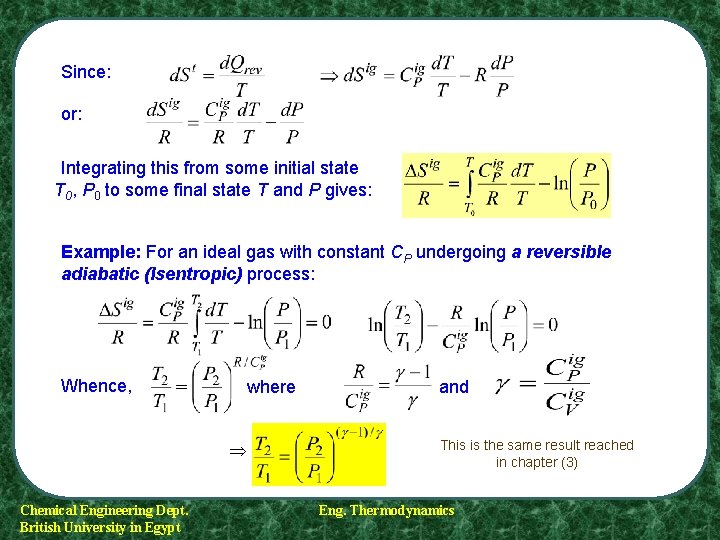
Entropy changes of an ideal gas To get started with computing entropy changes, we will consider entropy changes for processes involving ideal gasses. For one mole of fluid undergoing a mechanically reversible process in a closed system, the first law tells us that: and Differentiation of the defining relation Eliminating d. U gives: or: For an ideal gas: & With these substitution and then division by T, Chemical Engineering Dept. British University in Egypt Eng. Thermodynamics
Since: or: Integrating this from some initial state T 0, P 0 to some final state T and P gives: Example: For an ideal gas with constant CP undergoing a reversible adiabatic (Isentropic) process: Whence, where Chemical Engineering Dept. British University in Egypt and This is the same result reached in chapter (3) Eng. Thermodynamics
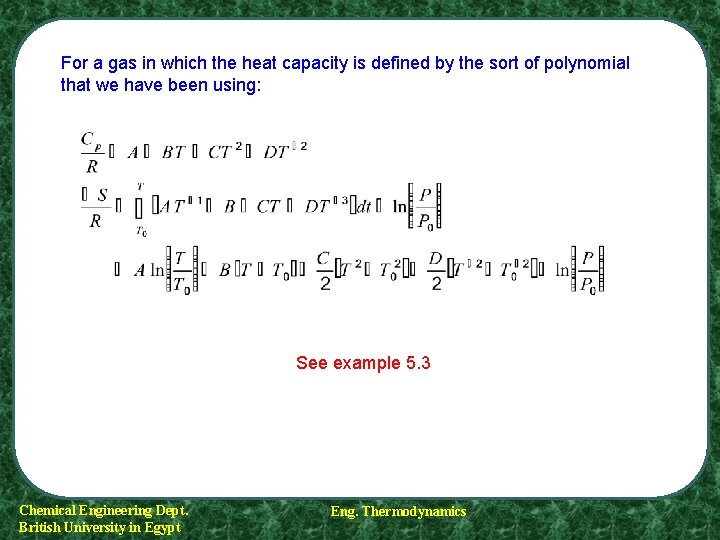
For a gas in which the heat capacity is defined by the sort of polynomial that we have been using: See example 5. 3 Chemical Engineering Dept. British University in Egypt Eng. Thermodynamics
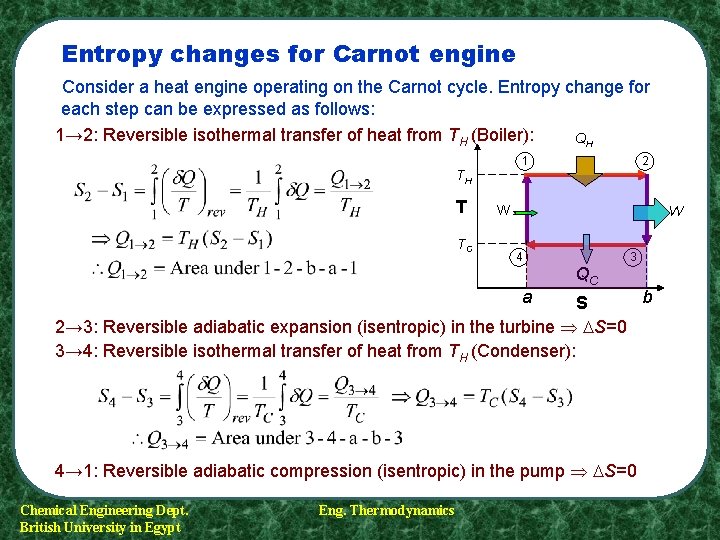
Entropy changes for Carnot engine Consider a heat engine operating on the Carnot cycle. Entropy change for each step can be expressed as follows: 1→ 2: Reversible isothermal transfer of heat from TH (Boiler): QH 1 TH T TC 2 W W 4 a 3 QC b S 2→ 3: Reversible adiabatic expansion (isentropic) in the turbine S=0 3→ 4: Reversible isothermal transfer of heat from TH (Condenser): 4→ 1: Reversible adiabatic compression (isentropic) in the pump S=0 Chemical Engineering Dept. British University in Egypt Eng. Thermodynamics
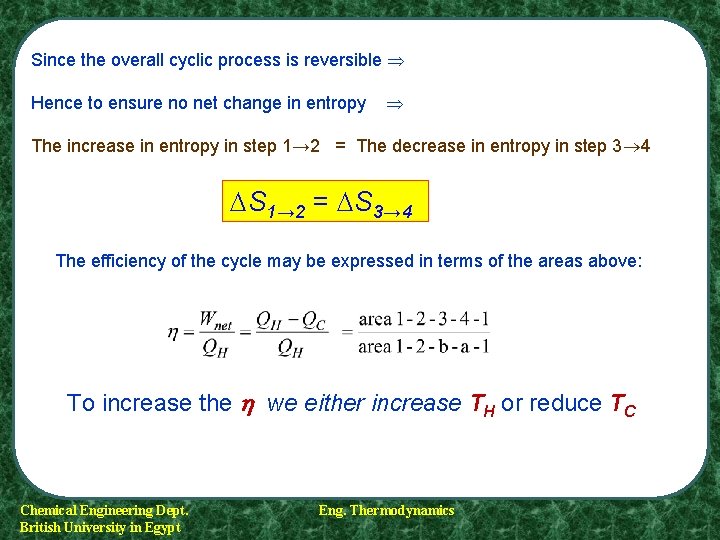
Since the overall cyclic process is reversible Hence to ensure no net change in entropy The increase in entropy in step 1→ 2 = The decrease in entropy in step 3 4 S 1→ 2 = S 3→ 4 The efficiency of the cycle may be expressed in terms of the areas above: To increase the we either increase TH or reduce TC Chemical Engineering Dept. British University in Egypt Eng. Thermodynamics
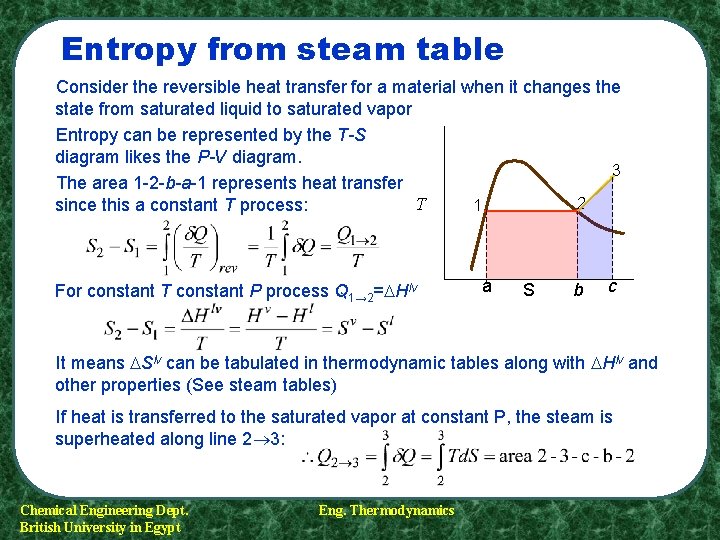
Entropy from steam table Consider the reversible heat transfer for a material when it changes the state from saturated liquid to saturated vapor Entropy can be represented by the T-S diagram likes the P-V diagram. 3 The area 1 -2 -b-a-1 represents heat transfer 2 T since this a constant T process: 1 For constant T constant P process Q 1→ 2= Hlv a S b c It means Slv can be tabulated in thermodynamic tables along with Hlv and other properties (See steam tables) If heat is transferred to the saturated vapor at constant P, the steam is superheated along line 2 3: Chemical Engineering Dept. British University in Egypt Eng. Thermodynamics
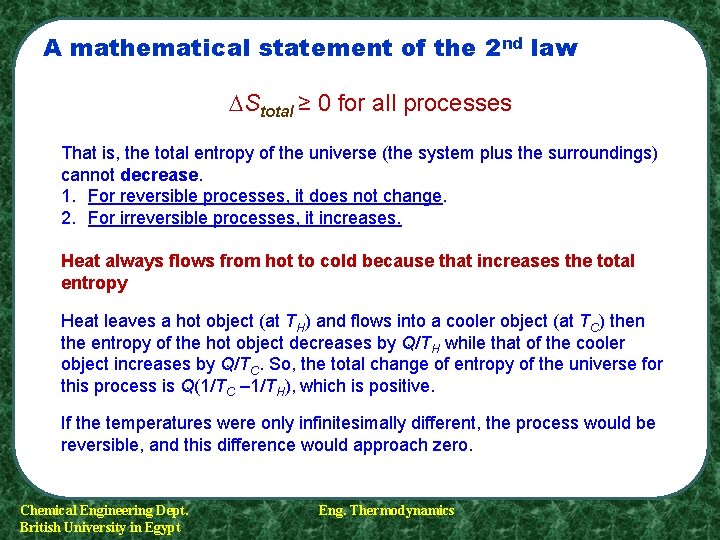
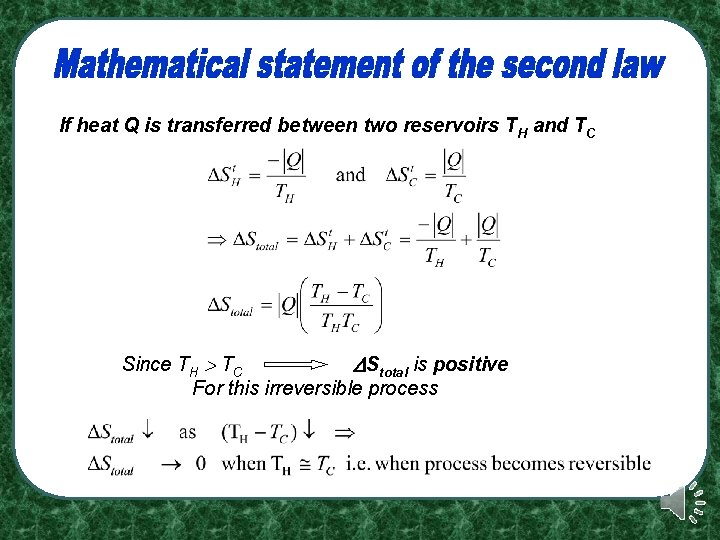
A mathematical statement of the 2 nd law Stotal ≥ 0 for all processes That is, the total entropy of the universe (the system plus the surroundings) cannot decrease. 1. For reversible processes, it does not change. 2. For irreversible processes, it increases. Heat always flows from hot to cold because that increases the total entropy Heat leaves a hot object (at TH) and flows into a cooler object (at TC) then the entropy of the hot object decreases by Q/TH while that of the cooler object increases by Q/TC. So, the total change of entropy of the universe for this process is Q(1/TC – 1/TH), which is positive. If the temperatures were only infinitesimally different, the process would be reversible, and this difference would approach zero. Chemical Engineering Dept. British University in Egypt Eng. Thermodynamics
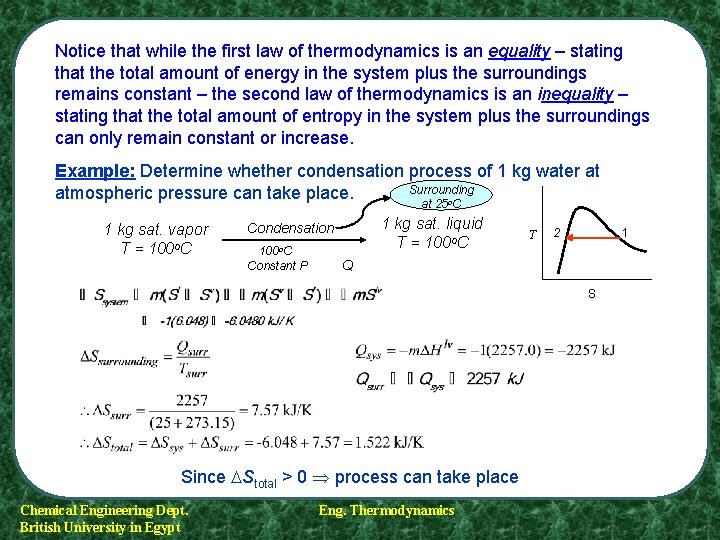
Notice that while the first law of thermodynamics is an equality – stating that the total amount of energy in the system plus the surroundings remains constant – the second law of thermodynamics is an inequality – stating that the total amount of entropy in the system plus the surroundings can only remain constant or increase. Example: Determine whether condensation process of 1 kg water at Surrounding atmospheric pressure can take place. o at 25 C 1 kg sat. vapor T = 100 o. C 1 kg sat. liquid T = 100 o. C Condensation 100 o. C Constant P T 2 1 Q S Since Stotal > 0 process can take place Chemical Engineering Dept. British University in Egypt Eng. Thermodynamics
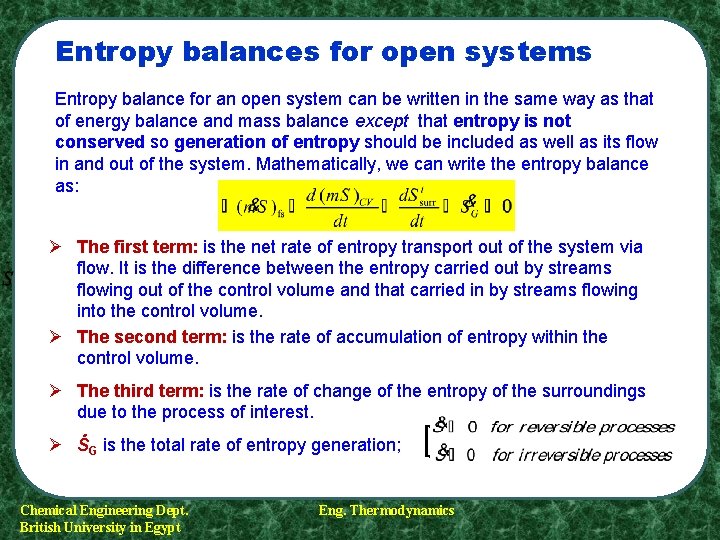
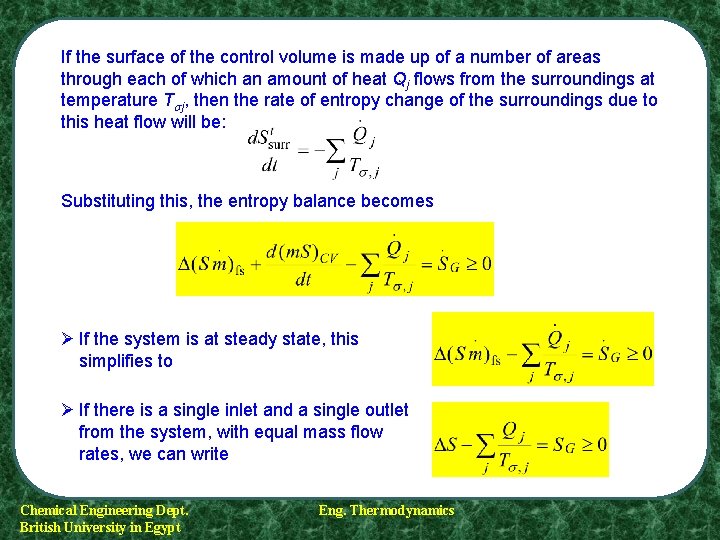
Entropy balances for open systems Entropy balance for an open system can be written in the same way as that of energy balance and mass balance except that entropy is not conserved so generation of entropy should be included as well as its flow in and out of the system. Mathematically, we can write the entropy balance as: Ø The first term: is the net rate of entropy transport out of the system via flow. It is the difference between the entropy carried out by streams flowing out of the control volume and that carried in by streams flowing into the control volume. Ø The second term: is the rate of accumulation of entropy within the control volume. Ø The third term: is the rate of change of the entropy of the surroundings due to the process of interest. Ø ṠG is the total rate of entropy generation; Chemical Engineering Dept. British University in Egypt Eng. Thermodynamics
If the surface of the control volume is made up of a number of areas through each of which an amount of heat Qj flows from the surroundings at temperature T j, then the rate of entropy change of the surroundings due to this heat flow will be: Substituting this, the entropy balance becomes Ø If the system is at steady state, this simplifies to Ø If there is a single inlet and a single outlet from the system, with equal mass flow rates, we can write Chemical Engineering Dept. British University in Egypt Eng. Thermodynamics
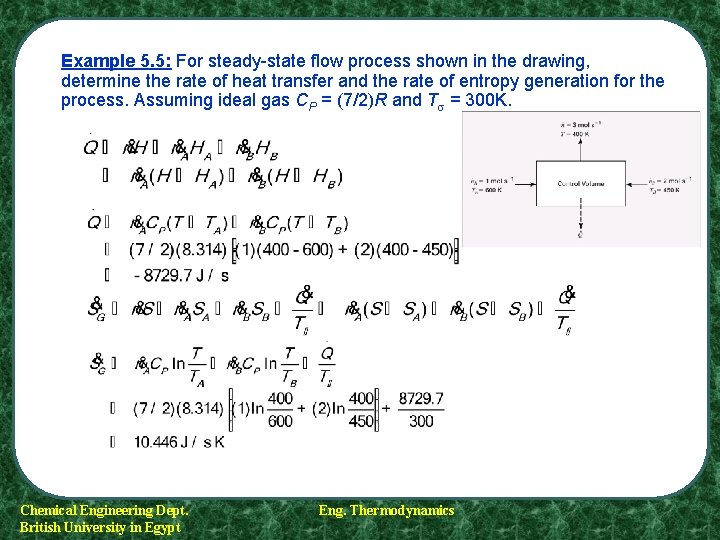
Example 5. 5: For steady-state flow process shown in the drawing, determine the rate of heat transfer and the rate of entropy generation for the process. Assuming ideal gas CP = (7/2)R and T = 300 K. Chemical Engineering Dept. British University in Egypt Eng. Thermodynamics
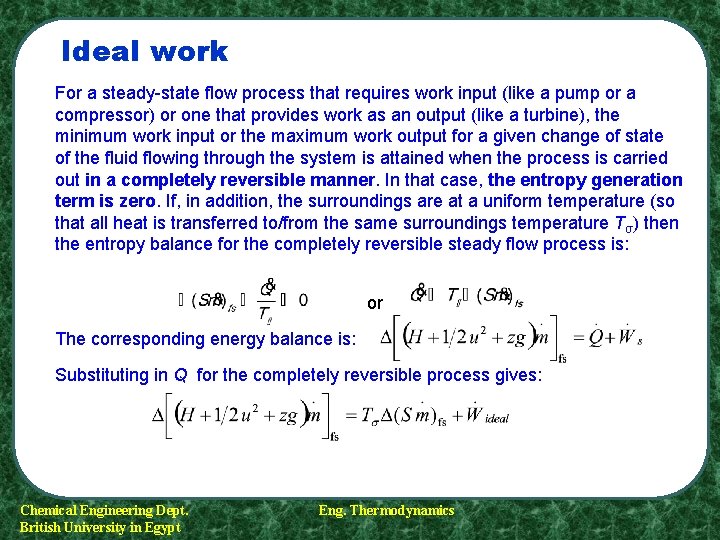
Ideal work For a steady-state flow process that requires work input (like a pump or a compressor) or one that provides work as an output (like a turbine), the minimum work input or the maximum work output for a given change of state of the fluid flowing through the system is attained when the process is carried out in a completely reversible manner. In that case, the entropy generation term is zero. If, in addition, the surroundings are at a uniform temperature (so that all heat is transferred to/from the same surroundings temperature Tσ) then the entropy balance for the completely reversible steady flow process is: or The corresponding energy balance is: Substituting in Q for the completely reversible process gives: Chemical Engineering Dept. British University in Egypt Eng. Thermodynamics
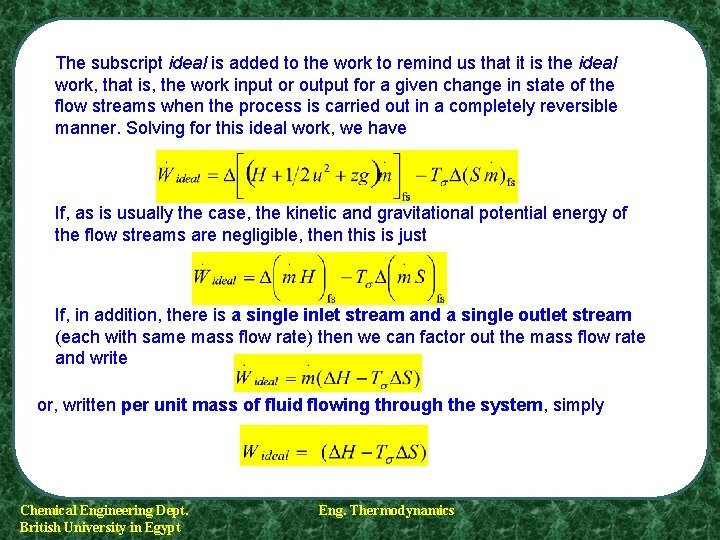
The subscript ideal is added to the work to remind us that it is the ideal work, that is, the work input or output for a given change in state of the flow streams when the process is carried out in a completely reversible manner. Solving for this ideal work, we have If, as is usually the case, the kinetic and gravitational potential energy of the flow streams are negligible, then this is just If, in addition, there is a single inlet stream and a single outlet stream (each with same mass flow rate) then we can factor out the mass flow rate and write or, written per unit mass of fluid flowing through the system, simply Chemical Engineering Dept. British University in Egypt Eng. Thermodynamics
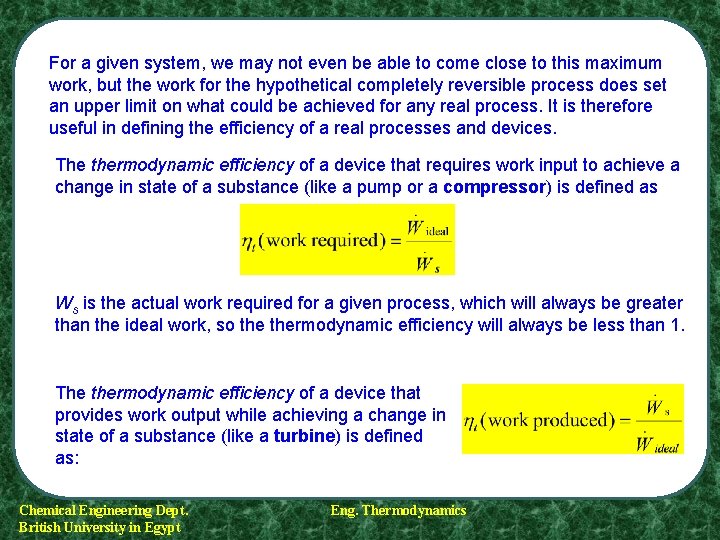
For a given system, we may not even be able to come close to this maximum work, but the work for the hypothetical completely reversible process does set an upper limit on what could be achieved for any real process. It is therefore useful in defining the efficiency of a real processes and devices. The thermodynamic efficiency of a device that requires work input to achieve a change in state of a substance (like a pump or a compressor) is defined as Ws is the actual work required for a given process, which will always be greater than the ideal work, so thermodynamic efficiency will always be less than 1. The thermodynamic efficiency of a device that provides work output while achieving a change in state of a substance (like a turbine) is defined as: Chemical Engineering Dept. British University in Egypt Eng. Thermodynamics
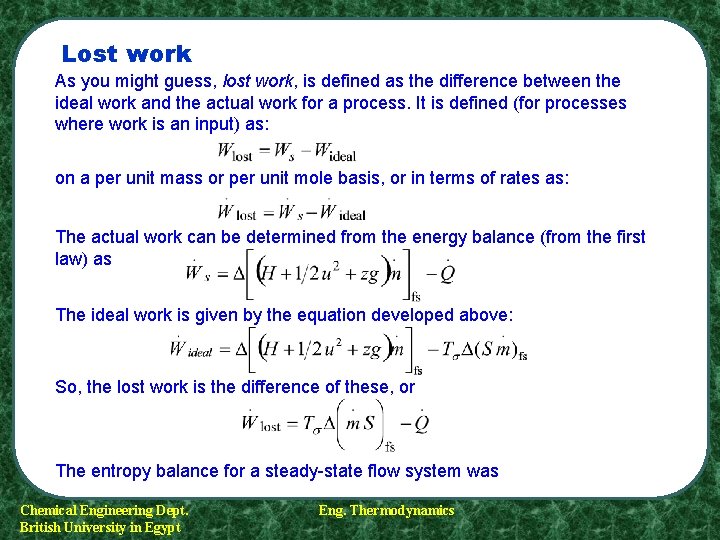
Lost work As you might guess, lost work, is defined as the difference between the ideal work and the actual work for a process. It is defined (for processes where work is an input) as: on a per unit mass or per unit mole basis, or in terms of rates as: The actual work can be determined from the energy balance (from the first law) as The ideal work is given by the equation developed above: So, the lost work is the difference of these, or The entropy balance for a steady-state flow system was Chemical Engineering Dept. British University in Egypt Eng. Thermodynamics
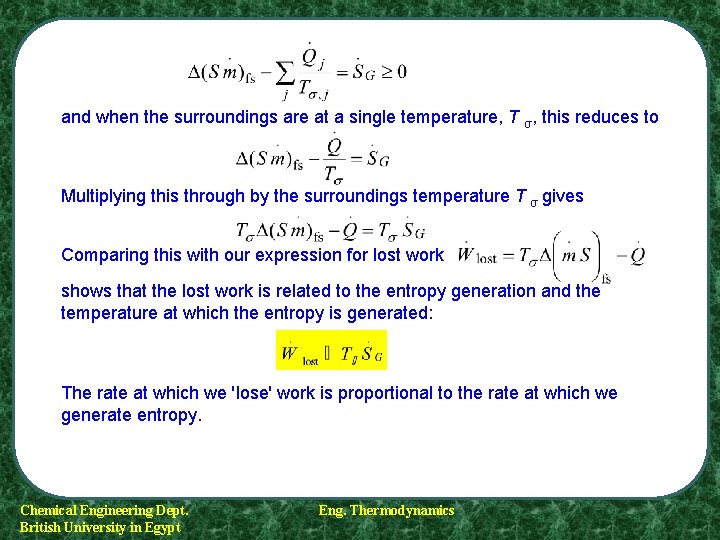
and when the surroundings are at a single temperature, T σ, this reduces to Multiplying this through by the surroundings temperature T σ gives Comparing this with our expression for lost work shows that the lost work is related to the entropy generation and the temperature at which the entropy is generated: The rate at which we 'lose' work is proportional to the rate at which we generate entropy. Chemical Engineering Dept. British University in Egypt Eng. Thermodynamics
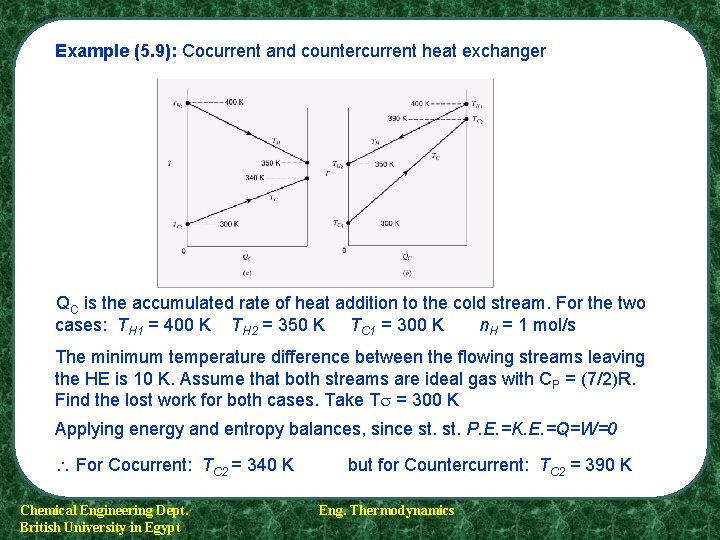
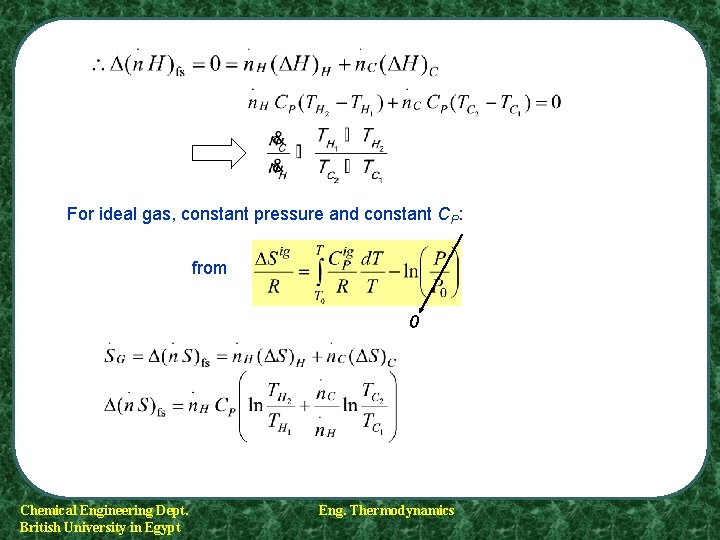
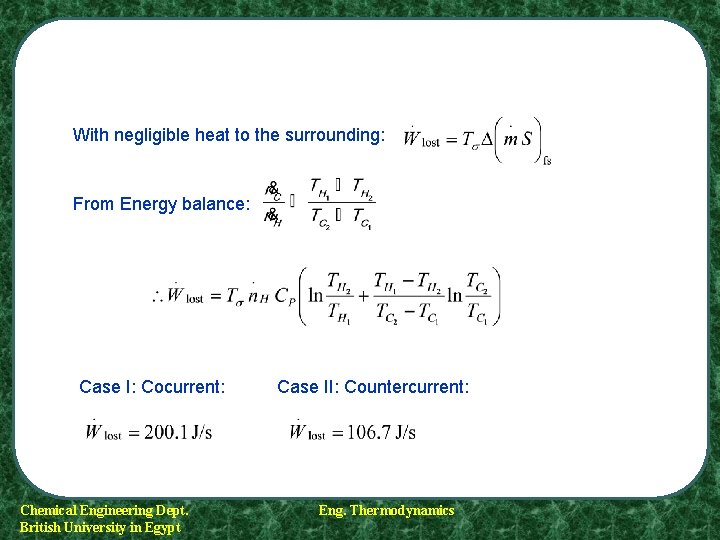
Example (5. 9): Cocurrent and countercurrent heat exchanger QC is the accumulated rate of heat addition to the cold stream. For the two cases: TH 1 = 400 K TH 2 = 350 K TC 1 = 300 K n. H = 1 mol/s The minimum temperature difference between the flowing streams leaving the HE is 10 K. Assume that both streams are ideal gas with CP = (7/2)R. Find the lost work for both cases. Take T = 300 K Applying energy and entropy balances, since st. P. E. =K. E. =Q=W=0 For Cocurrent: TC 2 = 340 K Chemical Engineering Dept. British University in Egypt but for Countercurrent: TC 2 = 390 K Eng. Thermodynamics
For ideal gas, constant pressure and constant CP: from 0 Chemical Engineering Dept. British University in Egypt Eng. Thermodynamics
With negligible heat to the surrounding: From Energy balance: Case I: Cocurrent: Chemical Engineering Dept. British University in Egypt Case II: Countercurrent: Eng. Thermodynamics
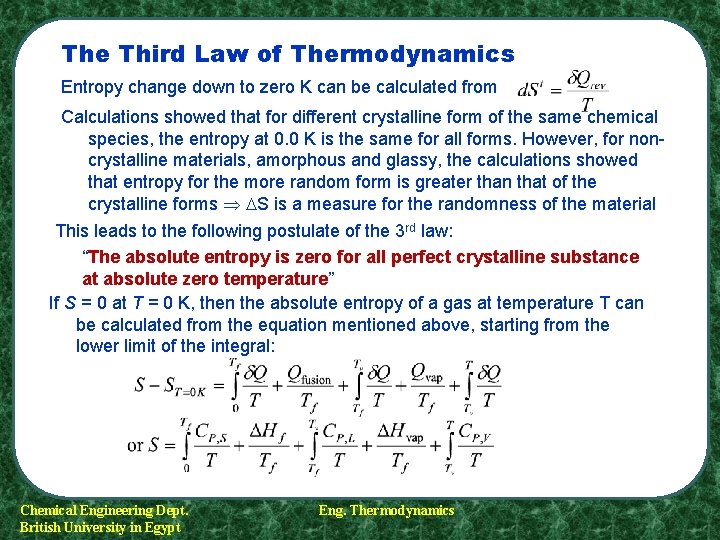
The Third Law of Thermodynamics Entropy change down to zero K can be calculated from Calculations showed that for different crystalline form of the same chemical species, the entropy at 0. 0 K is the same for all forms. However, for noncrystalline materials, amorphous and glassy, the calculations showed that entropy for the more random form is greater than that of the crystalline forms S is a measure for the randomness of the material This leads to the following postulate of the 3 rd law: “The absolute entropy is zero for all perfect crystalline substance at absolute zero temperature” If S = 0 at T = 0 K, then the absolute entropy of a gas at temperature T can be calculated from the equation mentioned above, starting from the lower limit of the integral: Chemical Engineering Dept. British University in Egypt Eng. Thermodynamics
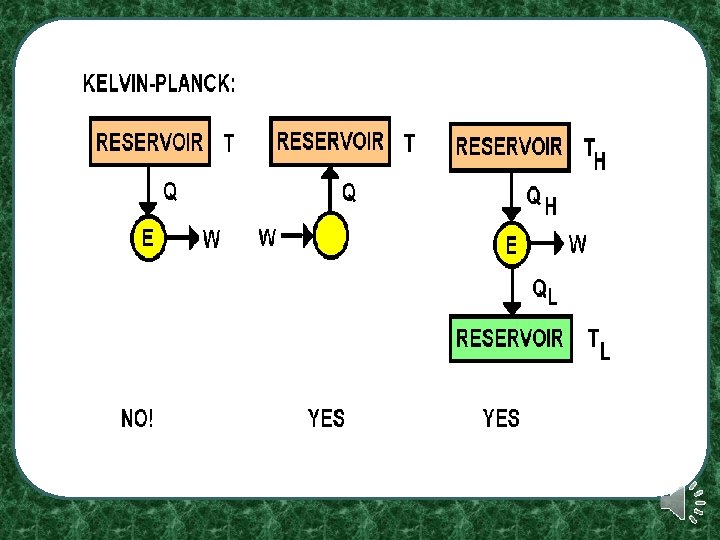
Statement of the second law: Lord Kelvin and Planck (1) No apparatus can operate in such a way that its only effect (in system and surroundings) is to convert heat absorbed by the system completely into work done by the system. [It is impossible by a cyclic process to convert the heat absorbed by a system completely into work done by the system] [ It is impossible to build a heat engine that produces a net work output by exchanging heat with a single fixedtemperature region ] Chemical Engineering Dept. British University in Egypt Eng. Thermodynamics
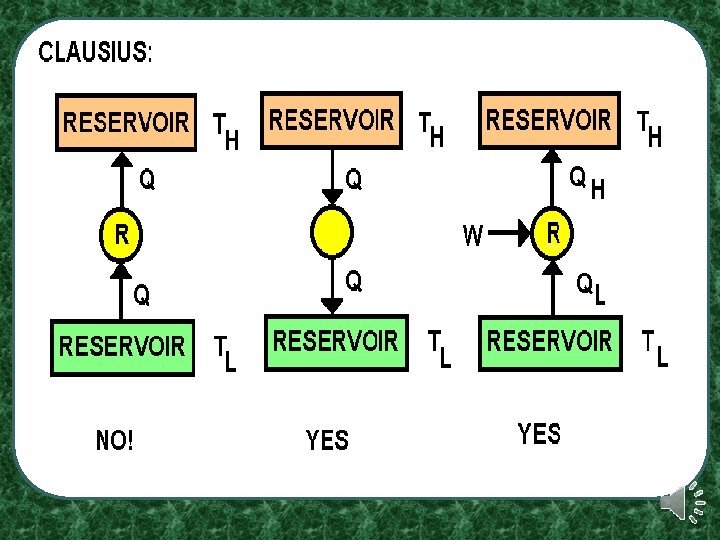
Statement of the second law (Cont. ) (2) No process is possible that consists solely in the transfer of heat from one temperature level to a higher one. [It is impossible to build a device (a refrigerator or heat pump) that has as its only effect the transfer of heat from a low- to a hightemperature region]
If heat Q is transferred between two reservoirs TH and TC Since TH TC Stotal is positive For this irreversible process
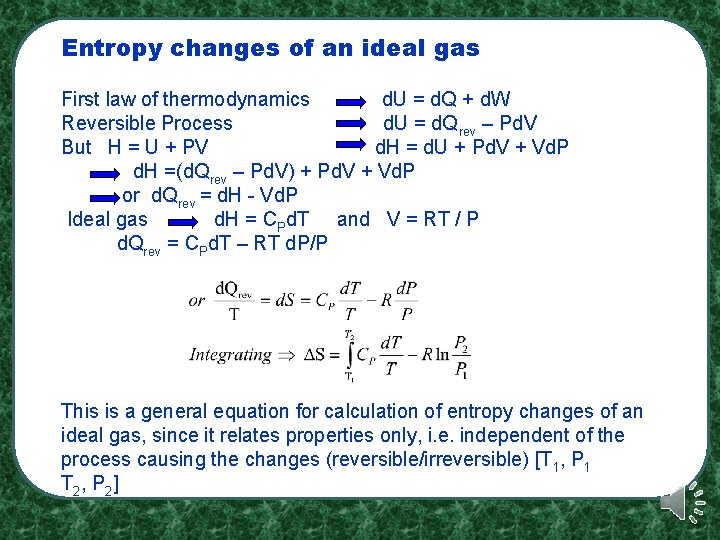
Entropy changes of an ideal gas First law of thermodynamics d. U = d. Q + d. W Reversible Process d. U = d. Qrev – Pd. V But H = U + PV d. H = d. U + Pd. V + Vd. P d. H =(d. Qrev – Pd. V) + Pd. V + Vd. P or d. Qrev = d. H - Vd. P Ideal gas d. H = CPd. T and V = RT / P d. Qrev = CPd. T – RT d. P/P This is a general equation for calculation of entropy changes of an ideal gas, since it relates properties only, i. e. independent of the process causing the changes (reversible/irreversible) [T 1, P 1 T 2 , P 2 ]
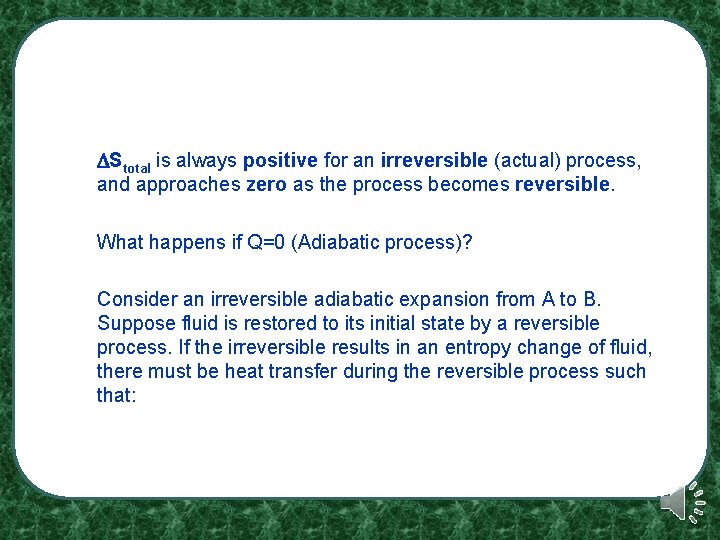
Stotal is always positive for an irreversible (actual) process, and approaches zero as the process becomes reversible. What happens if Q=0 (Adiabatic process)? Consider an irreversible adiabatic expansion from A to B. Suppose fluid is restored to its initial state by a reversible process. If the irreversible results in an entropy change of fluid, there must be heat transfer during the reversible process such that:
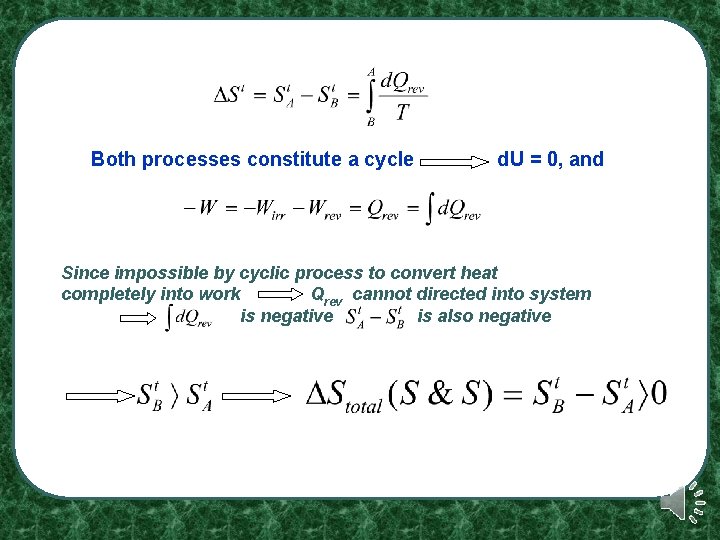
Both processes constitute a cycle d. U = 0, and Since impossible by cyclic process to convert heat completely into work Qrev cannot directed into system is negative is also negative
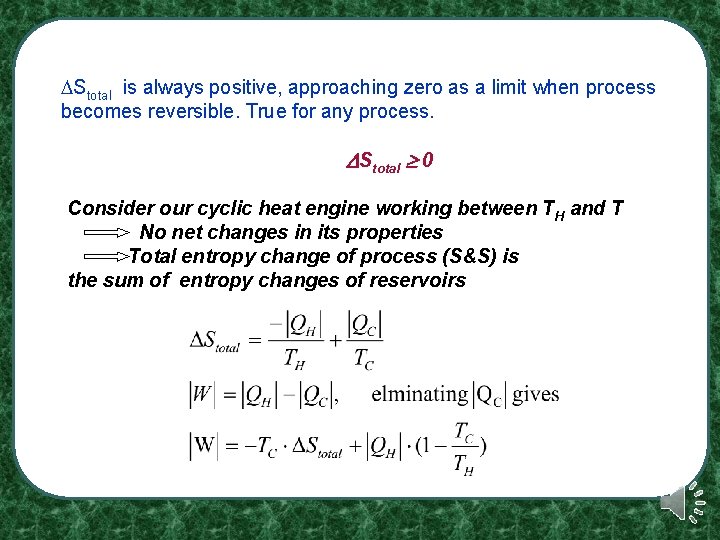
Stotal is always positive, approaching zero as a limit when process becomes reversible. True for any process. Stotal 0 Consider our cyclic heat engine working between TH and T No net changes in its properties Total entropy change of process (S&S) is the sum of entropy changes of reservoirs
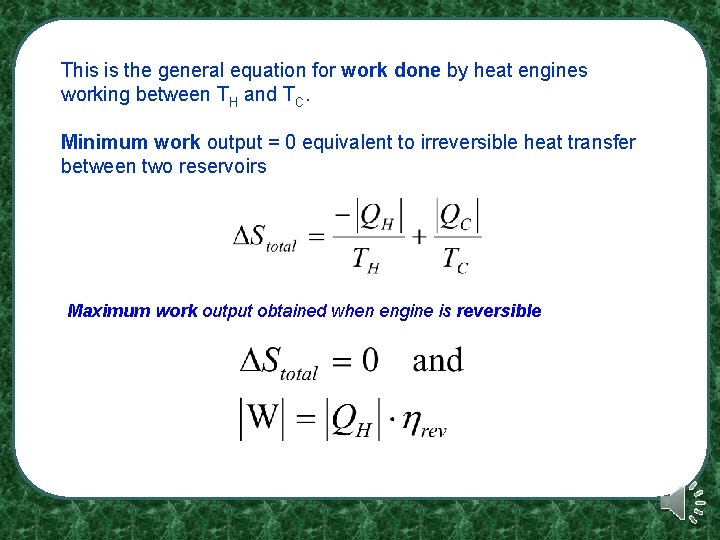
This is the general equation for work done by heat engines working between TH and TC. Minimum work output = 0 equivalent to irreversible heat transfer between two reservoirs Maximum work output obtained when engine is reversible
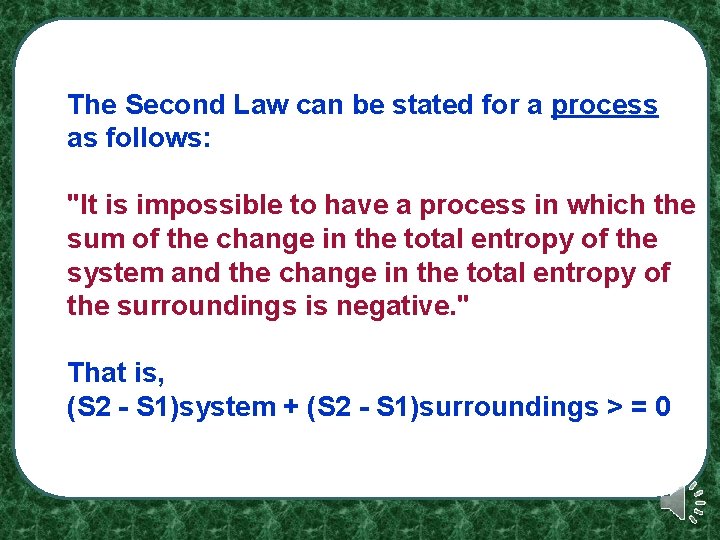
The Second Law can be stated for a process as follows: "It is impossible to have a process in which the sum of the change in the total entropy of the system and the change in the total entropy of the surroundings is negative. " That is, (S 2 - S 1)system + (S 2 - S 1)surroundings > = 0
Summary (1) The change in entropy of any system undergoing a reversible process is (2) For an irreversible (real) process applied to an arbitrarily reversible process that achieves the same change of state as the actual process. Entropy is a state function entropy changes for reversible and irreversible processes are identical. (3) Entropy is a property derived from the second law just as U was derived from first law. Chemical Engineering Dept. British University in Egypt Eng. Thermodynamics