
The Second Industrial Revolution Bessemer Process new process
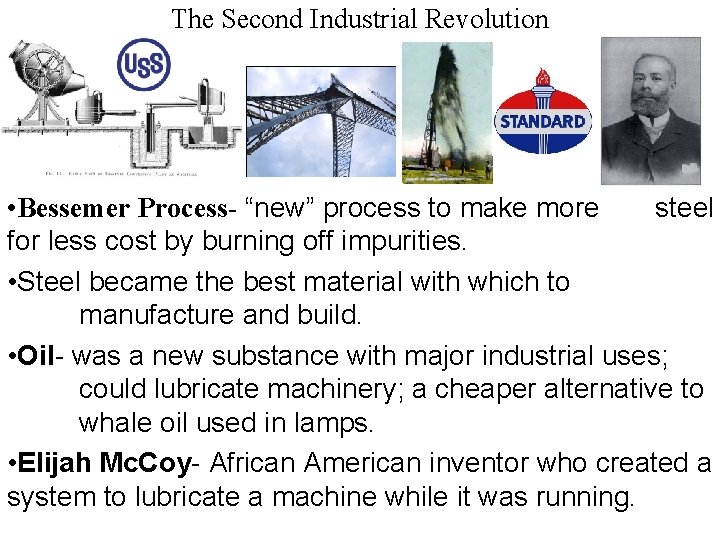
The Second Industrial Revolution • Bessemer Process- “new” process to make more steel for less cost by burning off impurities. • Steel became the best material with which to manufacture and build. • Oil- was a new substance with major industrial uses; could lubricate machinery; a cheaper alternative to whale oil used in lamps. • Elijah Mc. Coy- African American inventor who created a system to lubricate a machine while it was running.

The Second Industrial Revolution • The Transcontinental Railroad was finished in 1869 when the Central Pacific and the Union Pacific RRs met at Promontory Point, Utah. • Cornelius Vanderbilt created a RR empire by buying smaller RR lines and connecting major cities. (1870) • Inventors like the Duryea brothers tinkered with machines to create horseless carriages. (1890 s) • The Wright Brothers created their “flyer” and first achieved powered flight on December 17, 1903.

The Second Industrial Revolution • Morse invented the telegraph as a means of communicating over wires using electricity. (1837) • Bell invented the telephone in 1876, AKA, the “talking telegraph. ” • Christopher Sholes developed the typewriter in 1867 to quickly reproduce legible documents. • Edison invented the phonograph (1877) and the light bulb (1879) assisted by Lewis Latimer
The Second Industrial Revolution • Communist Manifesto- utopian political/economic pamphlet that explained communism: Proletariat would rise up against the Bourgeoisie, a world economic revolution would occur, all private wealth would be re-distributed to the masses. (Karl Marx & Frederick Engels) • Bourgeoisie- the middle/upper class. • Proletariat- the working class. • Communism- society shares all resources. • Capitalism- private ownership of resources. • Social Darwinism- Society of the fittest.

- Slides: 5