
The Second Five Year Development Plan FYDP II
- Slides: 14
The Second Five Year Development Plan (FYDP II) 2016/17 – 2020/21 Formulation Of The Implementation Strategy For FYDP II Presentation on Rationale for FYDP II Implementation Strategy Maduka Paul Kessy Deputy Executive Secretary Ministry of Finance and Planning 27 th October 2016
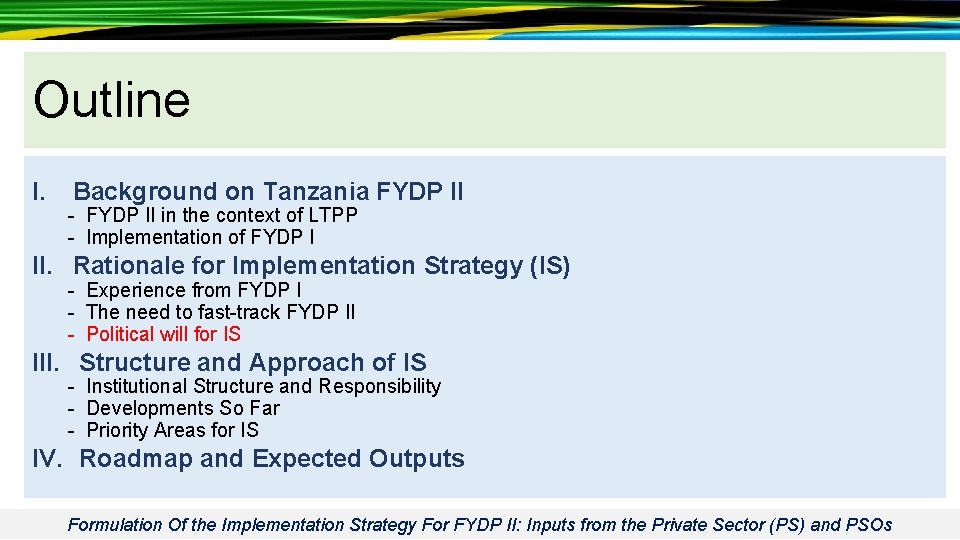
Outline I. Background on Tanzania FYDP II - FYDP II in the context of LTPP - Implementation of FYDP I II. Rationale for Implementation Strategy (IS) - Experience from FYDP I - The need to fast-track FYDP II - Political will for IS III. Structure and Approach of IS - Institutional Structure and Responsibility - Developments So Far - Priority Areas for IS IV. Roadmap and Expected Outputs Formulation Of the Implementation Strategy For FYDP II: Inputs from the Private Sector (PS) and PSOs
I. Background of FYDP II Context of FYDP II Tanzania Development Vision 2025 (NDV 2025) recognizes the role of the industrial sector in transforming the nation from a least developed country to a middle income, ‘semiindustrialized’ country by 2025. This objective has guided the development of the LTPP and is shaping the three FYDPs The Second Year Development Plan. Tanzania’s 2016/17 – 2020/21 (FYDP II) will FYDP I had. Five a theme: Unleashing Latent Growth therefore succeed the FYDP I which expired in June 2016. Theme for FYDP Potentials II (2016/16 – 2020/21): “Nurturing Industrialization for Economic Transformation and Human Development” Formulation Of the Implementation Strategy For FYDP II: Inputs from the Private Sector (PS) and PSOs
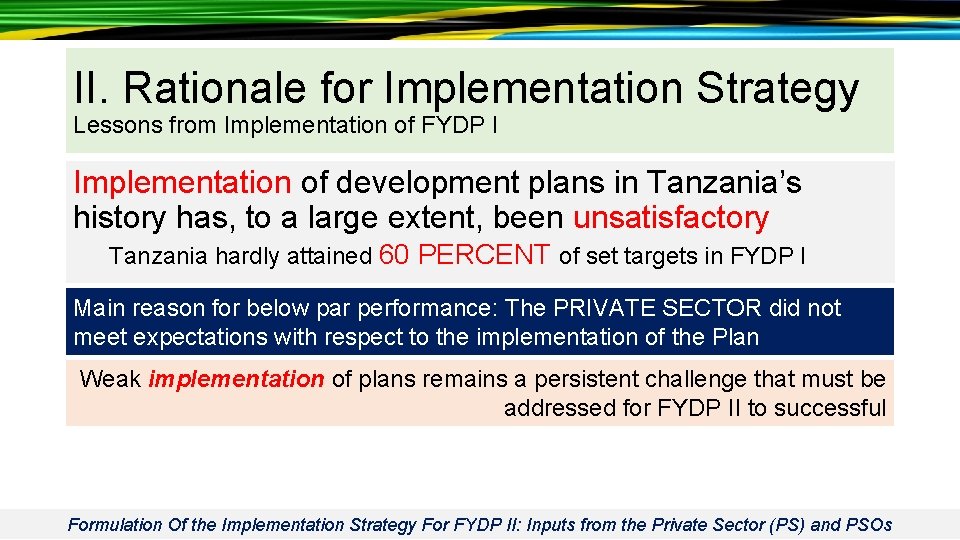
II. Rationale for Implementation Strategy Lessons from Implementation of FYDP I Implementation of development plans in Tanzania’s history has, to a large extent, been unsatisfactory Tanzania hardly attained 60 PERCENT of set targets in FYDP I Main reason for below par performance: The PRIVATE SECTOR did not meet expectations with respect to the implementation of the Plan Weak implementation of plans remains a persistent challenge that must be addressed for FYDP II to successful Formulation Of the Implementation Strategy For FYDP II: Inputs from the Private Sector (PS) and PSOs
II. Rationale for Implementation Strategy Lessons from Implementation of FYDP I Factors that led to weak Implementation: A. Weak institutional capacities Lack of capacity in institutions required to ensure good governance, accountability, coherency in policies, information and procedures, as well as, enforcement of implementation Also, the organization and coordination for effective monitoring, evaluation and reporting was weak B. Polarized decision making and weaknesses in resources mobilization C. Vested institutional and individual interests and lack of final command Formulation Of the Implementation Strategy For FYDP II: Inputs from the Private Sector (PS) and PSOs
II. Rationale for Implementation Strategy Need to Fast-Track FYDP II In order to fast-track the implementation of FYDP II and that of LTPP, the Government has recognized business environment as well as a need to strengthen implementation. Of the four objectives of the FYDP II, two are on enterprise development and on implementation: § Creating a conducive environment for business and enterprise development; and § Foster and strengthen implementation effectiveness Formulation Of the Implementation Strategy For FYDP II: Inputs from the Private Sector (PS) and PSOs
II. Rationale for Implementation Strategy Political will: Demand for an Implementation Strategy “The Fifth Phase Government that I lead is committed to bringing about fundamental improvements in the lives of Tanzanians. To do this, however, the attitudes of Tanzanians towards work must be more positive; commitment to addressing stumbling blocks in the course of implementing this Plan should be unwavering; and resolve to achieve the set targets should be abiding” Dr. John Pombe Joseph Magufuli, Key Note to the FYDP II, 2016. “There is a wisdom well known that a plan without an implementation strategy is a draft. … This time we should learn to avoid the mistakes of the past by crafting an Implementation Strategy of the Plan” Majaliwa Kassim Majaliwa, Inaugural Speech of FYDP II, 2016 “It is worth reiterating that there are less than ten years remaining between now and the terminal year of Vision 2025. As such, effective implementation of this Plan is critical” Dr. Philip Isdor Mpango, Preface to FYDP II, 2016 Formulation Of the Implementation Strategy For FYDP II: Inputs from the Private Sector (PS) and PSOs
III. Structure and Approach of IS Components of IS and Mandate The envisaged FYDP II Implementation Strategy has four components: A. Action Plans for the interventions of FYDP II; B. Communication Strategy; C. Financing Strategy; and D. A Monitoring and Evaluation Framework. Functionary mandate of the Ministry of Finance and Planning: § The need to foster culture results oriented management and experience coming with BRN; and § Enhancing Smart Partnership in implementing the Plan. Formulation Of the Implementation Strategy For FYDP II: Inputs from the Private Sector (PS) and PSOs
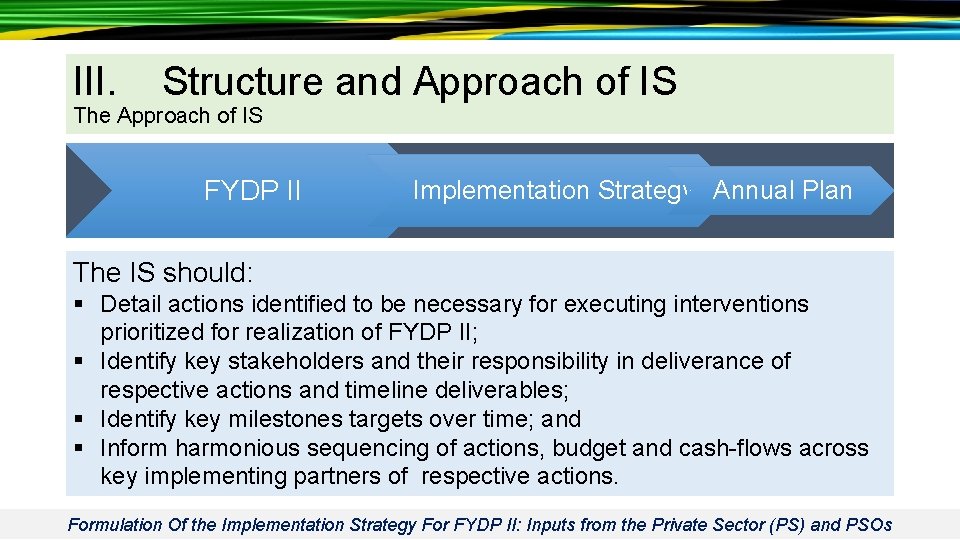
III. Structure and Approach of IS The Approach of IS FYDP II Implementation Strategy Annual Plan The IS should: § Detail actions identified to be necessary for executing interventions prioritized for realization of FYDP II; § Identify key stakeholders and their responsibility in deliverance of respective actions and timeline deliverables; § Identify key milestones targets over time; and § Inform harmonious sequencing of actions, budget and cash-flows across key implementing partners of respective actions. Formulation Of the Implementation Strategy For FYDP II: Inputs from the Private Sector (PS) and PSOs
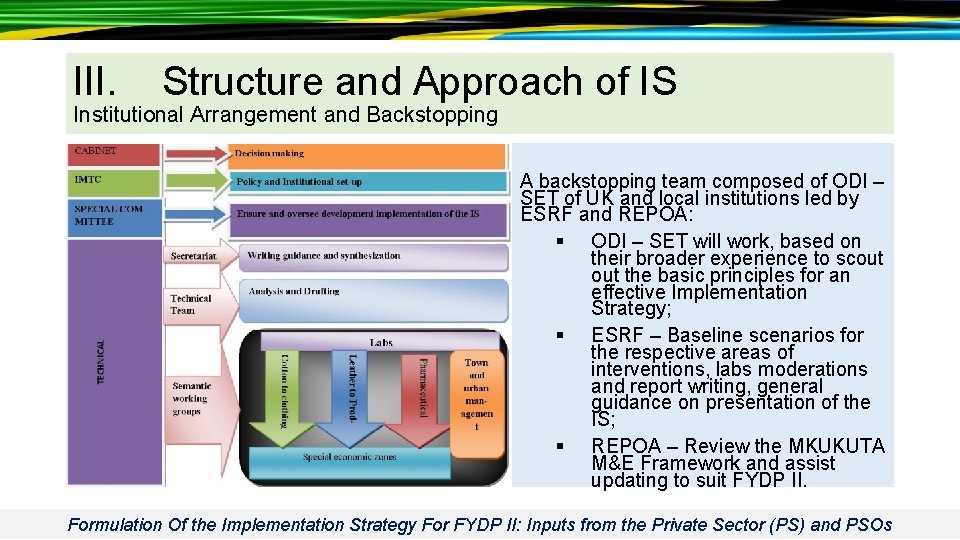
III. Structure and Approach of IS Institutional Arrangement and Backstopping A backstopping team composed of ODI – SET of UK and local institutions led by ESRF and REPOA: § ODI – SET will work, based on their broader experience to scout the basic principles for an effective Implementation Strategy; § ESRF – Baseline scenarios for the respective areas of interventions, labs moderations and report writing, general guidance on presentation of the IS; § REPOA – Review the MKUKUTA M&E Framework and assist updating to suit FYDP II. Formulation Of the Implementation Strategy For FYDP II: Inputs from the Private Sector (PS) and PSOs
III. Structure and Approach of IS Developments So Far Concept Note to the formulation of FYDP II Implementation Strategy approved at IMTC; The Note established the organisation and coordination framework for the formulation; The Concept Note will be presented separately IMTC already has appointed some of PSs as members of the Steering Committee; Secretariat has been composed; Technical Team has been assembled to lead analytical work for the formulation of FYDP II - IS; Action Plan; Financing; Communication; and M&E Framework. Formulation Of the Implementation Strategy For FYDP II: Inputs from the Private Sector (PS) and PSOs
III. Structure and Approach of IS Priority Areas of Implementation The preparation of IS will be iterative. To start with, FIVE priority areas have been identified as pilot projects: A. Cotton to Textile and Clothing; B. Leather to leather products; C. Pharmaceuticals and medical facilities; D. Urbanisation and Urban Management; and E. Special Economic Zones/Export Processing Zones Management. We expect this workshop to provide very useful input for the IS especially with regards to the first three priorities
IV. Roadmap and Expected Output A. Roadmap of IS preparation – December 2016 B. Roll out waves – January up February, 2017 C. Consolidation of IS by end March, 2017 What the workshop should achieve: A. Build consensus on the importance of the IS, approach and the importance of disclosure of necessary information; B. A shared understanding of the work ahead and roles across stakeholders; C. Solicit ideas from the private sector on effective implementation of FYDP II in preparing and implementing the IS and its components.
Asanteni Sana!