
The Scope of the 2000 International Energy Conservation
- Slides: 18
The Scope of the 2000 International Energy Conservation Code U. S. Department of Energy Office of Codes and Standards Produced by the Pacific Northwest National Laboratory
Course Outline • Introduction to IECC • Residential Provisions – Chapter 4 – Chapter 5 – Chapter 6 • Commercial Provisions – Chapter 7 – Chapter 8
What is the IECC? A REQUIRED MINIMUM LEVEL OF ENERGY EFFICIENCY IN NEW CONSTRUCTION • Enables effective use of energy in new building construction • Regulates the design and selection of the • building envelope • mechanical systems • electrical systems • service water heating systems
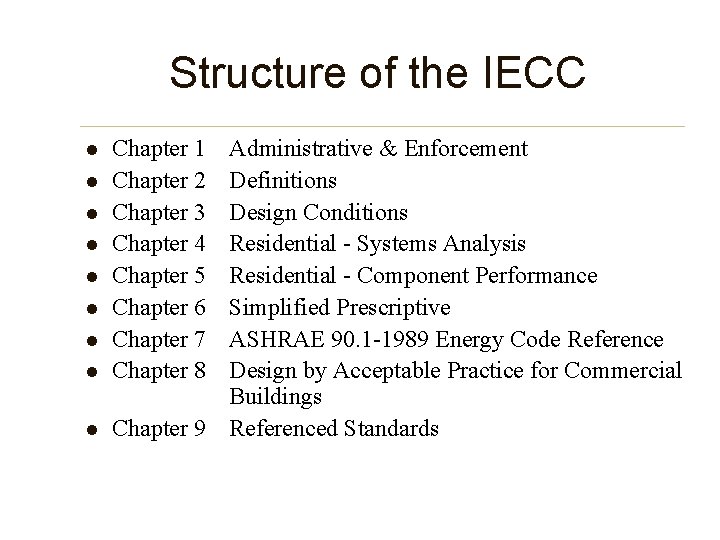
Structure of the IECC l l l l l Chapter 1 Chapter 2 Chapter 3 Chapter 4 Chapter 5 Chapter 6 Chapter 7 Chapter 8 Administrative & Enforcement Definitions Design Conditions Residential - Systems Analysis Residential - Component Performance Simplified Prescriptive ASHRAE 90. 1 -1989 Energy Code Reference Design by Acceptable Practice for Commercial Buildings Chapter 9 Referenced Standards
What is the 90. 1 Code? • ASHRAE/IES 90. 1 -1989 in code language • Standard of stringency established by EPAct ‘ 92 • States required to update their nonresidential energy standards to be at least as stringent
Structure of 90. 1 Code (Relevant Sections) • Chapter 3 Design Conditions • Chapter 4 Building Design Requirements – 401 Electrical Systems and Equipment – 402 Building Envelopes – 403 Building Mechanical Systems and Equipment – 404 Building Service Systems and Equipment • Chapter 5 Reference Standards • Appendix A - ACP Tables • Appendices B and C (reserved) • Appendix D - Duct Insulation R-values
Application • When does the IECC apply? – Newly conditioned space – New construction in existing buildings – Alterations to existing spaces – Additions – Mixed use buildings – Change in occupancy
Newly Conditioned Space (Previously Unconditioned) (Section 101. 4) • Envelope, mechanical and lighting systems must be brought into compliance • Potential problem areas – Building envelope – Lighting system • Recommendations – Demonstrate compliance for systems at the time of permit
New Construction in Existing Buildings (Tenant Improvements) (Section 101. 4) • New system(s) must comply – Envelope (should already comply) – Mechanical – Lighting
Additions (Section 101. 4. 2) • Construction of new conditioned space or the conditioning of previously unconditioned space • Treat the envelope, lighting, and mechanical systems as if the addition were a new building
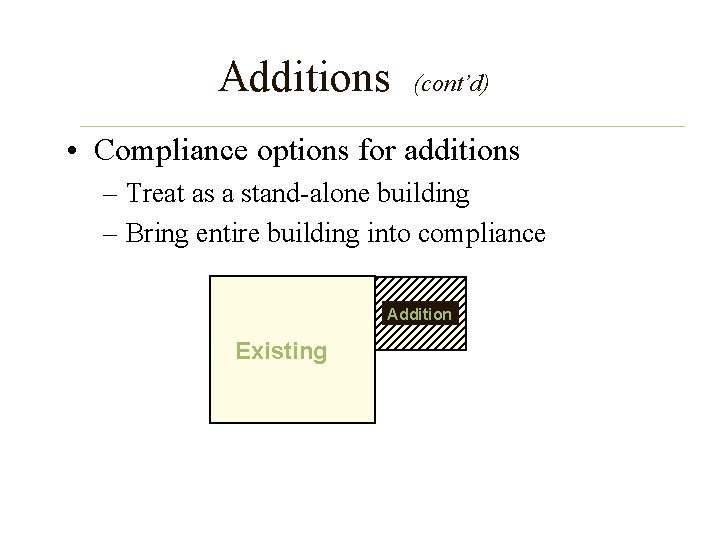
Additions (cont’d) • Compliance options for additions – Treat as a stand-alone building – Bring entire building into compliance Addition Existing
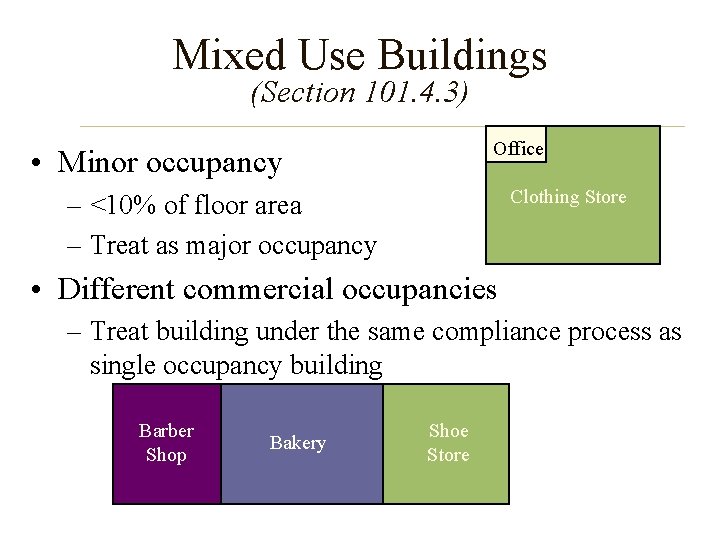
Mixed Use Buildings (Section 101. 4. 3) Office • Minor occupancy Clothing Store – <10% of floor area – Treat as major occupancy • Different commercial occupancies – Treat building under the same compliance process as single occupancy building Barber Shop Bakery Shoe Store
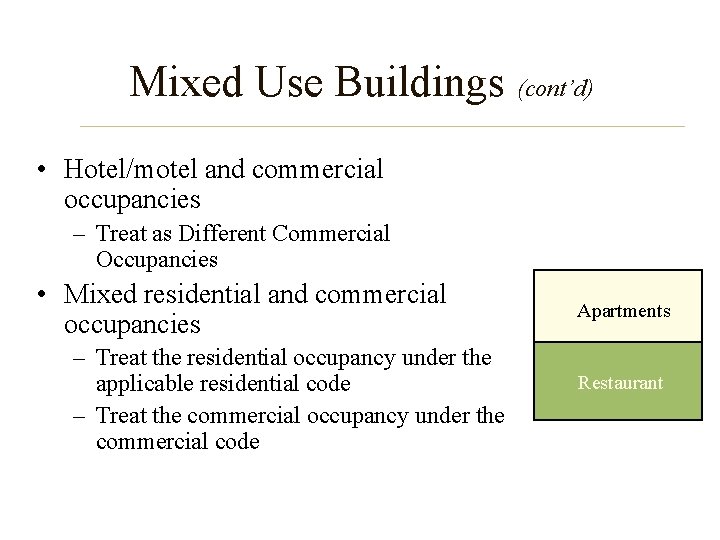
Mixed Use Buildings (cont’d) • Hotel/motel and commercial occupancies – Treat as Different Commercial Occupancies • Mixed residential and commercial occupancies – Treat the residential occupancy under the applicable residential code – Treat the commercial occupancy under the commercial code Apartments Restaurant
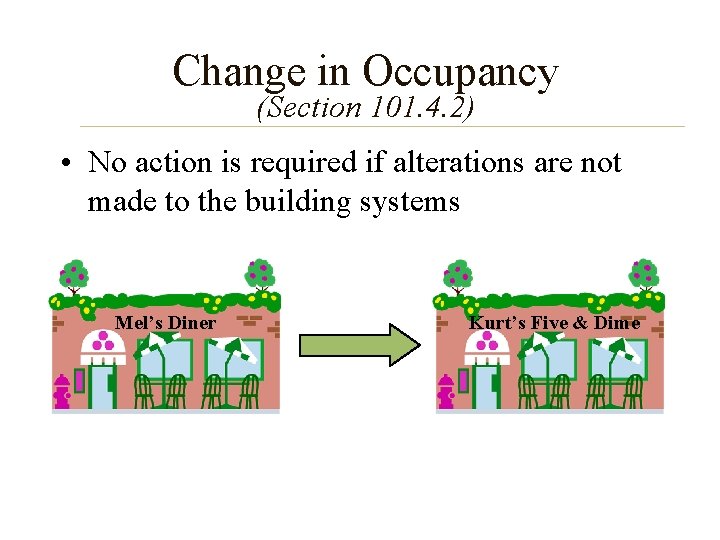
Change in Occupancy (Section 101. 4. 2) • No action is required if alterations are not made to the building systems Mel’s Diner Kurt’s Five & Dime
Problem Question A building owner wants to rearrange some interior partitions and reposition the light fixtures in the affected rooms. Do any requirements exist for this alteration?
Change In Occupancy • Alterations to Existing Spaces • Applies to only portions of the systems being altered • Applies if alteration increases energy use • Alterations must meet the requirements applying to the altered component • New systems in the alterations must comply
Problem Question A building owner wants to install a new window in an old building, which will increase the glazing area. Must the building comply with the code?
Exceptions (Section 101. 4. 1) • Very low energy use buildings (<3. 4 Btu/h-ft 2 or 1 watt/ft 2) • Buildings (or portions of) that are neither heated nor cooled • Buildings designated as historic (Section 101. 4. 2. 3)