
The Scope of Semantics Sense and Reference Fifth
- Slides: 7
The Scope of Semantics: Sense and Reference Fifth Lecture/ Part 2 Third Year/ Evening Classes Translation Department/ College of Arts/ Mustansiriyah University Lecturer Zayneb Elaiwi Sallumi (Ph. D)
O The dictionary is usually concerned with sense relations, with relating words to words. O Though, it could be argued that the ultimate aim of the dictionary is to supply its user with referential meaning by relating a word whose meaning is unknown to a word or words whose reference is already understood, i. e. it provides referential meaning via sense.
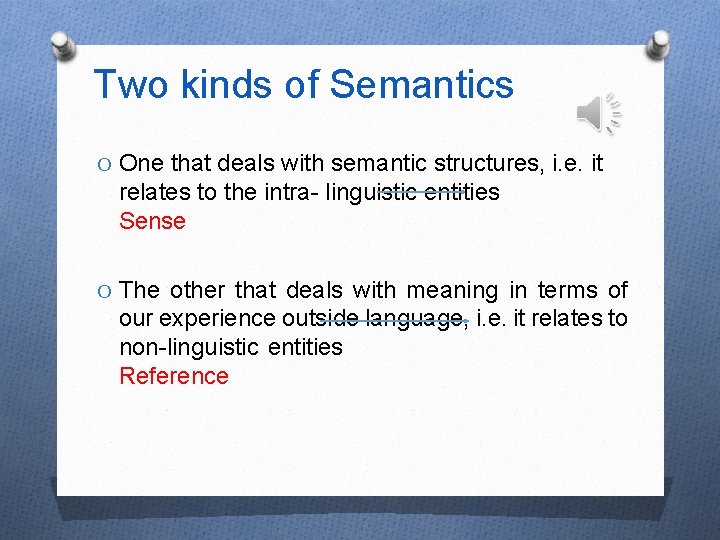
Two kinds of Semantics O One that deals with semantic structures, i. e. it relates to the intra- linguistic entities Sense O The other that deals with meaning in terms of our experience outside language, i. e. it relates to non-linguistic entities Reference
O Some linguists have attempted to limit semantics, both in theory and practice, to sense relations. For example, Katz and Fodor in their article ‘The Structure of a Semantic Theory’ talk about sentences’ meanings, and argue that a semantic theory must account for ambiguity, anomaly and paraphrase.
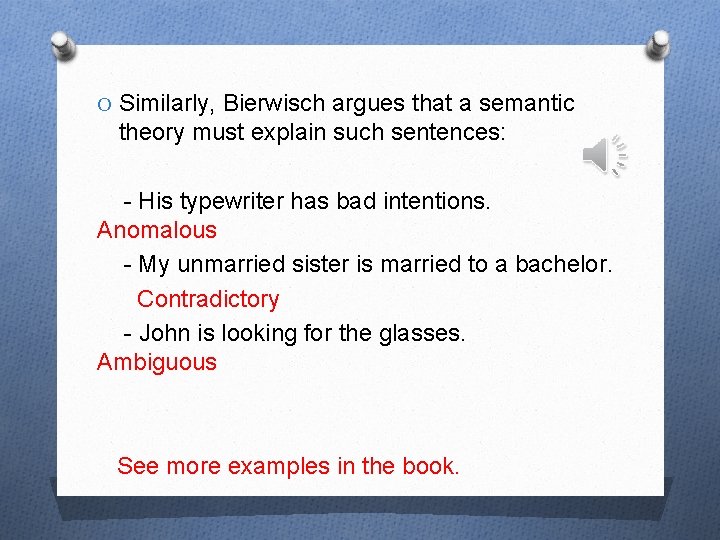
O Similarly, Bierwisch argues that a semantic theory must explain such sentences: - His typewriter has bad intentions. Anomalous - My unmarried sister is married to a bachelor. Contradictory - John is looking for the glasses. Ambiguous See more examples in the book.
O Katz and Fodor exclude from a semantic theory any reference to the ‘settings’ of sentences. Semantics is not, or cannot be, concerned with the way words and sentences are used in relation to the world around us, i. e. they exclude reference. O However, Bierwisch talks about (i) ‘the interpretation of sentences’ and (ii) ‘how these interpretations are related to the things spoken about’, but he gives no indication how we can proceed from the one to the other.
So to conclude… ü It is not always possible to distinguish between SENSE & REFERENCE because the categories of our language correspond to real-world distinctions. ü Whether language determines the shape of the world or vice versa is a “chicken and egg” problem. We have ram/ ewe in the semantic structure of English, but it also relates to the fact that there are male and female sheep and cattle. But we have to keep in mind that: (1. ) not all languages will make the same distinctions (2. ) there is considerable indeterminacy in the categorisation of the real world ü We must allow that there is no absolute line between sense and reference , between what is in the world and what is in the language.