
The Scope of Prevention PSY 372 Developmental Psychology

- Slides: 19
The Scope of Prevention PSY 372 Developmental Psychology and Social Intervention
Learning Objectives (1) Understand Prevention Classifications Primary, Secondary, Tertiary Universal, Secondary, Indicated (2) Define Health Promotion and Differentiate it from Prevention Describe Health Promotion Outcomes (3) Explain the Mental Health Intervention Spectrum and Give Examples
Defining Prevention 1952 Public Health Classifications: Primary, Secondary, and Tertiary Prevention Primary prevention is designed to prevent a disease or condition (such as arthritis), from occurring in the first place (before the onset). Examples: (a) Regular physical activity to reduce the risk of developing cardiovascular disease and vaccination against infectious diseases are classic examples of primary prevention measures. (b) An example of a primary prevention for arthritis is protecting a joint from repetitive stresses and injuries which can lead to osteoarthritis. (c) Come up with examples of primary prevention for MEBs Source: http: //www. cdc. gov/arthritis/temp/pilots-201208/pilot 1/online/arthritis-challenge/03 -Prevention/concept. htm
Defining Prevention 1952 Public Health Classifications: Primary, Secondary, and Tertiary Prevention Secondary prevention attempts to identify a disease at its earliest stage so that prompt and appropriate management can be initiated. Detection of initial symptoms is critical. Example: (a) A person with joint symptoms sees their doctor and is diagnosed with arthritis, allowing treatment to begin at an early stage of the disease. (b) Come up with examples of secondary prevention for MEBs Source: http: //www. cdc. gov/arthritis/temp/pilots-201208/pilot 1/online/arthritis-challenge/03 -Prevention/concept. htm
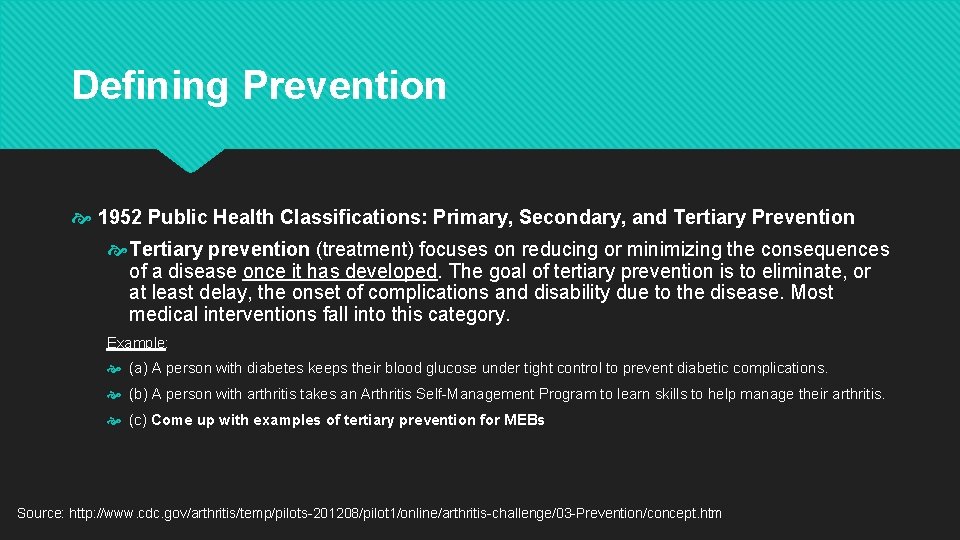
Defining Prevention 1952 Public Health Classifications: Primary, Secondary, and Tertiary Prevention Tertiary prevention (treatment) focuses on reducing or minimizing the consequences of a disease once it has developed. The goal of tertiary prevention is to eliminate, or at least delay, the onset of complications and disability due to the disease. Most medical interventions fall into this category. Example: (a) A person with diabetes keeps their blood glucose under tight control to prevent diabetic complications. (b) A person with arthritis takes an Arthritis Self-Management Program to learn skills to help manage their arthritis. (c) Come up with examples of tertiary prevention for MEBs Source: http: //www. cdc. gov/arthritis/temp/pilots-201208/pilot 1/online/arthritis-challenge/03 -Prevention/concept. htm
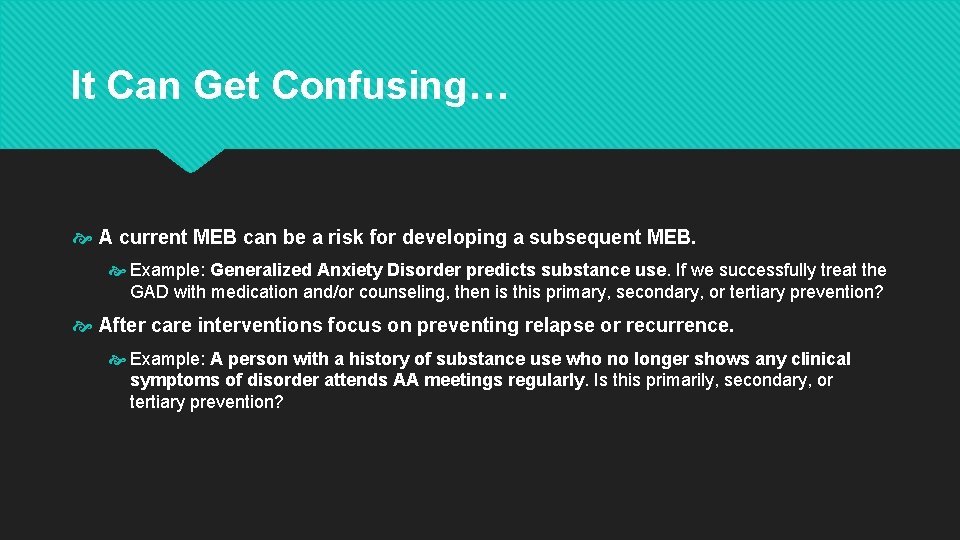
It Can Get Confusing… A current MEB can be a risk for developing a subsequent MEB. Example: Generalized Anxiety Disorder predicts substance use. If we successfully treat the GAD with medication and/or counseling, then is this primary, secondary, or tertiary prevention? After care interventions focus on preventing relapse or recurrence. Example: A person with a history of substance use who no longer shows any clinical symptoms of disorder attends AA meetings regularly. Is this primarily, secondary, or tertiary prevention?
Defining Prevention 1983 Re-Classification by Gordon: Universal, Selective, and Indicated Prevention The term “preventive” should not include what is referred “tertiary prevention” Prevention measures can be classified on the basis of population groups among which they are optimally used. Source: http: //www. ncbi. nlm. nih. gov/pmc/articles/PMC 1424415/
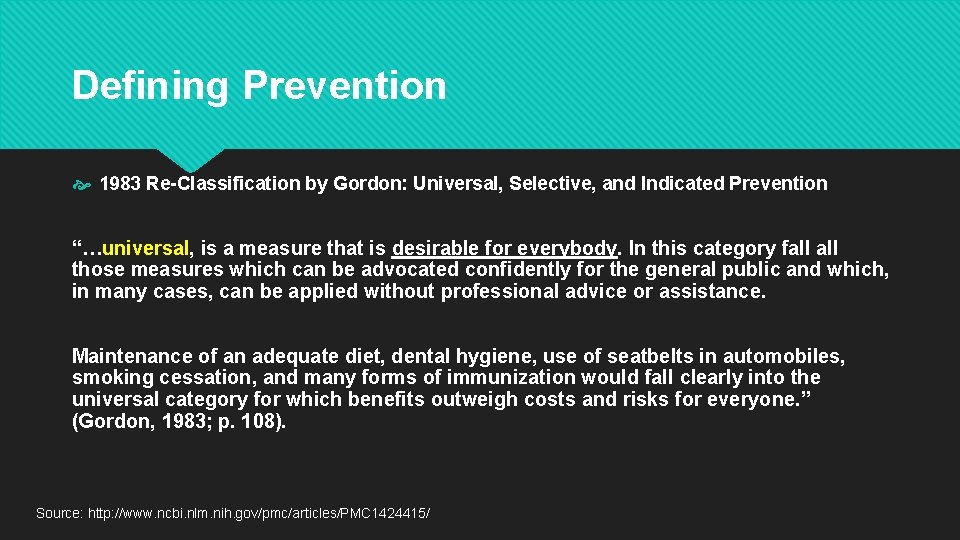
Defining Prevention 1983 Re-Classification by Gordon: Universal, Selective, and Indicated Prevention “…universal, is a measure that is desirable for everybody. In this category fall those measures which can be advocated confidently for the general public and which, in many cases, can be applied without professional advice or assistance. Maintenance of an adequate diet, dental hygiene, use of seatbelts in automobiles, smoking cessation, and many forms of immunization would fall clearly into the universal category for which benefits outweigh costs and risks for everyone. ” (Gordon, 1983; p. 108). Source: http: //www. ncbi. nlm. nih. gov/pmc/articles/PMC 1424415/
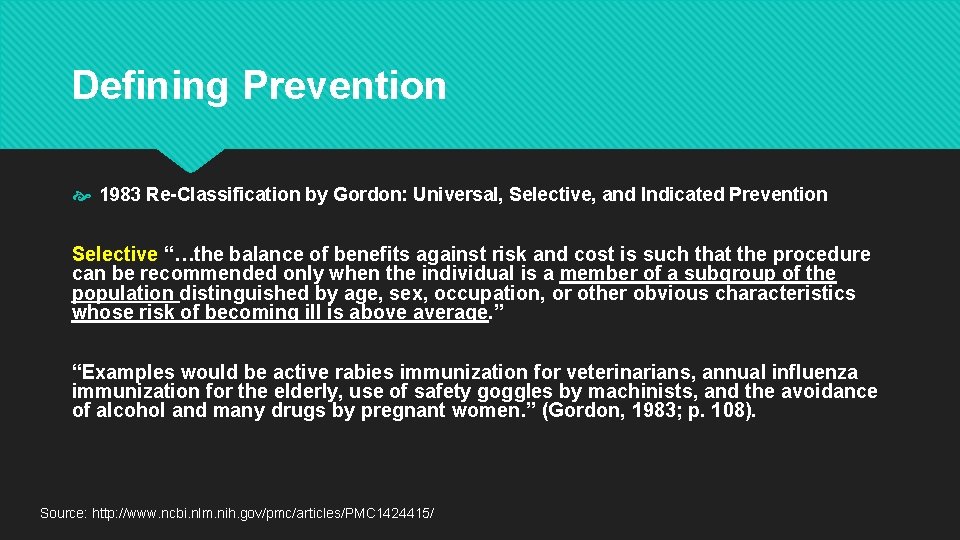
Defining Prevention 1983 Re-Classification by Gordon: Universal, Selective, and Indicated Prevention Selective “…the balance of benefits against risk and cost is such that the procedure can be recommended only when the individual is a member of a subgroup of the population distinguished by age, sex, occupation, or other obvious characteristics whose risk of becoming ill is above average. ” “Examples would be active rabies immunization for veterinarians, annual influenza immunization for the elderly, use of safety goggles by machinists, and the avoidance of alcohol and many drugs by pregnant women. ” (Gordon, 1983; p. 108). Source: http: //www. ncbi. nlm. nih. gov/pmc/articles/PMC 1424415/
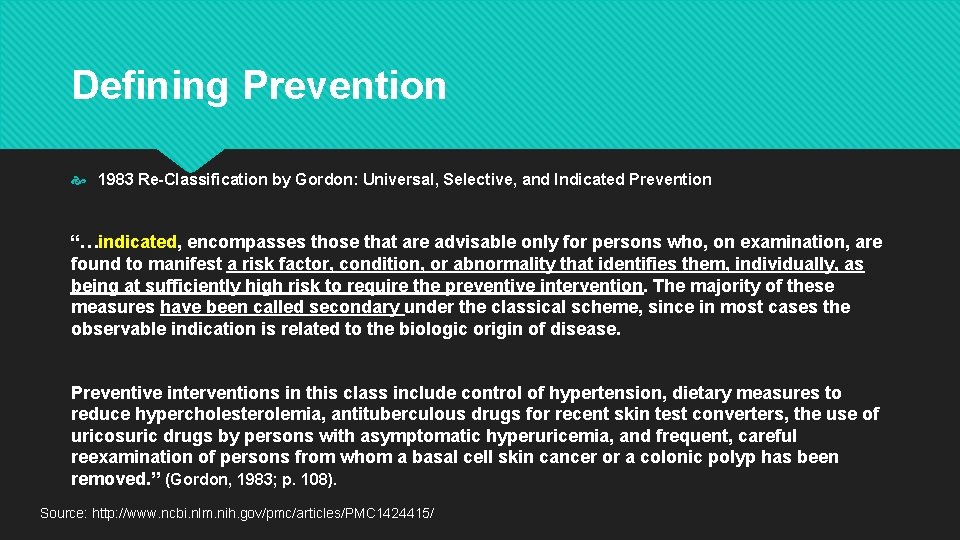
Defining Prevention 1983 Re-Classification by Gordon: Universal, Selective, and Indicated Prevention “…indicated, encompasses those that are advisable only for persons who, on examination, are found to manifest a risk factor, condition, or abnormality that identifies them, individually, as being at sufficiently high risk to require the preventive intervention. The majority of these measures have been called secondary under the classical scheme, since in most cases the observable indication is related to the biologic origin of disease. Preventive interventions in this class include control of hypertension, dietary measures to reduce hypercholesterolemia, antituberculous drugs for recent skin test converters, the use of uricosuric drugs by persons with asymptomatic hyperuricemia, and frequent, careful reexamination of persons from whom a basal cell skin cancer or a colonic polyp has been removed. ” (Gordon, 1983; p. 108). Source: http: //www. ncbi. nlm. nih. gov/pmc/articles/PMC 1424415/
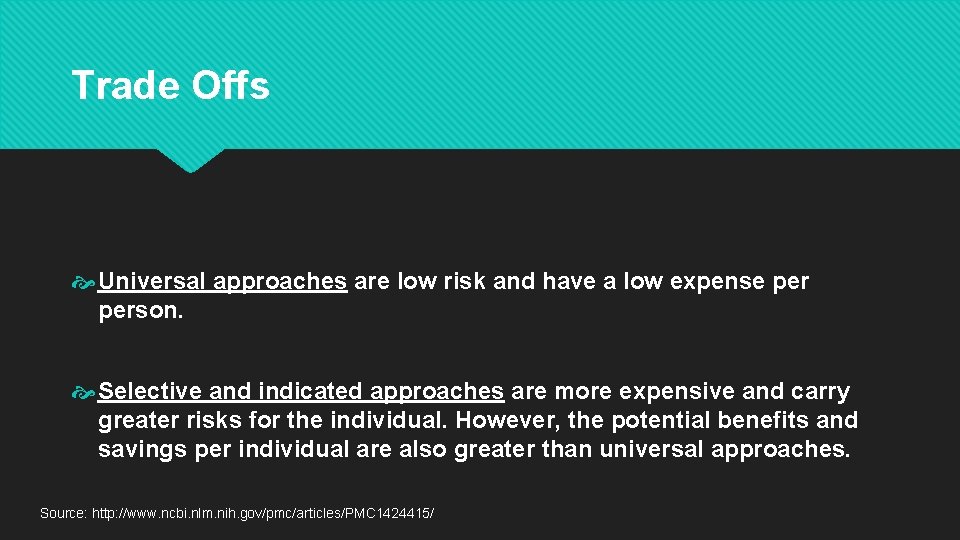
Trade Offs Universal approaches are low risk and have a low expense person. Selective and indicated approaches are more expensive and carry greater risks for the individual. However, the potential benefits and savings per individual are also greater than universal approaches. Source: http: //www. ncbi. nlm. nih. gov/pmc/articles/PMC 1424415/
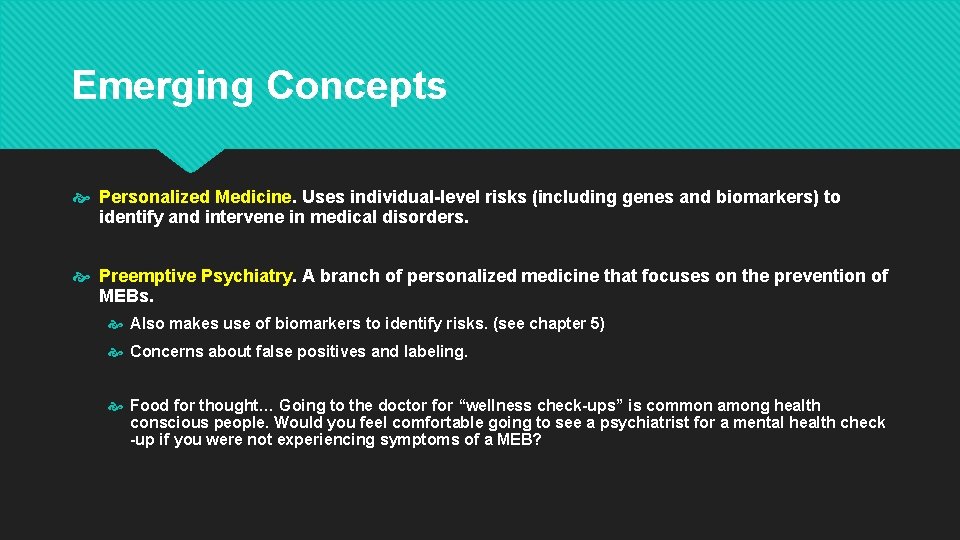
Emerging Concepts Personalized Medicine. Uses individual-level risks (including genes and biomarkers) to identify and intervene in medical disorders. Preemptive Psychiatry. A branch of personalized medicine that focuses on the prevention of MEBs. Also makes use of biomarkers to identify risks. (see chapter 5) Concerns about false positives and labeling. Food for thought… Going to the doctor for “wellness check-ups” is common among health conscious people. Would you feel comfortable going to see a psychiatrist for a mental health check -up if you were not experiencing symptoms of a MEB?
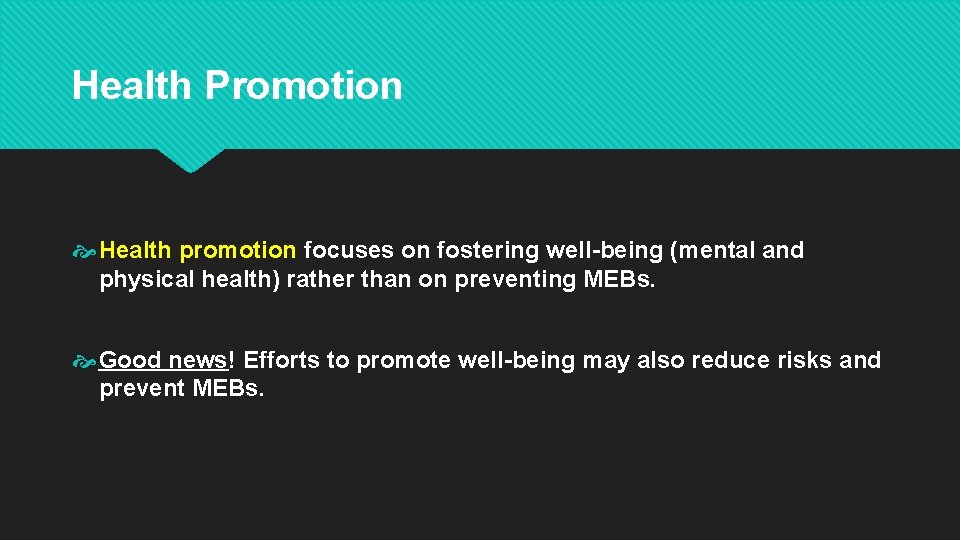
Health Promotion Health promotion focuses on fostering well-being (mental and physical health) rather than on preventing MEBs. Good news! Efforts to promote well-being may also reduce risks and prevent MEBs.
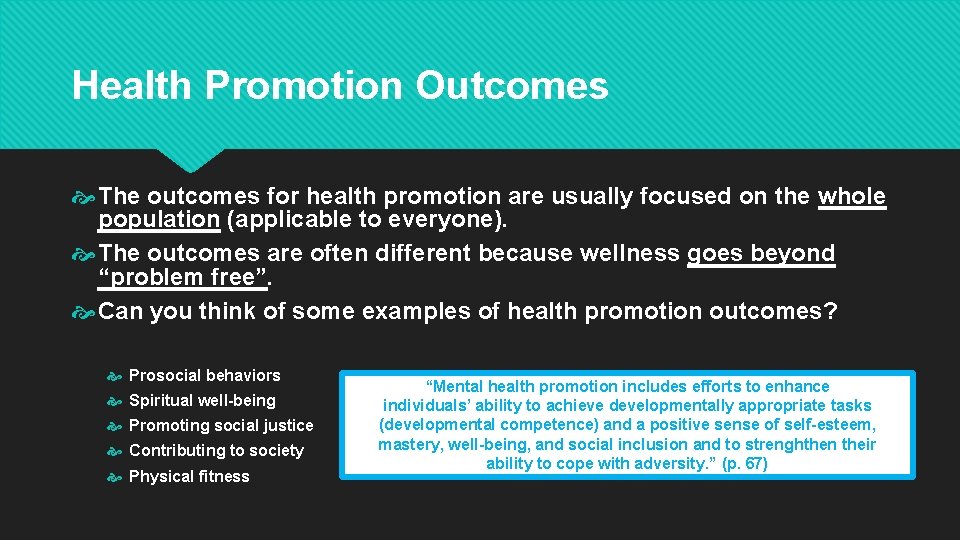
Health Promotion Outcomes The outcomes for health promotion are usually focused on the whole population (applicable to everyone). The outcomes are often different because wellness goes beyond “problem free”. Can you think of some examples of health promotion outcomes? Prosocial behaviors Spiritual well-being Promoting social justice Contributing to society Physical fitness “Mental health promotion includes efforts to enhance individuals’ ability to achieve developmentally appropriate tasks (developmental competence) and a positive sense of self-esteem, mastery, well-being, and social inclusion and to strenghthen their ability to cope with adversity. ” (p. 67)
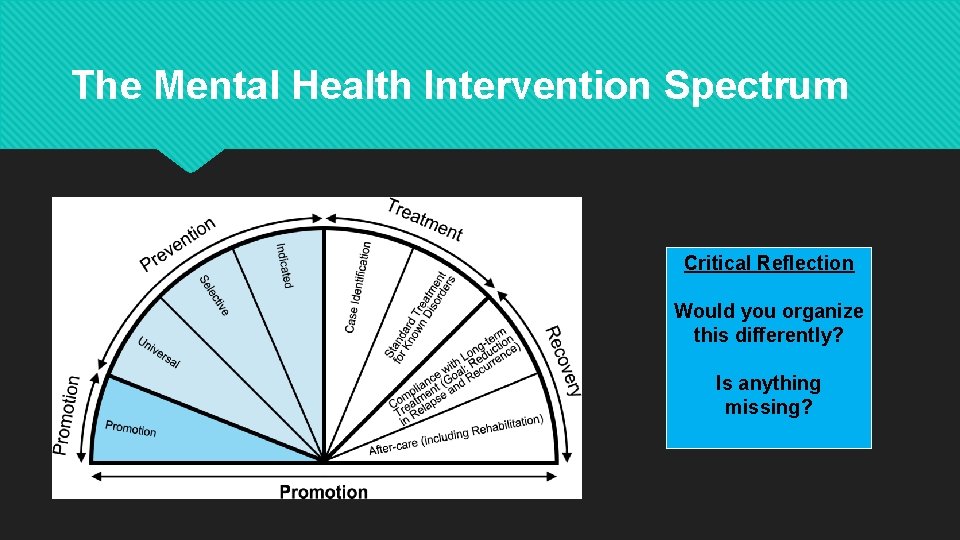
The Mental Health Intervention Spectrum Critical Reflection Would you organize this differently? Is anything missing?
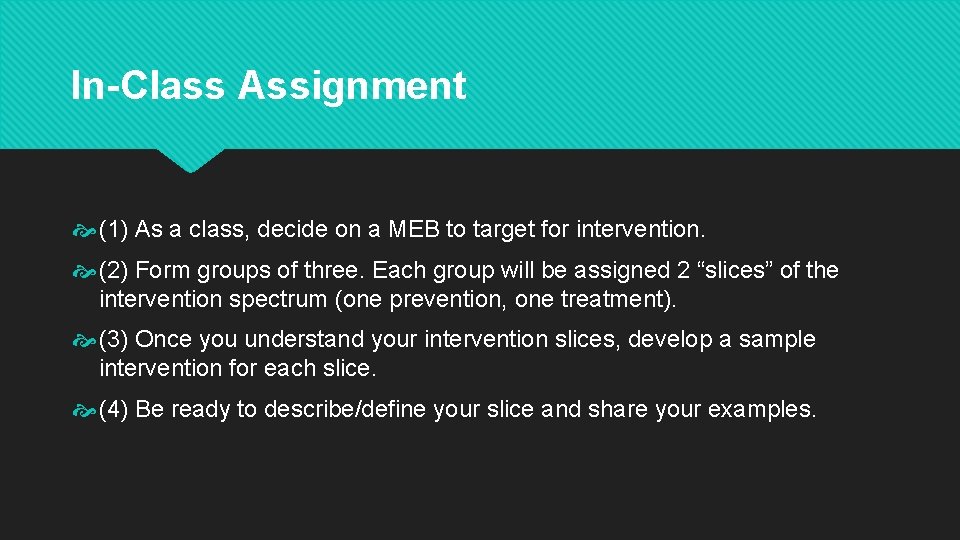
In-Class Assignment (1) As a class, decide on a MEB to target for intervention. (2) Form groups of three. Each group will be assigned 2 “slices” of the intervention spectrum (one prevention, one treatment). (3) Once you understand your intervention slices, develop a sample intervention for each slice. (4) Be ready to describe/define your slice and share your examples.
Learning Objectives (1) Understand Prevention Classifications Primary, Secondary Tertiary Universal, Secondary, Indicated (2) Define Health Promotion and Differentiate it from Prevention Describe Health Promotion Outcomes (3) Explain the Mental Health Intervention Spectrum and Give Examples
Graded Take-Home Assignment Read the Coie et al. (1993) article on “The Science of Prevention. ” In addition to your reaction paper, each student will be assigned to discuss a particular principle of prevention science (pp. 1014 -1016) and give an example of the principle. You may use an example from the article but try to come up with your own if you can.
Be Sure to Read! Chapter 4, Table 4 -2, pp. 84 -91