
The Scintillation Tile Hodoscope Sci Til Sci Til
- Slides: 28
The Scintillation Tile Hodoscope (Sci. Til) Sci. Til C. Schwarz on behalf of the Si. PM Group at GSI (given by A. Sanchez Lorente, HIM, Mainz) ● Motivation ● Event timing/ event building/ software trigger ● Conversion detection ● Charged particle TOF (relative timing) ● Requirements, Simulations ● Prototype ● Mechanics ● Work packages 1 Si. PM workshop EU(HP 3) 16. Feb. 2013, Vienna
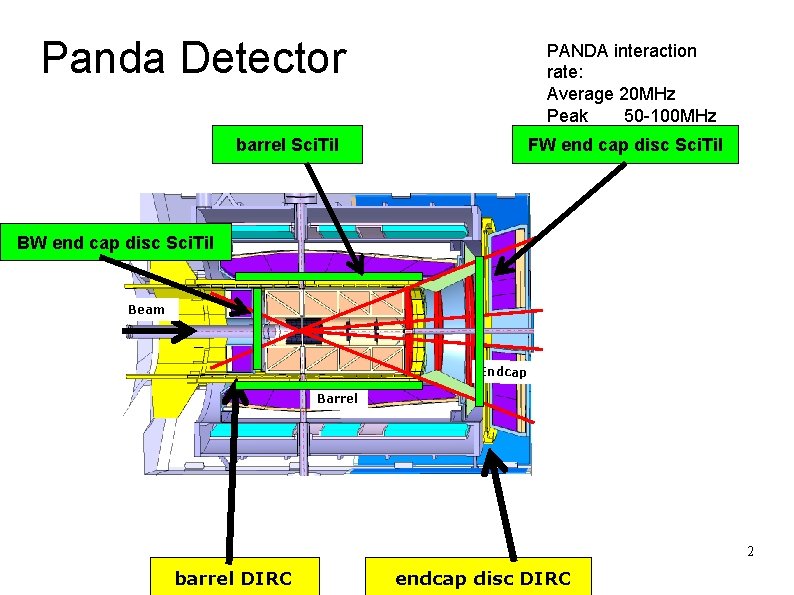
Panda Detector PANDA interaction rate: Average 20 MHz Peak 50 -100 MHz barrel Sci. Til FW end cap disc Sci. Til Beam Endcap Barrel 2 barrel DIRC endcap disc DIRC
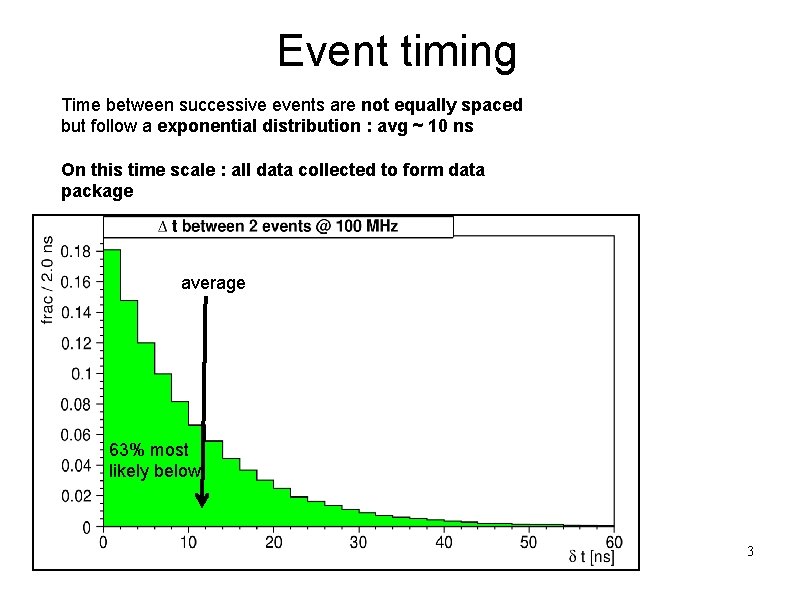
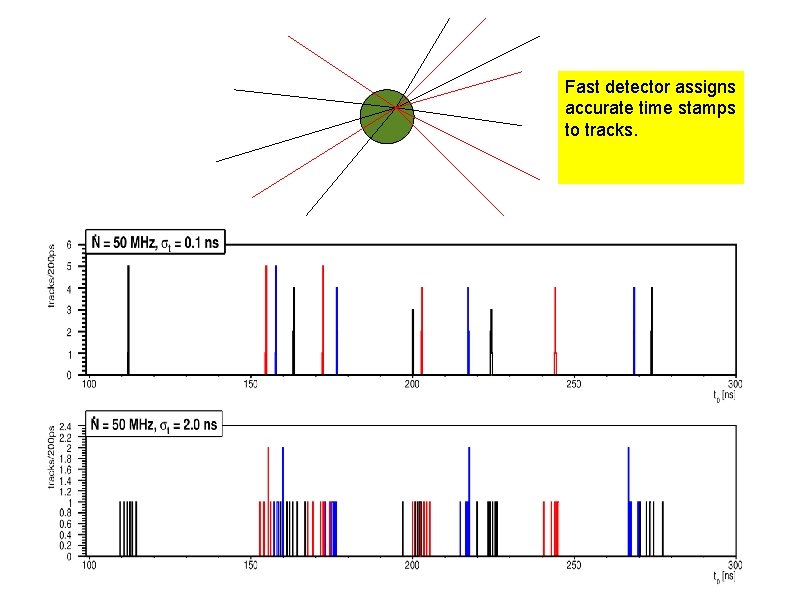
Event timing Time between successive events are not equally spaced but follow a exponential distribution : avg ~ 10 ns On this time scale : all data collected to form data package average 63% most likely below 3
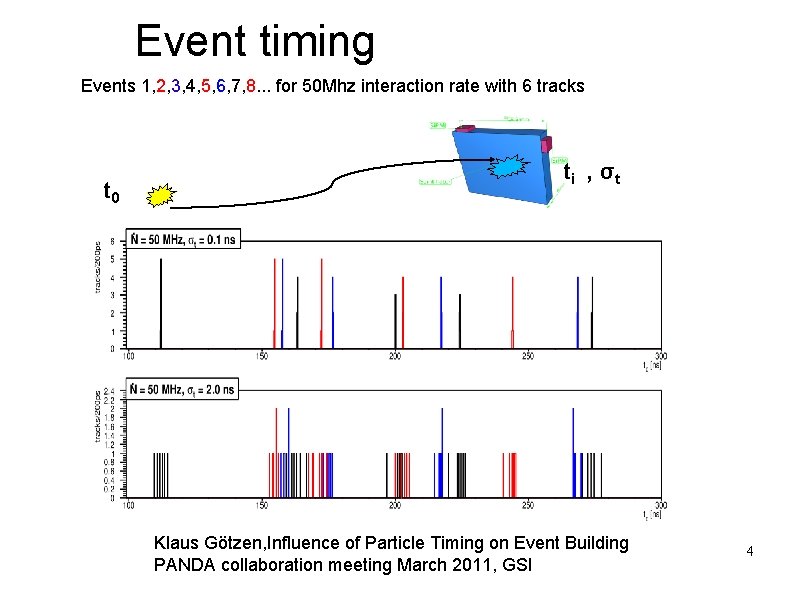
Event timing Events 1, 2, 3, 4, 5, 6, 7, 8. . . for 50 Mhz interaction rate with 6 tracks t 0 ti , σ t Klaus Götzen, Influence of Particle Timing on Event Building PANDA collaboration meeting March 2011, GSI 4
Fast detector assigns accurate time stamps to tracks. 5
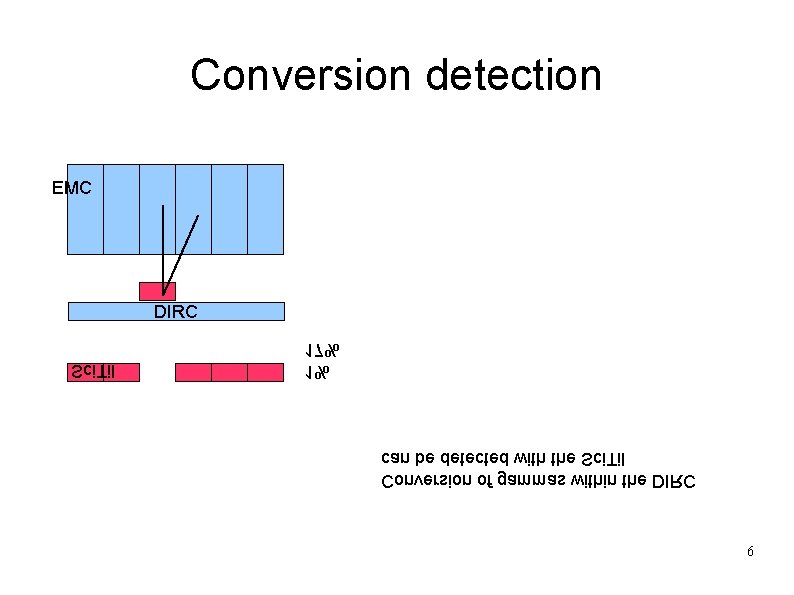
Conversion detection EMC DIRC Sci. Til 17% 1% can be detected with the Sci. Til Conversion of gammas within the DIRC 6
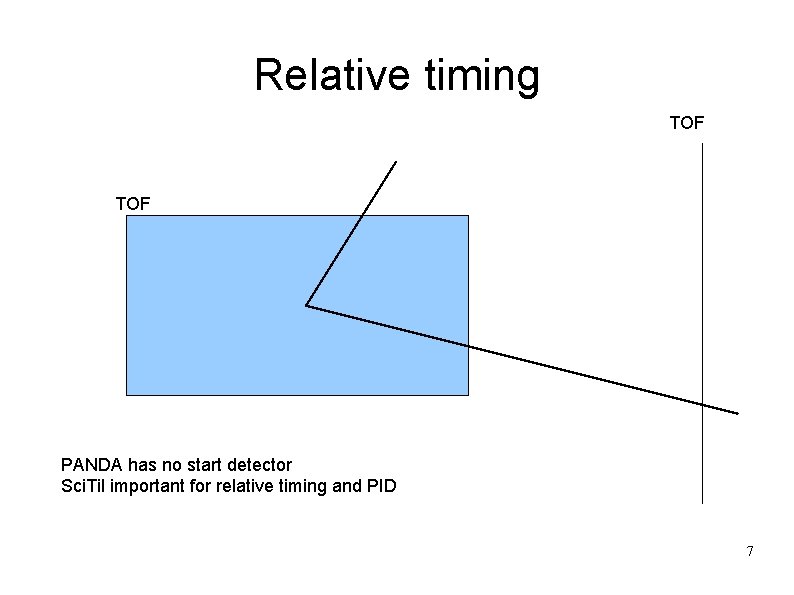
Relative timing TOF PANDA has no start detector Sci. Til important for relative timing and PID 7
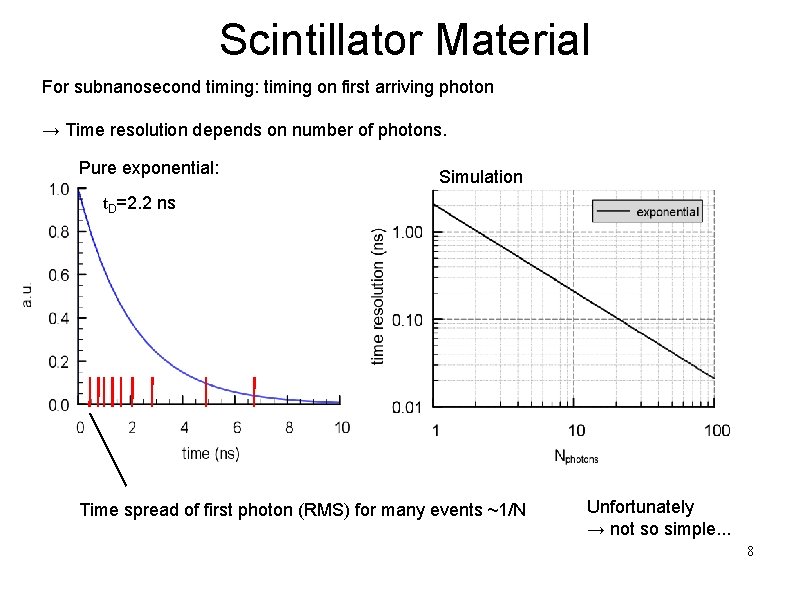
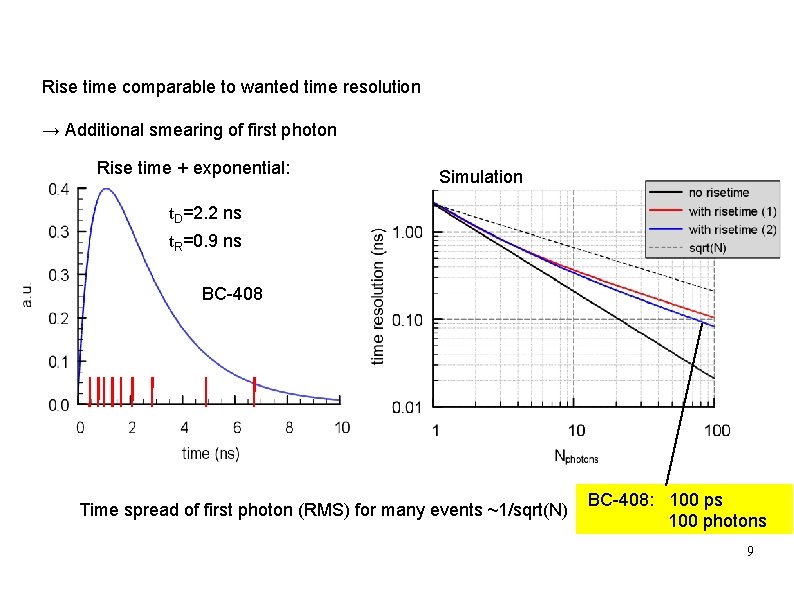
Scintillator Material For subnanosecond timing: timing on first arriving photon → Time resolution depends on number of photons. Pure exponential: Simulation t. D=2. 2 ns Time spread of first photon (RMS) for many events ~1/N Unfortunately → not so simple. . . 8
Rise time comparable to wanted time resolution → Additional smearing of first photon Rise time + exponential: Simulation t. D=2. 2 ns t. R=0. 9 ns BC-408 Time spread of first photon (RMS) for many events ~1/sqrt(N) BC-408: 100 ps 100 photons 9
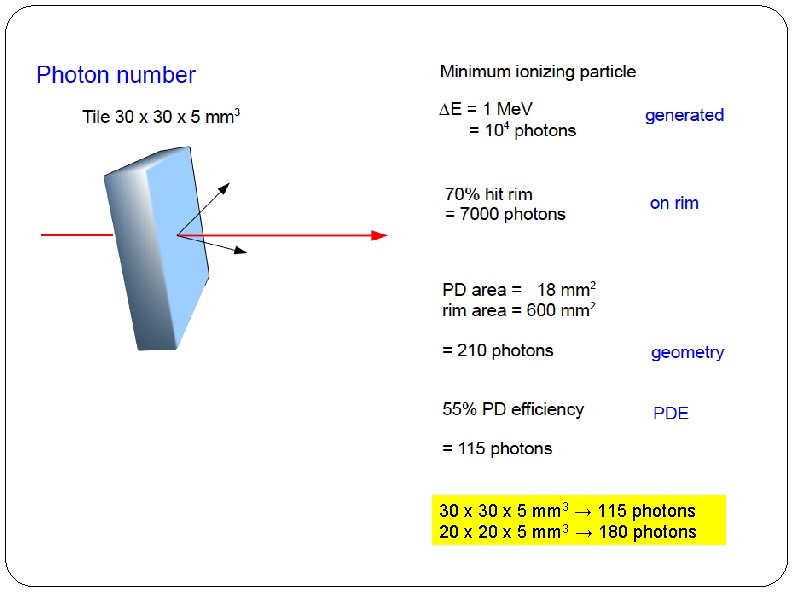
30 x 5 mm 3 → 115 photons 20 x 5 mm 3 → 180 photons
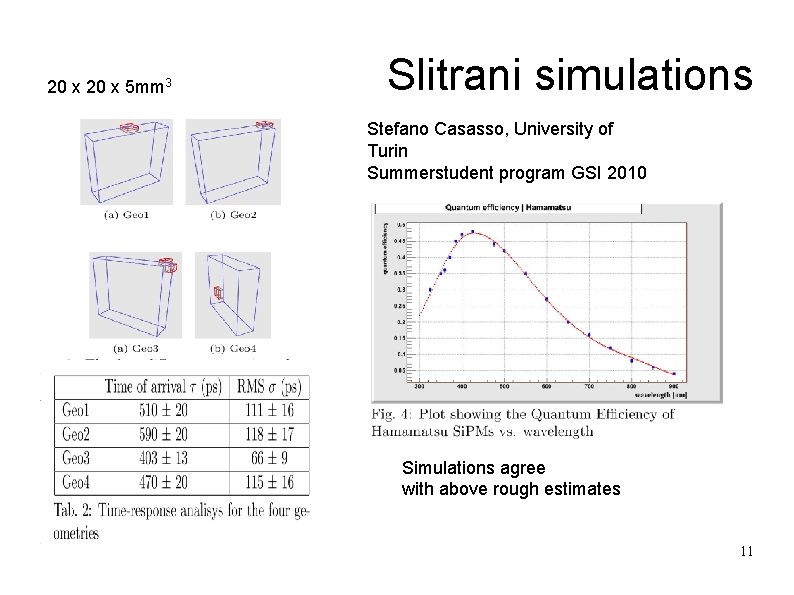
20 x 5 mm 3 Slitrani simulations Stefano Casasso, University of Turin Summerstudent program GSI 2010 Simulations agree with above rough estimates 11
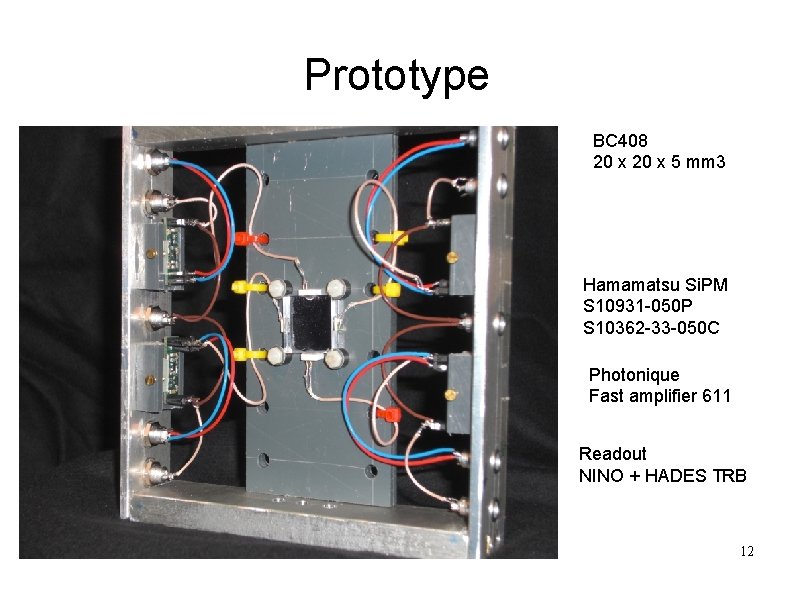
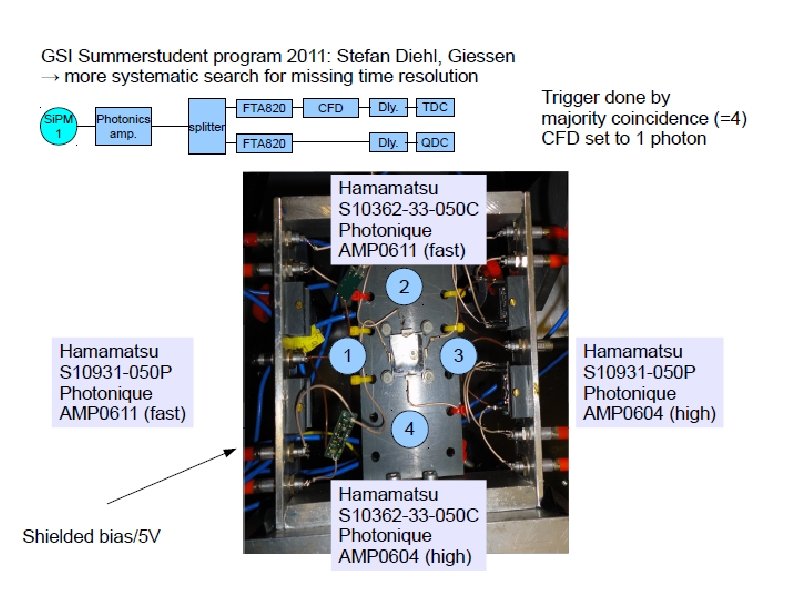
Prototype BC 408 20 x 5 mm 3 Hamamatsu Si. PM S 10931 -050 P S 10362 -33 -050 C Photonique Fast amplifier 611 Readout NINO + HADES TRB 12
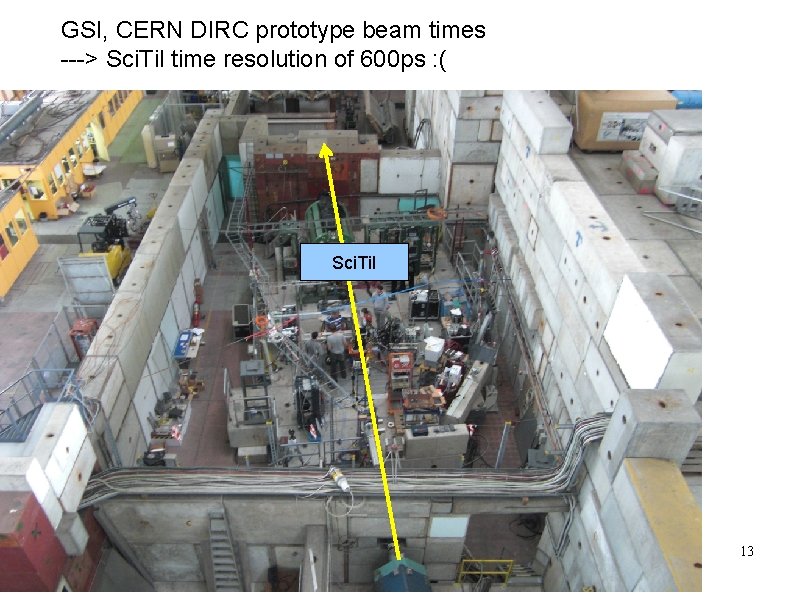
GSI, CERN DIRC prototype beam times ---> Sci. Til time resolution of 600 ps : ( Sci. Til 13
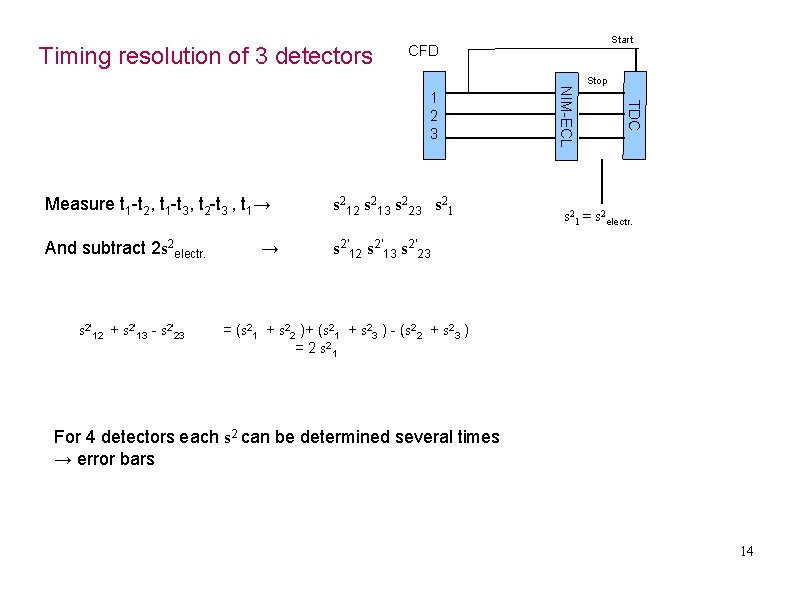
Timing resolution of 3 detectors CFD s 212 s 213 s 223 s 21 And subtract 2 s 2 electr. s 2'12 s 2'13 s 2'23 s 2'12 + s 2'13 - s 2'23 Stop TDC Measure t 1 -t 2, t 1 -t 3, t 2 -t 3 , t 1→ NIM-ECL 1 2 3 → Start s 21 = s 2 electr. = (s 21 + s 22 )+ (s 21 + s 23 ) - (s 22 + s 23 ) = 2 s 21 For 4 detectors each s 2 can be determined several times → error bars 14
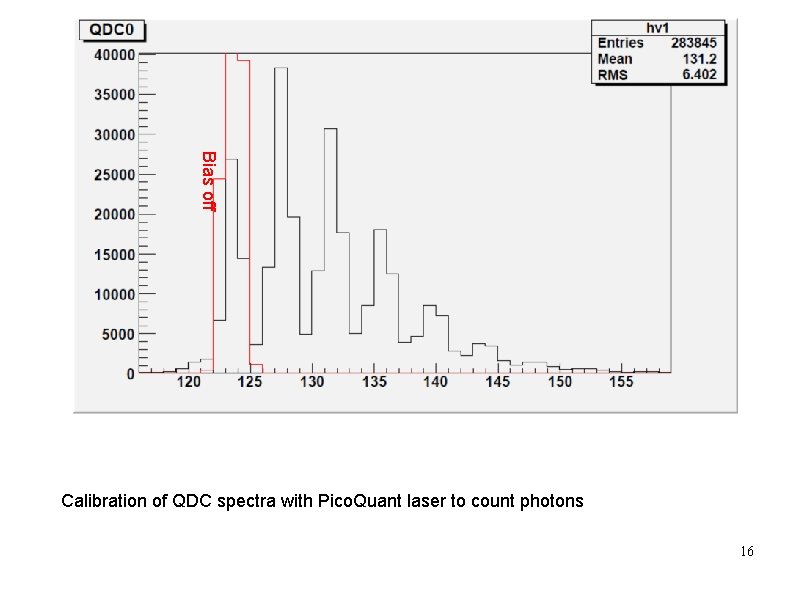
Bias off Calibration of QDC spectra with Pico. Quant laser to count photons 16
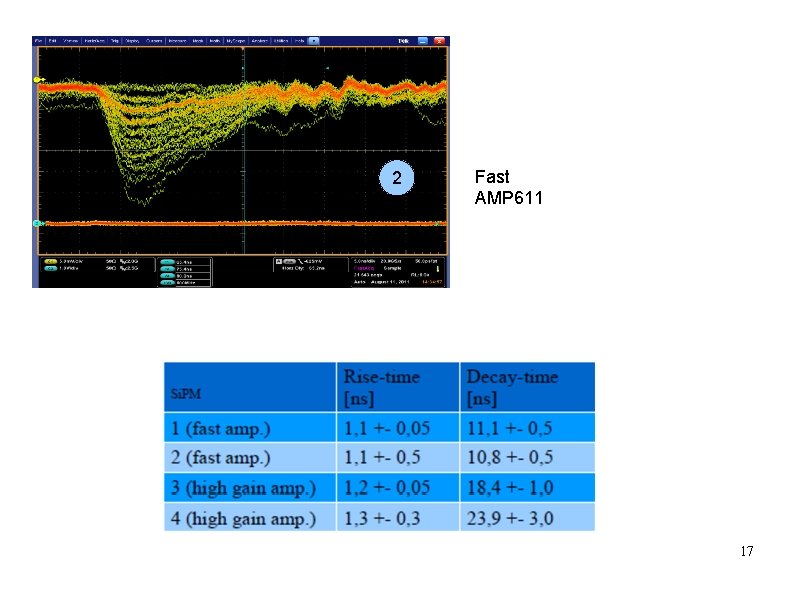
2 Fast AMP 611 17
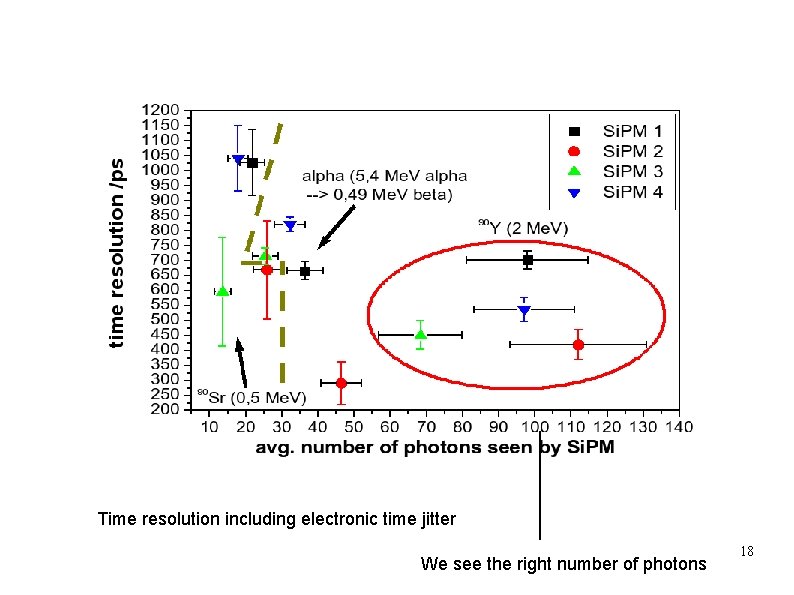
Time resolution including electronic time jitter We see the right number of photons 18
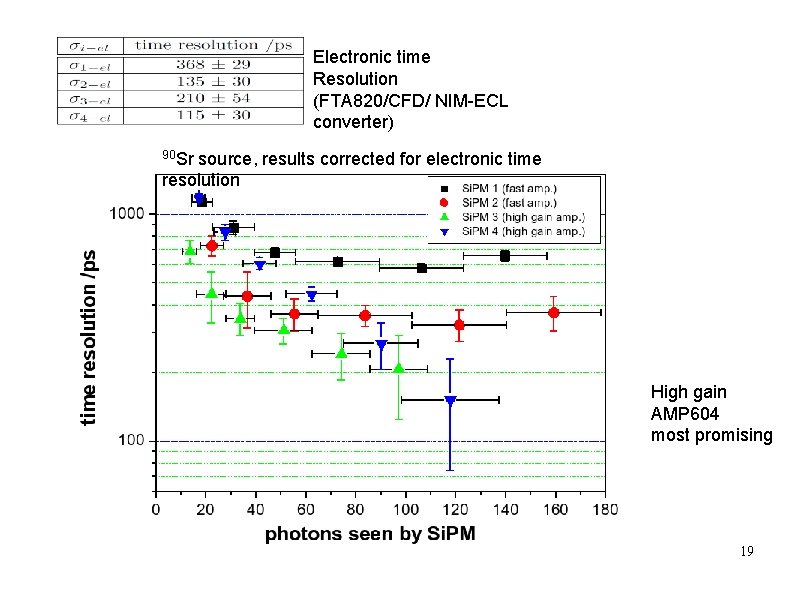
Electronic time Resolution (FTA 820/CFD/ NIM-ECL converter) 90 Sr source, results corrected for electronic time resolution High gain AMP 604 most promising 19
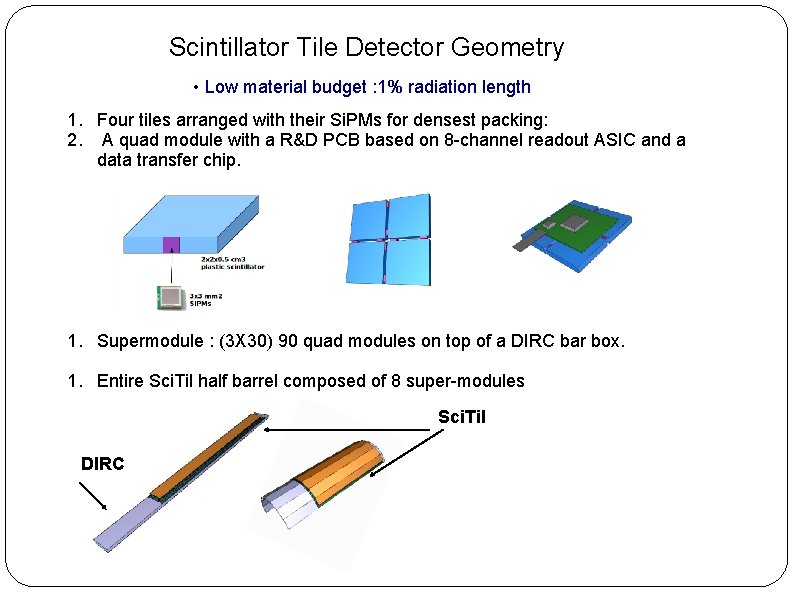
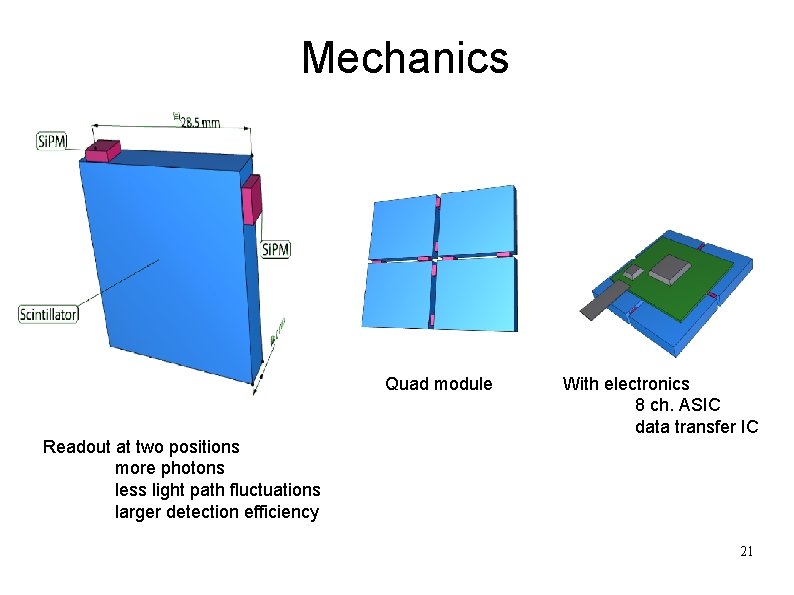
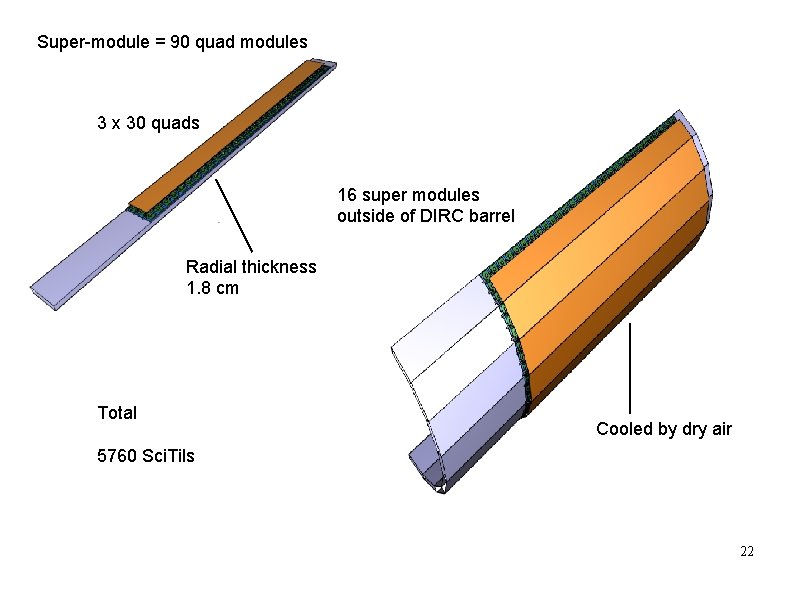
Scintillator Tile Detector Geometry • Low material budget : 1% radiation length 1. Four tiles arranged with their Si. PMs for densest packing: 2. A quad module with a R&D PCB based on 8 -channel readout ASIC and a data transfer chip. 1. Supermodule : (3 X 30) 90 quad modules on top of a DIRC bar box. 1. Entire Sci. Til half barrel composed of 8 super-modules Sci. Til DIRC 20
Mechanics Quad module Readout at two positions more photons less light path fluctuations larger detection efficiency With electronics 8 ch. ASIC data transfer IC 21
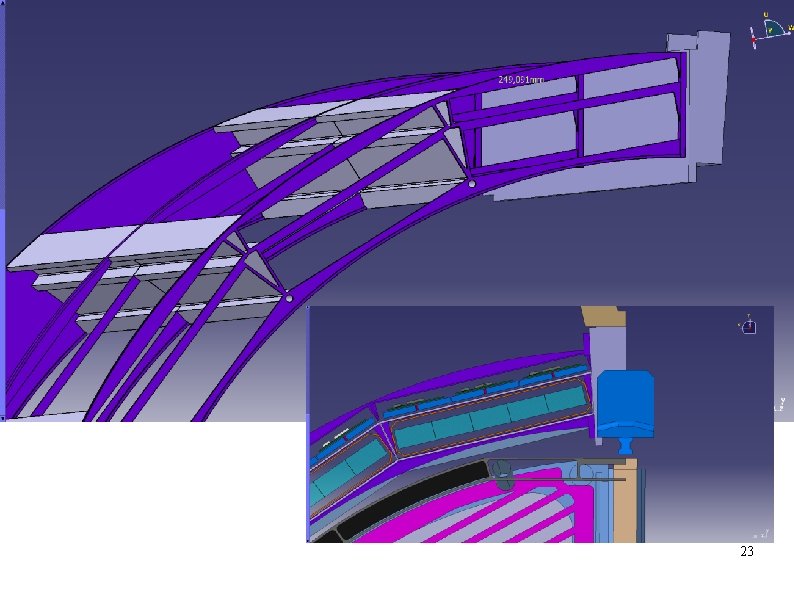
Super-module = 90 quad modules 3 x 30 quads 16 super modules outside of DIRC barrel Radial thickness 1. 8 cm Total Cooled by dry air 5760 Sci. Tils 22
23
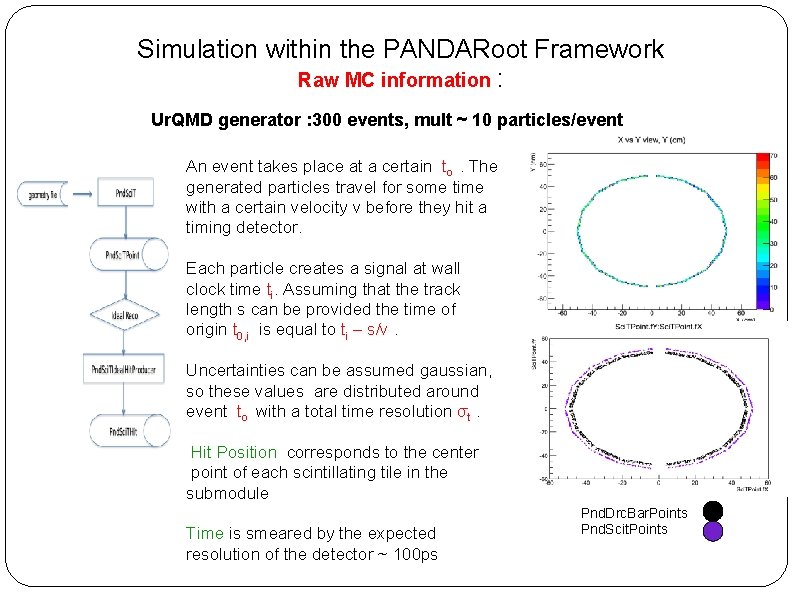
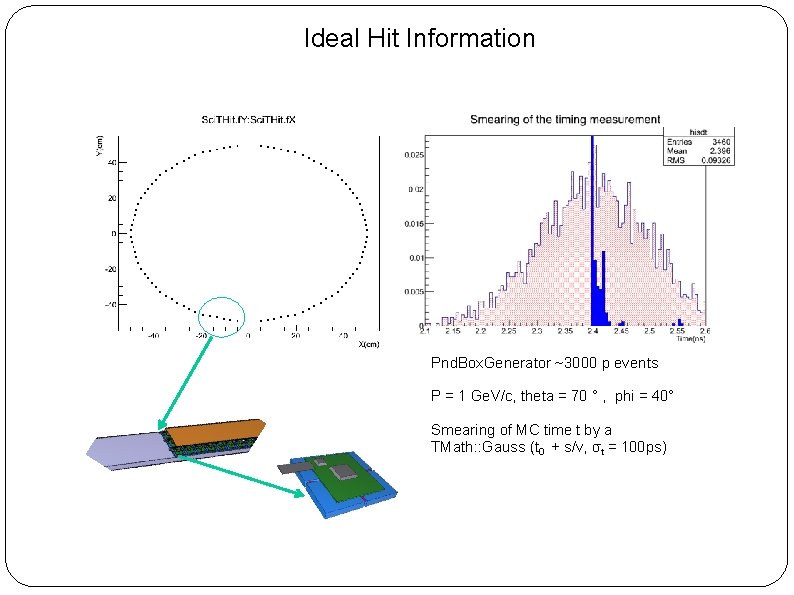
Simulation within the PANDARoot Framework Raw MC information : Ur. QMD generator : 300 events, mult ~ 10 particles/event An event takes place at a certain to. The generated particles travel for some time with a certain velocity v before they hit a timing detector. Each particle creates a signal at wall clock time ti. Assuming that the track length s can be provided the time of origin t 0, i is equal to ti – s/v. Uncertainties can be assumed gaussian, so these values are distributed around event to with a total time resolution σt. Hit Position corresponds to the center point of each scintillating tile in the submodule Time is smeared by the expected resolution of the detector ~ 100 ps Pnd. Drc. Bar. Points Pnd. Scit. Points
Ideal Hit Information Pnd. Box. Generator ~3000 p events P = 1 Ge. V/c, theta = 70 ° , phi = 40° Smearing of MC time t by a TMath: : Gauss (t 0 + s/v, σt = 100 ps) 25
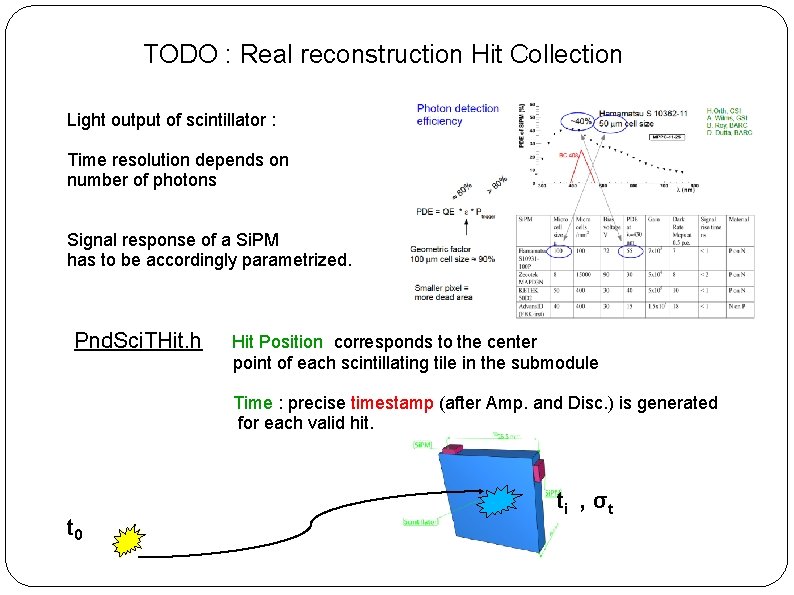
TODO : Real reconstruction Hit Collection Light output of scintillator : Time resolution depends on number of photons Signal response of a Si. PM has to be accordingly parametrized. Pnd. Sci. THit. h Hit Position corresponds to the center point of each scintillating tile in the submodule Time : precise timestamp (after Amp. and Disc. ) is generated for each valid hit. t 0 ti , σ t
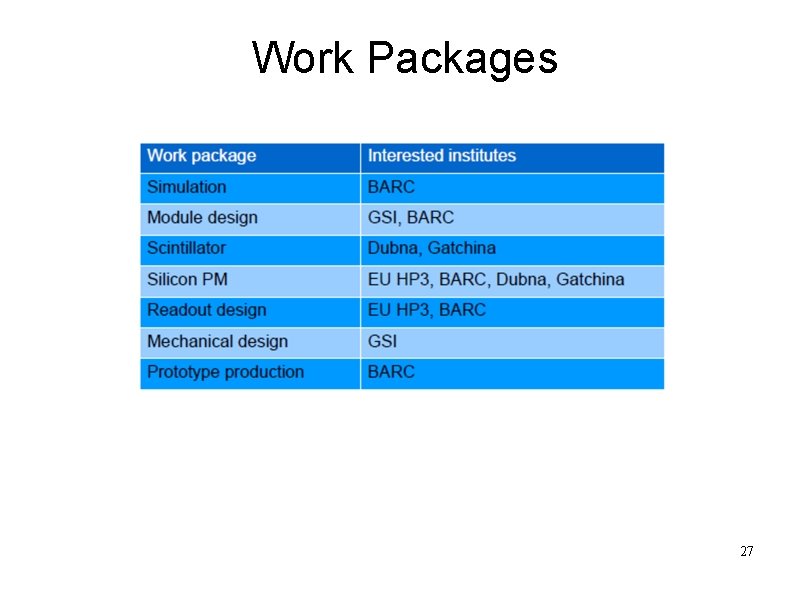
Work Packages 27
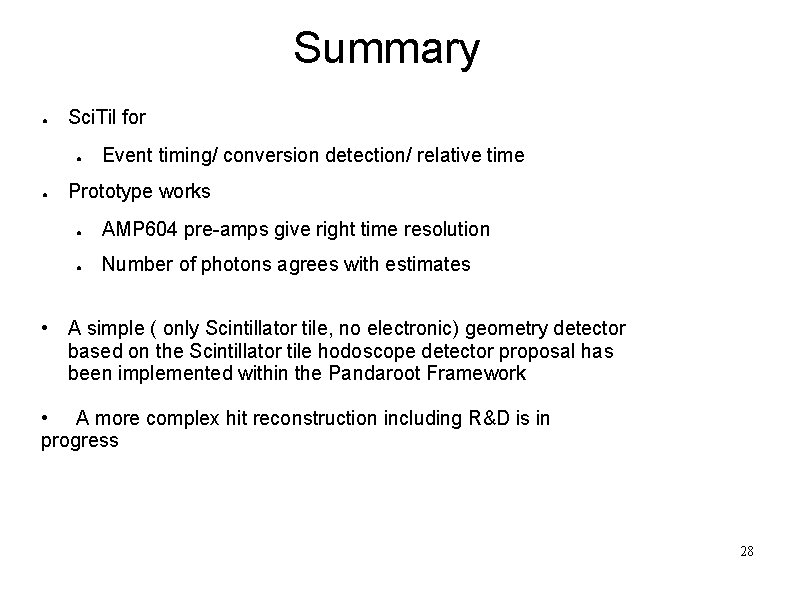
Summary ● Sci. Til for ● ● Event timing/ conversion detection/ relative time Prototype works ● AMP 604 pre-amps give right time resolution ● Number of photons agrees with estimates • A simple ( only Scintillator tile, no electronic) geometry detector based on the Scintillator tile hodoscope detector proposal has been implemented within the Pandaroot Framework • A more complex hit reconstruction including R&D is in progress 28