
The Scientific Revolution CIV 101 02 Fall November
The Scientific Revolution CIV 101 -02 Fall November 20, 2015 Class 37
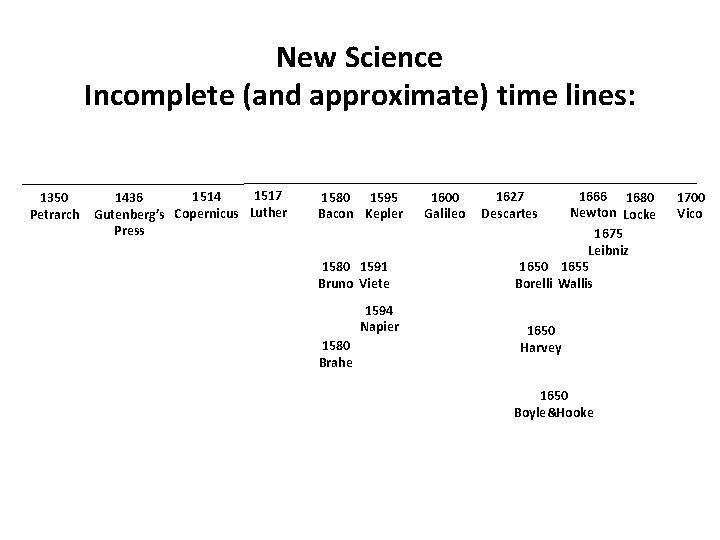
New Science Incomplete (and approximate) time lines: 1350 Petrarch 1517 1514 1436 Gutenberg’s Copernicus Luther Press 1580 1595 Bacon Kepler 1580 1591 Bruno Viete 1594 Napier 1580 Brahe 1600 Galileo 1666 1680 Newton Locke 1675 Leibniz 1650 1655 Borelli Wallis 1627 Descartes 1650 Harvey 1650 Boyle&Hooke 1700 Vico
Descartes (1627) • Radical Skepticism/Universal Doubt – Why? Gets him somewhat free of the Church’s dogmatic pronouncements about truth – reason over learning—gets him somewhat free from using received wisdom in science • Math over Syllogism – Why? Gets him somewhat free of the ancient’s reasoning methods (Aristotelian logic and Scholasticism) • This causes trouble for more than religion. It also damages the 7 liberal arts approach to learning

Descartes (1627) • The Cartesian Split – Subject/Object • Drawn from Bacon’s faculty psychology • Helps with the illusion of maintaining faith in the Church/religion • Moves away from ancient reasoning and rhetoric • Experiment over disputation • Moves away from ancient reasoning and rhetoric and from received wisdom in science
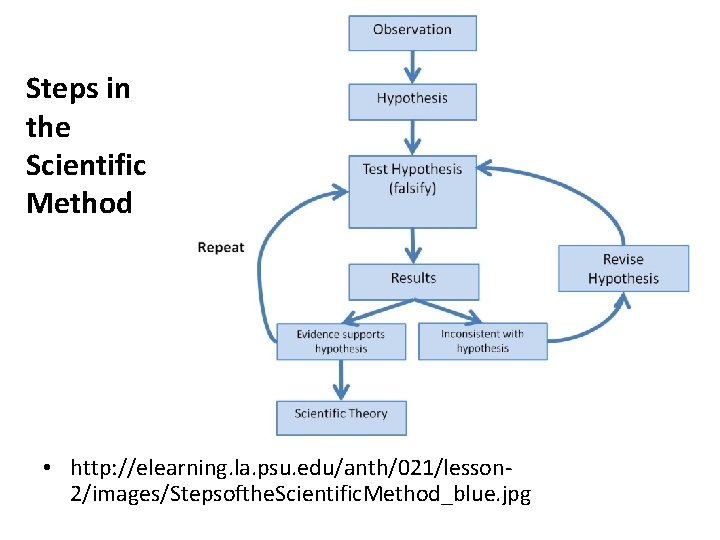
Steps in the Scientific Method • http: //elearning. la. psu. edu/anth/021/lesson 2/images/Stepsofthe. Scientific. Method_blue. jpg
New Science, cont. • 1650 Borelli: Human mechanics – The biomechanics of muscles and movement • 1650 Boyle & Hooke: Physics of air – Also springs and elasticity • 1650 Harvey: dissection leads to understanding blood circulation • 1655 Wallis: ideas foundational to differential calculus
Newton, 1666 • Laws of motion (including gravity) – The status quo had been that explanations for motion differ depending on whether the objects of interest were on the earth or in the sky. – All particles emit the same forces. – Newton works out the relationships among objects in both spheres, that they follow the same laws, and that attraction and repulsion relates to object size, mass, and distances. – Newtonian physics stands: inertia, acceleration, and action and reaction • Except for modifications in the universe of the small, covered by quantum mechanics, that do not follow Newtonian rules.
New Science, cont. • 1675 Leibniz: (perhaps with Newton) Calculus (and lots of scientific PHILOSOPHY) • 1680 Locke: popularizes Bacon and Descartes – relations among perception, thought, and language – faculties of the mind • theory of ideas as held in patterns in the mind • Reason unites ideas by association.
A counter-voice • 1700 Vico: answers Descartes – But only for us when Grassi rediscovers and presents him; he was little read in his time. – Plus, he was a flaming, vicious, racist and anti-Semite – But he was right and had he been read, the way we study HUMANS (Social Science) would have been radically altered, probably for the better. – Math isn’t THE human language. • In fact, it’s not a human language at all, it’s scientific notation. – The human spirit (ingenium) is formed in language • We are who we are because we speak the way we speak – History and narration are the most factual ways to study HUMANS • Science is great for rocks, air, motion, animals. Not so good for understanding humans. – The debate over these issues goes on today.
One additional “counter” voice • I am become death, the destroyer of worlds. Bhagavad Gita, XI, 32 Quoted by Robert Oppenheimer, about “the bomb” We will take this and other matters up, next time. https: //www. youtube. com/watch? v=jjz 1 OUi 2 yp. M &src_vid=6 x. ZUGVLCLYA&feature=iv&annotation_i d=52 f 18222 -0 -2283 -82 a 6 -1 a 11 c 1 c 0 fc
- Slides: 10