
The Scientific Revolution Chapter 6 Section 1 Before
The Scientific Revolution Chapter 6 Section 1
Before 1500 To determine what was true/false people turned to ancient Greek/Roman authors or the Bible.
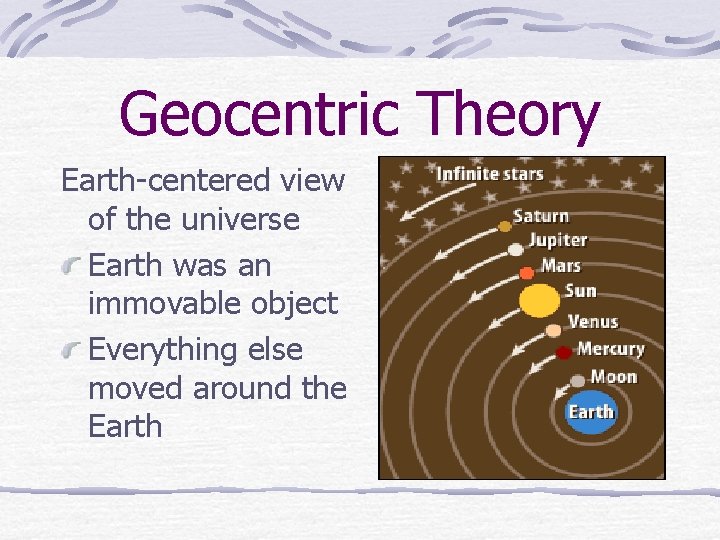
Geocentric Theory Earth-centered view of the universe Earth was an immovable object Everything else moved around the Earth
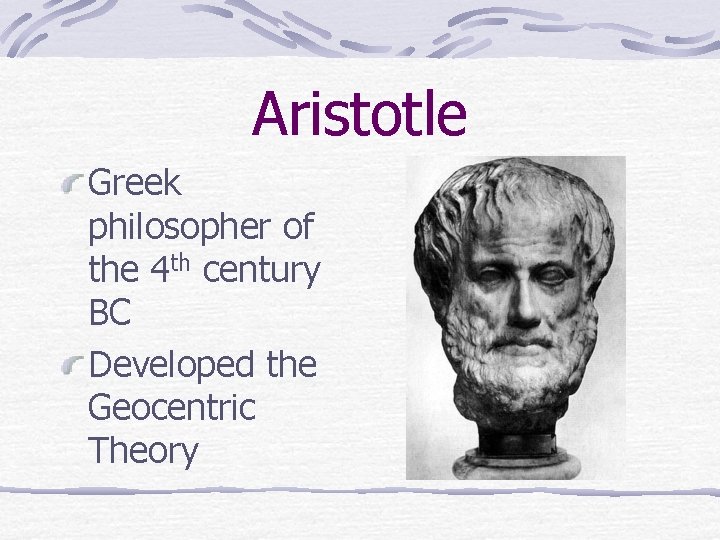
Aristotle Greek philosopher of the 4 th century BC Developed the Geocentric Theory
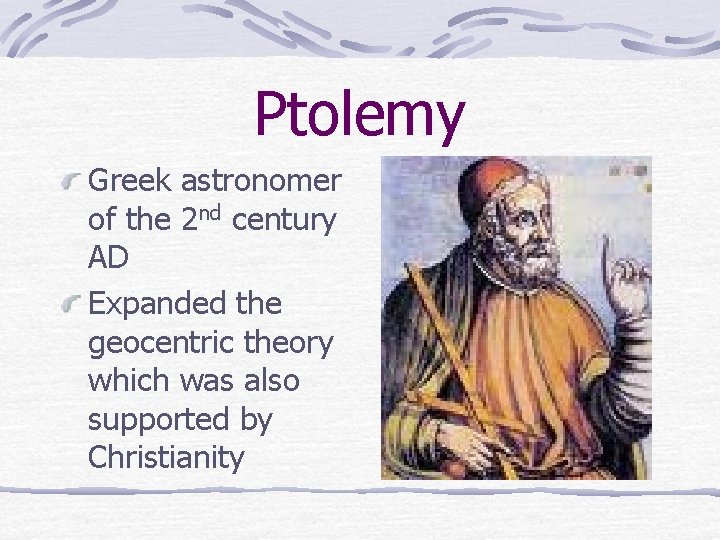
Ptolemy Greek astronomer of the 2 nd century AD Expanded the geocentric theory which was also supported by Christianity

Scientific Revolution A new way of thinking about the natural world based on natural observation and willingness to question accepted beliefs Mid 1500 s Challenged the ideas of the ancient thinkers and the church Replaced old assumptions with new theories
Causes Renaissance Exploration Printing Press
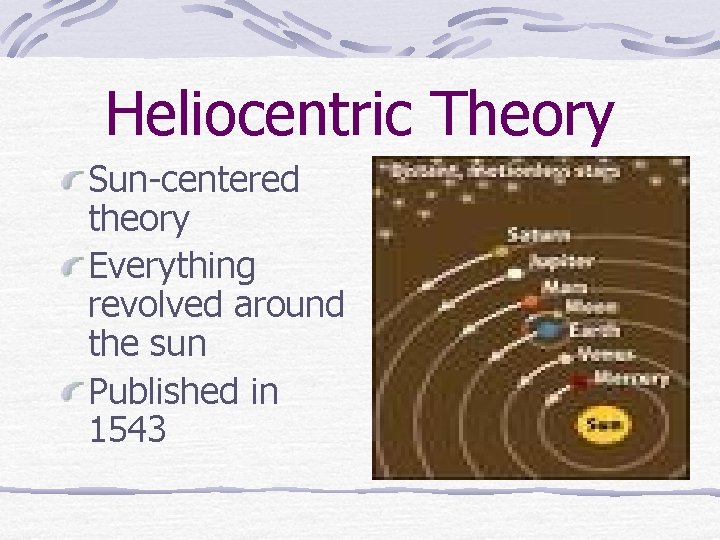
Heliocentric Theory Sun-centered theory Everything revolved around the sun Published in 1543
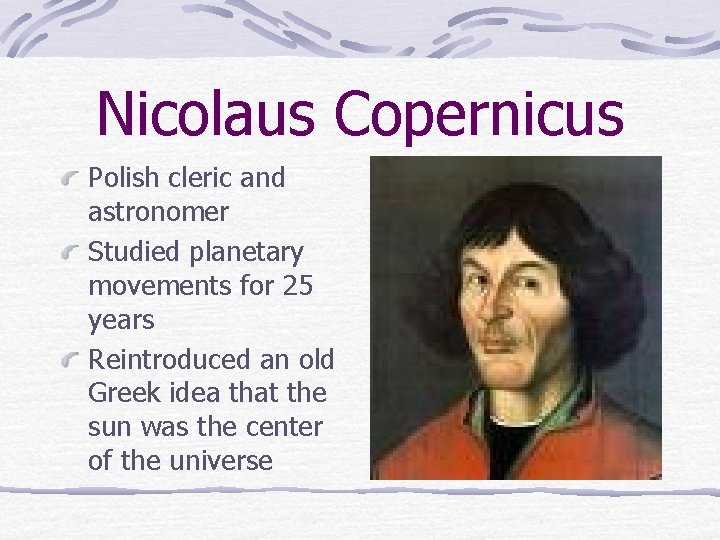
Nicolaus Copernicus Polish cleric and astronomer Studied planetary movements for 25 years Reintroduced an old Greek idea that the sun was the center of the universe
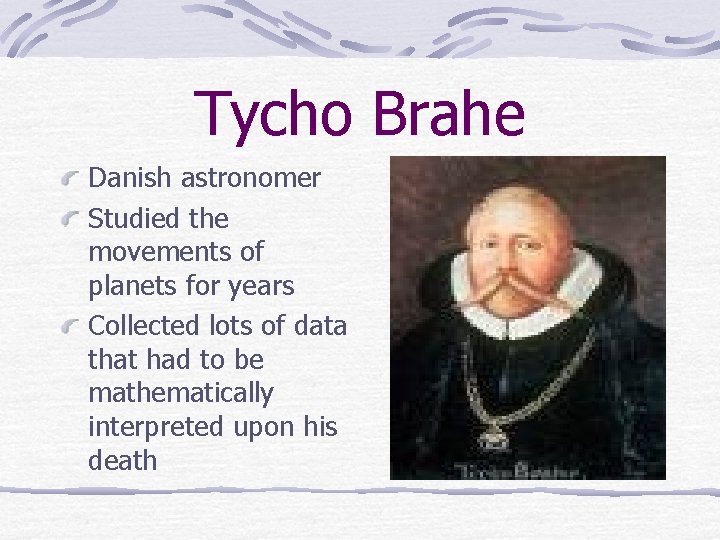
Tycho Brahe Danish astronomer Studied the movements of planets for years Collected lots of data that had to be mathematically interpreted upon his death
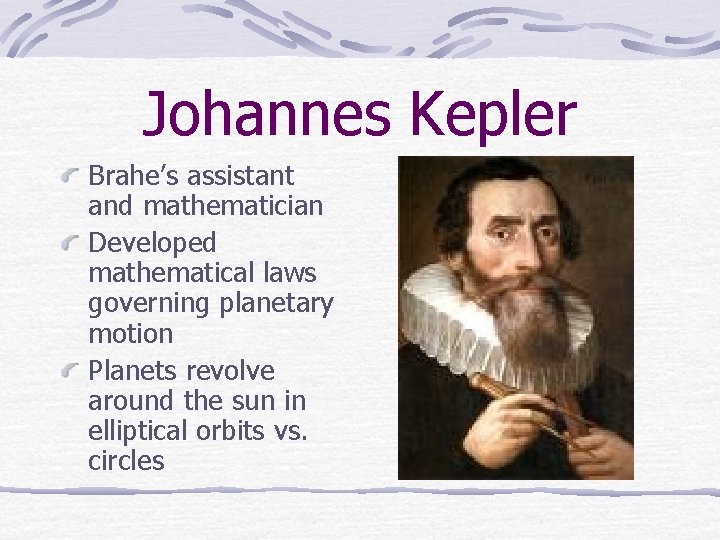
Johannes Kepler Brahe’s assistant and mathematician Developed mathematical laws governing planetary motion Planets revolve around the sun in elliptical orbits vs. circles
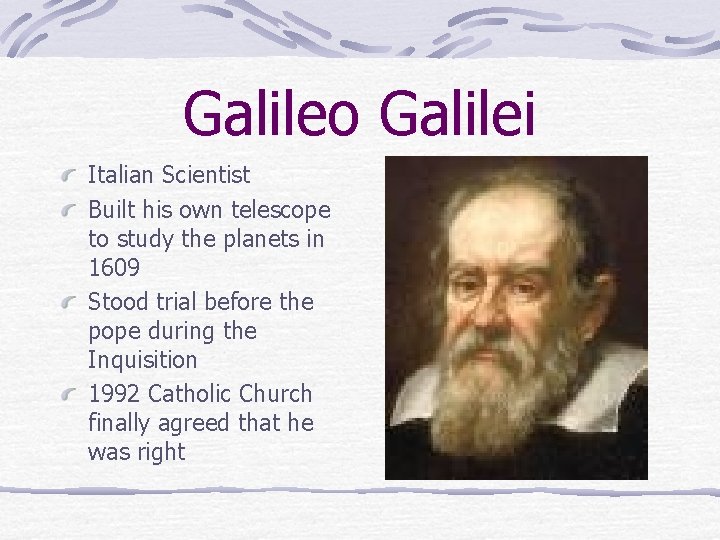
Galileo Galilei Italian Scientist Built his own telescope to study the planets in 1609 Stood trial before the pope during the Inquisition 1992 Catholic Church finally agreed that he was right
Galileo Galilei’s Ideas Jupiter had 4 moons Sun had dark spots Earth’s moon had a rough, uneven surface His theories and laws of motion supported Copernicus rather than Aristotle

Scientific Method Logical procedure for gathering and testing ideas
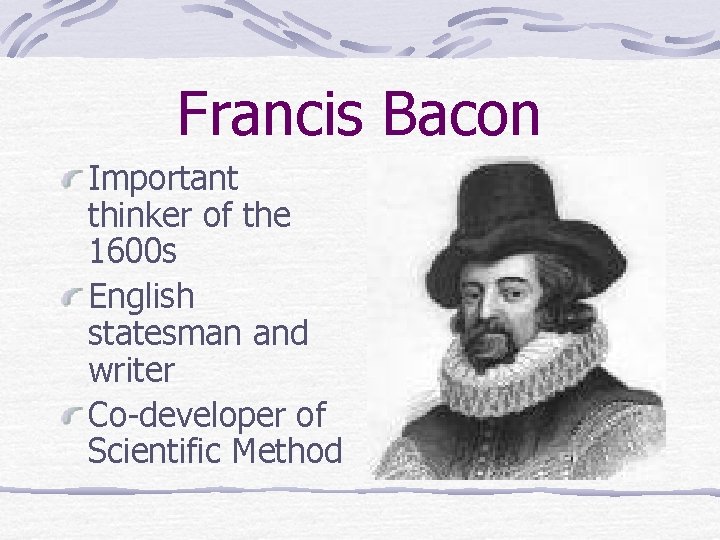
Francis Bacon Important thinker of the 1600 s English statesman and writer Co-developer of Scientific Method
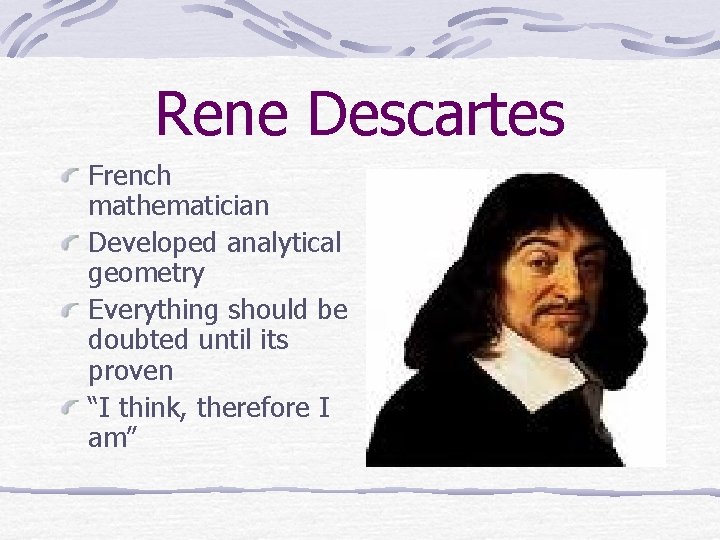
Rene Descartes French mathematician Developed analytical geometry Everything should be doubted until its proven “I think, therefore I am”
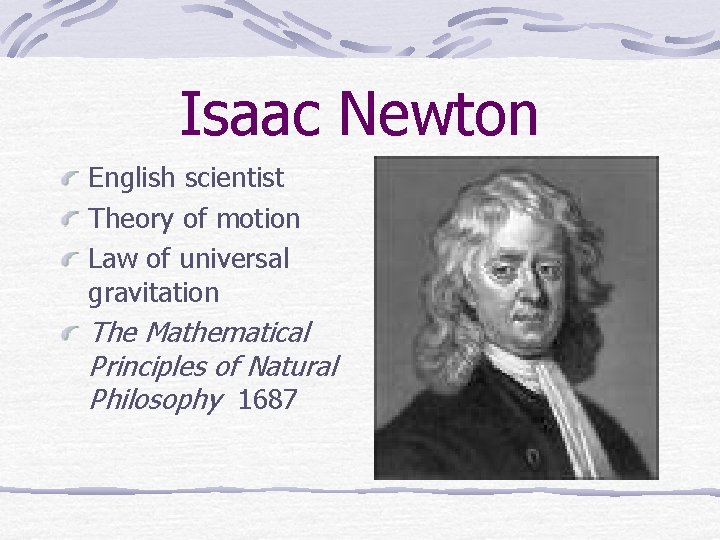
Isaac Newton English scientist Theory of motion Law of universal gravitation The Mathematical Principles of Natural Philosophy 1687
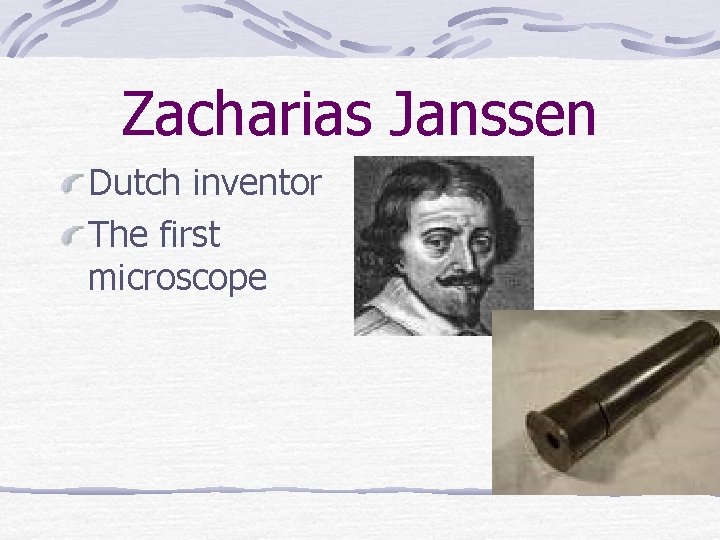
Zacharias Janssen Dutch inventor The first microscope
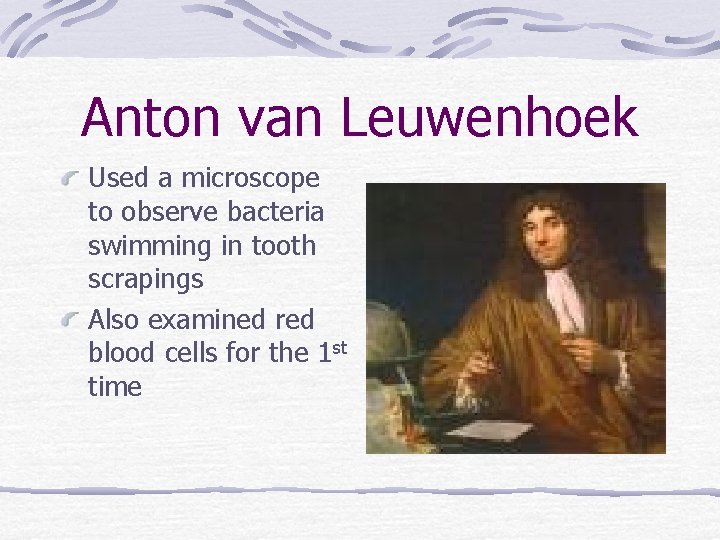
Anton van Leuwenhoek Used a microscope to observe bacteria swimming in tooth scrapings Also examined red blood cells for the 1 st time
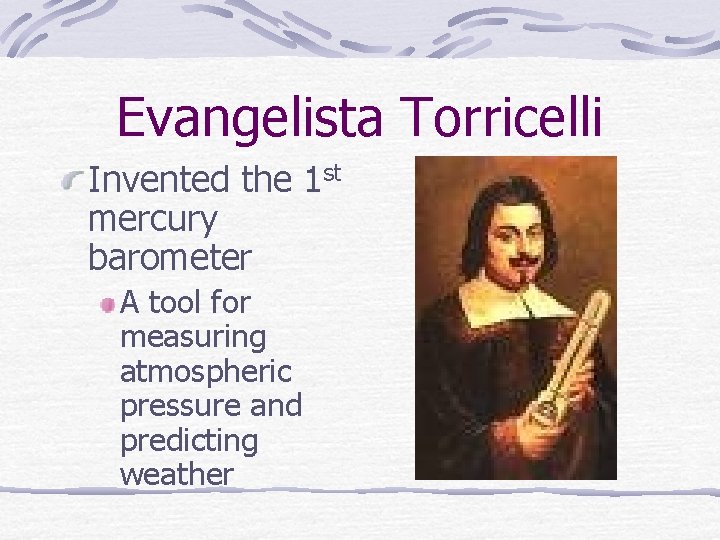
Evangelista Torricelli Invented the 1 st mercury barometer A tool for measuring atmospheric pressure and predicting weather
Gabriel Fahrenheit German physicist Made the 1 st thermometer to use mercury in glass Water freezing at 32 degrees
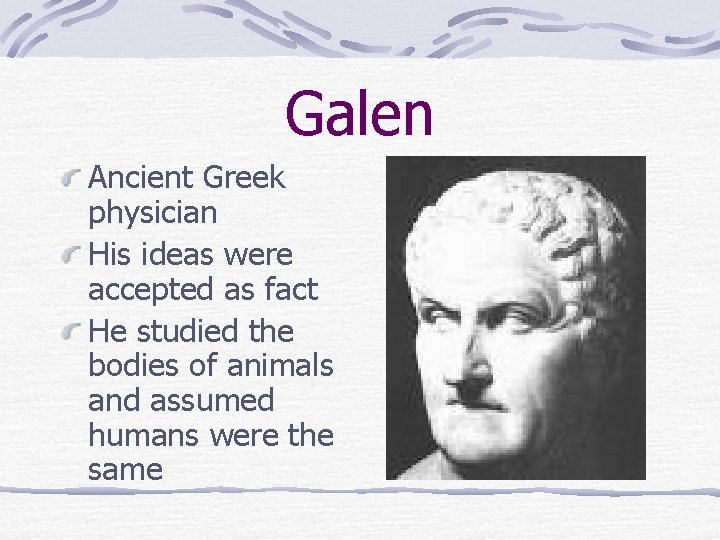
Galen Ancient Greek physician His ideas were accepted as fact He studied the bodies of animals and assumed humans were the same
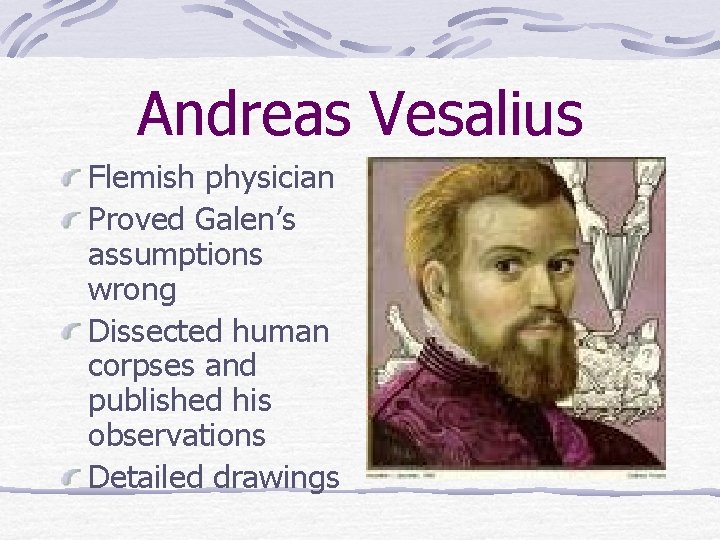
Andreas Vesalius Flemish physician Proved Galen’s assumptions wrong Dissected human corpses and published his observations Detailed drawings
Edward Jenner British physician of the late 1700 s Vaccine to prevent smallpox He used cowpox to inoculate for smallpox in humans
Robert Boyle Pioneered use of scientific method in chemistry Father of modern chemistry Matter Boyle’s Law Volume, temperature, pressure of gas
Anders Celcius Swedish astronomer Created another scale for the mercury thermometer showing water freezing at 0 degrees
- Slides: 26