
THE SCIENTIFIC REVOLUTION Chapter 22 Section 1 Pages

- Slides: 24
THE SCIENTIFIC REVOLUTION Chapter 22 Section 1 Pages 623 -628
ESSENTIAL QUESTIONS n What defines a turning point? n How does technological change affect people, places or things? n Can 1 person influence world events?
s i t a h W ? N O I T U L O V E R a
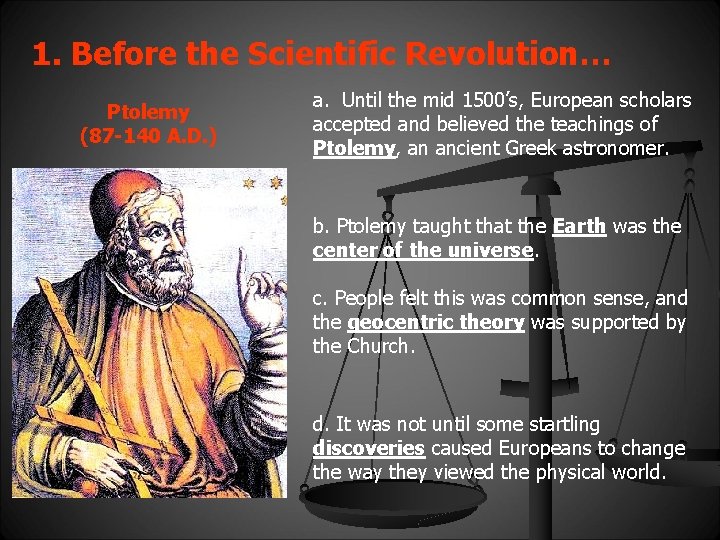
1. Before the Scientific Revolution… Ptolemy (87 -140 A. D. ) a. Until the mid 1500’s, European scholars accepted and believed the teachings of Ptolemy, an ancient Greek astronomer. b. Ptolemy taught that the Earth was the center of the universe. c. People felt this was common sense, and the geocentric theory was supported by the Church. d. It was not until some startling discoveries caused Europeans to change the way they viewed the physical world.
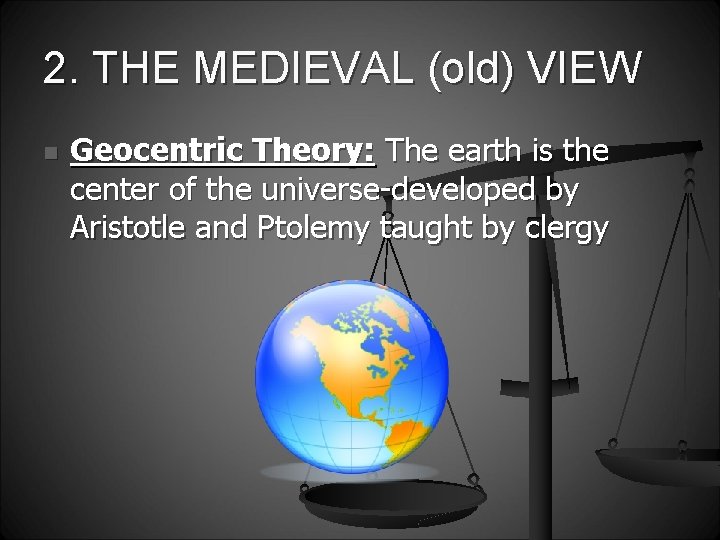
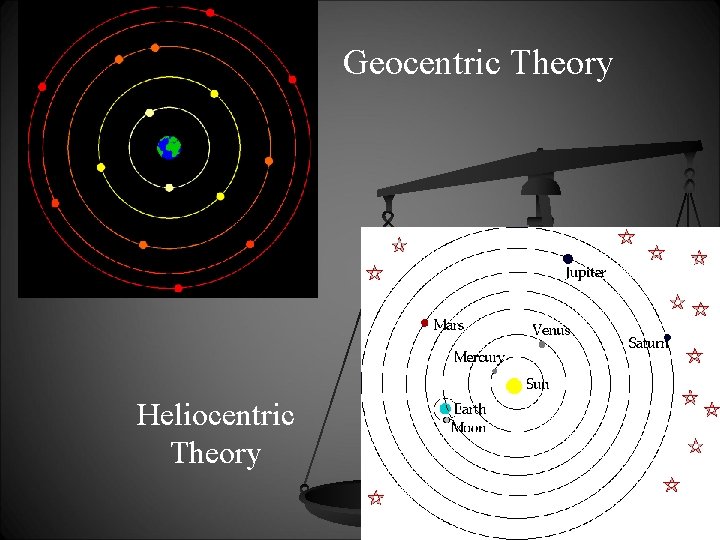
2. THE MEDIEVAL (old) VIEW n Geocentric Theory: The earth is the center of the universe-developed by Aristotle and Ptolemy taught by clergy
3. Why Question Authority Now? A New Understanding • Discoveries lead to doubt – Columbus • Scholars challenge traditional thought – Copernicus, Galileo, & Vesalius • Inventions – Telescope, Microscope, & Navy
4. The Scientific Revolution 1. new way of thinking a. based on observation b. willingness to question accepted beliefs 2. Began in the mid 1500’s 3. started with the Renaissance
5. What else led to the Scientific Revolution? 1. Renaissance: rebirth of learning and the arts inspired new ways of thinking =THE QUESTIONING SPIRIT 2. New technology ie telescope, improved math, printing press 3. Exploration to Africa and Asia
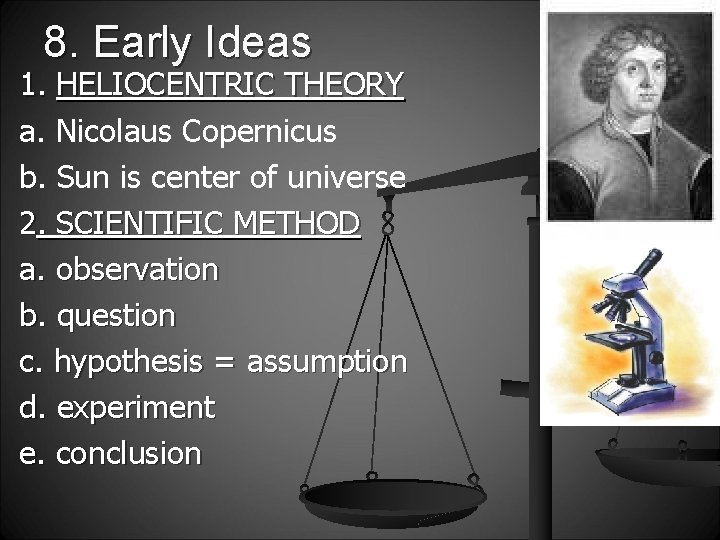
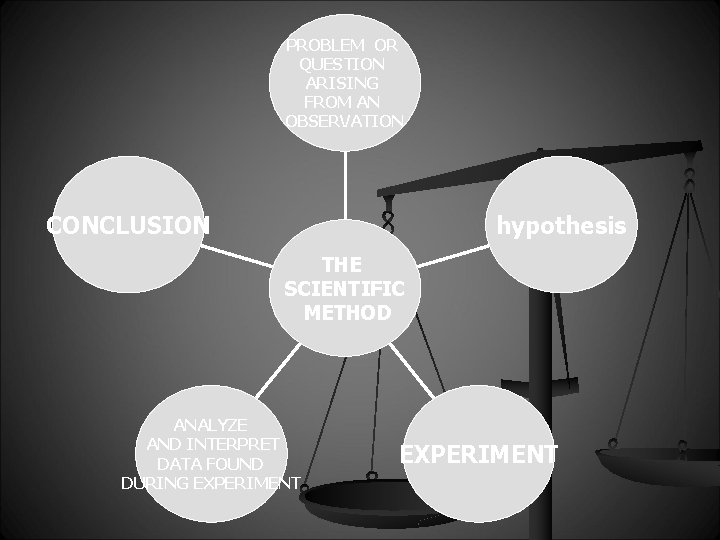
8. Early Ideas 1. HELIOCENTRIC THEORY a. Nicolaus Copernicus b. Sun is center of universe 2. SCIENTIFIC METHOD a. observation b. question c. hypothesis = assumption d. experiment e. conclusion
PEOPLE OF THE SCIENTIFIC REVOLUTION
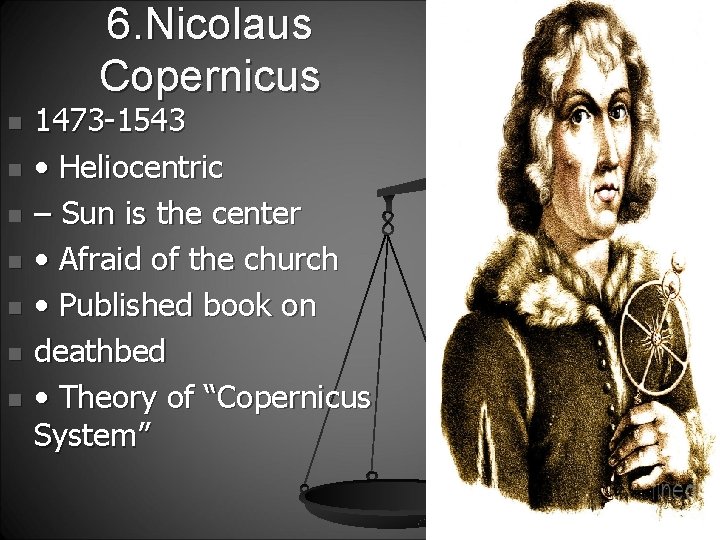
6. Nicolaus Copernicus n n n n 1473 -1543 • Heliocentric – Sun is the center • Afraid of the church • Published book on deathbed • Theory of “Copernicus System”
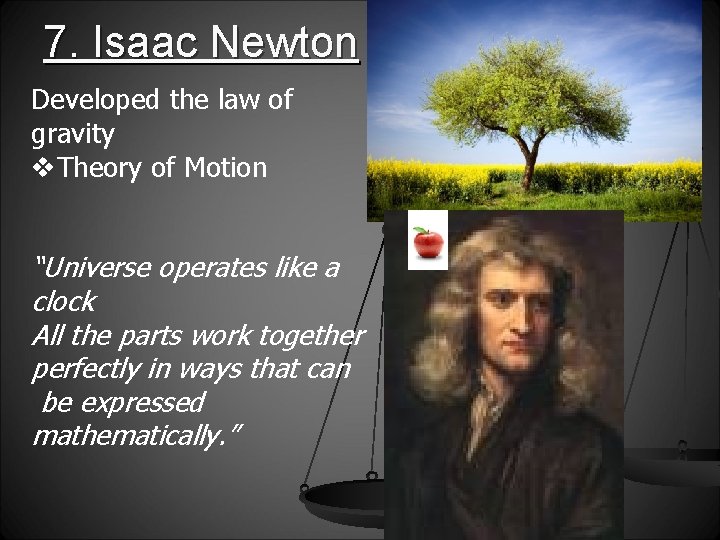
7. Isaac Newton Developed the law of gravity v. Theory of Motion “Universe operates like a clock All the parts work together perfectly in ways that can be expressed mathematically. ”
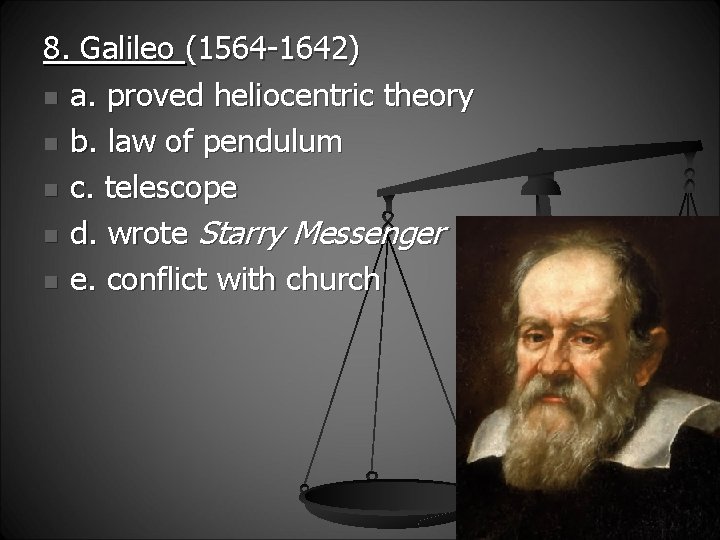
8. Galileo (1564 -1642) n a. proved heliocentric theory n b. law of pendulum n c. telescope n d. wrote Starry Messenger n e. conflict with church
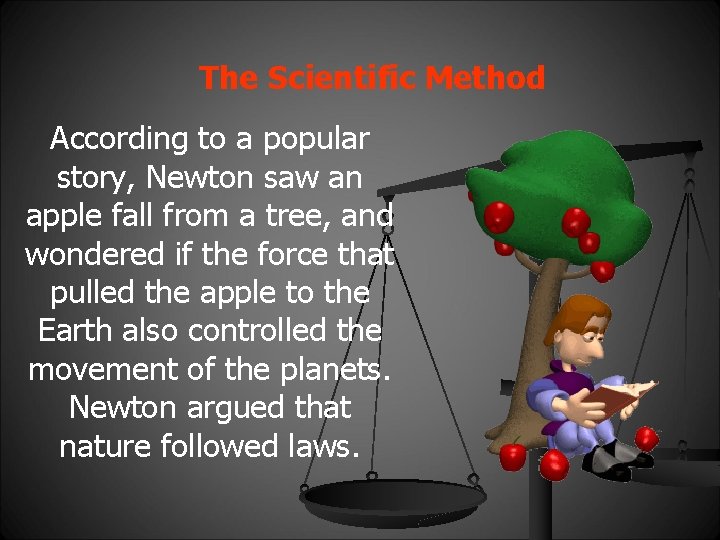
The Scientific Method According to a popular story, Newton saw an apple fall from a tree, and wondered if the force that pulled the apple to the Earth also controlled the movement of the planets. Newton argued that nature followed laws.
n n n n n . Zacharias Janssen a. microscope. Anton van Leeuwenhoek a. first to see red blood cells Bacterica swimming in tooth scrapings. Evangelista Torricelli a. mercury barometer. Anders Celsius a. scale for thermometer
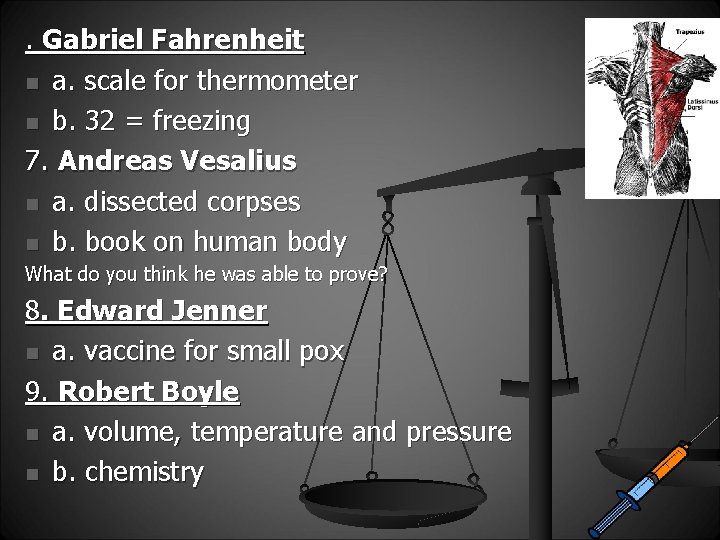
. Gabriel Fahrenheit n a. scale for thermometer n b. 32 = freezing 7. Andreas Vesalius n a. dissected corpses n b. book on human body What do you think he was able to prove? 8. Edward Jenner n a. vaccine for small pox 9. Robert Boyle n a. volume, temperature and pressure n b. chemistry
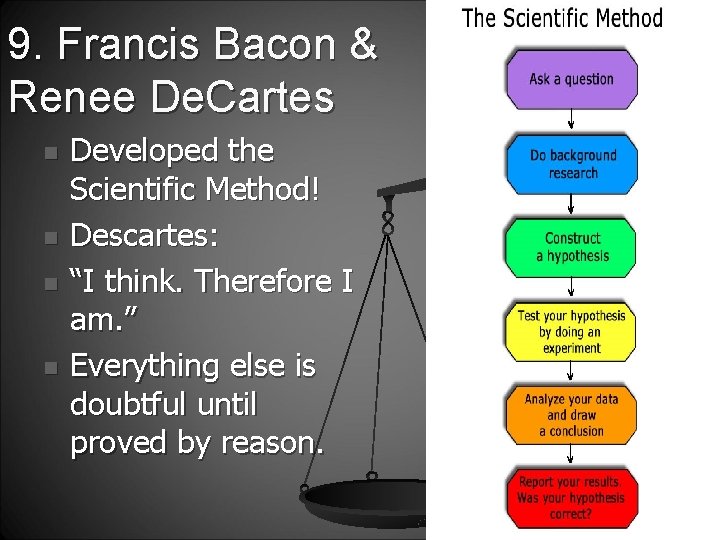
9. Francis Bacon & Renee De. Cartes n n Developed the Scientific Method! Descartes: “I think. Therefore I am. ” Everything else is doubtful until proved by reason.
Geocentric Theory Heliocentric Theory
10. A NEW WAY OF THINKING n The Scientific Revolution: a new way of thinking about the natural world that was based on careful observation and a willingness to challenge and question accepted beliefs.
PROBLEM OR QUESTION ARISING FROM AN OBSERVATION CONCLUSION hypothesis THE SCIENTIFIC METHOD ANALYZE AND INTERPRET DATA FOUND DURING EXPERIMENT
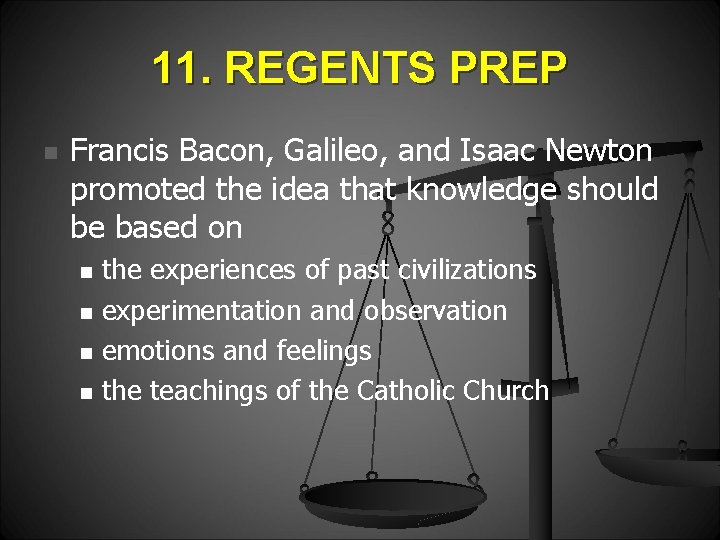
11. REGENTS PREP n Francis Bacon, Galileo, and Isaac Newton promoted the idea that knowledge should be based on n n the experiences of past civilizations experimentation and observation emotions and feelings the teachings of the Catholic Church
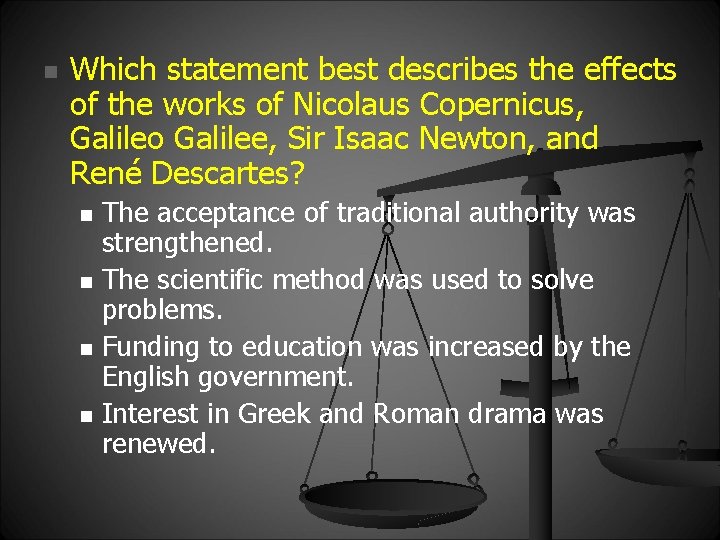
n Which statement best describes the effects of the works of Nicolaus Copernicus, Galileo Galilee, Sir Isaac Newton, and René Descartes? n n The acceptance of traditional authority was strengthened. The scientific method was used to solve problems. Funding to education was increased by the English government. Interest in Greek and Roman drama was renewed.