
The Scientific Revolution Chapter 17 Section 1 Background
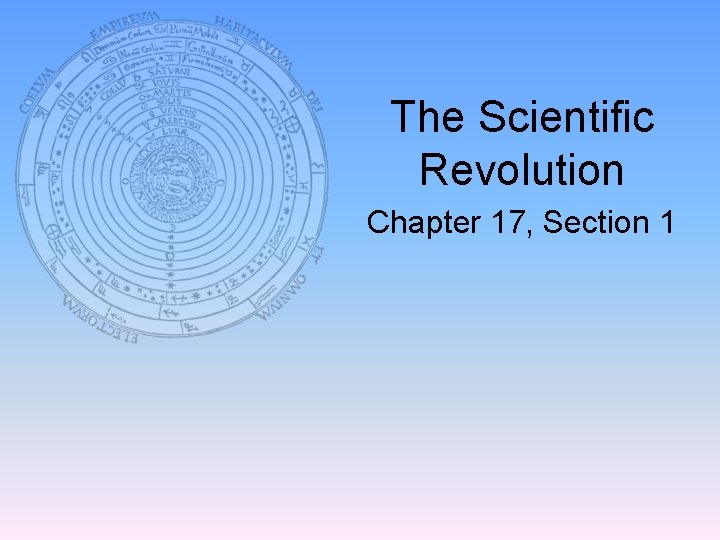
The Scientific Revolution Chapter 17, Section 1
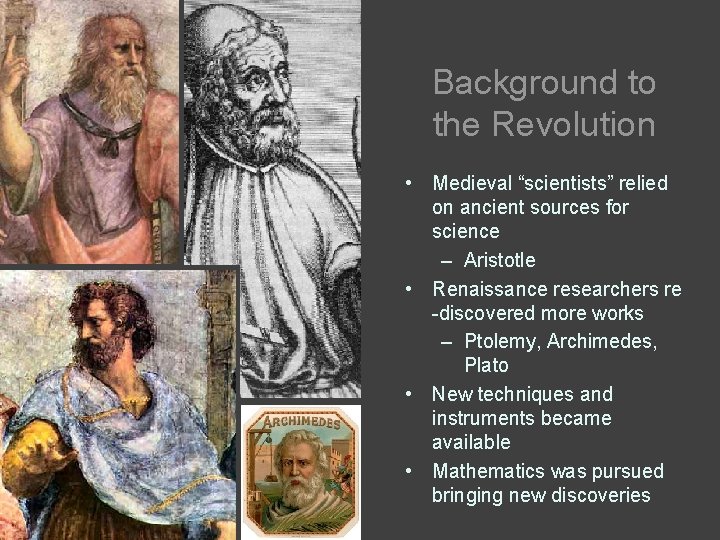
Background to the Revolution • Medieval “scientists” relied on ancient sources for science – Aristotle • Renaissance researchers re -discovered more works – Ptolemy, Archimedes, Plato • New techniques and instruments became available • Mathematics was pursued bringing new discoveries
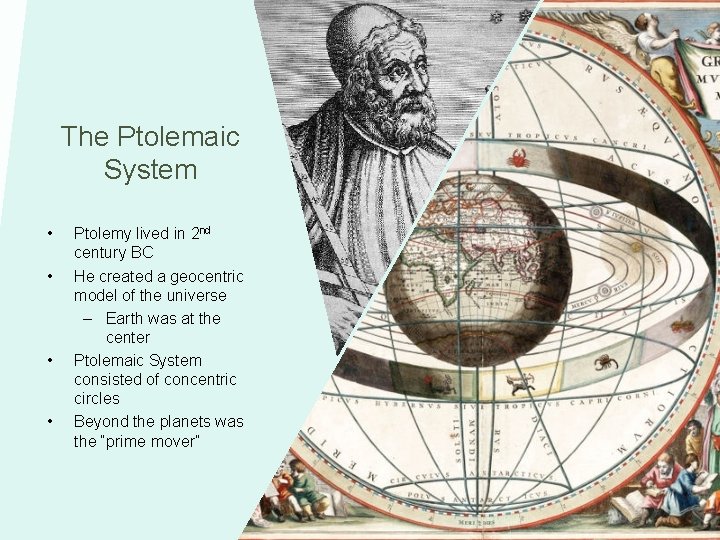
The Ptolemaic System • • Ptolemy lived in 2 nd century BC He created a geocentric model of the universe – Earth was at the center Ptolemaic System consisted of concentric circles Beyond the planets was the “prime mover”
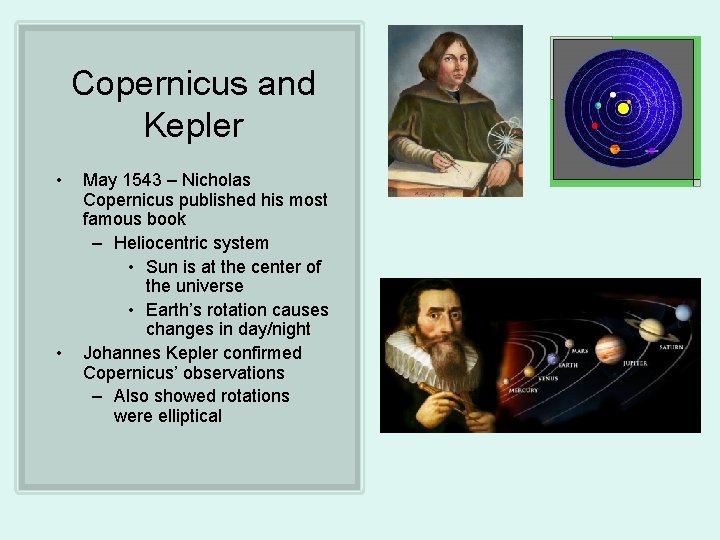
Copernicus and Kepler • • May 1543 – Nicholas Copernicus published his most famous book – Heliocentric system • Sun is at the center of the universe • Earth’s rotation causes changes in day/night Johannes Kepler confirmed Copernicus’ observations – Also showed rotations were elliptical
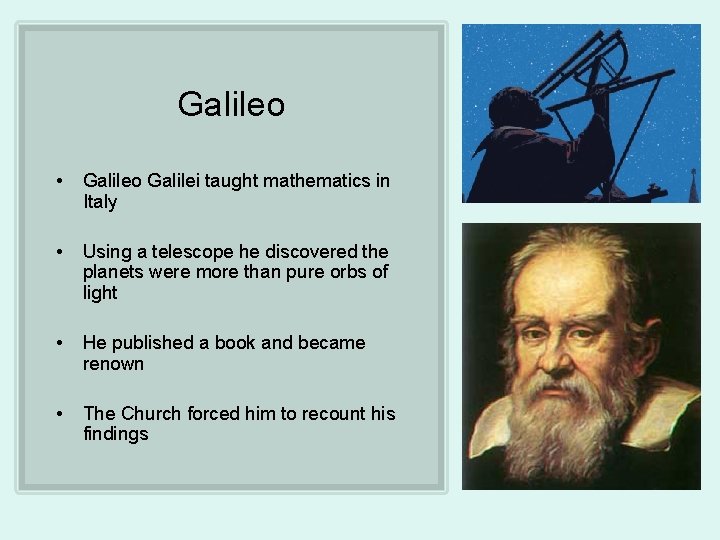
Galileo • Galileo Galilei taught mathematics in Italy • Using a telescope he discovered the planets were more than pure orbs of light • He published a book and became renown • The Church forced him to recount his findings
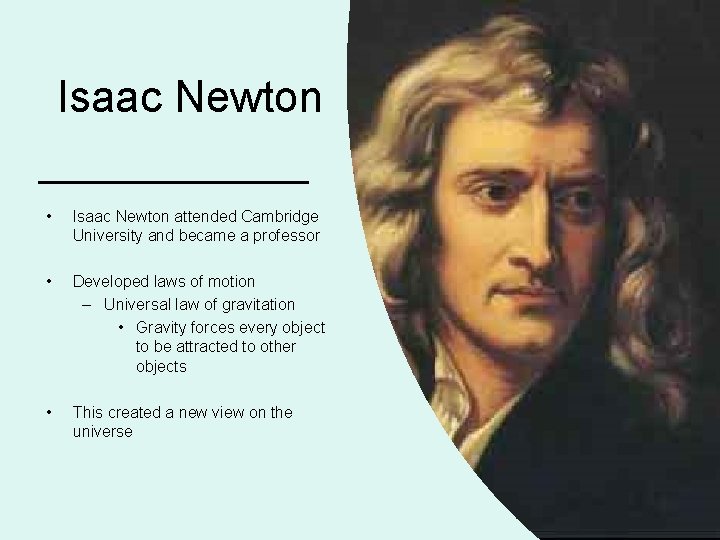
Isaac Newton • Isaac Newton attended Cambridge University and became a professor • Developed laws of motion – Universal law of gravitation • Gravity forces every object to be attracted to other objects • This created a new view on the universe
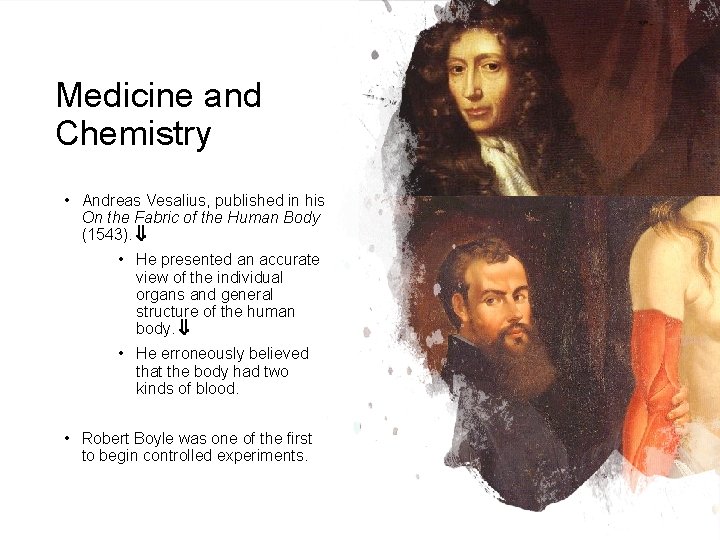
Medicine and Chemistry • Andreas Vesalius, published in his On the Fabric of the Human Body (1543). • He presented an accurate view of the individual organs and general structure of the human body. • He erroneously believed that the body had two kinds of blood. • Robert Boyle was one of the first to begin controlled experiments.
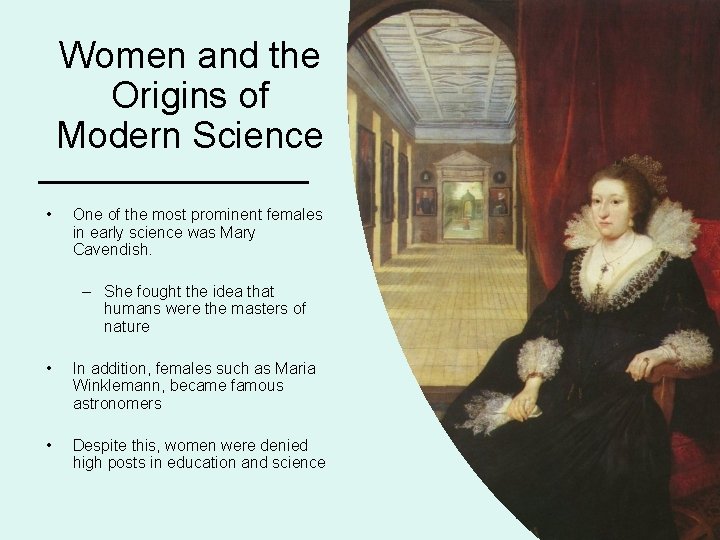
Women and the Origins of Modern Science • One of the most prominent females in early science was Mary Cavendish. – She fought the idea that humans were the masters of nature • In addition, females such as Maria Winklemann, became famous astronomers • Despite this, women were denied high posts in education and science
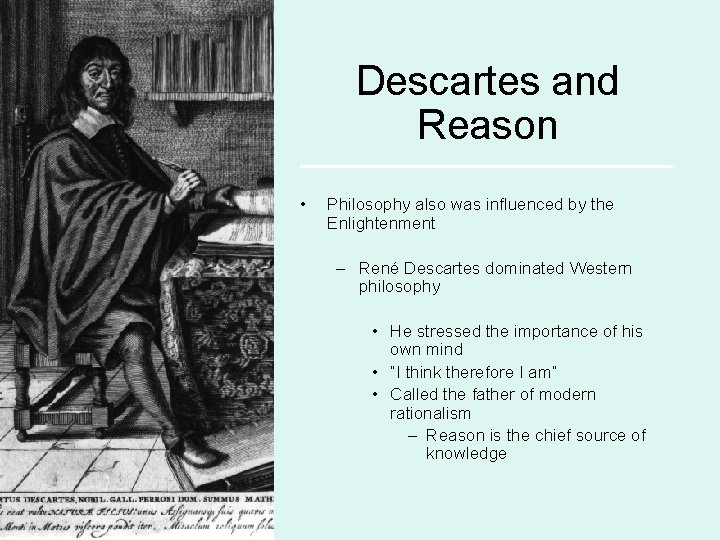
Descartes and Reason • Philosophy also was influenced by the Enlightenment – René Descartes dominated Western philosophy • He stressed the importance of his own mind • “I think therefore I am” • Called the father of modern rationalism – Reason is the chief source of knowledge
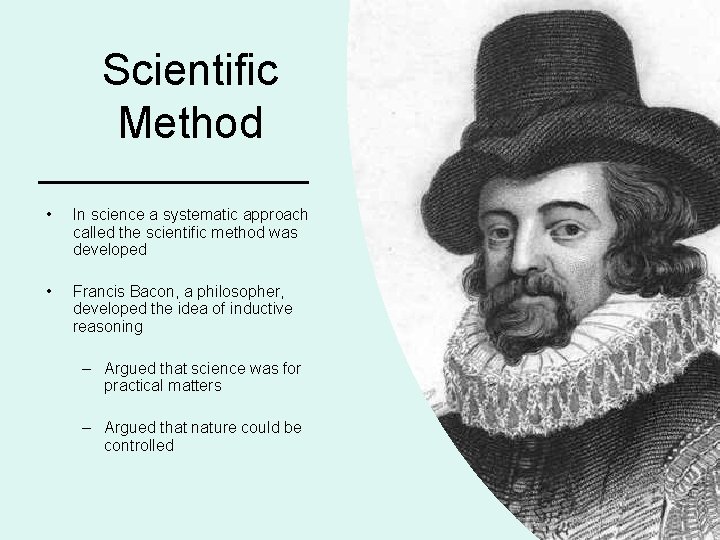
Scientific Method • In science a systematic approach called the scientific method was developed • Francis Bacon, a philosopher, developed the idea of inductive reasoning – Argued that science was for practical matters – Argued that nature could be controlled
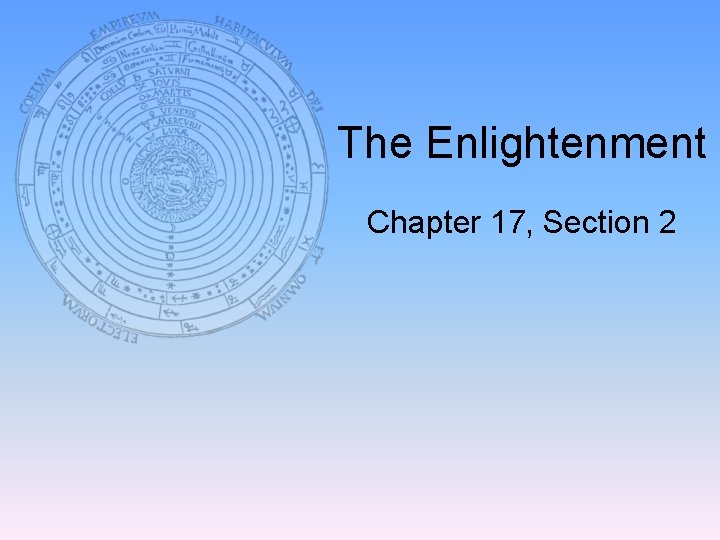
The Enlightenment Chapter 17, Section 2
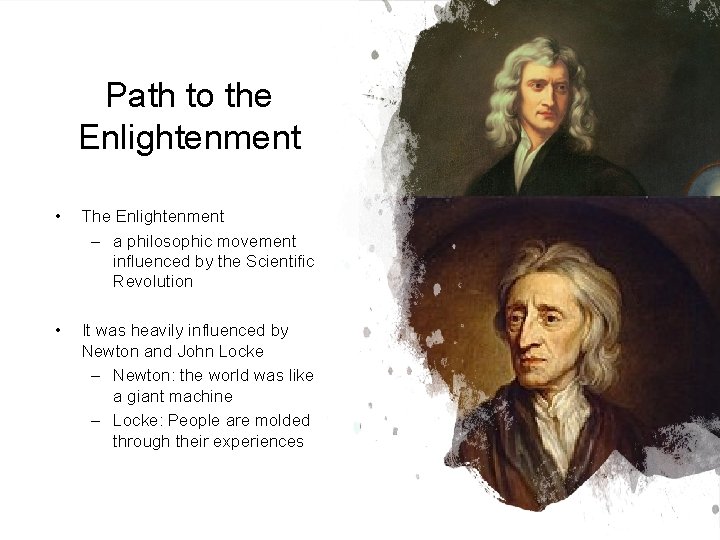
Path to the Enlightenment • The Enlightenment – a philosophic movement influenced by the Scientific Revolution • It was heavily influenced by Newton and John Locke – Newton: the world was like a giant machine – Locke: People are molded through their experiences
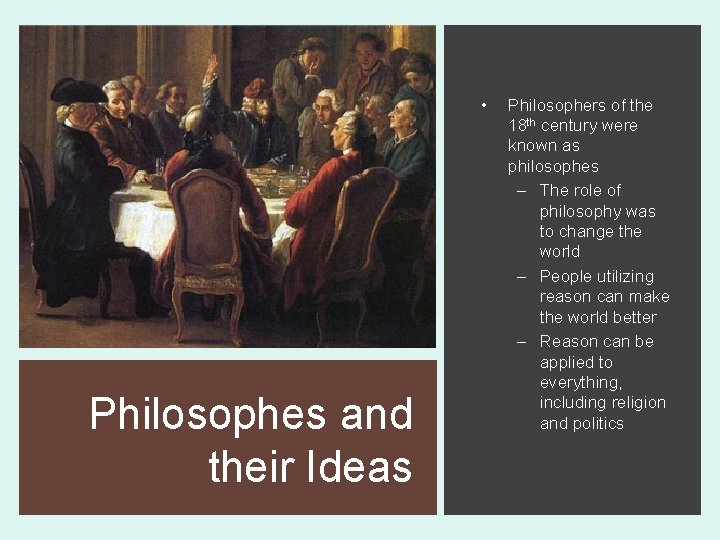
• Philosophes and their Ideas Philosophers of the 18 th century were known as philosophes – The role of philosophy was to change the world – People utilizing reason can make the world better – Reason can be applied to everything, including religion and politics
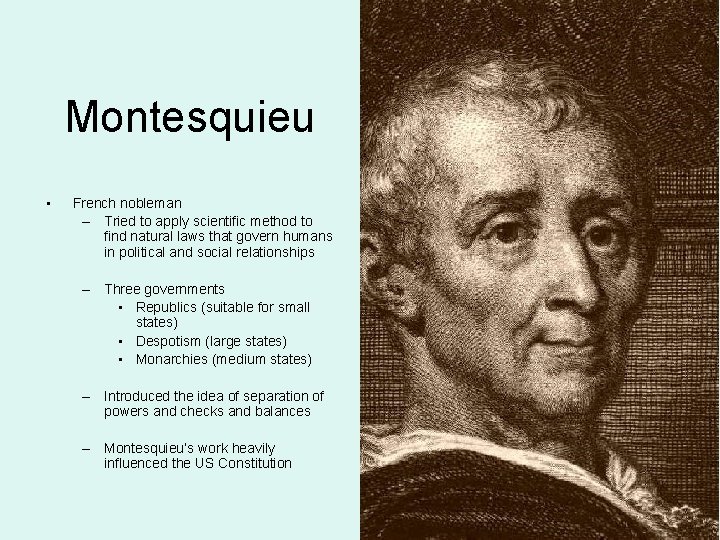
Montesquieu • French nobleman – Tried to apply scientific method to find natural laws that govern humans in political and social relationships – Three governments • Republics (suitable for small states) • Despotism (large states) • Monarchies (medium states) – Introduced the idea of separation of powers and checks and balances – Montesquieu’s work heavily influenced the US Constitution
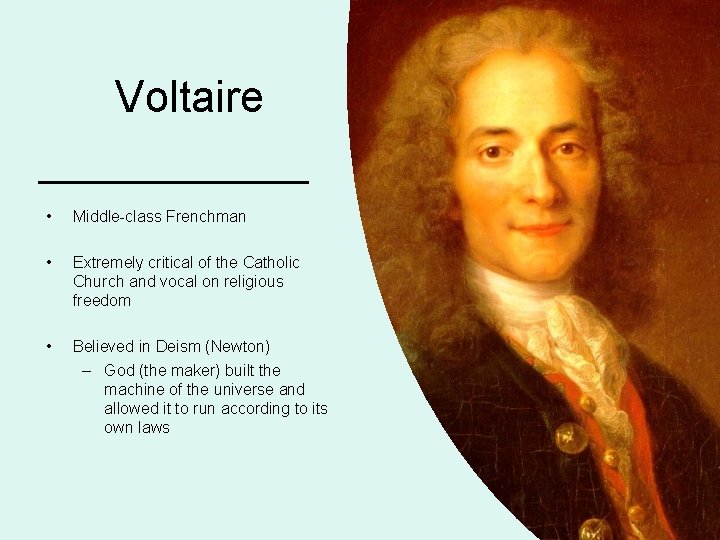
Voltaire • Middle-class Frenchman • Extremely critical of the Catholic Church and vocal on religious freedom • Believed in Deism (Newton) – God (the maker) built the machine of the universe and allowed it to run according to its own laws
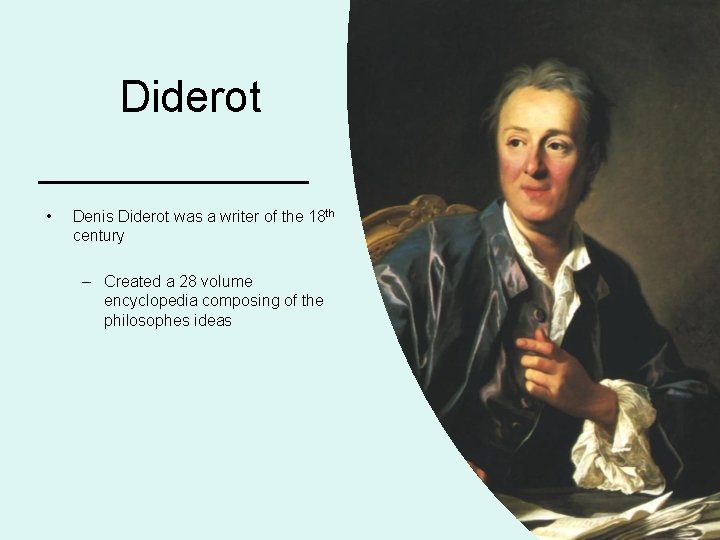
Diderot • Denis Diderot was a writer of the 18 th century – Created a 28 volume encyclopedia composing of the philosophes ideas
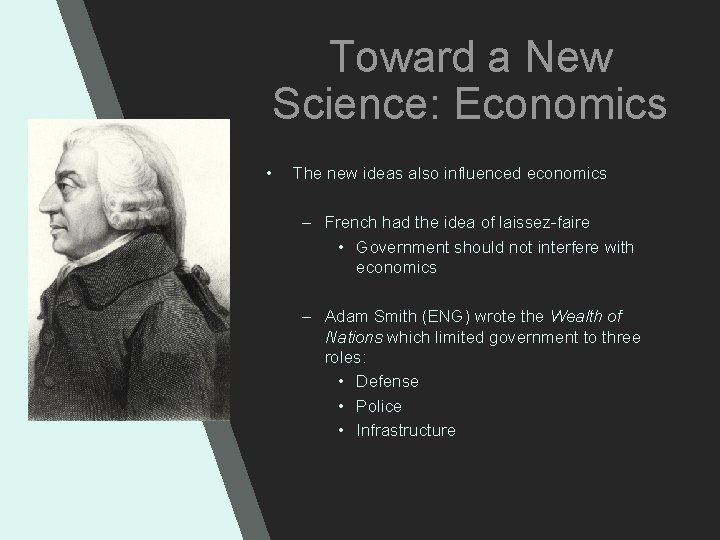
Toward a New Science: Economics • The new ideas also influenced economics – French had the idea of laissez-faire • Government should not interfere with economics – Adam Smith (ENG) wrote the Wealth of Nations which limited government to three roles: • Defense • Police • Infrastructure
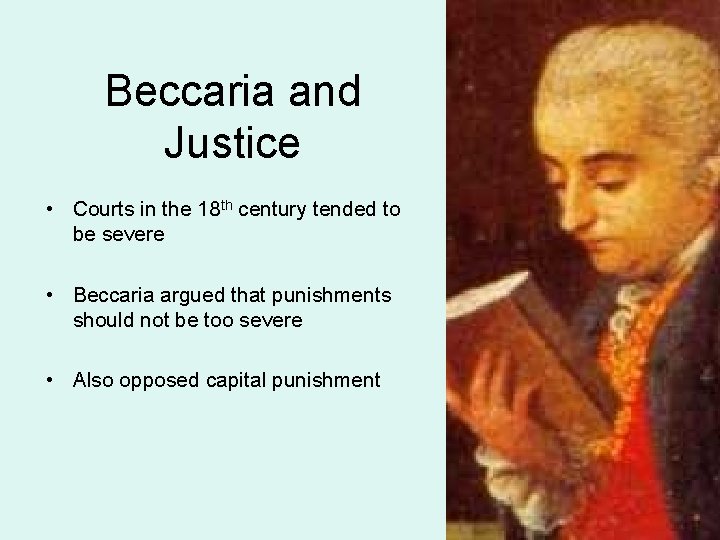
Beccaria and Justice • Courts in the 18 th century tended to be severe • Beccaria argued that punishments should not be too severe • Also opposed capital punishment
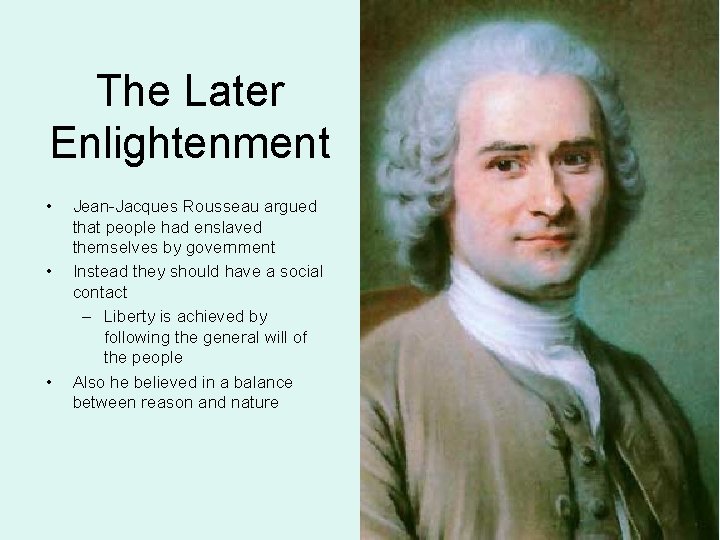
The Later Enlightenment • • • Jean-Jacques Rousseau argued that people had enslaved themselves by government Instead they should have a social contact – Liberty is achieved by following the general will of the people Also he believed in a balance between reason and nature
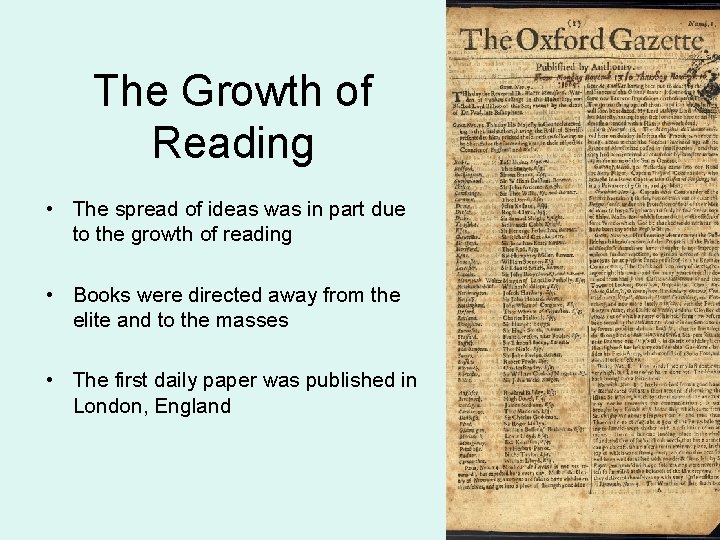
The Growth of Reading • The spread of ideas was in part due to the growth of reading • Books were directed away from the elite and to the masses • The first daily paper was published in London, England
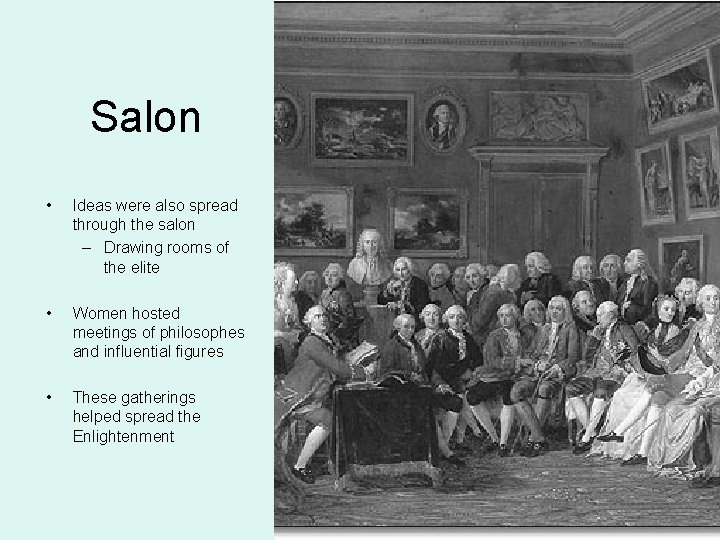
Salon • Ideas were also spread through the salon – Drawing rooms of the elite • Women hosted meetings of philosophes and influential figures • These gatherings helped spread the Enlightenment
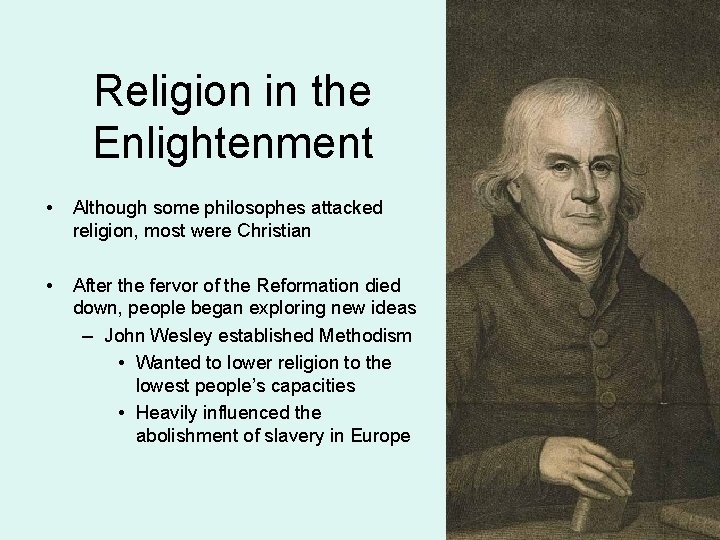
Religion in the Enlightenment • Although some philosophes attacked religion, most were Christian • After the fervor of the Reformation died down, people began exploring new ideas – John Wesley established Methodism • Wanted to lower religion to the lowest people’s capacities • Heavily influenced the abolishment of slavery in Europe
The Impact of the Enlightenment Chapter 17, Section 3
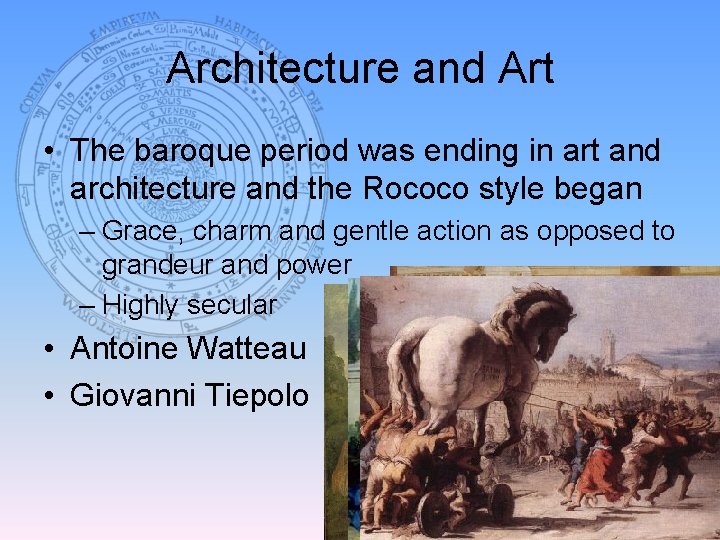
Architecture and Art • The baroque period was ending in art and architecture and the Rococo style began – Grace, charm and gentle action as opposed to grandeur and power – Highly secular • Antoine Watteau • Giovanni Tiepolo
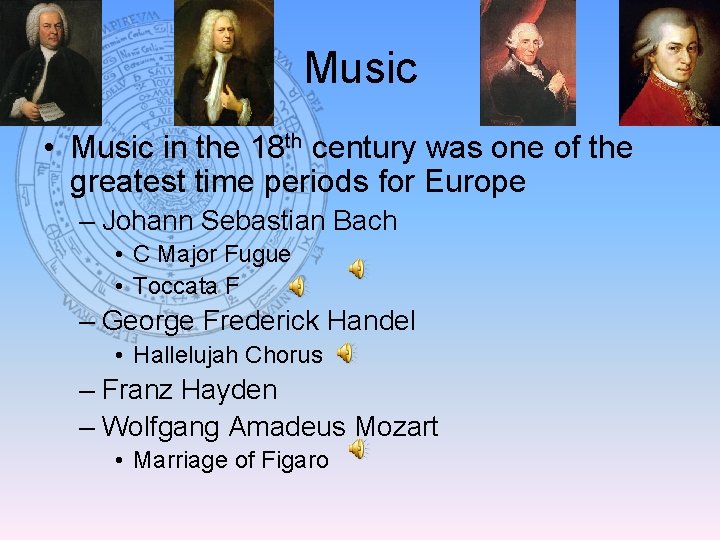
Music • Music in the 18 th century was one of the greatest time periods for Europe – Johann Sebastian Bach • C Major Fugue • Toccata F – George Frederick Handel • Hallelujah Chorus – Franz Hayden – Wolfgang Amadeus Mozart • Marriage of Figaro
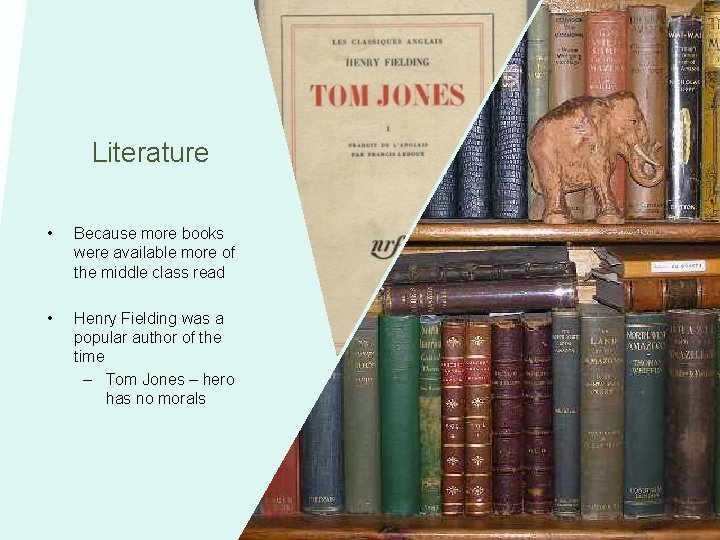
Literature • Because more books were available more of the middle class read • Henry Fielding was a popular author of the time – Tom Jones – hero has no morals
Enlightened Absolutism • The Enlightenment called for rulers to be enlightened also – Obeyed the rules as well as enforced them fairly – Allowed certain freedoms – Only strong rulers had the ability top be enlightened rulers – But were there enlightened rulers during this time?
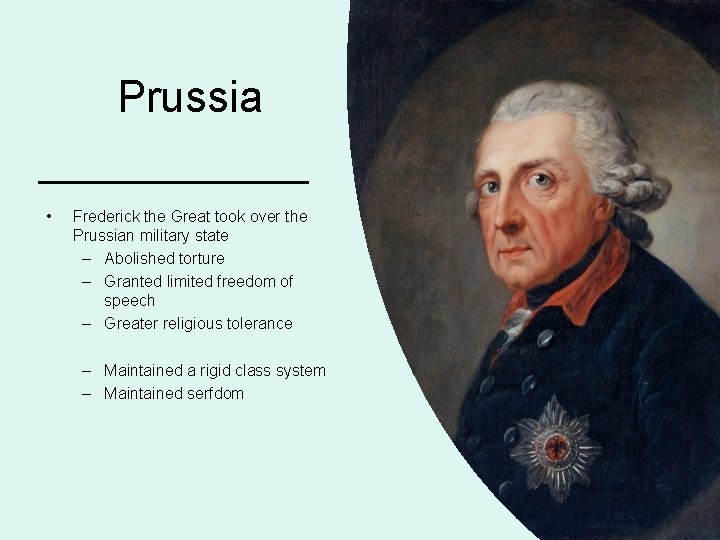
Prussia • Frederick the Great took over the Prussian military state – Abolished torture – Granted limited freedom of speech – Greater religious tolerance – Maintained a rigid class system – Maintained serfdom
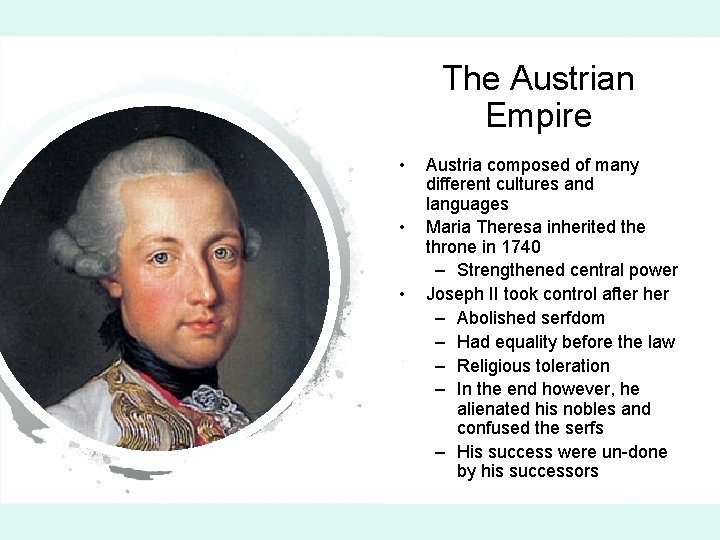
The Austrian Empire • • • Austria composed of many different cultures and languages Maria Theresa inherited the throne in 1740 – Strengthened central power Joseph II took control after her – Abolished serfdom – Had equality before the law – Religious toleration – In the end however, he alienated his nobles and confused the serfs – His success were un-done by his successors
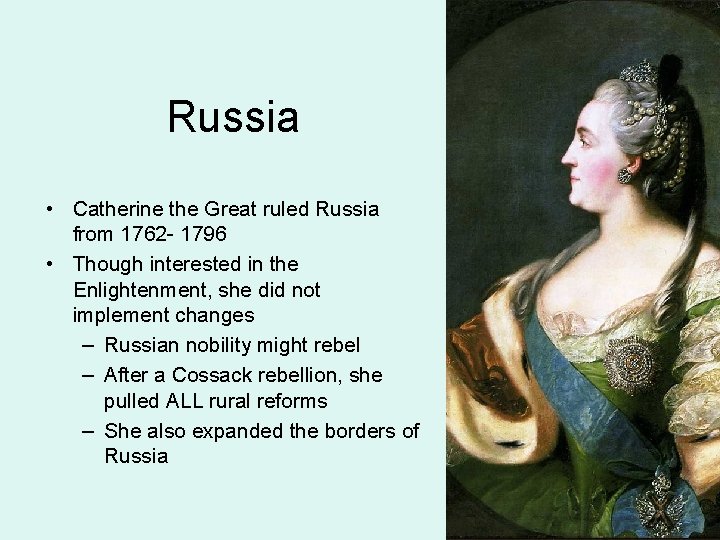
Russia • Catherine the Great ruled Russia from 1762 - 1796 • Though interested in the Enlightenment, she did not implement changes – Russian nobility might rebel – After a Cossack rebellion, she pulled ALL rural reforms – She also expanded the borders of Russia
• In the three countries mentioned, only Joseph II tried to reform and he failed Enlightened Absolutism? • Most rulers were more concerned with their own power than the people • Therefore states continued to look out for their own interests rather than join the Enlightened movement
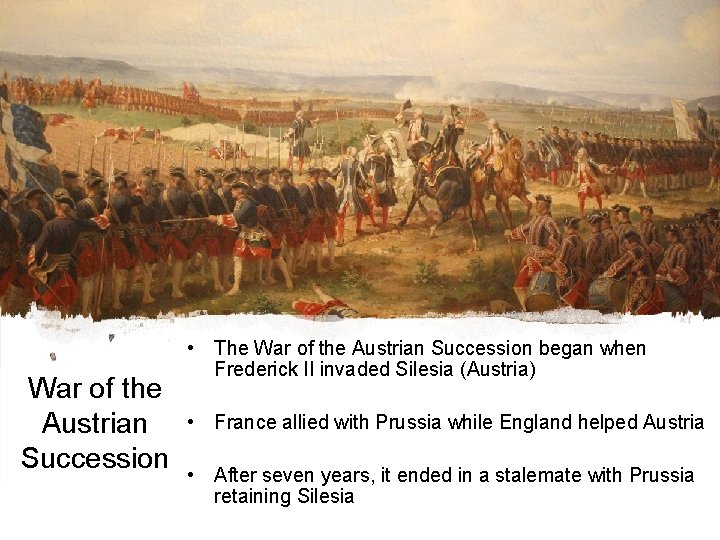
War of the Austrian Succession • The War of the Austrian Succession began when Frederick II invaded Silesia (Austria) • France allied with Prussia while England helped Austria • After seven years, it ended in a stalemate with Prussia retaining Silesia
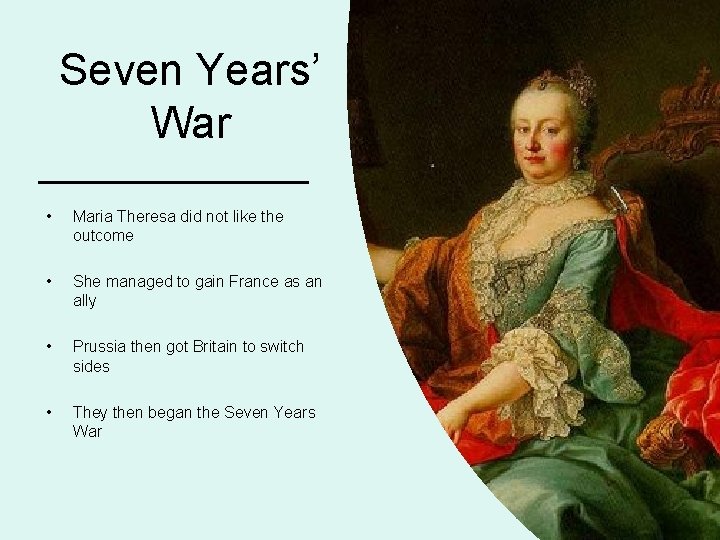
Seven Years’ War • Maria Theresa did not like the outcome • She managed to gain France as an ally • Prussia then got Britain to switch sides • They then began the Seven Years War
• In Europe, Frederick II fought Russia, Austria and France The War in Europe • Initially successful, the Prussians eventually began to lose • Russia however pulled out, leading to another stalemate • Austria finally recognized Prussia’s ownership of Silesia
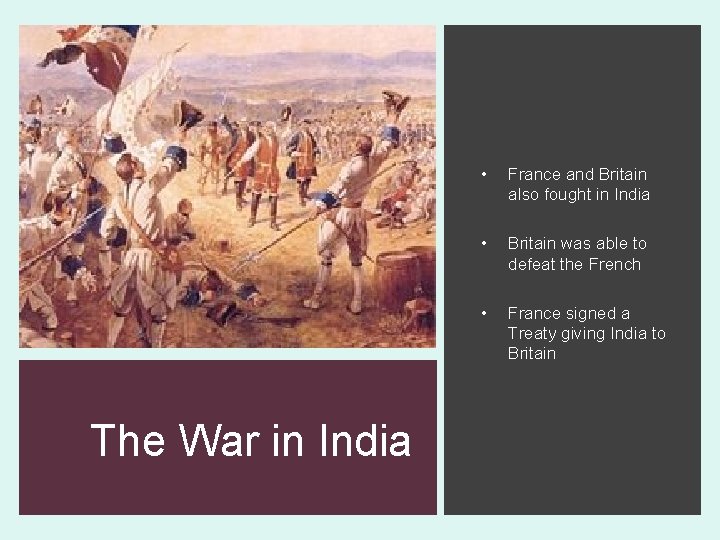
The War in India • France and Britain also fought in India • Britain was able to defeat the French • France signed a Treaty giving India to Britain
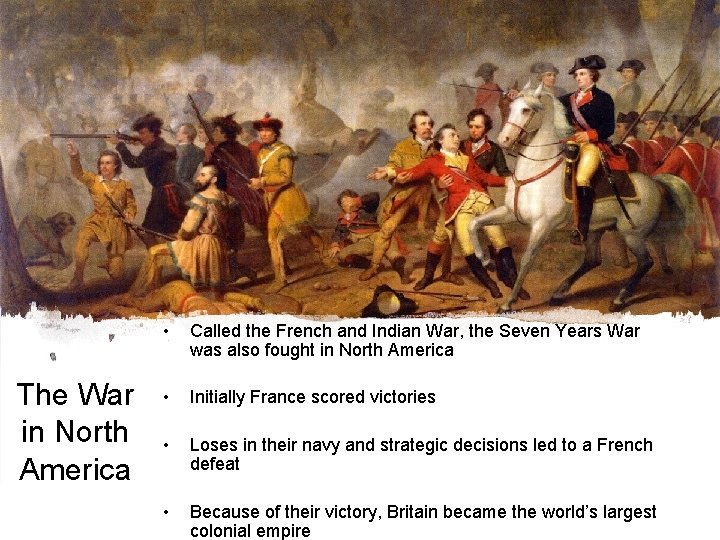
The War in North America • Called the French and Indian War, the Seven Years War was also fought in North America • Initially France scored victories • Loses in their navy and strategic decisions led to a French defeat • Because of their victory, Britain became the world’s largest colonial empire
Colonial Empires and the American Revolution Chapter 17, Section 4
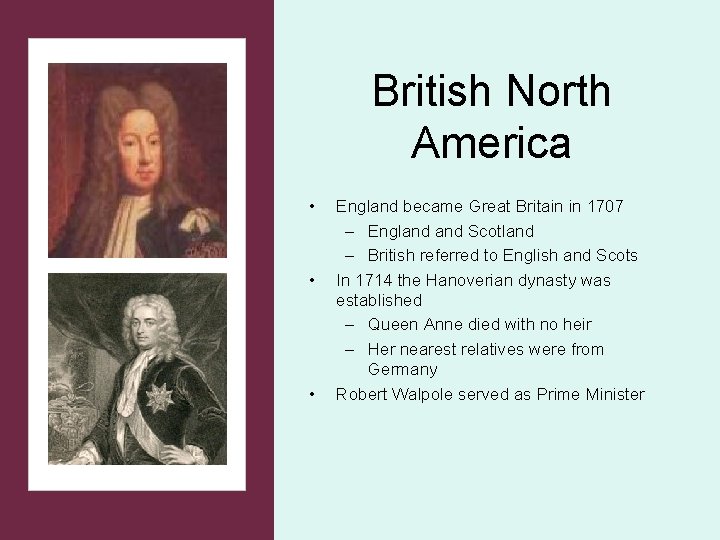
British North America • • • England became Great Britain in 1707 – England Scotland – British referred to English and Scots In 1714 the Hanoverian dynasty was established – Queen Anne died with no heir – Her nearest relatives were from Germany Robert Walpole served as Prime Minister
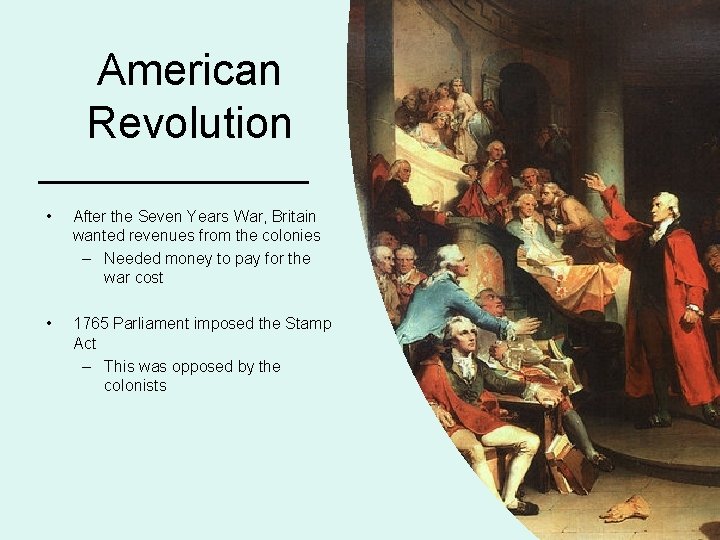
American Revolution • After the Seven Years War, Britain wanted revenues from the colonies – Needed money to pay for the war cost • 1765 Parliament imposed the Stamp Act – This was opposed by the colonists
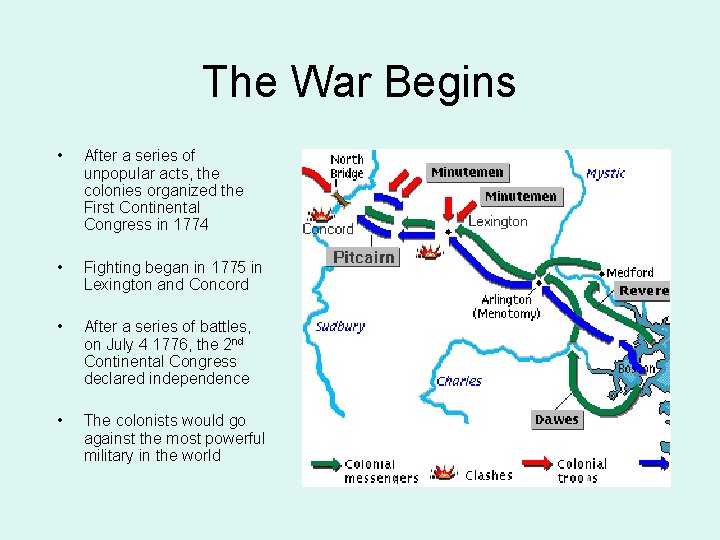
The War Begins • After a series of unpopular acts, the colonies organized the First Continental Congress in 1774 • Fighting began in 1775 in Lexington and Concord • After a series of battles, on July 4 1776, the 2 nd Continental Congress declared independence • The colonists would go against the most powerful military in the world
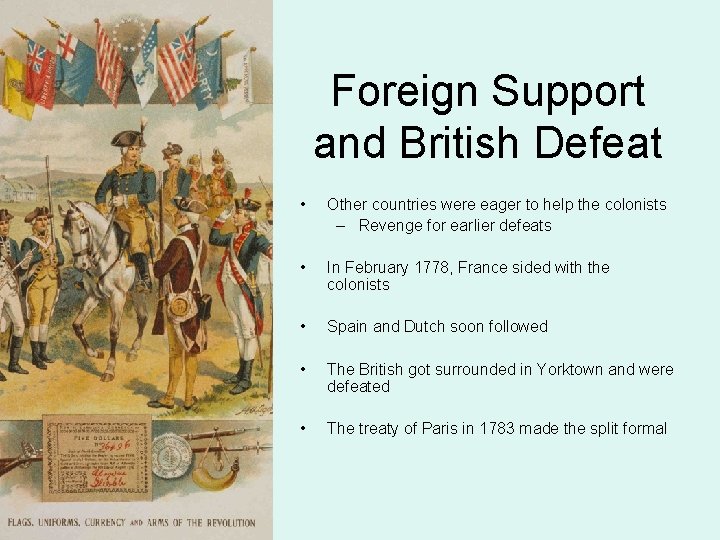
Foreign Support and British Defeat • Other countries were eager to help the colonists – Revenge for earlier defeats • In February 1778, France sided with the colonists • Spain and Dutch soon followed • The British got surrounded in Yorktown and were defeated • The treaty of Paris in 1783 made the split formal
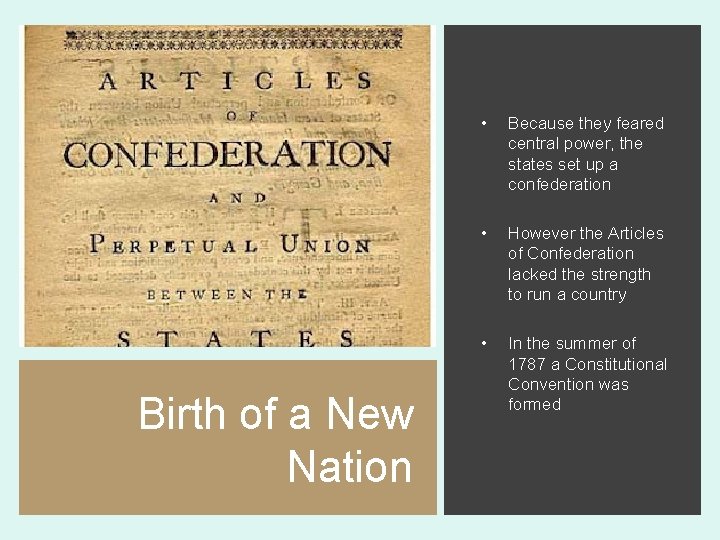
Birth of a New Nation • Because they feared central power, the states set up a confederation • However the Articles of Confederation lacked the strength to run a country • In the summer of 1787 a Constitutional Convention was formed
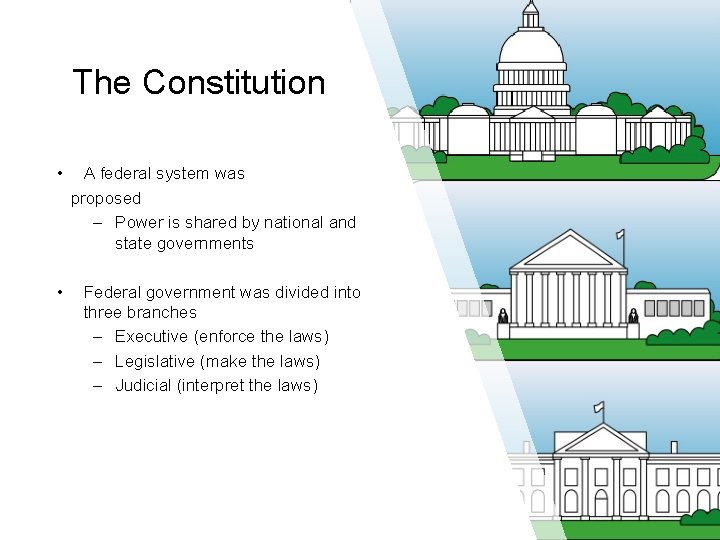
The Constitution • A federal system was proposed – Power is shared by national and state governments • Federal government was divided into three branches – Executive (enforce the laws) – Legislative (make the laws) – Judicial (interpret the laws)
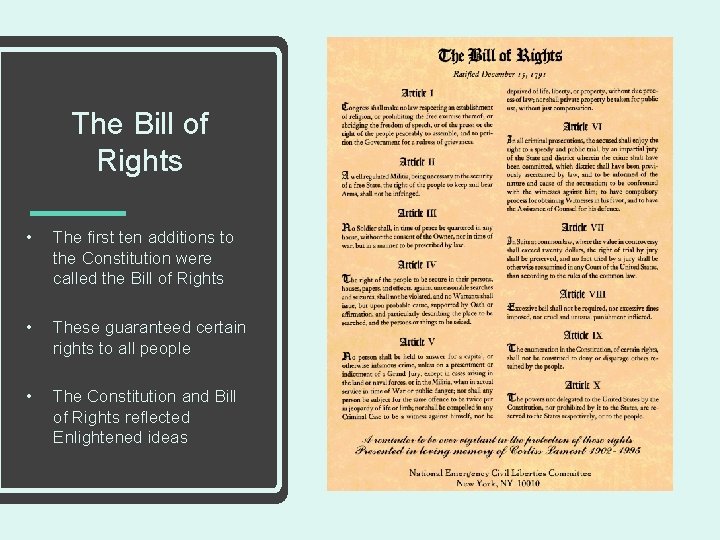
The Bill of Rights • The first ten additions to the Constitution were called the Bill of Rights • These guaranteed certain rights to all people • The Constitution and Bill of Rights reflected Enlightened ideas
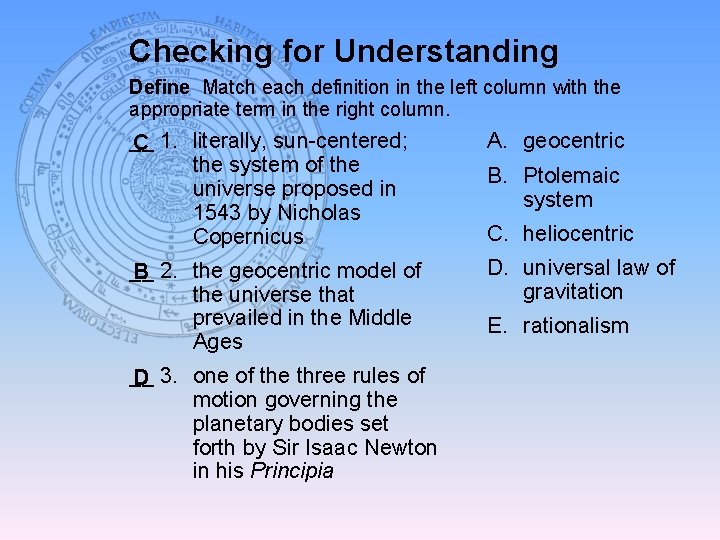
Checking for Understanding Define Match each definition in the left column with the appropriate term in the right column. __ C 1. literally, sun-centered; the system of the universe proposed in 1543 by Nicholas Copernicus A. geocentric __ B 2. the geocentric model of the universe that prevailed in the Middle Ages D. universal law of gravitation __ D 3. one of the three rules of motion governing the planetary bodies set forth by Sir Isaac Newton in his Principia B. Ptolemaic system C. heliocentric E. rationalism
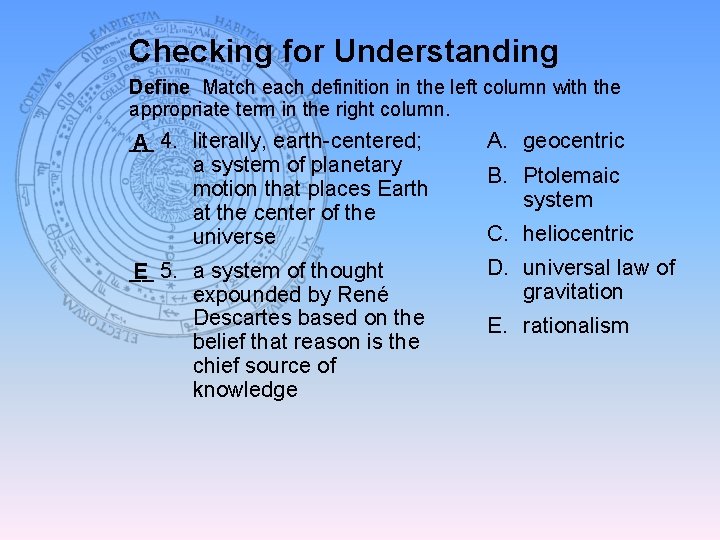
Checking for Understanding Define Match each definition in the left column with the appropriate term in the right column. __ A 4. literally, earth-centered; a system of planetary motion that places Earth at the center of the universe A. geocentric __ E 5. a system of thought expounded by René Descartes based on the belief that reason is the chief source of knowledge D. universal law of gravitation B. Ptolemaic system C. heliocentric E. rationalism
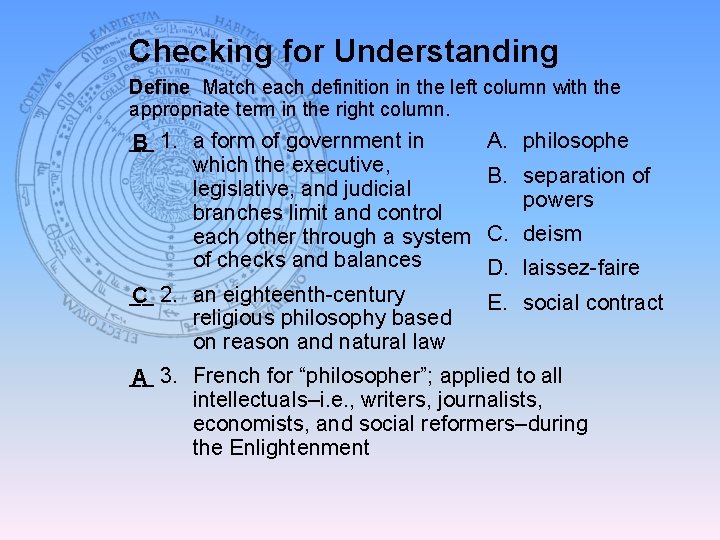
Checking for Understanding Define Match each definition in the left column with the appropriate term in the right column. __ B 1. a form of government in which the executive, legislative, and judicial branches limit and control each other through a system of checks and balances A. philosophe __ C 2. an eighteenth-century religious philosophy based on reason and natural law E. social contract B. separation of powers C. deism D. laissez-faire __ A 3. French for “philosopher”; applied to all intellectuals–i. e. , writers, journalists, economists, and social reformers–during the Enlightenment
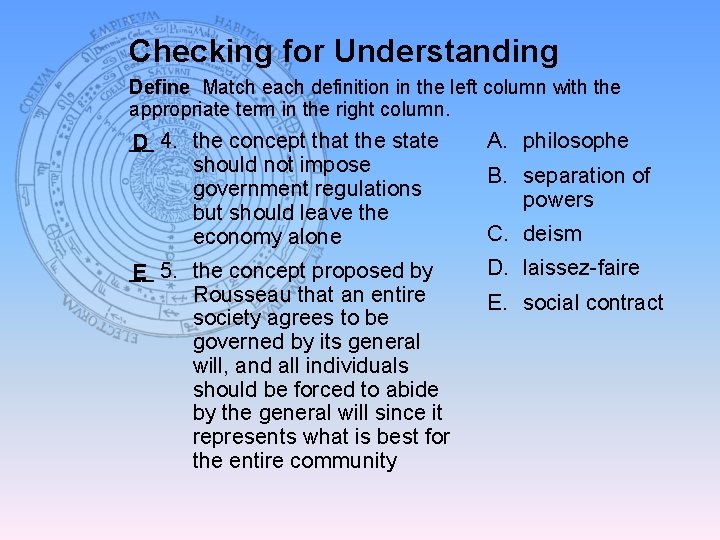
Checking for Understanding Define Match each definition in the left column with the appropriate term in the right column. __ D 4. the concept that the state should not impose government regulations but should leave the economy alone A. philosophe __ E 5. the concept proposed by Rousseau that an entire society agrees to be governed by its general will, and all individuals should be forced to abide by the general will since it represents what is best for the entire community D. laissez-faire B. separation of powers C. deism E. social contract
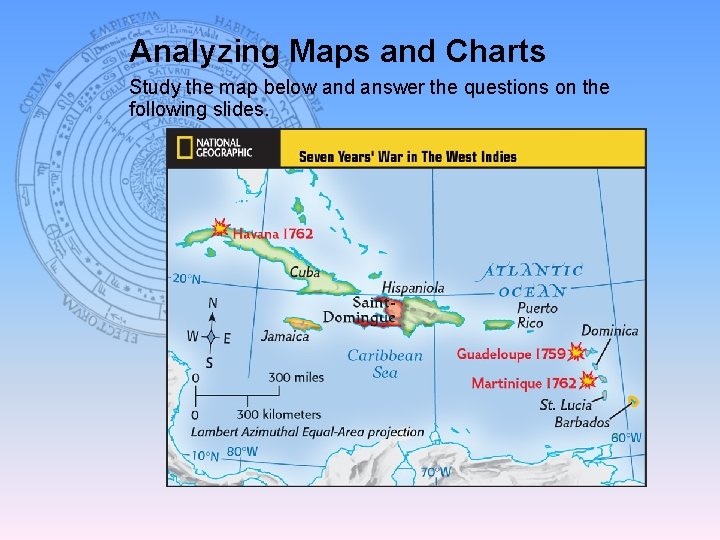
Analyzing Maps and Charts Study the map below and answer the questions on the following slides.
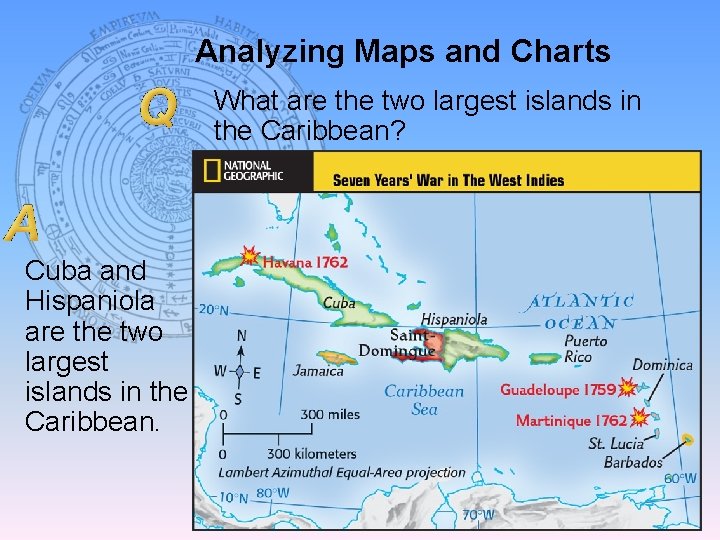
Analyzing Maps and Charts What are the two largest islands in the Caribbean? Cuba and Hispaniola are the two largest islands in the Caribbean.
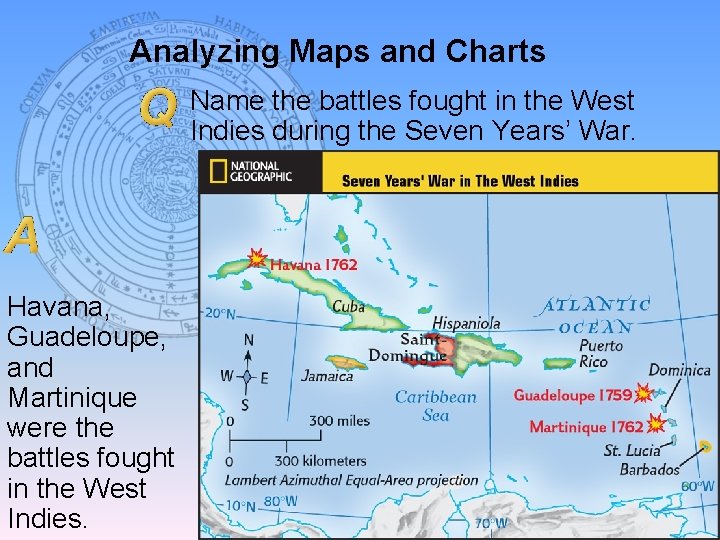
Analyzing Maps and Charts Name the battles fought in the West Indies during the Seven Years’ War. Havana, Guadeloupe, and Martinique were the battles fought in the West Indies.
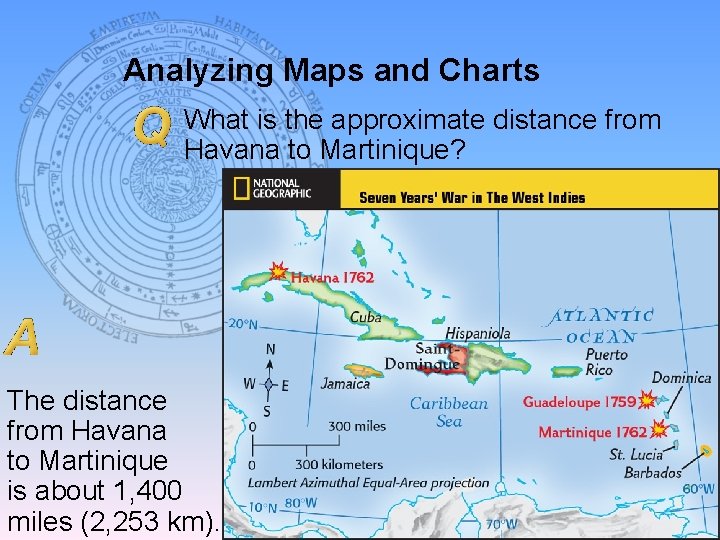
Analyzing Maps and Charts What is the approximate distance from Havana to Martinique? The distance from Havana to Martinique is about 1, 400 miles (2, 253 km).
- Slides: 52