
The Scientific Revolution and The Enlightenment The Rise
- Slides: 26
The Scientific Revolution and The Enlightenment The Rise of European Secularism and its influence upon the World.
The Scientific Revolution - 1550 n What is a “revolution? ” n Scientific discovery changed the way people thought!
Your Political Philosophy…see handout. n n How do you explain things you don’t understand? What is freedom? What does it do for you? Are you and the person next to you equal? What would life be like if everything was controlled by a church? n n n n Occupation Education Worship Government Salary and Promotion Marriage TV Others?
n If you were arrested for a crime, a priest should determine your punishment.
n In order to research some information about planetary motion, you would refer to the bible.
n The president should not have to follow the same laws as ordinary citizens.
n Government should not protect an individual’s rights to liberty or life. Each man/woman should fend for him/herself.
n. The president can legitimize his authority through god.
n. A government can be trusted not to abuse its power. No system of ‘checks and balances’ is needed.
n Even if a leader of a country represses his/her people, the people do not have a right to rebel.
n. Laws are not really necessary to preserve order.
n. A rich person should be acquitted (not charged) of a crime even if s/he is guilty.
n An individual must be told which religion he or she should practice and should be persecuted if he or she does not agree.
n Scientists should refer to church teachings and common sense to explain things like the weather.
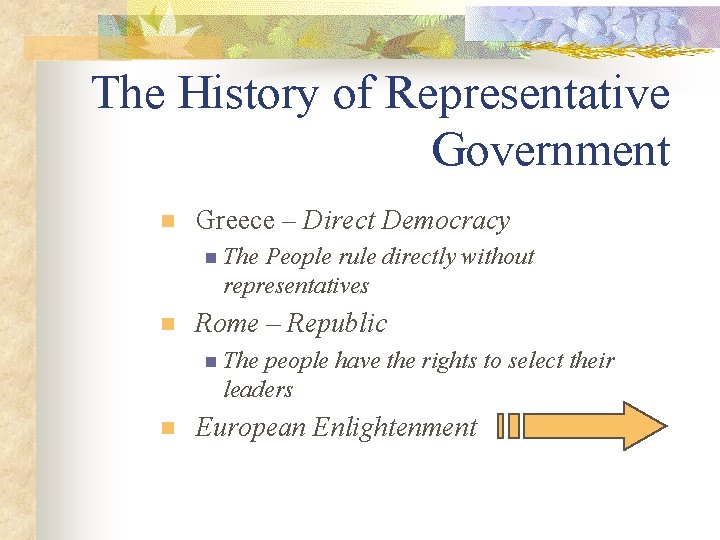
The History of Representative Government n Greece – Direct Democracy n The People rule directly without representatives n Rome – Republic n The people have the rights to select their leaders n European Enlightenment
The European Enlightenment n Inspired by the Scientific Revolution and the Renaissance n During the 17 th and 18 th centuries n Called the “Age of Reason” n In what age do we live?
The 4 Main Ideas of The Enlightenment Thinkers 1. Natural Law: The universe can be understood through natural and not supernatural (religious) forces. n 2. Reason: Truth discovered through logic. n 3. Human reason can solve social problems. Progress: Society could improve itself to achieve social perfection. n 4. God exists, put does not take an active daily part in human interaction Education is key - the nobles/kings were no better than others, they just had better educations. Liberty: Society is, by nature, free of governmental control.
Hmmm. . . • How do you think the churches of Europe reacted to the Scientific Revolution and Enlightenment? • How do you think the aristocracy reacted? • How do you think the sovereigns reacted?
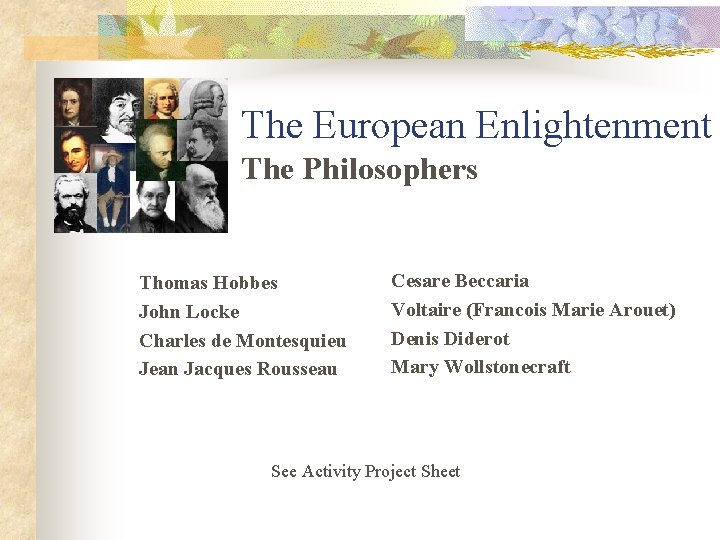
The European Enlightenment The Philosophers Thomas Hobbes John Locke Charles de Montesquieu Jean Jacques Rousseau Cesare Beccaria Voltaire (Francois Marie Arouet) Denis Diderot Mary Wollstonecraft See Activity Project Sheet
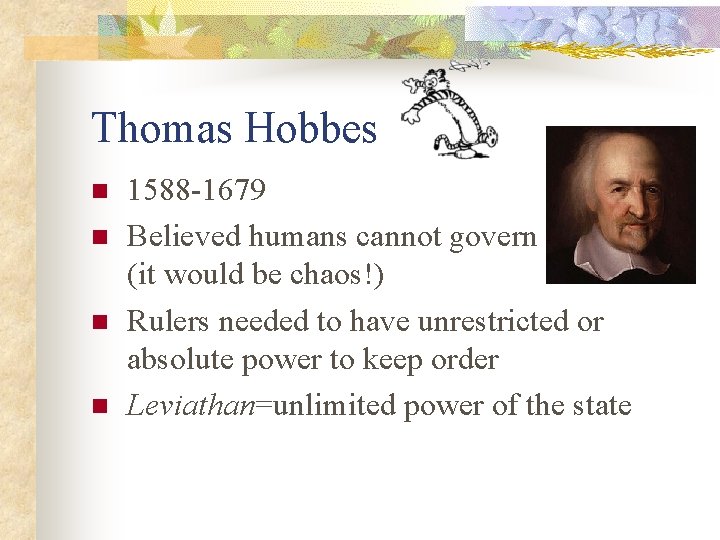
Thomas Hobbes n n 1588 -1679 Believed humans cannot govern themselves (it would be chaos!) Rulers needed to have unrestricted or absolute power to keep order Leviathan=unlimited power of the state
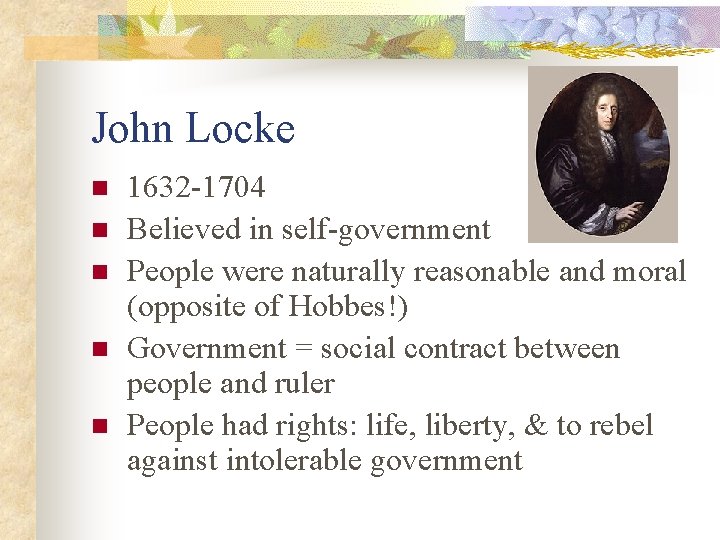
John Locke n n n 1632 -1704 Believed in self-government People were naturally reasonable and moral (opposite of Hobbes!) Government = social contract between people and ruler People had rights: life, liberty, & to rebel against intolerable government
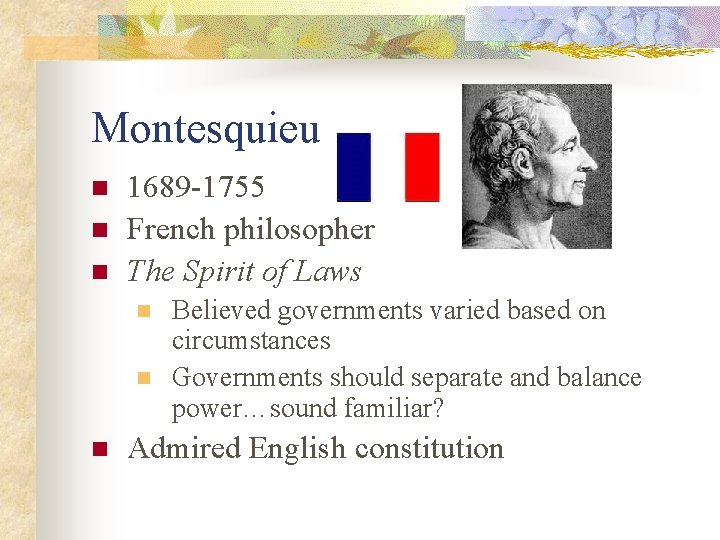
Montesquieu n n n 1689 -1755 French philosopher The Spirit of Laws n n n Believed governments varied based on circumstances Governments should separate and balance power…sound familiar? Admired English constitution
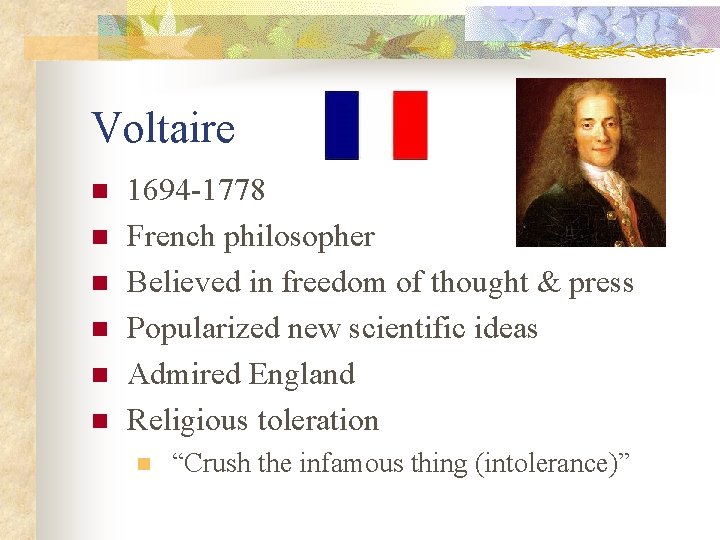
Voltaire n n n 1694 -1778 French philosopher Believed in freedom of thought & press Popularized new scientific ideas Admired England Religious toleration n “Crush the infamous thing (intolerance)”
Rousseau n n n 1712 -1778 French philosopher The Social Contract n n n Good men came from improved society Contract = common interests that unite people Government is secondary
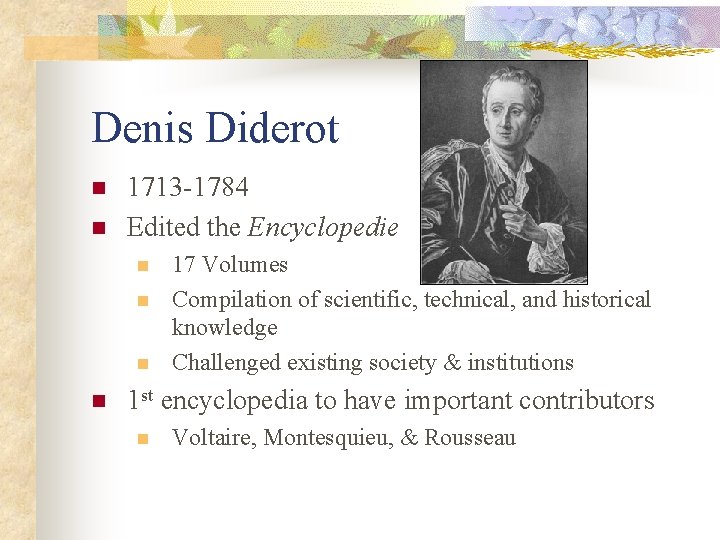
Denis Diderot n n 1713 -1784 Edited the Encyclopedie n n 17 Volumes Compilation of scientific, technical, and historical knowledge Challenged existing society & institutions 1 st encyclopedia to have important contributors n Voltaire, Montesquieu, & Rousseau
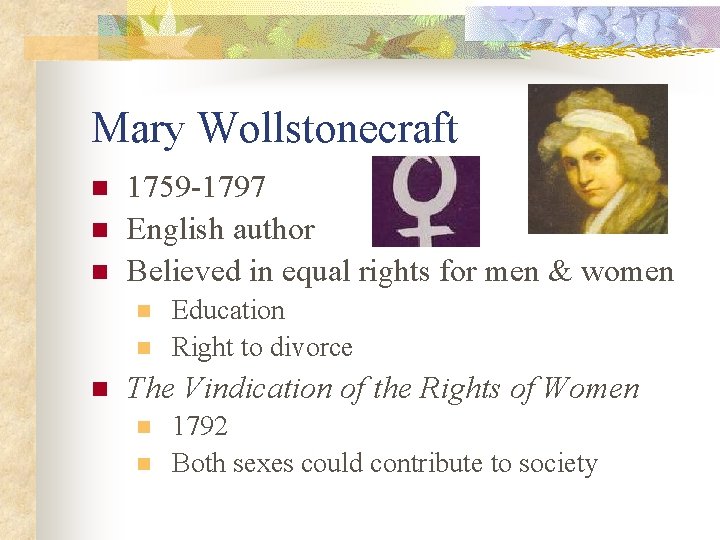
Mary Wollstonecraft n n n 1759 -1797 English author Believed in equal rights for men & women n Education Right to divorce The Vindication of the Rights of Women n n 1792 Both sexes could contribute to society