
THE SCIENTIFIC REV Ch 6 Sec 1 Notes

- Slides: 39
THE SCIENTIFIC REV. Ch. 6 Sec. 1 Notes
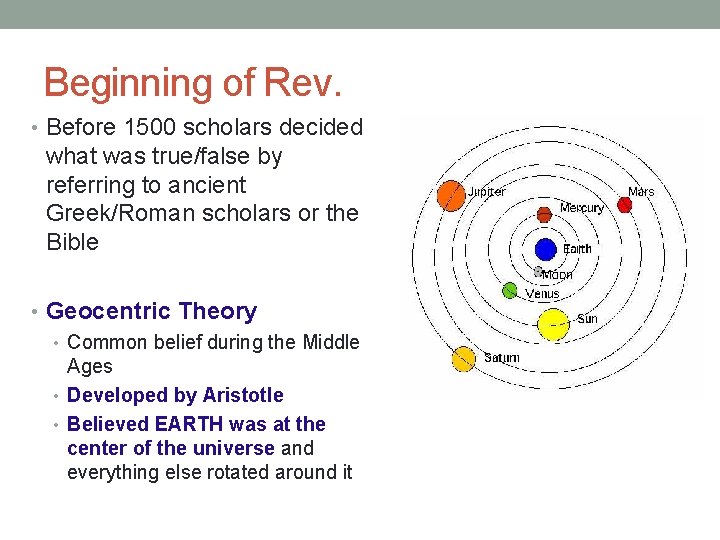
Beginning of Rev. • Before 1500 scholars decided what was true/false by referring to ancient Greek/Roman scholars or the Bible • Geocentric Theory • Common belief during the Middle Ages • Developed by Aristotle • Believed EARTH was at the center of the universe and everything else rotated around it
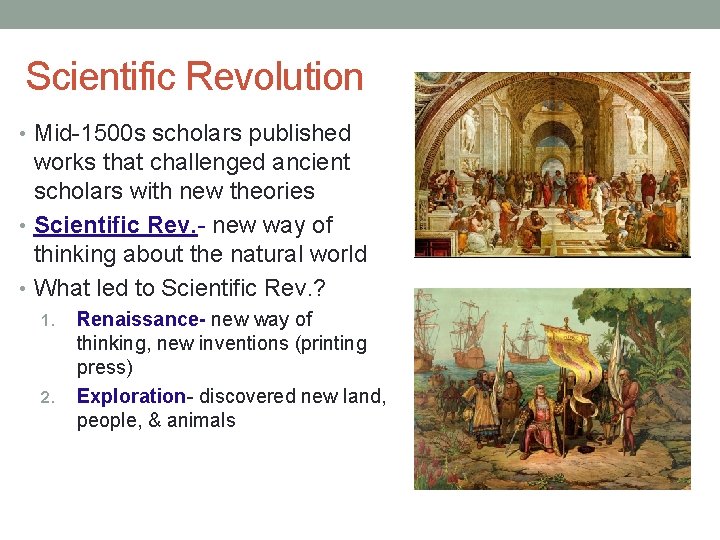
Scientific Revolution • Mid-1500 s scholars published works that challenged ancient scholars with new theories • Scientific Rev. - new way of thinking about the natural world • What led to Scientific Rev. ? 1. 2. Renaissance- new way of thinking, new inventions (printing press) Exploration- discovered new land, people, & animals
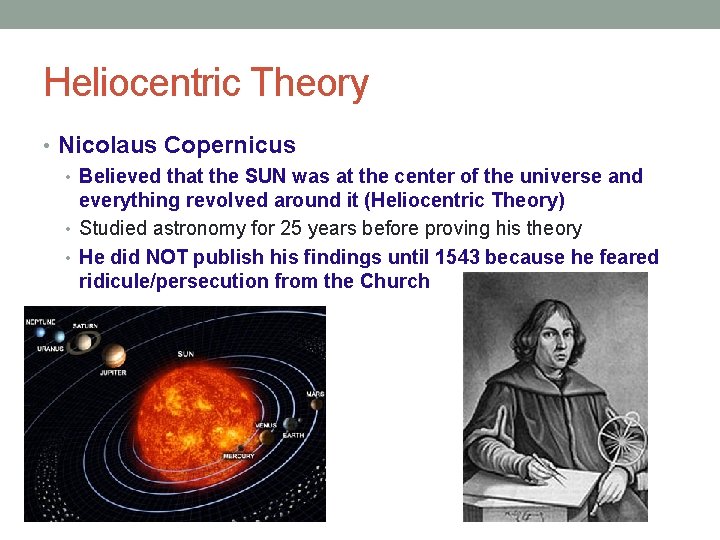
Heliocentric Theory • Nicolaus Copernicus • Believed that the SUN was at the center of the universe and everything revolved around it (Heliocentric Theory) • Studied astronomy for 25 years before proving his theory • He did NOT publish his findings until 1543 because he feared ridicule/persecution from the Church
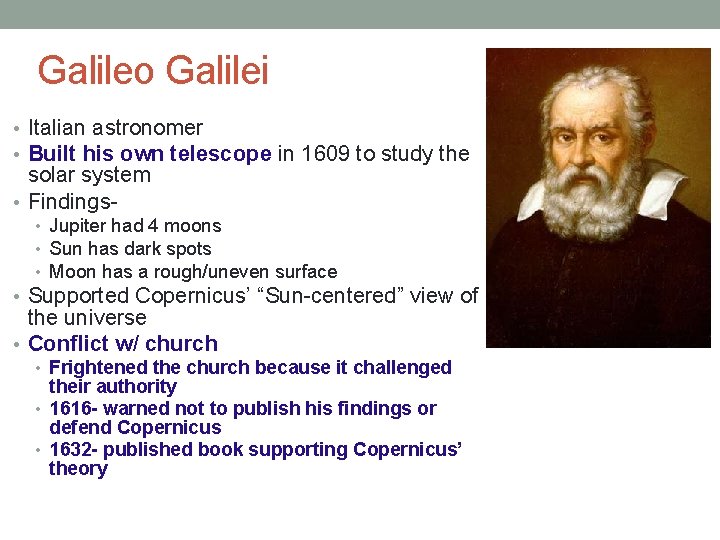
Galileo Galilei • Italian astronomer • Built his own telescope in 1609 to study the solar system • Findings- • Jupiter had 4 moons • Sun has dark spots • Moon has a rough/uneven surface • Supported Copernicus’ “Sun-centered” view of the universe • Conflict w/ church • Frightened the church because it challenged their authority • 1616 - warned not to publish his findings or defend Copernicus • 1632 - published book supporting Copernicus’ theory
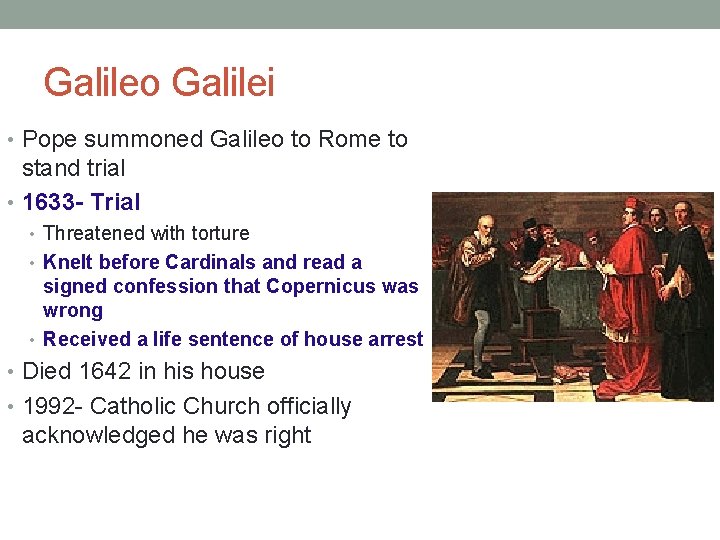
Galileo Galilei • Pope summoned Galileo to Rome to stand trial • 1633 - Trial • Threatened with torture • Knelt before Cardinals and read a signed confession that Copernicus was wrong • Received a life sentence of house arrest • Died 1642 in his house • 1992 - Catholic Church officially acknowledged he was right
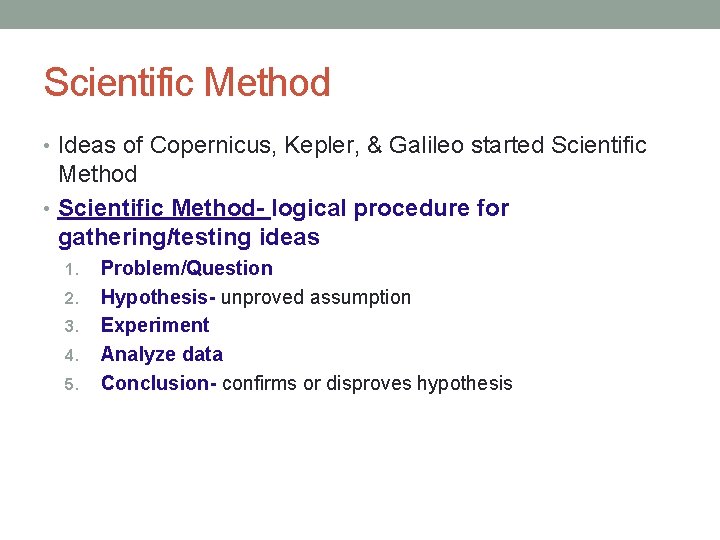
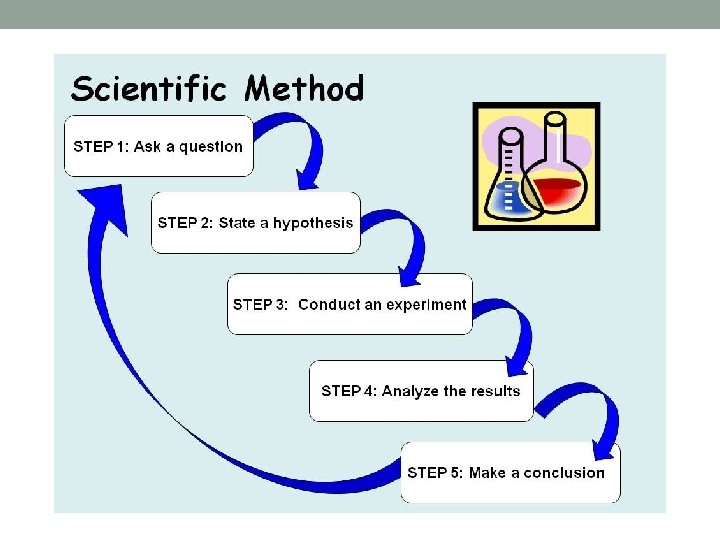
Scientific Method • Ideas of Copernicus, Kepler, & Galileo started Scientific Method • Scientific Method- logical procedure for gathering/testing ideas 1. 2. 3. 4. 5. Problem/Question Hypothesis- unproved assumption Experiment Analyze data Conclusion- confirms or disproves hypothesis
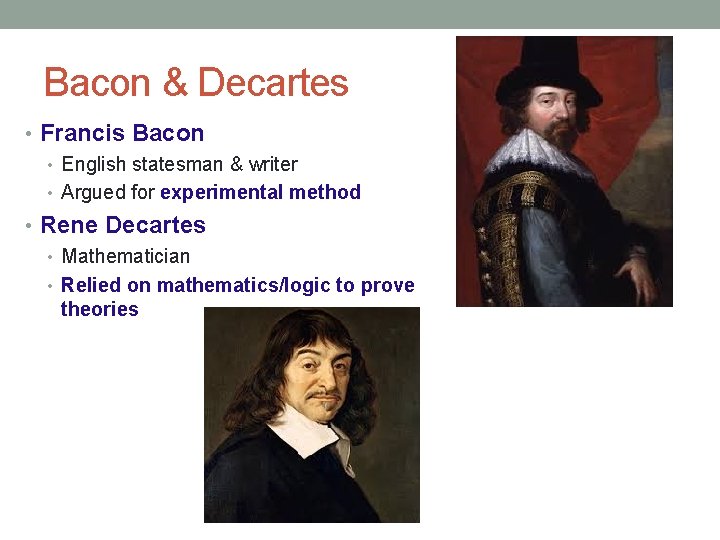
Bacon & Decartes • Francis Bacon • English statesman & writer • Argued for experimental method • Rene Decartes • Mathematician • Relied on mathematics/logic to prove theories
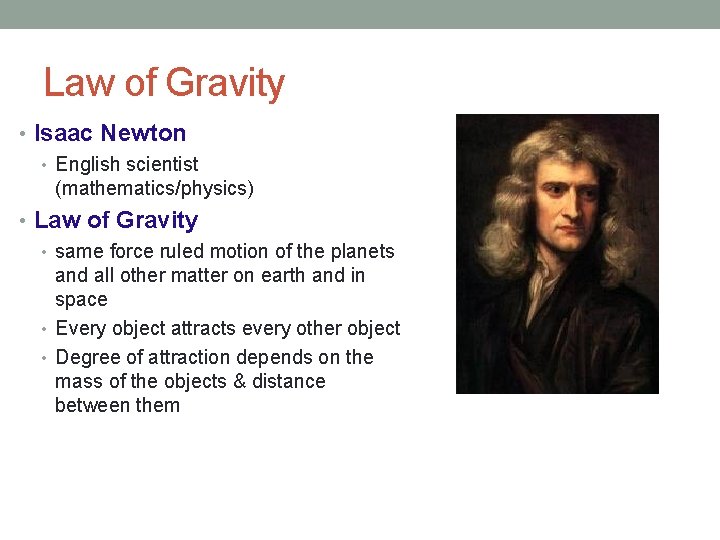
Law of Gravity • Isaac Newton • English scientist (mathematics/physics) • Law of Gravity • same force ruled motion of the planets and all other matter on earth and in space • Every object attracts every other object • Degree of attraction depends on the mass of the objects & distance between them
Scientific Breakthroughs • Zacharias Janssen (1590) - microscope • Gabriel Fahrenheit (1714) - first thermometer using mercury in glass • Anders Celcius (1742) – created new scale for mercury thermometer • Edward Jenner- created vaccine to prevent smallpox • Used innoculation • Robert Boyle- Boyle’s Law • Disagreed that physical world consisted of four elements- earth, air, fire, & water (Aristotle’s idea) • Proposed that matter was mad up of smaller particles joined together in different ways
Pg. 194 • Main Ideas • #3, #4, #5, • Critical Thinking & Writing • #8 • Inquisition= trial
ENLIGHTENMENT IN EUROPE Ch. 6 Sec. 2
Thomas Hobbes • English Civil War convinced him that people are selfish & wicked • Social Contract: • People give up rights to gain law & order • Believed ruler needed total power to keep citizens under control • Favored absolute monarchy
John Locke • Believed people could learn from experience & improve • Criticized monarchy and favored self-government • Believed people possess 3 Natural Rights: • Life, Liberty, and property • government should protect those rights and if not the citizens have the right to overthrow it
Voltaire • French philosophe • Wrote more than 70 books of political essays, philosophy, and drama • Attacked the clergy, aristocracy, and government • What did he advocate? 1. 2. Religious Freedom of Speech
Montesquieu • Devoted to the study of political liberty • Believed Great Britain was the best governed/politically balanced country of his day • Major Idea • Separation of Powers: division of power amoung branches of gov. • Kept one group from gaining total control over the gov. • Basis of separation of powers/ checks and balances in U. S. Constitution
Rousseau • Committed to individual freedom • Favored a direct democracy • Argued all people were equal and titles of nobility should be abolished
Beccaria
John Locke • “Government has no other end, but the preservation of life, liberty, and property”
Beccaria • “For a punishment to be just it should consist of only such gradations of intensity as suffice to deter men from committing crimes”
Mary Wollstonecraft • “Educate women and equip them for success, make them citizens, and they will quickly become good wives”- that is if men do not neglect the duties of husbands & fathers”
Thomas Hobbes • “Without governments, there would be “war…of every man against every man”
Voltaire • “I do not agree with a word you say, but will defend to death your right to say it”
Montesqiueu • “Power should be a check to power”
Rousseau • “Man is born free, and everywhere he is in chains”
Mary Astell • “If absolute sovereignty be not necessary in a state, how comes it to be so in a family? . . . if all men are born free, how is it that all women are born slaves”
THE AMERICAN REVOLUTION
British & American Colonies • 1770 - population was approx. 2, 150, 000 • Population was growing quickly • Been in America for about 150 years • Colonies thrived economically through trade with European countries • 1760 - King George III becomes King of England • 13 colonies enjoyed a type of self-government • Colonists saw themselves as more Virginians or Pennsylvanians than British • HOWEVER- they were expected to abide by British Law
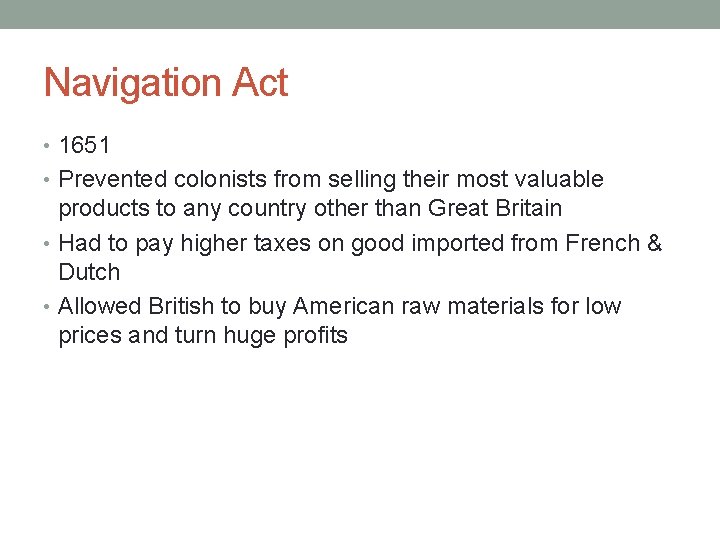
Navigation Act • 1651 • Prevented colonists from selling their most valuable products to any country other than Great Britain • Had to pay higher taxes on good imported from French & Dutch • Allowed British to buy American raw materials for low prices and turn huge profits
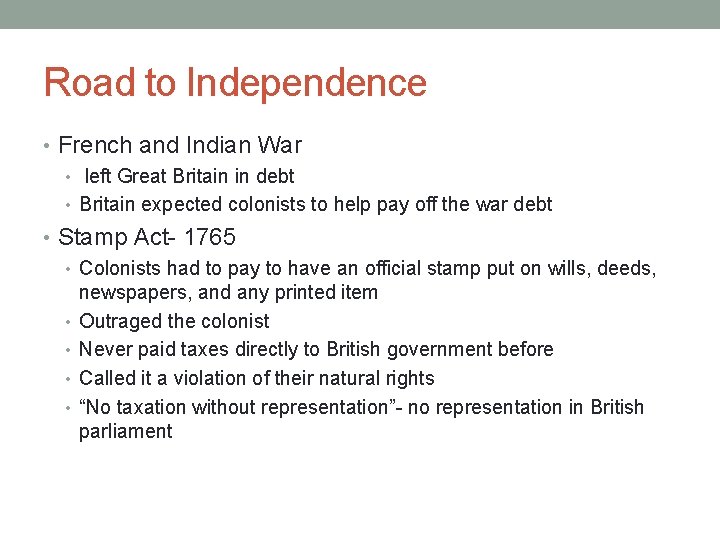
Road to Independence • French and Indian War • left Great Britain in debt • Britain expected colonists to help pay off the war debt • Stamp Act- 1765 • Colonists had to pay to have an official stamp put on wills, deeds, newspapers, and any printed item • Outraged the colonist • Never paid taxes directly to British government before • Called it a violation of their natural rights • “No taxation without representation”- no representation in British parliament
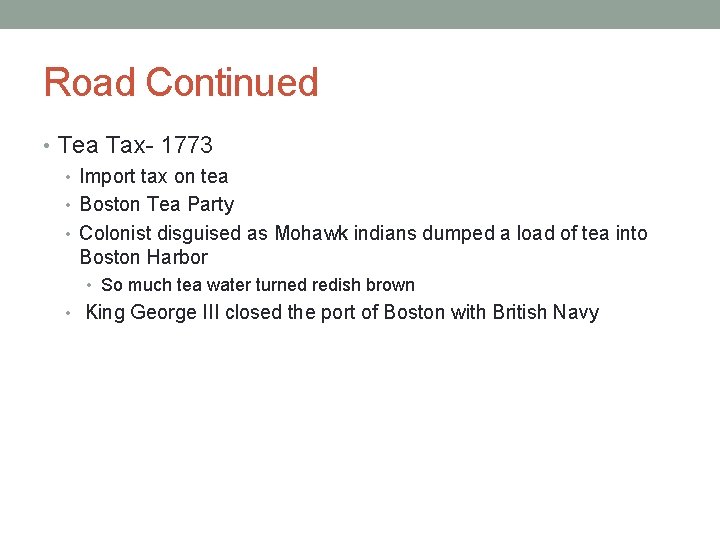
Road Continued • Tea Tax- 1773 • Import tax on tea • Boston Tea Party • Colonist disguised as Mohawk indians dumped a load of tea into Boston Harbor • So much tea water turned redish brown • King George III closed the port of Boston with British Navy
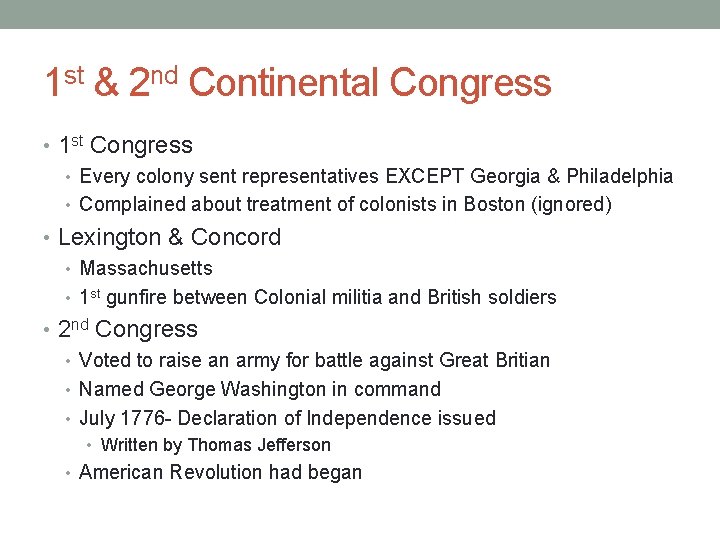
1 st & 2 nd Continental Congress • 1 st Congress • Every colony sent representatives EXCEPT Georgia & Philadelphia • Complained about treatment of colonists in Boston (ignored) • Lexington & Concord • Massachusetts • 1 st gunfire between Colonial militia and British soldiers • 2 nd Congress • Voted to raise an army for battle against Great Britian • Named George Washington in command • July 1776 - Declaration of Independence issued • Written by Thomas Jefferson • American Revolution had began
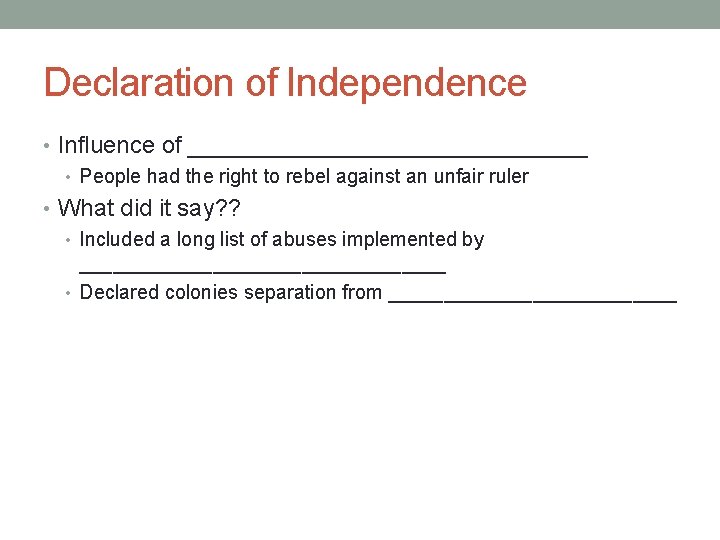
Declaration of Independence • Influence of _______________ • People had the right to rebel against an unfair ruler • What did it say? ? • Included a long list of abuses implemented by _________________ • Declared colonies separation from _____________
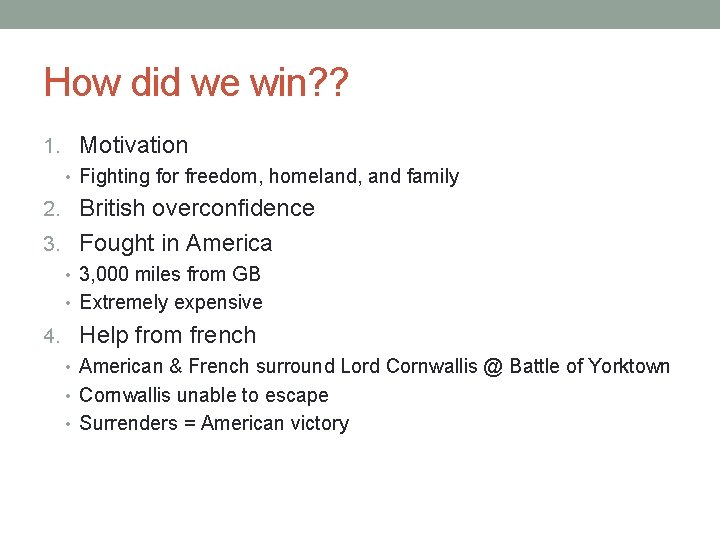
How did we win? ? 1. Motivation • Fighting for freedom, homeland, and family 2. British overconfidence 3. Fought in America • 3, 000 miles from GB • Extremely expensive 4. Help from french • American & French surround Lord Cornwallis @ Battle of Yorktown • Cornwallis unable to escape • Surrenders = American victory
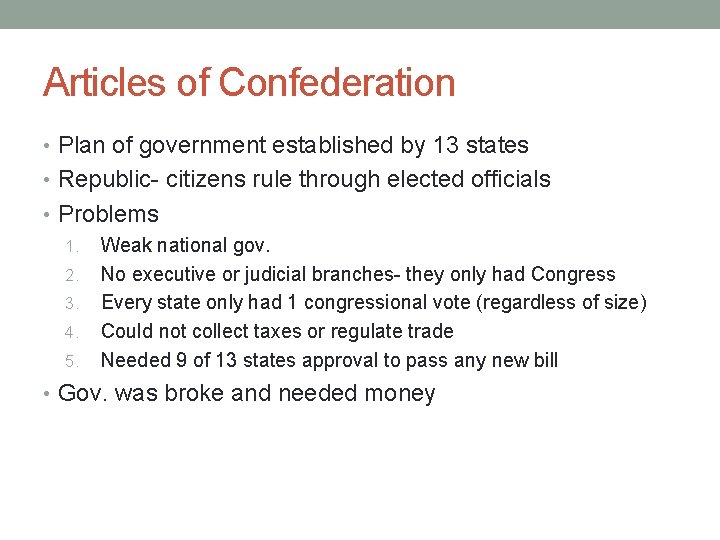
Articles of Confederation • Plan of government established by 13 states • Republic- citizens rule through elected officials • Problems 1. Weak national gov. 2. No executive or judicial branches- they only had Congress 3. Every state only had 1 congressional vote (regardless of size) 4. Could not collect taxes or regulate trade 5. Needed 9 of 13 states approval to pass any new bill • Gov. was broke and needed money
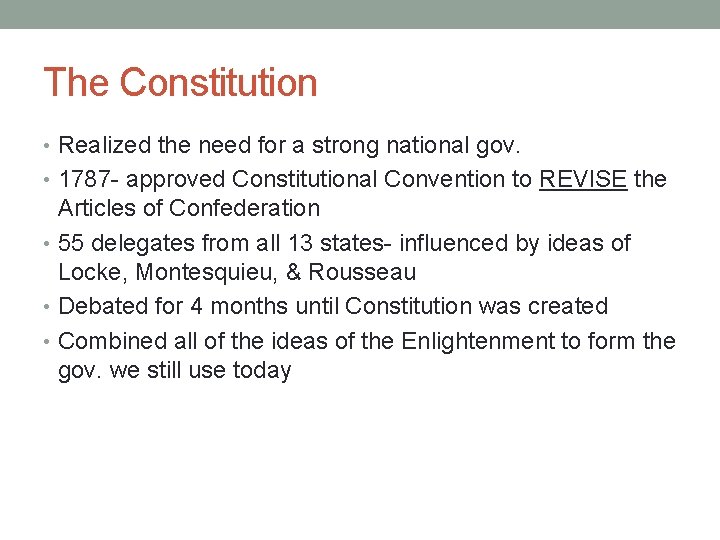
The Constitution • Realized the need for a strong national gov. • 1787 - approved Constitutional Convention to REVISE the Articles of Confederation • 55 delegates from all 13 states- influenced by ideas of Locke, Montesquieu, & Rousseau • Debated for 4 months until Constitution was created • Combined all of the ideas of the Enlightenment to form the gov. we still use today
Federal System • Distrusted a powerful central gov. - Montesquieu • Established 3 separate branches • Legislative, Executive, Judicial • Provided checks & balances- each branch checks actions of other • Ex. How a bill becomes a law • Federal System • Divided gov. power amongst National & State governments
Bill of Rights • Constitution finished- required 9 of 13 states approval • Federalist- supporters of new constitution • Anti- Federalists: gave central gov. too much power • Federalist propose a compromise • Added to the constitution to protect basic rights • Speech, religion, assembly, press, etc. • Advocated by Voltaire, Rousseau, & Locke