
The Scientific Method What is It n Finish
- Slides: 9
The Scientific Method
What is It ? n Finish this thought: The Scientific Method is… n (one answer could be)…a series of steps used to help solve a problem.
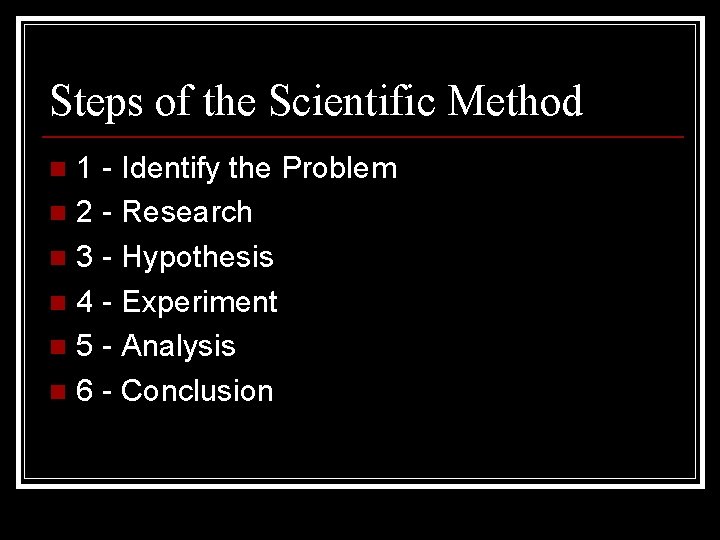
Steps of the Scientific Method 1 - Identify the Problem n 2 - Research n 3 - Hypothesis n 4 - Experiment n 5 - Analysis n 6 - Conclusion n
Step 1 - Identify the Problem n What do you want to know or find out? This is usually after observation. n Example: I have observed that most of you are wearing short sleeve shirts. What could I change for you to wear long sleeve shirts?
Step 2 - Research n Gather more information - learn all that you can to be sure your experiment makes sense. n Example - My research could be asking each of you what temperatures seem cold enough for you to wear long sleeves.
Step 3 - Hypothesis n Make a statement that explains what you think will happen after you have completed all the steps. AKA the “educated guess” or the “If…then…” statement. n Example - I think that if I turn the room temperature down then you will all put on your long sleeve shirts and jackets.
Step 4 - Experiment n Test your hypothesis. Set your variables for the first trial (test); then change the independent variable for additional trials. Be safe, take detailed notes and take your time. n Example - I will see what the room temperature is now. That will be my control temperature. Then I will turn the temperature down for each trial, maybe 5 degrees at a time. I will be sure to carefully change and record temperatures and reactions to those changes.
Step 5 - Analysis n This is where I record the data - numbers and observed results - and make tables and graphs that show what I found out. Be sure to include your variables, constant and control. n Example - I will make a table that shows how many people put on long sleeve shirts with each 5 degree change of thermostat. I will then use this to make my graph.
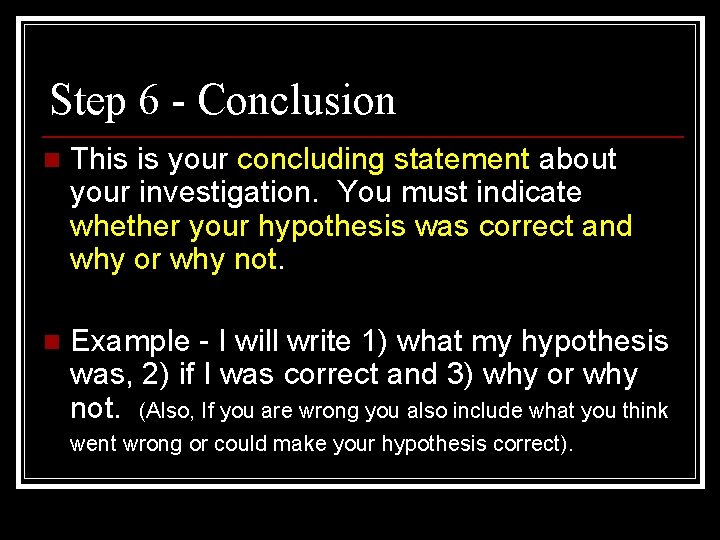
Step 6 - Conclusion n This is your concluding statement about your investigation. You must indicate whether your hypothesis was correct and why or why not. n Example - I will write 1) what my hypothesis was, 2) if I was correct and 3) why or why not. (Also, If you are wrong you also include what you think went wrong or could make your hypothesis correct).