
The Scientific Method State the ProblemQuestion The problem
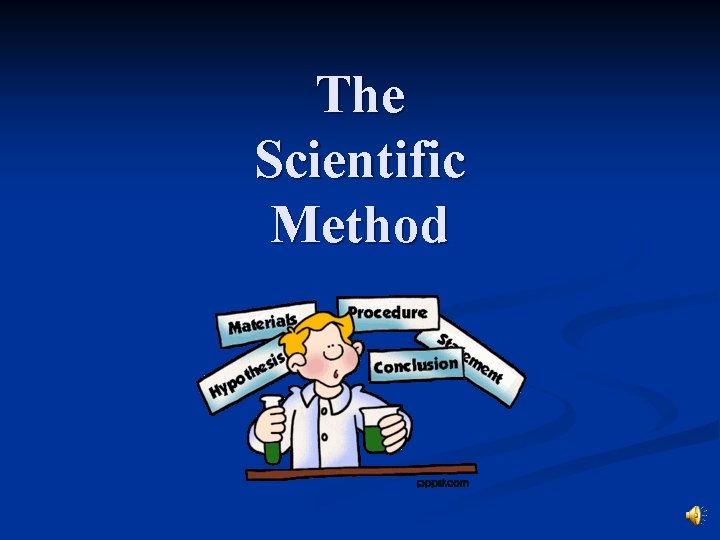
The Scientific Method
State the Problem/Question The problem identifies what you want to find out. n Develop a clear statement defining the problem. n Make sure your problem is narrowed/specific enough. n State the problem in the form of a question: How does _____ affect _______? n
What is a hypothesis? An explanation that is based on prior scientific research or observations and that can be tested. n “Educated Guess” ( your high school teacher may not like this definition) n “If… then… because” Statement n
How do you test a hypothesis? n Design a Controlled Experiment An experiment that tests only one variable at a time by using a comparison of a control group and an experimental group. n Must be run multiple times. n n Control Group n n The group that the scientist changes nothing in. The control group is used for comparison. Experimental Group n The group that the scientist has changed something. It is the variable in the experiment where you want to see how this condition affects something.
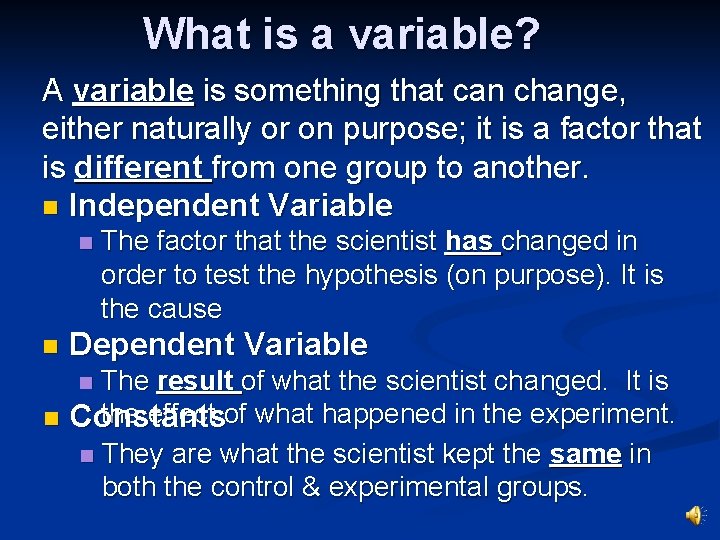
What is a variable? A variable is something that can change, either naturally or on purpose; it is a factor that is different from one group to another. n Independent Variable n n The factor that the scientist has changed in order to test the hypothesis (on purpose). It is the cause Dependent Variable The result of what the scientist changed. It is the effect of what happened in the experiment. n Constants n They are what the scientist kept the same in both the control & experimental groups. n
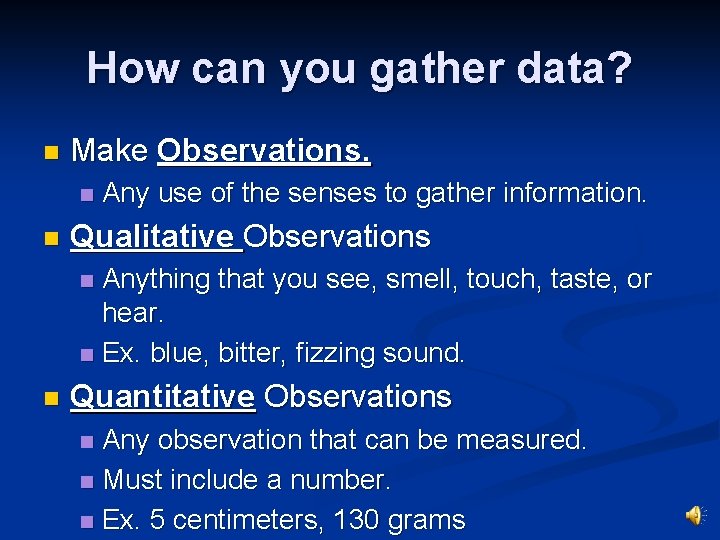
How can you gather data? n Make Observations. n n Any use of the senses to gather information. Qualitative Observations Anything that you see, smell, touch, taste, or hear. n Ex. blue, bitter, fizzing sound. n n Quantitative Observations Any observation that can be measured. n Must include a number. n Ex. 5 centimeters, 130 grams n
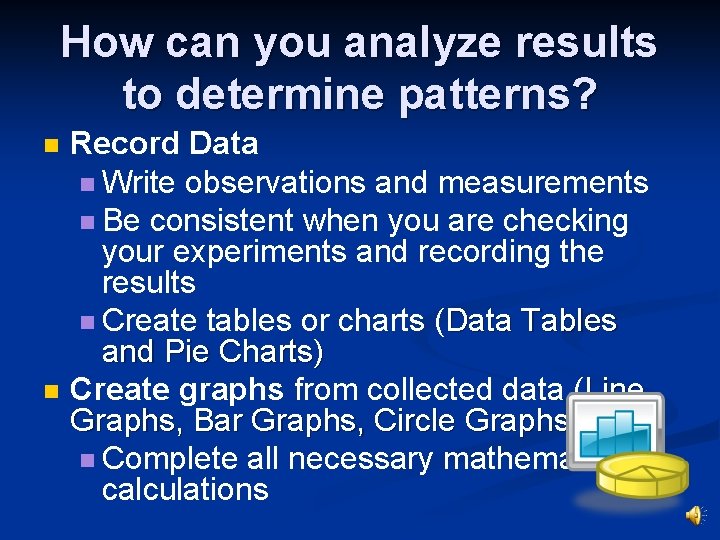
How can you analyze results to determine patterns? n n Record Data n Write observations and measurements n Be consistent when you are checking your experiments and recording the results n Create tables or charts (Data Tables and Pie Charts) Create graphs from collected data (Line Graphs, Bar Graphs, Circle Graphs) n Complete all necessary mathematical calculations
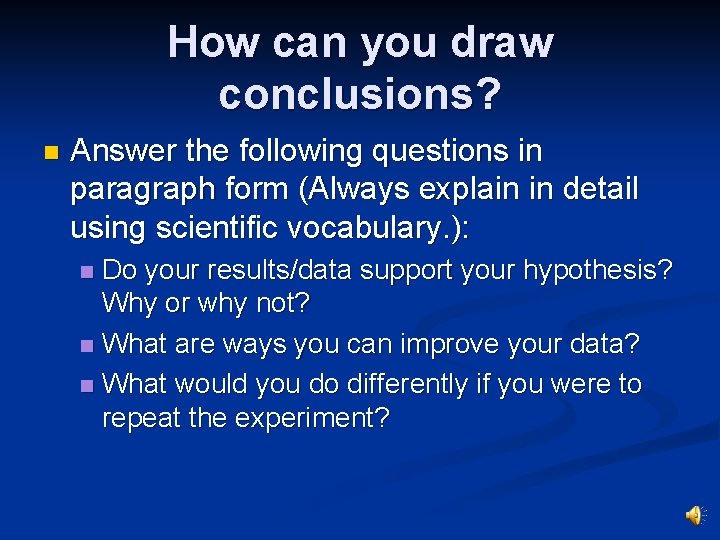
How can you draw conclusions? n Answer the following questions in paragraph form (Always explain in detail using scientific vocabulary. ): Do your results/data support your hypothesis? Why or why not? n What are ways you can improve your data? n What would you do differently if you were to repeat the experiment? n
What is in a conclusion? You restate the purpose of your experiment n You indicate what the results were. Use numbers!!!!! Example: “On average after 3 trials, ……. ” n You explain why those results were given. Here you think about what you found out in your research. n You consider any improvements to your procedure. This is error analysis. n You ask a new question – what do you n
How would you communicate results? n n Share data and information with others, such as scientists. Publish your findings in a book, magazine, journal, the internet.
What are scientific models? n Model n A representation of an object or system. n Physical Models n Mathematical Models n Conceptual Models
What is the difference between a scientific theory and a scientific law? n Theory An explanation that ties together many hypotheses and observations. n Supported by repeated trials. n May help with further predictions. n Tells why it happens. EX: Cell Theory of Evolution Germ Theory n n Law A summary of many experimental results and observations. n Tells how things work n Only tells what happens, it does not explain why. EX: Law of Gravity Newton’s Laws of Motion n
- Slides: 12