
The Scientific Method So what exactly is Science
- Slides: 13
The Scientific Method
So what exactly is Science? • Science (from Latin scientia, meaning "knowledge" ) is a systematic enterprise that builds and organizes knowledge in the form of testable explanations and predictions about the universe.
What do Scientists do?
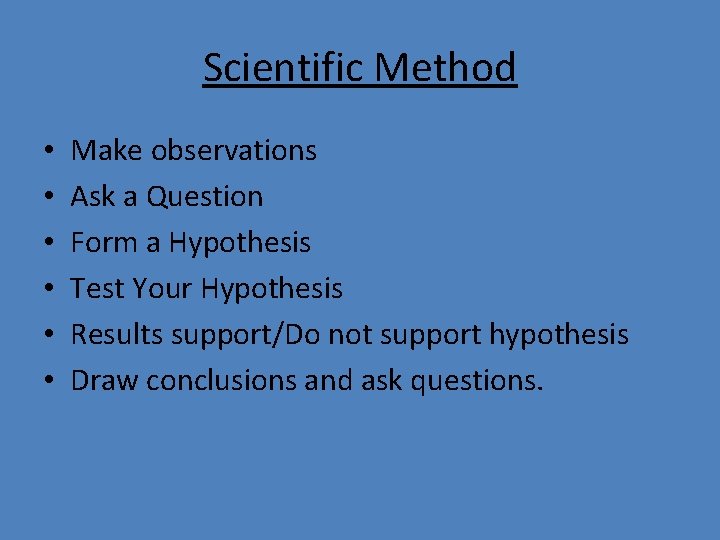
Scientific Method • • • Make observations Ask a Question Form a Hypothesis Test Your Hypothesis Results support/Do not support hypothesis Draw conclusions and ask questions.
Observations • the act of careful watching and listening : the activity of paying close attention to someone or something in order to get information
Asking questions • What will help you to form your questions?
Form a Hypothesis • Ask lots of “why” questions. • Look for connections between important variables. • Suggest possible explanations for these connections. • !!!Make sure the explanations can be tested!!!
What makes a good hypothesis? ? • Evaluate your observations. • Imagine possible explanations.
Experimentation (testing your hypothesis) • The experimentation stage of the scientific method is rad in that you get to put all of your observations and your hypothesis to the test. • What could possibly go wrong? ? ?
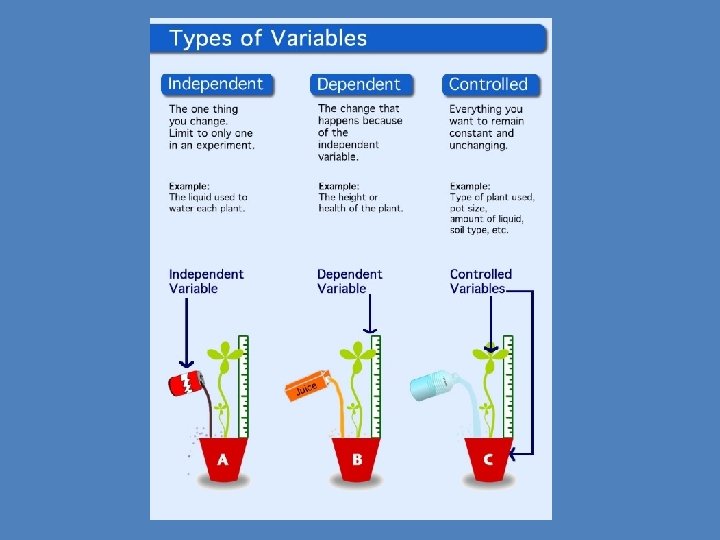
Variance and Variables • Variable- An object, event, time period, or any category you are trying to measure. An experiment usually has three kinds of variables: independent, and controlled. • Independent Variable- The values that can be changed in an experiment. They provide the "input" which is modified by the model to change the "output. " • Dependent Variable- The values that result from the independent variable. • Controlled variable- something that is constant and unchanged. (Referred to as “the control” in science lingo. )
Data Analysis • Qualitative Data –vs- Quantitative Data. • Qualitative Data- A categorical measurement expressed not in terms of numbers, but with a language description. Example: favorite color = "blue" height = "tall“. • Quantitative Data- Information that can be measured with numbers. Example: your height, your shoe size, and the length of your fingernails.