
The Scientific Method Paul Aplin In making sense
- Slides: 17
The Scientific Method Paul Aplin In making sense of our world, there should be few occasions in which we are forced to concede “It just is” or “It’s magic” or “Because I said so” S Pinker
What is science? § Science is a systematic and logical approach to discovering how things in the universe work § Science is also the body of knowledge accumulated through the discoveries about all the things in the universe § The word ‘science’ is derived from the Latin word scientia, which means knowledge based on demonstrable and reproducible data § True to this definition, science aims for measurable results through testing and analysis § Science is based on fact, not opinion or preferences § The process of science is designed to challenge ideas through ‘research’ Source: www. livescience. com
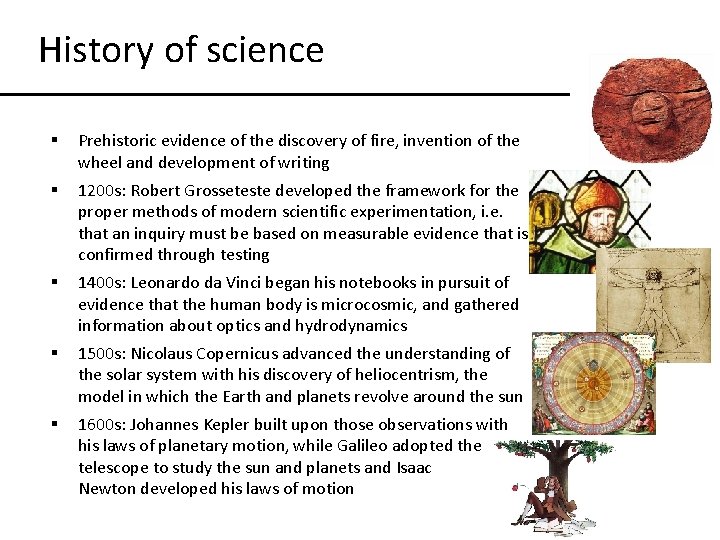
History of science § Prehistoric evidence of the discovery of fire, invention of the wheel and development of writing § 1200 s: Robert Grosseteste developed the framework for the proper methods of modern scientific experimentation, i. e. that an inquiry must be based on measurable evidence that is confirmed through testing § 1400 s: Leonardo da Vinci began his notebooks in pursuit of evidence that the human body is microcosmic, and gathered information about optics and hydrodynamics § 1500 s: Nicolaus Copernicus advanced the understanding of the solar system with his discovery of heliocentrism, the model in which the Earth and planets revolve around the sun § 1600 s: Johannes Kepler built upon those observations with his laws of planetary motion, while Galileo adopted the telescope to study the sun and planets and Isaac Newton developed his laws of motion
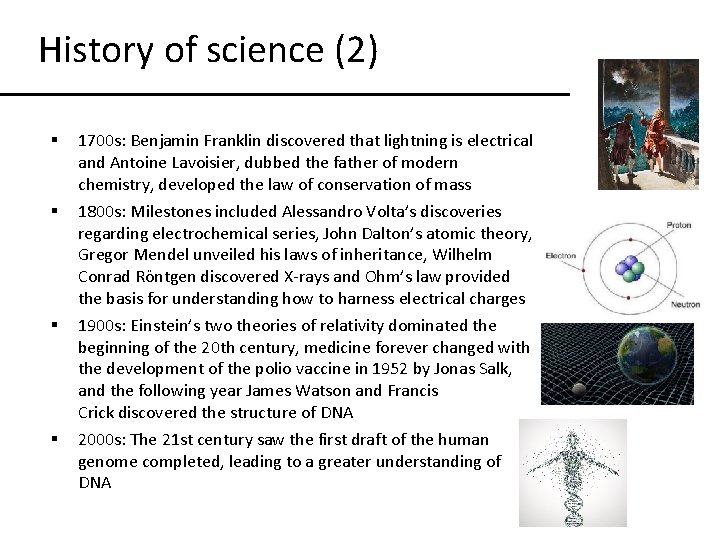
History of science (2) § 1700 s: Benjamin Franklin discovered that lightning is electrical and Antoine Lavoisier, dubbed the father of modern chemistry, developed the law of conservation of mass § 1800 s: Milestones included Alessandro Volta’s discoveries regarding electrochemical series, John Dalton’s atomic theory, Gregor Mendel unveiled his laws of inheritance, Wilhelm Conrad Röntgen discovered X-rays and Ohm’s law provided the basis for understanding how to harness electrical charges § 1900 s: Einstein’s two theories of relativity dominated the beginning of the 20 th century, medicine forever changed with the development of the polio vaccine in 1952 by Jonas Salk, and the following year James Watson and Francis Crick discovered the structure of DNA § 2000 s: The 21 st century saw the first draft of the human genome completed, leading to a greater understanding of DNA
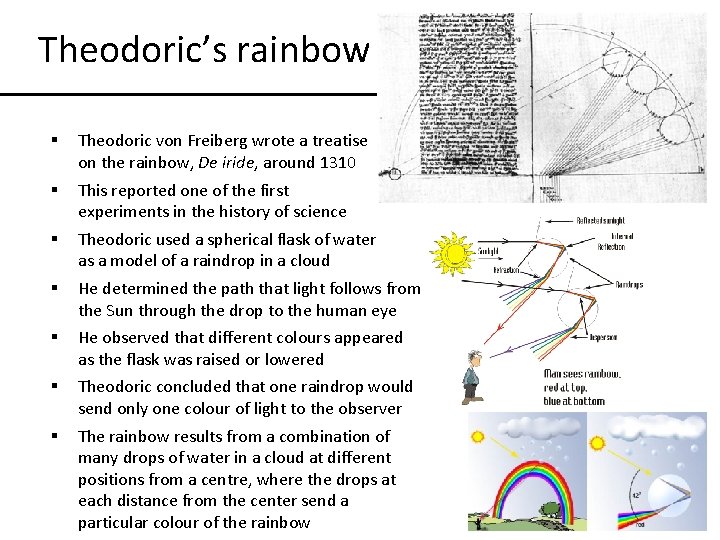
Theodoric’s rainbow § Theodoric von Freiberg wrote a treatise on the rainbow, De iride, around 1310 § This reported one of the first experiments in the history of science § Theodoric used a spherical flask of water as a model of a raindrop in a cloud § He determined the path that light follows from the Sun through the drop to the human eye § He observed that different colours appeared as the flask was raised or lowered § Theodoric concluded that one raindrop would send only one colour of light to the observer § The rainbow results from a combination of many drops of water in a cloud at different positions from a centre, where the drops at each distance from the center send a particular colour of the rainbow
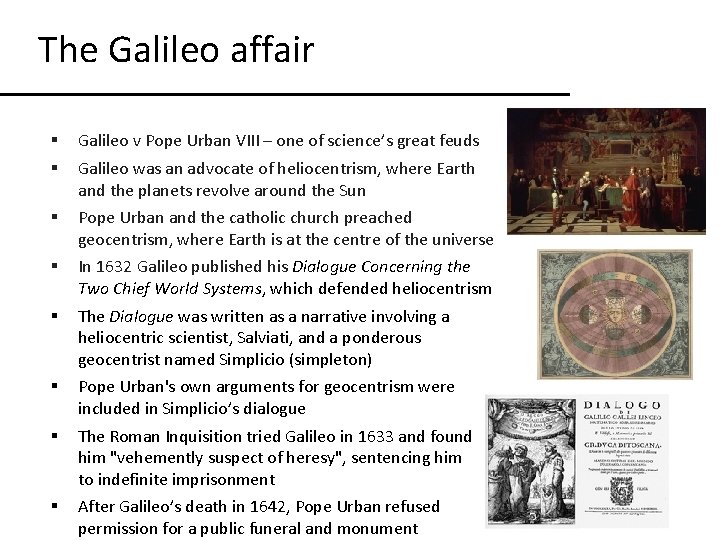
The Galileo affair § § Galileo v Pope Urban VIII – one of science’s great feuds § Pope Urban and the catholic church preached geocentrism, where Earth is at the centre of the universe § In 1632 Galileo published his Dialogue Concerning the Two Chief World Systems, which defended heliocentrism § The Dialogue was written as a narrative involving a heliocentric scientist, Salviati, and a ponderous geocentrist named Simplicio (simpleton) § Pope Urban's own arguments for geocentrism were included in Simplicio’s dialogue § The Roman Inquisition tried Galileo in 1633 and found him "vehemently suspect of heresy", sentencing him to indefinite imprisonment § After Galileo’s death in 1642, Pope Urban refused permission for a public funeral and monument Galileo was an advocate of heliocentrism, where Earth and the planets revolve around the Sun
Scientific research § When conducting research, scientists use the ‘scientific method’… Ø to collect measurable, ‘empirical’ evidence… Ø in an experiment related to a scientific ‘hypothesis’… Ø where the results aim to support or contradict a scientific ‘theory’ Richard Feynman – The Scientific Method
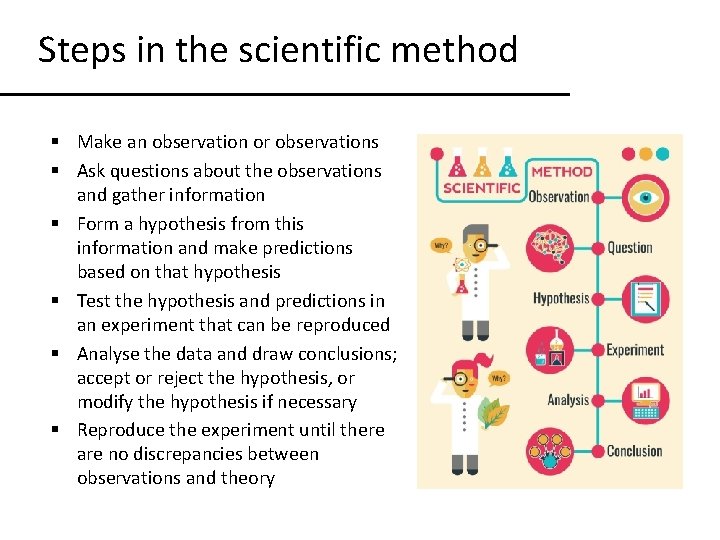
Steps in the scientific method § Make an observation or observations § Ask questions about the observations and gather information § Form a hypothesis from this information and make predictions based on that hypothesis § Test the hypothesis and predictions in an experiment that can be reproduced § Analyse the data and draw conclusions; accept or reject the hypothesis, or modify the hypothesis if necessary § Reproduce the experiment until there are no discrepancies between observations and theory
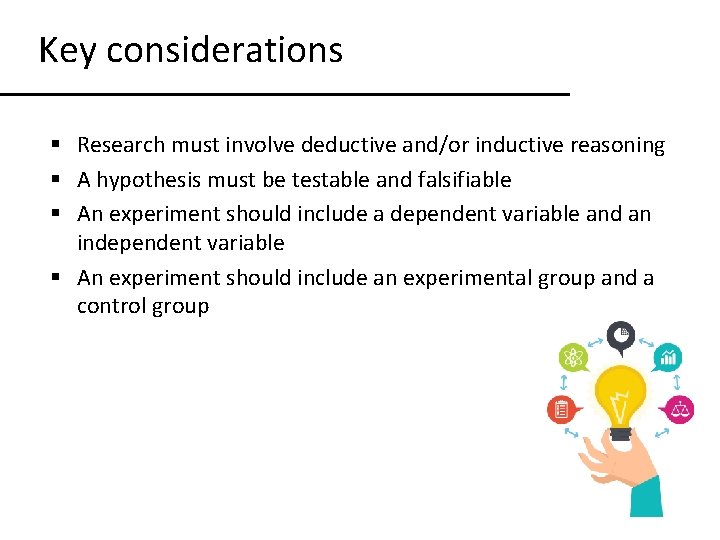
Key considerations § Research must involve deductive and/or inductive reasoning § A hypothesis must be testable and falsifiable § An experiment should include a dependent variable and an independent variable § An experiment should include an experimental group and a control group
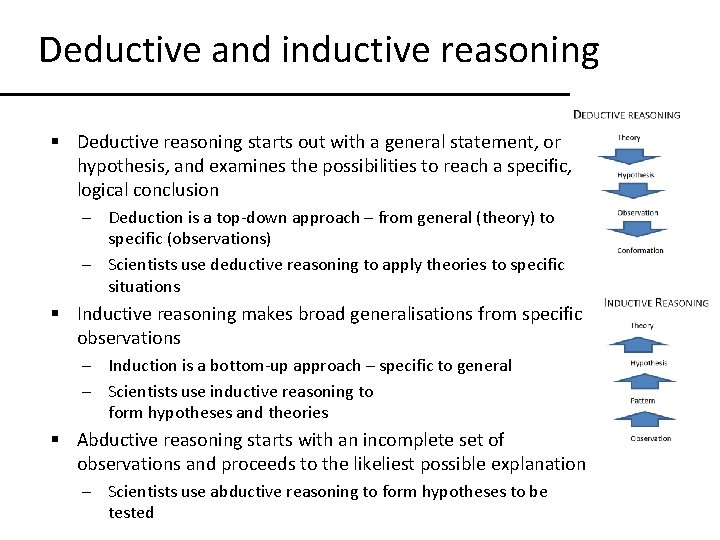
Deductive and inductive reasoning § Deductive reasoning starts out with a general statement, or hypothesis, and examines the possibilities to reach a specific, logical conclusion Deduction is a top-down approach – from general (theory) to specific (observations) Scientists use deductive reasoning to apply theories to specific situations § Inductive reasoning makes broad generalisations from specific observations Induction is a bottom-up approach – specific to general Scientists use inductive reasoning to form hypotheses and theories § Abductive reasoning starts with an incomplete set of observations and proceeds to the likeliest possible explanation Scientists use abductive reasoning to form hypotheses to be tested
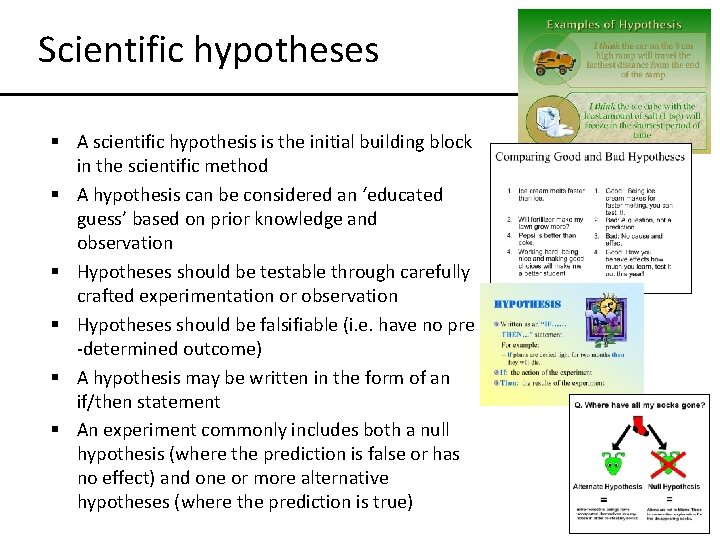
Scientific hypotheses § A scientific hypothesis is the initial building block in the scientific method § A hypothesis can be considered an ‘educated guess’ based on prior knowledge and observation § Hypotheses should be testable through carefully crafted experimentation or observation § Hypotheses should be falsifiable (i. e. have no pre -determined outcome) § A hypothesis may be written in the form of an if/then statement § An experiment commonly includes both a null hypothesis (where the prediction is false or has no effect) and one or more alternative hypotheses (where the prediction is true)
Empirical evidence § Empirical evidence is information acquired by observation or experimentation § Empirical evidence can be quantitative or qualitative § Quantitative research involves collection and statistical analysis of numerical data § Qualitative research, often used in the social sciences, involves collection and analysis of non-numerical data § Identifying empirical evidence: Can the experiment be recreated and tested? Does the experiment have a statement about the methodology, tools and controls used? Is there a definition of the group or phenomena being studied?
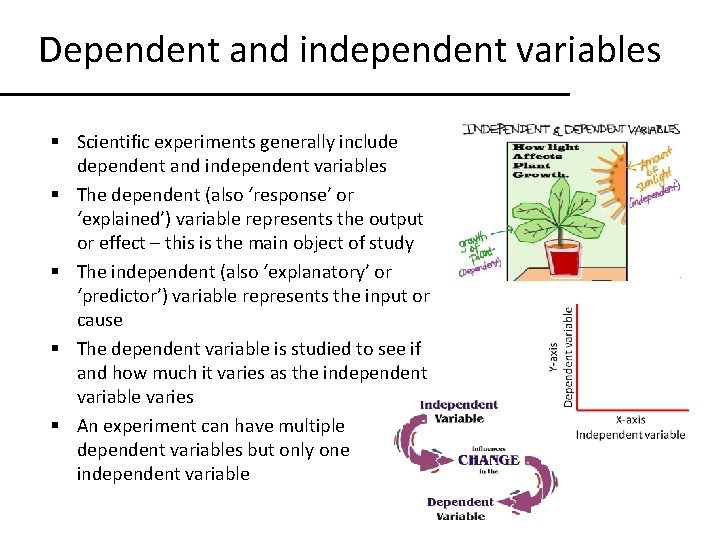
Dependent and independent variables § Scientific experiments generally include dependent and independent variables § The dependent (also ‘response’ or ‘explained’) variable represents the output or effect – this is the main object of study § The independent (also ‘explanatory’ or ‘predictor’) variable represents the input or cause § The dependent variable is studied to see if and how much it varies as the independent variable varies § An experiment can have multiple dependent variables but only one independent variable
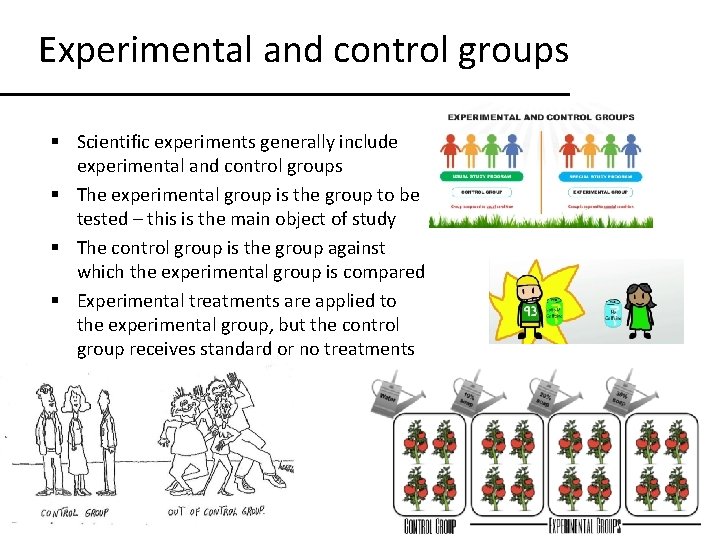
Experimental and control groups § Scientific experiments generally include experimental and control groups § The experimental group is the group to be tested – this is the main object of study § The control group is the group against which the experimental group is compared § Experimental treatments are applied to the experimental group, but the control group receives standard or no treatments
Reading § § § Feynman, R. , 1964, The scientific method, www. youtube. com/watch? v=Qd. Mmba. QHIs 0, accessed 19 September 2017. Henry, J. , 2008, The Scientific Revolution and the Origins of Modern Science, 3 rd edition, Palgrave Macmillan livescience, 2017, www. livescience. com, accessed 19 September 2017. (Key source for this lecture. ) Parvin, P. , 2010, Karl Popper, Continuum International Publishing Group. (See pages 34 -48 on Popper’s epistemology. Available as an ebook through the library. ) Pinker, S. , 2013, Science is not your enemy, The New Republic, www. newrepublic. com/article/114127/science-not-enemy-humanities, accessed 19 September 2017. Valiela, I. , 2009, Doing Science: Design, Analysis, and Communication of Scientific Research, 2 nd edition, Oxford University Press.
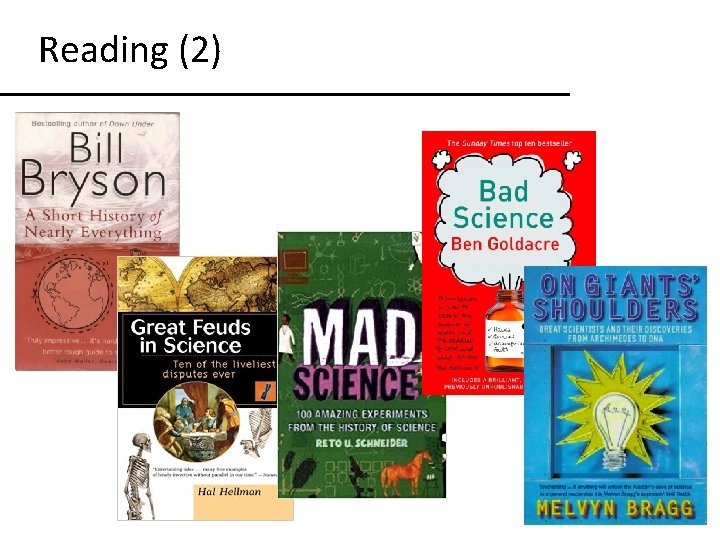
Reading (2)
Group work – Giant biographies § Research, discuss and present brief biographies of notable scientists § Choose a scientist from the list and research their life, career and achievements § How have they influenced the field of science, what was their most notable theory or experiment, what was the process of development or discovery, how was the work received by the scientific community and the public, how has the field progressed since then. . ? § Groups of 5 or so students § 30 minutes research time § Few minutes’ presentation The scientific giants ‒ Archimedes ‒ Galileo Galilei ‒ Isaac Newton ‒ Antoine Lavoisier ‒ Michael Faraday ‒ Charles Darwin ‒ Jules Henri Poincaré ‒ Sigmund Freud ‒ Marie Curie ‒ Albert Einstein ‒ Francis Crick and James Watson ‒ or choose one of your own…